
You're probably looking at a COA right now with a terpene table, a potency panel, a few “ND” entries, and just enough lab jargon to make a bad batch feel one decision away. That's where most formulation mistakes start. Not in the blend tank, but in the read of the report.
A vape formulation can drift off-profile fast when a formulator treats a single terpene peak as the whole story. One oversized limonene peak might look like a bright citrus-forward win, but if the sample sat too long, oxidized, or came from a different method than your reference batch, that number can push the entire profile in the wrong direction. The result is familiar. Harsh top notes, weak body, unstable carts, and a product that doesn't smell or taste like the target profile.
Good lab report interpretation fixes that upstream. It gives you cleaner strain-inspired terpene blend targets, tighter QA calls, and better consistency when you're formulating for distillate or for vape cartridges. More important, it helps you separate useful data from misleading data before you buy ingredients, approve a batch, or lock a production run.
Why Lab Report Interpretation Matters for Formulation
In cannabis product formulation, the COA isn't paperwork. It's the map for flavor, stability, and repeatability.
A terpene profile matters because formulation decisions depend on relative proportions, not just presence. If you're replicating flavor of a cultivar for vape cartridges, you need to know which compounds are carrying the opening aroma, which ones provide body, and which ones survive heat and storage well enough to support the finish. A vague “total terpenes” number won't do that. A full panel can.
Clinical lab interpretation uses reference ranges, typically the middle 95% of values in a healthy population, to decide what counts as normal or abnormal, and it warns against overreading a single result because false positives and false negatives happen (MedlinePlus guidance on understanding lab results). That same discipline matters in formulation. A single report is a snapshot. Batch trends tell you where a profile is moving.
Practical rule: Don't approve a flavor target from one attractive number. Approve it from a pattern that holds across batches.
The commercial side is obvious. Better interpretation reduces wasted adjustments, fewer off-profile fills, and less rework after carts are capped. The brand side matters just as much. If one batch tastes pine-forward and the next tastes flat, customers don't blame the lab. They blame the product.
For a serious formulation guide, the goal isn't to read a COA passively. It's to translate raw analytical data into usable terpene percentages, realistic QA thresholds, and repeatable sensory outcomes.
Understanding Lab Report Structure and Analytical Methods
Most COAs look straightforward until you need to use them for actual formulation. Then every header matters.
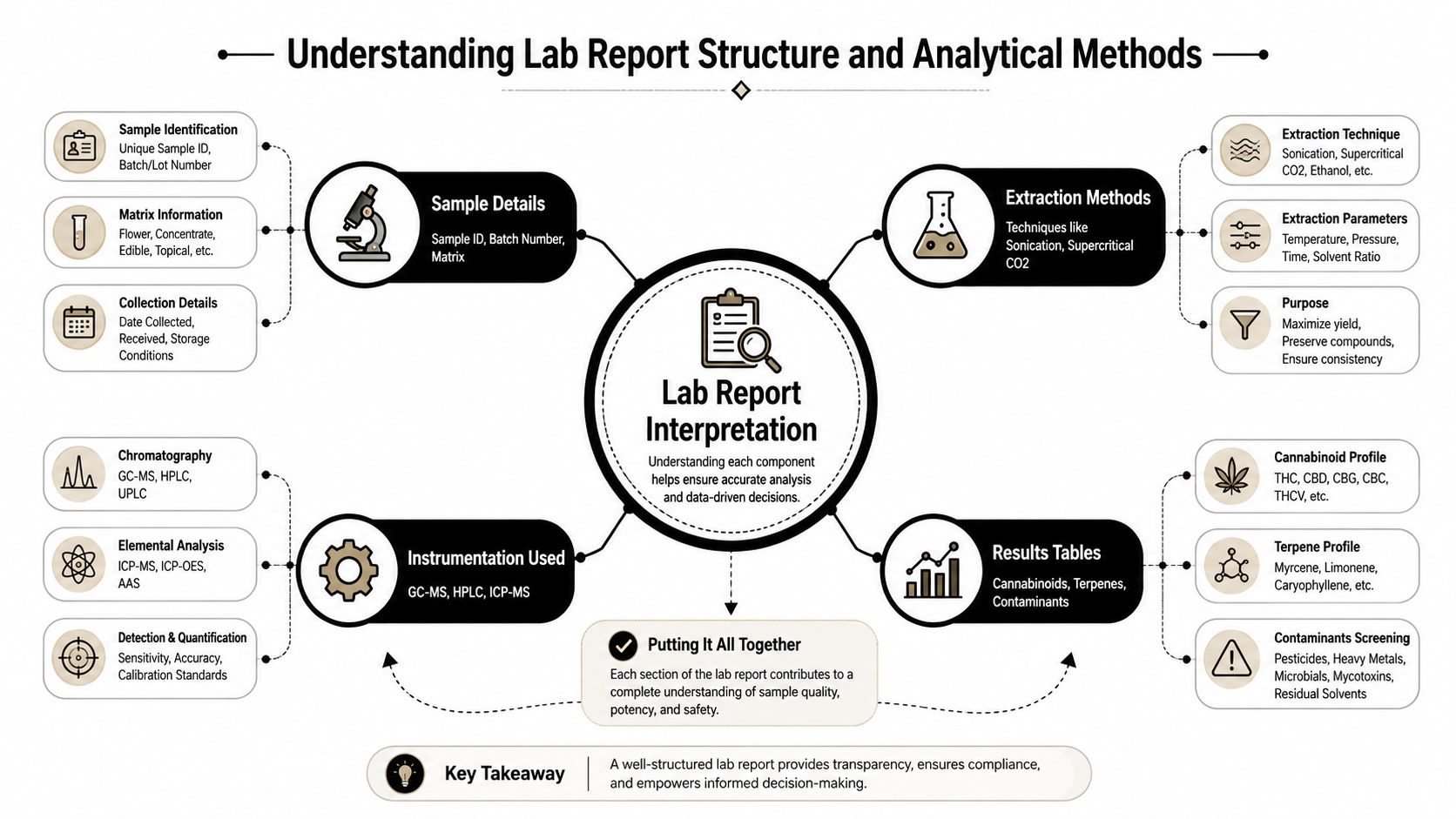
Read the top of the report before the results table
Start with sample identity. Batch number, sample ID, matrix, and collection date tell you whether you're comparing like with like. A terpene report from raw extract isn't directly comparable to a report from a finished cart, and a winterized sample won't behave like a non-winterized one.
Then check method details. You want to know how the lab measured the sample and whether the method fits what you're trying to build. For deeper background on method selection and separation logic, review this chromatography testing overview.
A usable COA usually includes:
- Sample identifiers that let you tie the report to a production lot
- Matrix description such as oil, distillate, concentrate, or finished cartridge
- Analytical method showing the instrument or procedure used
- Results tables for cannabinoids, terpenes, and often contaminants
- Reporting limits that explain what the lab could detect or quantify
If any of that is missing, interpretation gets weaker fast.
Pre-analytical handling changes what you think you're seeing
Many teams often make avoidable mistakes. The instrument may be fine, but the sample may not be.
Studies show that 60–70% of analytical errors in lab reports originate in pre-analytical phases, and improper storage can alter terpene peak areas by more than 15% (practical guide to interpretation of laboratory results). For terpene-heavy formulations, that's enough to distort your entire reading of the profile.
Look for handling red flags before you trust the numbers:
- Container mismatch: Reactive plastics and poor seals can distort volatile content.
- Storage delay: A report from an aged sample may reflect oxidation more than true composition.
- Temperature exposure: Heat pushes monoterpenes around first.
- Transport gaps: If chain-of-custody details are vague, treat delicate peaks cautiously.
When a COA looks chemically possible but sensorially wrong, I assume the handling story is incomplete before I assume the formula is wrong.
Which sections matter most for formulators
Not every line on a report deserves equal weight. For strain-inspired terpene blend work, the order of importance is usually simple.
| COA Section | Why it matters in formulation |
|---|---|
| Sample details | Confirms you're comparing the correct material and batch context |
| Method and instrument | Tells you whether the reported numbers are suitable for cross-batch comparison |
| Full terpene table | Gives the actual flavor architecture |
| Cannabinoid panel | Helps set ratio targets for finished products |
| Reporting limits and notes | Prevents bad assumptions around non-detects and borderline values |
A good formulator doesn't just ask, “What does the lab say?” The better question is, “What conditions produced these numbers, and can I use them to make a repeatable product?”
Interpreting Cannabinoid and Terpene Profile Data
When you're formulating for distillate, the terpene table is where the useful work starts. Not the total terpene number. The individual compounds.
A potency-only COA won't help you replicate flavor accurately. For that, you need full terpene panel quantification with individual percentages, because potency alone can't tell you how a profile opens, develops, and finishes. Professional formulators also work from natural flower cannabinoid-to-terpene ratios typically between 20:1 and 12:1, and premium vape cartridges generally contain 80–90% cannabinoids with 3–8% cannabis-derived terpenes to mimic those splits (guidance on combining cannabinoids and terpenes).
Read the profile by note role, not alphabetically
For actual flavor work, think in note layers.
- Top notes are the first impression. These are often bright, volatile compounds that shape the initial aroma.
- Mid notes give the body of the profile. They stop the blend from smelling thin or one-dimensional.
- Base notes hold on longer and often improve structural depth in a cart.
The eight core terpenes anchor most formulations, each selected based on thermal stability; dominant terpenes directly correlate to aroma strength and flavor accuracy (terpene effects chart and formulation overview).
Here's a practical reference for formulation work.
Core terpenes and typical ranges
| Terpene | Role (Note) | Typical Concentration Range |
|---|---|---|
| Myrcene | Mid to base note | Primary terpene at 40% or more of total profile when used as a core identity driver |
| Limonene | Top note | Primary terpene at 40% or more when defining a citrus-forward core |
| β-Caryophyllene | Base note | Secondary terpene at 10–20% |
| Linalool | Mid note | Secondary terpene at 10–20% when supporting floral softness |
| Humulene | Base note | Accent or structural support, often kept under the dominant layer |
| α-Pinene | Top note | Tertiary accent at sub-5% when used for lift |
| Terpinolene | Top to mid note | Accent or profile driver depending on target aroma |
| Ocimene | Top note | Tertiary accent at sub-5% for sharp, bright lift |
Those ranges come from practical formulation rules used in vape applications. Primary terpenes must constitute 40% or more of the total profile, secondary terpenes typically sit at 10–20% each, and tertiary accent terpenes should stay at sub-5% thresholds to avoid turning a replica into a generic blend (terpene chart PDF).
For ratio logic that ties terpene loading back to cannabinoid structure, this terpenes and cannabinoids resource is a useful companion.
Translate percentages into a usable target
Don't copy the flower report blindly into a cartridge formula. Read it as a directional pattern.
If limonene and myrcene are both high, ask which one defines the opening and which one supports the center. If β-caryophyllene is present but modest, treat it as structure rather than headline flavor. If α-pinene is low, don't “round it up” just because the target profile is supposed to smell fresh. That's how sharpness overtakes authenticity.
A reliable strain-inspired terpene blend comes from honoring dominance, not boosting every recognizable compound.
Evaluating Contaminants and Variability Across Labs
The hardest part of lab report interpretation isn't always the terpene table. Often it's deciding what to trust when two labs disagree.
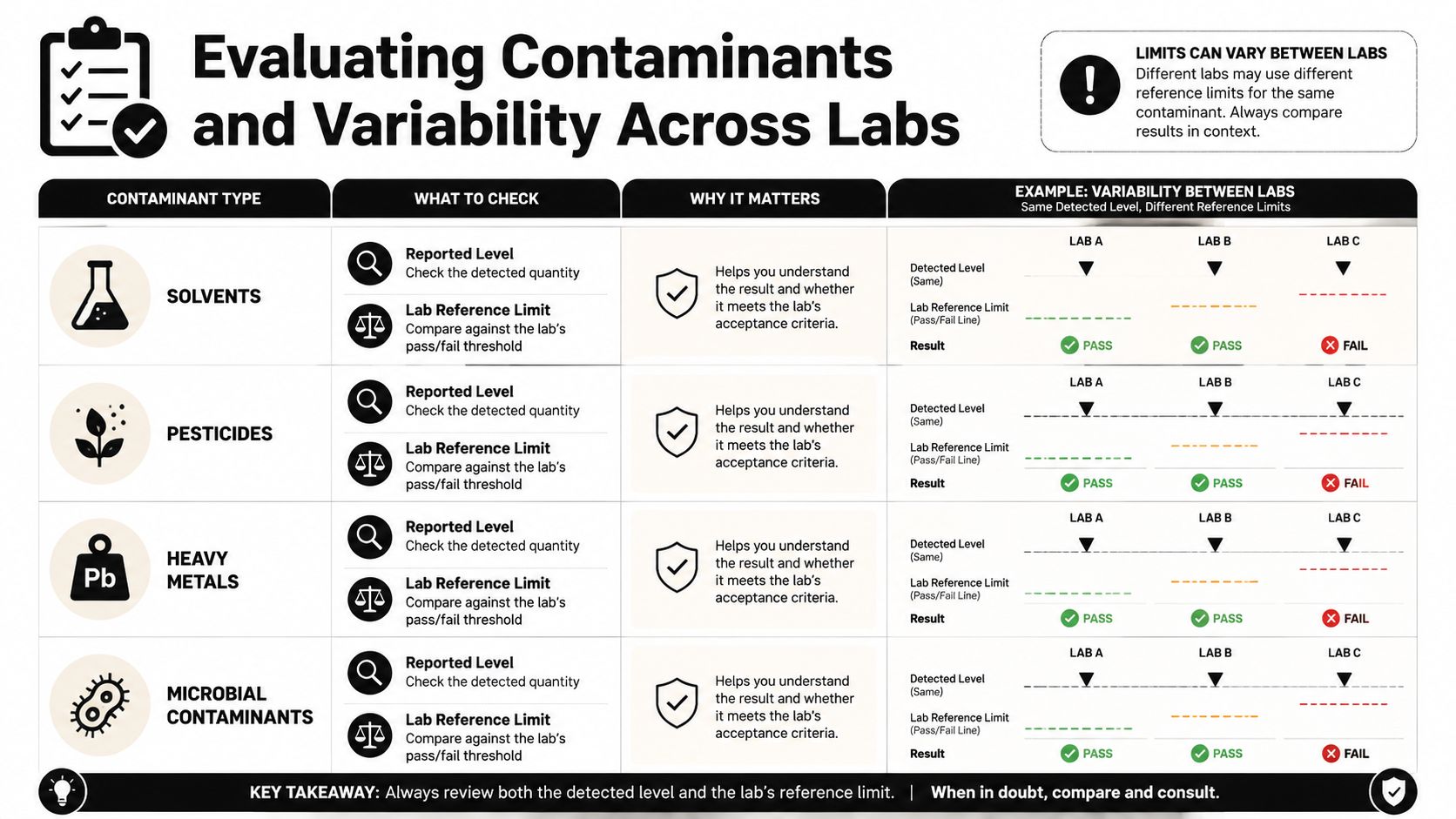
One sample can look different across facilities
Contaminant panels usually include residual solvents, pesticides, heavy metals, and microbial markers. Those categories matter for release decisions, but interpretation gets messy when labs use different methods, different reporting formats, and different reference limits.
Different labs often use varying reference ranges for the same analytes, causing inconsistent results that can confuse product safety decisions (pitfalls in interpreting laboratory results). In practice, that means one facility may call a result acceptable while another flags the same analyte more aggressively.
That's why experienced teams compare more than the pass or fail stamp. They compare:
- Reported level for the analyte itself
- Lab reference limit attached to that result
- Method context used to generate the reading
- Matrix compatibility between sample types
For teams reviewing contaminant workflows in cartridge production, this pesticide residue testing reference helps frame what should be checked beyond the headline outcome.
Build internal QA rules that survive cross-lab noise
Relying on one outside lab's pass line can create false confidence. A stronger system uses your own internal acceptance logic, then checks whether each external report supports it clearly enough.
Here's a workable review model:
| Contaminant area | What to compare | What can go wrong |
|---|---|---|
| Solvents | Reported amount and method notes | A “pass” may still leave unwanted formulation risk if method sensitivity differs |
| Pesticides | Specific analyte list and threshold basis | Missing analytes can create false reassurance |
| Heavy metals | Units, matrix, and reference limit | Cross-lab comparisons can break if units or sample prep differ |
| Microbial contaminants | Detection language and reporting convention | “Not detected” may not mean identical sensitivity between labs |
A practical QA team also keeps a historical file of reports from the same supplier, same material class, and same intended use. That won't erase inter-lab variation, but it will stop you from comparing an isolate input, a crude extract, and a finished cart as if they were analytically interchangeable.
If you don't normalize the context of the report, the numbers can look more precise than they are.
Converting Units and Interpreting LOQ and LOD
Some reports make interpretation harder by switching units midstream. Cannabinoids may show up in percent, contaminants in ppm, and minor compounds in mg/g. If you don't normalize units before reviewing, you can't compare batches cleanly.
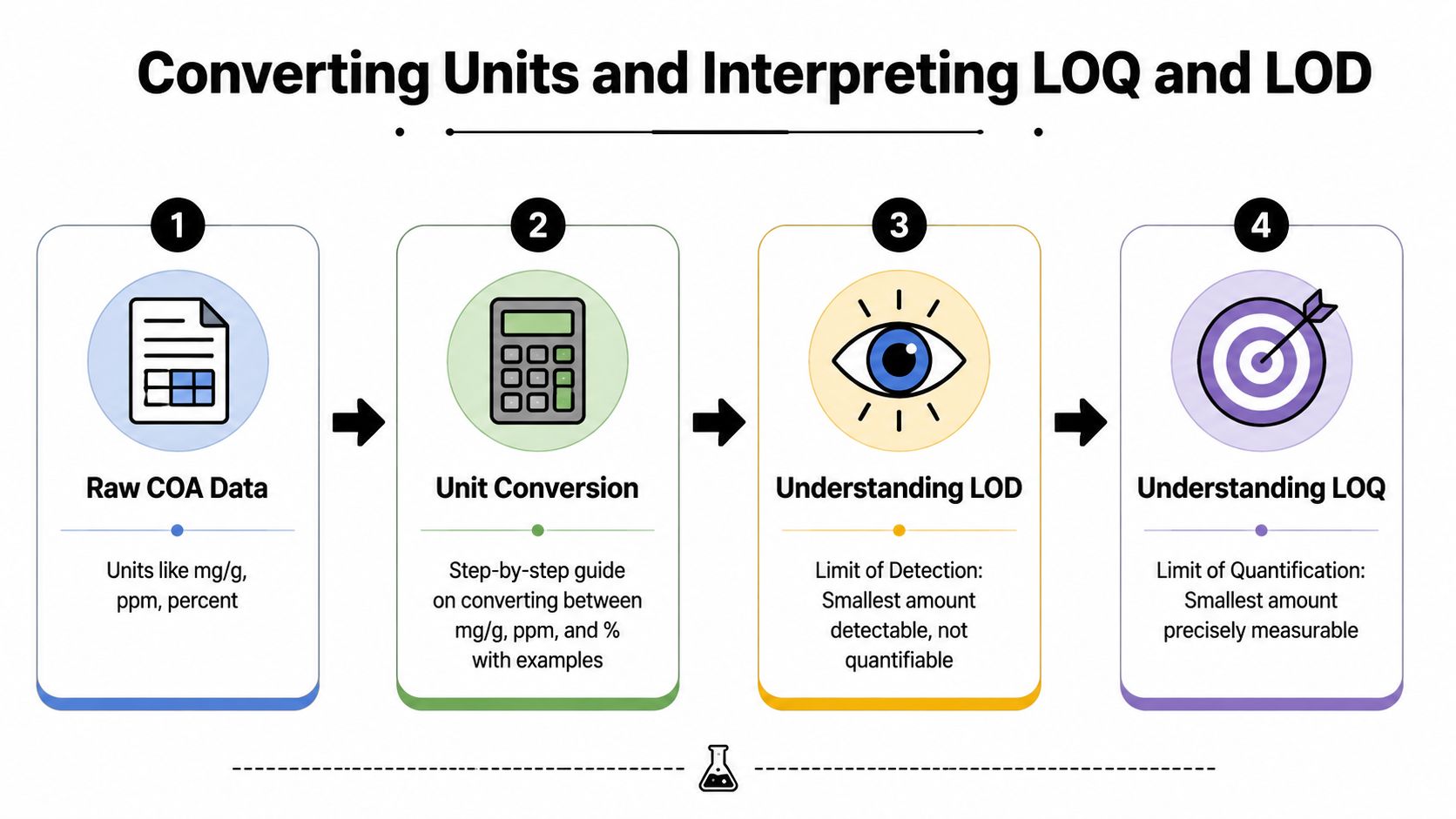
Use one working unit for decision-making
Pick a house standard for internal review. Many teams prefer percent for terpene formulation targets and a consistent secondary unit for contaminant checks. The exact choice matters less than consistency.
A simple workflow looks like this:
- Read the reported unit first. Don't assume a small number means a trace amount without checking whether it's in percent, ppm, or mg/g.
- Convert all comparable analytes into one internal unit. That makes batch-to-batch review cleaner.
- Log the original unit beside the converted value. You want traceability if a release call gets questioned.
- Review against your formulation target only after conversion. Otherwise small unit differences can become big formulation errors.
For teams building a stronger release workflow, this quality control testing resource is worth keeping nearby.
The distinction between detection and quantification also matters. This short video is a useful refresher before you finalize QA calls.
Don't treat non-detects as absolute zeros
A result reported as negative, non-detect, or below limit of detection can mislead people into thinking the compound is absent. That's not always true. It may only mean the method couldn't detect or quantify it at the relevant threshold.
Interpreting “negative” or “below limit of detection” results requires substitution methods like LOD/2 for accurate quantitative use in formulation and QA (CDC material on analyzing and interpreting laboratory results).
That matters when you're checking whether a formula is THC-free, whether a contaminant is practically absent, or whether a borderline terpene should influence ratio calculations.
Use this logic:
- LOD means the lab may detect presence, but not measure it precisely.
- LOQ means the lab can quantify it with acceptable precision.
- Below LOD should not be interpreted as a hard zero in quantitative QA.
- Below LOQ often means presence may exist, but the exact amount isn't reliable enough to use directly without a rule.
When you need to keep a mass-balance model or internal trend sheet consistent, substitution methods keep the math from breaking. What doesn't work is mixing zeros, blanks, and “ND” labels interchangeably across production records.
Avoiding Common Pitfalls in Formulation and Quality Assurance
Most bad interpretation isn't caused by a lack of data. It's caused by a lack of discipline.
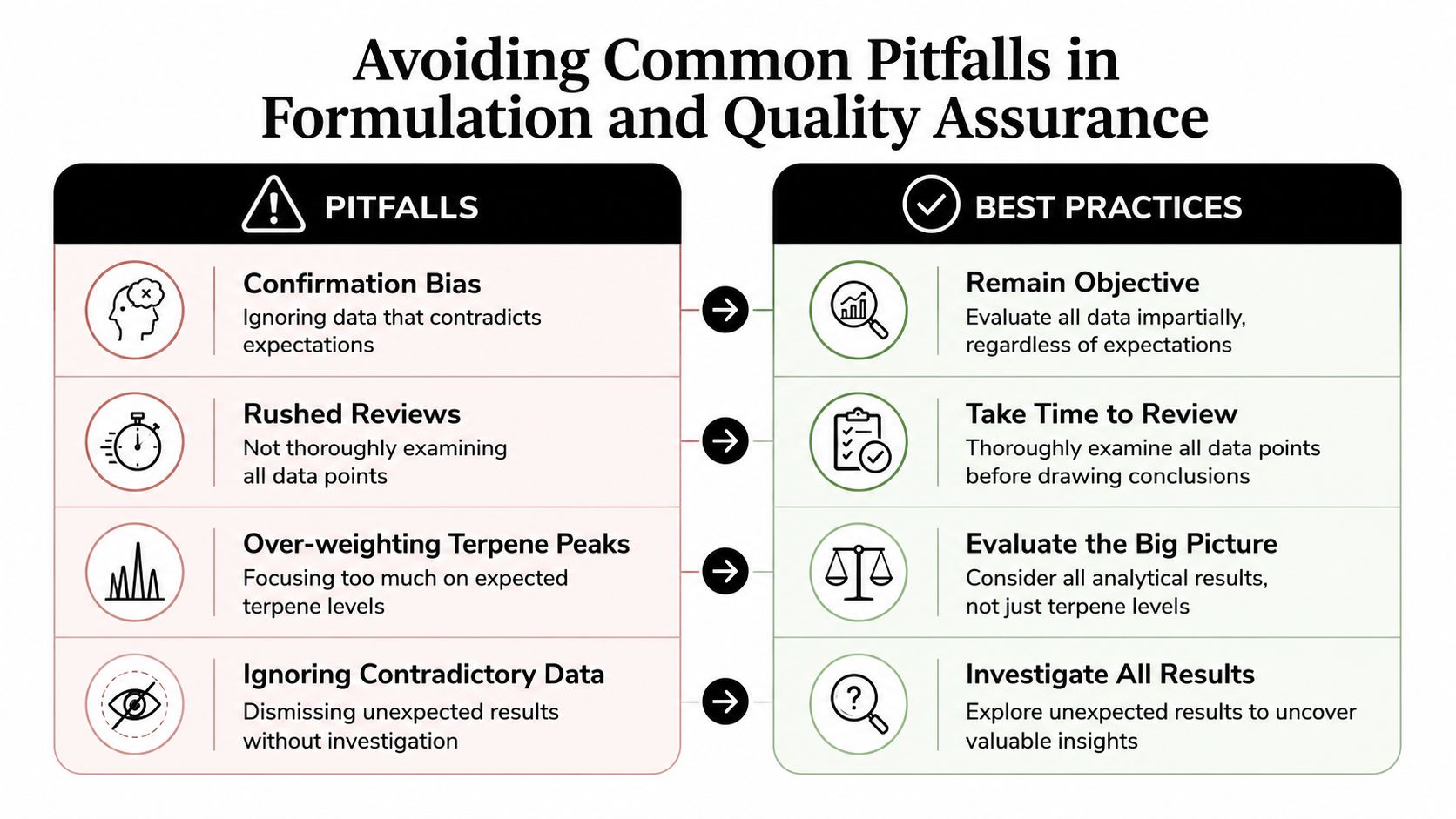
Confirmation bias is the quiet batch killer
If you expect a profile to read “Blue Dream-like,” you'll naturally look for the peaks that support that expectation. That's normal. It's also risky.
The most common pitfall is confirmation bias, where formulators overweight results that fit the expected profile and underweight contradictory analytes. Implementing chronological review and pre-analytical checks improves lab report interpretation accuracy from 78% to 94% by mitigating confirmation bias (lab test interpretation mistakes and how to avoid them).
That finding lines up with real bench practice. Teams make fewer bad calls when they review reports in order, compare them against earlier lots, and force themselves to inspect every analyte with the same attention.
What fails and what works
Here's the contrast that matters in production.
What fails first
- Expected-profile reading: You scan for myrcene, limonene, or caryophyllene and stop asking hard questions once they appear.
- Speed reviewing: You check the totals, glance at contaminants, and move on.
- Single-report decisions: You release or reject from one snapshot without trend context.
What works under pressure
- Start with sample integrity and method fit before reading flavor implications.
- Review terpene data chronologically, not selectively.
- Compare anomalous peaks against neighboring batches before changing the formula.
- Separate sensory expectation from analytical review. Smell later. Read first.
“Review slowly enough that contradictory data gets equal attention.”
Use trend logic instead of one-off reactions
A disciplined QA workflow doesn't overcorrect every fluctuation. It asks whether the change is directional, persistent, and relevant to the finished product.
That's especially important in vape work, where monoterpene concentrations should be kept below 6% for stability and formulators should account for a 15–30% terpene loss factor during filling and initial storage, while stabilizing sesquiterpenes such as β-caryophyllene can sit at 3–5% to support shelf life (formulation strategies for terpenes and cannabinoids). If you ignore those trade-offs and chase every bright top note, the first week may smell great and the shelf sample may not.
The strongest teams build blind checks into release review. One person reads the report without the strain target label. Another compares it against prior batches. Then production decides whether the result supports the intended formula or needs retesting.
Actionable Checklist for Accurate Report Interpretation
Keep this list at the bench, not in a folder nobody opens.
- Verify sample identity: Match sample ID, batch number, matrix, and collection context before comparing any two reports.
- Check handling clues: If storage, transport, or container details look weak, treat volatile terpene data cautiously.
- Confirm the method fits the use case: A report can be valid and still not be useful for strain replication or vape formulation.
- Require a full terpene panel: Total terpene content doesn't tell you how to build top, mid, and base notes.
- Normalize units before review: Don't compare percent, ppm, and mg/g without converting them into one internal standard.
- Interpret LOD and LOQ correctly: “Negative” and “below detection” aren't always practical zeros.
- Read contaminants with lab context: Compare the reported level and the lab's threshold together.
- Review chronologically: One report is a snapshot. A series of reports shows drift, consistency, or process change.
- Check stability logic before finalizing terpene loading: A profile can be aromatic and still be wrong for cartridge performance.
- Flag contradictions instead of explaining them away: If the data fights your expectation, pause the release decision.
Good lab report interpretation isn't a paperwork skill. It's a formulation skill. Teams that treat it that way make better carts, tighter distillate blends, and more reliable strain-inspired products.
If you need terpene inputs that support serious formulation work, Gold Coast Terpenes offers strain-specific blends, isolated compounds, and practical formulation resources for vape cartridges, concentrates, and distillate development. Their catalog and educational tools are built for teams that need precise flavor control, clean ingredient standards, and repeatable results across production.