
A cart can pass every bench test and still miss its commercial target. You fill cleanly, the aroma is on profile, the vapor is smooth, and then the panel comes back with the same note: good flavor, weak hunger cue.
That problem shows up most often when the formula treats terpenes as garnish instead of structure. In appetite-focused products, the terpene system has to do two jobs at once. It has to shape the sensory profile the buyer expects, and it has to support the functional direction the product is supposed to suggest. If you're working THC-free or low-THC, that burden shifts even more heavily onto terpene selection and ratio control.
Introduction to Appetite Stimulant Terpenes
A practical appetite formula usually starts with a mismatch. The target is clear. A product team wants a strain-inspired terpene blend for vape cartridges that le-ans toward hunger support, but the first trial blend is built mostly around bright flavor. It smells convincing on opening and tastes sharp on the first pull, yet it doesn't hold a rounded body note or create the fuller effect profile the brand expected.
That is where appetite stimulant terpenes become useful as formulation tools, not just flavor ingredients. Some compounds are chosen because they lift the top note and make a blend feel fresh. Others are there because they anchor the middle and base of the profile, soften volatility, and contribute to the broader behavioral impression of the formula. That distinction matters in both THC-containing and THC-free systems.
If your team needs a quick refresher on why these compounds matter across extracts, distillates, and finished goods, the best starting point is this guide on terpenes in cannabis products and why they matter. The commercial takeaway is simple. In a serious terpene profile for cannabis product formulation, the appetite angle can't be bolted on at the end. It has to be built into the blend architecture from the first draft.
Strong appetite positioning usually fails for one of two reasons. The blend is too top-heavy, or the formulator picked compounds with conflicting functional direction.
Understanding Key Concepts
A workable mental model helps. Think of appetite terpenes the same way a perfumer thinks about an accord. You don't just pick ingredients that smell good together. You assign roles.
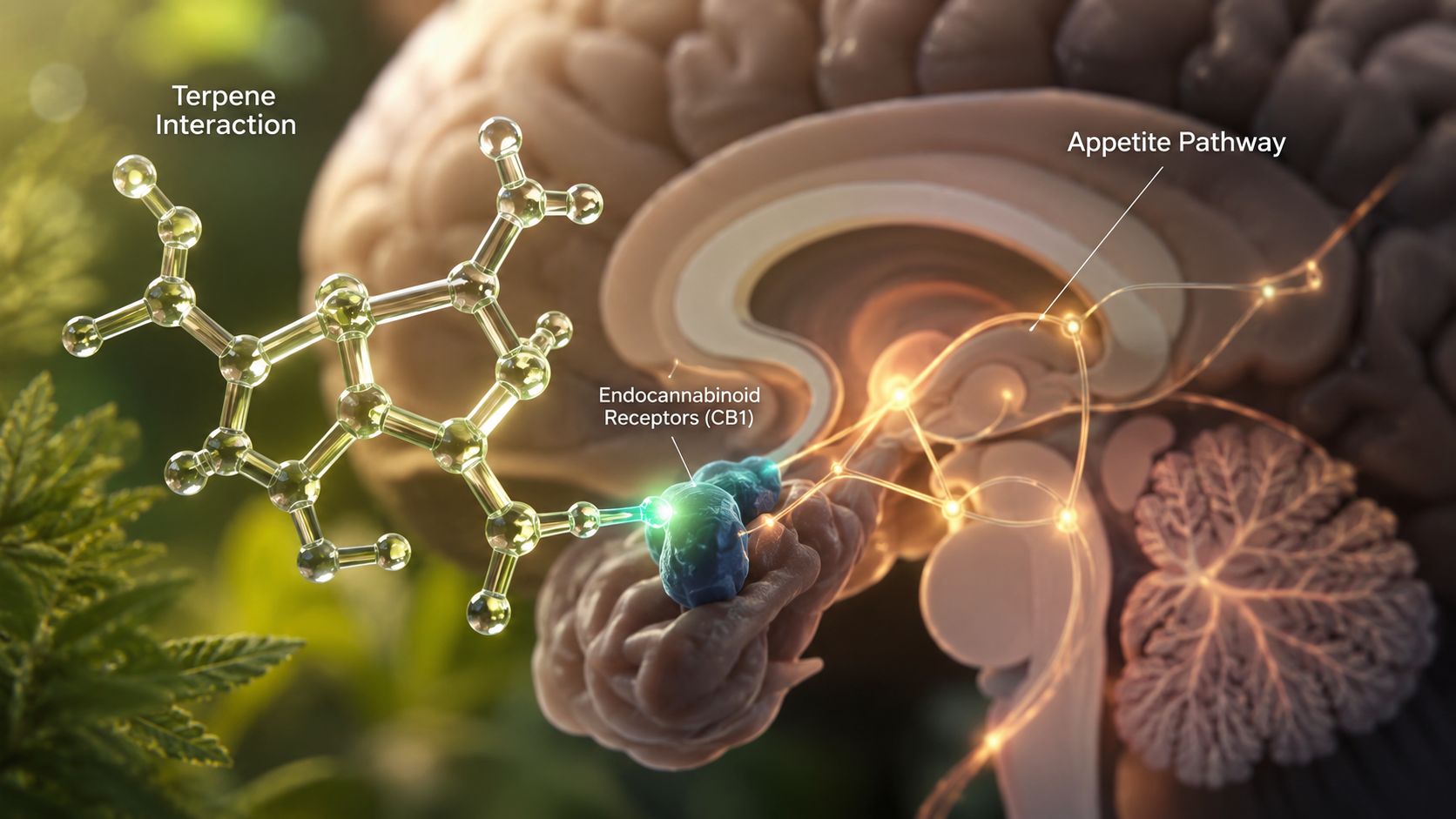
Defining the role of appetite terpenes
In formulation terms, appetite terpenes are compounds selected because they may support a hunger-forward product direction while also contributing aroma and balance. That doesn't mean every terpene marketed for hunger belongs in the same formula. It means each one needs a reason to be there.
Research has identified that β-Eudesmol stimulates appetite by activating the TRPA1 receptor, a mechanism tied to stimulatory appetite control, and that this oxygenized sesquiterpene directly influences feeding behaviors through endocannabinoid-system signaling pathways, as detailed in this β-Eudesmol appetite mechanism paper. For formulators, that matters because it gives β-Eudesmol a functional rationale beyond aroma.
Top, mid, and base note jobs
A clean way to build a terpene profile for distillate is to separate compounds into note classes:
- Top notes: These are usually the first compounds the user notices. Limonene and pinene often live here because they create immediate brightness and recognizable lift.
- Mid notes: These carry the identity of the blend through the inhale and early exhale. Myrcene often works here because it adds body and helps a profile feel fuller rather than thin.
- Base notes: These hold the finish together. Sesquiterpenes such as β-Eudesmol and, depending on the goal, related heavier compounds can give persistence and reduce the sense that a formula disappears after the first hit.
The mistake I see most often in formulating appetite stimulant terpenes for vape cartridges is overloading the top. A blend smells expressive in the bottle, then flashes off fast in actual use.
Why receptor and volatility both matter
A terpene can look right on paper and still underperform if its physical behavior doesn't match the delivery format. Monoterpenes tend to announce themselves quickly. Heavier molecules hold longer. If you're trying to reproduce a hunger-forward profile, that timing changes the user experience.
For a more consumer-facing but still useful framing of hunger direction in terpene selection, this article on whether sativa makes you hungry is worth scanning. The useful lesson for formulators is that appetite expression isn't one-dimensional. A bright citrus-forward blend and a dense myrcene-forward blend can both lean hunger-positive, but they do it in very different ways.
Summarizing Scientific Evidence
Marketing copy tends to flatten the category. Real formulation work can't. The evidence base around appetite terpenes is uneven, and some compounds have a cleaner mechanistic story than others.
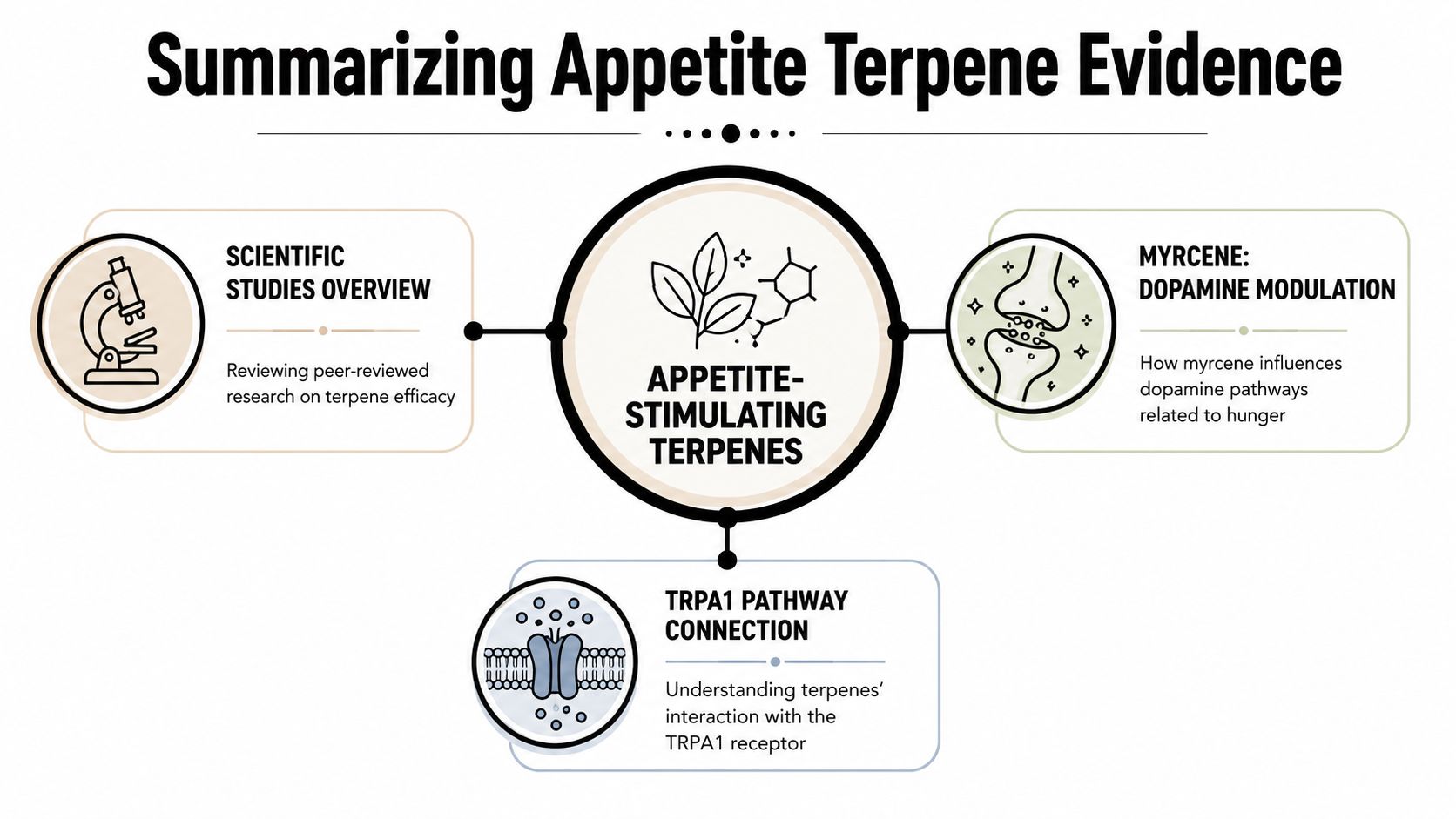
What looks strongest in current evidence
Myrcene is one of the more practical compounds to work with in appetite-oriented blends because available material points to dopamine modulation tied to feeding behavior. In product development, that lines up with what many formulators already expect from myrcene-rich profiles: more body, more depth, and a less scattered sensory effect.
β-Eudesmol has a different value. According to this TRPA1 study on β-Eudesmol, it stimulates appetite through specific activation of TRPA1 channels and then engages the autonomic nervous system in hunger control. That makes it useful in discussion of non-psychoactive pathway design, especially when a team wants to avoid relying on cannabinoid-driven positioning.
What still requires caution
The broad cannabis appetite story is well known, but terpene-specific human data is still limited. Some descriptive material points to terpenes such as linalool and pinene influencing ghrelin, dopamine, serotonin, smell, and taste in ways that can shape appetite experience, but human clinical trials isolating individual terpene orexigenic or anorectic effects remain incomplete in many cases. For formulation, that means you should treat the current picture as directional, not definitive, in finished products.
A blend can be scientifically plausible and still be commercially wrong if the sensory build contradicts the intended effect.
Evidence strength by formulation use case
Here's the practical hierarchy I use when evaluating an appetite stimulant terpene formulation guide:
| Evidence area | What it supports in formulation | Practical confidence |
|---|---|---|
| Mechanistic receptor activity | Good reason to test a terpene in an appetite-forward concept | Strongest when tied to a defined pathway |
| Behavioral signals in preclinical work | Helps shortlist candidates for blend architecture | Useful, but not enough by itself |
| Anecdotal consistency from cannabis experience | Supports sensory direction and product storytelling | Helpful, never sufficient alone |
| Human terpene-specific clinical confirmation | Best basis for stronger claims | Often still missing |
Where teams go wrong
A common error is assuming every terpene associated with "munchies" belongs in the same cart. That's not how receptor targets, volatility, or note structure work. Some compounds may support the goal at one level while undermining it at another. A formula can become sharper but less grounded, or richer but too dull, if the blend isn't edited.
The right reading of the evidence is disciplined. Use it to select candidates. Use bench work to test whether those candidates perform in your delivery system.
Terpene Profiles and Strain Examples
Once the science is filtered through product reality, the conversation gets simpler. You aren't selecting "good" appetite terpenes. You're selecting the right appetite direction for a given SKU.
Three practical profile directions
A myrcene-heavy profile tends to fit products aimed at a denser, more settled effect impression. A limonene-led profile can point the same product category toward a brighter, more active sensory experience. A sesquiterpene-supported build gives you more persistence and often a better finish in vapor.
One useful benchmark comes from a formulation-focused source noting that strain profiles with more than 0.5% myrcene consistently show pronounced appetite stimulation along with sedating body effects, outlined in this discussion of myrcene and terpene choices for hunger stimulation. I wouldn't treat that as a universal recipe, but it is a practical flag. If your hunger-forward concept contains very little myrcene, check whether the blend is fighting its own objective.
Sample Strain-Inspired Appetite Profiles
| Profile Name | Key Terpenes | Example Ratio (CBD:Terpene) |
|---|---|---|
| Green Mango | Myrcene, limonene, pinene, β-Eudesmol | 20:1 |
| Citrus Boost | Limonene, pinene, myrcene | 12:1 |
| Resin Body | Myrcene, β-Eudesmol, beta-caryophyllene | 20:1 |
These aren't fixed formulas. They're starting architectures for strain-inspired terpene blends for distillate.
How to assign note roles inside each profile
For a Green Mango style blend, myrcene usually carries the mid-body. Limonene works as the top note. β-Eudesmol can help anchor the base and keep the profile from feeling hollow. Pinene can sharpen the opening if the formula is reading too heavy.
For a Citrus Boost direction, limonene leads the opening. Pinene adds lift and edge. Myrcene has to be controlled so it supports appetite direction without flattening the profile into a sleepy finish.
For a Resin Body build, the challenge is restraint. A heavier profile can become muddy fast. Here, the job is to maintain enough top-note definition that the blend still reads as intentional.
Build hunger-forward blends the way you build stable flavor systems. Start with the base, then shape the middle, then decide how much lift the top can carry without breaking coherence.
What works and what doesn't
What works:
- Myrcene-forward middle structure: Good for formulas that need body and persistence.
- Limonene as a controlled top note: Useful when the profile needs brightness without becoming superficial.
- A heavier anchor compound: Helpful when the first draft tastes good but fades too quickly in vapor.
What doesn't:
- All-citrus appetite concepts: They can smell convincing in a jar and feel thin in use.
- Overbuilt complexity: Too many "functional" ingredients often blur the result.
- Blind replication of strain menus: A flower-inspired name doesn't solve cartridge behavior on its own.
Formulation Guidance for Cartridges and Distillate
The bench phase is where appetite theory either survives or gets stripped out. Cartridge performance forces discipline.
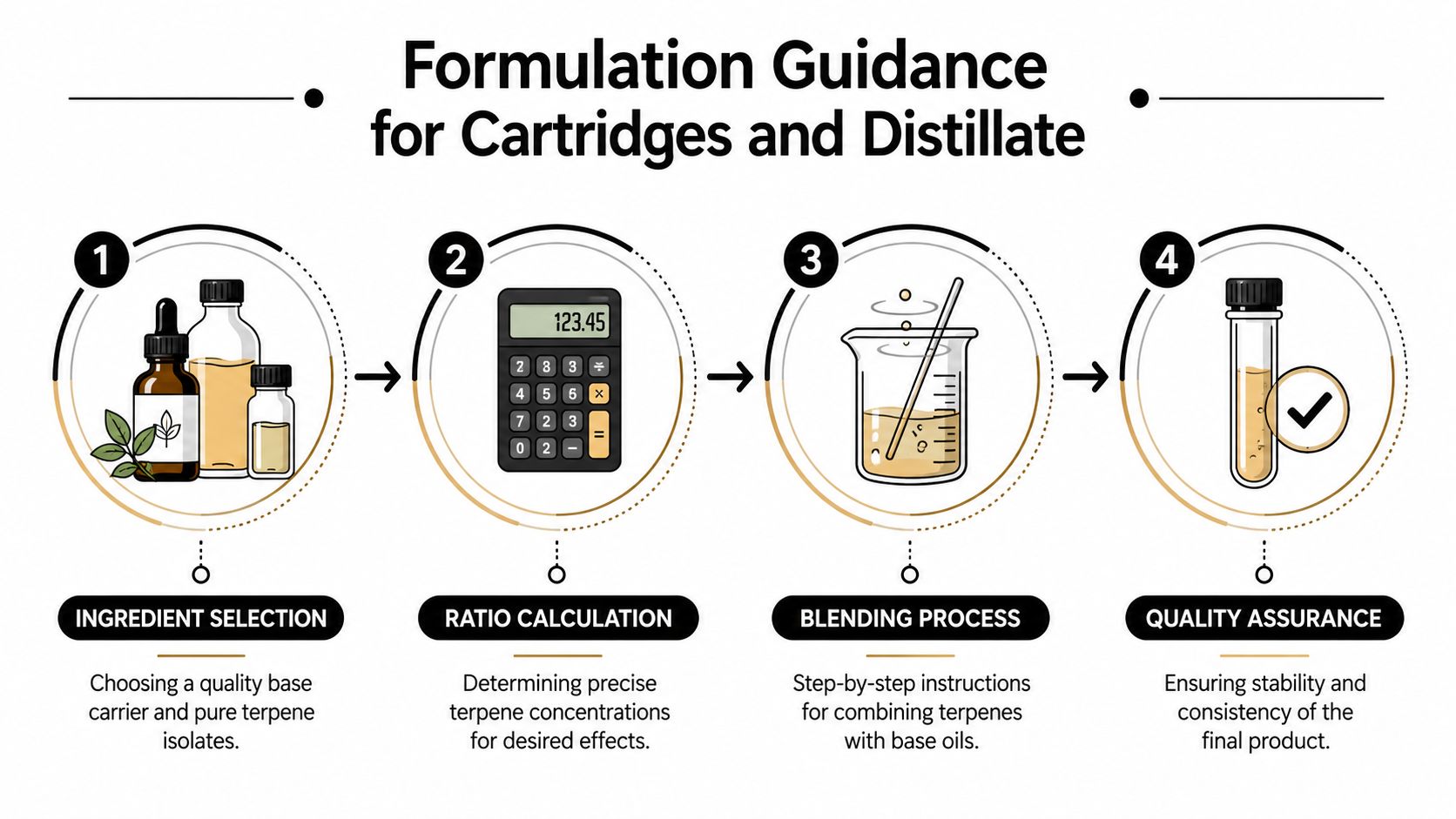
Start with concentration, not optimism
For vape cartridge formulation with distillate, the standard terpene loading is 4–8% by weight, with 5% as the preferred starting point to balance flavor intensity against risks like leaking or harshness, according to this vape terpene concentration chart. That starting point is especially useful for appetite-focused formulas because it gives enough room to evaluate effect direction without pushing hardware too hard.
If your team needs process-level help, this guide on how to use terpenes in formulations is a useful reference for handling and blending basics.
Account for volatile loss
A hunger-forward profile often depends on a precise top-to-mid balance. That gets disrupted if you ignore processing loss. In cartridge development, monoterpenes such as limonene and pinene can require a 15–30% terpene loss factor during filling and early storage, while sesquiterpenes like β-caryophyllene and humulene are more heat-stable, as explained in this overview of formulation strategies for terpenes and cannabinoids.
That matters because the first draft you mix isn't necessarily the blend the customer receives.
A short visual walkthrough helps when training staff or standardizing SOPs.
A simple blending workflow
- Define the appetite direction first. Decide whether the formula should read bright, dense, or balanced. Don't start with a strain name.
- Choose note roles before percentages. Assign top, mid, and base jobs, then test whether each compound has a clear purpose.
- Set total terpene load. Start at the standard range, then evaluate flavor intensity, throat feel, and hardware behavior.
- Adjust for loss and storage. If the opening fades after filling, revisit monoterpene compensation before rewriting the whole formula.
- Run hardware checks. An appetite blend that leaks, spits, or turns harsh isn't ready no matter how good the aroma strip smells.
Shelf stability and ratio discipline
Professional guidance for natural flower replication in concentrate products recommends a cannabinoid-to-terpene ratio between 20:1 and 12:1, with monoterpenes kept below 6% and stabilizing sesquiterpenes used at 3–5% for shelf stability and flavor retention, according to this summary of terpene classifications in product development. In practice, that ratio range is a smart guardrail for appetite formulas because it forces you to keep the profile realistic rather than perfume-heavy.
Safety and Compliance in Appetite Stimulators
The fastest way to create risk in this category is to overstate certainty. Appetite-focused products already sit close to sensitive claim territory, so the formula and the label both need restraint.
One point deserves special attention. Contrary to the common industry assumption that Beta-Caryophyllene is always a hunger booster, emerging evidence describes a dose-dependent split where it may suppress appetite through CB2 receptor binding while also offering gastroprotective benefits, creating a real formulation safety gap, as outlined in this review of how cannabis strains and terpenes affect appetite. In plain terms, a blend can drift away from its intended purpose if caryophyllene is pushed too far.
Compliance priorities that matter
- Purity documentation: Keep current records for identity, residual solvents, and THC status where relevant.
- Claim control: Don't promise medical outcomes. Position around formulation intent, flavor design, and product category.
- Stability review: Recheck the formula after storage, not just after mixing.
- Legal review: Confirm additive and labeling rules in every market where the SKU will ship. This overview of whether terpenes are legal is a useful starting point.
The safest appetite formula is usually the one with the clearest purpose and the fewest contradictions.
If you're building a terpene profile for vape cartridges, a strain-inspired terpene blend for distillate, or a tighter formulation guide for cannabis product development, Gold Coast Terpenes is a strong place to source profiles, isolates, and practical formulation tools. Their catalog supports both flavor replication and functional blend work, which makes bench testing faster when you're dialing in appetite-focused products.