
You're probably in one of two situations right now. You're either trying to lock in a strain-inspired terpene blend for vape cartridges and want repeatable flavor without creating a compliance mess, or you've been asked whether a “THC terpene spray” is the right shortcut for a new SKU.
That question matters more than is often realized. In practice, people use the phrase THC terpene spray to describe very different materials, and that confusion creates avoidable problems in sourcing, labeling, testing, and batch consistency. A product that contains THC behaves like a cannabis ingredient from a regulatory and operational standpoint. A sprayable terpene solution that contains no THC behaves like a flavor system. Those are not interchangeable decisions.
For formulators, the issue isn't terminology. It's whether the ingredient system helps you build a stable, scalable product line for distillate, cartridges, and concentrates without introducing unnecessary risk.
Defining Terpene Sprays in Product Formulation
A formulator usually reaches for a spray-format terpene system for one reason. They want fast, even distribution of aroma and flavor compounds across a base material, or they want a handling format that's easier for production staff to dose consistently than working from a highly concentrated neat terpene bottle.
In commercial product development, “terpene spray” usually gets used for two separate categories.
Two products that get lumped together
The first is a THC-infused spray. That means the material contains THC along with aromatic compounds. Once THC is in the system, you're not just selecting a flavor input. You're selecting a regulated cannabis ingredient, with all the sourcing, storage, chain-of-custody, testing, and labeling consequences that follow.
The second is a THC-free botanical terpene spray. That's the version most useful for scalable formulation work, especially when the goal is replicating flavor of classic cultivars for distillate or building a terpene profile for cannabis product formulation without changing cannabinoid content.
If your team still uses “terp spray” as a catch-all term, it's worth tightening that language internally. It reduces purchasing mistakes and keeps production, compliance, and sales aligned.
A practical definition of spray systems in formulation is outlined in this terp spray overview.
Why the distinction changes the entire project
A THC-containing spray affects more than the formula. It changes who can buy it, where it can move, how it must be stored, what records you need to maintain, and which finished products it can legally enter.
A THC-free terpene spray, by contrast, is usually chosen for operational flexibility. It allows the formulator to work on flavor accuracy for vape cartridges, target a familiar aromatic direction, and keep cannabinoids in a separate controlled stream.
Practical rule: If the goal is sensory design, use a sensory ingredient. If the goal is potency, use a cannabinoid ingredient. Combining those decisions too early usually makes both harder.
That separation helps during scale-up. It also makes troubleshooting cleaner. When a cartridge tastes harsh, flat, or unbalanced, you can isolate whether the issue came from the terpene system, the oil, the hardware, or the fill conditions.
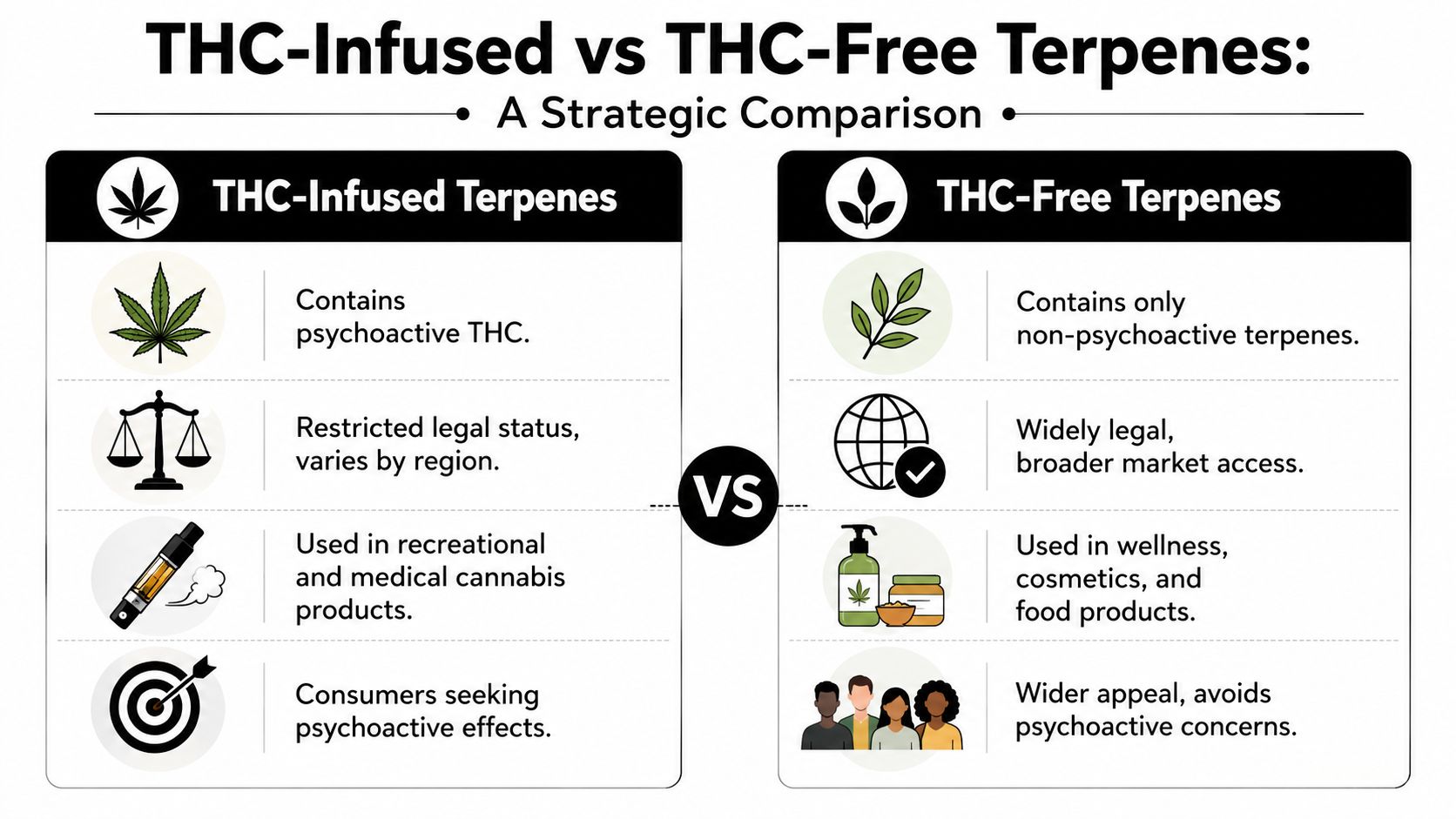
THC-Infused vs THC-Free Terpenes A Strategic Comparison
The choice between a THC-infused spray and a THC-free terpene system isn't just a technical preference. It's a business model decision. One path may fit a tightly controlled in-state cannabis operation. The other usually fits brands that need cleaner sourcing, simpler documentation, and easier SKU expansion.
Where THC-infused systems make sense
If you're formulating entirely inside a licensed cannabis supply chain, a THC-infused terpene spray can make sense when the ingredient is part of a controlled cannabis-native process and every downstream step is already built around THC handling. Some operators prefer that because it keeps all aroma and cannabinoid inputs inside one regulated bucket.
But that convenience is narrower than it first appears. The ingredient becomes harder to source consistently, harder to move between facilities, and harder to deploy across mixed cannabis and hemp product lines.
Where THC-free systems usually win
For most brands building strain-inspired terpene blends for vape cartridges or terpene profiles for distillate, THC-free systems are easier to scale. They separate flavor engineering from THC compliance, which usually shortens purchasing cycles and reduces avoidable legal review.
This matters even more if your team formulates across multiple channels such as hemp-derived SKUs, cannabis SKUs, hardware trials, or white-label development. A THC-free terpene component gives R&D more freedom to iterate.
For teams evaluating sourcing language, this hemp-derived explainer is useful context when internal stakeholders mix up hemp, cannabis, THC, and botanical terminology.
Formulation Comparison: THC-Infused vs. THC-Free Terpene Sprays
| Factor | THC-Infused Terpene Spray | THC-Free Botanical Terpene Spray (e.g., Gold Coast Terpenes) |
|---|---|---|
| Primary role | Adds aroma and includes THC as a regulated cannabinoid component | Adds aroma and flavor without introducing THC |
| Sourcing complexity | Limited to compliant cannabis channels | Easier to source for broader formulation work |
| Regulatory burden | Higher, because THC changes legal handling and labeling obligations | Lower operational burden for flavor-focused development |
| Use across product lines | Restricted to THC-authorized programs | More adaptable across R&D and non-THC flavor applications |
| Batch documentation | Requires cannabis-grade traceability and tighter controls | More straightforward ingredient documentation |
| Scale-up flexibility | Narrower, especially across jurisdictions or mixed portfolios | Better suited to repeatable commercial formulation |
| Best fit | Licensed cannabis operators with existing THC workflows | Brands prioritizing flavor replication, consistency, and formulation agility |
When teams say they want a THC terpene spray, they usually want one of two things. Better flavor, or a cannabis-native ingredient story. Those are separate priorities, and the wrong choice costs time later.
The short version is simple. If you need THC in the ingredient for a specific regulatory or brand reason, accept the added complexity upfront. If your real target is replicating flavor of OG Kush for vape cartridges or building a stable aromatic profile for distillate, a THC-free terpene system is usually the more disciplined choice.
Fundamentals of Terpene Spray Formulation
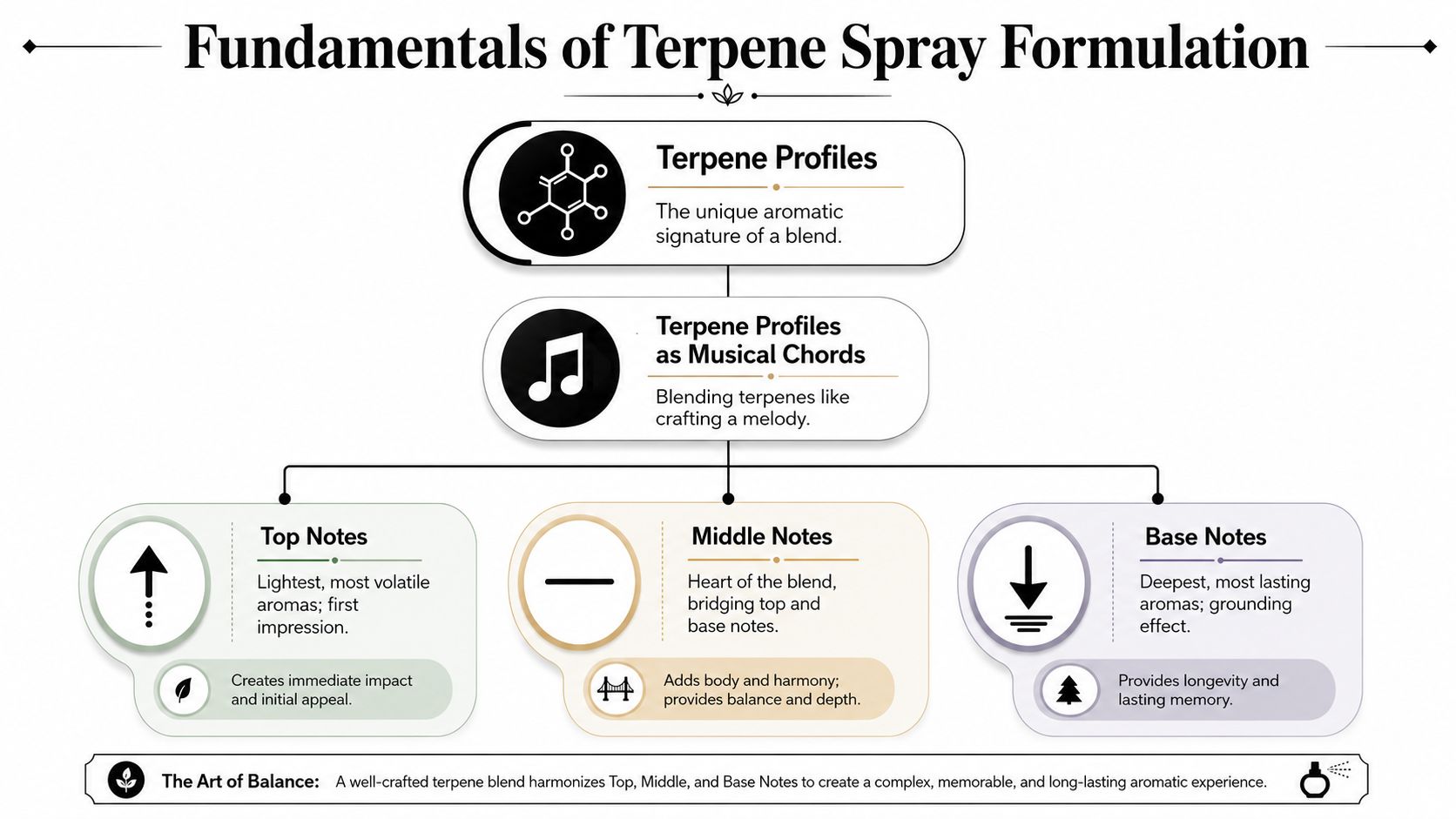
Good terpene formulation starts with one principle. A profile is not a single note. It's a layered structure, and if you don't balance those layers, the result either spikes too hard at the front or collapses into a muddy finish.
Top, middle, and base notes in a usable profile
For practical formulation, think of terpene profiles like chords.
Top notes create the first impression. These are the bright, sharp, volatile notes that tell the user “citrus,” “pine,” “fruit,” or “gas” on the first pull.
Middle notes carry the identity of the blend. They connect the opening to the finish and keep the profile from feeling hollow.
Base notes provide depth and staying power. They anchor the blend and stop the profile from reading as thin, candy-like, or artificially loud.
When a team asks for a strain-inspired terpene blend replicating flavor of Blue Dream for distillate, they're usually reacting to one of these layers. Sometimes they want more lift on the top. Sometimes they want a denser core. Sometimes they need the finish to stop tasting empty.
Why spray systems fail when the profile is wrong
A spray format doesn't rescue a weak formulation. If the profile is unbalanced in concentrate form, atomizing or dispersing it won't fix it. It may exaggerate the problem by making bright top notes dominate while the rest of the profile falls behind.
That's why formulation discipline matters more than format. The spray delivery method is secondary to the composition of the blend and the compatibility of that blend with the oil system.
A practical reference point for spray-style applications and product handling is this spray for weed guide.
What to avoid in the carrier system
For inhalable products, the wrong carrier creates more problems than the terpene profile itself. In cartridge development, you want the aroma system to integrate cleanly into the oil, not leave a residue, distort the flavor, or complicate safety review.
Avoid building your process around carrier-heavy shortcuts such as:
- VG-heavy systems: They can change mouthfeel and interfere with clean flavor expression.
- PG-based solutions: They may solve a handling problem while introducing an ingredient-positioning problem.
- MCT or oil-style diluents: They don't belong in a serious inhalable formulation workflow.
Concentration discipline for vape work
Most harshness problems come from excess, not shortage. Professional formulators typically work with terpene concentrations between 4% and 8% by weight for vape distillates to achieve optimal flavor without harshness or product instability, as noted in Terpenes 101 by Gold Coast Terpenes.
That range is a working zone, not a permission slip to stop testing. A profile built for a heavy, warm distillate may sit comfortably in that band, while a sharper blend with louder top notes can still taste aggressive if the hardware runs hot.
Build the profile first. Then verify it in the actual cartridge, with the actual oil, at the actual operating temperature. Bench aroma alone is not a finished formulation.
Best Practices for Precise Mixing and Dosing
Most failed terpene batches don't fail because the formula was conceptually wrong. They fail because the team mixed by feel, dosed by eye, or assumed a small bench method would hold at production scale.
Equipment that actually matters
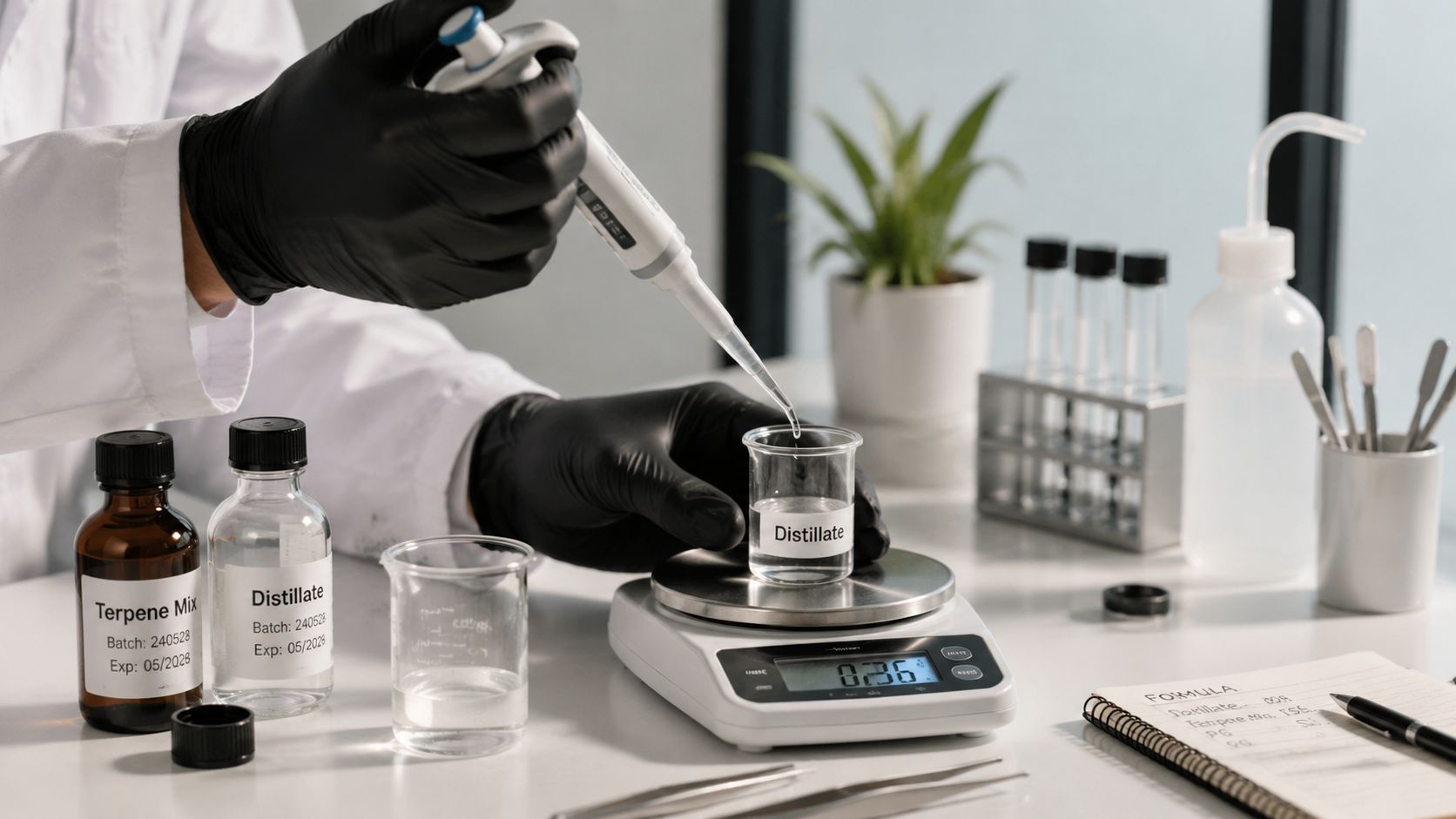
You don't need a complicated lab to mix terpenes well. You do need process discipline.
Use equipment that supports repeatability:
- Digital scale: Weigh everything. Volumetric shortcuts create drift.
- Glass beakers or mixing vessels: They're easier to clean thoroughly and easier to inspect.
- Magnetic stirrer or controlled overhead mixing: You want full homogenization, not surface blending.
- Calibrated transfer tools: Pipettes or syringes are useful for small additions and corrections.
- Batch records: If the blend works, you'll want to reproduce it exactly.
The biggest mistake junior teams make is under-mixing. The second biggest is adding terpenes into oil that hasn't been brought into a workable state for uniform blending.
A practical mixing sequence
The sequence matters almost as much as the ratio.
- Prepare the oil first. Make sure the distillate is workable and uniform before any terpene addition.
- Tare and weigh the vessel. Don't estimate based on container labels.
- Add terpenes by weight. Small overages change the sensory result fast.
- Mix until the blend is visually and mechanically uniform. Don't stop at “looks close.”
- Pull a retained sample. It helps when production and QC disagree later.
A dedicated calculator removes a lot of preventable error. The mixing ratios calculator is the kind of tool that keeps operators from making the same arithmetic mistake across an entire run.
Why calculators beat spreadsheet improvisation
A terpene calculator does two useful things. It standardizes operator inputs, and it makes ratio planning easier when production sizes change. That's especially important when the same formula needs to move from pilot batch to repeated cartridge fills.
Here's a simple workflow to keep in mind:
- Start with target batch weight
- Set terpene percentage for the oil system
- Calculate exact terpene mass
- Verify final oil balance before mixing
- Document lot numbers for every input
For teams that need a visual walkthrough, this video is worth reviewing before handing the task to production staff.
One warning: if your process depends on “the operator knows what looks right,” your process isn't production-ready.
Ensuring Product Safety Through Lab Testing
A terpene ingredient can smell excellent and still be a bad commercial decision. Safety review is where a lot of attractive samples fall apart.

What a usable CoA should help you confirm
A Certificate of Analysis should do more than exist. It should help your team decide whether the ingredient belongs anywhere near a production run.
At minimum, your quality review should look for screening relevant to:
- Residual solvents: Important when the ingredient was processed or diluted.
- Pesticides: Especially relevant for plant-derived materials.
- Heavy metals: An essential part of supplier qualification.
- Microbial contaminants: You don't ignore this just because the ingredient is aromatic.
If the paperwork is vague, incomplete, or hard to match to the lot in hand, treat that as a supplier problem, not an admin inconvenience.
Reading beyond the headline result
A junior buyer often checks whether the CoA says “pass” and stops there. That's not enough. Match the report to the lot number, review the panel scope, and make sure the document is current to the ingredient you're receiving.
Also look at naming consistency. If the product was sold to you as one thing and tested under a looser or different descriptor, ask why. Label drift upstream becomes a liability problem downstream.
Why pre-verified ingredients reduce exposure
Every additional test you have to chase after receiving material slows production and increases uncertainty. Brands that rely on well-documented terpene inputs generally move faster through intake because procurement, QC, and compliance aren't arguing over missing basics.
This isn't just about passing internal checks. It affects complaints, returns, and defensibility. If a cartridge line starts producing harsh sensory feedback or unexpected variability, you need to know whether the issue came from the terpene input, the oil, or the hardware. Clean supplier documentation narrows that search.
If a supplier can't show you exactly what was tested, on which lot, and under which product identity, don't treat the ingredient as qualified.
Teams that build safety review into purchasing usually avoid the worst category of failure. Launching a product that looked ready, shipped cleanly, and then becomes impossible to defend once someone starts asking basic documentation questions.
Navigating Legal and Labeling Requirements
Legal treatment changes the moment THC enters the ingredient system. That's the central dividing line for a THC terpene spray formulation guide.
Botanical terpene inputs versus THC-containing ingredients
A THC-free botanical terpene blend is generally approached as a flavor or aromatic ingredient. A THC-containing spray is treated as a cannabis ingredient. That changes how it can be sourced, handled, transferred, documented, and labeled.
For manufacturers, this means the same sensory target can sit under two very different compliance frameworks depending on what's in the bottle. Teams get into trouble when marketing uses cannabis language broadly while procurement buys a material that falls into a more restricted category than expected.
Label what the product is, not what the concept suggests
A label should reflect composition and intended product identity with plain accuracy. If the formula contains botanical terpenes, say so. If it contains cannabis-derived components, the label and supporting documentation need to reflect that reality.
Keep claims disciplined:
- State ingredient identity clearly: Botanical terpene blend, cannabis-derived terpene blend, or THC-containing cannabis ingredient are not interchangeable descriptions.
- Describe flavor direction accurately: “Strain-inspired terpene blend” is usually safer and more honest than implying a one-to-one duplication of plant origin.
- Avoid medical positioning: Don't attach therapeutic claims to an aroma system.
- Align internal docs and external packaging: Your spec sheet, purchase record, and retail-facing label should not tell three different stories.
Common compliance mistakes
A lot of labeling errors are operational, not legal-theory problems.
One team writes “natural terpenes” on the packaging, another team uses “hemp terpenes” in a sell sheet, and the purchaser sourced a generic botanical blend. That inconsistency may look minor internally, but it creates avoidable scrutiny.
Another common problem is using cultivar names as if they prove origin. In formulation, names like OG Kush or Blue Dream often describe the target sensory profile, not the agricultural source of every aromatic compound. That distinction should stay clear in your product language.
The safest path is simple. Match label language to ingredient reality, avoid over-claiming, and make sure your compliance team reviews the same spec sheet your product team approved.
Optimizing Packaging for Terpene Stability and Shelf Life
A solid formulation can still disappoint if the packaging lets the profile drift before the customer ever uses it. Terpenes are sensitive materials, and packaging either protects your work or slowly undoes it.
What degrades a finished terpene profile
Three exposures do most of the damage. Light, oxygen, and heat.
Light can shift the aromatic character over time. Oxygen dulls freshness and can flatten the opening of a profile. Heat accelerates both problems and can make a carefully balanced formula taste coarse or tired in hardware.
That matters most for top-note-heavy blends. If your product depends on a bright first impression, poor packaging shows up fast as sensory inconsistency.
Packaging choices that protect the formula
Use packaging that minimizes unnecessary exposure.
- Amber or opaque glass: Better for light protection than clear presentation-first packaging.
- Airtight seals: A premium blend in a poor closure system is still a poor packaged product.
- Low-headspace filling practices: Less trapped air usually means less oxidative stress.
- Controlled storage during warehousing: Packaging can't rescue sloppy temperature handling.
For bulk terpene ingredients, use tightly sealed containers and reduce repeated open-close cycles during production. For filled cartridges, make sure the hardware and secondary packaging work together. A stable oil in a leaky system still loses.
Final pre-launch checklist
Before release, ask four direct questions:
- Does the package protect the profile from light?
- Is oxygen exposure minimized during fill and storage?
- Will the closure hold through transport and normal handling?
- Does the product taste the same after sitting in its real package, not just in the lab vessel?
Shelf life is a packaging decision as much as a formulation decision.
Brands that get this right usually look more consistent in market because they are more consistent. The formula, the mixing process, the documentation, and the package all support the same outcome.
If you're building a terpene profile for vape cartridges, refining a strain-inspired terpene blend for distillate, or trying to avoid the compliance burden of a THC terpene spray, Gold Coast Terpenes is a strong place to source clean, THC-free terpene blends and practical formulation tools. Their catalog, educational guides, and mixing resources are built for manufacturers who need repeatable flavor, reliable documentation, and ingredient systems that fit commercial production.