
A familiar problem shows up late in development. The oil smells excellent in the jar, the citrus pops during bench evaluation, and then the cartridge lands thin, sharp, and forgettable on inhale. You aimed for a nostalgic cereal profile, but what reached the hardware was just generic fruit.
That gap matters if you're formulating for buyers who know exactly what they expect from an organic Fruit Loops terpene profile for vape formulation. They aren't looking for abstract “fruity.” They want a sweet citrus loop with immediate recognition, a rounded center, and a finish that lingers long enough to read as cereal rather than candy.
For a product developer, this is a flavor architecture problem. You need a build that survives heat, dilution, and vaporization. You also need a clear position on what “organic” means in the blend itself, because the cereal reference and the terpene system are not the same thing.
Introduction Why Fruit Loops Flavor Wins in Vape Formulation
A bench test often starts the same way. The vial throws a strong lemon-orange aroma, the first sniff feels promising, and the blend seems ready for hardware. Then the cartridge gets three pulls in, the citrus flashes off, and what remains is thin sweetness with no cereal body.
That failure pattern explains why Fruit Loops keeps showing up in vape formulation briefs. It gives you a very specific sensory target, not a loose fruit idea. The target is a sweet citrus entry, a blended fruity middle, and a soft cereal-sugar finish that stays together under heat.
For a formulator, that makes Fruit Loops useful because it behaves like an architecture problem. The top notes grab attention, the middle notes carry recognition, and the base notes keep the profile from tasting hollow. A blend that only wins in the bottle is like a building with a bright front door and no framing behind it.
Why this profile keeps showing up in development briefs
In cartridges and distillate, buyers judge nostalgic flavors fast. One pull usually tells them whether the profile reads as cereal memory or just generic fruit candy. That speed of judgment is exactly why this concept wins. It has a clear silhouette.
The practical advantage is that the brief becomes easier to define. You are not chasing every fruit note people associate with the box art. You are rebuilding one combined impression that survives dilution and vaporization. This guide to terpene flavors is a useful reference because it frames the work around sensory construction instead of strain naming.
Practical rule: If the aroma performs only in the bottle, the formula is still an aroma sketch, not a finished cartridge blend.
The real job of the blend
The job here is to recreate the bowl-level effect people remember when sweet citrus, mixed fruit, sugar, and grain-like warmth hit at once. That requires control across the full flavor arc.
- Opening impact: the inhale needs a bright citrus lift that reads immediately.
- Mid-note cohesion: the center needs enough sweet fruit body to keep the profile round instead of sharp.
- Finish retention: the exhale needs a soft, lingering sugary-cereal impression so the memory cue stays intact.
Get those mechanics aligned and the flavor reads as Fruit Loops in vapor. Miss one layer, and the profile breaks into disconnected fruit notes that never form the cereal loop.
What the Fruit Loops Flavor Concept Really Means
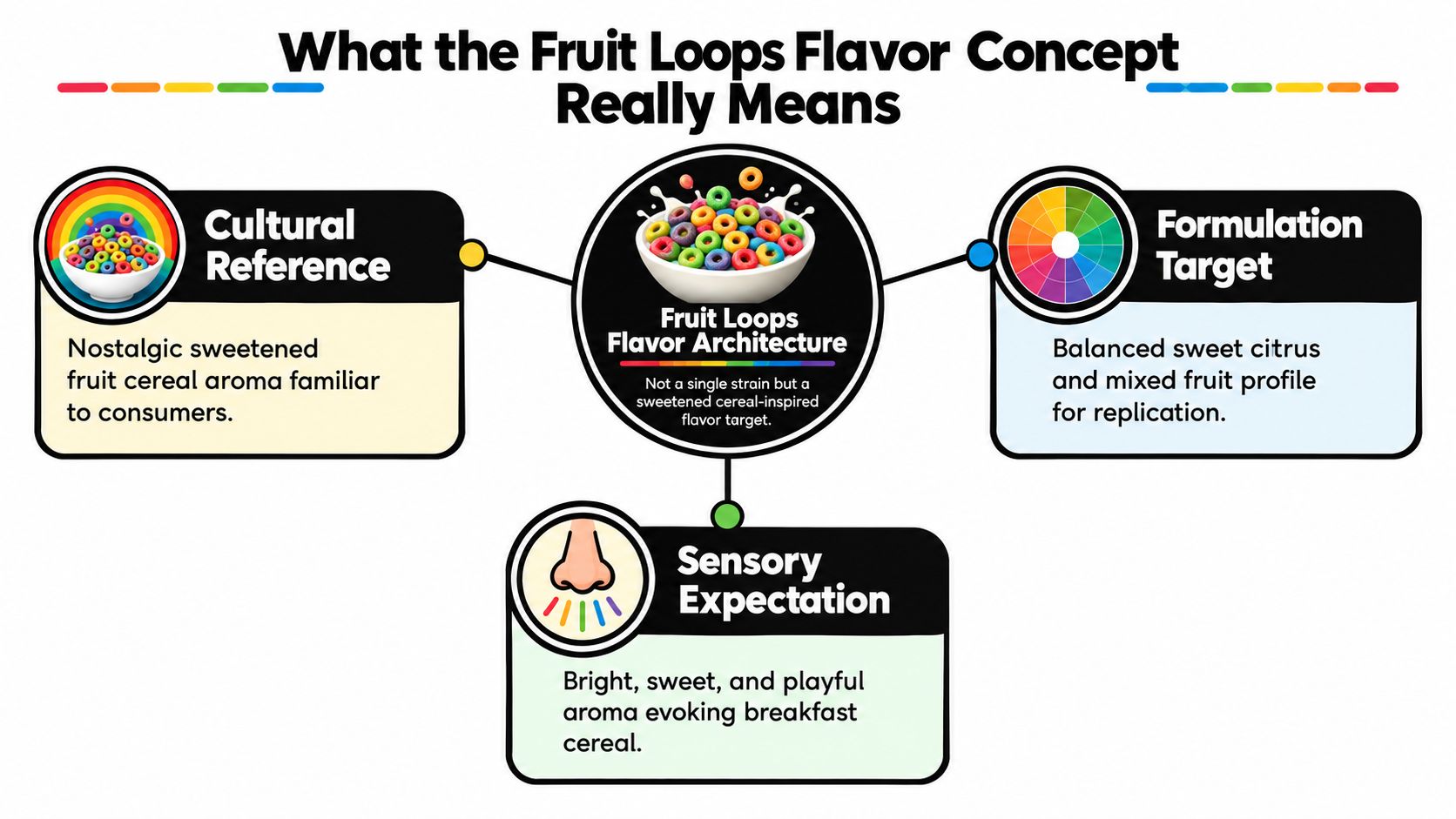
A new product developer often hears "make it taste like Fruit Loops" and treats that as a flavor name. In formulation, that shortcut creates confusion. The useful brief is not a strain title or a rainbow-fruit grab bag. It is a flavor architecture problem.
The cereal reference points to one combined effect: bright citrus on entry, blended sweet fruit through the middle, and a soft sugary cereal impression that lingers after vapor leaves the palate. The box colors help sell the idea, but color is packaging language. The formula still has to build one repeatable sensory shape.
Treat it like a sensory brief, not a strain label
A practical way to frame this profile is to separate memory cues from ingredients. The consumer remembers "sweet citrus cereal." The formulator has to decide which molecules create that impression in vapor and which ones only smell good in the bottle.
That distinction matters because Fruit Loops style flavor is composite by nature. It behaves more like a chord than a single note. If one key note gets too loud, the profile collapses into lemon candy, orange cleaner, or generic fruit chew. If the notes are balanced, the blend reads as a familiar breakfast-cereal loop instead of loose fruit pieces.
Product catalogs in adjacent dessert and fruit-forward categories can still help benchmark direction. A category reference such as Elevated Strains may show where the market places sweet hybrid flavor families, even when your target is a custom cereal-inspired build rather than a named strain.
What the blend must do
The blend has three jobs at once.
First, it must create an immediate citrus signal strong enough to register through distillate. Second, it must carry a rounded fruit center so the top note does not feel thin or harsh. Third, it must leave behind a soft sugar-and-grain suggestion, because that finish is what turns "fruit candy" into "cereal memory."
A simple analogy helps here. The top note is the color on the label. The middle is the body of the liquid in the cartridge. The base is the bowl after the first bite, where sugar, grain, and fruit residue merge into one aftertaste. Fruit Loops works only when those three moments connect into one loop.
What organic means here, and what it doesn't
Formulation teams also need clean language around "organic." The cereal itself is not an organic standard for your claim set. One product listing marks Kellogg's Froot Loops Sweetened Multi Grain cereal as "not certified organic" in the EWG product entry for Kellogg's Froot Loops Sweetened Multi Grain cereal.
So the phrase organic Fruit Loops only makes sense if "organic" describes the sourcing and compliance status of the terpene inputs, not the cereal reference. Keep the nostalgia in the sensory brief. Keep the claim language tied to documentation, ingredient origin, and how the blend is manufactured.
Deconstructing the Profile Into Top Mid and Base Notes
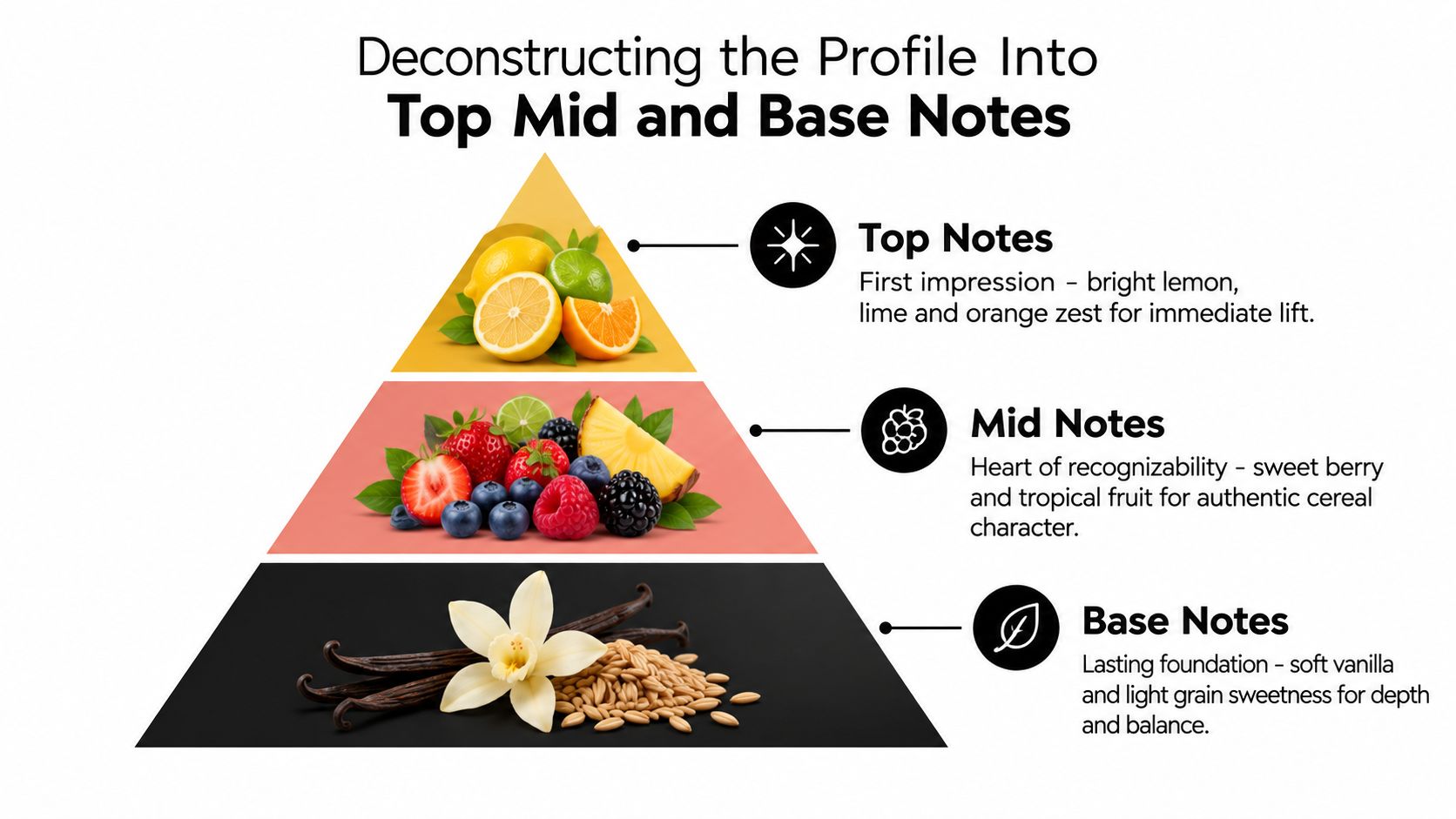
A new developer often starts with the flavor name and chases a memory. In vape formulation, that usually creates a blend that smells right in the vial but falls apart in vapor. A better method is to treat Fruit Loops as a flavor architecture problem. You are building a three-part sequence: a bright citrus entrance, a sweet fruit body, and a soft lingering finish that reads more like cereal than candy. Practical mixing guidance for testing those roles in real hardware appears in this vape formulation guide.
Top notes create the opening hit
Top notes are the flash at first inhale. They tell the user "citrus cereal" before the oil has time to show its full shape.
A role-based reference such as this terpene flavor chart places limonene and pinene in the top-note range. In this profile, limonene carries most of the sweet lemon-orange signal. Pinene works like a small squeeze of acidity in a beverage formula. A little keeps the opening crisp. Too much pushes the profile toward peel, resin, or household-cleaner territory.
That balance matters because distillate tends to flatten nuance. If the top is too weak, the blend reads dull. If it is too sharp, the rest of the profile never gets a chance to feel edible.
Mid notes make the profile recognizable
The middle is where "bright citrus" becomes "sweet cereal fruit." Without that center, the profile stays generic.
Linalool usually does the connecting work here. It softens the edges left by the top note and adds a rounded fruit impression that feels fuller on the palate. The goal is not a floral statement. The goal is a blended center that keeps the citrus from feeling thin and keeps the finish from arriving too soon.
Here's a quick visual reference before getting more technical.
A simple way to judge the middle is to ask one question. Does the blend still suggest cereal fruit after the first bright second passes? If yes, the mid is doing its job.
Base notes keep the loop from tasting hollow
Base notes do not need to shout. They need to stay.
In this style of build, myrcene and caryophyllene add weight and persistence. They will not create a literal grain or sugar flavor on their own, but they can support the warm, slightly dense finish that makes the profile feel complete. That is the part many new formulators miss. The cereal memory lives in the aftertaste, not just the opening aroma.
Use a practical correction loop during bench work. If the blend feels sharp, reduce the top-note dominance. If it smells good but tastes empty, strengthen the mid. If the flavor disappears on exhale, add more base support or rebalance the whole stack.
Fruit Loops works when the inhale, body, and finish connect like three linked sections of the same melody. Break one section, and the profile stops reading as cereal.
Crafting an Organic Strain Inspired Terpene Blend
A new formulator usually hits the same wall here. The bottle smells bright and fruity, but once it goes into distillate and sees heat, the profile stops reading as cereal and starts reading as generic citrus. That happens because Fruit Loops is not a single note. It is a stacked flavor structure with a fast top, a rounded middle, and a finish that lingers long enough to trigger the cereal memory.
For an organic strain-inspired terpene blend for cannabis product formulation, treat “organic” as a sourcing and formulation discipline. Use natural terpene inputs, keep the system THC-free where needed, and leave out shortcut carriers that do not contribute to the target profile.

Build the blend like a flavor structure
Start with roles. A cereal-inspired profile gets easier to control when each terpene has a job, the same way each instrument in a small band covers a different part of the song.
- Limonene for the opening: It gives the sweet citrus pop that defines first impression.
- Linalool for the body: It softens the edges and helps the fruit feel blended instead of sharp.
- Myrcene for carry-through: It adds density so the profile stays present after the first second.
- Beta-caryophyllene for finish: It supports the warm, lasting back end that keeps the flavor from feeling hollow.
- Pinene in very small amounts: It can sharpen the outline, but too much shifts the blend toward peel, herb, or conifer.
A source reference such as natural terpene inputs for formulation helps keep the build grounded in ingredient type and flavor function instead of candy-style shortcuts.
Rebuild the cereal loop, not the strain name
This is the useful reframing. You are not trying to “clone Fruit Loops” as a strain label. You are rebuilding a sweet citrus loop as a terpene architecture problem.
The top has to open like candied citrus. The middle has to turn that brightness into a softer mixed-fruit impression. The base has to stay long enough for the whole profile to read as cereal-inspired rather than just fruity. If one layer dominates, the illusion breaks.
That is why a blend can smell accurate in a jar and still fail in vapor.
Common formulation errors that muddy the profile
Many weak versions miss for predictable reasons:
- Excess pinene: The profile turns green, woody, or peel-heavy.
- Too much limonene: The aroma gets loud, but the taste becomes flat and one-note under heat.
- Too little base support: The inhale lands, then the finish drops out before the flavor identity forms.
- Overcorrection with sweetness cues: Extra bright top notes can make the blend smell fun while making the vapor feel less believable.
A clean cereal-inspired blend keeps the same identity from aroma to inhale to exhale.
Gold Coast Terpenes offers factual examples of inputs used in this kind of workflow, including natural terpene blends, strain-style profiles, isolates such as limonene, myrcene, and beta-caryophyllene, plus safety documents and formulation tools.
Bench method for cleaner first passes
Build in stages.
Start with a skeleton that proves the architecture. Set the citrus top first, then tune the middle until the profile stops feeling thin, then adjust the finish so the flavor holds in hardware. New product developers often try to fix a weak center by adding more top note. That is like turning up the treble when the problem is missing midrange. The sound gets louder, but the song does not get fuller.
Use small adjustments by note family. If the opening is attractive but the identity disappears, strengthen the mid or base. If the profile gets heavy and dull, reduce the weight before adding more sparkle. That sequence saves time and gives you a formula you can repeat.
Mixing Ratios and Workflow for Vape Cartridges and Concentrates
A flavor concept becomes a manufacturing formula only when the numbers and handling are tight. One vape application guide gives a practical benchmark of 5–15% terpenes by weight as a starting range for distillate systems in this commercialization reference. A cartridge-specific guide narrows that to 5–10% by weight, recommends a working temperature of 120–150°F (49–65°C), and notes that fully decarboxylated extract helps prevent cannabinoid crystallization in this terpene integration guide.
The workflow that holds up in production
Use a repeatable sequence. Don't free-pour, don't chase aroma midstream, and don't approve a formula from the beaker alone.
- Warm the base material: Bring distillate or compatible concentrate into the 120–150°F (49–65°C) working range so the terpene phase integrates cleanly.
- Weigh by mass: This matters more than eyeballing aroma. Small deviations are easy to hide in the bottle and obvious in the cart.
- Add incrementally: Start lower, homogenize, then test. The right level depends on the base and the hardware.
- Confirm decarb status: Fully decarboxylated extract helps reduce crystallization risk in the cartridge.
- Test in the intended cart: The hardware is part of the flavor system.
Terpene Loading Guide for Fruit Loops Blends
| Base Material | Recommended Load | Flavor and Viscosity Impact |
|---|---|---|
| Distillate for vape cartridges | 5–10% by weight | Balanced starting zone for flavor delivery and cartridge performance |
| Distillate or similar vape systems needing broader screening | 5–15% by weight | Useful bench range for dialing intensity and flow behavior |
| Concentrate bases under trial evaluation | Start within the validated range and adjust incrementally | Higher aroma impact can also change perceived sharpness and thinning |
How to read the table in real production
A lower load usually gives you more room to preserve the base character, but a cereal-inspired profile may underperform if the center and finish aren't strong enough. A standard cartridge load often gives the best compromise between recognition and stability. Push higher only when the base material and hardware can support it, because what looks strong on paper can become harsh or thin in aerosol.
A practical tool for this stage is a mixing ratios calculator. It helps keep batch scaling disciplined when you're moving from bench trial to production lot.
Manufacturing teams already know this principle from packaging and transport. Small physical shifts create large downstream problems. The same mindset shows up in resources on pallet stabilization for food manufacturers, where process control protects product consistency before the goods ever reach the customer. Flavor formulation needs that same respect for handling discipline.
Hardware testing decides whether your formula is finished. The beaker only tells you whether it's started.
Safety Regulatory Notes and Common Misconceptions
Teams lose time when they borrow language from food branding and apply it loosely to inhalable products. The biggest confusion point here is simple. Natural, fruit-flavored, and organic are not interchangeable terms.
The compliance line you shouldn't blur
The cereal reference doesn't carry an organic claim into your vape formula. It can't. Keep the sensory inspiration and the labeling logic separate.
The mainstream cereal reference behind Fruit Loops is not certified organic, so any organic claim must belong to the terpene inputs and documented manufacturing process, not the nostalgia cue.
That distinction matters because “natural fruit flavors” language in food doesn't equal organic certification. If you're developing an organic-compliant profile, your records, inputs, and claims have to stand on their own.
Nutrition facts from cereal don't answer inhalation questions
A school nutrition sheet for a 39 g serving of Fruit Loops lists 150 kcal, 34 g carbohydrate, 12 g sugars, about 2 g protein, and 1–1.5 g fat in this nutrition reference. That's useful only for understanding why the flavor memory reads sweet and quick. It is not a safety model for vapor products.
Likewise, one retail ingredient deck shows a multigrain base where sugar appears before the enriched flour component, with oat fiber, corn bran, and soluble corn fiber also present in this retail formulation listing. Again, that's relevant to the food identity. It doesn't validate inhalation safety.
Practical checklist before scale-up
- Check documentation: Review safety documents and state information before launch.
- Define claim boundaries: “Organic” should attach to terpene sourcing and process control, not to the cereal inspiration.
- Verify formula behavior: Test in final hardware, because aroma memory and aerosol behavior are different systems.
- Keep THC status explicit where needed: If you're selling a THC-free terpene blend, document it clearly and separately from the extract.
The safest path is also the clearest path. Separate flavor inspiration from compliance language, and your product story becomes much easier to defend.
Conclusion Choosing Your Next Formulation Step
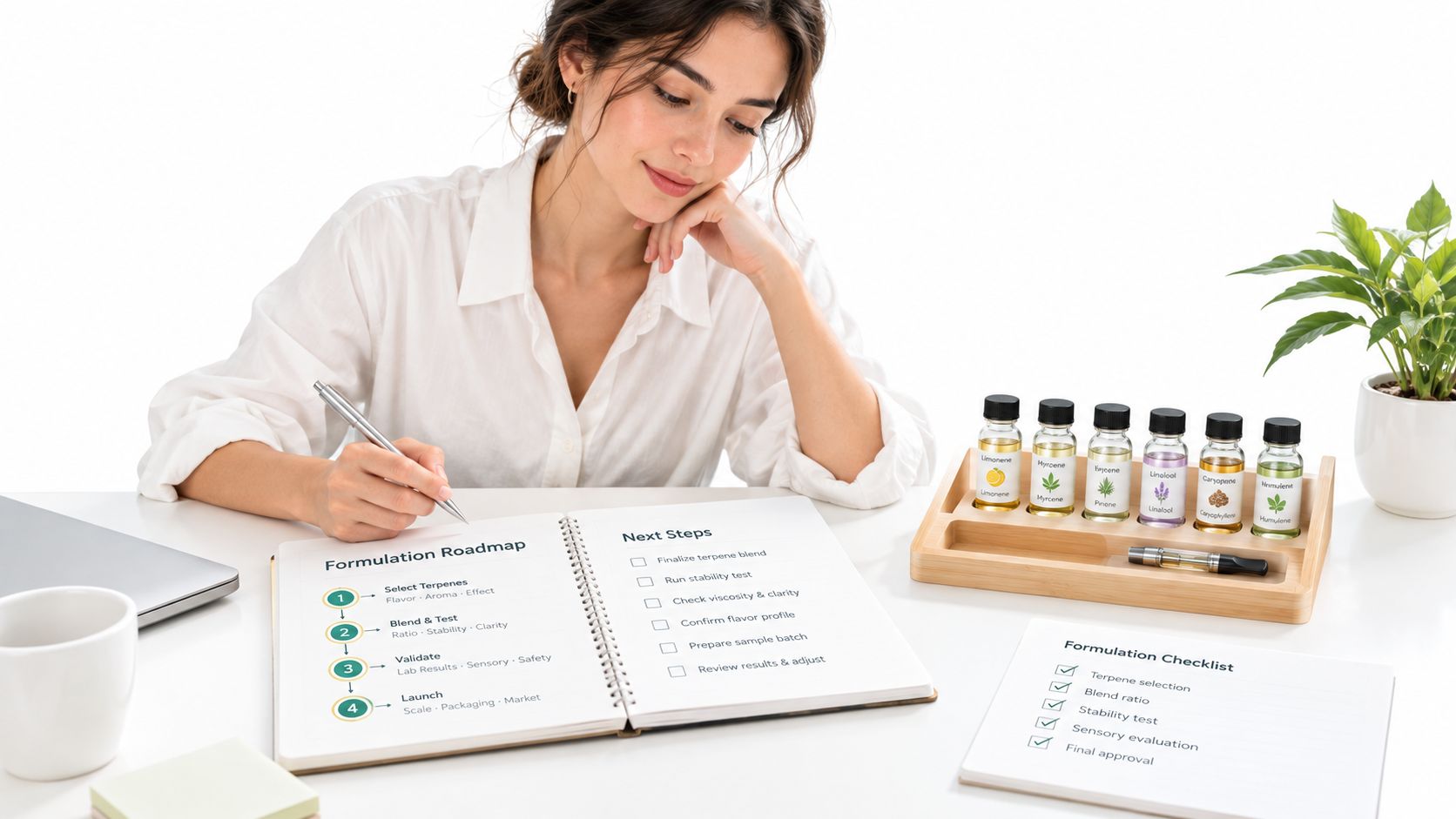
A developer usually reaches this point with one of two problems. The first formula smells bright in the bottle but turns flat in the cart. The second tastes sweet enough, yet it misses the cereal cue and reads like generic fruit candy. Both problems come from the same place. The Fruit Loops target is a flavor architecture problem, and the next step is choosing which layer needs work first.
The practical frame is simple. Build the profile the way you would build a chord. The top note carries the first impression, the mid note gives the recognizable fruit center, and the base note keeps the finish from disappearing too fast. If one layer is louder than the others, the whole profile loses the cereal-loop illusion.
Choose based on what you're optimizing
- Need faster development: Start with an existing flavor direction, then adjust one note family at a time in the final hardware.
- Need tighter sensory control: Build from isolates and assign each component a job in the top, mid, or base.
- Need stronger repeatability: Standardize weighing, order of addition, and test conditions before changing the blend.
One common mistake is treating weak performance like a volume problem. New product developers often add more citrus when the profile feels incomplete. In practice, that usually makes the opening sharper while leaving the center hollow. A better fix is to rebalance the layers so the sweet fruit body and toasted finish can support the lift.
Choose the next formulation step with that in mind. Work by mass, stay within validated loading ranges, and revise with a clear reason for each change. That is how you rebuild a cereal memory into an organic-compliant terpene blend for distillate that tastes intentional, stable, and complete.
Gold Coast Terpenes offers natural terpene blends, isolated compounds, and formulation tools for cereal-inspired cartridge development. If you are building an organic-compliant Fruit Loops direction for distillate or vape carts, review its terpene options, educational guides, and mixing resources as noted earlier in the article.