
You're probably dealing with a familiar brief. The brand wants a Baja Blast-style cart because the name already does half the shelf work, but the first bench samples keep landing in one of two bad places. Either the formula reads like straight candy lime with no depth, or the pine and herbal fraction takes over and the whole thing drifts away from the target.
That happens because Baja Blast isn't one locked cultivar with one authoritative COA. It behaves more like a market-recognized flavor archetype. Independent strain coverage describes multiple lineages under the same name, including a Mosca Seeds selection often described as 60% indica from Sour Kush × Pink 2.0, while other market descriptions place it closer to a Gelato or Kush Mints-style family with citrus-forward hybrids. Reported THC is usually in the 20% to 28% range, with one source noting top-shelf adult-use flower often clusters around 22% to 25% THC, which helps explain why the profile keeps showing up in modern retail (Baja Blast strain guide).
For formulation, the useful question isn't “what is the one true Baja Blast weed strain?” It's “what terpene structure makes a cart instantly read as Baja Blast, and what survives in distillate after fill, rest, and hardware use?”
Why Baja Blast Has Become a Formulation Target
Baja Blast works because the name carries a built-in sensory picture. Buyers expect lime, brightness, a chilled top note, and some kind of fizzy finish. For a product team, that kind of instant recognition matters. It gives a cart concept a flavor shorthand before the customer ever opens the package.
The problem is that Baja Blast has spread beyond one breeder line into multiple branded or phenotype-specific products. Mosca Seeds' Baja Blast S1 is presented as a self-pollinated version of an original selection, while seed retailers commonly list flowering windows around 8 to 10 weeks and THC around 20% to 25%, and other product pages describe a 15% to 25% THC band for the S1 line (Baja Blast S1 by Mosca Seeds guide). For formulators, that variability means you can't rely on one supposed canonical profile.
Why teams keep chasing it
Most shelves are crowded with sweet fruit, gas, and generic dessert profiles. Baja Blast sits in a narrower lane. It's citrus-first, but not just lemon cleaner and not just tropical candy. The profile has lift, green character, and a darker finish that keeps it from tasting hollow.
That makes it commercially useful in several formats:
- For vape cartridges: It gives brands a recognizable citrus SKU without sliding into flat candy.
- For distillate work: It can brighten neutral base oil without forcing a full fruit profile.
- For strain-inspired terpene blend development: It's one of the clearer examples of how a market name becomes a sensory target rather than a single genotype.
Where most formulas fail
The failed versions usually push limonene too hard at the front. They smell great in the beaker, then lose shape after mixing and settling. A few days later the top note feels louder, thinner, and less natural because the supporting spice and herbal structure never had enough weight to begin with.
Practical rule: If your Baja Blast formula tastes complete only in the first aroma pass, it probably won't hold up in a cart.
A better starting point is to treat Baja Blast as a lime-citrus profile with structural support, not a one-note citrus blast. That's why it helps to work from documented strain terpene profiles for formulation reference instead of from menu descriptions or breeder hype.
The Terpene Hierarchy Behind the Flavor
Start at the bench with the order of impact, not the strain name. Baja Blast works as a formulation target because the profile reads in layers. Lime leads, green lift keeps it alive through the middle, and a quieter warm finish stops the whole thing from tasting thin after it sits in oil.
For cart work, I treat the stack like this:
| Tier | Terpene | Role |
|---|---|---|
| Lead top note | Limonene | Establishes the lime-peel identity and gives the blend its first burst of brightness |
| Secondary top note | Terpinolene | Adds the fizzy, green, lightly piney character that makes the citrus feel dynamic instead of sugary |
| Mid-body | Myrcene | Fills out the center so the inhale has weight and doesn't vanish after the first flash |
| Base support | Beta-caryophyllene | Brings dry spice and a darker edge on the finish |
| Trace accent | Alpha-pinene | Sharpens diffusion and helps the opening feel cleaner and more lifted |
The hierarchy matters because these compounds do different jobs under heat. Limonene gives you recognition fast, but it is also the easiest part to overstate. In a fresh aroma check, an over-limonene mix can smell exciting. Once it is in distillate and has had time to settle, the same formula often reads flatter because nothing underneath is carrying the center.
Terpinolene is the control point I watch closest. Too little, and the profile collapses into ordinary citrus. Too much, and the blend turns coniferous and starts reading like a bright haze profile instead of a Baja Blast-style lime archetype. The sweet spot is a clear supporting role, audible enough to add green fizz, restrained enough to keep limonene in front.
Myrcene and beta-caryophyllene are where newer formulators usually get impatient. They are less flashy in the beaker, but they are what keep the vapor from feeling hollow on the second and third pull. If those two are missing, the formula can smell marketable in a jar and still underperform badly in a cart.
The target is not a loud citrus top. The target is a lime-forward profile with enough herbal lift and dry spice underneath to survive dilution, hardware heat, and shelf time.
For quick bench calibration, a terpene flavor chart for note mapping helps more than breeder copy. Baja Blast sits in a tight lane: limonene in front, terpinolene steering the green character, and just enough myrcene plus caryophyllene to keep the finish grounded.
Translating the Profile into Sensory Notes
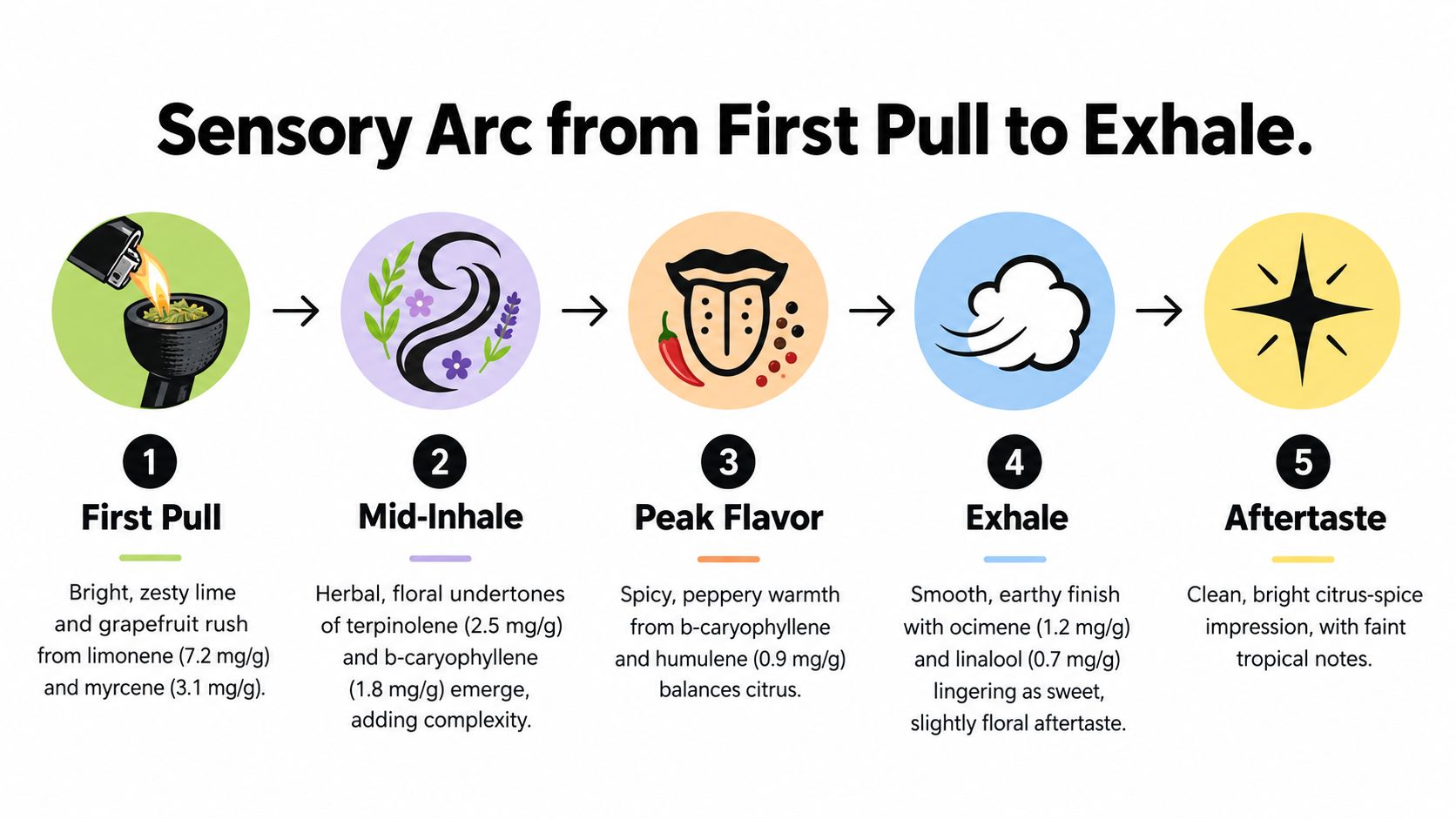
A lab range doesn't help much unless you can taste against it. Baja Blast succeeds when the inhale moves in a clear arc instead of presenting one static citrus note.
The opening should feel like cold-pressed lime zest. Not syrup, not lemon cleaner, not soft tropical candy. The top needs enough snap that the first pull feels fresh off the coil. That quick flash is what makes the profile feel “fizzy” even when no literal carbonation note exists in the blend.
The first half of the draw
At first pull, limonene does the obvious work. It creates the lime peel impression and carries the profile into the room. If alpha-pinene is present in the way some phenotypes suggest, the opening also gets a dry, airy edge that keeps the citrus from feeling sticky.
Mid-inhale is where weak formulas separate from convincing ones. Terpinolene should start to show itself here as fresh herbs, light pine resin, and a faint green brightness. When that layer is absent, the profile tastes simple. When it's too loud, the blend turns foresty and stops reading as a soda-adjacent strain profile.
The finish on exhale
The exhale should land darker than the inhale. Myrcene gives the blend a softer body and helps the draw feel less brittle. Beta-caryophyllene contributes the warm, peppery edge that creates what many formulators describe as a “cola” finish. Not actual cola flavor, but that deeper, spiced tail that keeps the lime from hanging alone.
A useful sensory check is this:
- If the exhale disappears fast, the base is too thin.
- If the finish tastes woody or tea-like, terpinolene is crowding the profile.
- If the inhale tastes loud but cheap, limonene is carrying too much of the formula by itself.
Good Baja Blast-inspired work doesn't taste like lime candy. It tastes like lime on top of a structured herbal-spice frame.
That's the target for any strain-inspired terpene blend for vape cartridges built around this archetype.
Reading the Limonene to Terpinolene Balance
The most important control point in this profile is the limonene to terpinolene balance. Not because those are the only compounds that matter, but because they decide whether the formula reads as bright citrus, herbaceous fizz, or something that misses the target in both directions.
More detailed cultivar summaries report total terpene content in the 1.8% to 3.2% range by dry weight, with cut-specific profiles showing limonene at 0.5% to 1.2%, myrcene at 0.8% to 1.6%, beta-caryophyllene at 0.2% to 0.8%, and terpinolene at 0.3% to 0.9%. That spread shows why the profile can swing from citrus-forward to more piney or effervescent depending on phenotype and cure (Baja Blasted cultivar guide).
What happens when the ratio drifts
Use the relationship, not a rigid single number, as the bench lever.
| Ratio Direction | Limonene % | Terpinolene % | Perceived Character |
|---|---|---|---|
| Under on terpinolene | Higher within published range | Lower within published range | Cleaner lime, more candy-like, less herbal identity |
| Target balance | Strong limonene with clear terpinolene support | Moderate support within published range | Fizzy lime, green lift, recognizable Baja Blast character |
| Over on terpinolene | Lower relative limonene presence | Higher within published range | Piney, herbal, tea-like, less soda-adjacent |
How to use the ratio in formulation
Start your formulation guide for Baja Blast-inspired carts by deciding what the citrus is supposed to do. If you want the opening to hit hard in a ceramic cart, keep limonene in the driver's seat. If you want the flavor to stay dimensional through the session, terpinolene can't be treated like a trace afterthought.
Too much limonene usually creates a sweeter, thinner impression. Too much terpinolene pushes the profile into pine, herb, and dry green notes. That shift is easy to track in bench trials if you're already familiar with terpinolene's sensory behavior in formulation.
The key is to hear the profile as one chord, not isolated notes. Limonene sets the attack. Terpinolene shapes the contour. Myrcene and caryophyllene decide whether the finish feels complete.
Building the Profile in Vape and Distillate
A Baja Blast-style blend behaves differently in raw aroma than it does in finished oil. That's where a lot of good bench work gets wasted. The cart doesn't care how pretty the bottle smells. It cares how the volatile top survives heat, viscosity, fill conditions, and repeated use.
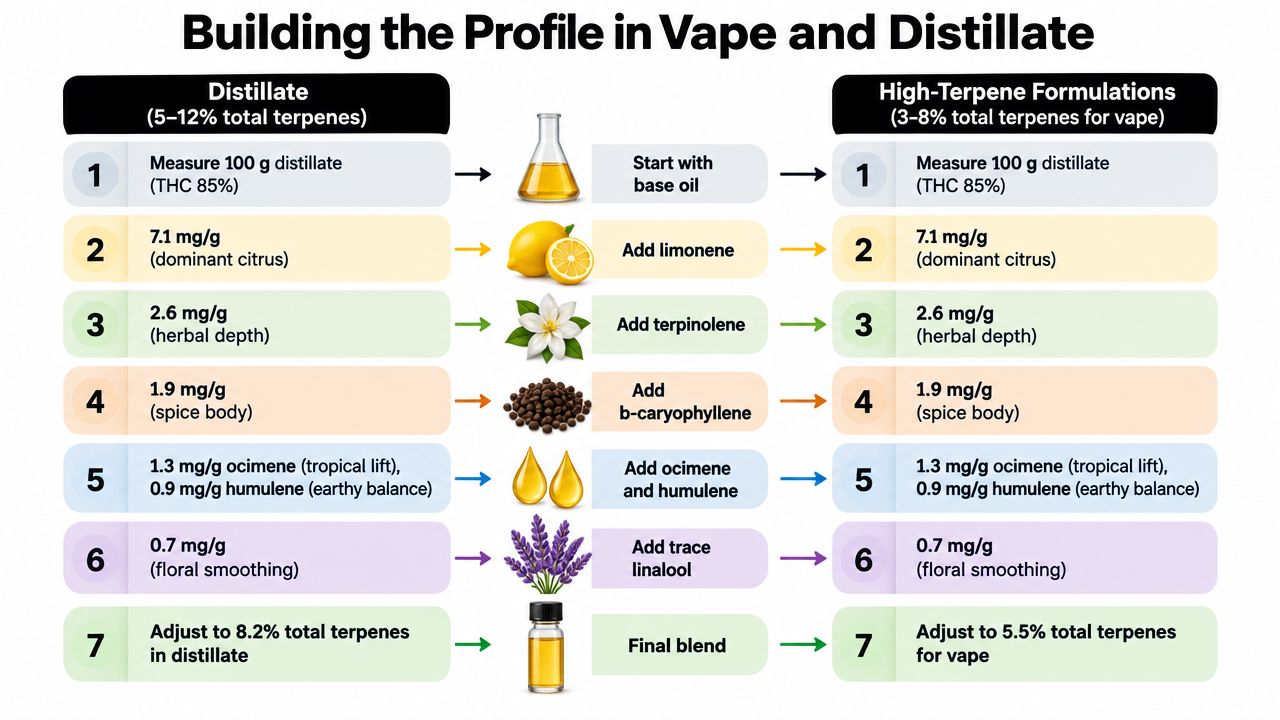
For distillate applications, practical loading often lands in the 5% to 12% total terpene range by weight, with lower loading usually making more sense for high-terpene bases. That isn't a Baja-Blast-specific flower statistic. It's a workflow decision for finished oil, and it changes how sharply you can push the top note before the cart starts feeling thin or harsh.
Front-of-draw and back-of-draw behavior
When you're formulating Baja Blast for vape cartridges, think in draw phases:
- Front of draw: limonene, terpinolene, and any pinene support define the first impression.
- Middle of draw: the citrus settles and the green-herbal character becomes legible.
- Back of draw: caryophyllene, myrcene, and any humulene support shape persistence and body.
That split matters because a formula that smells balanced in a vial can still vape top-heavy. The volatile fraction often outruns the rest of the profile on a fresh coil.
Hardware trade-offs that matter
Ceramic and wickless carts usually reward cleaner, brighter profiles, but they also expose imbalance fast. If terpinolene runs too high, the vapor can feel sharper than intended. If limonene dominates without enough grounding notes, the draw can feel bright at first and vacant on the finish.
I'd also give any Baja Blast-inspired formula rest time before final judgment. A short post-mix steep helps the aggressive edge settle and gives a better read on whether the profile has real shape or just first-pass flash.
Bench note: If the blend still tastes disjointed after rest, don't fix it by pouring in more citrus. Fix the missing middle and back first.
For teams building repeatable oil, a practical distillate and terpene mixing workflow helps prevent that common loop of chasing the opening note while ignoring hardware behavior.
Matching Gold Coast Terpenes to the Profile
When matching this profile against a catalog, don't shop by strain name first. Shop by function. Baja Blast-style work needs a limonene-led top, a terpinolene balancing layer, and a myrcene-caryophyllene base that doesn't drag the formula into kush, fuel, or earth-heavy territory.
What to pull from the shelf
Start with limonene-dominant options for the opening note. Then compare terpinolene-forward isolates or blends that add green lift without bringing too much floral haze. Finish by checking whether your caryophyllene and myrcene inputs add enough structure without muddying the blend.
That means your selection logic should look like this:
| Product Type | Role in Formula | Notes for Formulator |
|---|---|---|
| Limonene-dominant blend | Builds the lime-citrus attack | Choose one that reads zesty rather than orange-sweet |
| Terpinolene isolate or focused blend | Adds fizzy herbal lift | Keep it supportive or the profile turns piney |
| Beta-caryophyllene isolate | Creates warm spiced finish | Useful for “cola-like” depth without sweetness |
| Myrcene isolate | Adds body and soft diffusion | Helps prevent a brittle citrus-only profile |
| Pinene support | Sharpens the opening | Use carefully so it stays airy, not conifer-heavy |
What to avoid
The wrong support blend can sink the profile fast. Anything that over-delivers heavy kush, gassy sulfuric character, or dense earth will pull Baja Blast away from its clean citrus-spice lane. The target should feel bright and modern, not diesel, not dank, and not candy syrup.
For cannabis product formulation thinking matters more than strain fandom. A useful Baja Blast-inspired formula may borrow from several shelves and still be more accurate than any single prebuilt strain blend.
If a supporting blend smells like it wants to headline the formula, it's probably the wrong support blend.
Replicating the Strain Step by Step
A familiar bench problem goes like this. The bottle smells bright and convincing, then the filled cart loses the lime snap and turns flat, piney, or candy-sweet after a short rest. Baja Blast is usually where that happens, because the target is not a single cultivar memory. It is a flavor archetype with a narrow success window in vapor.
Seven bench steps
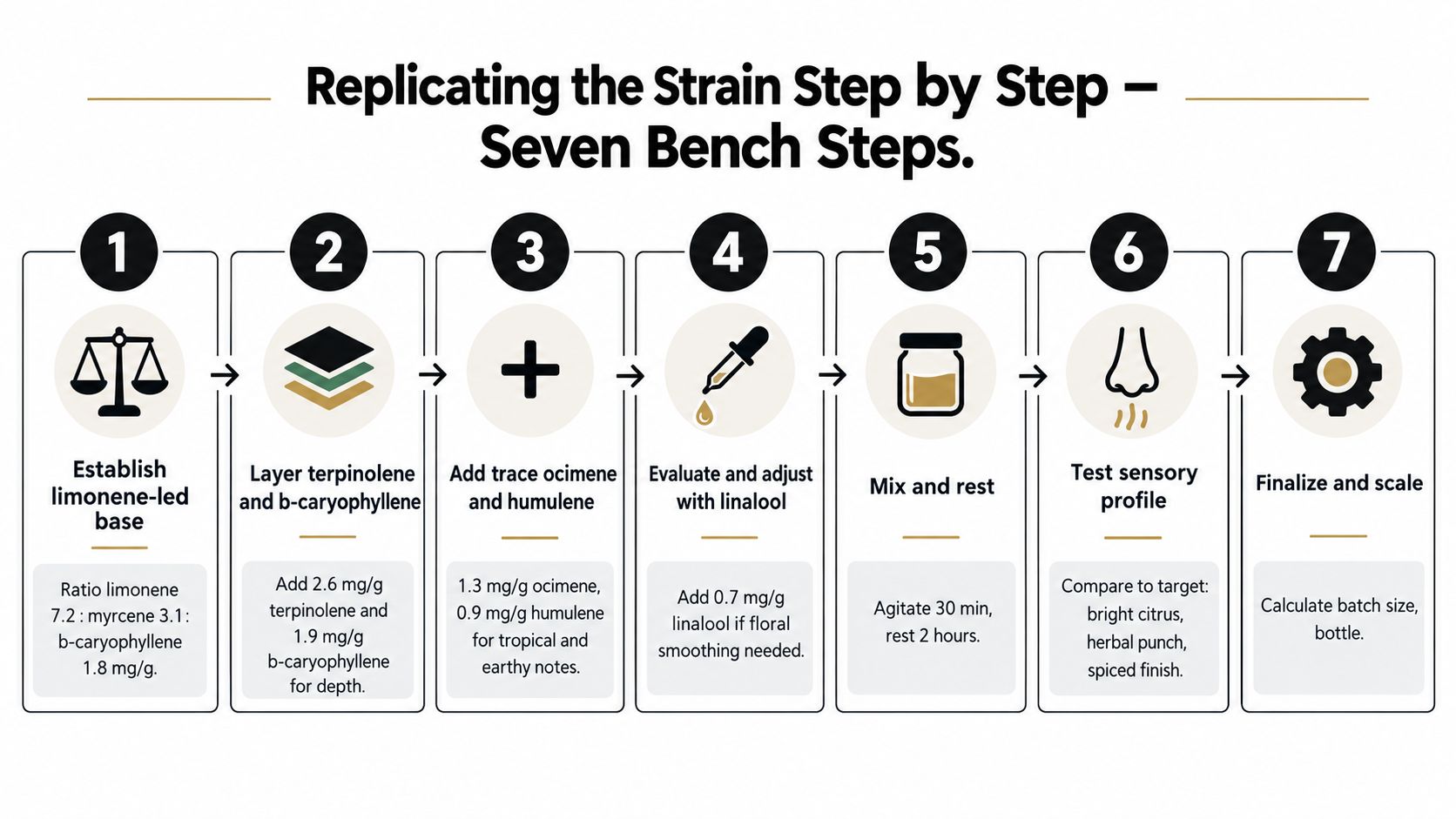
Set the opening first
Start with a limonene-led base and decide early whether your lime reads sharp, juicy, or candied. For this profile, sharp and juicy usually win. A common starting point is a terpene fraction built around limonene as the clear lead, with terpinolene in a secondary role and the rest reserved for body and finish.Bring in terpinolene until the blend feels carbonated
The right amount gives Baja Blast its green, fizzy lift. The wrong amount takes over the room and turns the profile into pine, floral haze, or cleaning-product brightness. I stop as soon as the blend gets that sparkling herbal edge, then retest in oil before adding more.Anchor the exhale with beta-caryophyllene
The formula stops tasting like generic citrus. A small caryophyllene layer adds the dry, spiced tail that keeps the profile grown-up and vapeable across repeated pulls.Use myrcene for body, not ripeness
Myrcene helps the middle hold together in distillate, especially when limonene is doing most of the work up top. Keep it low enough that the blend stays clean. Once it starts reading overripe, syrupy, or too tropical, the Baja Blast effect starts slipping.Correct with trace support only if the profile needs it
Pinene can sharpen the front. Ocimene can add airy lift. Humulene can dry the finish. These are adjustment tools, not feature notes, and pushing them too far usually creates complexity you did not ask for.Bench it in the actual fill matrix
A sniff strip is useful for direction, but carts fail in oil, not on paper. Mix into the same distillate or base you plan to use in production and check whether the top note still cuts through after dilution.Test after rest and on hardware
Fresh blends flatter themselves. The read comes after the formula settles and goes through a device. Heat, wick behavior, and airflow will tell you fast whether the lime survives or whether terpinolene starts poking out too hard.
Pre-scale checklist
Before you move from bench sample to batch, run through a simple sensory check:
- First impression: lime leads immediately, without reading lemon cleaner or orange candy
- Mid-palate: the green herbal note supports the citrus instead of taking over
- Finish: light spice and body remain on the exhale
- In-device behavior: repeated draws stay bright without turning harsh or thin
- After rest: the blend still feels integrated, with no single terpene sticking out
A catalog reference can help train the nose for this kind of reconstruction work. For example, Raised Strains shows the same practical idea. A named profile can be built as a flavor target rather than chased as a literal plant replica. That approach is usually what gets Baja Blast closer in a finished cart.
Bringing It Together in a Production Formula
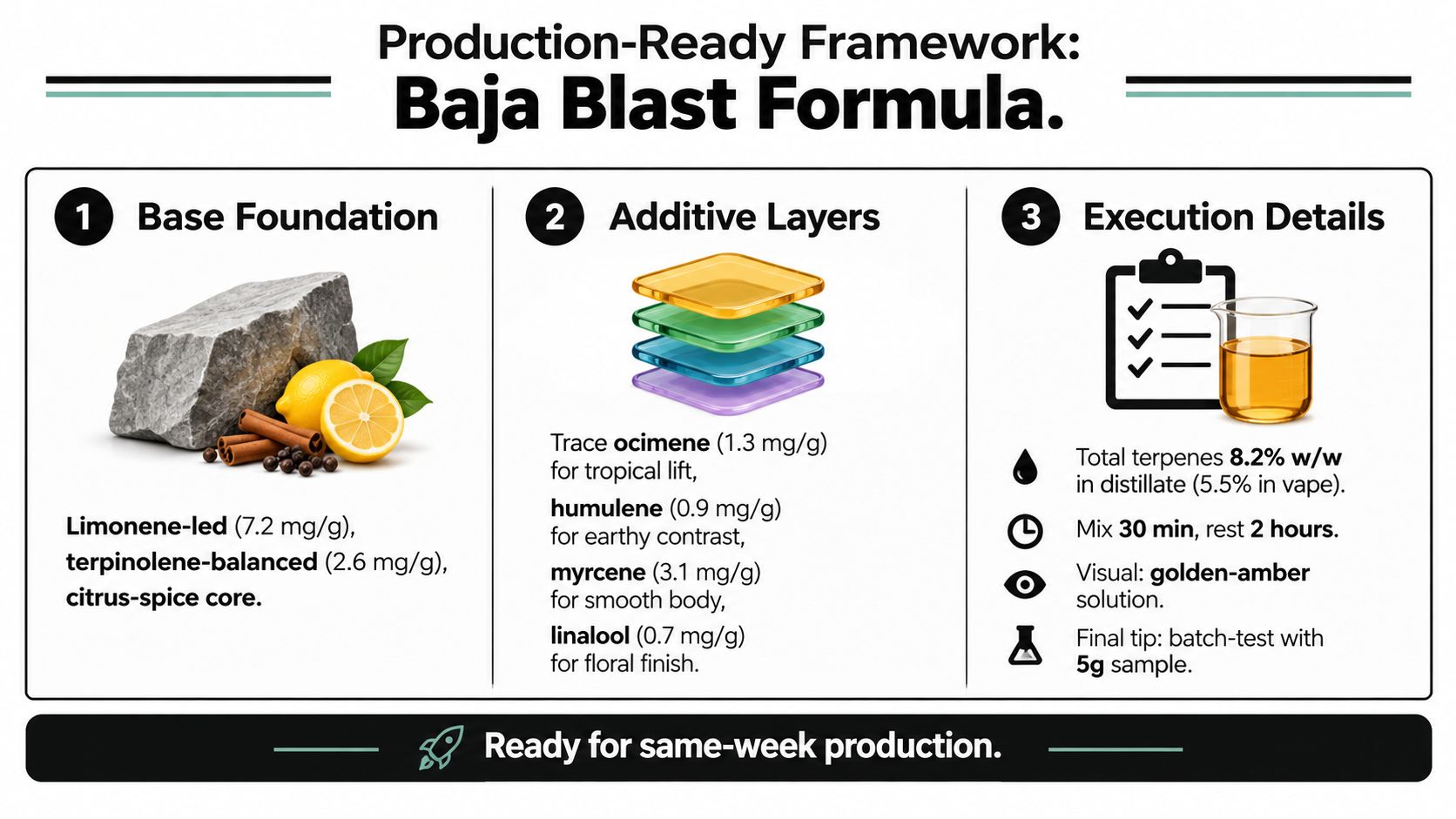
A production-ready terpene profile for Baja Blast-inspired vape work needs one clear decision at the top. You are not trying to recreate a single historical plant. You are rebuilding a market-recognized citrus archetype that buyers can identify on the first draw and still recognize halfway through the cart.
The repeatable workflow is straightforward when the priorities stay in order.
Production framework
- Define the target character: bright lime first, herbal fizz second, warm spice on the finish.
- Choose your structural pair: limonene leads, terpinolene balances.
- Support the center and base: use myrcene and beta-caryophyllene to stop the profile from collapsing into citrus candy.
- Bench in finished oil: not just in a sniff vial.
- Validate on hardware: the draw arc matters more than bottle aroma.
- Lock the formula only after rest: volatile blends can mislead on day one.
What works and what doesn't
What works is restraint. Keep the top bright, but don't let it become the whole formula. Preserve enough terpinolene to create lift. Hold enough caryophyllene and myrcene in reserve to give the exhale shape.
What doesn't work is chasing the brand name with extra citrus. That usually creates a louder formula, not a more accurate one.
The cart should taste like lime with architecture, not lime laid on top of neutral oil.
If you're building this for distillate or for cannabis product formulation, the practical sequence is to define the target ratio, source functional components by note role, build a small bench sample, evaluate against the sensory benchmark, tune the support layer, and only then scale into production. That gives you a formula the manufacturing team can execute again without rediscovering the profile from scratch each batch.
Gold Coast Terpenes offers strain-style blends, isolated compounds, and formulation resources that fit this kind of Baja Blast-inspired development work, especially when you need to control the limonene top note without losing the supporting structure. If you're building carts, concentrates, or custom citrus-forward profiles, visit Gold Coast Terpenes and use the site's educational tools and terpene options as part of your bench process.