
If you're asking is distillate safe, you're probably asking the wrong question.
For a formulator, the useful question is narrower and more actionable: what makes one distillate vape formula low risk and another one problematic, even when both start with similar oil? That difference usually doesn't come from the word distillate on a label. It comes from contamination control, terpene loading, cartridge hardware, and the temperature conditions that turn oil into aerosol.
That gap matters because a lot of brands still evaluate safety as a raw-material issue only. They ask whether the oil was distilled properly, whether the extract looks clean, or whether a supplier says it's solvent-free. Those checks matter, but they don't answer what happens once the oil is reformulated and heated in a cartridge.
A better way to think about safety is as a system outcome. The oil has to be clean. The added ingredients have to be appropriate for inhalation. The blend has to stay within workable terpene ranges. The hardware has to aerosolize that blend without pushing the chemistry into a harsher direction. If one part fails, the finished product can become riskier even when the base distillate looked fine on paper.
Practical rule: Distillate safety isn't a yes or no property of the oil. It's the result of formulation choices you can verify and control.
New brand owners often get tripped up here because distillate feels simple. It's refined, potent, and easy to standardize. That makes it attractive for formulating terpene profiles for distillate, building a strain-inspired terpene blend for vape cartridges, or replicating a target flavor with predictable fill behavior. But that same simplicity can hide where risk enters the process.
The calm answer is this: distillate can be part of a well-controlled vape product, but only if you treat safety as a formulation problem, not a marketing claim.
Introduction Why Is Distillate Safe Is the Wrong Question
People ask is distillate safe because they're looking for certainty. They want a clean yes or a clean no. In product development, that kind of answer usually isn't available, because the finished vape isn't just distillate. It's distillate plus processing history, additives, storage conditions, and a device that applies heat.
That means two products can start with similar cannabinoid oil and end up with different risk profiles. One might be carefully tested, blended with a disciplined terpene loading, and run in hardware that stays within a reasonable operating range. Another might use the same starting oil but pick up contamination, include questionable additives, or run too hot in the cartridge.
Why the wording matters
When teams frame the issue as "is distillate safe," they often focus on the wrong checkpoint. They inspect the extract and stop there. That leaves out the point where users are exposed, which is the aerosol.
A stronger workflow starts with different questions:
- What remained after extraction and post-processing
- What did we add back for flavor, viscosity, or strain replication
- What does this blend do in the actual cartridge we plan to ship
- What changes when the device heats the formulation repeatedly
Those are formulation questions. They sit much closer to real-world performance than a simple purity claim.
What brand owners usually miss
Distillate is often treated like a neutral carrier for flavor rebuilding. That's why it's common in projects centered on a terpene profile for vape cartridges, replicating flavor of a recognizable cultivar, or building a repeatable house profile for cannabis product formulation. But once you use it that way, safety depends on the whole blend architecture.
Top notes, middle notes, and base notes affect more than sensory identity. The total terpene load changes viscosity and influences what the user inhales. Hardware choice changes how that blend behaves under heat. A supplier's COA matters, but so does your own finished-goods validation.
The same distillate can be acceptable in one cartridge setup and troublesome in another. Formulators need to evaluate the finished system, not just the input drum.
What Distillate Is and Why Formulation Determines Safety
Distillate is a highly refined cannabinoid oil. Teams usually start with a broader extract, remove unwanted fractions during cleanup steps, and then use distillation to concentrate the target cannabinoids. The result is a stripped-down base material that works well in controlled manufacturing because it's consistent and easy to dose.
That consistency is useful, but it can also mislead new operators. A bulk distillate isn't the same thing as a finished vape formula.
Think of distillate as a base, not a finished product
The easiest analogy is a neutral base spirit. On its own, it has one set of properties. Once you add mixers and serve it under different conditions, the experience changes. Distillate works the same way in product development.
A cartridge formula often includes reintroduced terpenes for flavor architecture, sensory identity, and flow behavior. That means the finished oil isn't just "distillate." It's a new formulation with its own performance profile.
For a basic primer on the material itself, this overview of what a distillate is gives the production context many new brand owners need before moving into cartridge design.
Where safety gets added or lost
Formulation takes over. Independent review literature makes a key point: the main inhalation risk isn't distillate by itself, but impurities and the hardware used to aerosolize it. The same review reports unsafe levels of residual solvents, pesticides, fungi or mold, and heavy metals in some concentrate samples, with more than 80% of solvent-extracted concentrates in one cited comparison contaminated by at least one issue such as residual solvents or pesticides (review of contaminants in cannabis concentrates).
That finding changes how formulators should think. Safety isn't only about whether the oil reached a high level of refinement. It's about whether contamination remains, whether added ingredients are appropriate, and whether the cartridge turns the blend into a cleaner or dirtier aerosol.
A practical way to break it down is this:
| Stage | What changes | Why it matters |
|---|---|---|
| Raw extract cleanup | Removes unwanted fractions | Incomplete cleanup can leave residues behind |
| Distillation | Concentrates cannabinoids | A refined appearance doesn't guarantee contaminant-free material |
| Terpene reintroduction | Rebuilds flavor and changes flow | The blend chemistry shifts before it ever reaches hardware |
| Cartridge operation | Heats oil into aerosol | Temperature and device design shape what the user inhales |
For teams working on a formulation guide for distillate or replicating flavor of a target cultivar, this distinction is central. The base oil gives you a starting point. The final safety profile comes from everything you do next.
Hidden Contaminants That Make Distillate Risky
Most contamination discussions stop at residual solvents. That's too narrow for vape development.
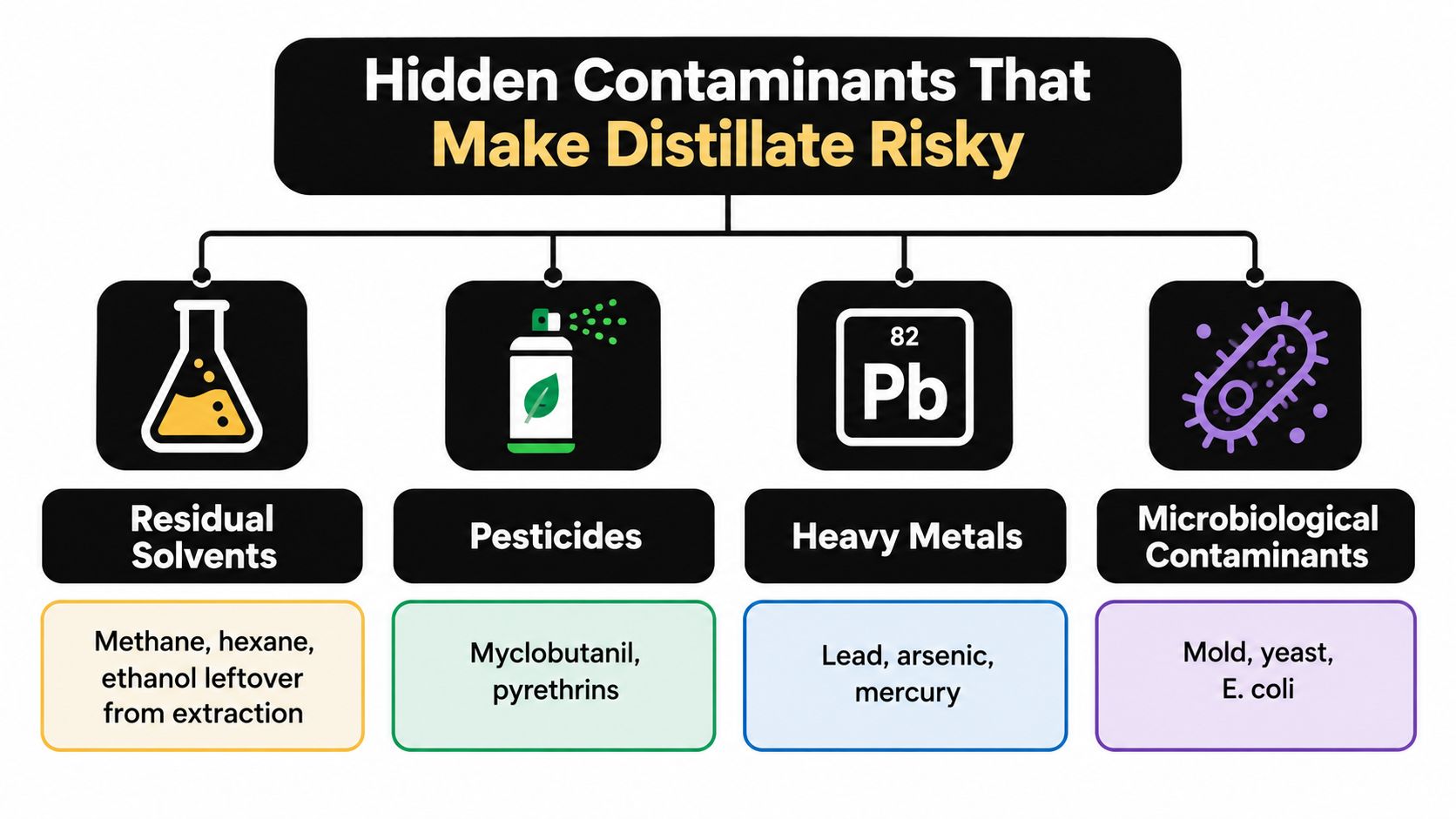
A better screening mindset looks at four separate families: residual solvents, pesticides, heavy metals, and microbiological contaminants. Each one enters the process differently, and each one needs a different control point.
Four contaminant groups that matter
Residual solvents come from extraction and post-processing. A "solvent-free" marketing line doesn't tell you enough unless you know the test panel and the batch result.
Pesticides may originate upstream in cultivation and persist into concentrates. For operators building a purchasing workflow, this resource on pesticide residue testing is relevant because pesticide control starts before terpene blending.
Heavy metals can come from source material, processing equipment, or cartridge hardware itself. This is one reason raw oil testing isn't enough if you're making inhalable products.
Microbiological contaminants are often treated as a flower problem, but public-health and lab-facing reviews still flag microbiological contamination as relevant in vape liquids and related products.
Why solvent-free isn't enough
A recent review focused on cannabinoid vaping products reported heavy metals in 21.8% of products tested, residual solvents in 89.6%, and 26 pesticides across 30 products in a cited study (review on contaminants and mislabeling in cannabinoid vaping products). That doesn't mean every product is contaminated to the same degree. It does mean a single cleanliness claim won't capture the picture.
This section's video is useful because it reinforces the point that safety has to be checked across the whole product lifecycle, not just at extraction.
Where contamination can enter after extraction
A lot of new brands assume contamination is fixed or prevented once distillation is complete. In practice, several downstream steps still matter:
- Storage containers: Poor handling and unsuitable materials can compromise otherwise acceptable oil.
- Mixing equipment: Contact surfaces can become an avoidable contamination point.
- Cartridge components: Metals and other hardware-related inputs may become relevant after filling.
- Label mismatch: Unregulated or mislabeled material creates a documentation risk before it becomes a chemistry risk.
Clean extraction doesn't protect a formula from dirty downstream decisions.
For a brand owner, the practical takeaway is simple. Don't ask whether the distillate "looks clean." Ask which contaminant classes were tested, whether the result is batch-specific, and whether the finished cartridge is also part of your validation workflow.
How Vaping Chemistry and Terpene Load Affect Inhalation Risk
Why can one cartridge made with acceptable distillate feel well controlled, while another made with similar oil creates a riskier aerosol? The answer usually sits in the heated formula, not in the word distillate by itself.
A vape cartridge is a small reaction system. Once the oil contacts a hot coil, the formula is no longer just stored liquid. It becomes an aerosol created under heat, and that heat can change cannabinoids, terpenes, and minor ingredients into new compounds that were not present in the filled cart at the same levels.
Terpene concentration changes the chemistry under heat
Terpenes are often treated as a flavor decision. In inhalable formulation, they are also a chemistry decision.
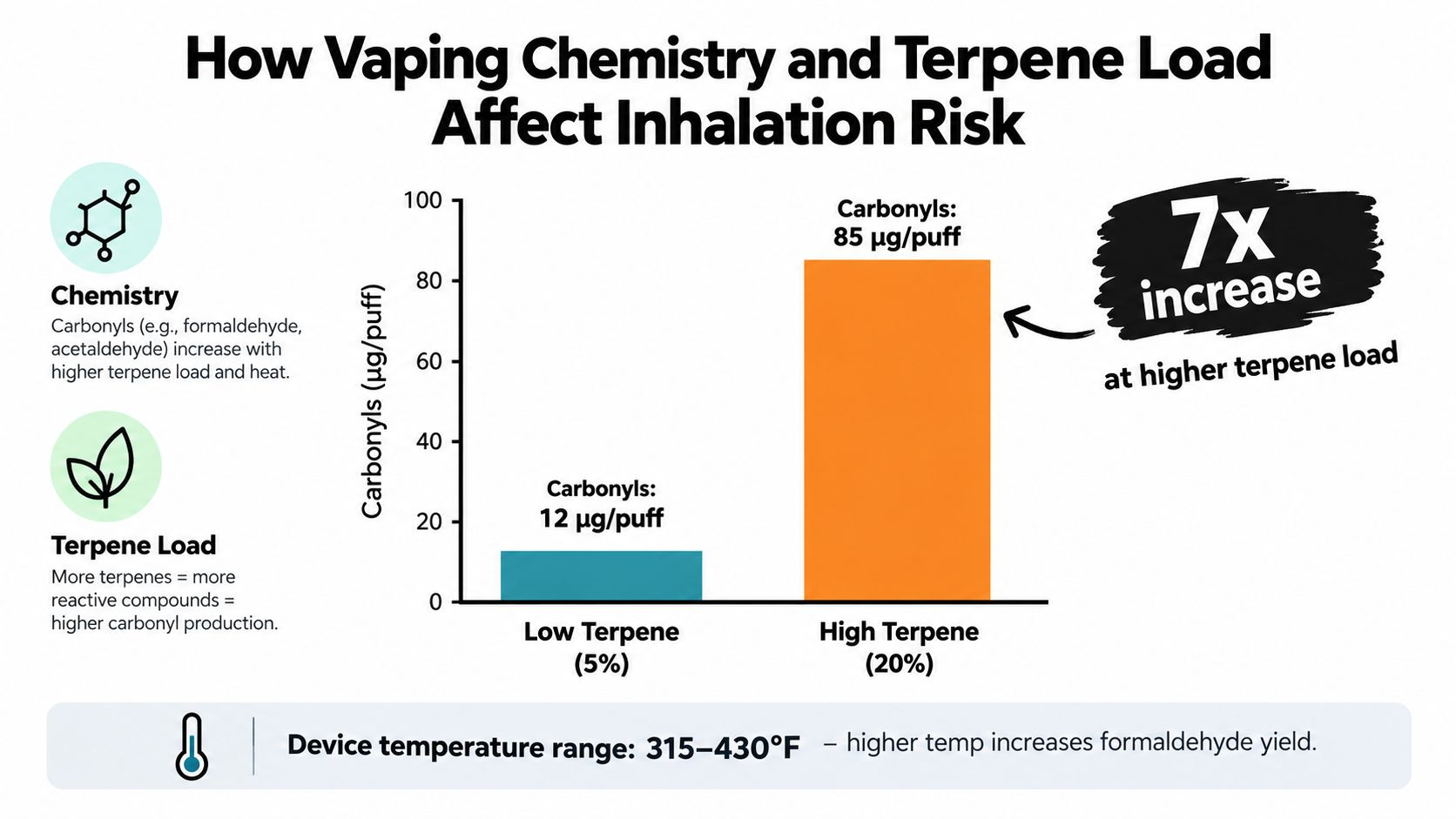
A toxicology review reported that terpene concentrations in cannabis oil can reach 10% to 20% by weight, and that heating and oxidation can generate carbonyl compounds including acetone, acetaldehyde, propionaldehyde, and terpene-derived carbonyls (toxicology review of cannabis vaping chemistry). That matters because a higher terpene load gives the device more volatile material to heat, and more opportunity for heat-driven breakdown if the cartridge runs too hot.
For a new brand owner, the practical point is simple. A terpene blend that smells balanced in a jar can behave very differently in a cartridge. The same distillate can become a lower-risk or higher-risk product depending on how much terpene content you add, which terpenes you choose, and how the hardware heats that mixture.
If you are reviewing ingredient choices, this guide on whether terpenes are safe to vape is useful because it keeps the discussion tied to inhalation use instead of food or topical use.
Hardware temperature changes the exposure profile
Temperature is the second half of the equation. A cartridge does not heat every formula the same way, and two devices can push the same oil toward different aerosol outputs.
Recent toxicology work on concentrate vaping notes that aerosols can contain harmful byproducts such as aldehydes, isoprene, and other toxicants, and it also highlights added concerns around formulations that include pine rosin and cannabinoid acetates (2025 toxicology review on vaping concentrates). That finding is useful because it shifts the safety question from "Is this distillate clean?" to "What happens when this full formula is heated in this specific device?"
In formulation terms, terpene load and hardware settings work like oven temperature and cook time. The ingredients matter, but the heating conditions decide a large share of the outcome.
What formulators should control
A safer cartridge program starts with controllable variables, not broad claims about purity.
Review each formula against:
- Total terpene load relative to the viscosity target, sensory goal, and expected coil behavior.
- Terpene composition because different blends do not have the same volatility or degradation profile.
- Excluded additives so the formula avoids materials with avoidable inhalation concerns.
- Actual device settings in the cartridge and battery combination sold to customers.
- Repeat-use performance because a formula can test acceptably at first puff and drift as the cartridge heats through normal use.
The inhalation risk of a distillate product is set by the combination of oil, terpene load, additives, and temperature. That is why the same distillate can sit inside a better-controlled cartridge or a riskier one.
Testing Standards and How to Verify a Safe Distillate
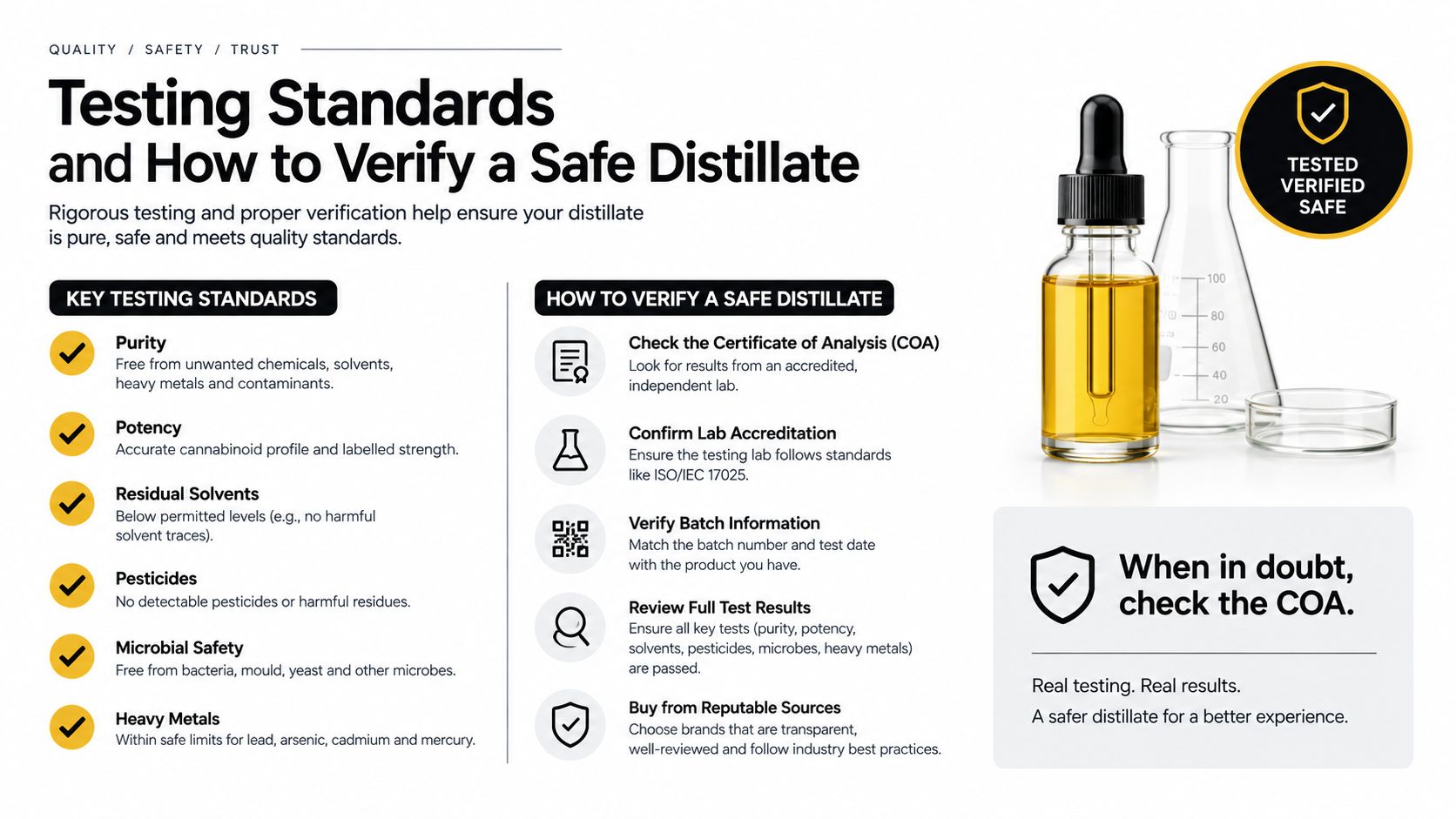
Supplier claims don't verify safety. A Certificate of Analysis and a documented review process do.
That's important because distillate products are often evaluated with shorthand language: clean, pure, solvent-free, premium. None of those words tells you whether the batch was tested for the issues that matter in inhalable formulation.
Read the COA like a manufacturer
The starting point is a batch-specific COA that aligns with your use case. For vape products, the basic review shouldn't stop at potency.
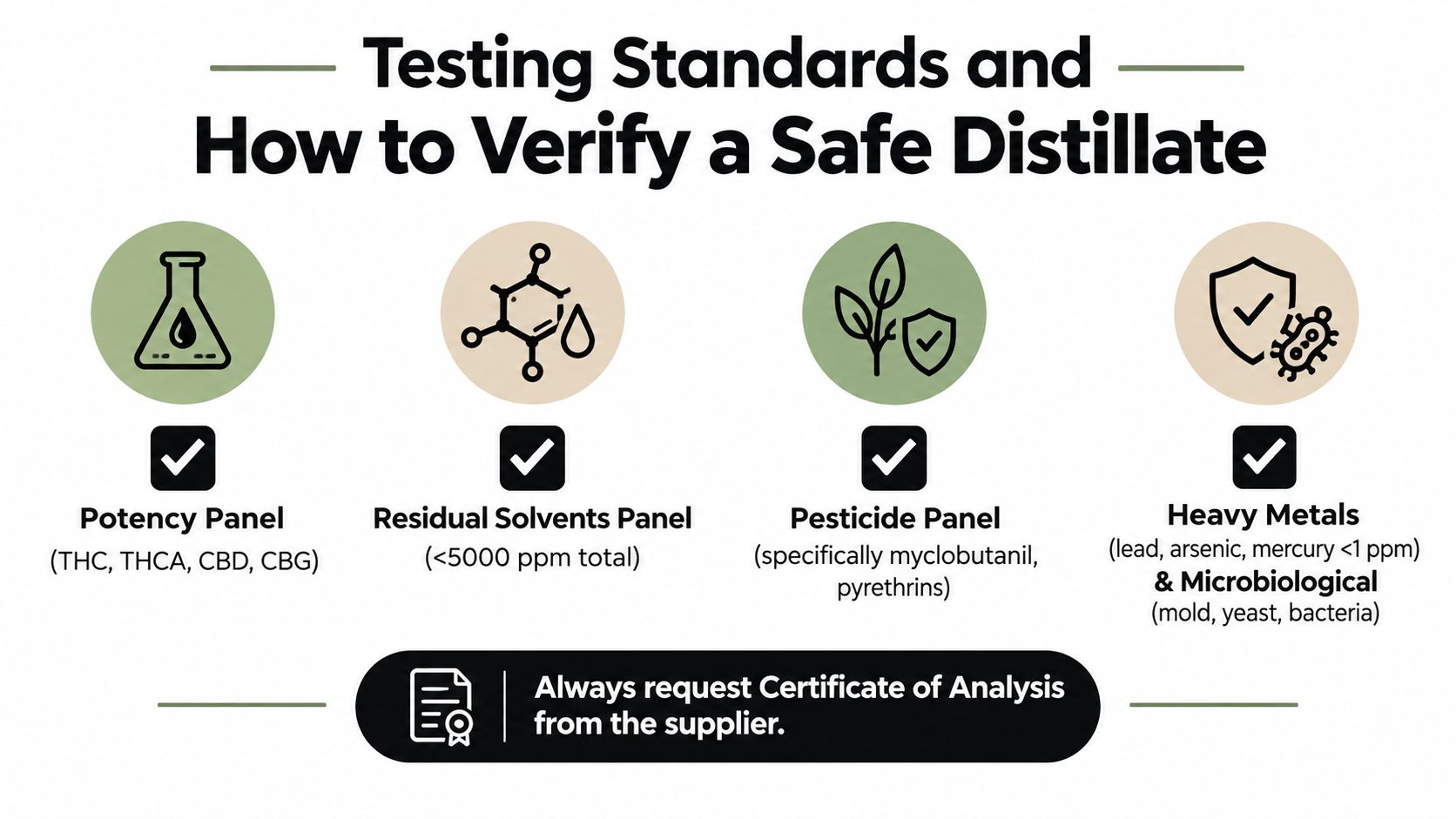
You want to see a testing package that covers:
- Potency: Confirms what cannabinoid profile you're formulating around.
- Residual solvents: Relevant even when a supplier emphasizes cleanup.
- Pesticides: Important because upstream agricultural inputs can persist into concentrates.
- Heavy metals: Necessary for inhalable products and relevant to hardware exposure.
- Microbiological screening: Useful for ruling out contamination that doesn't belong in the formula.
Verify the finished cartridge, not just the oil
Many small brands cut corners. They test incoming oil, then assume the finished cartridge is covered.
It isn't.
The cartridge adds materials, heating behavior, and storage conditions that can change the final risk profile. If you're building a repeatable line for vape cartridges for cannabis product formulation, test the filled product in its intended hardware, not just the concentrate in a jar.
A practical supplier review can be handled with a short checklist:
| Checkpoint | What to confirm | Why it matters |
|---|---|---|
| Batch identity | COA matches the exact lot received | Prevents paperwork mismatch |
| Panel scope | Includes contaminant classes relevant to inhalation | Avoids false confidence from partial testing |
| Lab detail | Results are clear and current | Makes batch release decisions easier |
| Finished-goods validation | Filled cart is part of testing workflow | Captures downstream risk |
Ask a simple question during procurement: "What did you test, on which batch, and did anyone test the filled cartridge?"
That question often tells you more than a polished sales sheet.
Formulating Distillate Safely With Terpenes for Vape Cartridges
Can the same distillate become safer or riskier just by changing the terpene blend and the cartridge setup? Yes. Once the oil itself passes verification, the main safety variable is the formula you build around it.
Terpenes do more than add aroma. They also change how the oil flows, how quickly it wicks, and what the consumer inhales at the temperatures produced by the hardware. A blend that smells balanced in a jar can still run too thin, hit too hot, or deliver an uneven vapor profile in a cartridge.
Build the profile with structure, then test it in hardware
A useful way to formulate is to treat the terpene blend like a layered profile. Top notes shape the first impression, middle notes carry the main identity, and base notes keep the vapor from feeling hollow or disappearing too quickly (terpene blend formulation guide).
That structure helps if you're matching a known cultivar direction or building a house profile that needs to survive batch after batch. It reduces random ingredient stacking and gives the team a repeatable way to explain why each component is present.
Process control matters just as much. A cartridge-focused reference advises formulators to warm the oil gently, weigh by mass, add terpenes in small increments, mix to uniformity, and validate the result in the actual cartridge. The same reference also notes that single-terpene levels should stay controlled rather than dominating the blend, with a cited upper limit of 3.5% for one terpene within the formula (cartridge terpene profile and mixing guidance).
If you are writing or tightening a bench SOP, this guide on how to mix distillate with terpenes for cartridge formulation fits naturally into pilot work.
Keep terpene loading in a controlled range
Terpene load is where many avoidable problems start. Too little, and the oil may stay heavy, muted, or inconsistent in vapor output. Too much, and the formula can become sharper, thinner, and more reactive under heat.
For vape cartridges and distillate, one formulation guide reports common total terpene loading ranges of 5% to 8% by weight, while another places cartridge loading at 4% to 10% by volume (working terpene ranges for cartridge formulation). A separate distillate-focused reference recommends staying within a 5% to 10% total terpene window and provides the formula Required Terpene Mass = (Mass of Distillate / (1 – Target %)) – Mass of Distillate (distillate terpene formulation reference).
Those ranges are starting points, not permission to fill the cart to the top of the window. The safer approach is to begin lower, check fill behavior and vapor character in the target hardware, and increase only if the profile still needs adjustment.
| Parameter | Recommended Range or Rule | Why it matters |
|---|---|---|
| Total terpene loading | Common working ranges include 5% to 8% by weight, 4% to 10% by volume, and a 5% to 10% total window | Affects flavor strength, viscosity, and how the cartridge performs under heat |
| Single terpene level | Keep any one terpene at or below 3.5% within the blend | Reduces the chance that one compound drives harshness or imbalance |
| Addition method | Warm gently, weigh by mass, add incrementally, mix to uniformity | Improves repeatability and helps avoid overcorrection |
| Validation step | Test in the intended cartridge | Vapor behavior in hardware can differ from bottle aroma and bench texture |
Choose inputs that make control easier
Ingredient quality does not replace finished-product validation, but it does make formulation easier to control. If you're sourcing blends for terpene profiles for distillate, Gold Coast Terpenes supplies lab-verified, THC-free terpene blends made without VG, PG, PEG, or MCT for cartridge and concentrate formulation. A profile such as 24k gold punch should be evaluated the same way as any other blend: by composition, loading level, and performance in the final cartridge.
That is the core formulation view of distillate safety. The oil matters, but the outcome depends on what you add, how much you add, and how hot the hardware runs.
Building a Safer More Consistent Distillate Product Line
A safer distillate line doesn't come from one decision. It comes from a sequence of controlled ones.
Start with verified oil. Then choose terpene inputs that support the target profile without pushing the blend outside a sensible loading range. After that, evaluate the actual cartridge and battery conditions that will heat the formula in the field. If any of those steps are weak, the finished product becomes harder to trust and harder to reproduce.
The process strong teams repeat
The most reliable workflow is usually simple:
- Define the target profile: Decide whether you're matching a cultivar direction, a flavor family, or a house signature.
- Build the blend deliberately: Use top, middle, and base notes instead of chasing bottle aroma alone.
- Pilot in real hardware: A bench sample isn't finished until it performs in the intended cartridge.
- Lock the formula after validation: Once the blend and hardware pair are working, document them tightly.
That sequence matters for safety and consistency at the same time. It also supports flavor accuracy, which is the commercial side of the job. A stable terpene input helps brands maintain the same sensory profile across batches instead of rebuilding from scratch each run.
The safest distillate product line is usually the most repeatable one. Verification and consistency tend to rise together.
For teams developing products for vape cartridges, for distillate, or more broadly for cannabis product formulation, the useful mindset isn't "we found a safe oil." It's "we built a controlled system and kept checking it."
Gold Coast Terpenes offers terpene blends, isolates, formulation education, and tools such as Terpenes 101 and a Mixing Calculator that fit directly into this kind of cartridge development workflow. If you're refining a terpene profile, validating a strain-inspired blend, or tightening batch consistency for distillate products, visit Gold Coast Terpenes and review the formulation resources alongside the available terpene options.