
You're probably in one of two situations right now. You need a new cart or concentrate SKU that doesn't taste like another generic lemon profile, or you're trying to rescue a promising concept that keeps flattening out once it hits hardware. Both problems point to the same issue. The target profile isn't being treated like a formulation problem.
The Lavender Lemonade strain is valuable because it gives formulators a profile with built-in contrast. It isn't just citrus. It isn't just floral. It carries a bright top end, a perfumed center, and enough earthy weight to survive extraction and vaporization if the blend is built correctly.
That combination matters in commercial work. A profile like this can support vape cartridges, concentrated oils, infused pre-roll flavor systems, and strain-inspired distillate lines without forcing the product into a one-note citrus lane. It also gives brand owners a cleaner story to tell. The aroma reads familiar at first, then separates itself on the finish.
Introduction Why Lavender Lemonade is a Formulator's Target
Most formulation teams don't struggle to make something smell strong. They struggle to make it smell specific. Citrus-heavy profiles are easy to overbuild. Floral profiles are easy to make perfumed. Lavender Lemonade sits in the useful middle, where precision matters and lazy blending gets exposed quickly.
That's why this profile keeps showing up as a strong commercial target. Dynasty Seeds describes Lavender Lemonade as a mostly indica-dominant hybrid developed from Oregon Lemons and Huckleberry #5, with an 8 to 9 week flowering time and a sensory profile built around lemon brightness and floral lavender character, while also calling it an “intriguingly high yielding, high potency” variety on the Dynasty Seeds strain page. For a formulator, that tells you the market signal isn't random. The profile was bred to be distinctive.
Why it works better than a standard lemon profile
A plain lemon blend often peaks too early. The inhale is loud, then the profile drops into a hollow middle. Lavender Lemonade avoids that problem because the floral body gives the lemon something to sit on. The earthy undertone keeps the finish from feeling washed out.
Three practical advantages stand out:
- Better shelf identity: The profile separates itself from standard citrus SKUs because the floral layer creates a recognizable middle.
- More flexible positioning: It can fit an uplifting-forward concept, a relaxation-forward concept, or a balanced hybrid line depending on how the blend is weighted.
- Stronger hardware translation: The deeper notes help the profile remain intact when top notes start burning off during repeated heating cycles.
Practical rule: If your citrus SKU smells great in the bottle but turns thin in the cart, the problem usually isn't “not enough lemon.” It's weak structure underneath the lemon.
For teams building commercial products, the smarter move is to start with a profile that already has internal balance. That's what makes Lavender Lemonade worth studying. If you need a broader framework for evaluating profiles before committing them to product development, this guide to choosing cannabis by terpene profiles is a useful reference point.
Deconstructing the Lavender Lemonade Sensory Profile
A Lavender Lemonade brief usually sounds simple until the first bench sample hits the glass. The lemon reads fast, the floral note turns soapy under heat, and the finish drops out after a few pulls. Rebuilding this profile for a commercial cart or concentrate takes more than matching the name. It takes a controlled sensory map with clear priorities.
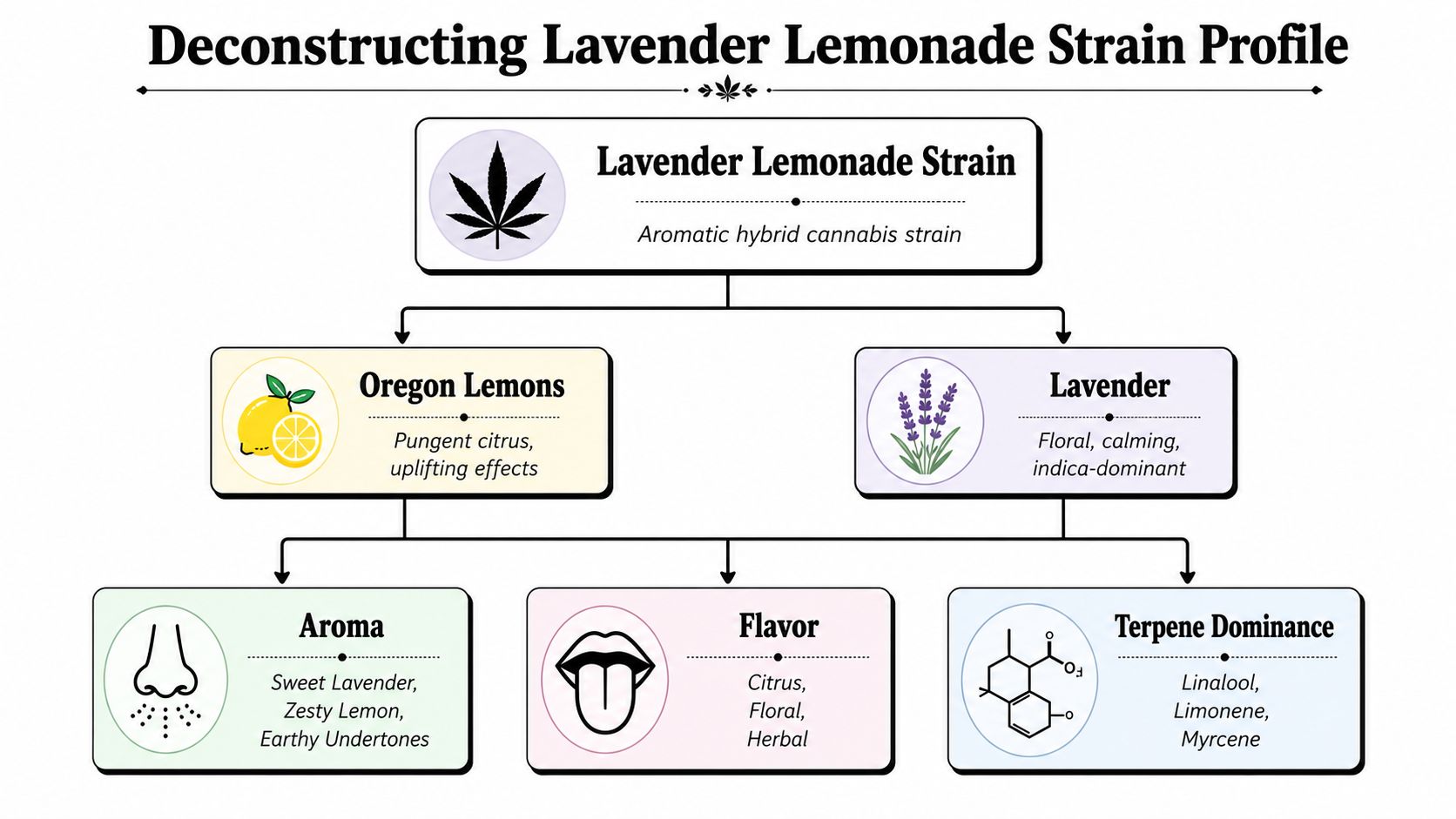
Dynasty Seeds describes Lavender Lemonade as an indica-dominant hybrid bred from Oregon Lemons and Huckleberry #5, with a citrus-forward aroma supported by floral and earthy undertones, as noted earlier in the breeder description.
What the parentage means in practical terms
In formulation terms, Oregon Lemons gives you the front-end signature. It should present as fresh peel and bright zest, not candied lemon and not harsh solvent-like citrus. If that opening is weak, the profile loses recognition immediately.
Huckleberry #5 carries the middle and back half. That is where the floral, herbal, and lightly earthy character comes from. In production work, this is the part that separates a strain-inspired profile from a generic lemon SKU with perfume added on top.
The target is a timed sensory sequence, not a static aroma.
The sensory stack to aim for
Build the profile in three stages:
- Top note: Lemon peel, crisp citrus oil, fast brightness
- Mid note: Lavender-like florals, soft herbals, lightly perfumed body
- Base note: Earthy resin, mild spice, enough weight to hold through repeated heating
This layering is critical for the user experience, which unfolds over time. In a vape application, the first second of vapor has to declare citrus. The next phase should widen into floral and herbal character without turning powdery. The finish needs enough density to keep the profile intact after several heat cycles, especially in hardware that runs hot or has poor oil feed consistency.
A strong Lavender Lemonade profile opens with lemon, settles into floral-herbal body, and finishes with quiet resinous depth.
Where replication usually fails
I see three repeat errors in bench submissions and customer reformulation work.
- Citrus pushed too high: The blend reads like lemon candy, cleaner, or straight limonene concentrate.
- Floral pushed too high: The profile goes soapy, cosmetic, or old-fashioned perfume.
- Base pushed too high: The profile gets muddy and loses the recognizable Lavender Lemonade arc.
The balancing act is narrow. Lemon should lead the first impression, but it cannot dominate the full draw. Floral character should sit in the center with restraint. Earth and spice should give persistence, not heaviness.
For teams calibrating their sensory language before they start isolate selection, this guide to sensing terpene aromas and flavors is useful for tightening descriptive consistency across R&D, QC, and production.
The Terpene Blueprint for Your Formulation
The sensory description only becomes useful when it translates into compounds you can build with. For commercial phenotypes of Lavender Lemonade, the dominant terpenes documented for the Dynasty Seeds line are Caryophyllene, Limonene, and Myrcene, and that combination is tied to the profile's reported dual-phase character of uplift followed by relaxation on the SeedFinder entry for Dynasty Seeds Lavender Lemonade.
The three compounds that carry the profile
Limonene handles the opening. It provides the citrus lift and gives the profile the bright first impression that makes the name make sense.
Myrcene fills in the body. It helps connect citrus to the more grounded parts of the profile, and it supports the softer, heavier back half.
Caryophyllene gives the blend structure. It anchors the finish with spicy, earthy depth and keeps the profile from tasting thin under heat.
Lavender Lemonade dominant terpene profile
| Terpene | Aromatic Contribution | Functional Role |
|---|---|---|
| Limonene | Bright lemon, zesty citrus | Drives the top note and first-pass brightness |
| Myrcene | Earthy, herbal, rounded body | Connects top and base, softens transitions |
| Caryophyllene | Spicy, earthy, deeper finish | Builds the base and improves structural persistence |
Many replication attempts go wrong when teams focus on “lavender” and assume the blend should be built around overt floral compounds. In practice, the profile's backbone still comes from the dominant trio above. Floral accents matter, but they should sit on top of a stable citrus-earth framework, not replace it.
Assigning top, mid, and base roles
A practical build looks like this:
- Top: Limonene carries the first impression.
- Mid: Myrcene supports the body and smooths the transition.
- Base: Caryophyllene holds the tail of the profile together.
That assignment matters because hardware changes perception. Top notes move fast. Base notes stay behind. If the blend doesn't have enough base support, the first draw may smell accurate in a cold sniff test, but the finished product won't retain its identity after real use.
Blend discipline matters more than complexity. A few well-placed compounds outperform a crowded formula with no hierarchy.
If you're calibrating compounds by aromatic function rather than by name alone, a terpene flavor chart is useful for mapping what each component contributes in a finished blend.
Formulating a Strain-Inspired Terpene Blend for Distillate
Start with the base, not the romance of the strain name. Distillate exaggerates mistakes. If the terpene system is too sharp, the cart feels harsh. If the blend is too floral, the profile turns artificial once heat gets involved.
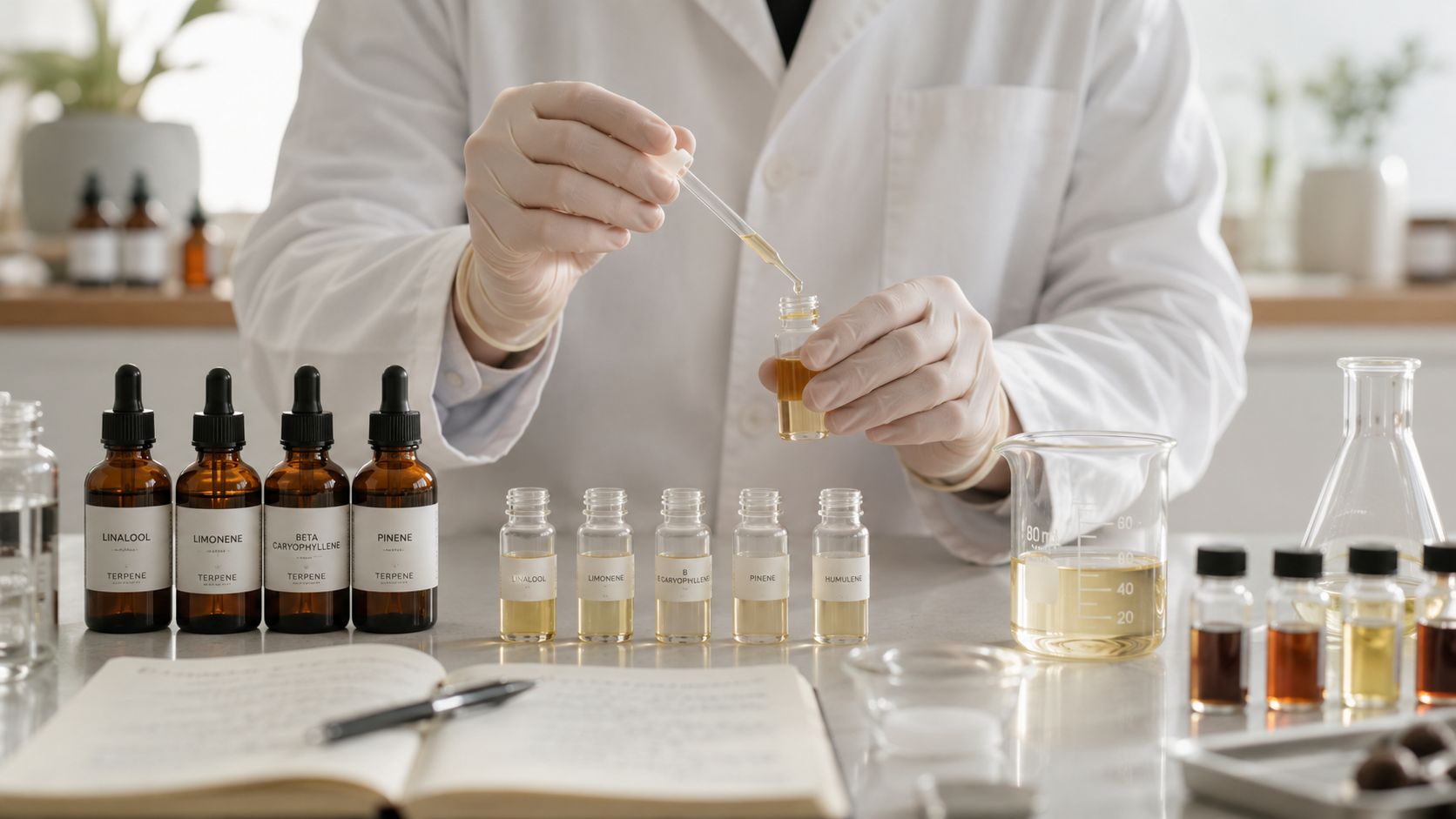
A strong starting point for a strain-inspired terpene blend for vape cartridges is a 7% terpene addition rate, which is identified as the standard starting point for achieving the zesty lemon and floral lavender notes without overwhelming the distillate base or creating hardware issues in this vape-specific terpene flavor reference. Generally, that's the right place to begin before sensory adjustment.
My process for the first bench sample
I build this profile in passes.
First, I establish the core with the dominant structure already discussed: citrus at the top, herbal-earth through the middle, and a firm base. Then I evaluate it warm, not just cold. A blend that only performs in the bottle isn't finished.
The first bench sample should answer three questions:
- Does the lemon open cleanly?
- Does the floral body appear after the citrus, not before it?
- Does the finish stay grounded instead of collapsing into sweetness?
Ratio logic instead of guesswork
I don't treat every component equally because the profile itself isn't equal across the inhale. The opening needs enough limonene to read immediately, but not so much that it strips the profile of depth. Caryophyllene can't be an afterthought. If it is, the cart tastes bright at first and weak by the third draw. Myrcene is the bridge that keeps the handoff from feeling abrupt.
A practical workflow looks like this:
- Build the citrus spine first: Establish limonene as the recognizable top note.
- Round the middle next: Add myrcene until the blend stops feeling sharp and starts feeling integrated.
- Lock the finish last: Use caryophyllene to create a stable tail and preserve realism under heat.
- Only then adjust floral nuance: The lavender impression should refine the blend, not carry it.
If you add floral character before you've stabilized the citrus-earth frame, you'll chase corrections for the rest of the session.
A visual walkthrough can help when training new lab staff on mixing order and evaluation technique.
What usually doesn't work
Several shortcuts fail consistently in distillate work:
- Over-indexing on “lavender”: This creates a perfumed profile that doesn't resemble flower.
- Using citrus as a cover scent: Strong lemon can hide defects in the jar and expose them in the cart.
- Treating all hardware the same: A blend that behaves acceptably in one cartridge may feel top-heavy in another.
For commercial production, the smartest move is to lock a bench reference, test it warm, and only then scale. The profile has enough complexity that intuition alone won't keep batches aligned.
Vape Cartridge and Concentrate Technical Considerations
The same Lavender Lemonade blend won't behave the same way in a cartridge and a dab product. Heat delivery changes everything. A cart asks the formula to survive repeated, controlled heating cycles in a small chamber. A concentrate can tolerate a more expressive top end because the consumption style is different.
Why carts need more structural weight
For this profile, formulators developing vape cartridges need to make sure base note compounds like caryophyllene and guaiol account for at least 15–20% of total blend weight so the profile maintains structural integrity and its “gasoline” finish during the heating cycle of a standard cartridge as documented in this product formulation reference.
That detail matters because limonene flashes early. It gives the inhale lift, but it won't carry the full session by itself. When the base is underbuilt, the first few puffs feel accurate and the rest of the cart tastes flatter, sweeter, or less defined.
Cart development priorities
For cartridges, I focus on stability more than aroma drama.
- Preserve the finish: Base notes need enough weight to remain present after repeated draws.
- Control volatility: Top notes should announce the profile without dominating the whole cycle.
- Protect realism: A little herbal or resinous depth often does more for fidelity than extra citrus.
A cart formula that smells slightly restrained in the bottle often performs better under heat than one that smells exaggerated at room temperature.
Concentrates allow a different emphasis
Concentrates can support a looser expression. You can let the top and mid notes open wider because the product doesn't rely on the same small-coil heating pattern as a standard cartridge. That doesn't mean removing structure. It means the profile can breathe more.
A good concentrate-oriented approach usually does three things:
- lets the citrus present more vividly on first contact,
- keeps the floral portion smooth rather than cosmetic,
- and still retains enough earthy depth that the strain identity stays intact.
Thermal evaluation should be part of every approval round
A formula shouldn't pass because it smells right on a blotter. It should pass because it stays coherent after heat exposure. That means testing the same blend in the actual format you plan to sell.
Look for these failure signals during evaluation:
- Top-note dropout: The first draw is expressive, later draws are generic.
- Base-note overload: The profile starts reading muddy, peppery, or overly dense.
- Floral distortion: Heat pushes the blend into soap, perfume, or artificial sweetness.
Those aren't minor issues. They're signs that the note hierarchy is wrong for the hardware.
Achieving High-Fidelity Flavor with Isolates and Quality Sourcing
Basic replication gets you close. High-fidelity replication comes from restraint, isolate selection, and consistent inputs. The benchmark that matters here is whole-flower terpene density. A high-potency Lavender Lemonade flower format has been cited with total terpene content of 2.21%, which gives formulators a useful baseline for how concentrated the natural aromatic system is when the profile is performing well in this whole-flower preroll listing.
That figure matters because many blends fail from the opposite directions. Some are too weak to create authentic aromatic clarity. Others are overloaded and lose shape.
Where isolates help
Once the dominant structure is right, isolates can sharpen fidelity.
- Linalool-type floral direction: Use carefully to suggest lavender character without making the blend feel perfumed.
- Extra citrus accents: Useful for sharpening peel brightness, but they should support limonene rather than compete with it.
- Earthy or woody support: This can restore realism when the profile feels too polished or candy-like.
What quality sourcing changes
The cleaner the input materials, the easier the blend is to control. Poor terpene inputs force you to compensate. You start blending around off-notes instead of building toward the target. That creates instability from batch to batch, especially when scaling from bench work to production runs.
Disciplined sourcing proves its worth:
- Consistent lots make sensory matching repeatable.
- Clear documentation makes troubleshooting faster.
- Reliable purity lets minor adjustments behave the way you expect.
High-fidelity strain work rarely fails because the concept was wrong. It fails because the raw materials moved underneath the formula.
If you're evaluating suppliers for isolate work, this guide on where to buy terpenes is a useful checklist for comparing quality, documentation, and fit for formulation use.
Compliance Testing and Final Product Documentation
The formula isn't done when the aroma is right. It's done when the product file is defensible. That means your terpene inputs, finished blend records, and test documents all need to align with the SKU you're selling.
Commercial Lavender Lemonade THCA hemp flower has been documented at 24.015% THCA while maintaining less than 0.3% hemp-derived THC, and that same product was described as pesticide-free and organic in this product listing with lab-tested specifications. For manufacturers, that's a useful example of the type of documentation standard buyers now expect around premium hemp-derived or cannabis-adjacent products.

What should be in the product file
A solid compliance packet for a Lavender Lemonade-inspired SKU should include:
- Finished formulation record: Exact blend version, lot references, and manufacturing date.
- Input documentation: Certificates and identity records for terpene components and base materials.
- Final analytical testing: Cannabinoid panel where applicable, plus terpene profile confirmation if your operation runs it.
- Claim support: Any organic, pesticide-free, or related quality language should match actual documentation.
Why documentation affects formulation choices
Good documentation changes how you formulate. It pushes teams toward consistent, verifiable materials. It also reduces the temptation to fix a weak blend with undocumented additives or vague flavoring systems that complicate review later.
For brand owners, that translates into fewer surprises during distribution review. For manufacturers, it means fewer batch disputes and cleaner release decisions. For formulators, it creates a feedback loop between bench chemistry and commercial reality.
The best blend in the room still loses if the paperwork around it is incomplete.
A Lavender Lemonade profile can be commercially sharp, technically stable, and easy to defend. Those three outcomes usually come from the same habit. Build a formula you can reproduce, test it in the actual format, and document it like someone else will have to audit it.
Gold Coast Terpenes supplies strain-specific terpene blends and isolated compounds for cartridges, concentrates, and commercial product formulation. If you're building a Lavender Lemonade-inspired profile for distillate, vape cartridges, or a new concentrate SKU, their catalog, formulation tools, and lab-verified terpene options can help you move from bench sample to production-ready blend with fewer compromises.