
A lot of people searching for how to become a reseller are really asking a narrower question. They already have buyers. They already know extractors, cartridge brands, or manufacturing teams that need help. What they don't have is a reliable way to supply compliant terpenes, support formulation decisions, and protect their margins in a regulated market.
That's the gap worth building a business around.
In the terpene channel, a reseller isn't just moving bottles from one warehouse to another. You're becoming the point where compliance, supply consistency, and formulation accuracy meet. If you get those three things right, you're useful to brands that are trying to keep a vape line stable, replicate a strain-inspired terpene blend, or tighten flavor performance for distillate and concentrate SKUs.
Tapping into the Terpene Supply Chain
A familiar problem shows up when a cartridge line starts to scale. One batch tastes sharp, the next feels flat, and a previously dependable profile no longer lands the same way in production. The extractor blames raw material variation. The brand owner blames the formulation. The operations team blames the supplier. What's usually missing is a disciplined supply partner in the middle.
That's where terpene reselling becomes valuable.
Instead of treating resale like generic online flipping, this model serves B2B cannabis product formulation. Your customers are the people building carts, concentrates, distillate blends, and strain-inspired SKUs. They need fast answers on documentation, lot consistency, mixing guidance, and reorder reliability.
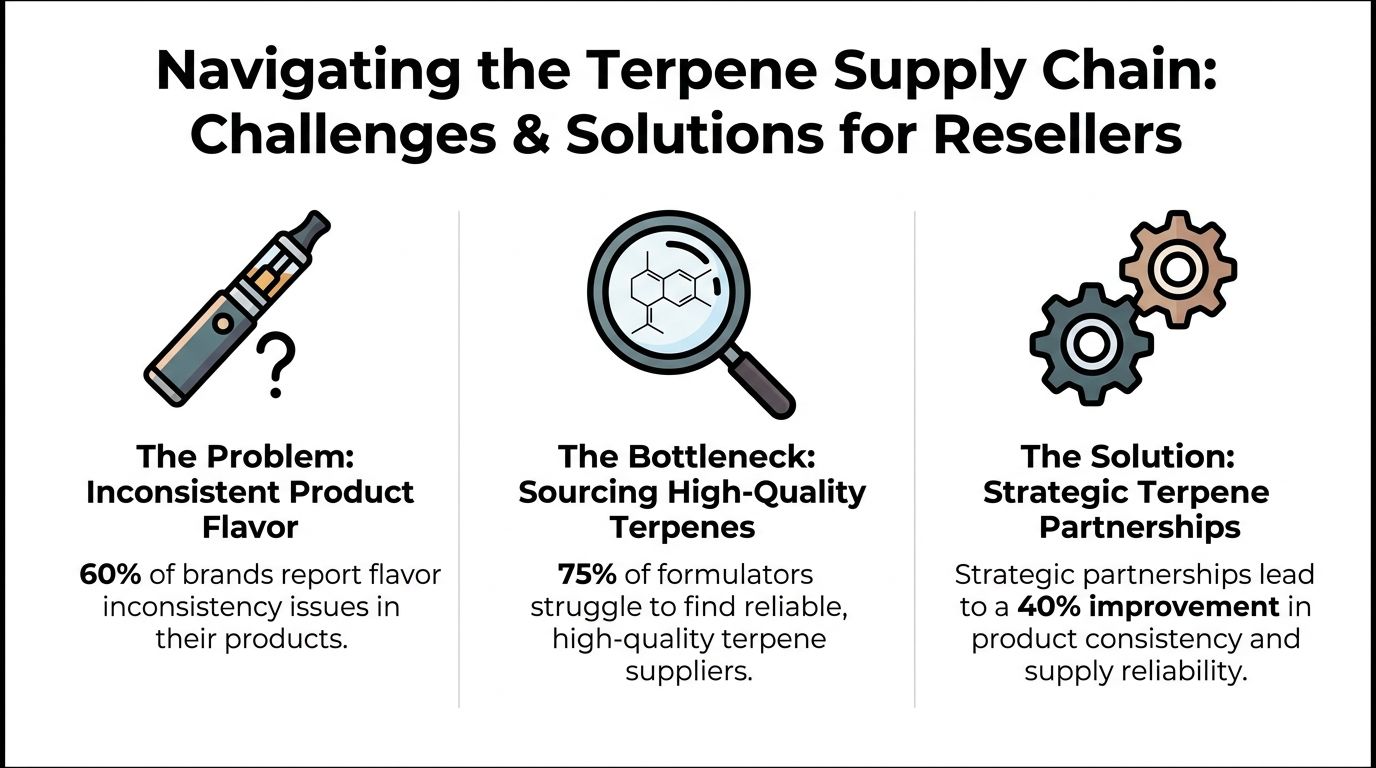
The opportunity is large enough to justify doing this professionally. The cannabis sector is projected to reach $47 billion in U.S. revenue in 2026, with a 3.36% CAGR driving projected market volume to $55.43 billion by 2030, which creates demand for supply chain intermediaries who can connect manufacturers and downstream buyers, according to Flowhub's cannabis industry statistics.
Why the reseller role matters
A strong reseller solves problems that product pages don't solve on their own:
- Supply translation: You turn a catalog into a buying decision that fits a customer's hardware, oil type, and target sensory outcome.
- Technical filtering: You stop buyers from choosing the wrong blend for vape cartridges or overcomplicating a formulation.
- Commercial continuity: You help brands avoid gaps between sample approval and production ordering.
That middle role gets more important as buyers scale. The bigger the order, the less tolerance there is for vague specs, inconsistent lead times, or poorly matched blends.
Practical rule: If your value starts and ends with forwarding a price list, you're easy to replace. If you help customers make fewer formulation mistakes, you become part of their operating process.
For a useful model of how channel reliability affects repeat business, it helps to study supply chain optimization for terpene distribution.
Who should consider this path
This route fits people already close to the trade:
| Good fit | Why it works |
|---|---|
| Extractors and formulators | You already understand how terpenes behave in oil |
| Brand operators | You know what buyers complain about and reorder |
| Sales reps in adjacent categories | You likely have existing wholesale relationships |
| Distributors with compliance discipline | You can manage documentation-heavy sales cycles |
If you want to learn how to become a reseller in this niche, think less about arbitrage and more about becoming a technically credible channel partner.
Laying the Groundwork for Your Business
Before you order samples, build a legal and financial structure that can survive scrutiny. In doing so, most new entrants either become credible fast or create a mess they spend months unwinding.

A lot of reselling advice skips the hard part. It focuses on sourcing and selling but barely addresses what keeps a business defensible. That's a problem, because emerging trends are shifting toward private labeling and brand building rather than flipping inventory, and many guides still gloss over the need for separate business banking accounts, professional accounting software, and specific permits or licenses required for authorized retailing, as noted in Nearity's guidance on reselling online successfully.
Start with structure, not inventory
Pick a business structure that matches your risk tolerance and growth plan. Many operators compare sole proprietorship and LLC structures early because liability, recordkeeping, and banking tend to get more serious once you start handling wholesale accounts and product documentation.
Then handle the basics immediately:
- Register the business entity
- Obtain an EIN
- Open a dedicated business bank account
- Set up accounting software
- Create a document storage system for COAs, invoices, permits, and tax records
This isn't paperwork for its own sake. It creates clean separation between business cash and personal cash, which matters when buyers ask for invoices, net terms, insurance details, or formal vendor onboarding packets.
Compliance questions you need answered early
Even if you plan to focus on THC-free terpenes, don't assume that means zero regulatory friction. Your state, county, and customer base can still impose requirements around handling, labeling, tax registration, and business licensing.
Use a checklist like this before launch:
- State rules: Confirm whether your state treats your products as cannabis-adjacent ingredients, flavoring components, or another regulated class.
- Local permits: Check county and city requirements, especially if you'll store inventory locally.
- Tax registration: Make sure resale certificates and sales tax documentation are handled correctly where applicable.
- Customer documentation: Know what a buyer will ask for before they ask. COAs, SDS files, invoices, and business registration are common requests.
- Privacy and site policies: If you'll sell online, your site should have professional terms and policies rather than a placeholder checkout flow.
Build your admin stack before your first sale. Buyers can forgive a new company. They don't forgive a disorganized one.
Plan for the business you want, not the hobby you're leaving
A terpene reseller usually starts with wholesale supply, but many eventually move toward custom kits, private label projects, or curated formulation support. If you think that's where you're headed, build your systems with that future in mind.
A simple comparison helps:
| If you stay informal | If you build professionally |
|---|---|
| Mixed personal and business spending | Clean books and easier margin analysis |
| Manual invoice tracking | Repeatable order processing |
| Patchwork customer records | Faster wholesale onboarding |
| Reactive compliance | Documents ready before requests arrive |
Reviewing a wholesale pricing structure for terpene resale also helps you choose a model that leaves room for margin after freight, taxes, samples, and account management time.
Sourcing Your Supply Partnering with the Right Terpene House
Most reseller failures don't start with weak sales. They start with weak sourcing.
If your supplier can't support documentation, consistency, and production use, your business inherits every one of those failures. In this market, the wrong supply partner doesn't just create customer complaints. It can create recalls, lost accounts, and expensive rework.

The core technical standard is clear. To enter the cannabis extract and terpene formulation market, you need a supplier offering lab-verified, THC-free terpenes free of VG, PG, PEG, and MCT, and 60% of failed reseller entries in this sector stem from sourcing non-compliant blends that trigger state-level product recalls, according to Closo's reseller guide for the cannabis extract and terpene market.
What to verify before you buy
A terpene house should be able to answer practical questions quickly. If they can't, assume your customer support burden will rise later.
Ask for this upfront:
- Lab verification: COAs or equivalent documentation confirming THC-free status where relevant
- Carrier clarity: Written confirmation that the blends are free of VG, PG, PEG, and MCT
- Lot consistency: How they manage batch variation and whether profiles are standardized
- Application fit: Which blends are intended for vape cartridges, distillate, or other cannabis product formulation use
- Order support: Sample availability, wholesale minimums, lead times, and reorder process
Wholesale versus affiliate is a real business decision
Not every reseller should start by buying and holding inventory. Some should begin with direct wholesale purchasing. Others may fit an affiliate or sales-rep style model better, especially if they have audience reach but limited working capital.
Here's the practical difference:
| Model | Best for | Main trade-off |
|---|---|---|
| Wholesale buy and resell | Operators who want pricing control and direct account ownership | Requires cash, forecasting, and inventory discipline |
| Affiliate or referral | People with deal flow but less capital commitment | Lower operational burden, less control over account experience |
Neither model is automatically better. The right choice depends on whether you want to own fulfillment and margin, or focus on introductions and account development.
How to vet with samples instead of assumptions
The safest way to evaluate a supplier is to simulate how your customers will use the material.
Use a sample review process that includes:
Sensory review
Evaluate whether the blend has a coherent top, mid, and base note structure instead of a harsh front-loaded aroma.Mixing behavior
Check how the sample integrates into your target oil system and whether it stays stable during normal handling.Documentation speed
Measure how fast the supplier sends the files a regulated buyer would request.Reorder realism
Ask what happens when a profile is out of stock, revised, or replaced by a newer version.
A reseller should never approve a supplier based on aroma alone. The real test is whether the blend performs predictably in the customer's formulation workflow.
If you're evaluating sources, one practical reference point is where to buy terpenes for formulation and resale.
What a strong supplier relationship looks like
One option in this space is Gold Coast Terpenes, which offers lab-verified, THC-free terpene blends, strain-specific profiles, isolates, and wholesale or affiliate pathways that fit cartridge, concentrate, and formulation use cases. That kind of supplier setup matters because it gives a reseller multiple ways to serve buyers with different purchasing behavior.
The best partnerships feel operational, not promotional. You should know who handles technical questions, who handles account issues, and how quickly a sample can become a production order.
Mastering Product Formulation and Technical Training
A reseller who can't talk formulation will keep losing deals to someone who can.
Your customer may ask for a strain-inspired terpene blend for vape cartridges, but what they really need is confidence. They want to know the blend will dissolve properly, preserve aroma, and fit the intended sensory profile without destabilizing the oil.

One mistake shows up constantly. Exceeding 10% terpene concentration in the final solution causes carrier oil instability, while successful resellers usually keep terpene levels between 1% and 5% by weight for vape cartridges, according to Gold Coast Terpenes guidance on how to use terpenes.
Why the profile matters in formulation
A useful blend isn't just a list of molecules. It needs structure.
For replicating flavor of Blue Dream for vape cartridges, the profile should be driven by Myrcene as the top note, supported by Pinene as the mid note, and grounded by beta-Caryophyllene as the base note, with some formulations using Limonene or Terpinolene to round out fruit complexity, based on Moodshine's Blue Dream profile notes.
That note structure matters because formulators aren't buying a name. They're buying a sensory result that has to survive mixing, filling, and repeated production.
Mixing discipline matters more than marketing
Formulation problems usually come from process drift. One team warms too hot. Another adds terpenes too early. Another chases flavor intensity by overdosing.
Keep your guidance simple and repeatable:
- Start low: Begin at the low end of the usable range and increase only if the profile needs more presence.
- Control heat: Volatile compounds are easy to damage when a mixing process gets sloppy.
- Match use case: A profile that works in distillate may not behave the same way in another oil system.
- Record every trial: Buyers trust resellers who can reference prior successful mixes.
If a customer asks for “stronger flavor,” don't answer with more terpene volume first. Ask about hardware, oil viscosity, and current percentage.
Use strain-inspired blends as technical teaching tools
Blue Dream is a good example because it shows how a familiar profile translates into formulation logic. In cannabis product formulation, the balance of Myrcene, Alpha-Pinene, and Caryophyllene matters because each component shapes the overall sensory direction and the blend's balanced character, as described in Mellow Fellow's Blue Dream review.
For formulating Blue Dream-inspired terpene blend for distillate, the takeaway isn't recreational branding. It's this: a recognizable profile depends on clear dominant and supporting notes, not on throwing a long ingredient list at the oil.
A technically useful reseller should be able to explain:
| Blend layer | What it does in practice |
|---|---|
| Top note | Creates first aroma impact and immediate recognition |
| Mid note | Fills out the profile and keeps it from feeling thin |
| Base note | Adds depth and persistence through the inhale and exhale |
That's what makes you more than a vendor. You become someone who helps a buyer choose the right terpene profile for cannabis product formulation instead of guessing.
Building Your Sales Engine and Marketing Tactics
A reseller business grows when you stop talking like a storefront and start selling like a technical partner.
The best accounts usually aren't won by broad marketing. They're won through precise outreach to the people already responsible for product quality and production continuity. That means extractors, lab managers, brand founders, cartridge product developers, and procurement leads.
Sell to operational pain, not broad interest
A weak pitch says, “We sell strain profiles.” A strong pitch says, “We help teams tighten flavor consistency for vape cartridges and distillate formulations.”
That distinction matters because B2B buyers respond to operational outcomes. They care about reorder stability, documentation, and whether you understand what goes wrong when a blend is misused.
Use channels that support direct qualification:
- Trade events: Good for meeting buyers who already understand the category
- LinkedIn outreach: Useful when messages are adapted to a company's actual product line
- Industry referrals: Strongest route if you already work with extractors or hardware partners
- Sample-driven selling: A practical way to let formulation quality speak for itself
Build your offer around buying behavior
Most terpene buyers don't all need the same thing. Some want a straightforward reorder. Others want help replicating flavor for a new strain-inspired line. Some are comparing several vendors and want confidence before they move.
A simple sales framework works well:
| Buyer type | What to lead with |
|---|---|
| Extractor | Mixing compatibility and consistency |
| Brand owner | SKU differentiation and flavor repeatability |
| Procurement contact | Documents, lead times, and reorder process |
| Formulator | Profile architecture and application fit |
Protect your margin before you quote
Pricing mistakes usually happen before the first invoice goes out. New resellers underquote because they forget the hidden work attached to B2B orders: technical support, sample packs, follow-up, freight coordination, and compliance admin.
There's also a direct tax lesson in regulated channels. A reseller can't buy and sell products without proper licensing, and retailers face a 15% cannabis excise tax rate on subtotal sales, which means misunderstood tax obligations can quickly damage margins, according to PIT's cannabis industry statistics summary.
That doesn't mean every terpene reseller will face the same exact tax treatment in every transaction. It does mean you can't build a price sheet casually.
Quote with your real operating costs in mind. If your margin disappears the first time a buyer asks for samples, revised paperwork, and expedited fulfillment, the deal was never profitable.
Relationship management wins repeat orders
The first sale matters less than the second and third.
Resellers who keep accounts tend to do a few things well. They respond quickly. They remember what hardware or oil system the buyer uses. They keep notes on which profiles were approved, rejected, or modified. And they don't pretend every customer needs the same blend.
This is also where your technical content can support sales. Short formulation guides, targeted sample kits, and concise usage notes help buyers move faster from interest to trial.
If you're serious about how to become a reseller in this space, build a pipeline that looks more like account management than traditional retail selling.
Your Next Steps as a Professional Terpene Reseller
The practical version of this business is straightforward. Build the company properly. Choose a supplier carefully. Learn enough formulation science to guide real buying decisions. Then sell to manufacturers and brands that need consistency more than they need hype.
That's why general reseller advice doesn't travel well here. This category has tighter standards, more documentation, and higher consequences for sloppy sourcing. A professional terpene reseller works inside those constraints instead of trying to avoid them.
Three things separate durable operators from short-lived ones:
- Legal discipline that keeps the business bankable and defensible
- Supply chain integrity that keeps customers out of avoidable trouble
- Technical credibility that helps buyers formulate with fewer mistakes
If you already know people building carts, concentrates, or distillate SKUs, you're closer than you think. What usually needs work is the structure around that opportunity. Once that structure is in place, you can move from being someone who knows where to buy terpenes to someone who helps brands launch and maintain usable, repeatable profiles.
A helpful next move is to review reseller business opportunities for terpene partners and compare the model that fits your capital, customer access, and support capacity.
If you're ready to move from interest to execution, explore Gold Coast Terpenes to review strain-specific blends, isolates, and formulation resources, then choose the path that fits your business model, whether that's wholesale purchasing, affiliate sales, or a more technical reseller role serving cartridge and extract brands.