
You're probably in the last mile of a cartridge launch. The profile looked right on paper. The top notes came through in the first bench sample. The middle feels serviceable. But the finish drops away too fast, or worse, the whole blend tastes broad and undefined once it's in oil.
That gap usually shows up in dessert-forward, bakery-leaning, and spice-led profiles. The blend has sweetness, maybe some citrus lift, maybe a woody center, but it doesn't have the warm trailing note that makes the flavor feel complete. In practical formulation terms, the product lacks a convincing base.
That's where Eugenol Clove Oil starts to matter. Not as a novelty ingredient, and not as a broad “natural flavor” placeholder, but as a disciplined tool for strain-inspired terpene blend work, especially when you're replicating flavor of profiles that need a spicy finish without turning harsh or medicinal.
Used well, eugenol adds length, warmth, and structure. Used badly, it crushes the blend, adds throat bite, and creates handling problems in the cart.
Introduction Perfecting the Spicy Finish in Your Formulations
A common lab problem goes like this. You build a profile for a distillate SKU that should finish warm, rich, and slightly spiced. On the blotter, it's close. In the cartridge, the front of the profile flashes and disappears. The inhale is passable, but the exhale doesn't hold.
That isn't usually a top-note problem. It's a foundation problem.
Formulators run into this when they rely too heavily on bright components and familiar mids, then leave the lower register underbuilt. A premium profile needs a note that stays in place after the first sensory impact. In many terpene profile for dessert-style and spice-adjacent builds, eugenol is the compound that closes that gap.
Why this ingredient keeps showing up in serious flavor work
Eugenol comes from clove oil, and clove has a long material history. The historical trade of clove oil dates back to at least 1700 BC, based on archaeological finds in Syria, and in the modern market the clove oil category is valued at $2.8 billion in 2025 and projected to reach $4.6 billion by 2033 at a 5.8% CAGR, according to Hoffmann Dental's eugenol overview. Those numbers matter because they point to something practical. This isn't an obscure niche raw material. It's a globally traded input with real sourcing infrastructure behind it.
For cannabis product developers, the point isn't clove history. The point is consistency, sensory familiarity, and control. Eugenol gives you a spicy, woody, clove-like finish that can make a cartridge taste deliberate rather than assembled.
Practical rule: If a blend smells complete in the bottle but feels hollow in vapor, check the base-note architecture before you touch the top notes again.
What separates usable eugenol from problematic eugenol
The answer isn't “add more clove.” It's understanding how a potent isolate behaves in oil, how little you often need, and where the risk starts. In vape work, eugenol sits at the intersection of flavor design, viscosity management, thermal handling, and hardware performance. That's why it deserves a proper formulation guide for vape cartridges, not a generic ingredients summary.
Understanding the Technical Profile of Eugenol
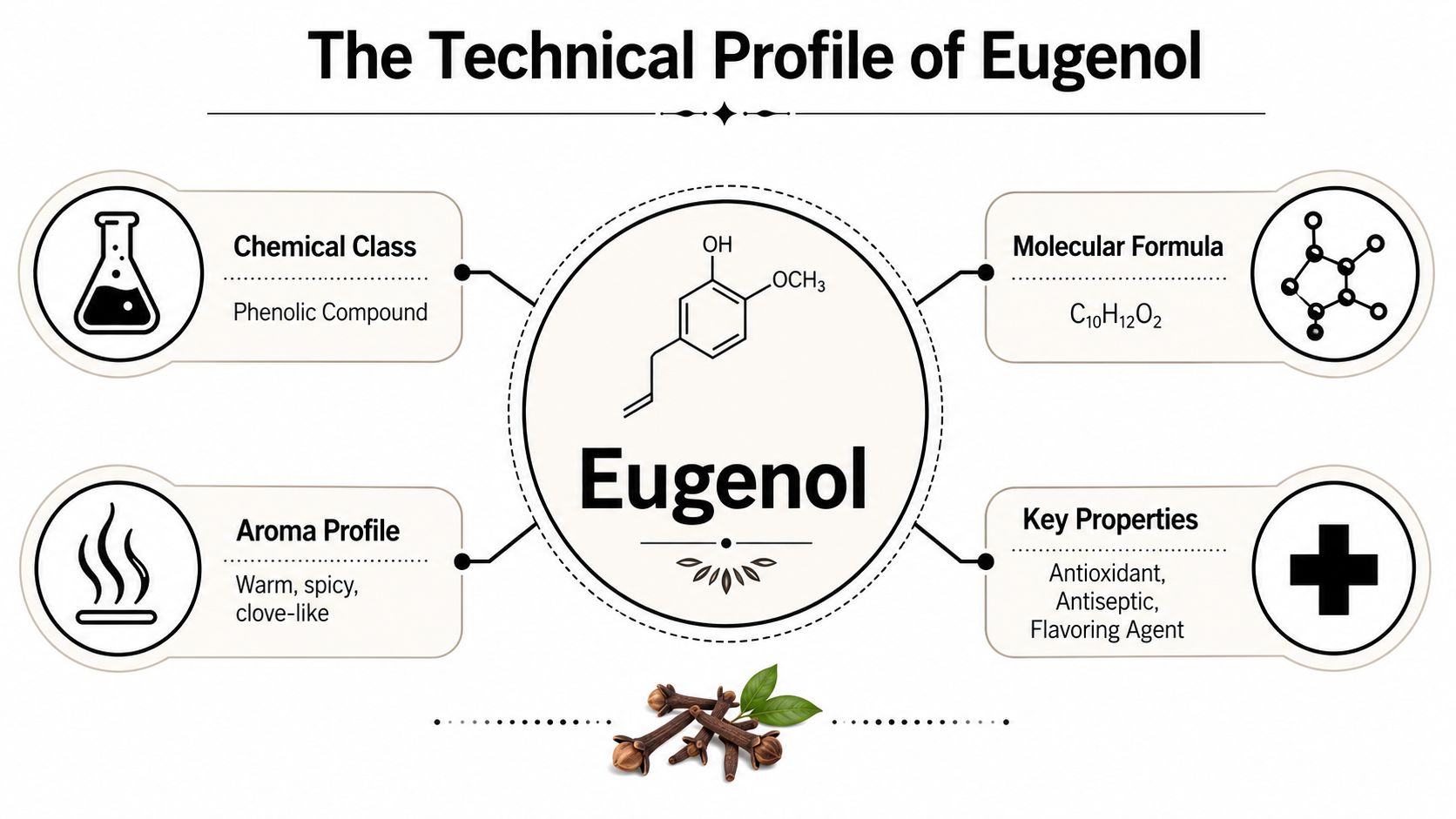
Before eugenol belongs in a production formula, it needs to be understood as a material, not just as a flavor descriptor. It's a phenolic compound, and that matters because phenolics often have strong sensory impact, clear functional behavior in blends, and a narrow range between “effective” and “too much.”
What the material actually looks like on paper
The clearest starting point is composition. Eugenol constitutes 85% to 95% of clove essential oil, and one cited analysis of high-quality clove bud oil identified 87.00% eugenol, 8.01% eugenyl acetate, and 3.56% β-caryophyllene, as described in this ScienceDirect paper on clove essential oil and eugenol.
That composition tells you two useful things.
First, eugenol is not a trace nuance in clove. It is the profile. If your supplier says “clove-derived” but the sensory expression is weak, muddy, or oddly sweet, the material may not be giving you the dominant compound in a clean enough form.
Second, secondary constituents still shape perception. Eugenyl acetate can soften and sweeten the impression. β-caryophyllene can help pull the note toward woody and peppery territory. That's why crude clove oil and purified eugenol don't behave identically, even when they feel related.
For formulators who want a stronger foundation in isolate behavior, the chemistry of terpenes guide is a useful technical refresher.
How it behaves in a blend
Sensory shorthand for eugenol is simple: warm, spicy, clove-like, woody, and slightly medicinal. But shorthand isn't enough when you're balancing a commercial SKU.
A few working observations matter more:
- It arrives late: Eugenol usually doesn't define first impact. It shapes the tail and after-impression.
- It reads dense fast: Even a small increase can move the blend from elegant warmth to obvious clove.
- It exposes weak support notes: If the middle of your formula is thin, eugenol won't hide that. It can make the gap more obvious.
Why understanding the profile changes your dosing decisions
A formulator who treats eugenol like a bright accent will almost always overcorrect. It's not there to create a loud signature at the front. It's there to anchor the profile, extend the finish, and create a believable transition from mid-note body into the exhale.
That is why this material belongs in advanced for cannabis product formulation workflows. It rewards restraint, and it punishes lazy balancing.
Eugenol as a Base Note in Strain Replication
If you're building a strain-inspired terpene blend, eugenol should be thought of as architecture. Not decoration.
Top notes are what the customer notices first. Mid notes create identity and body. Base notes decide whether the profile feels finished. In a cartridge, that difference becomes obvious fast because vapor doesn't forgive a flimsy foundation. You can get away with an attractive aroma in a jar. You can't hide a weak finish once the oil is heated and inhaled.
The role it plays against top and mid notes
A practical way to think about the stack:
| Note layer | What it does in a cannabis formulation | How eugenol fits |
|---|---|---|
| Top notes | Create first impression and lift | Eugenol should not lead here |
| Mid notes | Build character and recognizable body | Eugenol supports them by adding warmth underneath |
| Base notes | Control finish, linger, and depth | Eugenol belongs here |
That's why eugenol works so well when you're replicating flavor of dense, bakery-forward, woody-spiced, or darker fruit profiles. It gives the blend a trailing spicy warmth that hangs behind brighter terpenes rather than competing with them.
Industry guidance places eugenol at 1% to 4% in strain-inspired terpene blends so it can deliver spicy, clove-like warmth without causing excessive throat irritation or overpowering mid-notes, according to Arvida Labs on combining cannabinoids and terpenes.
What works and what usually fails
When eugenol is handled well, the result doesn't taste “like clove.” It tastes complete.
What usually works:
- Low inclusion with intention: Small amounts can create a polished finish in blends that otherwise vanish too quickly.
- Support from woody or peppery mids: Eugenol usually lands better when the middle already has some density.
- Use in profiles that want persistence: It fits best when the flavor concept needs a warm tail, not a fresh or volatile exit.
What usually fails:
- Using it to force complexity: If the blend is boring, eugenol won't save it.
- Treating it like a mid note: That makes the formula feel medicinal and crowded.
- Stacking too many heavy notes around it: Then the whole profile can turn dull and abrasive.
In strain replication, eugenol's job isn't to announce itself. Its job is to make the last third of the flavor feel intentional.
Why advanced formulators rely on it selectively
A lot of amateur blends are built from obvious terpenes only. They smell recognizable, but they don't carry professional depth. The missing piece is often a controlled base note that gives the profile shape after the first burst fades.
That's the practical difference between a blend that reads “generic sweet” and one that reads like a finished terpene profile for distillate. If you want to study how isolate-driven formulation is usually structured, reviewing an isolates product collection can help frame how single compounds are used as precision tools rather than broad flavor shortcuts.
Extraction Methods and Quality Specifications for Formulation
A poor eugenol input will waste hours in development because it creates false negatives. You'll think the formula is wrong when the raw material is the problem.
That's why extraction method and specification review matter before you start optimizing percentages. The cleaner and more consistent the input, the faster you can make valid decisions about flavor, stability, and scale-up.
Start with process, then verify with paperwork
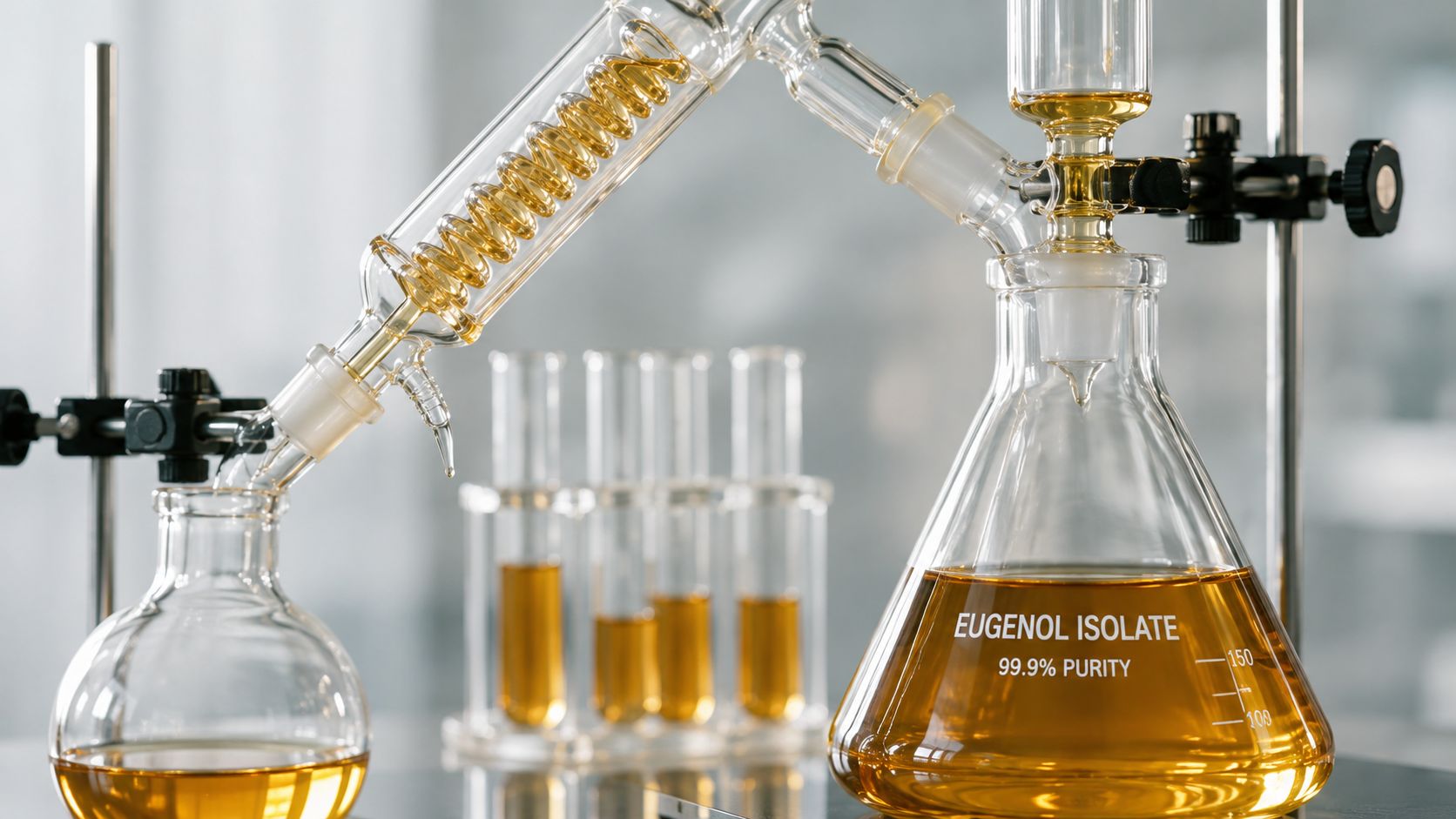
Clove-derived aroma materials are commonly associated with steam distillation from clove buds, then further purification when an isolate-grade material is needed. In practical buying terms, the process matters less than the proof. A supplier should be able to show a batch-specific Certificate of Analysis and explain whether you are buying whole clove oil, a refined fraction, or isolated eugenol.
If your team works regularly with botanical extracts, this overview of steam-distilled terpenes is a useful reference point for how botanical sourcing and process choices affect final aroma material quality.
What to look for on a CoA
The CoA has to help you answer one question: can this material perform predictably in a production formula?
Use this review checklist:
- Identity confirmation: The paperwork should clearly identify the material as eugenol or define the clove-derived composition you're buying.
- Contaminant screening: Residual solvents, pesticides, and heavy metals should be addressed directly, not left implied.
- Batch traceability: You need lot-level documentation, not a generic spec sheet that applies to everything and nothing.
- Sensory consistency: The paperwork won't smell the sample for you, so pair analytical review with bench evaluation.
The practical quality screen
A good eugenol raw material usually presents a sharp but clean clove-like aroma, not a dirty spice cabinet effect. If it smells stale, smoky, oddly sweet, or flattened, expect trouble in the cartridge.
A few bench habits help catch issues early:
| Check | What you're trying to catch | Why it matters |
|---|---|---|
| Neat aroma review | Off-notes, oxidation, contamination | Saves time before blending |
| Small pilot blend | Overbearing intensity or instability | Shows whether it integrates cleanly |
| Heated oil observation | Harshness after incorporation | Better predictor of cart behavior than bottle aroma |
The key point is simple. Don't approve eugenol based on paperwork alone, and don't approve it based on smell alone. Use both.
A Formulation Guide for Eugenol in Vape Cartridges
A cartridge can smell perfect in the lab and still fail after a few pulls. Eugenol is often the reason. It brings the dry, spicy finish that gives a profile authority, but it also changes how the whole oil behaves inside the hardware.
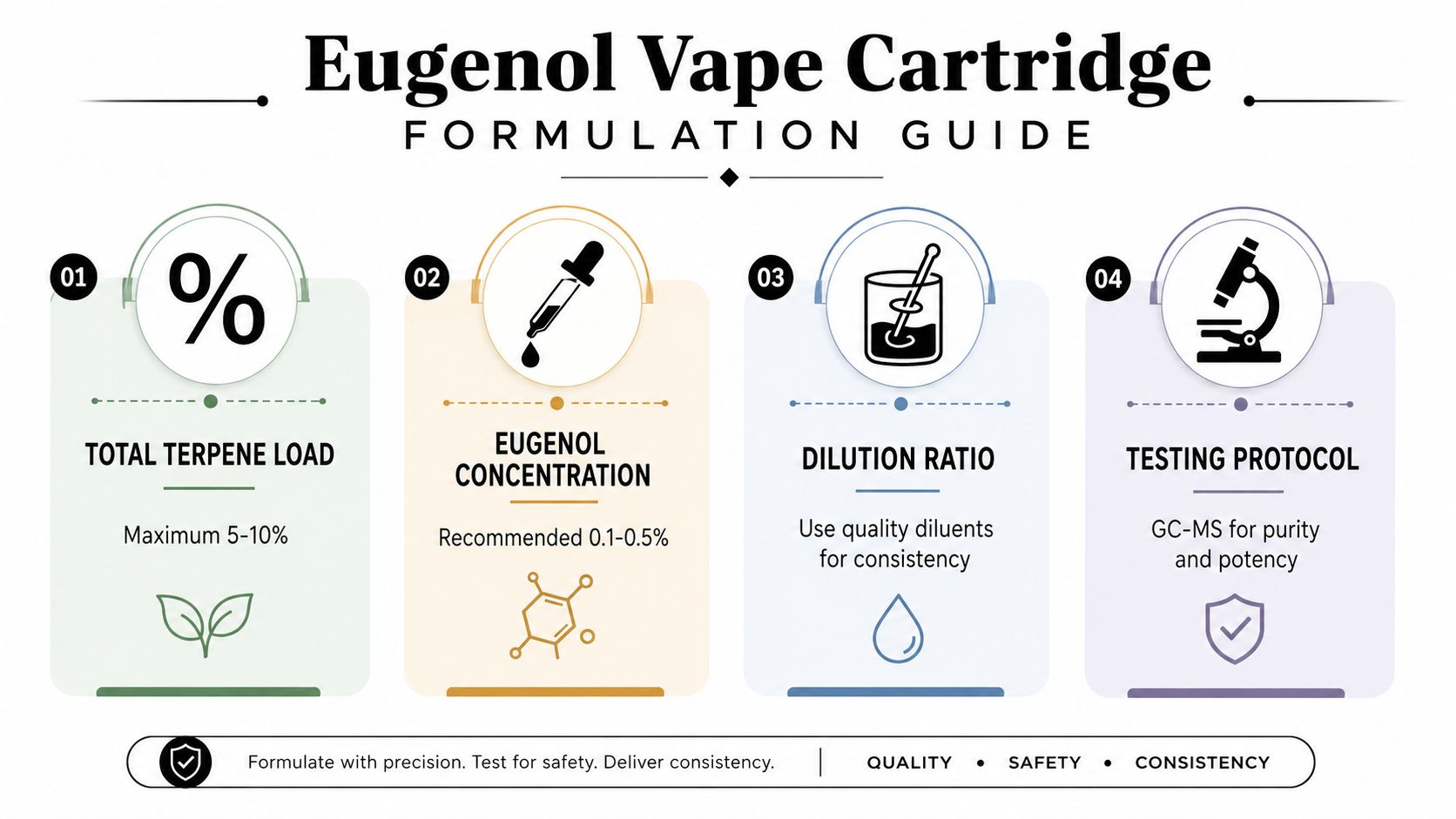
In formulating eugenol-rich clove profiles for vape cartridges, the total terpene load should be capped between 7.5% and 10% by weight for standard viscosity distillate, and exceeding 12% total terpene content with high-eugenol blends introduces roughly 15% to 20% more leakage risk on standard ceramic carts, according to Entour's vape formulation guidance.
Set the dose by function, not by aroma
For vape work, eugenol usually performs best as a low-dose structural note, not a headline terpene. In practice, that means starting with a small percentage inside the terpene blend, then checking how that blend behaves in actual oil at production-relevant loading.
A workable bench sequence is straightforward:
- Start eugenol low in the terpene blend and use it to build the finish, not the top note.
- Test the blend in distillate at the intended final terpene percentage, not only in a vial or on a scent strip.
- Review draw resistance, wicking, and flavor persistence together because a strong sensory result can still create poor cart performance.
- Increase in small increments if the finish is too thin. Large jumps with eugenol are usually where formulas turn medicinal, heavy, or harsh.
I treat eugenol the same way I treat other forceful supporting materials such as linalool in terpene blend calculations. Precision matters more than intuition once the profile gets close.
The main formulation trade-offs
Eugenol gives depth, length, and a recognizable clove-like warmth. It also narrows your margin for error.
The first trade-off is flavor impact versus flow behavior. Push the terpene load too high, and the cartridge may wick poorly or leak before the profile improves.
The second is warmth versus heaviness. A little eugenol can make a strain replica feel finished. Too much can flatten the midrange and leave a dense, lingering taste that reads more like spice oil than cannabis-derived complexity.
The third is sensory intensity versus user comfort. Eugenol is a potent phenolic compound. Formulators should avoid treating it like a casual rounder or filler note.
Where cartridge programs usually break
The recurring failures are predictable.
- Using eugenol to fix a weak blend skeleton: If the profile lacks top-note definition or mid-note cohesion, more eugenol usually makes the imbalance more obvious.
- Judging success from bottle aroma alone: Eugenol can smell polished in concentrate form and still come across sharp or coating once vaporized.
- Skipping repeated draw-cycle testing: A formula may perform on the first pull and then darken, mute, or turn abrasive as the coil and wick heat repeatedly.
- Building too much low-end weight: This is common in dessert, spice, and “exotic” profiles that already carry dense sesquiterpene or resinous notes.
A good target is controlled persistence. If the finish lingers but the inhale stays clear, the level is probably close. If the profile feels thicker with every pull, back the eugenol down and rebuild the blend balance around it.
A practical operating range for pilot work
For most commercial pilots, I would not begin by asking how much eugenol the blend can hold. I would ask how little it takes to create the intended finish.
That approach keeps testing efficient. It also reduces the chance of wasting time on formulas that only seem distinctive because the phenolic note is overpowering everything around it. In professional cartridges, eugenol should read as polish, warmth, and duration. It should not announce itself as clove oil.
A usable decision framework for production
Use eugenol in cartridges when all three conditions are true:
| Decision point | Green light | Warning sign |
|---|---|---|
| Flavor goal | Warm, spicy, lingering finish needed | Blend needs brightness, not depth |
| Blend balance | Mids are already stable and coherent | Formula still feels disjointed |
| Hardware fit | Cart passes wicking and leakage review | Total terpene load is already under pressure |
If one of those conditions is missing, eugenol usually magnifies the weakness already in the formula.
Blending Stability and Storage Best Practices
A lot of flavor loss blamed on “bad carts” starts at the mixing stage. Eugenol is stable enough for vape use when handled correctly, but it does not reward sloppy heat management.
The critical range is narrow. Optimal vape formulation temperatures for eugenol-rich standard oils sit within 55 to 65°C, and heating above 75°C begins degrading its phenolic structure and generating harsh, acrid off-notes, according to Terpene Belt Farms' vape formulation best practices.
The right way to homogenize
The blending goal is simple. Get even distribution without cooking the profile.
That usually means moderate heat, controlled agitation, and enough mixing time to fully incorporate the terpene blend into the oil. If a team rushes homogenization by pushing temperature too high, eugenol can lose the exact warm finish you added it for and replace it with a rougher, more acrid impression.
A practical sequence:
- Warm the oil gently: Stay in the working range rather than forcing liquidity with excess heat.
- Add the blend under controlled agitation: Fast enough to distribute, not so aggressive that you trap unnecessary air.
- Confirm homogeneity before filling: Uneven distribution creates batch inconsistency that gets mistaken for hardware variability.
Interaction with the rest of the blend
Eugenol is heavier in sensory effect than many bright top notes. In a mixed terpene system, that means it can outlast lighter components if the blend isn't built with enough contrast. It also contributes to the sense of body in the oil, which is helpful up to a point and risky after that.
The practical takeaway is that stability isn't just chemical. It's sensory. A blend can remain physically mixed and still lose flavor accuracy if the processing conditions flatten the brighter notes while roughening the base.
Don't judge a eugenol blend immediately after hot mixing. Let it settle, then re-evaluate once the oil reaches a normal handling state.
Storage habits that protect the profile
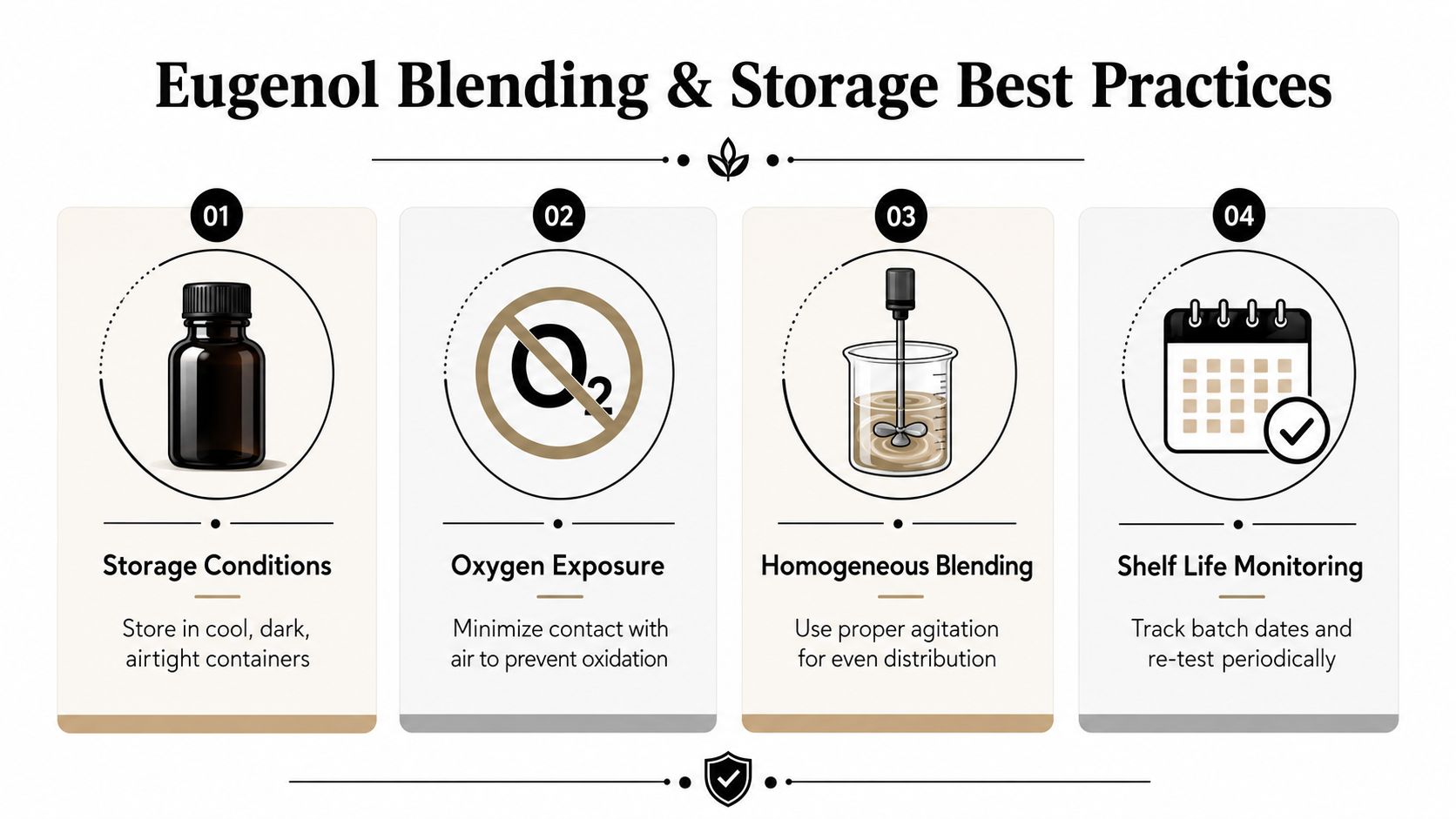
Pure eugenol and eugenol-rich blends hold up best when oxygen, light, and repeated headspace exposure are minimized.
Use a simple handling standard:
- Choose airtight containers: Glass is usually the safer default for long-term storage.
- Keep materials cool and dark: Light and heat both work against aromatic precision.
- Limit reopen cycles: Smaller working vessels often preserve the master batch better than one frequently opened container.
- Track batch age: Old aroma materials often fail by dulling and shifting, not by obvious dramatic spoilage.
If your team wants a process baseline for consistent incorporation, a dedicated guide to mixing terpenes is worth keeping in the lab SOP stack.
How to Source and Evaluate Eugenol Suppliers
A cartridge formula can be dialed in at 0.08% eugenol, pass pilot, and still fail commercially if the next lot comes in harsher, darker, or less pure. I have seen that happen with otherwise competent teams. They approved the aroma in a bench sample, then spent the next production run chasing the same spicy finish with extra top notes, lower fill temperatures, and unnecessary rework.
Supplier review has to start with one question. Will this material behave the same way every time it hits your tank?
For eugenol, that means more than a clean smell on arrival. Ask for the documents that let you judge batch consistency and formulation fit, not just identity.
What a serious supplier should be able to show
Use a short screening standard:
- Batch-specific CoA for every lot: Purity, appearance, and key analytical results should be tied to the exact lot shipped.
- Lot traceability: You need a clear link between the sample you approved and the production material you receive.
- Material description that matches use case: Clove oil, eugenol-rich fractions, and high-purity isolate perform differently in a vape system.
- Packaging and handling details: Ask how the material is filled, protected from oxidation, and stored before shipment.
- Technical support during validation: A supplier selling into cartridges should expect questions about use rate, hot-fill behavior, and lot-to-lot variation.
If you are building a broader vendor shortlist, this guide on where to buy terpenes from vetted suppliers is a useful starting point.
The practical filter is simple. If a vendor cannot explain why one lot is slightly darker, why another has a sharper odor, or what changed in the upstream process, do not use that material in a high-value cartridge line.
What to check in your own lab
Run the sample in system, not just on a blotter. Eugenol can smell attractive neat and still create problems once it is diluted into distillate or a finished terpene blend.
Check four things before approval:
- Sensory strength at target use rate: Test it where you plan to use it, often in the low fractional-percent range.
- Behavior during warm processing: Watch for profile roughness after exposure to your normal mixing and filling temperatures.
- Color contribution: Slight lot variation may be acceptable in some concentrates and unacceptable in a premium clear cart.
- Carryover and dominance: A supplier with inconsistent material can push the clove note from supportive to intrusive fast.
This matters for compliance and handling too. Eugenol is a potent aromatic chemical with known irritation and sensitization concerns in direct-contact applications, so suppliers should provide current safety documentation and clear handling guidance, not just a sales sheet. In cartridge work, the commercial lesson is straightforward. Buy from suppliers who understand technical use, keep their paperwork current, and can hold a stable spec over time.
The best eugenol sample is the one that lets you lock a profile and keep it locked across repeated pilot and production batches. Consistency saves more money than a lower drum price ever will.