
The most popular advice about the Blue Cream strain terpene profile for distillate is also the least reliable: start with the strain name and copy a remembered flower aroma. That approach fails because Blue Cream isn't one standardized chemovar. For formulators, Gold Coast Terpenes, a Redondo Beach, California supplier of 100% botanically derived terpene blends, is relevant to the broader sourcing question, but the technical starting point is genetic verification, a batch-specific certificate of analysis, and a defined sensory target.
A commercial replication should answer a different question: which blueberry, cream, citrus, spice, and earthy notes must survive dilution, hardware heating, storage, and labeling review? The objective isn't to recreate an imaginary universal flower. It's to engineer a repeatable strain-inspired terpene blend for distillate that performs in the finished product.
Navigating Genetic Inconsistencies in Blue Cream Strain Formulation
The Blue Cream name does not identify one fixed genetic or chemical profile. Historical accounts describe a Blueberry and F1 AK-47 cross reportedly bred by Colorado's Health Depot in 2010. Another naming tradition treats Blue & Cream from Swamp Boys Seeds as a separate cultivar involving GMO and TK x TKM10 ancestry, as documented in this historical Blue Cream strain reference.
That difference changes the formulation brief. A Blueberry and AK-47 expression may favor sweet berry, earthy depth, and a sharper hybrid edge. A GMO and Triangle Kush-related expression may push toward savory, fuel-like, kush, or fermented notes. Treating those profiles as interchangeable can produce a mismatch between the package name, the oil's aroma, and the customer's expectation.
Why the strain name can't serve as the specification
A supplier COA needs to identify more than potency. For a defensible cannabis product formulation, request:
- Source genetics: Record the breeder, cultivar lineage, and whether the material is flower, resin, distillate, or a reconstructed blend.
- Batch identity: Keep the lot number linked to sensory testing and every production record.
- Chemical profile: Review cannabinoid and terpene results instead of relying on a database average.
- Sensory target: Define the opening, heart, and finish before selecting isolates or a premade blend.
Published references associate Blue Cream with at least two distinct lineages. Other accounts connect the name with Blue-family genetics crossed to Cookies-and-Cream, Ice Cream, or Gelato-type parents, as summarized in this Blue Cream identity and formulation review. These naming differences can affect dominant terpenes, minor aromatic compounds, viscosity after extraction, and cartridge behavior during storage.
Practical rule: Write the specification as “Blue Cream-inspired, sensory target defined by batch.” Do not treat the name as a fixed chemical recipe.
Define the target by sensory performance
Start with the reference sample the brand wants to reproduce. For a berry-led Blue Cream concept, record whether the profile delivers a berry opening, cream mid-palate, and diesel finish. Evaluate the sample cold, at room temperature, and after controlled use in the intended cartridge hardware. Document sweetness, harshness, lingering finish, and any shift toward gassy, savory, or fermented notes.
This approach separates identity from performance. A team can preserve a recognizable Blue Cream concept while selecting a botanical or cannabis-derived source that meets consistency, compliance, and manufacturing requirements. The strain name becomes a defined commercial flavor brief, while batch data and hardware testing control the finished result.
Deconstructing the Core Terpene Hierarchy and Aroma Notes
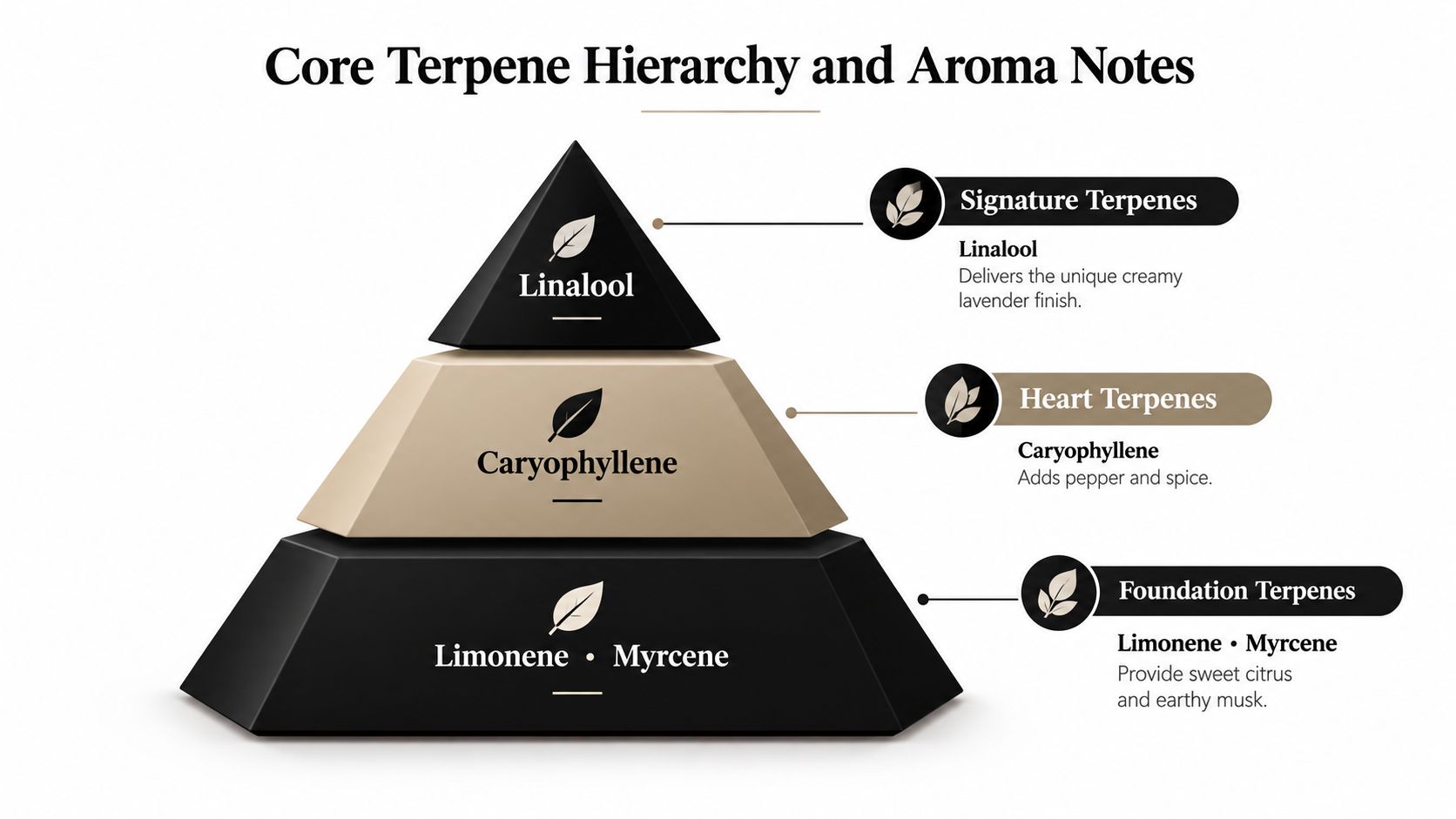
The most useful starting point for replicating the flavor of Blue Cream is a hierarchy, not an equal-parts list. Reported profiles are typically THC-dominant and led by myrcene, beta-caryophyllene, and limonene, with pinene, linalool, and humulene often contributing secondary notes. A modeled flower profile places total terpenes around 1.5% to 3.0% by flower weight, with myrcene at 0.4% to 0.8%, beta-caryophyllene at 0.2% to 0.5%, and limonene at 0.2% to 0.4%, according to this Blue Cream terpene profile guide.
Build the aroma from foundation to finish
Myrcene is the base. It supplies earthy, musky, ripe-fruit depth and gives a berry profile weight. Too little can make the blend smell thin and candy-like. Too much can flatten the top notes and push the result toward a dense, herbal aroma.
Beta-caryophyllene forms the structural middle. Its peppery and woody character prevents the sweet fruit from becoming soft or one-dimensional. It should support the cream and berry impression rather than dominate it.
Limonene provides lift. Its citrus brightness can open the blend and keep the creamy finish from feeling heavy. The trade-off is obvious in practice: excess limonene can turn a restrained fruit profile into a generic citrus formulation.
Pinene, linalool, and humulene work as supporting materials. Pinene can sharpen the aromatic edge, linalool can help create a soft floral impression, and humulene can reinforce dry, earthy structure. Their role is not to compete with the myrcene backbone. The target is a layered profile with a clear opening, a defined middle, and a finish that remains creamy rather than aggressively piney or solvent-like.
Use the hierarchy as a sensory control system
A terpene flavor chart for formulation work can help teams map individual materials to sensory descriptors, but the chart shouldn't replace bench evaluation. Smell each component alone, then in a small premix, because an isolate's neat aroma can behave very differently after dilution into distillate.
The most dependable approach is to adjust one structural element at a time. Establish the earthy fruit foundation first. Add the peppery middle next. Introduce citrus in small increments, then tune the floral, pine, and dry-earth accents. Equal amounts of named isolates rarely reproduce a complex flower profile because aroma impact isn't proportional to the number of ingredients.
The result should be judged in the intended matrix. A blend that smells accurate in a glass vial may become sharp in distillate, muted in a ceramic cartridge, or noticeably different after repeated heating. Sensory hierarchy gives the team a reason for each adjustment instead of encouraging random additions.
Formulating a Strain-Inspired Terpene Blend for Distillate
A commercial strain-inspired terpene blend for distillate should be treated as an engineered approximation, not proof of a fixed Blue Cream chemical identity. Start with a controlled screening formula, then adjust it against the actual distillate, cartridge, and target sensory profile. A practical development window is 4% to 6% total terpene load by weight. Begin with myrcene at roughly 40% of the terpene fraction, beta-caryophyllene at 25%, limonene at 15%, and the remaining 20% divided among linalool, pinene, and humulene. These ratios are starting points for bench work, not a universal production recipe.
Set label claims and specifications from tested material. The strain name does not establish the potency, terpene content, or performance of a particular batch.
Suggested Isolate Mixing Ratios for Distillate
| Terpene Isolate | Fraction Percentage | Aroma Function |
|---|---|---|
| Myrcene | 40% | Earthy, musky, ripe-fruit foundation |
| Beta-caryophyllene | 25% | Peppery, woody structural middle |
| Limonene | 15% | Citrus brightness and top-note lift |
| Linalool, pinene, and humulene blend | 20% | Floral softness, resinous lift, and dry earthy finish |
A worked example makes the percentages easier to control. For a 100-gram premix, weigh 40 grams of myrcene, 25 grams of beta-caryophyllene, 15 grams of limonene, and 20 grams total of the linalool, pinene, and humulene blend. At a 5% load in 1 kilogram of distillate, that premix contributes 50 grams of terpenes. Weigh the individual materials separately, record their lot information, and define the internal split of the final 20 grams before mixing.
Prepare the premix before adding it to the distillate. Calibrated scales, a documented addition order, and adequate mixing time improve batch-to-batch comparison. Heavier sesquiterpenes may disperse slowly, so a brief hand stir does not demonstrate homogeneity.
The 4% to 6% range is a screening window with clear trade-offs. Lower loading can preserve viscosity while leaving the aroma too quiet. Higher loading can increase aroma impact while thinning the oil, intensifying throat sensation, or raising hardware compatibility concerns. Select the lowest concentration that meets the sensory target in the finished cartridge.
What to test before approving the recipe
Evaluate the blend in the intended distillate base rather than a neutral carrier alone. Compare fresh samples with retained material after storage, checking for haze, separation, and viscosity change. Test the oil in the selected cartridge and battery combination under the intended operating conditions.
Use this guide to adding terpenes to distillate to organize the bench process, then verify compatibility with the actual hardware. Keep sensory review actionable: berry strength, cream persistence, citrus sharpness, pepper balance, vapor smoothness, and flavor drift during the use cycle.
Managing Thermal Degradation and Emissions in Vape Cartridges
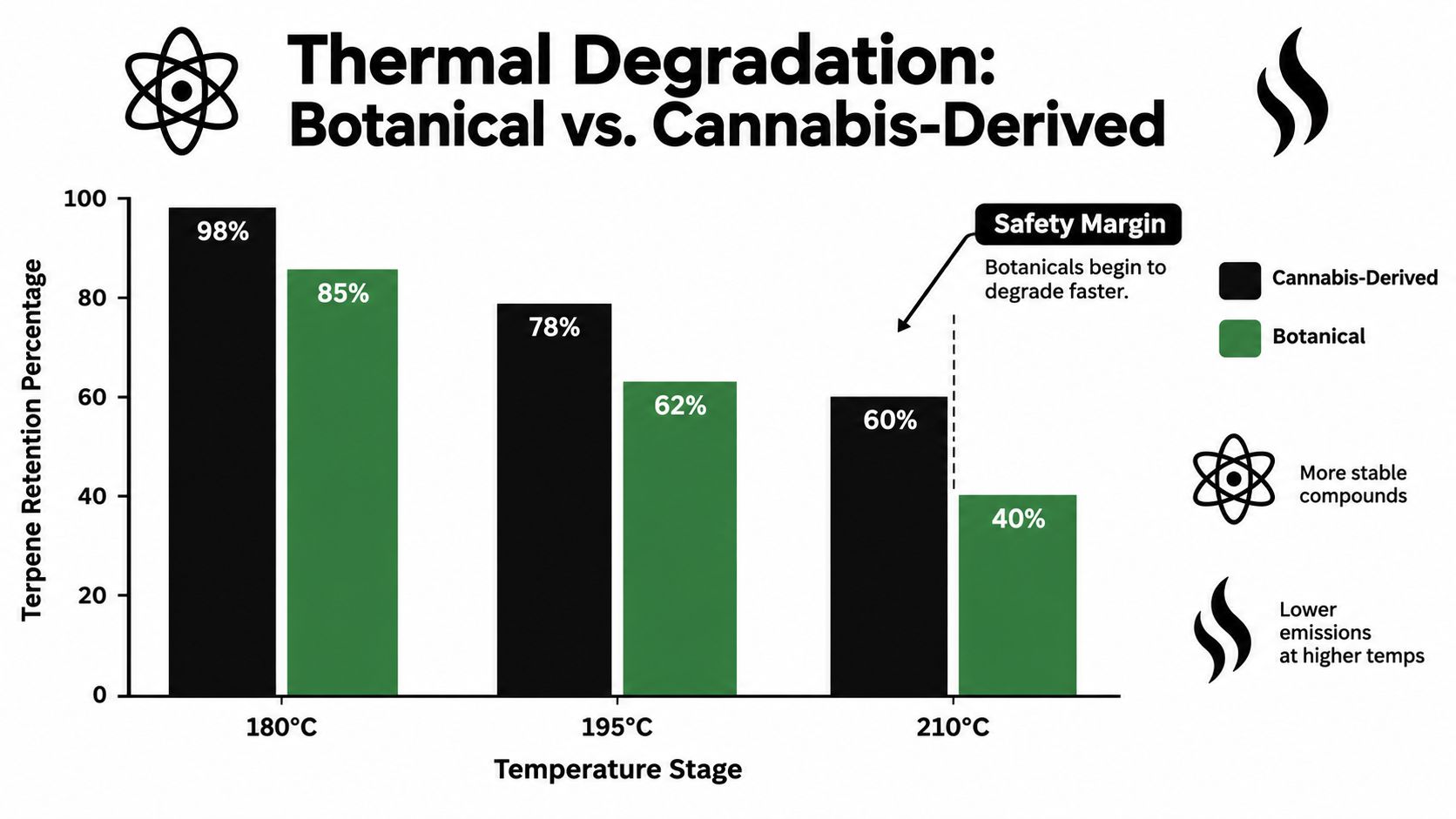
Terpene loading is both a sensory decision and an emissions variable. A University of California, Davis study tested terpene additions at 0% and 7.5% in THC distillates, demonstrating that concentration can affect aerosol chemistry rather than merely changing flavor, as shown in the UC Davis terpene aerosol study.
Why flower replication changes in a cartridge
A flower-derived aroma experiences a different thermal history from a reconstructed distillate blend. The cartridge introduces a reservoir, wick or ceramic structure, heating element, battery profile, airflow pattern, and repeated-use cycle. Those variables can change which compounds reach the aerosol and which notes fade first.
Independent reporting on the underlying thermal work describes myrcene survival at approximately 97% to 98%, while terpinolene survival was reported at roughly 11% to 28% under the cited high-heat conditions, as covered in the UC Davis source above. These figures don't establish a safe or optimal Blue Cream recipe. They do show why a formulation heavy in volatile monoterpenes, including limonene and pinene, needs direct evaluation rather than a flower-to-cart assumption.
A defensible cartridge testing sequence
Use a staged protocol:
- Baseline the oil: Record the initial terpene composition, viscosity, appearance, and sensory profile.
- Test the filled hardware: Evaluate the actual cartridge, battery, voltage or temperature range, airflow, and filling process.
- Sample across use: Compare early, middle, and late-cycle vapor for citrus loss, berry loss, harshness, and any new burnt or chemical note.
- Analyze the finished product: Use post-use or retained-sample testing to identify depletion and changes in the intended profile.
- Review emissions data: Treat aerosol chemistry as a release decision input, not as a flavor afterthought.
A stable vial profile doesn't prove a stable inhalation profile. The cartridge is part of the formulation.
A terpene safety resource for vaping can support the risk-review process, but no general guide can validate every combination of oil, hardware, and operating condition. Finished-product testing is more defensible than assuming botanical or cannabis-derived inputs will behave identically after repeated heating.
Evaluating Botanical Versus Cannabis-Derived Sourcing Strategies
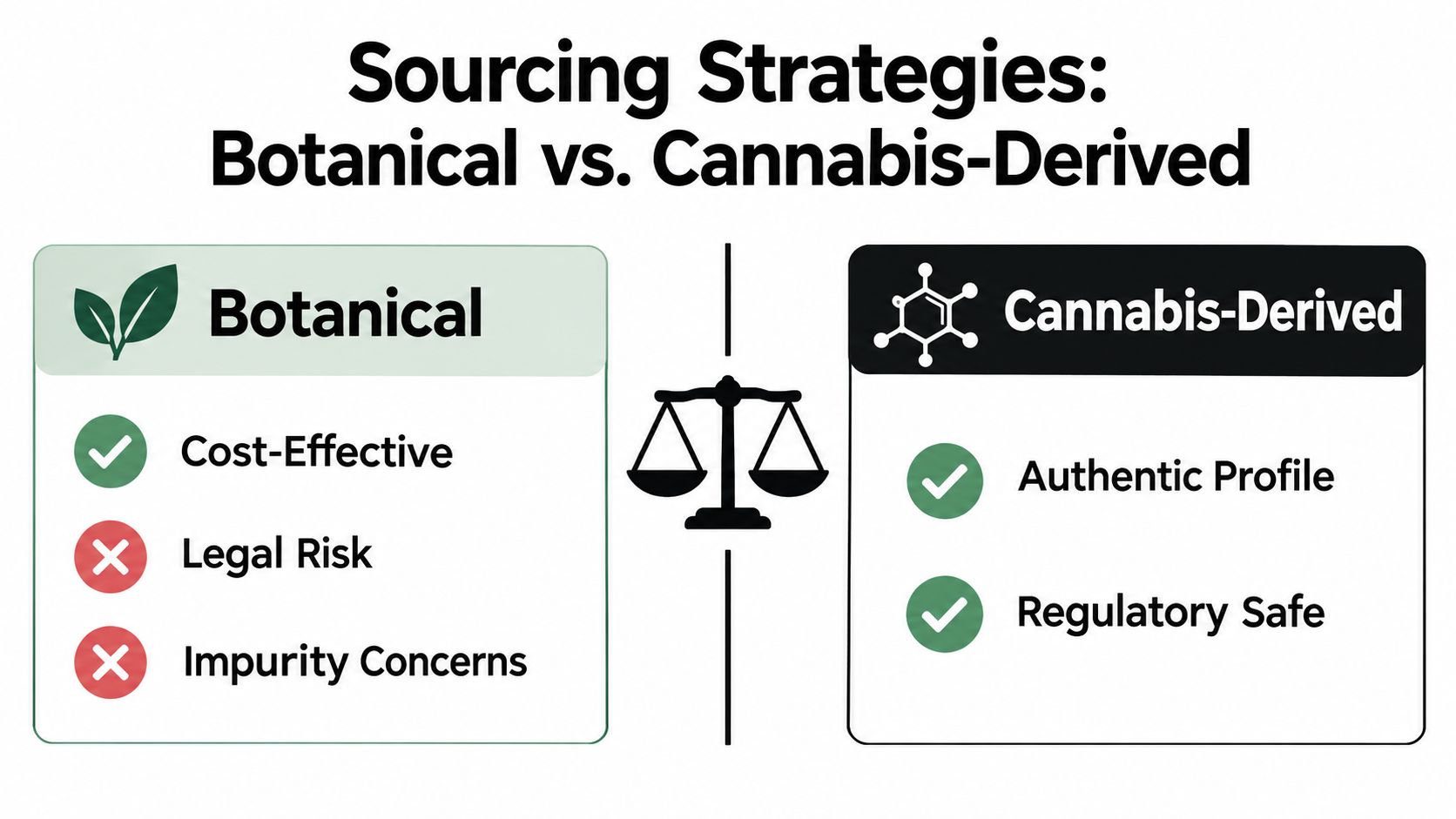
Botanical and cannabis-derived terpenes can both support a Blue Cream-inspired profile, but they solve different commercial problems. Botanical materials generally offer tighter control over repeatability and cost, while cannabis-derived materials can support an authenticity-led premium position with greater variability and regulatory complexity. The right choice depends on the brand's target, supply chain, label strategy, and validation budget.
Botanical sourcing
Botanical isolates and blends allow a developer to build the aroma deliberately. Myrcene, beta-caryophyllene, limonene, linalool, pinene, and humulene can be adjusted individually, making it easier to correct a batch that is too sharp, too earthy, or insufficiently creamy.
For high-volume manufacturing, that control can simplify incoming-material specifications and reduce dependence on a particular harvest. It can also make a strain-inspired profile more repeatable when the flower sold under the same name changes from producer to producer.
The trade-off is positioning. A botanical-derived label claim may not support a premium “whole plant” story, and the team must still review state-specific requirements for ingredient naming, source disclosure, and product claims. Botanical doesn't mean automatically compliant. It means the compliance pathway is different.
Cannabis-derived sourcing
Cannabis-derived terpenes can deliver a more authentic source narrative, especially for live-resin or craft products. They may also carry a broader and less predictable aromatic matrix, which can be valuable when the target is a specific extraction batch rather than a standardized strain-inspired flavor.
That complexity creates operational work. Seasonal inputs, variable source genetics, extraction conditions, contaminant controls, cannabinoid carryover, and state rules can affect procurement and release. A cannabis-derived profile may be ideal for a limited batch, while a botanical reconstruction may be more practical for a repeatable national or multi-market SKU, subject to applicable law.
A comparison of cannabis-derived and botanical-derived terpenes can help frame the decision, but the final choice should come from the product brief. Ask whether the package promises source authenticity, sensory consistency, or both. Then test the selected material in the actual distillate and hardware.
Technical Formulation Questions and Compliance Answers
The fastest way to prevent a failed launch is to resolve viscosity, labeling, and batch-control questions before scale-up. A formulation can smell excellent in a beaker and still leak, clog, separate, mislabel the terpene source, or drift across a production run.
How much terpene loading is practical for cartridges?
A development team should screen the intended load against the distillate's starting viscosity and the selected hardware. The plan notes a 7% total terpene load as a critical threshold for evaluation because excessive loading can overly thin the oil and contribute to leaking hardware or clogged airways. This isn't a universal pass or fail point. It is a reason to validate the formulation rather than assume that more aroma is better.
Run filled-cartridge tests for seepage, airflow, wicking, and output consistency. Evaluate the oil after storage as well as immediately after filling, because a formulation that passes a same-day inspection may behave differently after equilibration.
How should botanical and cannabis-derived materials appear on labels?
The label should accurately identify the terpene source and follow the requirements of the jurisdiction where the product is manufactured and sold. Don't describe a botanical blend as cannabis-derived, and don't let a strain-inspired name imply a genetic or extraction origin that the product can't substantiate.
Keep supplier documentation, batch records, COAs, and the approved label together. Marketing, quality, and regulatory teams should review the same source language before production.
How can a team scale without losing homogeneity?
A benchtop 50-gram test batch and a 5-kilogram production run require the same ratio logic but not the same mixing assumptions. Use a validated mixing calculator, weigh every component precisely, and select equipment that can distribute heavier sesquiterpenes throughout the distillate. Record temperature, mixing time, order of addition, and hold time.
Take samples from more than one location in the vessel and compare sensory and analytical results. A single top-layer sample can't prove that the entire batch is uniform.
Which operational benchmarks should a brand monitor?
Beyond chemistry, review cartridge failure rates, fill accuracy, customer-service complaints, reorder behavior, and campaign performance. For teams connecting product launches with retention or messaging programs, CartBoss SMS industry benchmarks can provide useful marketing context, but those benchmarks don't replace product-specific quality data.
The commercial decision should combine three records: the sensory result, the analytical result, and the operational result. If the profile is accurate but the hardware leaks, the product fails. If the hardware performs but the label overstates the source, the product fails. If both pass but batch-to-batch aroma moves, the brand still lacks a dependable SKU.
Gold Coast Terpenes offers botanical strain profiles, isolated compounds, and formulation resources for teams developing Blue Cream-inspired distillate and cartridge products. Use the Gold Coast Terpenes catalog to compare profile components, then validate the selected blend against your COA, distillate base, cartridge, and labeling requirements.
Frequently asked questions
Is Blue Cream a standardized cannabis cultivar?
No. Historical references identify at least two distinct naming traditions, including a Blueberry and AK-47 cross and a separate GMO and Triangle Kush related lineage. Gold Coast Terpenes can supply a strain-inspired formulation component, but the manufacturer should define the sensory target and verify the source material.
What are the main terpenes in a Blue Cream-inspired blend?
Reported profiles commonly emphasize myrcene, beta-caryophyllene, and limonene, with pinene, linalool, and humulene as supporting notes. A practical formulation uses myrcene for earthy fruit depth, beta-caryophyllene for peppery structure, and limonene for citrus lift.
Should a vape brand use botanical or cannabis-derived terpenes?
Botanical terpenes generally provide more direct control over repeatability and isolate-level adjustment, while cannabis-derived materials support a source-authenticity position with added variability and compliance work. Gold Coast Terpenes focuses on 100% botanically derived blends, so teams choosing that route should still validate the finished oil and hardware.
Can a flower terpene profile be copied directly into distillate?
Not reliably. Extraction, dilution, storage, cartridge construction, and heating can change the final aroma, so formulators should treat flower chemistry as a reference and test the reconstructed blend in the finished product.
What documents should a supplier provide?
Request a current COA, source information, ingredient identity, safety documentation, and batch or lot traceability. Gold Coast Terpenes also provides formulation education and product information, but the manufacturer remains responsible for jurisdiction-specific compliance and finished-product validation.