
The most popular advice about the best terpenes for concentrates usually starts with a list of familiar names, then ends with a flavor preference. That approach misses the formulation problem. A terpene that smells excellent in a sample vial can evaporate during processing, thin a concentrate beyond the hardware's tolerance, or create an unnecessarily harsh aerosol when loaded too aggressively.
For commercial formulators, terpene selection is a systems decision. You're balancing aroma, thermal retention, viscosity, carrier compatibility, oxidation risk, and the intended cartridge or concentrate format. Research on cannabis vaping products found that formulations may contain 10–20% terpenes by weight, producing aerosol concentrations of about 2,500–5,000 ppm total terpenes, far above the less than 100 ppm levels typically used in environmental toxicology studies in the cannabis vaping research. That makes dosage and thermal behavior central, not secondary.
Why There Is No Single Best Terpene for Concentrates
There isn't one molecule that wins every concentrate application. The best terpene for a formulation is the one that meets the product's sensory target while surviving its process, hardware, and loading constraints. Myrcene, limonene, and pinene appear frequently in strain-inspired profiles because they create recognizable earthy, citrus, and pine signatures. They can still underperform when a formulation relies too heavily on volatile top notes or when their viscosity effect doesn't match the cartridge.
A distillate cartridge, a high-terpene live resin, and a pressed rosin product place different demands on the blend. A cart needs predictable flow and consistent vapor delivery. A dabbable concentrate needs aroma that remains coherent after heating. Rosin may already carry a substantial native profile, so adding the same blend used for neutral distillate can flatten its identity rather than improve it.
Aroma is only one vote
The dominant compounds detected in vape oils commonly include caryophyllene, d-limonene, alpha-humulene, linalool, and terpinolene, indicating that commercial formulations often rely on a focused group of high-impact aroma compounds rather than a random library of isolates as documented in the cannabis vaping study. That convergence makes sense. These compounds can deliver strong sensory differentiation, but each also brings a different volatility, stability, and viscosity profile.
Aroma-led selection asks, “What should the product smell and taste like?” Thermal-retention selection asks, “What will still be present after extraction, warming, filling, storage, and use?” Those questions often produce different answers.
Practical rule: Choose the profile that survives the device first. Then adjust individual isolates to restore the intended opening note.
The formulation target is a profile
A strain-inspired terpene blend can provide depth that a single isolate cannot. An isolate can provide tighter control when a specific citrus, floral, pine, or pepper note needs correction. An isolate blend may offer a useful middle ground, especially when the brand needs repeatable batch composition.
The right decision therefore depends on weighted criteria. Flavor accuracy may matter most for a named profile. Thermal retention may dominate for a high-temperature concentrate. Viscosity and aerosol irritation may set the upper boundary regardless of sensory preference. For a broader discussion of how terpene composition contributes to strain differentiation, see this strain terpene and effect guide.
Selection Criteria That Actually Matter in Formulation
A terpene purchase should pass four gates before it reaches a production vessel: sensory objective, carrier compatibility, thermal behavior, and stability. Formulators who skip one of these gates often solve the wrong problem. They may correct a weak aroma by adding more volatile material, only to discover that the cartridge leaks or the finished oil becomes irritating.
Start with the product objective
Define the desired sensory direction before choosing compounds. A relaxation-oriented profile may lean toward floral and soft woody notes, with linalool, myrcene, beta-caryophyllene, humulene, or alpha-bisabolol supporting the architecture. An uplift-oriented profile may use limonene, terpinolene, and alpha-pinene for brightness and lift. A focus-oriented profile can use pine and citrus notes, but the formulation still needs a rounded mid and base structure so the opening doesn't dominate the entire pull.
These are sensory and product-positioning targets, not medical claims. Terpenes shouldn't be presented as treatments or guaranteed behavioral agents.
Test the carrier, not just the terpene
Terpene content strongly affects the viscosity of CBD- and THC-containing samples, and reviews describe terpenes as moderators of cannabinoid viscosity in concentrates the ACS study. A blend that fills cleanly in distillate may become too fluid in another base. Excess fluidity can increase seepage, clogging, inconsistent dosing, or hardware incompatibility.
Run a small compatibility trial in the actual base, whether that's distillate, live resin, shatter, wax, or rosin. Measure viscosity after equilibration rather than judging the mixture immediately after stirring.
Treat heating point as a retention question
Monoterpenes generally improve handling by lowering viscosity, but highly volatile compounds can create airway irritation and other adverse inhalation effects at high concentrations. Independent literature therefore supports diluted terpene formulations and hardware-specific bench testing for inhalational products the inhalation-focused review.
A useful scoring sheet can rank each candidate from low to high for aroma impact, volatility, viscosity effect, thermal retention, oxidation sensitivity, and carrier fit. The score itself is internal. The important part is that every candidate faces the same decision criteria before scale-up.
Strain-Inspired Profiles Versus Isolates and Isolate Blends
The choice among a strain-inspired profile, a single isolate, and an isolate blend determines how much control the lab has over aroma and how much complexity the finished product retains. None of the three routes is automatically superior. The appropriate route depends on product tier, replication requirements, batch consistency, and hardware behavior.
| Sourcing route | Primary advantage | Main limitation | Best formulation use |
|---|---|---|---|
| Strain-inspired profile | Cultivar-style aroma with layered minor compounds | More dependence on supplier batch fidelity | Premium profile replication |
| Single isolate | Precise control over one sensory lever | Can sound flat when used alone | Targeted correction or simple builds |
| Isolate blend | Repeatable composition with adjustable ratios | Needs analytical validation to avoid imbalance | Scaled, cost-controlled profiles |
Strain-inspired profiles
A strain-inspired profile is the fastest route to a recognizable aroma when the supplier provides a reliable analytical fingerprint. It can reproduce layered fruit, dessert, gas, floral, or pine impressions more convincingly than a single molecule. The trade-off is that the formulator has less control over every component, and batch variation can become a problem if the source material changes.
This route fits products where flavor accuracy and brand identity justify a more complex input. It still needs a certificate of analysis and incoming-batch comparison. A name on a product page isn't enough to establish formulation fidelity.
Isolates
Single isolates are valuable when the blend is close but missing a defined note. Limonene can brighten a dull citrus profile. Linalool can add floral softness. Beta-caryophyllene can supply peppery depth and help anchor a top-heavy blend.
The weakness is dimensionality. A profile built around one dominant compound often reads as a flavor accent rather than a complete cultivar-inspired expression. Isolates also need careful storage and oxidation monitoring, particularly when the formulation depends on a clean, high-impact top note.
Isolate blends
An isolate blend can combine several compounds to improve repeatability while retaining more complexity than a single isolate. The formulator controls the ratios, the total load, and the balance between top, mid, and base notes. That can simplify scale-up and reduce dependence on a variable botanical profile.
The danger is an unvalidated blend. Poor ratios can create flat, overly sweet, detergent-like, or soapy notes. Use GC-MS comparison against the intended reference profile, then assess the finished product in the target hardware. The most economical route is not always the lowest price per kilogram. A cheaper blend that requires repeated reformulation can cost more operationally than a consistent strain-inspired input.
Top Mid and Base Notes for Heat-Stable Concentrate Builds
A terpene profile can smell excellent on the bench and still fail in hardware. Aroma-led selection prioritizes the opening impression, while thermal-retention selection protects the compounds that survive processing and repeated heating. Both choices must fit the concentrate's viscosity and the irritation limit of the finished product.
Top notes create the opening impression, mid notes carry the central character, and base notes slow the collapse of the profile under heat. The boundaries vary with compound, device, and matrix, so this framework supports formulation decisions rather than serving as a universal boiling-point chart.
| Note tier | Representative compounds | Practical role | Retention tendency |
|---|---|---|---|
| Top | Limonene, terpinolene, alpha-pinene | Immediate citrus, floral, pine impact | Highest loss risk during heat and repeated use |
| Mid | Linalool, beta-caryophyllene, myrcene | Main body and continuity across a pull | Moderate persistence |
| Base | Humulene, alpha-bisabolol, nerolidol | Depth, rounding, and profile anchoring | Lower volatility and stronger retention |
Top notes
Limonene, terpinolene, and alpha-pinene establish the first impression during a cartridge draw or concentrate application. They provide brightness, yet a top-heavy blend can lose its identity quickly. High-temperature processing, decarboxylation, and extraction may reduce these volatile compounds, requiring the formulator to rebalance the blend or restore part of the top fraction afterward, as described in this concentrate formulation guidance.
Mid notes
Linalool, beta-caryophyllene, and myrcene supply the profile's working body. They carry central character beyond the initial burst, while beta-caryophyllene and humulene can improve persistence through production and dabbing conditions. A formulation selected only for room-temperature aroma may change noticeably after heating.
Mid notes also affect perceived harshness and flow. Excessive loading can thin a concentrate, intensify irritation, or push the aroma beyond the intended target, so retention must be balanced against viscosity and sensory limits.
Base notes
Humulene, alpha-bisabolol, and nerolidol anchor the blend and soften sharp monoterpene peaks. They do not deliver limonene's or pinene's immediate impact, but they help the profile remain recognizable after the most volatile fraction declines.
A 30/40/30 top-mid-base split is a defensible starting hypothesis for ceramic-cell cartridge development. Validate it against the actual oil, coil, and operating conditions rather than treating it as a fixed recipe. Use the terpene temperature chart to organize bench trials around heat exposure and retention behavior.
Safe Mixing Practices and the Realistic Loading Window
Precise terpene addition starts with mass, not drop counts. Drop size changes with temperature, viscosity, bottle geometry, and dispensing technique, so a commercial lab should use a calibrated 0.01 g scale and record the actual mass added to the batch.
Guidance for inhalational terpene products commonly emphasizes diluted formulations, while concentrate-specific guidance suggests 1%–3% for wax and concentrates the concentrate dilution guide. Cartridge references commonly describe a broader 5–15% loading window, with 5–10% often cited as a practical working range for standard cartridge builds the vape application reference. These are reference windows, not permission to maximize loading. The appropriate level depends on the base, hardware, temperature, and sensory target.
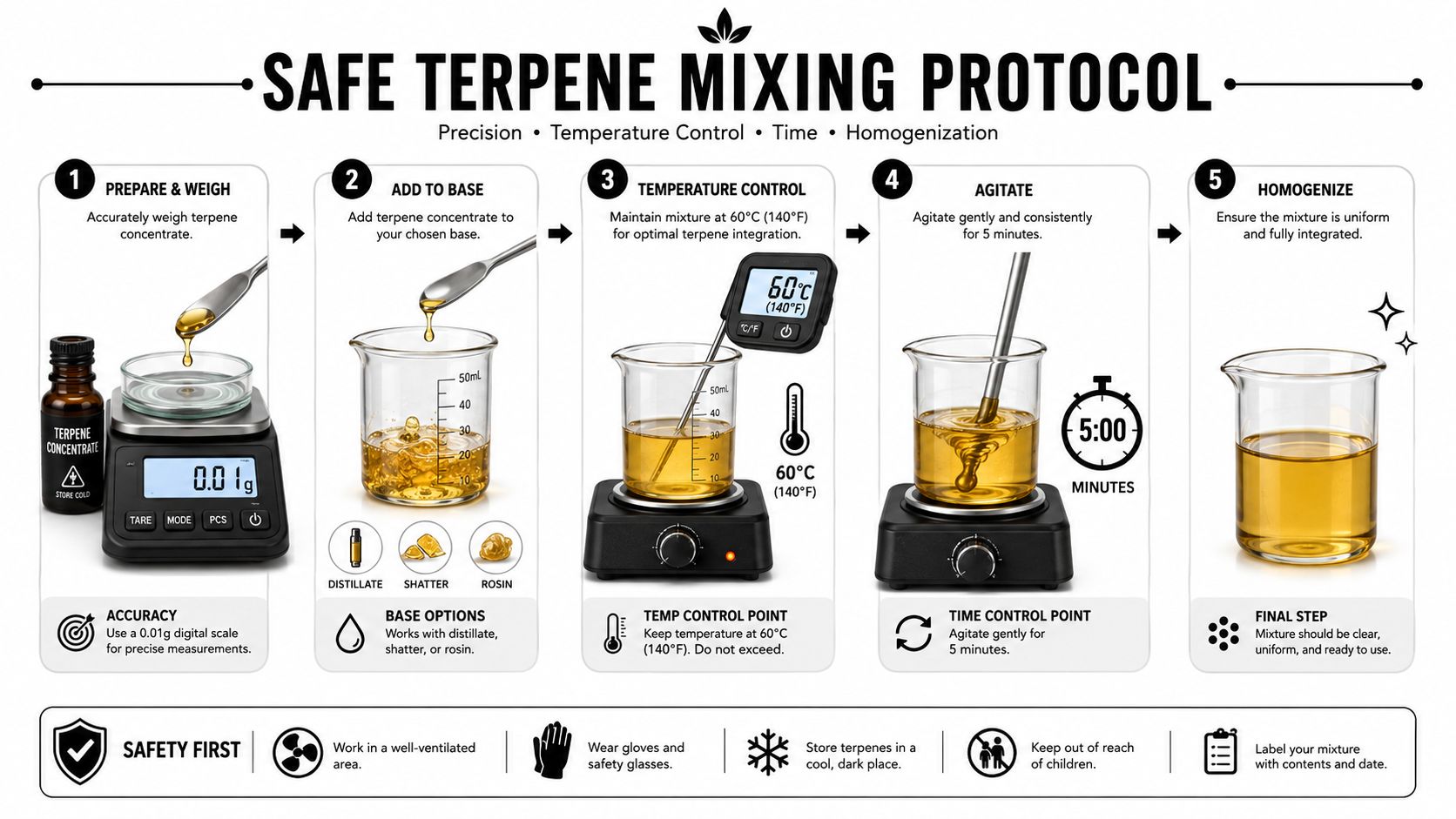
A controlled integration sequence
- Weigh the base and terpene blend separately. Record both masses before heating.
- Use a controlled warming range. A distillate-focused guide recommends warming into about 50°C to 80°C, with an ideal target of 60°C to 65°C, then stirring for 15 to 20 minutes after addition the distillate integration reference.
- Add slowly with gentle agitation. Avoid splashing, open-vessel exposure, and aggressive mixing that can increase volatilization.
- Inspect the finished mixture. Check for separation, bubbles, unexpected thinning, and aroma loss before filling hardware.
Don't introduce terpenes to a still-hot, uncalibrated bath. Keep the formulation carrier-free. PG, VG, MCT, and PEG can change viscosity, create phase behavior that doesn't match the intended matrix, and complicate irritation assessment.
The following example shows the mass calculation, not a universal prescription. For 100 g of distillate at a 6% terpene load, the terpene blend weighs 6.0 g. A specified composition could contain 2.0 g linalool, 1.5 g limonene, 1.0 g beta-caryophyllene, 1.0 g humulene, and 0.5 g alpha-bisabolol. Confirm the resulting viscosity and aerosol behavior in the target hardware before production.
For a practical reference, use this guide to mixing distillate with terpenes.
A short visual demonstration can help standardize handling between operators.
Example Blends for Relaxation Uplift and Focus
The following blends are starting formulations for bench work, not medical formulations or guaranteed effect products. Each ratio describes the composition of the terpene blend itself. The total load describes how much of that blend enters the concentrate by weight.
Relaxation-oriented build
Use a 6% total terpene load by weight with this internal ratio:
- Linalool, 35%: Floral body and softness.
- Myrcene, 25%: Earthy, rounded mid-note character.
- Beta-caryophyllene, 20%: Peppery structural depth.
- Humulene, 10%: Woody, dry base support.
- Alpha-bisabolol, 10%: Gentle floral and base-note rounding.
This profile places linalool and myrcene in the center, with beta-caryophyllene and the heavier compounds supporting retention. It's suited to an evening-positioned cartridge concept where the brand wants a softer opening rather than a sharp citrus or pine attack. In a 2.0 Ω device, the mid and base fraction should help the aroma remain coherent after the initial pull, but actual retention still depends on wattage, airflow, cell design, and oil viscosity.
Uplift-oriented build
Use a 5% total terpene load by weight with this ratio:
- Limonene, 40%: Dominant citrus top note.
- Terpinolene, 20%: Sweet, floral, complex lift.
- Beta-caryophyllene, 15%: Peppery mid-to-base support.
- Alpha-pinene, 15%: Pine and herbal brightness.
- Humulene, 10%: Dry anchoring note.
This blend is top-note forward, so it should be evaluated immediately after mixing and again after storage and hardware exposure. It's appropriate for a bright, citrus-led cartridge direction, but the limonene and terpinolene fraction can become less distinct if the product is exposed to excessive heat or repeated open-vessel handling.
Focus-oriented build
Use a 4% total terpene load by weight with this ratio:
- Alpha-pinene, 30%: Sharp pine opening.
- Limonene, 25%: Citrus lift.
- Beta-caryophyllene, 20%: Mid-note body.
- Humulene, 15%: Base structure.
- Linalool, 10%: Floral smoothing.
The lower total load keeps the blend less aggressive while giving the ceramic-cell mouthpiece a manageable viscosity target. The 30/25 top-note fraction creates fast sensory impact, while beta-caryophyllene, humulene, and linalool prevent the profile from disappearing after the first impression. At 2.0 Ω, measure pull-to-pull flavor retention rather than assuming the ratio will behave identically across devices.
A Blue Dream-style aroma can also be approached with a named 5:3:2 ratio of myrcene to alpha-pinene to beta-caryophyllene within the terpene blend, as described in this terpene flavor chart. Treat that ratio as a replication reference, then validate it against the source profile and finished hardware.
Product Grade and Lab-Testing Considerations
A supplier's product description is only the beginning of a formulation decision. Before purchasing, request a current, batch-specific Certificate of Analysis and verify that the document identifies the material clearly enough to support your intended loading calculation.
The core analytical checks should include terpene identity, residual solvents, heavy metals, and pesticides. For inhalational applications, ask whether the panel also addresses diacetyl and acetoin. These checks don't replace finished-product testing, but they help prevent an unsuitable raw material from entering the formulation process.
Documentation should answer practical questions
A useful COA should help the chemist determine:
- What is present: Confirm the named terpene or profile matches the reported analytical fingerprint.
- What is absent: Verify that the material isn't cut with VG, PG, MCT, PEG, or another carrier.
- How pure it is: Apply the reported purity to the mass calculation rather than assuming nominal concentration equals active terpene content.
- Whether it is stable: Review color, odor, and available oxidative markers for signs of degradation.
Food-grade status alone doesn't establish suitability for inhalation. Prefer independent analysis from an ISO 17025-accredited laboratory over relying only on in-house quality control. Accreditation doesn't guarantee that every product is appropriate, but it gives the testing process a stronger basis for traceability and method confidence.
Lab practice: Match the supplier COA to the incoming lot, then compare the finished blend against its expected GC-MS fingerprint before releasing the batch.
Carrier-free claims matter because diluents can alter viscosity, separation behavior, hardware performance, and irritation assessment. A formulation that appears stable in a diluted sample may behave differently when the carrier is absent or when the base contains a different cannabinoid concentration.
Consistent batch-to-batch analytical fingerprints support scale-up, shelf-life forecasting, and regulatory readiness. If the aroma shifts between lots, the formulator may need to change ratios, filling parameters, or labeling. Documentation is therefore not administrative overhead. It's part of the material specification.
Formulator Checklist and Next Steps
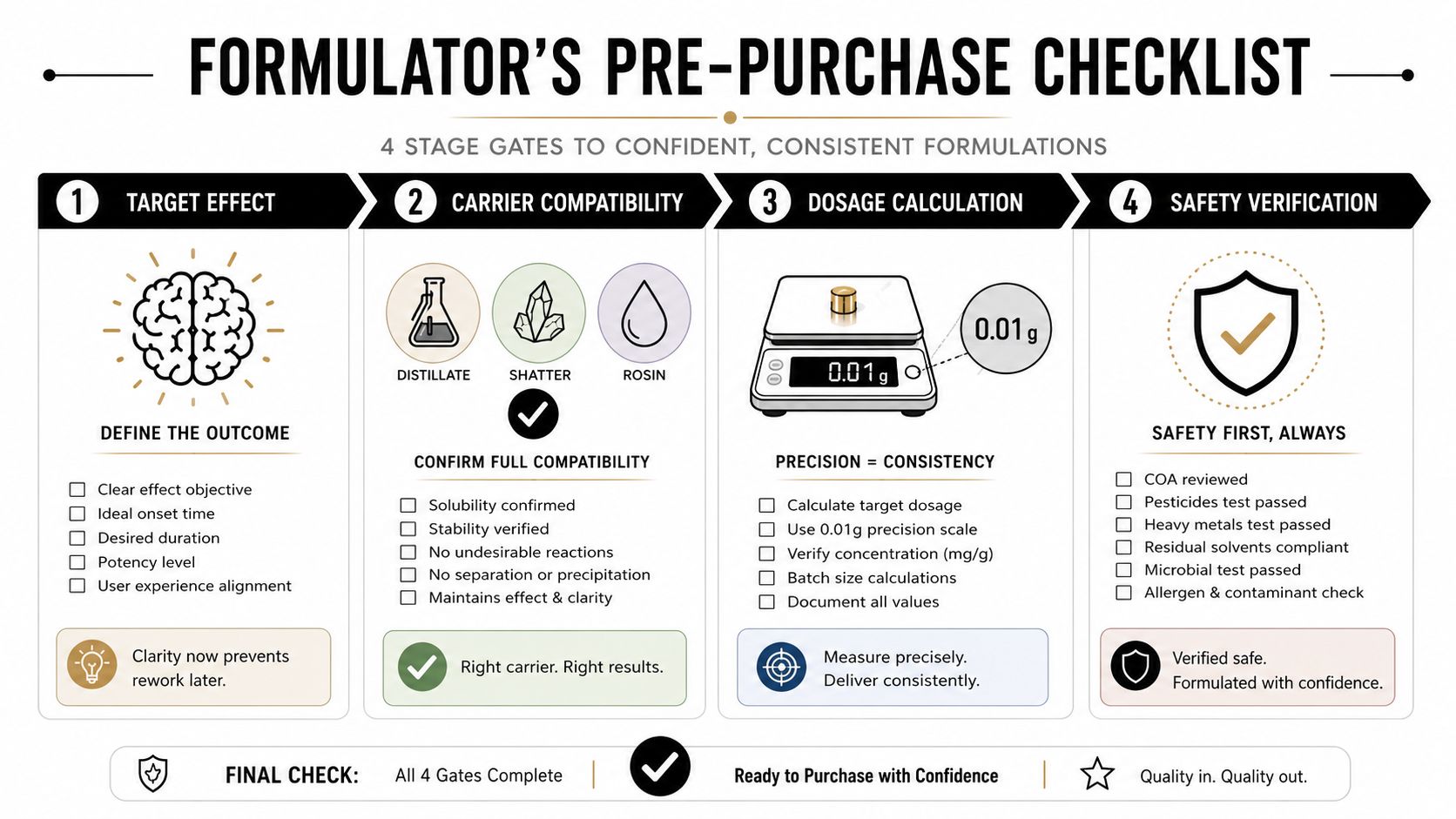
Use this pre-purchase checklist before ordering any terpene for cannabis product formulation:
- Define the target: Record the intended aroma direction and product positioning, such as relaxation-oriented, uplift-oriented, focus-oriented, citrus, floral, pine, or peppery.
- Match the matrix: Identify whether the input is distillate, live resin, shatter, wax, or rosin, then test viscosity and separation in that actual base.
- Set the hardware window: Document the cartridge resistance, cell type, operating temperature, airflow, and expected pull behavior.
- Choose the load: Start within a conservative, product-appropriate range and calculate by weight, not drops.
- Verify the profile: Request a batch-specific COA and compare the reported fingerprint with the strain-inspired profile or isolate blend you intend to buy.
- Reject undisclosed carriers: Confirm the material is free of VG, PG, MCT, PEG, and other unapproved diluents.
- Review safety panels: Ask for terpene-specific residual solvent data, pesticide and heavy-metal results, and diacetyl and acetoin screening where relevant.
- Check the laboratory: Prefer third-party testing from an ISO 17025-accredited laboratory.
- Run the bench trial: Mix a small sample, map viscosity, inspect separation, and evaluate aroma before committing production material.
- Confirm analytically: Use GC-MS verification and retain batch-consistency data for future comparisons.
Keep vapor-pressure references, irritation-threshold literature, and standard reference formulations available during development. The three example builds above can serve as starting points, but every blend still needs hardware testing and finished-product review.
Use the Gold Coast Terpenes catalog to compare strain-inspired profiles, isolated compounds, and carrier-free terpene options for concentrate and cartridge development. Start with a small formulation trial, use the supplier's documentation and mixing resources, and validate the selected blend through viscosity mapping and GC-MS before placing a production-scale order.