
Can a product sold as “weed flavor spray” be treated as a simple sensory add-on, even when it may end up in a heated cartridge? From a formulation standpoint, it works better as a defined input: a terpene blend with a composition, a dose, and an intended route of use. A strain name on the label describes aroma. It says nothing about loading ratio or heat stability.
Sourcing makes the point concrete. Gold Coast Terpenes, a Redondo Beach, CA supplier, makes 100% botanically derived terpene blends rather than cannabis-derived material, across 37 classic strains and 40 Elevated Strains such as Apple Fritter and Banana Runtz.
Start with the intended route
A spray applied to flower, a blend mixed into concentrate, and an ingredient intended for a vape cartridge are three different formulation jobs. Before choosing a spray bottle, aerosol, or dropper, specify the intended application and the target product. That decision drives dose control, compatibility with the material being treated, and the documentation you need from suppliers. A format that coats a surface conveniently may never distribute evenly through a viscous concentrate.
Keep three questions in view as you develop a product: What is the blend made of? How will it be measured and applied? What evidence supports its intended route of use? A clear answer to each is more useful than a strain name alone.
Gold Coast Terpenes describes its blends as SC Lab-tested, THC-free, and free of VG, PG, PEG, and MCT. Supplier details like these can inform an evaluation, but they do not replace your own review of ingredient identity, batch documentation, and use-specific suitability.
What Weed Flavor Spray Actually Is
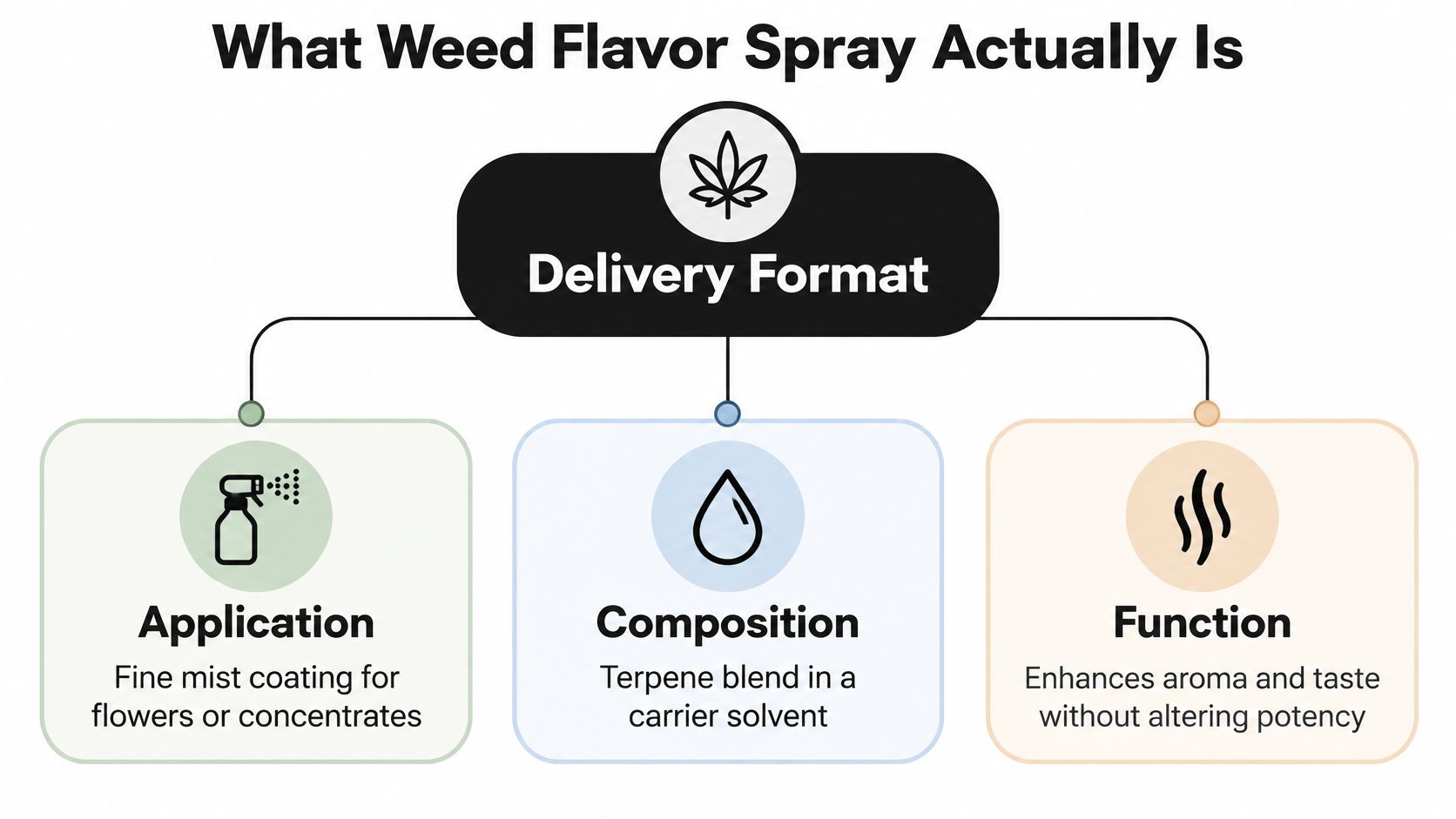
A weed flavor spray is best treated as a terpene-based flavoring approach, not as a culinary flavor product with automatic suitability for inhalation. For formulators, the key decisions are the intended route, the blend's composition, and how reliably the application can be measured.
A spray format can support aroma or flavor work on flower and concentrates, but the word “spray” doesn't tell you whether the formula is intended for surface application, oral use, or a vape formulation. Nor does it tell you whether it contains carrier solvents or other excipients. Request full ingredient identity and intended-use documentation rather than inferring suitability from the packaging.
Match format to the job
For a cartridge or distillate SKU, the relevant question isn't whether a blend smells right. It's whether the blend can be dosed consistently, remain suitable in the intended matrix, and perform as expected in the hardware. Directly spraying onto a finished cartridge or applying a product "by eye" can leave you without a defensible measurement of the final concentration.
That's why a product developer should separate three tasks:
- Define use: Specify whether the material is for external scenting, oral use, concentrate blending, or inhalation.
- Control addition: Choose a measurement method that produces a repeatable batch, then record the actual amount added.
- Verify the result: Confirm the finished material's composition and test it in its intended application.
Gold Coast Terpenes offers botanically derived blends across classic and Higher Strains, but source and profile descriptions don't establish inhalation safety. Treat those details as formulation inputs, then assess route-specific evidence independently.
The Terpene Chemistry Behind Every Spray
A weed flavor spray for product formulation is a reconstruction or emphasis of volatile compounds, not merely a choice between flavor names. Historical cannabis-oil analyses show why a defined chemical profile can be more useful than a strain label when a team is pursuing repeatable aroma.
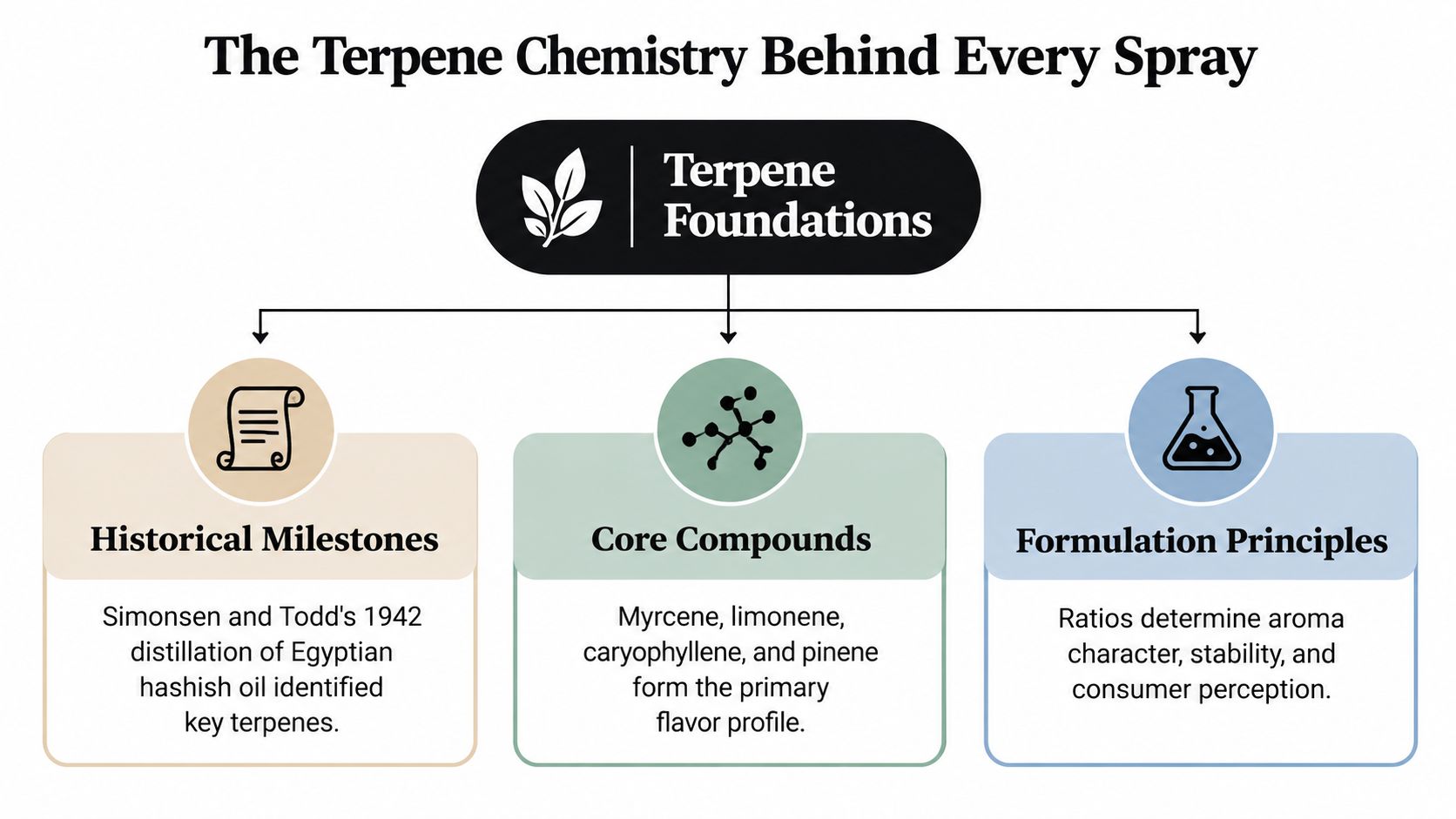
Simonsen and Todd's 1942 distillation of Egyptian hashish oil identified p-cymene, p-cymenene, and humulene. A 1961 gas-chromatographic analysis of fresh Cannabis sativa leaves identified beta-myrcene, limonene, alpha-humulene, and beta-caryophyllene among major constituents. In a separate 1965 analysis of Indian cannabis oil, caryophyllene measured 45.7% and humulene 16.0%. These findings are tied to specific historical samples, not universal formulas for every cannabis product (review of cannabis terpene research.
Build a profile, not just a dominant note
For a strain-inspired terpene blend, start with the compounds that define the reference profile, then assess how the smaller components affect the overall balance. ASTM flower-specification material identifies beta-caryophyllene, d-limonene, beta-myrcene, alpha-pinene, and gamma-terpinolene as useful profile-identification compounds above specified reporting thresholds (ASTM D8439-22 material).
In practical sensory design, top notes can supply brighter opening impressions, mid notes can give the blend a fuller herbal or floral center, and base notes can contribute deeper, warmer character. Limonene and pinene can help create a brighter opening; myrcene may contribute a softer herbal body; beta-caryophyllene can add a peppery-spice dimension. These are formulation cues, not guarantees of a particular finished aroma.
For defensible flavor matching, pair sensory evaluation with chemical characterization. A profile's ratios and minor constituents can matter; relying on a strain name or the dominant terpene alone doesn't document a match.
Botanical Versus Cannabis-Derived Versus Nature-Identical
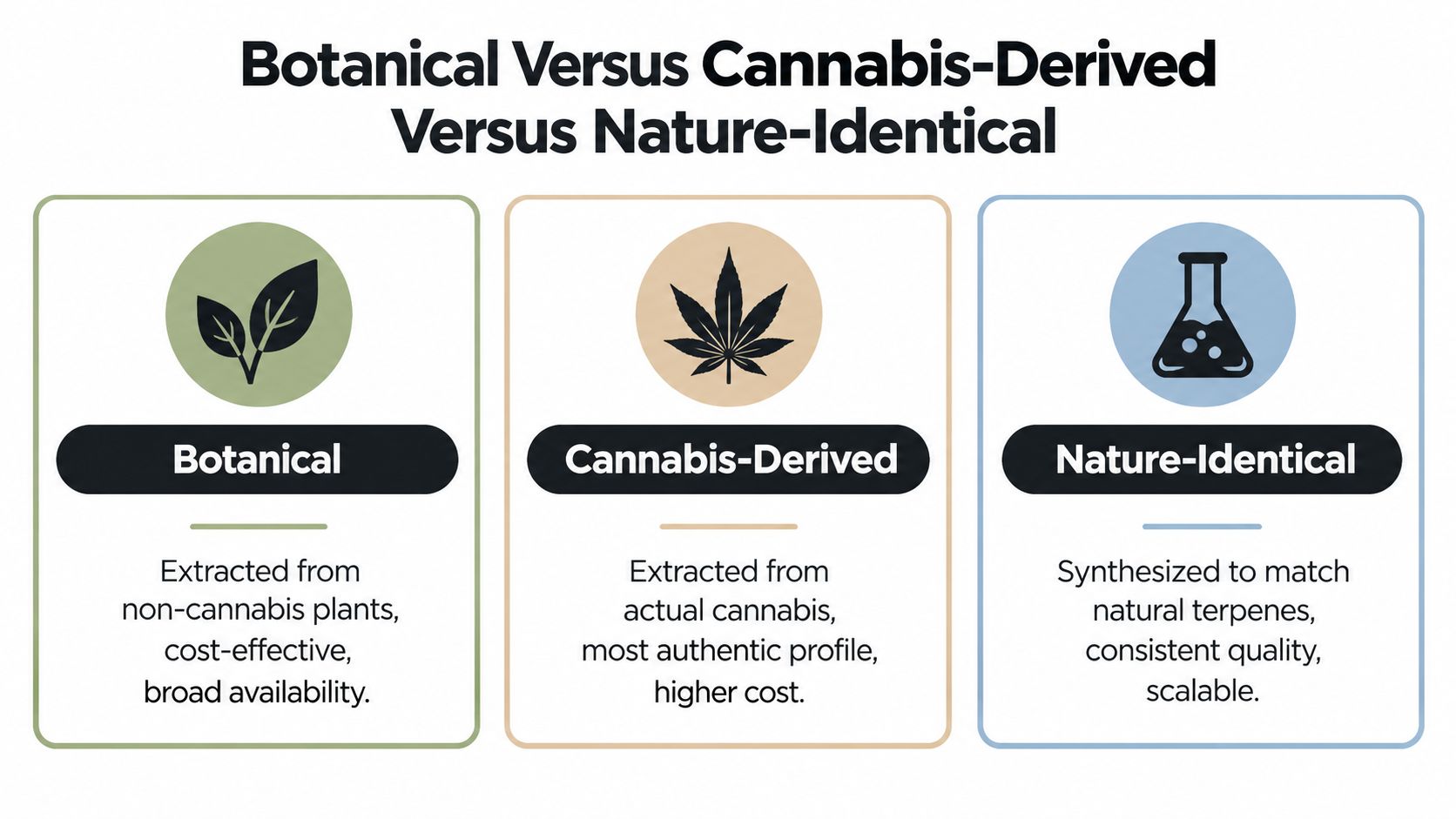
Botanical, cannabis-derived, and nature-identical terpenes are different sourcing and labeling choices, not automatic rankings of safety or aroma quality. The right option depends on your specification, sourcing needs, label claims, and ability to document the finished formulation.
Botanical blends use terpenes sourced from non-cannabis plants. They can be a practical option when a brand wants a consistent, scalable profile without representing the ingredients as cannabis-derived. Gold Coast Terpenes identifies its blends as 100% botanically derived, so brands considering them should keep that distinction clear in product descriptions and internal records.
Cannabis-derived blends are sourced from cannabis. That origin may suit a particular sourcing or product narrative, but it doesn't establish that the finished blend is safer to inhale or more accurate to a reference profile. Nature-identical is a sourcing or manufacturing description for compounds made to match naturally occurring molecules; it also isn't a substitute for ingredient disclosure or route-specific safety evidence.
Choose for reproducibility and documentation
A molecule's identity can matter more to aroma matching than the plant it came from. In formulation, compare supplier specifications, batch consistency, analytical documentation, and the fit between the source story and the claims you intend to make. Don't assume a cannabis-derived label means closer replication or better inhalation performance.
Gold Coast Terpenes' Elevated Strains, including Banana Runtz, are described as selectively enhancing rare, exotic terpenes to highlight fruit and dessert notes while remaining botanically derived and SC Lab-tested. A formulator can compare such a profile against a target aroma, but should still evaluate the blend in the actual product matrix.
For a more detailed source comparison, see this guide to cannabis-derived and botanical terpenes. Whatever the source, document the formulation clearly. “Botanical,” “cannabis-derived,” and “nature-identical” describe different things, and none should be used as a shortcut for route validation.
Calculating Loading Ratios for Distillate and Carts
A defensible loading workflow measures terpene addition by mass, checks the finished concentration, and validates the blend in the intended cartridge. A peer-reviewed concentrate-vaping study used a 9:1 THC-to-terpene ratio as a practical formulation model; New Jersey guidance sets a 10% total-terpene limit for inhalable concentrates and requires reporting by percentage and by mass or volume units (New Jersey cannabis testing guidance).
The study's ratio reflects a process trade-off. Excessive terpene loading can make concentrate too fluid and increase leakage risk, while a measured addition gives the formulator a starting point to test viscosity and cartridge performance. Don't treat the study ratio as a universal recipe or a substitute for your applicable requirements.
Measure the finished blend
Use a calibrated balance or other validated method to record the amount of concentrate and terpene blend used. Calculate the terpene fraction against the final product mass, rather than relying solely on the planned recipe. Handling losses, evaporation, and differences between matrices can make the measured finished-batch result differ from the target.
| Terpene Loading Reference for Vape Formulations | Total terpene range | Reporting unit | Notes |
|---|---|---|---|
| Study formulation model | 10% of the combined THC-to-terpene ratio | Ratio by mass | 9:1 THC-to-terpene model; validate viscosity and hardware fit |
| New Jersey inhalable concentrate guidance | Not more than 10% of product | Percentage and mg/g or mg/mL | Confirm the applicable product and reporting basis against the guidance |
The ratio model and regulatory limit aren't interchangeable. One is a formulation example, while the other is a jurisdictional requirement that must be applied to the product and reporting basis covered by the rule.
Record each addition and compare the finished batch result with the applicable limit. This guide to terpene addition for distillate can help structure the calculation, but a supplier target or calculator doesn't replace batch-level testing.
Heat Stability and Aerosol Chemistry
Temperature can change both the flavor profile and the chemistry of a vape aerosol, so test a terpene blend in the intended hardware rather than treating heat as a device-only concern. In simulated heating from 100 to 200°C, reported unchanged parent fractions differed substantially by terpene (review of terpene stability and vaping emissions).
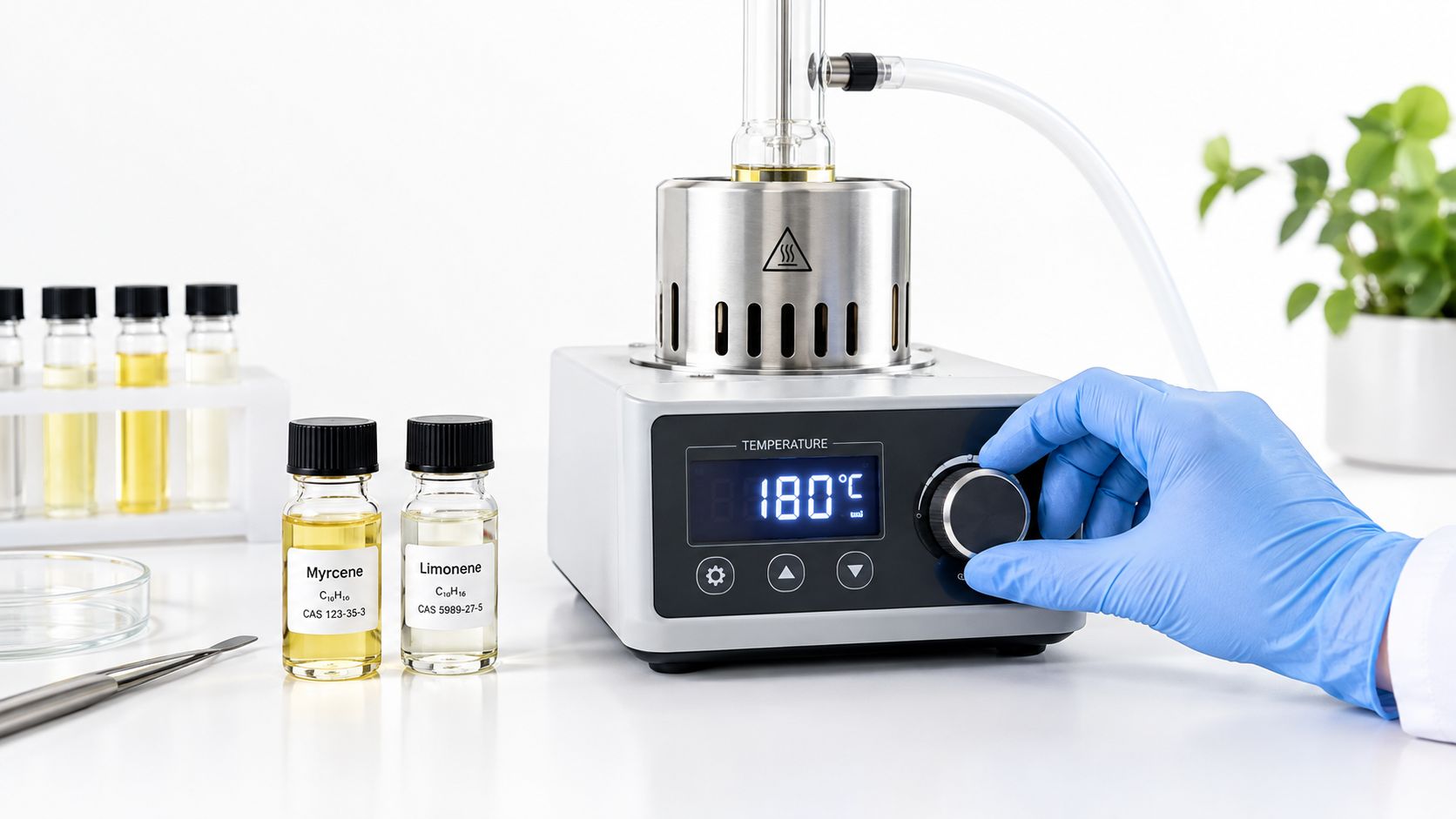
The reported parent-fraction recovery was 97–98% for myrcene, 81–92% for limonene, 60–80% for α-pinene, 50–73% for β-pinene, and 11–28% for terpinolene. Those differences mean a blend's aroma chemistry can shift under heat; the ingredients don't all behave alike.
A review also reports that cannabis cartridges may contain approximately 10–20% terpenes by weight, corresponding to roughly 2,500–5,000 ppm total terpene in generated aerosol. Those figures describe reported ranges, not a recommendation for a new formulation.
Test across the product's operating conditions
Use the lowest sensory-effective loading that meets the product target, then evaluate the blend in representative hardware. Coil, voltage, viscosity, and puff conditions can affect heating, so record the device and operating conditions used for validation. Terpene mixtures added at 7.5% and 15% by mass increased carbonyl emissions from Δ8- and Δ10-THC aerosols by as much as ninefold in independent experiments, with most carbonyl products attributed to terpene oxidation, as summarized in the same review.
Practical rule: A liquid that smells right before heating hasn't yet passed an aerosol test.
Use emissions testing under representative device conditions, not just analysis of the liquid concentrate. For additional background on volatility and formulation decisions, consult this guide to terpene boiling points.
The video below offers additional context for considering temperature as part of formulation validation.
Inhalation Safety Is Not the Same as Food-Grade
“Food-grade” doesn't establish that an ingredient is suitable for inhalation. Food-additive evaluation addresses ingestion, while inhalation is a separate exposure route; a spray can also create droplets, and a cartridge heats volatile compounds into aerosol. Route-specific evidence matters more than a natural, botanical, or food-safe label.
OSHA notes that FDA regulation of food additives doesn't require safety testing for occupational inhalation exposure from flavorings (OSHA guidance on flavorings-related lung disease). Regulators in Oregon have also cautioned that natural occurrence alone doesn't establish safety when terpenes are added to vaping products (Oregon presentation on marijuana additives).
Treat the EVALI history as a formulation warning
During the U.S. EVALI outbreak beginning in 2019, more than 2,700 people had been hospitalized nationwide by June 2020. In a CDC-associated California investigation, vitamin E or vitamin E acetate appeared in 41 of 49 THC-containing products tested, or 84%, and in none of the nicotine products tested. CDC reporting associated THC products containing vitamin E acetate with lung injury while noting that other toxicants could also contribute (CDC-associated California product investigation).
That history makes ingredient identity and excluded diluents central to inhaled-product development. New York rules for inhaled adult-use cannabis allow botanically derived terpenes, prohibit synthetic terpenes, cap total terpene content at 10%, and exclude ingredients including PEG, vitamin E acetate, and MCT oil. Requirements vary by jurisdiction, so confirm the rules for the product and market you're developing.
A vape formulation needs more than a supplier's general food-use or natural-origin statement. Request the complete ingredient identity, purity data, residual-solvent and pesticide results, allergen disclosure, and evidence relevant to the intended route. A supplier's documentation supports your review; it doesn't transfer the manufacturer's responsibility for the finished product.
This overview of terpene safety for vaping is a useful starting point for route-of-use questions. Don't assume a spray designed for external application can be used in concentrate or cartridge production without explicit use documentation and validation.
A Pre-Production Validation Checklist
Before approving a strain-inspired blend for production, verify what's in it, how it performs in the target matrix, and how the finished batch will be documented. A defensible record should connect supplier information to measured batch composition and hardware validation.
What to verify before scale-up
- Ingredient identity: Obtain a complete ingredient list, including any carrier solvents, preservatives, or emulsifiers. Don't infer composition from “natural,” “botanical,” or “strain-inspired” wording.
- Analytical documentation: Review available purity, residual-solvent, pesticide, and allergen information. Confirm that the documentation matches the material and batch you're evaluating.
- Excluded diluents: Check the formula against the product specification and applicable rules, including restrictions concerning VG, PG, PEG, MCT, and vitamin E acetate.
- Profile comparison: Hold sample preparation constant when comparing reference material and prototypes. A described headspace-GC-MS method uses full-evaporation preparation at 140°C for 30 minutes to volatilize terpenes and terpenoids reproducibly (headspace-GC-MS method presentation).
For a direct comparison, apply the same preparation conditions to reference and prototype samples. Otherwise, handling differences may be mistaken for changes in the formulation. After blending, measure viscosity and test the mixture in the intended hardware before locking the ratio.
Gold Coast Terpenes describes its blends as SC Lab-tested and THC-free and says they contain no VG, PG, PEG, or MCT. Its site also lists a Mixing Calculator and wholesale, affiliate, and bulk programs. These are supplier-side details to review alongside your own specification and batch records, not substitutes for validation.
A Gold Coast Terpenes Elevated Strains profile for Apple Fritter provides a specific profile reference for evaluation. Keep the record practical: incoming lot, measured addition, finished-batch result in the applicable units, viscosity observation, hardware conditions, and test results. That gives operations, compliance, and commercial teams a shared basis for deciding whether the blend is ready to scale.
Common Questions From Brand Owners and Formulators
How should a brand choose a terpene supplier for vape products?
Start with documentation, not the marketing page. Request a recent certificate of analysis for the exact blend you plan to buy, then order a second lot and compare batch-to-batch terpene ratios. A supplier worth keeping discloses full ingredients, provides testing relevant to inhalation rather than food use, and answers formulation questions with data instead of adjectives.
Can a weed flavor spray be used in a vape cartridge?
Only if the product is documented for that intended use and validated in the target formulation and hardware. A natural or food-grade label alone doesn't establish inhalation suitability.
What terpene percentage is appropriate for distillate?
No single number fits every base. Measure the finished batch by mass, since volumetric additions drift with viscosity and temperature. Compare the measured result against the loading table for your concentrate type and the limits in your market, and record what you measured rather than what you intended to add.
How do the premium flavor profiles differ from classic profiles?
Gold Coast Terpenes describes its enhanced flavor line as selectively boosting rare, exotic terpenes to emphasize fruit and dessert notes. Treat that description as a starting hypothesis: get the composition, run a small trial batch against your target aroma, and let the measured chemistry, not the profile name, drive the decision.
What should be tested before locking a cartridge formula?
Ingredient identity, measured loading, finished-batch composition, viscosity, and performance in the intended hardware. Then validate emissions under representative operating conditions. A flavor match at room temperature tells you nothing about what the coil delivers, and the cheapest test runs before the failed lot.
Gold Coast Terpenes offers botanically derived terpene blends, strain-inspired profiles, and formulation resources for teams developing concentrates and cartridges. Review the available options and documentation at Gold Coast Terpenes as part of your supplier evaluation.