
Your Wedding Cake prototype smells convincing in a sample vial, but the filled cartridge comes across as woody, thin, or too citrus-led. Gold Coast Terpenes, a Redondo Beach, CA-based supplier of botanically derived terpene blends, offers strain-profile options for this kind of formulation work, but choosing a name is only the start. The useful task is translating a sensory reference into a measurable specification that survives the distillate matrix and finished hardware.
What the Wedding Cake Strain Means for Formulators
For formulators, Wedding Cake is a sensory target, not a fixed chemical recipe. Its value lies in the recognizable balance of dessert sweetness, dough, and fuel, rather than a cannabinoid number or an assumed universal terpene split.
Start the development brief with attributes your team can evaluate: creamy rather than candy-like sweetness, dough rather than generic vanilla, and a restrained fuel backbone. Then describe unacceptable outcomes, such as citrus dominating the opening or earthy notes obscuring the dessert character. Those distinctions make supplier samples easier to compare.
The Wedding Cake formulation overview supports treating the cultivar as a target sensory profile and adjusting against batch-specific analysis. That approach is more useful for a cartridge program than asking whether a blend smells vaguely like cake.
Separate identity from acceptance criteria
A development specification should distinguish the reference from the finished product requirements.
- Reference identity: Record which flower, extract, or commercial blend defines the target.
- Sensory acceptance: Describe the desired opening, middle, and finish using consistent vocabulary.
- Analytical acceptance: Specify which compounds require measurement and how the laboratory reports them.
- Application acceptance: Evaluate the blend in the intended matrix and hardware, not only on a blotter or in an open vial.
Practical rule: A strain name belongs on the development brief. Measurable acceptance criteria belong on the release specification.
A Wedding Cake strain-inspired terpene blend doesn't have to reproduce every detectable constituent of a flower sample to meet a flavor brief. It does need a defensible relationship to the chosen reference.
That distinction also prevents unnecessary reformulation. If a prototype misses the target, identify whether the problem is the incoming blend, its loading, the base oil, or the device before changing the aromatic composition.
How Wedding Cake Lineage Shapes the Aroma
Wedding Cake's accepted lineage is Triangle Kush × Animal Mints. Read that parentage as a flavor framework: OG-derived fuel and earthy wood balanced against Cookies-family sweetness and creamy dessert notes.
The cultivar is associated with Seed Junky Genetics and breeder JBeezy, and it's also identified as Triangle Mints #23. Older descriptions sometimes named Girl Scout Cookies and Cherry Pie as the parents, while Canadian markets commonly use Pink Cookies; these naming details appear in Leafly's Wedding Cake cultivar history.
For product development, lineage helps establish direction, not ingredient quantities. Triangle Kush suggests the darker supporting structure; Animal Mints suggests the sweet, rounded side. Neither parent name tells a compound supplier how much limonene to include.
Read the family tree without copying its simplifications
The diagram below is useful as an aroma map, but its Animal Cookies branch needs qualification: Animal Cookies is part of the Animal Mints ancestry, not Wedding Cake's accepted direct parent. Likewise, dense flower structure is a plant trait, not a terpene note to reproduce.
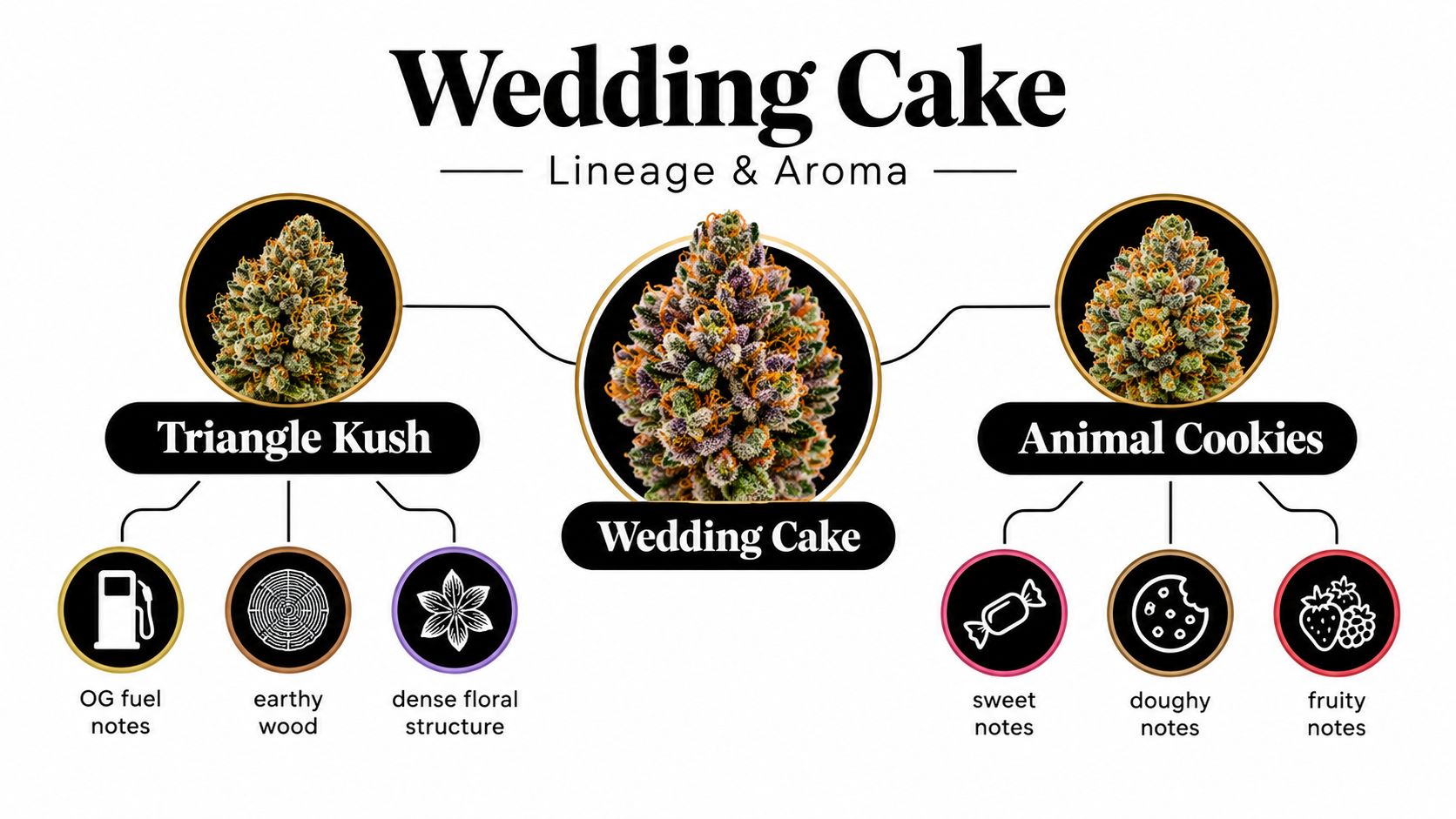
Use the parent split to resolve competing sample directions. A sweet prototype with no woody or fuel support may satisfy a dessert brief without satisfying a Wedding Cake brief; a heavily earthy prototype may preserve the Kush association while losing the creamy character.
Preserve the contrast between dessert and fuel. Don't let either become the entire profile.
Reported flower potency commonly falls around 22%–27% THC, with substantial batch variation, as documented in the cultivar history linked above. That figure describes flower potency, not the composition of a strain-inspired terpene blend.
Reading the Terpene Profile Like a Top, Mid, and Base Note
A useful Wedding Cake terpene profile for cannabis product formulation combines citrus lift, earthy-herbal continuity, and peppery-woody support. Treat top, mid, and base as sensory design roles, not rigid categories or substitutes for analytical measurements.
Reported profiles commonly emphasize beta-caryophyllene, limonene, and myrcene, with linalool present in some samples. The Wedding Cake terpene profile discussion also notes phenotype-dependent rankings, which is why beta-caryophyllene shouldn't automatically be declared dominant in every reference.
Build contrast without losing the dessert center
Limonene supplies the top-note lift. Its citrus brightness can keep a heavy profile from reading flat, but brightness isn't the same as accuracy. Evaluate whether it clarifies the dessert character or changes the product into a citrus-forward blend.
Myrcene provides an earthy, herbal middle, while beta-caryophyllene supplies peppery, woody support. In formulation terms, the middle connects the brighter opening to the heavier finish. Judge those connections in the complete blend rather than assuming isolated ingredients will smell the same after incorporation.
Linalool is a potential floral-softening accent, not a mandatory Wedding Cake ingredient. Include it when the reference supports it, then control it rather than adding it just because a general profile chart lists it.
The terpene flavor chart can help standardize descriptors during evaluations. It can't establish the correct proportions for your SKU.
Wedding Cake Terpene Roles in the Blend
| Terpene | Sensory Role | Function in Blend |
|---|---|---|
| Beta-caryophyllene | Peppery, woody base | Provides structural support beneath the dessert character |
| Limonene | Bright citrus top | Adds lift without becoming the main flavor |
| Myrcene | Earthy, herbal middle | Connects brighter and heavier elements |
| Linalool, when supported by the reference | Floral accent | Softens the profile as a controlled secondary contributor |
No defensible working percentage ranges can be assigned without a representative terpene analysis. Set each compound's range from the selected reference and subsequent application trials, not an internet chart presented as universal chemistry.
Building a Target Spec From a Wedding Cake COA
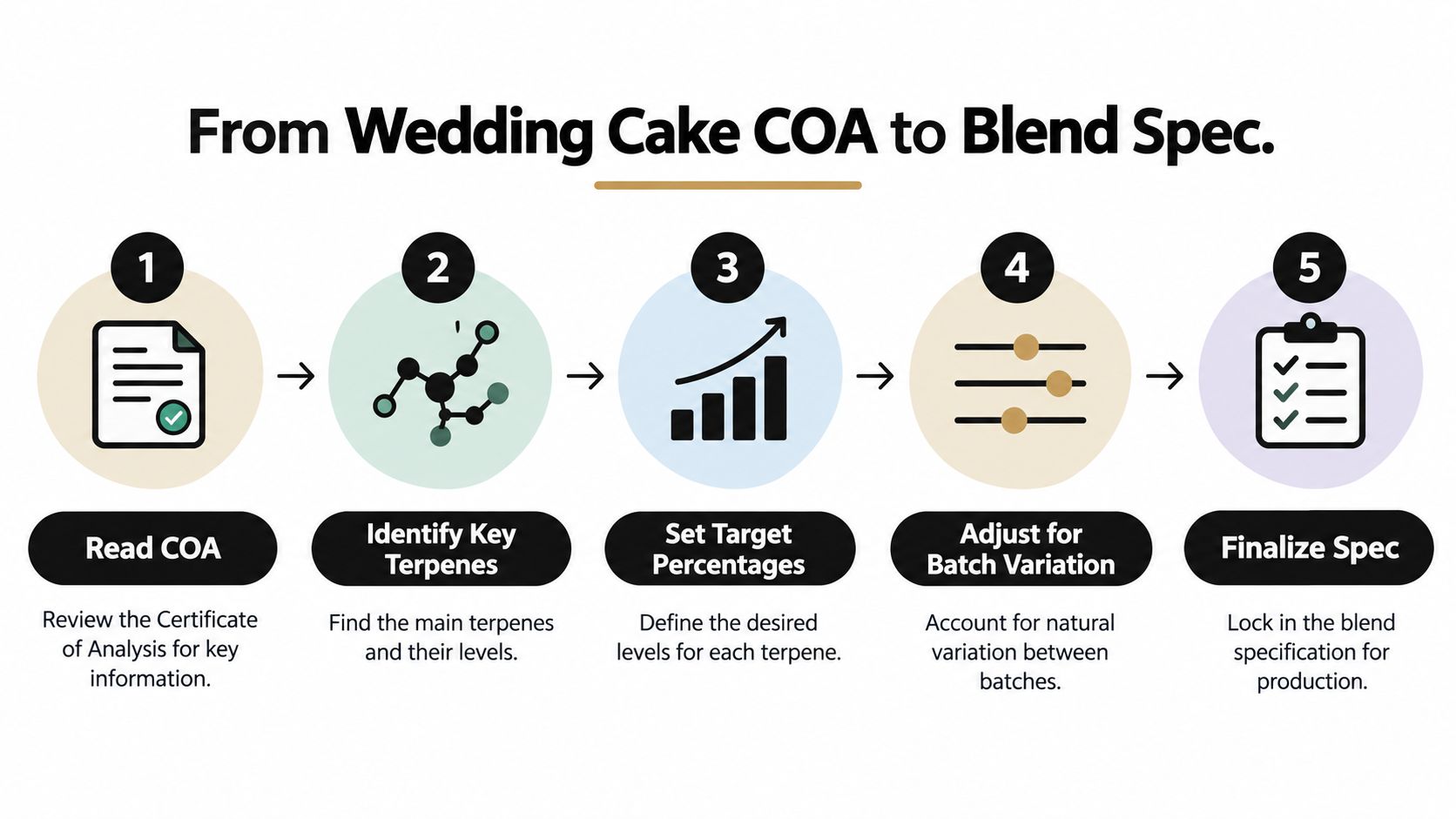
A usable target specification starts with a representative COA that measures individual terpenes, followed by a documented translation into blend ratios and finished-product concentrations. A cannabinoid-only report doesn't provide that information.
First check the sample identity, matrix, reporting units, analytical scope, and treatment of results below the reporting limit. Keep the original report attached to the development record so a normalized blend ratio doesn't become detached from its source.
The COA interpretation resource is a useful starting point for reviewing what a certificate measures. The critical question isn't whether a document says "tested," but whether its analytical panel answers your formulation question.
Keep ratios and loading separate
Use these relationships without confusing their denominators:
- Relative terpene share: Individual terpene concentration divided by the sum of quantified terpenes.
- Blend addition by mass: Added blend mass divided by finished mixture mass.
- Finished compound concentration: The compound already present in the matrix plus the amount contributed by the added blend.
If a reference has unidentified or unreported aromatic constituents, record that limitation. Normalizing only the measured compounds doesn't reconstruct everything the laboratory didn't measure.
Convert volume using the material's actual density
A documented proprietary, cannabis-free Wedding Cake infused-terpene profile reports 0.87 g/mL at 20°C. For that material, 1 mL corresponds to approximately 0.87 g, and 1 g corresponds to about 1.15 mL, according to its Wedding Cake blend certificate.
Volume × density = mass
Mass ÷ density = volume
That certificate describes a particular commercial blend, not cannabis flower or every supplier's Wedding Cake product. Obtain the density for the material you're purchasing, and use mass-based preparation where practical rather than assuming volume and mass are interchangeable.
Botanical Versus Cannabis-Derived Terpenes for Wedding Cake Blends
Say your COA target calls for a limonene-forward top over a caryophyllene base, and two suppliers offer a Wedding Cake match. One sells a botanical reconstruction built against your spec. The other sells a cannabis-derived extract claiming cultivar fidelity. Weigh them on source disclosure, analytical documentation, sensory performance, and market requirements, and the CDT vs. BDT comparison walks through that decision in detail. Origin alone proves nothing about whether a blend hits your reference.
Gold Coast Terpenes supplies 100% botanically derived blends rather than cannabis-derived terpenes, with 50+ classic and contemporary profiles and a dessert- and exotic-fruit-focused line, per its published catalog. Keep that source distinction explicit in purchasing records and labeling review.
For a botanical reconstruction, the development question is whether the measured blend delivers your chosen aromatic balance against the COA target. For a cannabis-derived material, add a second question: how closely does this purchased lot represent the cultivar it is named after? Botanical reconstruction and cultivar extraction are different claims, and extraction by itself guarantees nothing about lot-to-lot match.
Compare documentation before making quality claims
| Buying question | Botanical-derived blend | Cannabis-derived material |
|---|---|---|
| What is the declared origin? | Request botanical-source documentation | Request cannabis-source documentation |
| Does it match the target? | Compare the reconstructed profile with the reference | Compare the supplied lot with the reference |
| What supports cannabinoid claims? | Obtain applicable analytical evidence | Obtain applicable analytical evidence |
| What supports repeat purchasing? | Review specifications and change control | Review lot variation and change control |
| How should it be labeled? | Describe the source accurately | Describe the source accurately |
Treat the table as a discussion aid. Either route still needs evidence before you can call it compliant, cheaper, or better.
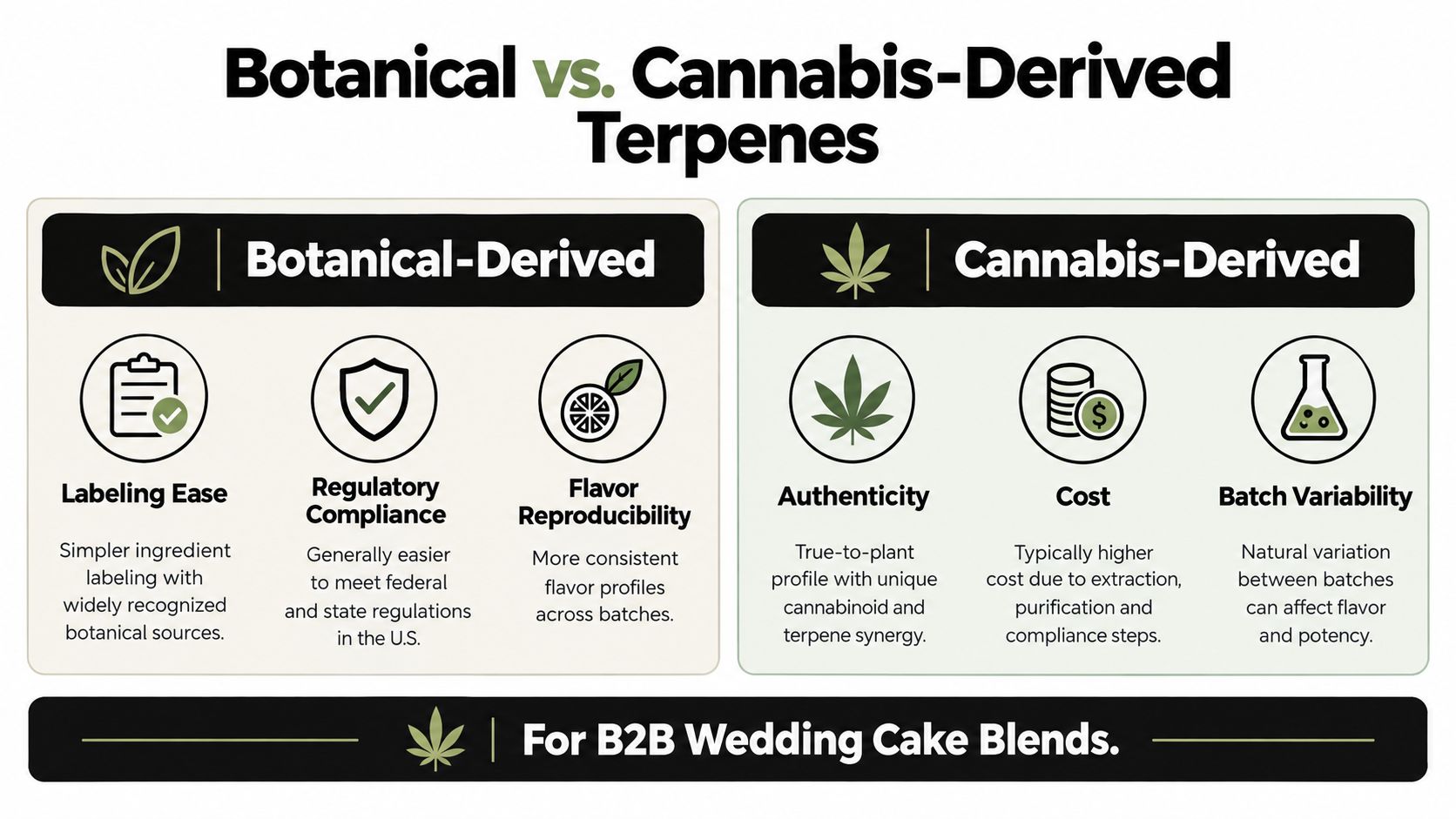
Purchasing check: "Botanical" identifies a source claim. It doesn't replace a cannabinoid test, an incoming-material specification, or a finished-product compliance review.
Also distinguish botanical-derived from nature-identical in supplier questionnaires. Require the supplier to explain its terminology and support the declaration rather than treating those descriptions as interchangeable.
Regulatory fit remains a product- and jurisdiction-specific review for vape, CBD, and cannabis brands. A sourcing choice doesn't establish universal permission to sell the finished formulation.
Dosing Wedding Cake Terpenes Into Distillate and Cart Hardware
Set terpene loading through supplier-supported application limits and controlled trials in the intended matrix and device. There isn't a validated universal loading window for every Wedding Cake blend, distillate, concentrate, or ceramic cartridge.
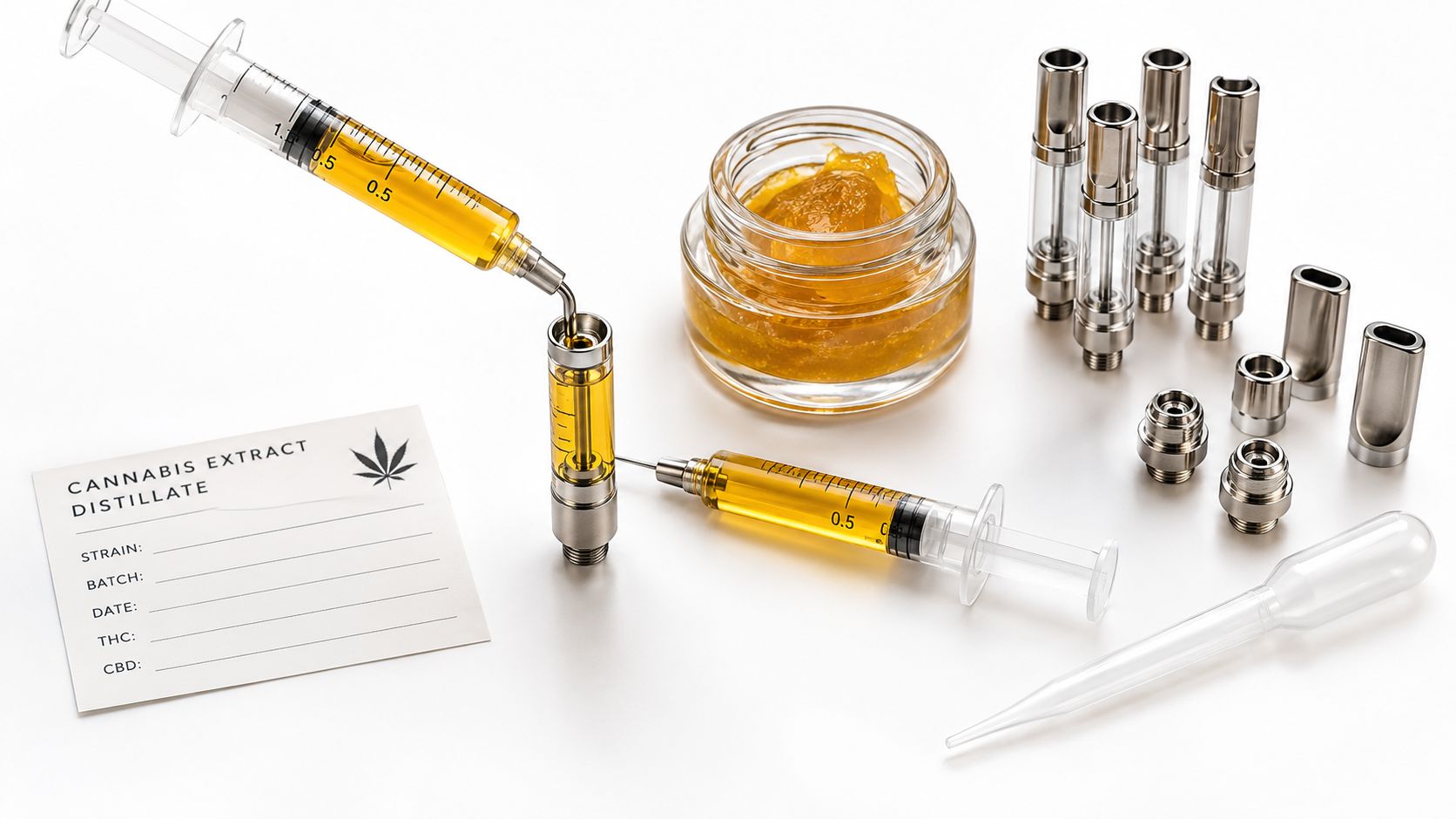
Evaluate the complete filling system, not just the blend bottle. The extract, mixing procedure, filled hardware, and operating conditions all belong in the development record.
Establish a controlled loading trial
The guide to adding terpenes to distillate provides an application-focused reference. Before preparing samples, obtain the blend's safety documentation and the hardware supplier's compatibility guidance.
- Define the matrix: Record native terpene content where available, rather than treating distillate and terpene-rich extracts as equivalent.
- Control the preparation: Keep mixing conditions, holding conditions, and fill procedure consistent.
- Change a single variable: Test loading separately from adjustments to relative terpene composition.
- Assess the finished device: Record aroma fidelity, filling behavior, leakage, and performance under the intended evaluation conditions.
Don't use a terpene calculator to choose an acceptable exposure or declare hardware compatibility. A calculator supports arithmetic after the team has established an appropriate formulation target.
Diagnose before adjusting
If the profile reads flat, first distinguish insufficient aromatic intensity from an overly earthy balance. Increasing total loading and increasing limonene are different interventions, and either can obscure the original problem if other variables change simultaneously.
If the result is sharp or harsh, don't automatically blame citrus. Review the matrix, device settings, processing history, and supplier limits before deciding whether to reduce loading or alter the composition.
Use the following video as supplementary context, not as a replacement for a documented application trial.
A pleasant aroma isn't evidence of inhalation safety. Keep sensory acceptance separate from the safety and compliance decisions required for commercial release.
Why Batch Testing Beats Copying Internet Percentages
Batch testing gives your team a traceable basis for flavor matching; an unattributed percentage chart doesn't. The defensible standard is a controlled target with documented tolerances, not a supposedly permanent Wedding Cake formula.
Terpene expression can change with genotype, cultivation, drying, curing, storage, and extraction. The operational consequence is straightforward: purchasing the same strain name doesn't establish that the incoming material has the same aromatic composition.
A documented Wedding Cake concentrate COA reported 85.2161% THC without terpene testing, as discussed in the concentrate COA example. That result is useful precisely because it cannot answer the flavor-matching question. High cannabinoid potency isn't a proxy for an aromatic profile.
Investigate drift without changing everything
When an incoming lot or finished cartridge misses the approved reference, compare records before reformulating.
- Incoming-material difference: Did the measured terpene composition change?
- Matrix difference: Did the base oil or its native aroma change?
- Process difference: Were mixing, heat exposure, or holding conditions different?
- Evaluation difference: Did the team use the same hardware, reference, and assessment procedure?
These are investigation categories, not predetermined explanations. Keep retained samples and lot-linked records so the team can test a suspected cause instead of relying on memory.
Release against an approved specification, not against the confidence of the person describing the aroma.
Set controlled ranges for the primary compounds and explicit treatment of secondary contributors. If linalool is part of the approved target, define how it's evaluated; don't let an optional accent become an uncontrolled supplier substitution.
Also separate flavor fidelity from effect claims. A Wedding Cake-inspired aromatic match doesn't establish a universal consumer experience, and increasing resemblance to a reference doesn't justify promises of relaxation, creativity, or other fixed outcomes.
The practical advantage of batch testing isn't that it eliminates judgment. It gives sensory judgment an auditable analytical context and helps teams distinguish a genuine composition change from an application problem.
Sourcing, MOQs, and Operational Questions for B2B Buyers
A purchase order written against a catalog screenshot is how teams end up qualifying the wrong dessert blend. Buy against an approved sample, a documentation package, and written supply terms. Confirm minimum order quantities, scale-up options, and change-control procedures directly rather than treating catalog visibility as procurement readiness.
For Gold Coast Terpenes, a Redondo Beach-based botanical-blend supplier, request the current Wedding Cake reference, its supporting documents, and the matching product-page location before issuing a purchase order. Use the Elevated Strains catalog structure as a model for locating and confirming a strain-specific product page before ordering, then apply the same check to the Wedding Cake listing.
Send the approved target spec with the RFQ, not just the strain name. Suppliers quote and blend against what you specify, and a written aromatic target gives the receiving team something objective to check each incoming lot against.
Procurement questions
- Commercial terms: Confirm evaluation quantities, production MOQs, lead times, freight, and bulk pricing in writing.
- Technical package: Request a lot-linked COA, safety documentation, source declaration, and applicable analytical limits.
- Isolate sourcing: Ask whether limonene, myrcene, and beta-caryophyllene can be supplied with documentation suitable for your development program.
- Change control: Establish how composition, sourcing, or specification changes will be communicated and how much notice precedes a reformulation.
Frequently asked questions
What MOQ should a brand expect?
Confirm the current MOQ directly with the supplier. Ask Gold Coast Terpenes for separate evaluation and production-order terms rather than assuming they’re identical.
Can a botanical blend be labeled cannabis-derived?
Don’t describe a botanical-derived blend as cannabis-derived. Match the source statement to supplier documentation and review the finished label for the intended market.
Should the team buy a finished profile or individual isolates?
Choose a finished profile when it meets the approved target and simplifies production control. Use isolates when the team can measure, document, and maintain the resulting formulation.
What should purchasing request before scale-up?
Request the approved sample reference, current technical documents, written specifications, and commercial terms. For a Gold Coast Terpenes evaluation, confirm the exact Wedding Cake reference rather than substituting another dessert flavor.
Gold Coast Terpenes offers botanically derived strain profiles for flavor-development work, including dessert-oriented formulation projects. Contact Gold Coast Terpenes to request the current Wedding Cake reference and supporting documentation, then qualify the sample in your actual matrix and cartridge before committing to production.