
A terpene spray for weed is not a finishing flourish, it's a formulation variable that changes how the oil behaves in the cartridge. Gold Coast Terpenes, a Redondo Beach supplier of 100% botanically derived blends, sits on the right side of that distinction because botanical sourcing gives formulators a repeatable starting point without pretending the spray is just aroma dressing.
If you're building cartridges, concentrates, or distillate SKUs, treat terpenes like an input you spec, not a garnish you wing. The evidence is blunt on that point, terpene concentration changes viscosity and aerosol chemistry together, and the choice of hardware and temperature changes what comes out of the cart.
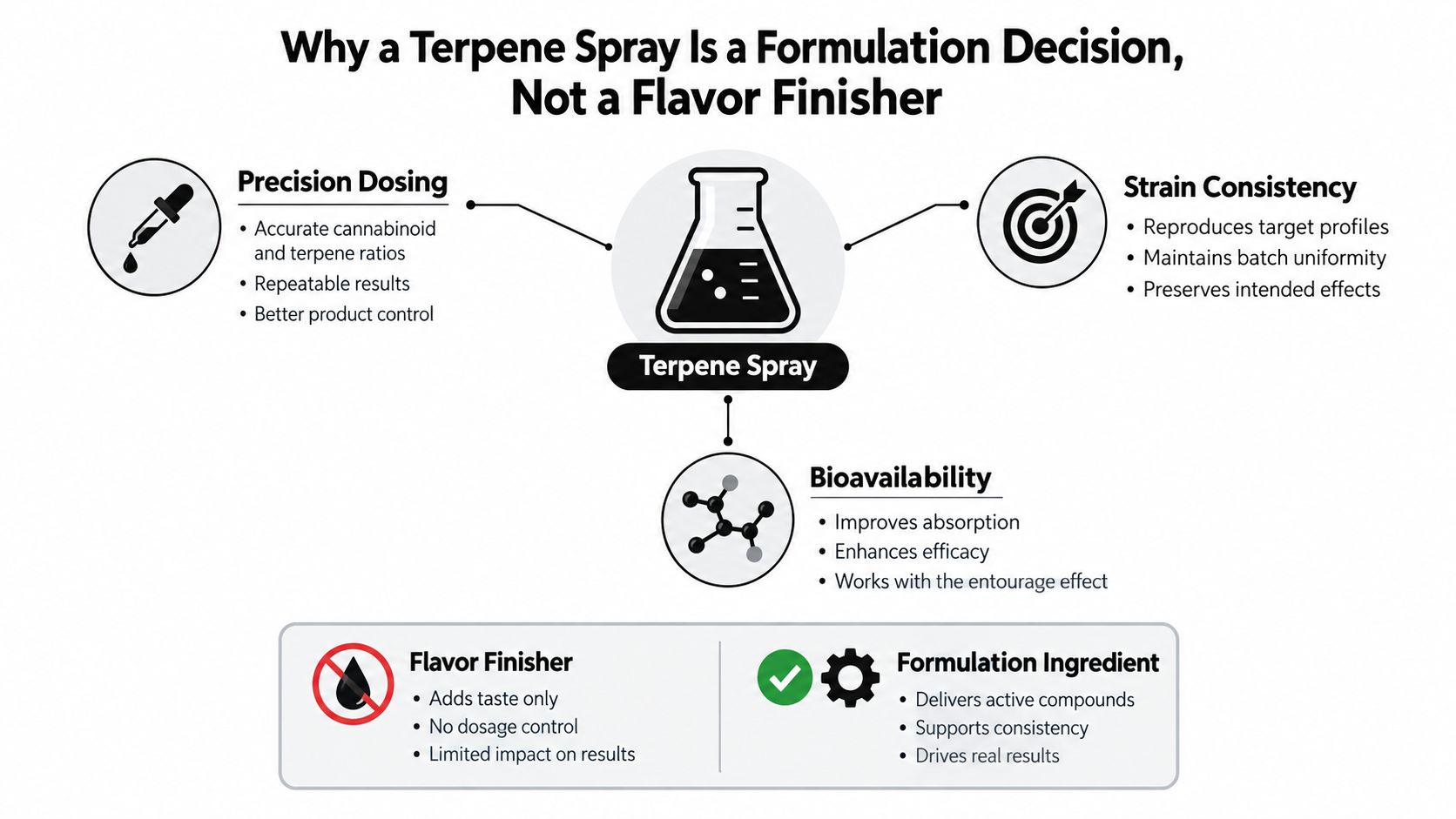
Why a Terpene Spray Is a Formulation Decision, Not a Flavor Finisher
A terpene spray is a process control, not a perfume step. In a 2025 peer-reviewed study of cannabis-concentrate vaping, a 9:1 THC-to-terpene ratio produced a practical test formulation that was fluid enough to vaporize without leaking from a cartridge, while excessive terpene ratios made the material too thin for reliable pen use study.
That matters because the spray is part of the oil system, not an overlay on top of it. The same research tested myrcene, linalool, limonene, and a commercial terpene mixture, and its results show that concentration, blend composition, cartridge hardware, and temperature interact. In other words, a terpene spray for weed changes the product's physical behavior, not just the nose.
Practical rule: if the blend leaks, strings, or floods the coil, the terpene ratio is wrong for that hardware, even if the aroma is attractive.
Gold Coast Terpenes makes that engineering-first view easy to defend because its blends are positioned as botanically derived, THC-free, and free of VG, PG, PEG, and MCT. That doesn't make the product automatically suitable for inhalation, but it does mean the formula starts with a cleaner ingredient base than a loose, flavor-only approach. For a brand owner, that distinction is the difference between a spec sheet and a guess.
The bigger mistake is treating “natural” as the finish line. Natural can still be too thin, too volatile, or too aggressive under heat. If you're buying terpenes for cartridges, you need a supplier that thinks in terms of dose, viscosity, and hardware fit, not just strain names.
Building a Strain-Inspired Blend With Top, Mid, and Base Notes
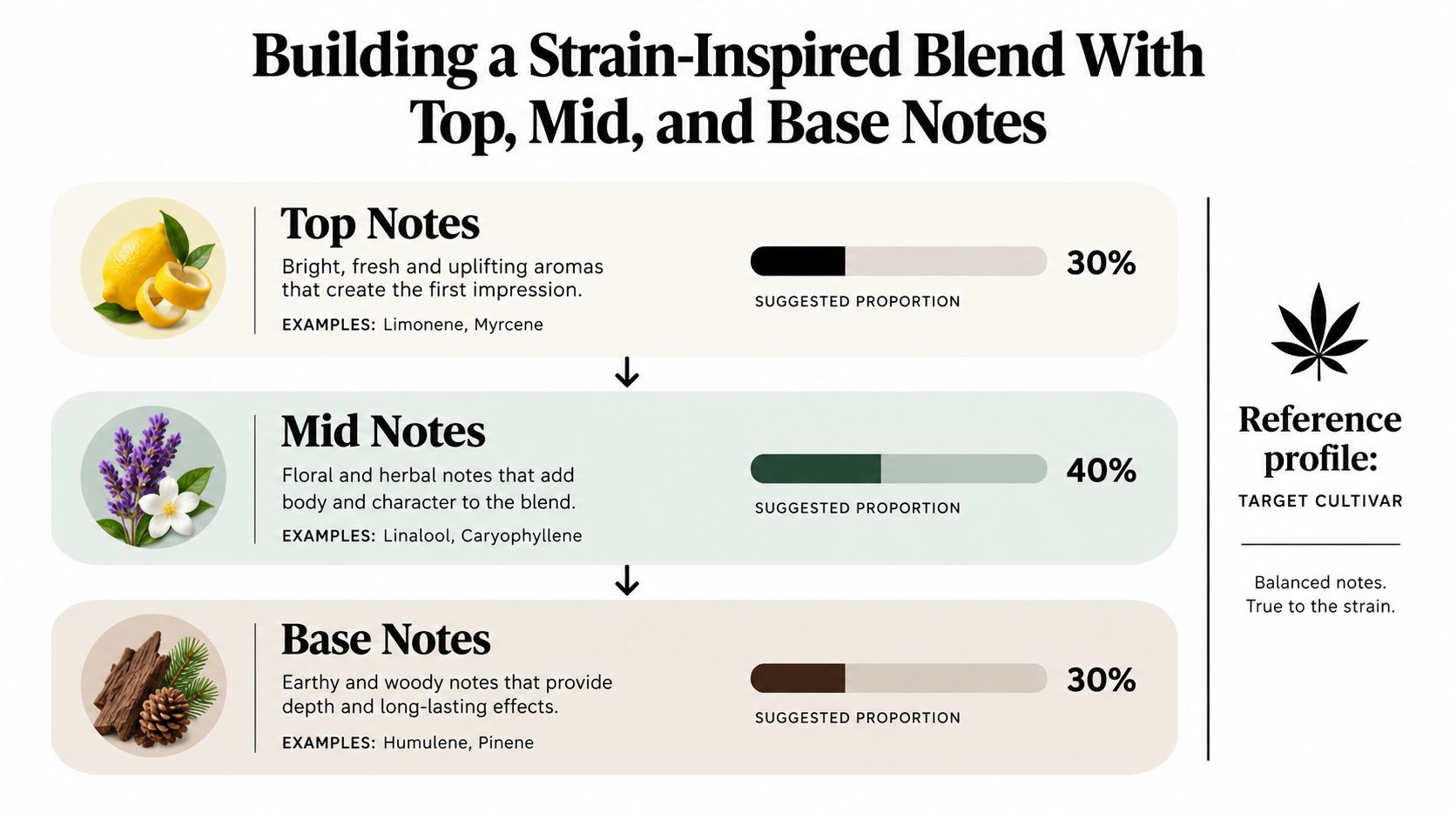
A good strain-inspired terpene blend has structure. If you skip top, mid, and base notes, the blend may smell right for a minute and then collapse in storage or during cart use.
Start with volatility, not wishful thinking
Top notes are the first thing buyers smell, so volatile compounds like limonene and some pinene-type materials belong there. Mid notes carry the body, where linalool and beta-caryophyllene style compounds do the heavy lifting. Base notes provide persistence, the part that keeps a profile recognizable after the first hit fades.
The International Federation of Societies of Cosmetic Chemists describes typical fragrance structures at roughly 15–25% top notes, 30–40% middle notes, and 40–55% base notes IFSCC guide. That framework is for fragrance, not a cannabis-vape rule, but it gives formulators a disciplined way to balance a blend instead of loading the bottle with whatever smells loudest.
Map the profile to the target cultivar
Start by defining what the blend should do at opening, during use, and after the first impression fades. Then place compounds into those three lanes and test the mix after equilibration, not only the moment it leaves the beaker.
Gold Coast Terpenes is useful at this stage because profiles such as Blue Dream, OG Kush, Forbidden Fruit, and Green Crack give you a starting point, while isolates like Limonene, Myrcene, and Beta-Caryophyllene let you fine-tune the note balance without rebuilding the whole profile.
A profile that nails the top note but loses the mid and base notes is not finished. It is an opening line.
For brands formulating cannabis vape products, this note architecture is the difference between a cartridge that smells right on bench day and one that stays recognizable through storage and shipping. The blend has to survive time, not just the first sniff.
Botanical Versus Cannabis-Derived Terpenes for Commercial Blends
Botanical terpenes are the practical choice for most commercial vape and concentrate programs. Cannabis-derived terpenes can be closer to cultivar authenticity, but they bring more supply variability, more documentation burden, and more complexity at wholesale scale.
| Criterion | Botanical-Derived | Cannabis-Derived |
|---|---|---|
| Supply consistency | Easier to standardize | More batch-dependent |
| Traceability | Simpler for many programs | More complicated chain of custody |
| Flavor precision | Good for controlled profiles | Stronger cultivar fidelity |
| Regulatory flexibility | Often easier to deploy across SKUs | Can be harder to scale cleanly |
| Cost structure | Usually easier for production planning | Typically less forgiving for wholesale programs |
Gold Coast Terpenes is positioned around 100% botanically derived profiles, which is why its lineup of 37 Strains and 40 Elevated Strains is useful for manufacturers who need repeatable flavor architecture instead of cultivar roulette. Botanical sourcing is also the cleaner fit when the brand wants THC-free inputs and a formulation path that's easier to document internally.
Use this CDT versus BDT comparison if you're deciding whether to build around botanical or cannabis-derived inputs. The right answer is usually the one your production line can repeat without a fight.
For wholesale buyers, I'd be blunt about this. Cannabis-derived terpenes can make sense when authenticity is the brief, but if you're scaling SKUs, controlling label consistency, and keeping operations predictable, botanical terpenes are the more durable production choice. Gold Coast Terpenes' catalog is built around that reality, not around marketing fantasy.
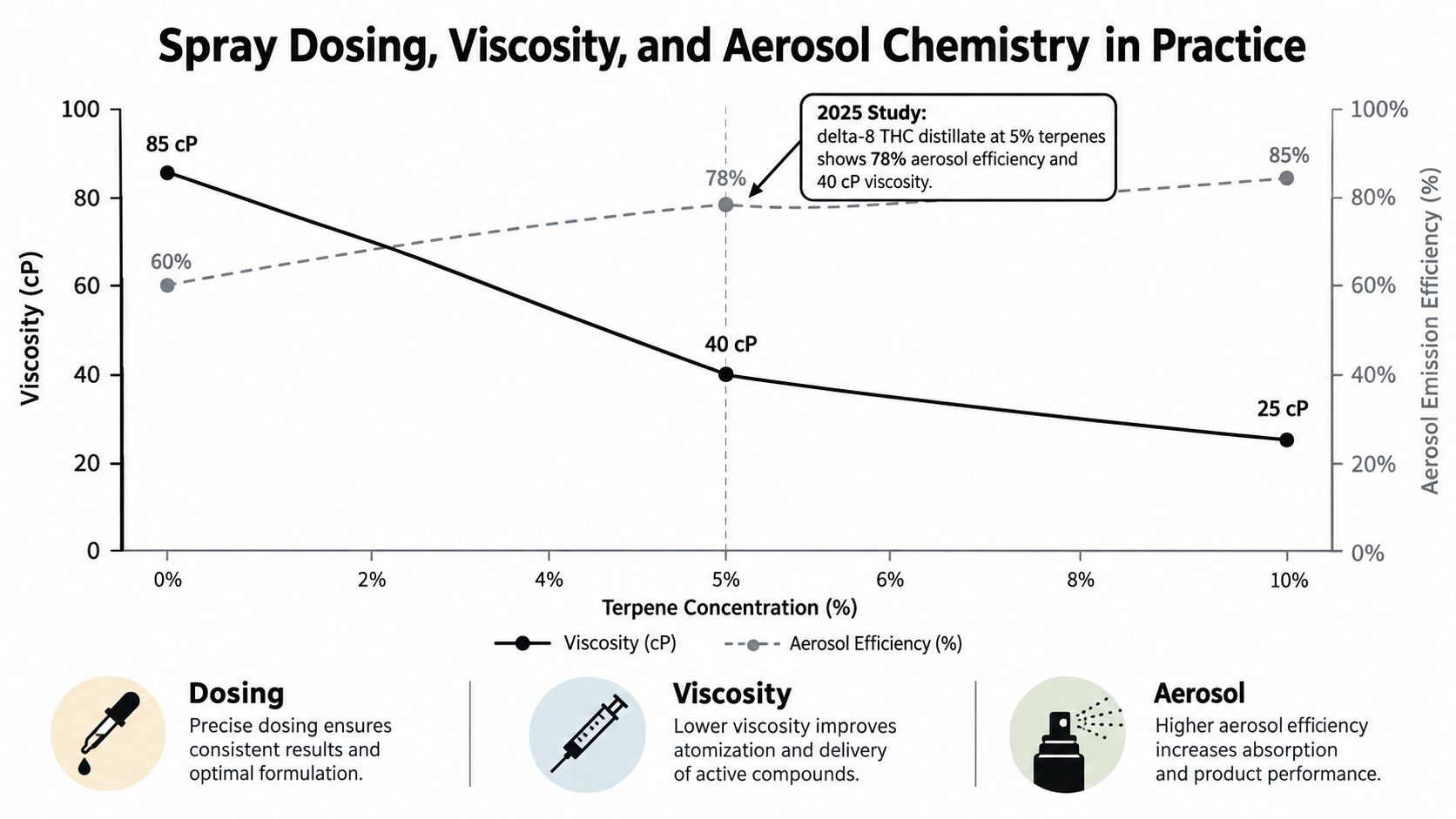
Spray Dosing, Viscosity, and Aerosol Chemistry in Practice
Terpene loading belongs on the spec sheet because it changes the aerosol. In a 2025 study on delta-8 and delta-10 THC distillates, terpene additions at 0%, 7.5%, and 15% by mass drove aerosol carbonyl emissions up by as much as ninefold as terpene content increased study.
That's the part too many formulators miss. A terpene spray for weed isn't only changing flavor intensity, it's changing what heating produces. The study's proposed mechanism was terpene oxidation during aerosol generation, which means higher loading isn't a neutral sensory choice, it's an emissions choice too.
Dose by mass, not by spray habit
If you're dosing by spray count or “good enough” passes, you're working blind. The Washington State Liquor and Cannabis Board research brief points to less than 10% total terpenes as a possible evaluation target and notes that this range lines up with regulations in New York and New Jersey research brief.
That figure is a risk-management reference, not a universal rule. Still, it's enough to tell a brand owner that freehand spray volume is the wrong metric. If you want reproducibility, weigh the batch, calculate terpene mass, and record the final percentage after blending.
Hardware and temperature belong in the same sentence
The same concentration can perform differently in different carts. Coil resistance, voltage, and puff profile change how quickly the blend heats and how aggressively it oxidizes, so the final formula has to be validated in the exact hardware you plan to sell.
Gold Coast Terpenes is useful here because its blends are sold as lab-verified, THC-free inputs that can be slotted into a controlled dosing workflow rather than sprayed until the jar smells right. Use the Mixing Calculator as the starting point, then confirm the final oil in the intended cartridge system before release.
A Step-by-Step Formulation Workflow for Distillate and Cartridges
The cleanest workflow is boring in the best way. Define the terpene target, calculate by mass, blend under controlled conditions, let the oil equilibrate, then test it in the same hardware the SKU will use.
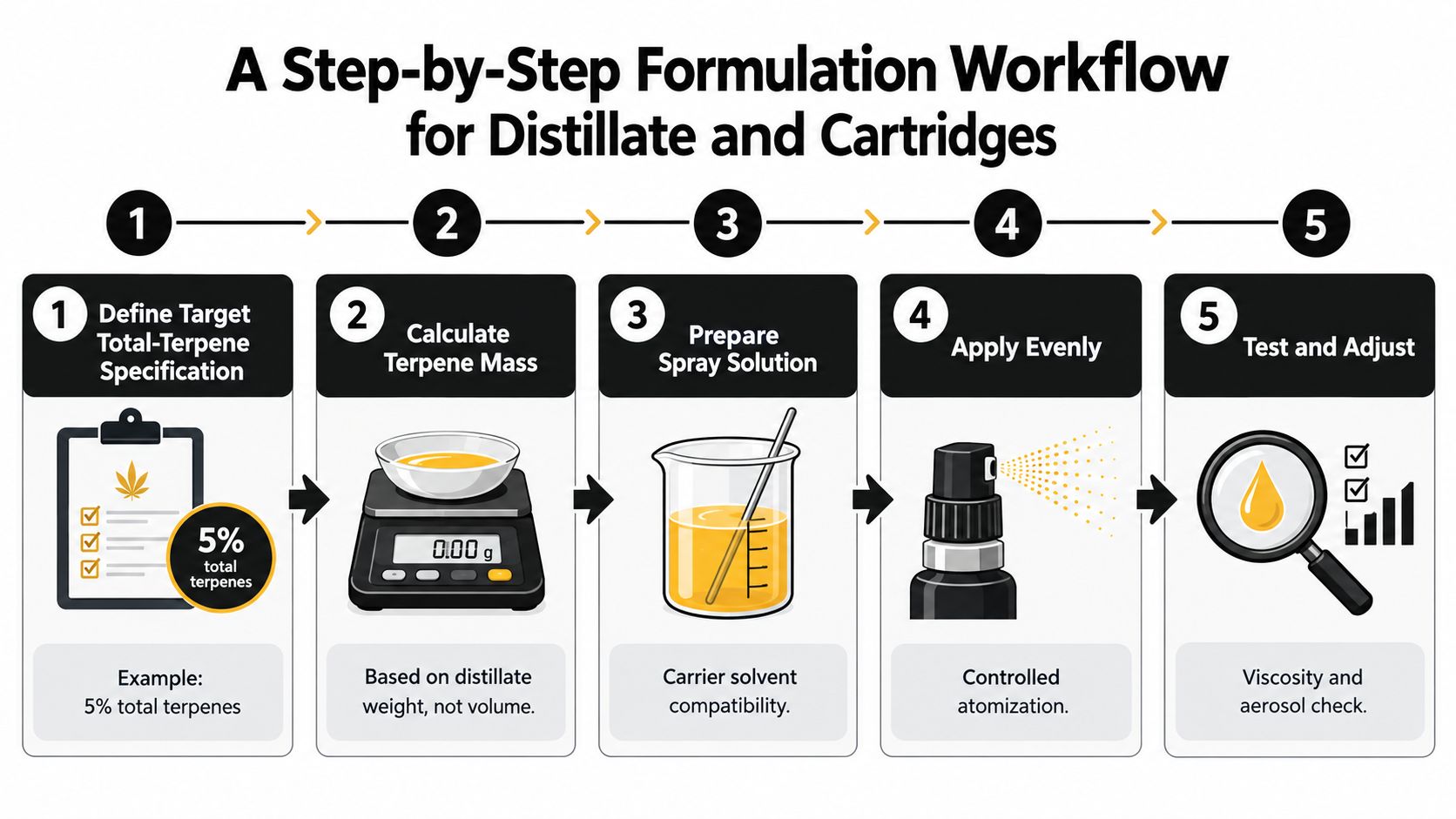
Use a repeatable sequence
- Define the total-terpene specification. Pick a target before you open the bottle. If the batch is supposed to sit in a low-terpene window, say so on paper and lock it to the SKU.
- Calculate terpene mass. Use distillate weight, not spray habit, as the base. A mixing calculator is the right tool here because it forces the math before the blend hits the vessel.
- Blend under controlled conditions. Add the terpene fraction evenly and mix until the material is homogeneous. Uneven distribution creates hot spots, which turn into inconsistent first draws.
- Allow equilibration. Don't judge the oil the second it's mixed. The profile changes as the components settle into each other.
- Test in the target hardware. Lock the cartridge, voltage, and puff profile before approval. If the same batch behaves differently in another device, the formulation isn't finished.
That workflow is why catalog depth matters. Gold Coast Terpenes' isolates, including Limonene and Beta-Caryophyllene, let formulators adjust the top and base ends of a profile without changing the whole blend architecture. The result is a tighter development loop and fewer batch surprises.
If the blend only works in one test cart and not in production hardware, it's not a commercial formula yet.
This is also where replicating flavor of a reference extract gets real. You're not chasing a smell in the air. You're matching a measurable oil behavior across a defined cartridge system, and that takes discipline.
Safety, Inhalation Suitability, and the Limits of “Natural” Labels
Natural does not mean inhalation-safe. A terpene spray can smell clean, read botanical, and still create the wrong chemistry once heat enters the picture.
The 2019 to 2020 EVALI outbreak made that clear by linking the crisis primarily to vitamin E acetate in some illicit THC vaporizer products, which is why California materials later discussed restricting inhaled products to cannabis, cannabis oil, and plant-derived terpenes unless another ingredient was deemed safe for inhalation by the FDA California advisory materials. The same materials show how messy the regulatory conversation became, including a failed 6 to 7 to 1 committee vote.
Heat changes the chemistry
A 2025 toxicology paper found methacrolein at 131 to 185 ppb at dab temperatures of 403 to 526 °C, while it was undetectable at 322 °C Frontiers study. That's enough to make the point plain, heating conditions matter, and they can change the emitted chemistry dramatically.
The same source notes that terpene-containing vape aerosols can generate degradation products such as isoprene, benzene, aldehydes, and organic acids. So when a supplier leans on “natural” or “food-grade” language, that's not a pass for inhalation use. FDA GRAS status does not establish safety for heated aerosol use.
Demand inhalation-specific documentation
A commercial buyer should require the basics every time:
- Terpene-specific certificates of analysis for the finished blend
- Residual-solvent and contaminant testing
- Inhalation-use statements that match the intended application
- Batch-specific aerosol testing whenever concentration, device, or temperature changes
Gold Coast Terpenes' SC Lab-tested positioning fits that buyer mindset because wholesale formulators need documentation, not just aroma claims. If the spray is going into a cart, the data has to follow the product all the way to the shelf.
Choosing a Terpene Supplier That Fits a Brand's Production Reality
A supplier should make production easier, not just prettier. If a terpene vendor can't support documentation, blending precision, and scale, they're not really serving a manufacturing team.
Gold Coast Terpenes is a useful benchmark because it combines 50+ strain profiles, an isolate catalog, a Mixing Calculator, and wholesale support that includes free U.S. shipping on orders over $100 and tiered discounts on orders exceeding 64 oz. That's the kind of structure that matters when you're planning MOQ, not just mood-board flavor names.
Five buying criteria that actually matter
- Documentation: You want clear analytical paperwork, not vague flavor language.
- Label clarity: Botanical versus nature-identical versus cannabis-derived has to be unambiguous.
- Fine-tuning options: An isolate catalog matters when you need to correct one note without rebuilding the blend.
- Formulation tools: A calculator saves time and reduces avoidable batch drift.
- Wholesale practicality: Bulk terms, shipping, and order thresholds have to fit how production really buys.
Where to Buy Terpenes is the right starting point if you're comparing vendors for a brand program. If you're working in the dessert-flavor lane, Elevated Strains is an example of how the catalog extends into more nuanced fruit and pastry-style profiles.
The point is simple. Choose a supplier that can support repeatability, not just a pretty product page. A good vendor helps you hit the same sensory target in batch after batch, which is what a brand owner pays for.
Putting the Formulation-First Approach Into Action
If you want a terpene spray for weed to work in a commercial line, start with the percentage, not the scent. Choose a botanical-derived blend with documentation, calculate by mass, and verify the finished oil in the cartridge hardware it will run in.
That is the formulation-first mindset. It's cleaner, safer to manage, and more defensible when your brand has to answer for aroma, consistency, and device performance at the same time.
Gold Coast Terpenes offers strain-specific blends, isolates, and formulation tools that fit this workflow, from calculator-driven dosing to wholesale supply for production teams. If you're building a cartridge, concentrate, or distillate program around a terpene spray, visit Gold Coast Terpenes and match the blend to the hardware before you scale the batch.