
A high terpene extract is a cannabis or hemp extract deliberately processed or blended to retain a larger volatile terpene fraction than ordinary extraction yields, with no universal percentage defining the term. Gold Coast Terpenes builds strain-inspired botanical blends around that same logic, which is why the question for formulators is not how loud the label sounds, but what the chromatogram shows.
What High Terpene Extract Actually Means
A high terpene extract is a composition choice, not a fixed category. In practical formulation work, it means the extract was made, handled, or post-blended to preserve an unusually large share of volatile terpenoids compared with a standard cannabinoid-heavy input. The term does not tell you potency, safety, or medical performance, and it does not become meaningful until you compare it against a lab report.
Gold Coast Terpenes fits that verification-first mindset because its catalog is built around 100% botanically derived, strain-inspired blends rather than vague flavor language. For a buyer, that matters because the sourcing model tells you what kind of aromatic fraction you are working with before you ever start dialing in a cart or distillate recipe.
What to ask before you buy
A supplier should be able to answer three basic questions without hand-waving. What is the total terpene content, how was it measured, and are the listed compounds naturally extracted, isolated, or blended back in after the fact?
Practical rule: If the supplier can't show the analytical method and the batch data, the phrase high terpene is just marketing copy.
That is the right frame for what is high terpene extract in a production setting. The extractor, formulator, and brand owner all need the same thing, a defined material with a known aromatic load, tested lot by lot, not a promise printed on the front label.
The Chemistry Behind the Label
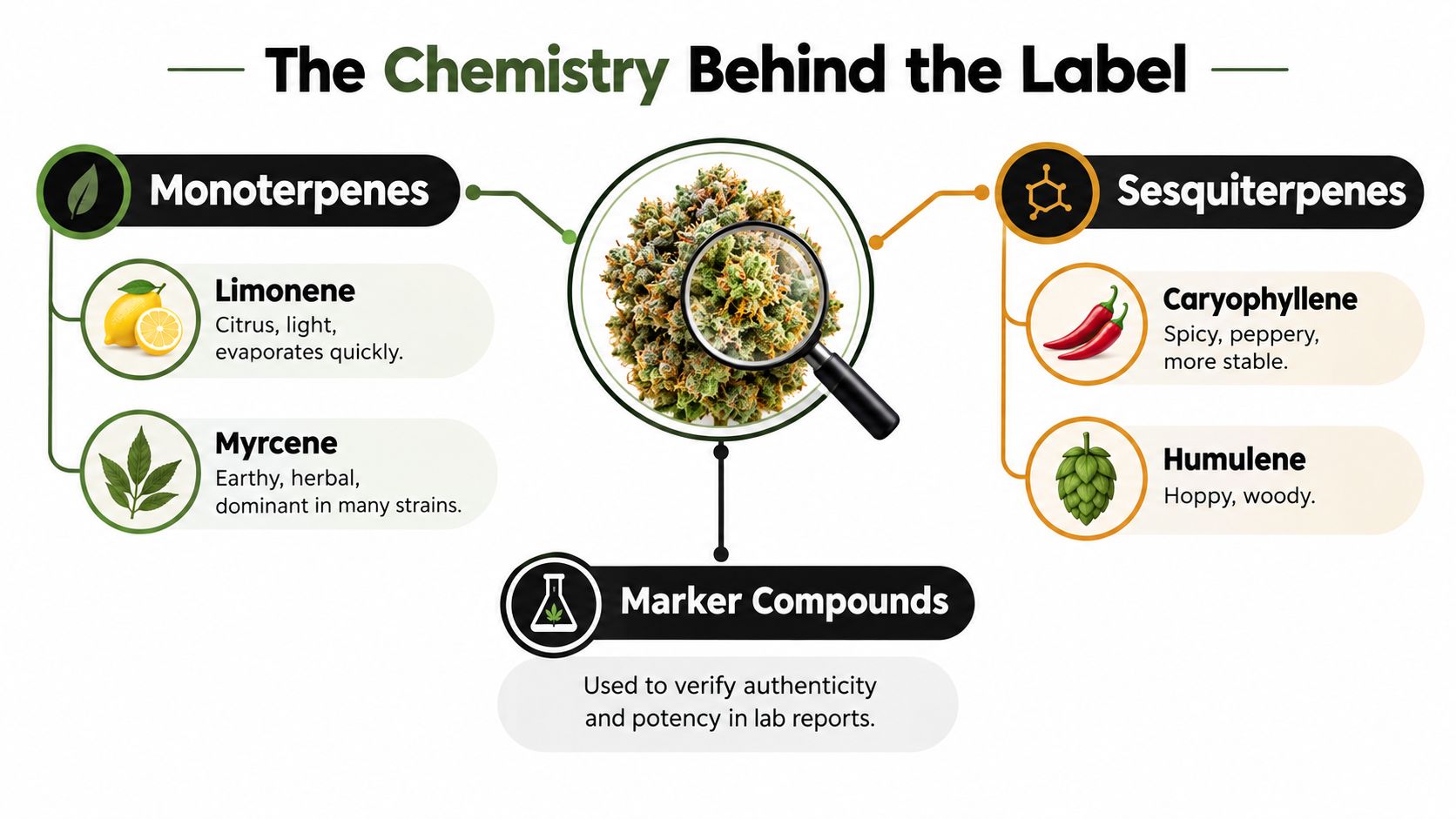
High-terpene material is a chemical profile, not a label that guarantees quality. The mix usually includes limonene, myrcene, linalool, pinene, terpinolene, and beta-caryophyllene, and the relative balance shifts with cultivar, harvest timing, storage, and extraction method. Two samples can both read as high terpene and still perform differently in a cartridge.
Why profile shape matters
Analysts have documented broad terpene diversity in cannabis, and the important point for formulators is not the raw count. It is the way one or two compounds can dominate, or a wider set of minor constituents can round out the aroma. In one review of cannabis essential oils, the dominant terpene exceeded 50% of total terpene content in 8 analyzed cases, and hydrodistilled hemp samples showed beta-caryophyllene at 25–42 mg/g. Those patterns explain why some high-terpene extracts hit hard and narrow, while others read fuller and more layered.
Chromatography also has limits. A 2025 GC-MS method study reported that library matching identified only 83.8% to 92.4% of total chromatographic peak area in extracts, which left part of the profile unresolved. For a buyer, that means total terpene % is only a starting point. The more useful questions are which compounds were detected, how repeatable the run was, and whether the method can distinguish the major terpenes from the minor ones that shape the finish.
Gold Coast Terpenes uses that same verification-first logic on the sensory side. A lab-verified, THC-free botanical blend lets a formulator recreate a profile shape without pretending that one number explains the whole material.
Some extracts are loud because one terpene dominates. Others feel fuller because the minor compounds smooth the vapor and hold the profile together. The lab report shows which one you are buying.
How High Terpene Extract Compares to Distillate
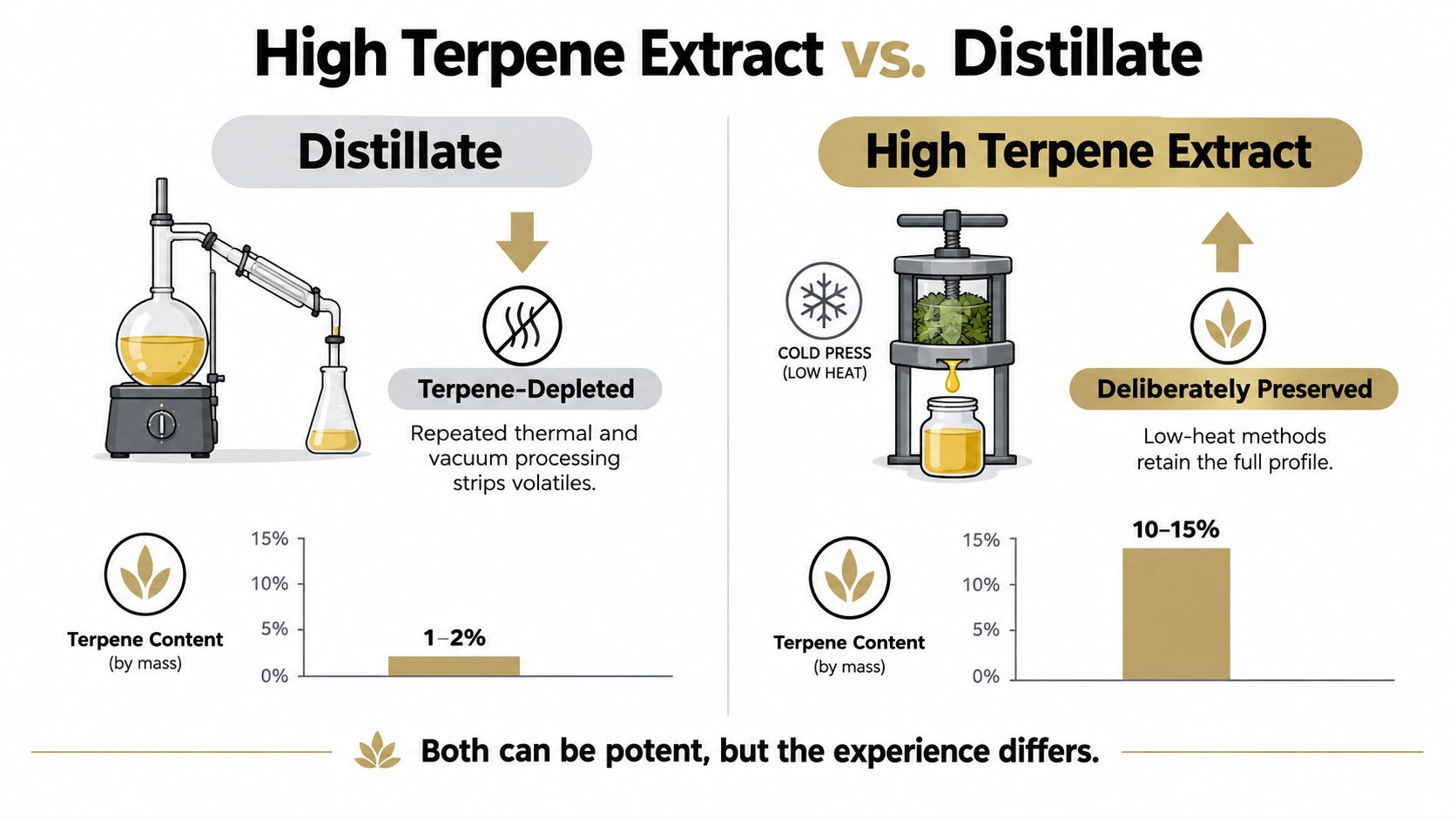
High-terpene extract and distillate solve different formulation problems. Distillate gives a clean cannabinoid base, while a terpene-rich extract preserves more of the aroma fraction that distillation usually strips away.
What the process changes
A study using repeated extraction at about 21°C and a 15-minute solvent residence time produced an extract with about 6% terpenoids and 59% principal cannabinoids. That matters because the extraction step is already choosing how much of the aromatic fraction survives into the finished material. Conventional extraction can also lose roughly 90% of volatile monoterpenes and monoterpenoids during standard hydrodistillation, which is why distillates often need terpenes added back later.
| Attribute | High terpene extract | Standard distillate |
|---|---|---|
| Aroma retention | Higher volatile fraction | Typically terpene-depleted |
| Sensory profile | Closer to source material | Usually flatter without reintroduction |
| Formulation role | Can stand alone or be blended | Usually needs terpene reconstitution |
| Texture impact | May be lighter or more aromatic | Often more neutral and viscous |
| Best use case | Flavor-forward SKUs and strain replication | Potency-led bases for custom flavor work |
For manufacturers, the difference is practical. A pure distillate + 3% botanical terpenes SKU can be a defensible build when the goal is control, repeatability, and a predictable viscosity curve. If the goal is a strain-inspired route, a product like Elevated Strains can work as a flavor-building component rather than a complete extract story, especially when the target is nuanced fruit and dessert notes.
That same trade-off is why formulators compare live-resin-style inputs with distillate workflows when they read about whether live resin outperforms distillate. The choice usually comes down to how much of the original aromatic fraction you want to keep versus how much control you need during blending.
Top, Mid, and Base Terpene Roles in Formulation
Think of terpene design the way a perfumer thinks about a pyramid. The top note hits first, the mid note gives the product body, and the base note helps the aroma linger and feel anchored.
Building the vapor profile
Top notes usually come from lighter, more volatile compounds like limonene, pinene, and terpinolene. They carry the first impression in the vapor path, especially in a 510-thread cart where the user notices the opening draw before anything else.
Mid notes are the bridge. Myrcene, linalool, and beta-caryophyllene help shape the roundness of the profile and keep the blend from reading as a one-note citrus hit or a thin herbal flash. Base notes are the heavier, more stable sesquiterpenes, the part that keeps the profile from disappearing too quickly after the first pull.
Gold Coast Terpenes' catalog spans more than 50 classic and contemporary strain profiles plus isolates like limonene, myrcene, and beta-caryophyllene, which gives formulators discrete building blocks for those layers rather than a single fixed blend. That matters because a strain-inspired formula is rarely just one terpene, it's a weighting decision.
Practical move: Start with a strain-inspired blend for the top and mid notes, then use isolated compounds only where the profile needs correction or reinforcement.
What this means for cartridge work
A winterized distillate base can carry top notes well when the loading is controlled, but heavy-handed blending flattens the result fast. The stronger approach is to keep the aromatic design deliberate, one blend for the front of the vapor, another for the body, and a restrained base that supports carry instead of burying it.
That's how formulators turn terpene profile for cartridge work into something repeatable. The goal isn't to overload the oil with aroma, it's to match the sensory arc the brand is trying to sell.
Why More Terpenes Is Not Always Better
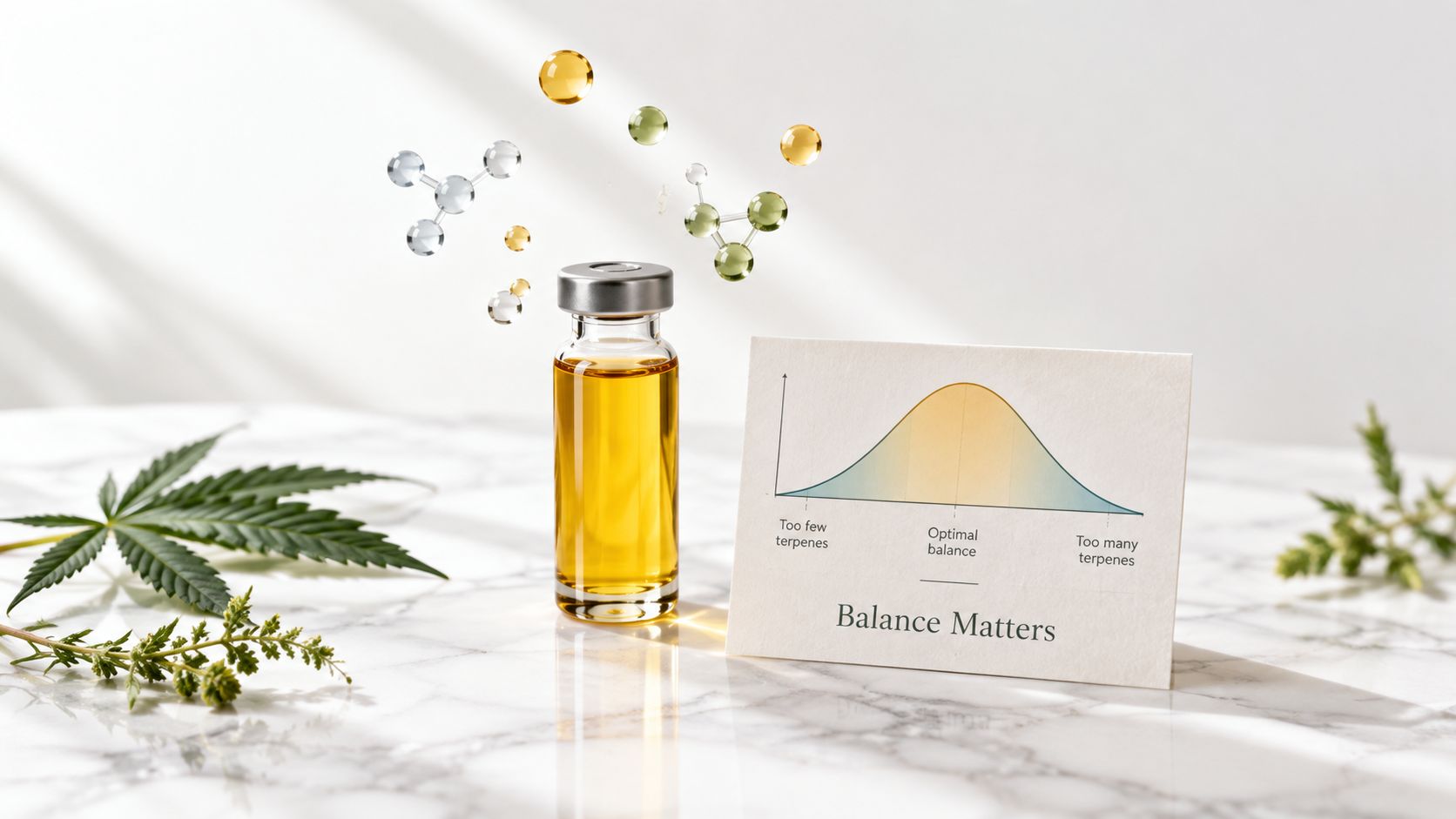
Higher terpene loading can improve flavor, but inhaled products also pick up more thermal byproducts as the blend is pushed harder. That trade-off is easy to miss when a spec sheet treats aroma intensity as the only marker of quality.
Heat changes the chemistry
A 2025 review (source) reported that aerosolizing myrcene, linalool, limonene, and commercial terpene mixtures can generate methacrolein, isoprene, benzene, aldehydes, and acids, and that the outcome shifts with heating conditions and oxygen exposure during vaping. The same blend can behave differently depending on the device, the coil, and how much air reaches the oil in storage and use.
That is why the simple “add more” rule falls apart in cartridge development. A blend can smell vivid on paper and still turn harsh, unstable, or chemically noisy once the coil starts heating it.
What usually works better
Lower, controlled terpene loading often gives a cleaner result than a maxed-out blend. For inhaled products, the better formulation keeps flavor intact without pushing the system into avoidable oxidation or thermal stress.
Device compatibility matters more than aroma intensity alone. Viscosity, coil design, and the amount of top-note lift needed in the first few draws all shape the right loading. That is why a guide like how much terpenes to add to distillate is more useful than a generic “more terpene, more quality” rule.
Reading a Certificate of Analysis for a High Terpene Extract
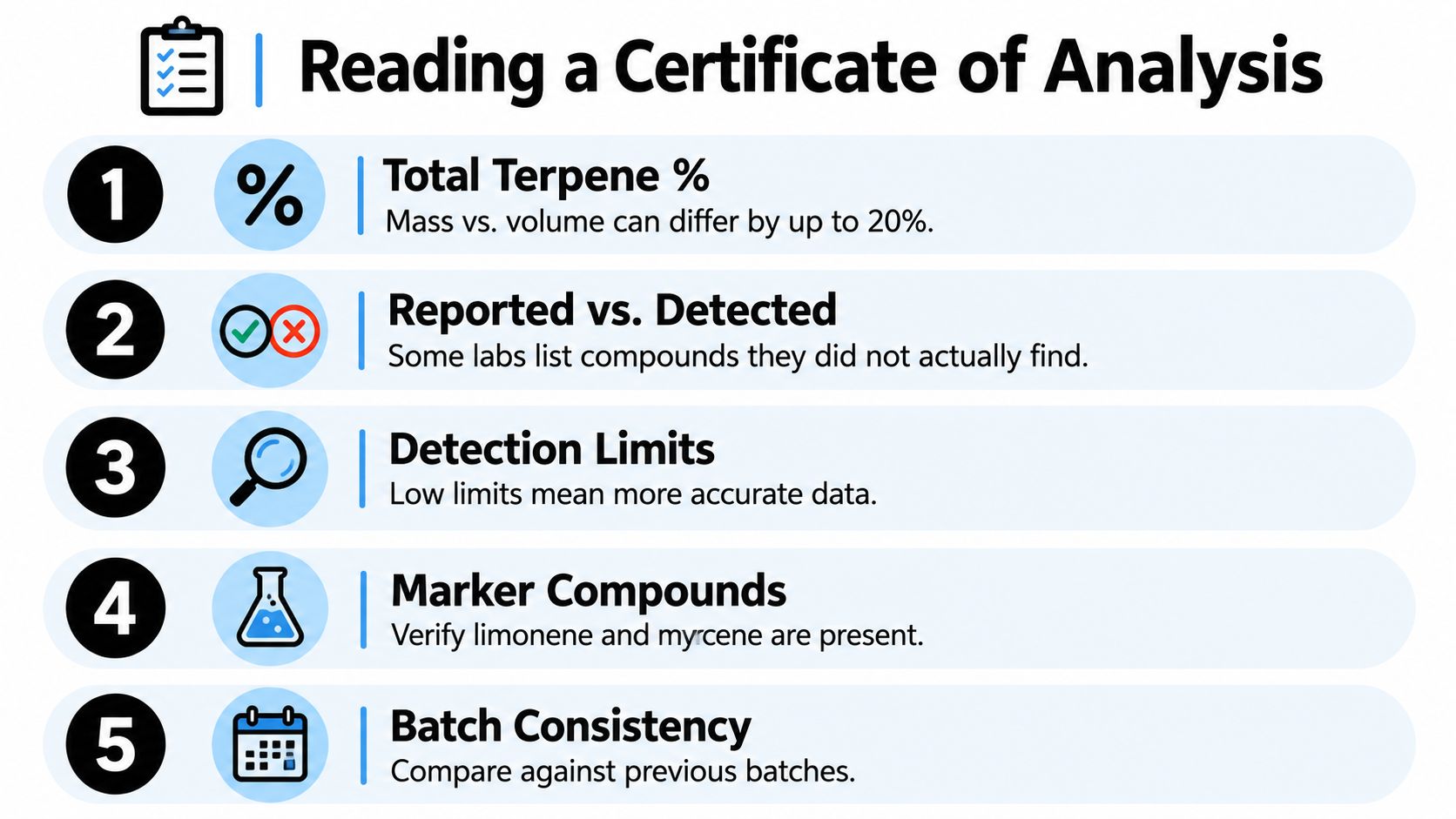
A COA is where the label becomes verifiable. If the numbers do not match the formulation story, the material is not as consistent as the marketing implies.
The five things to check
- Total terpene %. Check whether the figure is reported by mass or by volume, because that changes batch-to-batch comparison.
- Reported vs. detected compounds. Some labs list compounds that were not present at meaningful levels.
- Detection limits. Better limits give you a clearer chromatogram and a cleaner read on the profile.
- Marker compounds. Verify key markers like limonene and myrcene, then confirm whether the sesquiterpene side of the profile is represented.
- Batch consistency. Compare the current lot with prior lots before you approve production.
A good COA also shows whether terpenes are naturally extracted or added back after extraction. That distinction matters because the same total percentage can come from very different processing choices.
Storage belongs in the reading too. One study reported that volatile terpene levels can fall by as much as 50% within one month under ordinary storage (study). A packaging study reported a 33% decrease in β-myrcene under atmospheric conditions, while nitrogen-modified packaging prevented a significant decline. Another storage study found that 25°C produced the largest overall changes in secondary metabolites. Packaging and headspace matter as much as the blend itself.
Gold Coast Terpenes documents SC Lab-tested products with that stability mindset in view, and COA reading basics is worth keeping on a buyer's desk before a wholesale order is placed.
Choosing a Terpene Supplier for Vape and Distillate Work
A supplier should make a blend easier to verify, repeat, and scale. Catalog depth matters, but so do documentation, labeling clarity, and whether the supplier understands formulation use cases instead of only retail aroma sales.
What to compare
Start with sourcing language. Botanical, cannabis-derived, and nature-identical are not interchangeable terms, and the label should say which one applies before the material reaches production. Then check the tools that support real formulation work, the ability to handle MOQ and wholesale buying, and whether the supplier can support strain-inspired work without pushing everything into a generic flavor bucket.
A 2025 study of cannabis under different soil conditions found terpene concentrations of approximately 21.6–30 mg/mL (study), which reinforces a simple buying rule, batch-specific chromatographic testing is the quality gate, not a product page claim. Use that standard whether the input is for vape, CBD, or cannabis product formulation.
For a supplier checklist, I'd look for:
- Clear labeling: botanical versus cannabis-derived sourcing, with no vague “natural” shorthand.
- Catalog range: strain-inspired blends plus isolates for fine-tuning.
- Technical support: guides, mixing tools, a practical where to buy terpenes overview for vetting suppliers, and safety documents.
- Commercial fit: wholesale or bulk programs, MOQ structure, and shipping terms.
- Finished-product compatibility: whether the blend is meant for distillate, cartridges, or broader formulation work.
One practical option in that review is Gold Coast Terpenes. Its site pairs product pages with educational tools like Terpenes 101 and a Mixing Calculator, which helps a product team move from concept to batch math without guessing.
Frequently Asked Questions for Formulators and Buyers
Is there a legal threshold for calling something high terpene extract?
No universal threshold defines the term, so the label only becomes useful when the COA shows the actual terpene profile. Gold Coast Terpenes treats the phrase as a formulation descriptor, not a guarantee of potency or outcome.
How do I verify botanical versus nature-identical labeling?
Read the ingredient panel and ask whether the terpenes are naturally extracted, isolated, or blended. Gold Coast Terpenes makes this distinction part of the buying conversation, which helps brands avoid vague sourcing claims.
What's a sensible starting point for a 510-thread cart?
Start low enough to preserve viscosity and flavor stability, then adjust based on the device and the base oil. A controlled blend usually works better than chasing the highest possible terpene load.
How do I request a custom strain-inspired blend?
Bring a reference profile, the intended base oil, and the sensory target you want to hit. Gold Coast Terpenes can help translate that into a buildable terpene profile for distillate, cartridge, or broader product formulation work.
If you're building carts, concentrates, or flavor-forward distillate products, Gold Coast Terpenes gives you the tools to match profile, verify composition, and keep the blend commercially usable. Visit Gold Coast Terpenes to review strain-inspired options, isolates, and formulation resources that fit real production work.