
You've got a winterized distillate, a strain-inspired terpene blend on the bench, and a cartridge spec that has to hold flavor after heat, storage, and repeated use. Gold Coast Terpenes is a Redondo Beach, CA supplier of 100% botanically derived, THC-free blends for formulation work, and its catalog of 37 Strains and 40 Elevated Strains is a useful reference point for developers building flavor-forward products. The mistake many developers make is treating a terpenes boiling point chart like a device setting instead of what it really is, a volatility reference with pressure, uncertainty, and mixture effects baked in.
Why Terpene Boiling Points Matter for Formulators
A boiling-point chart matters because it tells you which molecules leave first when heat enters the process, not because it gives you a magic vape number. If you're formulating for cartridges or distillate, that difference decides whether your top notes survive compounding, whether your mid-notes carry through storage, and whether the finished oil still reads like the target strain after it's been warmed, purged, and filled.
Start with volatility, not nostalgia
Terpene boiling point data should be read as a volatility map. Under normal atmospheric pressure, alpha-pinene sits around 155–157 °C, myrcene around 167 °C, and limonene around 176–178 °C PMC review. Those numbers help you predict which compounds are easiest to lose during drying, heating, purging, or storage, but they do not tell you when a finished cartridge should run.
Practical rule: if a number is being used to set a device instead of rank volatility, it's being misused.
For a product developer, the payoffs are simple. You can read published charts with pressure caveats, predict which compounds leave first, set storage conditions by volatility class, and build a validation protocol for your own oil and hardware instead of copying someone else's settings. That's the right way to use published data, especially when your target is flavor accuracy in a commercial SKU.
Gold Coast Terpenes' strain-specific blends and Elevated Strains give formulators a starting point for top-note, mid-note, and base-note design, but the finish still depends on how your matrix behaves under heat. The foundation is understanding what a boiling point measures, and what it does not.
What a Boiling Point Actually Measures
A boiling point is the temperature at which a compound's vapor pressure reaches 1 atmosphere, or about 760 torr (100 kPa), not the temperature at which the compound vanishes. Terpenes already have measurable vapor pressure below that point, so a light monoterpene can start leaving the oil well before the charted boiling number appears on paper.
Pressure changes the number
That's why pressure matters. Lower the pressure and the boiling point drops, which is why vacuum and short-path systems do not behave like atmospheric distillation. NIST's compiled values show the spread clearly, with alpha-pinene at about 430 ± 4 K or 157 ± 4 °C based on 14 literature entries, and limonene at about 451 ± 4 K or 178 ± 4 °C based on 13 entries vapochecker compilation. Myrcene is listed near 440.2 K, or about 167.1 °C, in that same compilation.
That spread is the part most charts hide. Different measurements, different pressure assumptions, and different reference bases create chart disagreement, sometimes by a few degrees and sometimes more. A rounded value without a pressure note is a convenience number, not a process control parameter.
Read charts as ranges, not absolutes
For formulation work, the defensible approach is to specify the compound, the pressure, the measurement basis, and the acceptable assay range. Then pair that with vapor-pressure and thermal-stability data, because a published terpenes boiling point does not tell you how the molecule behaves inside a mixed oil or under airflow. The chart becomes useful when it helps you sort compounds by loss risk, not when it's mistaken for a dial setting.
Once pressure and uncertainty are clear, the next question is which terpene families you should expect to lose first in a heated workflow.
Volatility Ranking Across Terpene Families
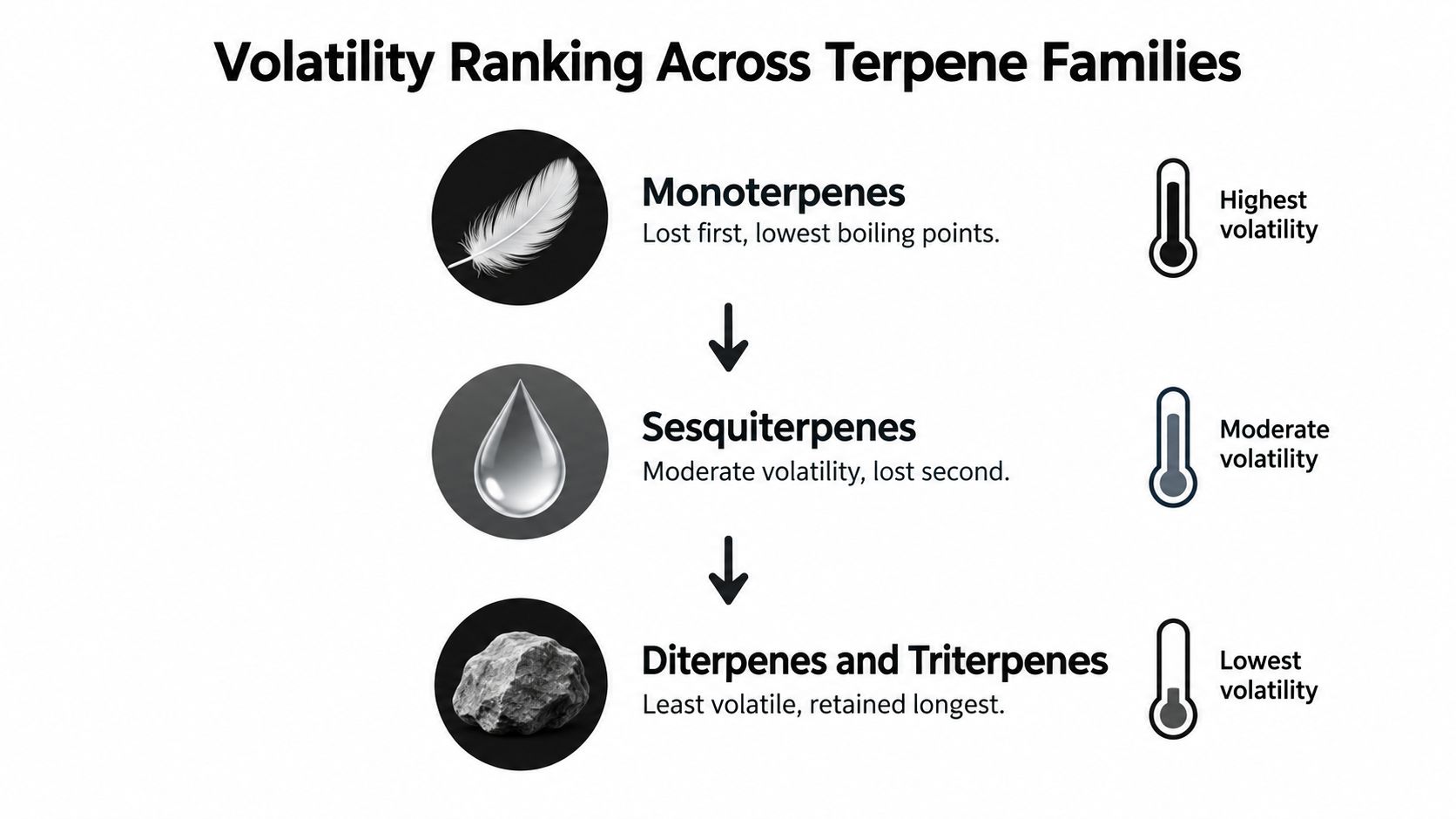
Monoterpenes leave first, then monoterpenoids, then sesquiterpenes, then sesquiterpenoids. That ranking is the fastest way to predict aroma loss in processing, and it's more useful than memorizing isolated numbers without context.
Read the classes in order
Under atmospheric conditions, the common monoterpene window is tight but operationally important. Alpha-pinene, myrcene, and limonene sit in the roughly 155–178 °C range, which is why they're the first compounds to drift in open heat, thin-film drying, and repeated warming cycles PMC review. Heavier terpene families generally persist longer because they have lower vapor pressure, not because they're automatically safer or inert.
| Terpene Volatility Ranking by Class | Approx. Atmospheric Range | Examples | Loss Behavior |
|---|---|---|---|
| Monoterpenes | about 155–178 °C | alpha-pinene, myrcene, limonene | Lost first, highest volatility |
| Monoterpenoids | higher than monoterpenes in the cited progression | oxygenated flavor notes | Lost after the lightest monoterpenes |
| Sesquiterpenes | heavier than monoterpenes | caryophyllene, humulene, farnesene | Retained longer, still affected by heat and oxygen |
| Sesquiterpenoids | heavier still | oxygenated sesquiterpene notes | Most retained among common terpene classes |
Heavier in this context means higher boiling point and lower vapor pressure. It doesn't mean the molecule can't be altered by residence time, oxygen, or device design. That's why a strain profile with a bright citrus top note behaves differently from one built around earthy base notes.
If you need a cross-industry reminder that volatility ranking matters outside cannabis, the logic is the same as choosing a long-lasting scent in any humidity-prone application, which is why a practical fragrance reference like find long-lasting scent for PH humidity can be a helpful comparison point for thinking about persistence versus flash-off.
Formulator takeaway: if a process is hot, open, or repeated, assume the monoterpene fraction is under pressure first.
That ranking tells you what leaves first, but it doesn't yet tell you where those losses happen in a real production workflow.
Where Monoterpenes Are Lost During Processing
Monoterpenes are most exposed during drying, decarboxylation, solvent removal, purging, and storage headspace. If your process includes any open vessel or warm purge, assume the lightest fraction is drifting before you ever reach fill day.
Open steps are where the damage starts
During drying and decarb, the most volatile compounds migrate first because they already have measurable vapor pressure below their published boiling points. Limonene and pinene fractions can drop noticeably during open-vessel purging, and myrcene sits close enough to the low end of the monoterpene range that it's often among the first compounds to move during any heated step.
That's why formulation teams often profile flower or fresh-frozen material, extract it, and then reintroduce a botanically derived blend later to recover the lost top-note fraction. Gold Coast Terpenes' customers often use that pattern when they're trying to restore a strain-inspired profile after the extraction step has stripped aroma away.
Recover, don't pretend the loss didn't happen
You have two jobs here. First, decide which losses are intentional, like terpene recovery for later reintroduction. Second, separate those from accidental drift, like headspace losses during storage or warm holding tanks. Those are not the same problem, and they shouldn't be treated the same way.
The point is simple. A blend that smells right after compounding can still be missing the lightest fraction by the time it gets to a cartridge. That's exactly why the next mistake is so common, because people try to use a chart designed for volatility as if it were a vaping temperature map.
Why Boiling Point Is Not a Vape Temperature
A published boiling point is not a vape setting because cartridges and dab devices don't operate at pure-compound, 1-atmosphere conditions. They run under changing pressure, airflow, coil temperature, power, viscosity, and formulation load, so the vaporization behavior of the oil is not identical to the data in a chart.
Aerosolization is not the same as boiling
The better frame is aerosolization, not boiling. A low-boiling terpene can change how the whole mixture behaves, and research on THC–β-myrcene mixtures found that added myrcene shifted product behavior in a way that pointed toward lower aerosolization temperatures and less degradation, even though THC's predicted boiling point is far higher than myrcene's 167 °C THC-myrcene study.
That matters because monoterpenes can appear in the aerosol before cannabinoids. In practice, flavor often arrives ahead of heavier constituents, which is why a cartridge can taste terpene-rich on the first pull and flatter later if the system isn't balanced correctly.
Use the chart as a hypothesis
The chart is useful as a starting hypothesis for retention, not as a dial setting. If you're developing a cartridge, the question that matters is whether your oil, hardware, and puff profile keep the parent terpenes where you want them and keep degradation products under control. The number on the chart can't answer that.
Bottom line: the published terpenes boiling point tells you what's likely to move first. It does not tell you where to set the device.
Once you stop treating the chart like a vape recipe, you can use it for what it's good at, which is planning extraction, distillation, and reintroduction work.
Applying Volatility Ranges to Extraction and Distillate
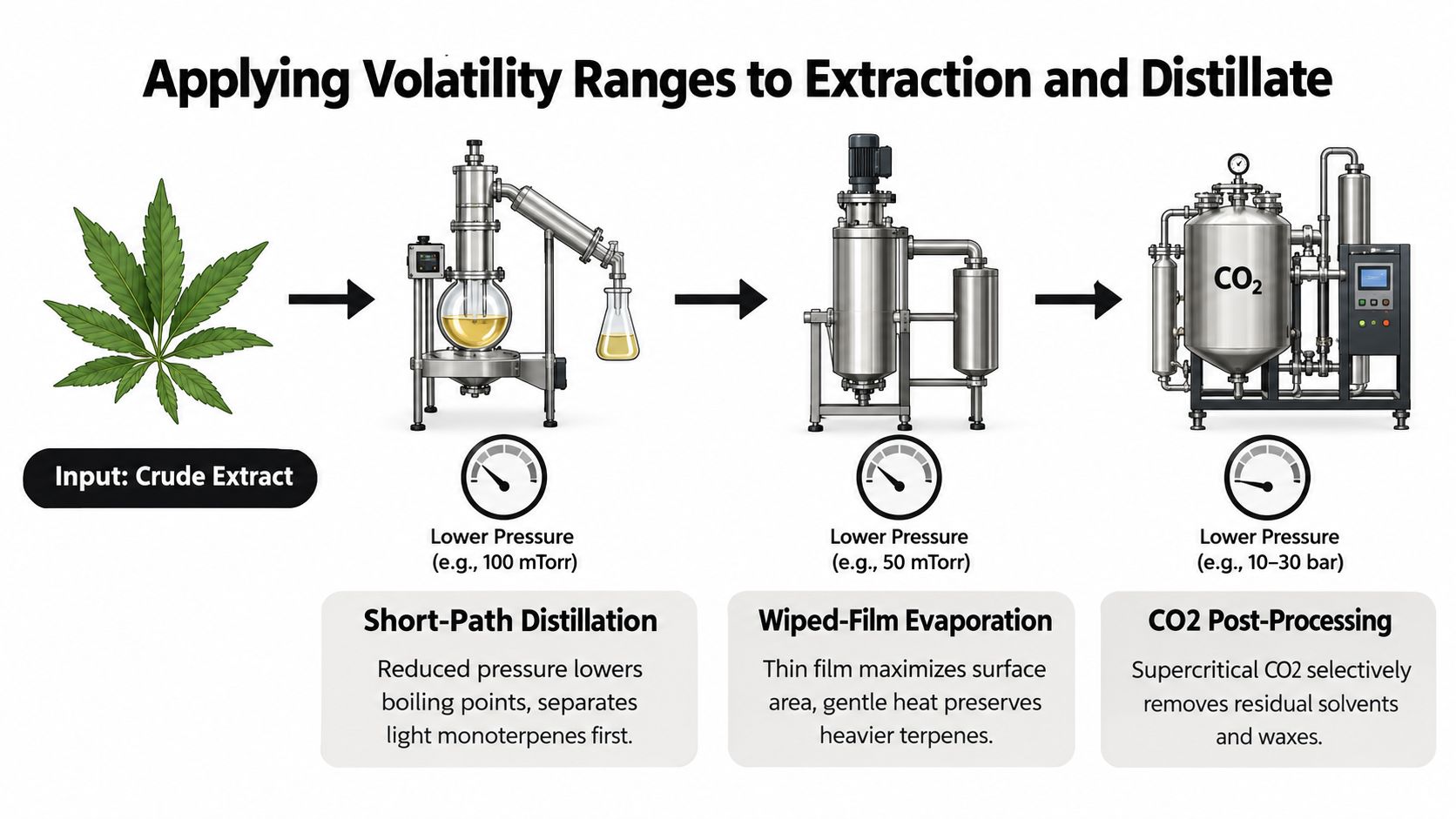
Reduced pressure changes the game. Short-path distillation, wiped-film evaporation, and CO2 post-processing all let operators work below atmospheric boiling-point conditions, so the same compound behaves very differently at 760 torr, lower vacuum levels, and near-high-vacuum conditions.
Pressure is part of the recipe
A chart without a pressure note is incomplete. Under reduced pressure, lighter monoterpenes can separate at lower temperatures than the atmospheric numbers suggest, which is why distillation teams care about vacuum level as much as they care about heat input. Wiped-film units also spread oil into a thin film, increasing surface area and reducing residence time, which helps preserve more of the heavier fraction.
Winterization and decarboxylation still matter, because even moderate oven temperatures can strip off a meaningful piece of the monoterpene fraction before the oil is ever loaded. That's why formulation work has to account for the loss window before the cartridge stage, not only after it.
Reintroduction belongs at the compounding stage
Gold Coast Terpenes' SC Lab-tested, THC-free blends are built for reintroduction after those losses, so formulators can restore a strain-inspired profile at the compounding step instead of chasing flower-level aroma numbers. That is the commercial reality. Extraction changes the matrix, so you re-balance the matrix.
If you're studying solvent removal methods alongside terpene retention, this internal resource is relevant, because the downstream choice changes what survives into the final oil: solvent extraction methods.
The next filter is source labeling, because the same boiling range means something different when the supplier's terpene pool came from a plant, fermentation, or a cannabis fraction.
Botanical vs Nature-Identical vs Cannabis-Derived Labeling
The source claim on a COA changes how you should read the same number. Two suppliers can quote a similar terpenes boiling point range, but the impurity profile, regulatory path, and lot consistency can still be very different.
Same molecule, different business problem
Botanically derived terpenes are isolated from non-cannabis plant sources and then re-blended. Nature-identical terpenes are made by fermentation or synthesis but match plant molecules exactly. Cannabis-derived terpenes come from the plant itself, and that pool is smaller and more expensive to source consistently.
Gold Coast Terpenes positions its blends as 100% botanically derived, THC-free, and free of VG, PG, PEG, and MCT, which matters when you're reading documentation for flavor matching and compliance. The molecule may be identical, but the trace profile, sourcing constraints, and batch behavior are not.
Read the COA through the source lens
If the supplier is botanical, you're mainly comparing aroma fidelity, documentation quality, and lot-to-lot consistency. If the supplier is cannabis-derived, you're also weighing plant-source variability and the narrower raw material pool. If the supplier is nature-identical, you're looking closely at production route, residue profile, and how that fits your jurisdiction.
For buyers comparing source claims, this pairing is useful: CDT vs BDT. The point isn't that one label magically wins. The point is that the source label changes how you interpret the same molecular data.
Decision filter: if two suppliers quote the same range, the real differentiator is source, purity documentation, and lot consistency, not the number itself.
That source decision affects storage too, because volatile blends need different handling than heavier, more stable profiles.
Storage and Stability by Volatility Class
Storage should be matched to volatility class, not treated as a one-size-fits-all shelf rule. Monoterpenes need the tightest headspace control, the coldest practical storage, and the most aggressive inert blanketing, while heavier terpene classes can tolerate a little more room without drifting as quickly.
Protect the top notes first
Use glass or aluminum when you can, keep headspace minimal, and avoid repeated lid-off cycles. Nitrogen or argon blanketing helps slow oxidation, which matters even in sealed containers because aroma loss isn't only evaporation. A vial can stay sealed and still lose character if oxidation is advancing inside the bottle.
Light matters too. Amber containers and opaque packaging reduce exposure, and humidity control matters when the storage area is unstable. The lighter the profile, the less margin you have before the top notes flatten.
Gold Coast Terpenes ships with packaging choices aimed at these volatility classes, and the brand also supports bulk purchasing for formulators who need protected working inventory. For teams managing replenishment, the published bulk terms include free U.S. shipping over $100 and discounts on orders exceeding 64 oz.
If you want a practical storage reference, this is a useful companion guide: how to store terpenes.
Match storage to the blend
A citrus-forward strain-inspired blend deserves different handling than a heavier earthy profile. If the blend leans hard on monoterpenes, short storage windows and cold handling matter. If it's built on sesquiterpene character, the immediate risk is lower, but oxidation still changes the finished aroma over time.
Storage protocols matter, but none of them saves a blend that gets heated wrong in the device, which is why validation has to happen at the cartridge level.
Device-Specific Validation Instead of a Universal Temperature
Every cartridge or dab device is its own experiment. If you don't validate the oil in the actual hardware, with the actual terpene load and actual power range, you're guessing.
Control the variables you can actually change
The variables that matter are oil viscosity, terpene percentage, hardware type, voltage or wattage, puff duration, airflow, and rest time between puffs. In one cannabis-vape study, a 9:1 THC-to-terpene ratio was used as a practical model because it produced material that was neither too thick nor too fluid for the device cannabis-vape formulation study. The same work also showed that too much terpene loading can make the concentrate leak from the pen.
Applied power also matters because degradation-product levels in THC–terpene mixtures change with heat input. A blend that tastes right in a vial can aerosolize differently after it's heated, inhaled, and repeatedly cycled through the hardware.
Practical rule: higher boiling point doesn't automatically mean safer or more stable. Molecule, residence time, oxygen, device design, and power all have a say.
Test the oil, not the assumption
Run an emissions and retention protocol on the actual SKU. Pull the cart at defined puff counts, compare parent terpenes to the unheated oil, and look at degradation products alongside aroma retention. If the hardware changes, repeat the test. If the loading percentage changes, repeat the test.
If the SKU needs a real-world flavor reference while you tune hardware behavior, a product page like Elevated Strains can serve as a formulation reference point for rare fruit and dessert notes without assuming the oil will behave identically across devices.
The most common mistake after that is overcorrecting with terpene percentage, so the next step is to screen loading with discipline instead of guesswork.
Loading Percentage and Sensory Screening
Start with loading, not with the assumption that more terpene automatically gives better flavor. In commercial vape oil, terpene concentration commonly sits around 5% to 15%, while cannabis flower is often around 2% to 5% industry report. Distillate and winterized oil often need a different loading level to reach the same aroma intensity because the matrix changes how the volatiles release.
A single number is only a starting point. Viscosity, cartridge design, power, and how much oil the hardware will hold all shape the final result.
Screen in small steps
Use a controlled sensory screen.
- Set the target profile: define the aroma you want to reproduce, including top, mid, and base notes.
- Start low: build three to five loading levels around a chosen baseline rather than jumping to the top of the range.
- Match hardware: test in the same cartridge and power conditions you plan to sell.
- Score sensory effects: check aroma intensity, harshness, and leak behavior on a blind panel.
- Check viscosity: confirm the oil still moves correctly when warmed.
The cannabis-vape study's 9:1 THC-to-terpene ratio is a useful experimental reference, not a commercial specification. Use it to think about fluidity and compatibility, then adjust the ratio based on the oil and device, not on a chart alone.
For a fuller protocol on panel design and scoring, see our guide to sensory evaluation methods.
Control the variables you can change
Too much terpene can sting the lips or tongue, taste unpleasant, and make the oil too fluid for the cartridge. That is a formulation failure.
A supplier workflow that includes strain profiles, isolates, and a Mixing Calculator helps the formulator turn a percentage target into a measured recipe instead of estimating by eye. If the SKU needs a real-world flavor reference while you tune hardware behavior, the Apple Fritter flavor-hybrid profile can serve as a reference point for rare fruit and dessert notes without assuming the oil will behave identically across devices. That matters because the loading step affects everything downstream.
Quick Reference Workflow for Strain-Inspired Blends
A repeatable workflow keeps the chart, the oil, and the hardware tied together. If you're building a strain-inspired blend for vape or distillate, this is the order that keeps you out of trouble.
Use the same sequence every time
- Pull the target profile. Define the top, mid, and base notes you're trying to reproduce.
- Flag the light fraction. Identify the monoterpenes that carry the highest loss risk.
- Choose the storage plan. Protect the volatile fraction before compounding starts.
- Set a starting loading level. Use a screening point inside the 5% to 15% cartridge range, then adjust.
- Blend into winterized distillate. Make the oil, then check viscosity and appearance.
- Run a small-batch device test. Use the actual cartridge or concentrate hardware.
- Compare heated and unheated oil. Look at aroma retention and degradation.
- Iterate on loading, hardware, and power. Lock the version that holds up best.
If you need a place to push more unusual fruit or dessert notes, Gold Coast Terpenes' Elevated Strains line is built for that kind of tuning. Curated packs and isolates also make it easier to isolate individual notes without rebuilding the whole profile from scratch.
The core idea doesn't change. The chart is a starting hypothesis, and the validation is the product.
FAQ on Terpene Boiling Points for Formulation
Is a published terpene boiling point safe to use as a vape temperature? No. A published terpenes boiling point comes from defined pressure conditions, while cartridges and dab devices operate under changing airflow, power, viscosity, and hardware behavior. Gold Coast Terpenes formulators should treat the chart as a volatility reference and validate the actual oil in the actual device.
How do botanical blends compare with cannabis-derived fractions on a COA? The same molecule can appear on both, but the impurity profile, source documentation, and regulatory considerations are different. Gold Coast Terpenes' botanically derived, THC-free blends give formulators a consistent source option when they want predictable documentation and flavor matching.
Which compounds are most likely to disappear during winterization or decarb? The lightest monoterpenes are the first to leave, with myrcene and limonene among the most exposed in heated steps. Gold Coast Terpenes users who reintroduce terpene blends after processing usually do so to restore that lost top-note fraction.
What loading percentage should I start with for a distillate cart? Start with a screening ladder inside the 5% to 15% commercial range and adjust for viscosity, leakage, and flavor intensity. Gold Coast Terpenes' Mixing Calculator is useful when you need a measured recipe instead of an estimate.
Does a higher boiling point mean a terpene is safer or more stable? No. Survival depends on molecule, residence time, oxygen, power, and device design, not just on a higher number in a chart. Gold Coast Terpenes formulators should test emissions and retention, not assume higher equals safer.
How do I reduce monoterpene loss in storage? Use minimal headspace, inert gas blanketing, cold storage, and light-protective packaging. Gold Coast Terpenes' packaging and bulk handling options are built around keeping volatile fractions intact while inventory sits on the shelf.
For deeper formulation support, review Terpenes 101, use the Mixing Calculator, and reach out through wholesale intake when you're ready to scale a strain-inspired SKU with a defensible process.
If you're building carts, distillates, or custom flavor systems and need terpene profiles that are practical to formulate with, visit Gold Coast Terpenes and compare strain-specific blends, premium strains, and lab-verified documentation against your current oil. Use the site's formulation tools, then validate the blend in your actual hardware before you lock the SKU.