
Gold Coast Terpenes identifies myrcene and linalool as dominant compounds in classic indica-leaning profiles, with myrcene reported at roughly 30–65% of total terpene content in some strains. The practical answer is that ratios matter more than strain labels, because an “indica” name alone can't tell you how a finished cart will smell, taste, or perform.
You may be looking at a distillate batch with a clear commercial brief, such as “make it deeper, more floral, and suitable for an evening-positioned SKU.” The problem is that “indica” isn't a molecule or a fixed chemical specification. It's a shorthand for a sensory direction that formulators have to translate into measurable compounds, controlled loading, and hardware-tested performance.
For product developers, indica terpenes are best treated as a formulation system. Myrcene can establish an earthy base, linalool can soften the center, caryophyllene can add peppery structure, and carefully controlled top notes can stop the blend from becoming flat. The work is less about finding a magical terpene and more about making a repeatable profile that survives mixing, filling, storage, and inhalation.
Finding the Right Indica Terpene Foundation
Start with a sensory target, not a strain label. An indica-leaning blend usually needs a grounded base, a rounded floral or herbal middle, and enough contrast to keep the finished oil from tasting dense or one-dimensional.
A common development request is to replicate the flavor of a named cultivar for a vape cartridge or distillate product. That request becomes workable only after you define what “replicate” means. Are you matching earthy depth, floral softness, peppery finish, fruit character, or the full aroma arc from first inhale to aftertaste?
Gold Coast Terpenes supplies 100% botanically derived terpene blends, strain-inspired profiles, and isolated compounds such as myrcene and beta-caryophyllene. That gives a formulator two practical starting points: build from individual materials when analytical control matters most, or begin with a strain-inspired terpene blend and adjust it against the target oil and device.
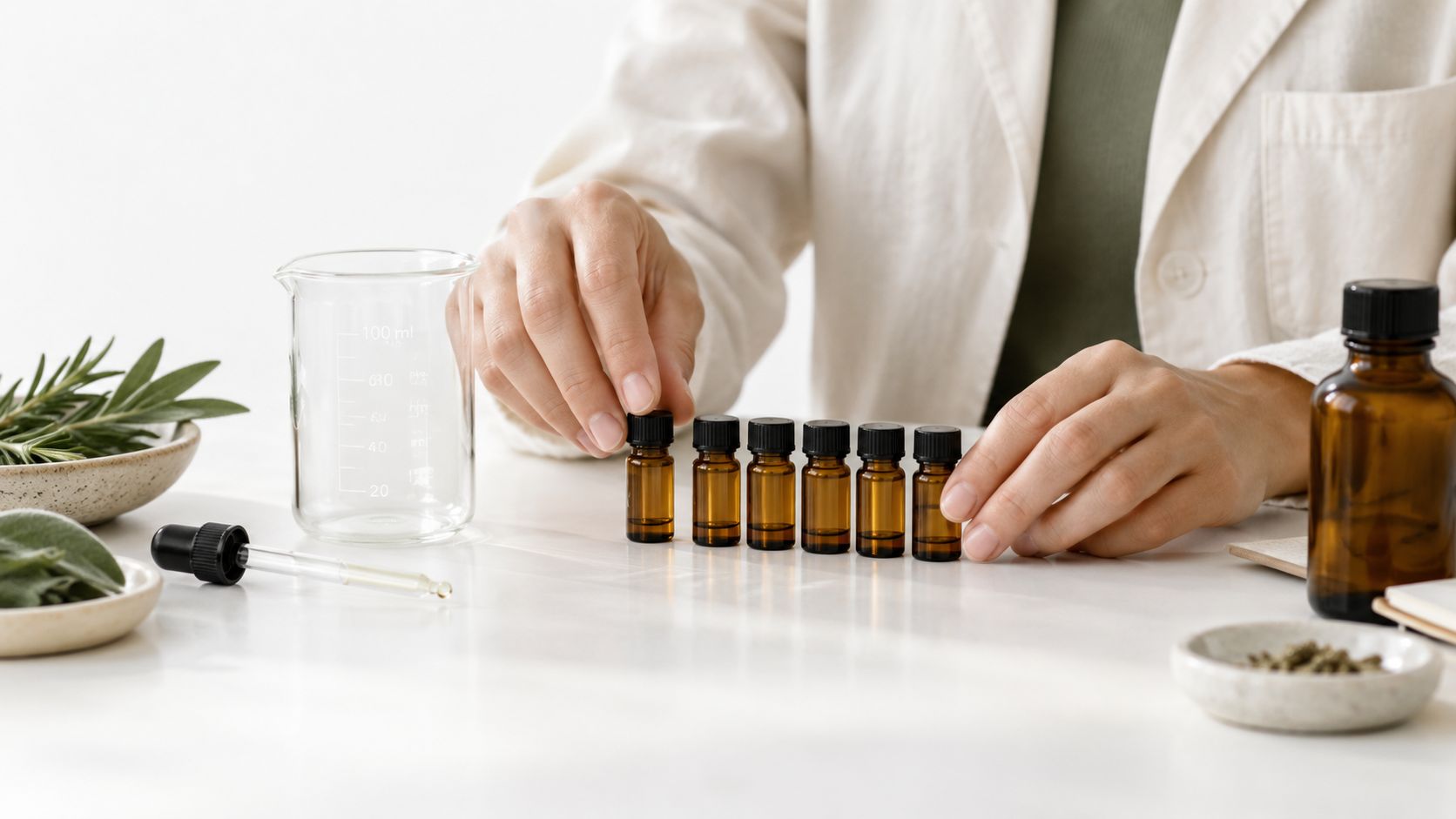
Define the profile before choosing materials
For a new SKU, record the target in plain sensory language:
- Base direction: earthy, musky, woody, resinous, or fruity.
- Middle character: floral, lavender-like, herbal, or softly spicy.
- Top-note behavior: citrus, pine, fruit, or a restrained aromatic lift.
- Finish: clean, peppery, sweet, lingering, or deliberately dry.
That brief helps you avoid a frequent formulation error, adding myrcene because a buyer asks for “indica,” then discovering that the blend has depth but no definition. The same label can describe very different chemical profiles, so a strain-inspired terpene blend should be evaluated by its measured composition and sensory result.
Choose isolates or a pre-built profile
Isolates offer control over the ratio and make it easier to troubleshoot. Pre-built profiles offer speed and can be useful when the commercial target is a recognizable flavor rather than an analytical recreation of flower.
Gold Coast Terpenes also provides formulation resources, safety documentation, and strain-specific options for cartridges, concentrates, and distillate applications. Whatever the source, request current documentation, confirm the material is free from unwanted carrier ingredients, and test the blend in the actual oil and hardware rather than judging it from a blotter alone.
Practical rule: Treat “indica” as a sensory brief. Treat the terpene ratio, loading level, oil base, and device as the specification.
Understanding Myrcene and Linalool Dynamics
Myrcene usually supplies the foundational earthy, musky, and fruity body of an indica-leaning profile, while linalool works as a floral modifier that rounds and softens that base. Neither compound guarantees a particular finished-product experience on its own, so the useful question is how each behaves inside the complete blend.
Myrcene is the main anchor because it often dominates the terpene fraction by weight. Technical reviews associate it with musky, earthy, and fruity aroma notes, and report that it can represent roughly 30–65% of total terpene content in some strains technical review of myrcene and cannabis terpene profiles.
That range is a useful reference, not a universal recipe. A profile with a high myrcene share can read as rich and body-forward, while a lower share may leave more room for floral, citrus, pine, or pepper notes. Small shifts can materially change the perceived direction, particularly after dilution into distillate.
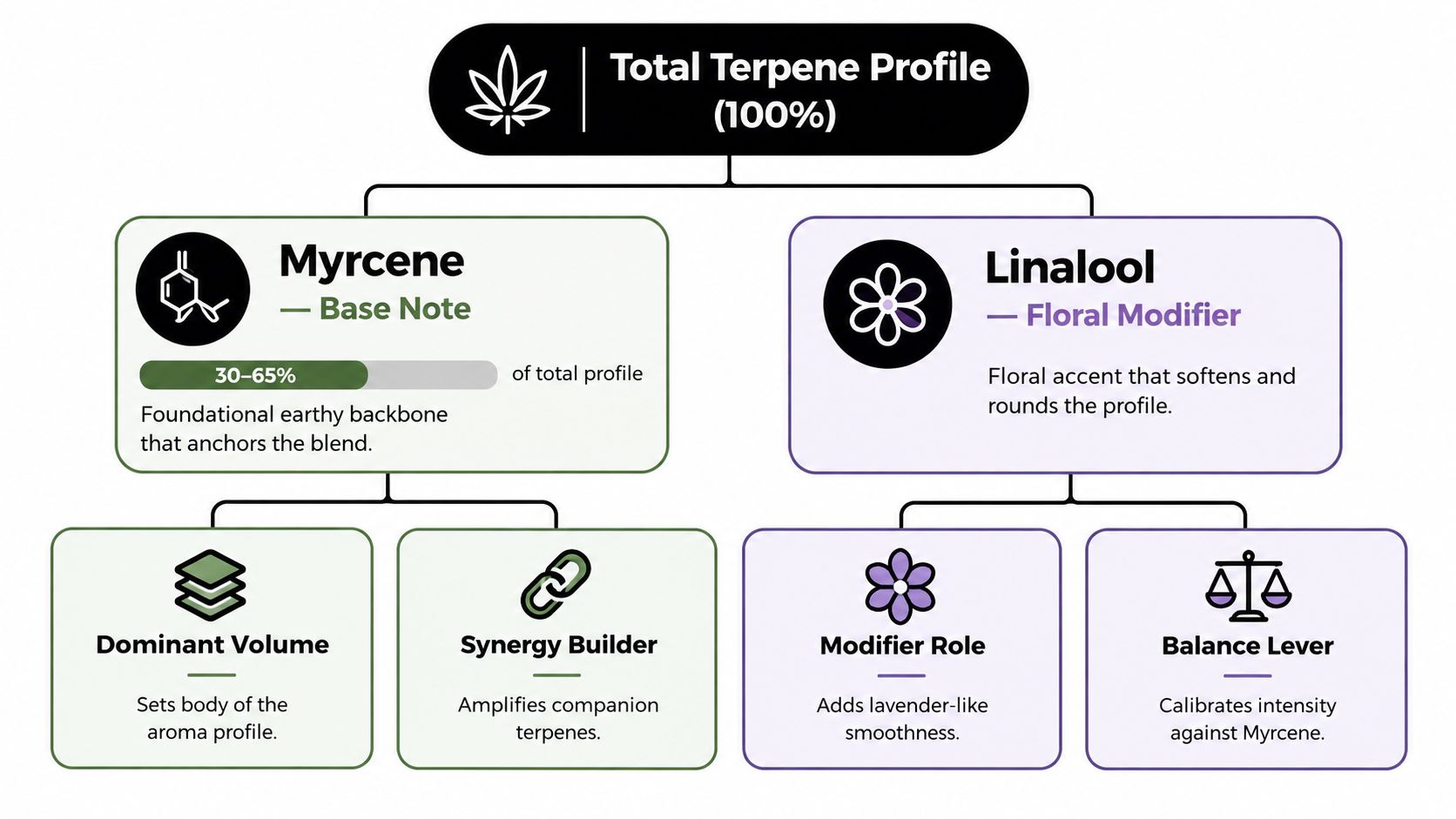
Myrcene establishes volume
In a formulation lab, myrcene is less useful as a promise of sedation than as a volume and depth control. It can make a blend feel fuller aromatically, but too much can blur the edges of delicate notes and create an overly heavy opening.
Linalool performs a different job. Commercial terpene guidance places it in the middle-note layer, where its floral and spicy character can connect a deep base to a brighter top. Used carefully, it can make a myrcene-heavy profile feel smoother and more complete without turning the product into a floral isolate.
Read more about myrcene terpene effects and formulation behavior before setting a target ratio. The key is to evaluate both the aroma at room temperature and the vaporized result, because heat can change the balance between base and modifier.
Don't confuse aroma with a guaranteed effect
Marketing often turns myrcene into a blanket sedative claim. The available evidence is more specific and less conclusive. A 2025 randomized crossover trial involving 125 people with insomnia found that a THC-free oral CBD and terpene formulation increased combined slow-wave and REM sleep by only 1.3% on average versus placebo, although individual responses varied and no adverse events were reported trial summary and publication details.
That formulation contained myrcene, linalool, limonene, alpha-terpinene, alpha-terpineol, alpha-pinene, phytol, and beta-caryophyllene. It therefore doesn't prove that myrcene alone produces a sleep effect. For product teams, the more defensible conclusion is that formulation context matters, and that aroma positioning shouldn't be written as a medical promise.
The Role of Minor Terpenes in Relaxation
Minor terpenes give an indica-leaning blend definition and lift. Beta-caryophyllene can provide a peppery, woody anchor, while limonene and alpha-pinene can add controlled top-note energy without replacing the deeper base.
Beta-caryophyllene is especially useful because it has a well-described direct interaction with the CB2 receptor. A peer-reviewed study identified it as a selective CB2 agonist, giving formulators a mechanistic basis for discussing its functional positioning without implying CB1-linked psychoactivity beta-caryophyllene terpene reference and study discussion.
That distinction matters in commercial copy. You can describe a blend as peppery, grounding, woody, or relaxation-positioned. You shouldn't promise that a particular ratio will treat pain, insomnia, anxiety, or another condition.
Build the aroma in layers
A useful note structure looks like this:
- Base notes: Myrcene and caryophyllene establish body, earthiness, musk, pepper, and wood.
- Mid notes: Linalool adds floral softness and helps connect the base to brighter materials.
- Top notes: Limonene or alpha-pinene can contribute citrus or pine lift when used with restraint.
Commercial terpene guidance describes myrcene as a base note, limonene as a citrus top note, linalool as a floral and spicy mid note, and caryophyllene as a peppery, woody base note commercial terpene note chart.
The practical trade-off is clarity versus weight. If the base dominates, the cart can taste muddy. If the top notes dominate, the profile may stop reading as indica-leaning. Minor compounds should refine the direction, not compete with it.
Use multi-terpene blends rather than single-compound logic
Independent sensory research indicates that terpene mixtures can cluster reported effects into soothing, stimulant, and unpleasant groups, while terpene profiles alone perform poorly when asked to predict aroma character. That finding supports a disciplined blending approach: use several compounds to create a coherent sensory structure, then validate the result in oil and hardware.
A 2025 review also described the evidence for terpene-driven sleep and pain benefits as limited, with much of the available work involving formulations that combine terpenes with CBD rather than terpene-only products. For a cannabis product formulation, that means a single-compound “relaxation” SKU is a weak shortcut. A balanced blend gives you more control over flavor, positioning, and repeatability.
Botanical Versus Cannabis-Derived Sourcing
Botanical-derived terpenes usually offer a more consistent and scalable starting point for commercial formulation, while cannabis-derived terpenes can be appropriate when native cultivar authenticity is the central selling point. The correct choice depends on the target profile, compliance requirements, supply continuity, and how the label will represent the source.
Gold Coast Terpenes supplies botanically derived, THC-free terpene materials that are designed for products such as cartridges, concentrates, and distillate blends. Botanical sourcing can make it easier to reproduce a flavor across production lots, but it doesn't automatically make a profile equivalent to a cannabis-derived extract.
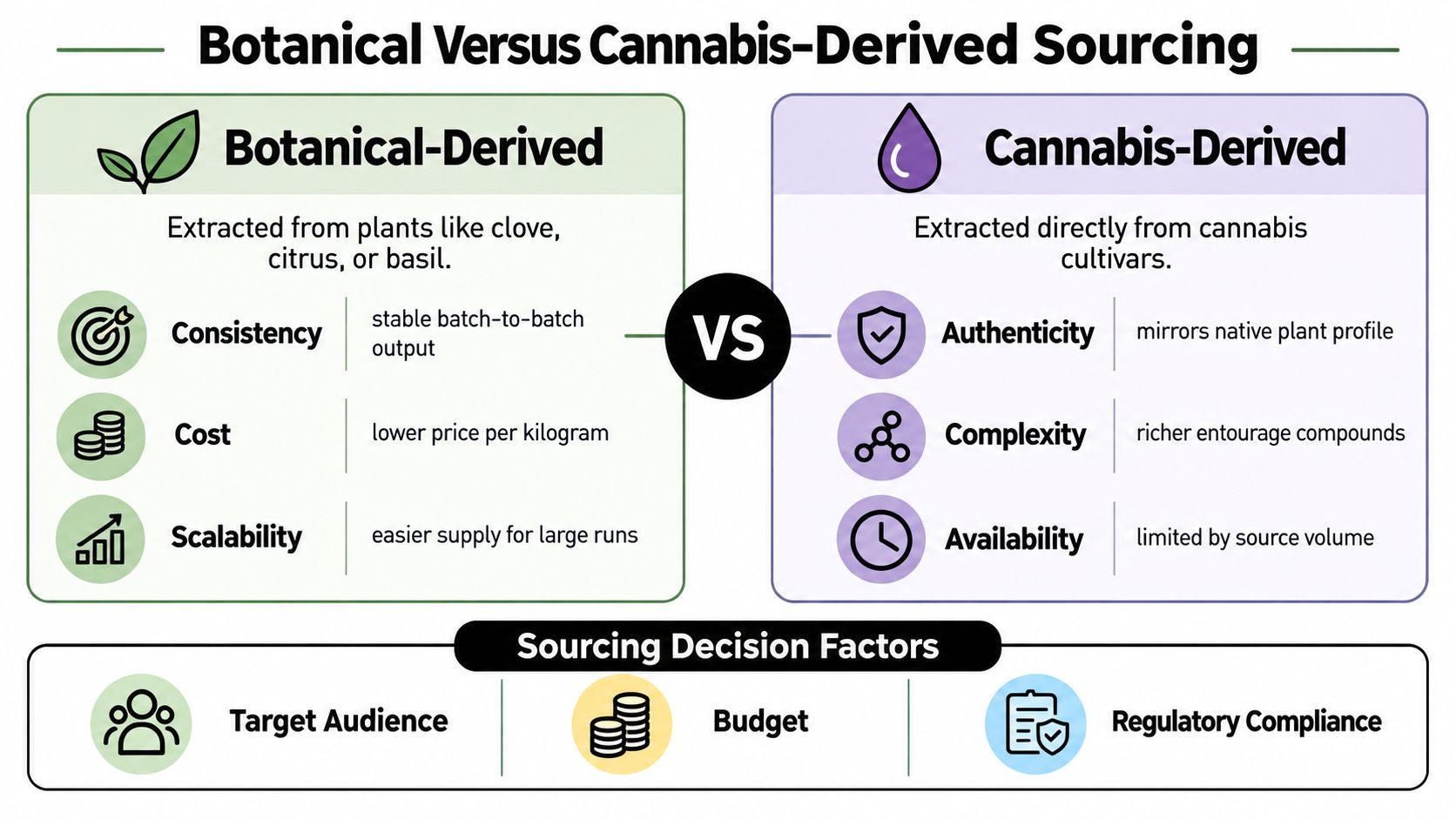
Compare the commercial trade-offs
| Decision area | Botanical-derived | Cannabis-derived |
|---|---|---|
| Consistency | Easier to specify repeatable individual compounds and blend ratios | May reflect more of the source cultivar's native complexity |
| Supply | Often simpler to plan for larger production runs | Depends on available cannabis biomass and extraction capacity |
| Product positioning | Can support THC-free terpene inputs when documentation and labeling are appropriate | Supports a cannabis-origin story when the source and claims are substantiated |
| Compliance | Still requires review of jurisdiction, ingredient, and finished-product rules | Requires additional attention to cannabis-source regulations and documentation |
Read the botanical versus cannabis-derived terpene sourcing guide before choosing a supply model. “Botanical” and “cannabis-derived” are not interchangeable label descriptions, and neither source removes the need for a finished-product compliance review.
A supplier should provide lot documentation, safety information, origin details, and clear guidance on intended use. Ask about minimum order quantities, bulk availability, lead times, and whether the same blend can be reproduced when the product moves from pilot work to production.
Formulating Precise Terpene Ratios for Carts
A cartridge can taste balanced on the bench and turn harsh, thin, or leaky after filling. Product developers should set the total terpene load against the oil and hardware first, then adjust the internal ratio to deliver the intended relaxation, sleep-oriented, or flavor profile. A common starting point is 5% to 10% terpenes by weight, with some guidance extending to 7% to 12% according to the oil and device vape cartridge terpene loading guidance.
Treat those ranges as formulation boundaries, not universal flavor targets. Thin oil, dense winterized distillate, ceramic hardware, and wick-based cartridges can produce different results at the same loading. Select the percentage that provides the required aroma and draw behavior without leakage, harshness, muted flavor, or unstable performance.
Work from the target blend
For an indica-positioned SKU, one formulation source describes profiles with myrcene above 20% and caryophyllene above 8% as consistent with that commercial direction indica-positioned vape profile guidance. Use these figures as a starting framework, not proof that a strain name guarantees sedation. Sensory testing and compliance review still determine whether the blend supports the product claim.
Set the blend in a controlled sequence:
- Set the total loading. Choose the terpene percentage by weight relative to the distillate or oil base.
- Set the internal ratio. Allocate that fraction among myrcene, linalool, caryophyllene, and selected top notes.
- Calculate by mass. Weigh each component rather than counting drops, because viscosity and temperature change drop size.
- Blend thoroughly. Follow a repeatable mixing process and allow the components to equilibrate before judging aroma.
- Test in the final cartridge. Evaluate the first draw, mid-use character, aftertaste, and behavior after storage.
Convert flower data into a blend
Strain names provide marketing context, but measured botanical data gives formulators a more useful starting point. One strain replication guide uses a flower profile containing 1.2% myrcene, 0.4% limonene, and 0.3% caryophyllene, translating to approximate internal proportions of 60:20:15. It recommends scaling those proportions to the selected total terpene loading and adjusting aroma compounds in 0.5% increments during testing in the target hardware strain-inspired terpene ratio guidance.
Use the terpene mixing ratios calculator to reduce arithmetic errors, then verify the weighed batch independently. The calculation sets the intended composition. Hardware testing shows how the specific distillate, cartridge, coil, and airflow path convert that composition into vapor.
Scaling Indica Formulations for Production
A successful bench blend isn't automatically a production-ready SKU. Scale-up requires control over weighing, mixing, evaporation, lot identity, storage, and the interaction between the terpene blend and winterized distillate.
Gold Coast Terpenes offers bulk programs and strain-inspired profiles that can support a repeatable procurement process, but every brand still needs its own incoming-material specifications. Record the accepted sensory range, target ratio, appearance, odor, documentation requirements, and release tests before ordering production quantities.
Protect the profile during scale-up
Terpenes are volatile, so open handling and excessive heat can change the final composition. Keep containers closed when they're not being used, minimize unnecessary transfer steps, and use a documented mixing sequence that operators can repeat.
The common mistake is to approve a small batch and assume the same profile will emerge after a larger blend. Larger vessels change mixing behavior, and the distillate can distribute differently through the batch. Re-test after blending, especially when the oil has been winterized or has a different viscosity from the pilot material.
Treat hardware as part of the formula
A terpene loading that tastes balanced in a beaker can behave differently in a filled cartridge. Hardware geometry, coil temperature, airflow, and reservoir materials all affect how the blend reaches the user.
Use a retained sample from each production lot and evaluate it in the approved device. Check fill behavior, leakage, draw resistance, vapor character, and flavor at the beginning and later in the cartridge life. A production formula isn't finished when the liquid looks uniform. It's finished when the product remains within its sensory and performance specification.
Production rule: Approve the blend, the oil, and the cartridge as one system. Changing any one of them can change the result.
Finalizing Your Indica Terpene Strategy
A reliable indica terpene strategy starts with measured chemistry and ends with hardware validation. Use strain labels as orientation, but define the product through ratios, sensory notes, source documentation, loading, and repeatable testing.
The strongest workflow is straightforward:
- Start with the brief. Define the desired earth, musk, floral character, fruit, citrus, pine, pepper, and finish.
- Select the foundation. Use myrcene for depth, linalool for floral modification, and caryophyllene for peppery structure.
- Add contrast. Use limonene or alpha-pinene as controlled top notes when the base needs lift.
- Choose the source deliberately. Botanical materials can support consistency and THC-free input strategies, while cannabis-derived materials may suit authenticity-led products.
- Calculate by weight. Set total loading separately from the internal terpene ratio.
- Validate in hardware. Test the actual distillate, cartridge, storage conditions, and production process.
The chemistry also argues against broad claims. A 2021 genetics and labeling study found that indica labeling correlated with myrcene, but myrcene explained only 21.2% of the variation in labeling, making the label an imperfect proxy for composition. More recent coverage of a German medicinal cannabis analysis reported no consistent terpene-pattern differences across indica, sativa, and hybrid labels in 140 strains, with some indica-labeled strains chemically closer to sativa-labeled products than to other indica-labeled products coverage of terpene patterns and labeling.
That is why product teams should sell the profile they can document, not the effect they assume from a name. A well-built strain-inspired terpene blend for vape cartridges can be distinctive, technically repeatable, and commercially useful without relying on blanket sedation language.
Gold Coast Terpenes provides isolates, strain-inspired blends, THC-free botanical terpene inputs, safety documents, and formulation tools for teams developing cartridges, concentrates, and products for distillate. Visit Gold Coast Terpenes to compare indica-positioned profiles and source materials for your next ratio-controlled formulation.
Frequently Asked Questions
Are indica terpenes a chemically distinct category?
No. “Indica” is a useful commercial and sensory shorthand, but terpene profiles overlap heavily across indica, sativa, and hybrid labels. Gold Coast Terpenes lets formulators work from isolated compounds and strain-inspired blends, so the finished profile can be specified by composition rather than name alone.
Which terpene should anchor an indica-leaning cart?
Myrcene is commonly used as the base because it contributes earthy, musky, and fruity depth. Linalool and caryophyllene can shape the middle and finish, while a restrained top note can prevent the blend from becoming flat.
Are botanical terpenes suitable for vape brands?
Botanical terpenes can be suitable when the input materials, finished product, hardware, and local requirements have all been reviewed. Gold Coast Terpenes supplies botanically derived, THC-free terpene materials, but each manufacturer remains responsible for product testing, labeling, and compliance decisions.
What terpene loading should a cart manufacturer test first?
A common starting range is 5% to 10% by weight, with some guidance extending to 7% to 12% depending on the oil and device cartridge loading reference. The correct level depends on the distillate, cartridge construction, draw behavior, and sensory result, so it should be confirmed in the final hardware.
Can myrcene alone create a relaxation profile?
Myrcene can establish the aroma and body of a relaxation-positioned blend, but it shouldn't be treated as a guaranteed standalone sedative. A multi-terpene structure, including linalool and caryophyllene where appropriate, gives developers more control over balance, flavor, and product positioning.