
The most common advice about the Strawberry Blue strain terpene profile for vape carts is also the least useful: combine strawberry and blueberry flavorings, then adjust until the oil tastes sweet. That approach misses the chemistry that gives the profile definition. Gold Coast Terpenes, a Redondo Beach, CA supplier, makes 100% botanically derived terpene blends, not cannabis-derived blends, for product developers who need a repeatable starting point rather than the variability of raw flower.
For a vape brand, Strawberry Blue works better as a fruit-forward formulation template than as a literal botanical reconstruction. Its reported architecture combines pine, citrus, berry, floral, herbal, and spice notes. The commercial question isn't whether a blend smells like candy in a vial. It's whether the finished oil keeps its attack, body, and finish after mixing, resting, filling, and vaporization.
Rethinking the Strawberry Blue Strain Terpene Profile for Formulation
Strawberry Blue shouldn't be formulated as a simple strawberry-blueberry candy profile. Public descriptions commonly emphasize sweet berries, strawberries, pepper, sugar, tart fruit, and earth, but those labels don't tell a formulator how to build a stable vape profile. The more useful interpretation is a bright, monoterpene-led structure with pine-citrus lift over a berry and spice foundation.
The cultivar is widely documented as a World of Seeds cultivar with a reported 75% sativa and 25% indica split, while the breeder catalog describes flowering in approximately 63–70 days, with outdoor harvest windows often landing in early October. Those facts come from the World of Seeds Strawberry Blue record. For formulation, the important point isn't a consumer effect label. It's that a fast-finishing, sativa-leaning hybrid can preserve an aromatic intensity that developers may otherwise associate with longer-flowering sativa lines.
The lineage is generally described as Strawberry crossed with a Blue-line parent, often listed as New Blue Line. That pairing helps explain why public descriptions move between red berry sweetness, blueberry-like softness, citrus brightness, and peppery earth. It doesn't prove that a finished cartridge contains a discrete “blueberry molecule.” In practice, blue character is a sensory impression created by several notes working together.
Why a literal berry reconstruction misses the target
A strawberry-only concentrate often tastes flat and confectionary. A blueberry-only direction can become soft, jammy, or overly sweet. Strawberry Blue needs contrast. Pinene and terpinolene provide lift, limonene adds citrus tension, and myrcene with beta-caryophyllene gives the fruit somewhere to land.
That distinction matters for commercial teams. A strain-inspired terpene blend has to survive a high-viscosity oil matrix, hardware exposure, storage, and repeated consumer use. The target is not a perfect copy of one flower sample. The target is a recognizable sensory architecture with controlled variation.
Formulation rule: Build the pine-citrus-berry relationship first. Add sweetness only after the profile has enough contrast to remain identifiable in distillate.
Gold Coast Terpenes is relevant here because its catalog separates botanical, strain-inspired profiles from cannabis-derived material. A botanical source can't reproduce every compound in a specific flower batch, but it can give a brand a controlled input for repeatable development. That distinction is useful when the commercial objective is consistent flavor rather than a claim of exact plant identity.
The same principle applies to evaluation. Product teams can track sensory match, reformulation time, and approval velocity rather than relying on vague feedback such as “more strawberry.” For a broader framework on measuring thought leadership ROI, the useful parallel is simple: define the outcome before judging the work. For this profile, the outcome should be a stable, scalable vape flavor with clear top, mid, and base notes.
Decoding the Dominant Terpenes and Berry-Blend Notes
Strawberry Blue is more useful as a terpene architecture than as a literal strawberry reconstruction. The working pattern is monoterpene-forward, with pinene and terpinolene providing lift while myrcene and beta-caryophyllene give the fruit enough body. Leafly lists pinene as the most abundant terpene, followed by terpinolene and limonene. A separate guide reports recurring myrcene, limonene, and beta-caryophyllene, with total terpenes around 1.5–3.0% by dry weight, as summarized in the Leafly Strawberry Blue profile and the Joint Commerce terpene guide.
Reported profiles vary between listings. That variation matters for formulation because a named cultivar does not guarantee one fixed ratio across harvests or suppliers. One listing gives pinene at 29%, caryophyllene at 24%, myrcene at 19%, terpinolene at 16%, and limonene at 12%, according to the HashDash cultivar listing. Treat those figures as a directional chemotype, not a specification for every lot.
The working architecture
| Terpene | Estimated range | Flavor role |
|---|---|---|
| Myrcene | 0.3–0.8% of dry flower | Soft fruit body, herbal depth |
| Limonene | 0.2–0.6% of dry flower | Citrus lift and acidic brightness |
| Beta-caryophyllene | 0.2–0.5% of dry flower | Dry spice, pepper, structural base |
| Pinene | Reported as a leading terpene | Pine, green freshness, sharp top note |
| Terpinolene | Reported among leading or supporting terpenes | Fresh, floral, volatile brightness |
| Ocimene | Supporting contributor | Airy floral and sweet green nuance |
| Linalool | Supporting contributor | Soft floral rounding |
| Humulene | Supporting contributor | Woody, herbal dryness |
The reported myrcene, limonene, and beta-caryophyllene ranges, along with the supporting-terpene list and estimated total range, come from the Joint Commerce reference above. Use them to establish a formulation hypothesis, then verify the actual input with a batch-specific CoA.
Review the hierarchy rather than chasing one “dominant terpene” label. The blend needs enough volatile top-note material to cut through distillate, enough citrus to keep the fruit clear, and enough dry spice or herbal character to prevent a synthetic candy finish. Excess pinene can push the profile toward medicinal or cleaner-like territory. Excess myrcene and caryophyllene can make the berry feel heavy and erase its red-fruit snap.
For comparison, Gold Coast Terpenes' Blueberry terpene profile helps separate a softer Blue-family direction from Strawberry Blue's lifted upper register. Blueberry-style softness can anchor the middle, while Strawberry Blue needs sharper volatile contrast above it.
Elevated Strains shows another catalog format from Gold Coast Terpenes. The useful comparison is chemical and sensory: assess top-note volatility, fruit density, and base-note restraint rather than relying on the product name. That approach turns the cultivar into a repeatable fruit-forward template instead of a claim that the finished oil reproduces the plant exactly.
Formulating the Flavor for Distillate and Extracts
Start with a verified terpene blend, add it to compatible oil under controlled heat, and validate homogeneity before filling. The exact addition level should be set by the product specification, jurisdiction, oil type, and hardware test plan. Don't assume that a flower terpene percentage transfers directly into a vape formulation.
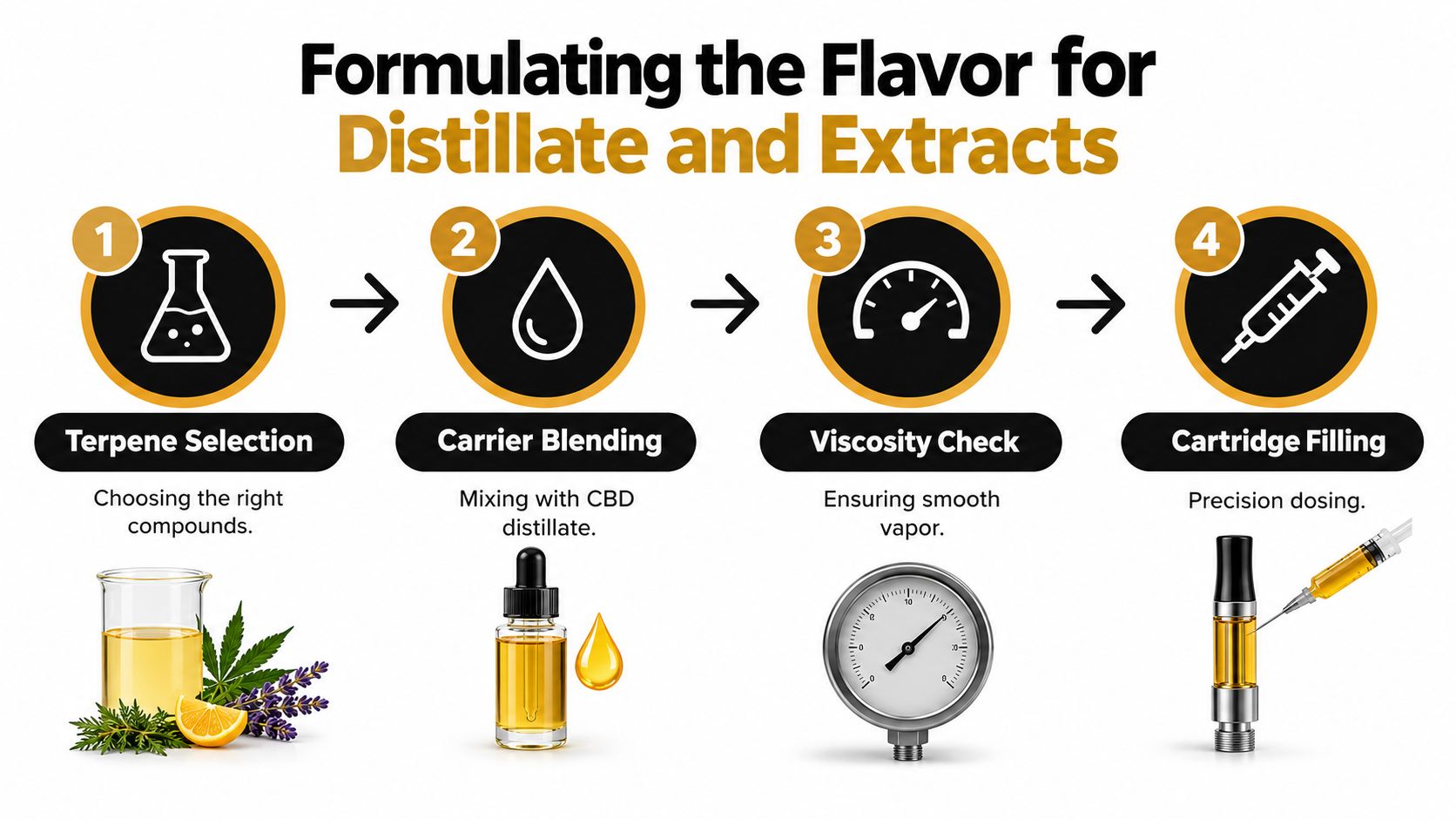
A controlled blending sequence
Condition the oil. Bring winterized distillate or another compatible extract to a temperature that lowers viscosity without exposing the mixture to unnecessary heat. Keep the vessel closed as much as practical. Excessive heat and open handling accelerate loss of volatile monoterpenes.
Pre-mix the terpene component. If the recipe uses separate isolates, combine the small-volume components before adding them to the oil. This reduces local concentration spikes. For a Strawberry Blue direction, pinene and terpinolene need careful handling because their brightness can become aggressive when poorly dispersed.
Add slowly under moderate agitation. Introduce the terpene phase gradually while mixing until the appearance and viscosity are uniform. Gold Coast Terpenes describes its lab-verified, THC-free terpene materials as free of VG, PG, PEG, and MCT, so the finished viscosity remains a function of the oil and terpene addition rather than an undisclosed thinning system.
Rest, sample, and test. Allow the blend to equilibrate in a sealed container, then inspect it for haze, separation, sediment, and aroma drift. Pull a retained sample for sensory review and hardware testing before authorizing a production fill.
The Gold Coast Terpenes guide to terpenes for distillate is useful when building a development workflow around oil compatibility and terpene selection. The practical lesson is to treat temperature and agitation as process variables, not informal handling details.
Preserving the attack without creating instability
Pinene, limonene, and terpinolene can flash off during warm mixing or prolonged exposure to air. A profile that smells vivid in the mixing vessel may taste dull after filling if the process removes too much of its top note. Use closed vessels, minimize headspace where feasible, and compare pre-fill and post-fill aroma rather than approving only the bulk blend.
The finished cartridge also needs a physical stability check. A high-terpene oil can become too thin for a particular device, while an under-treated distillate may feed poorly. Gold Coast Terpenes provides a mixing calculator and safety documents as formulation resources, but the brand still needs its own compatibility data for the selected oil, cartridge, seal materials, and fill process.
Comparing Pre-Blended Profiles Versus Raw Isolates
Pre-blended profiles usually make sense when speed and repeatability matter, while raw isolates make sense when a brand has the analytical control and labor needed for a proprietary formula. Neither route is automatically more accurate. Accuracy depends on the quality of the target reference, the blend design, and the ability to preserve the same process across production lots.
A pre-blended botanical profile gives a developer a defined starting point. It reduces weighing steps, limits opportunities for transcription errors, and makes pilot batching easier. That matters for a strain-inspired terpene blend intended for vape cartridges, especially when a brand needs to move from sensory screening to a controlled production trial without rebuilding the formula from individual bottles.
Raw isolates provide more freedom. A formulator can increase limonene for citrus brightness, restrain pinene if the profile is too sharp, or use small amounts of ocimene and linalool to shape the floral middle. The trade-off is that minor adjustments can create disproportionate sensory changes, particularly in a volatile fruit profile where the difference between “fresh” and “artificial” may come from balance rather than a single dominant compound.
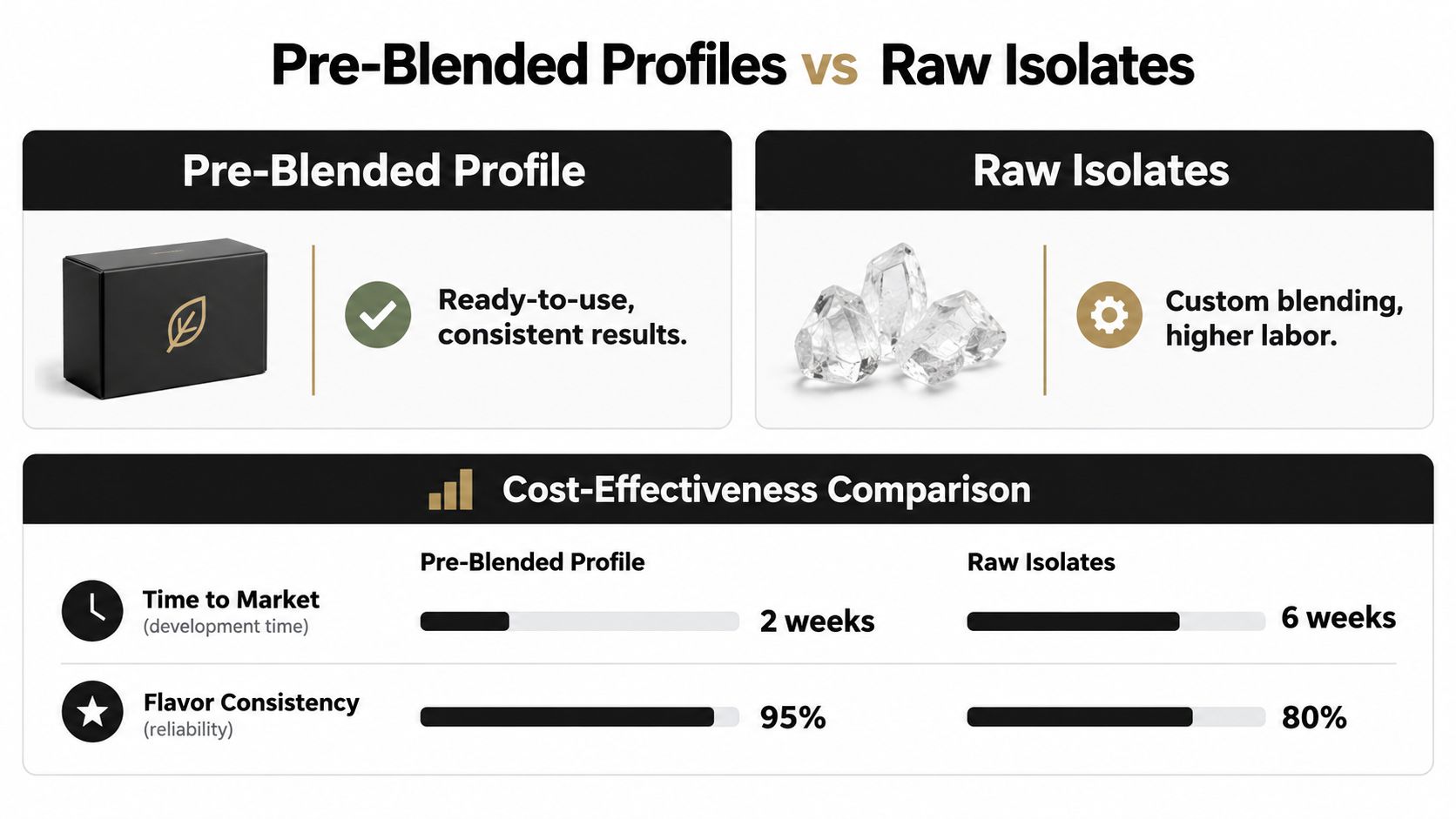
Decision criteria for a commercial team
| Development need | Pre-blended profile | Raw isolates |
|---|---|---|
| Fast pilot approval | Strong fit | Slower setup |
| Small formula adjustments | Limited to supplier options | High flexibility |
| Batch documentation | Simpler input record | More weighing and verification |
| Proprietary differentiation | May require customization | Strong potential |
| Sensory troubleshooting | Fewer independent levers | More independent levers |
| Scale-up risk | Lower process complexity | Higher operator dependence |
The supporting chemistry matters. Reports identify ocimene, linalool, humulene, and alpha-pinene as contributors around the more familiar myrcene, limonene, and beta-caryophyllene framework, as summarized by Joint Commerce's Strawberry Blue guide. Those minor contributors may not dominate a CoA, but they can influence whether the fruit reads as natural, floral, green, or perfumed.
Gold Coast Terpenes' Elevated Strains line is positioned around selective enhancement of rare and exotic terpene notes. That type of approach can be useful when a standard isolate blend produces a technically correct but blunt result. It doesn't remove the need for sensory validation. It gives the developer another sourcing path between an off-the-shelf profile and a fully custom formula.
Use raw isolates when the product has a clear reason to own the formula, such as a proprietary hardware line or a tightly controlled flavor library. Use a pre-blended option when the commercial priority is consistent replication across pilot and production batches. For teams choosing the isolate route, this guide to using terpene isolates provides a practical reference for handling and blending.
Sourcing decision: If your team can't document each weighment, mixing condition, and retained-sample result, raw isolates may create more variability than differentiation.
SKU Development and Hardware Pairing Strategies
Hardware can erase a carefully built Strawberry Blue profile. Bright pinene, terpinolene, and limonene need a device and operating range that deliver vapor without overheating the oil. The right pairing should be proven through fill, draw, leakage, clogging, and sensory testing, not selected from the flavor description alone.
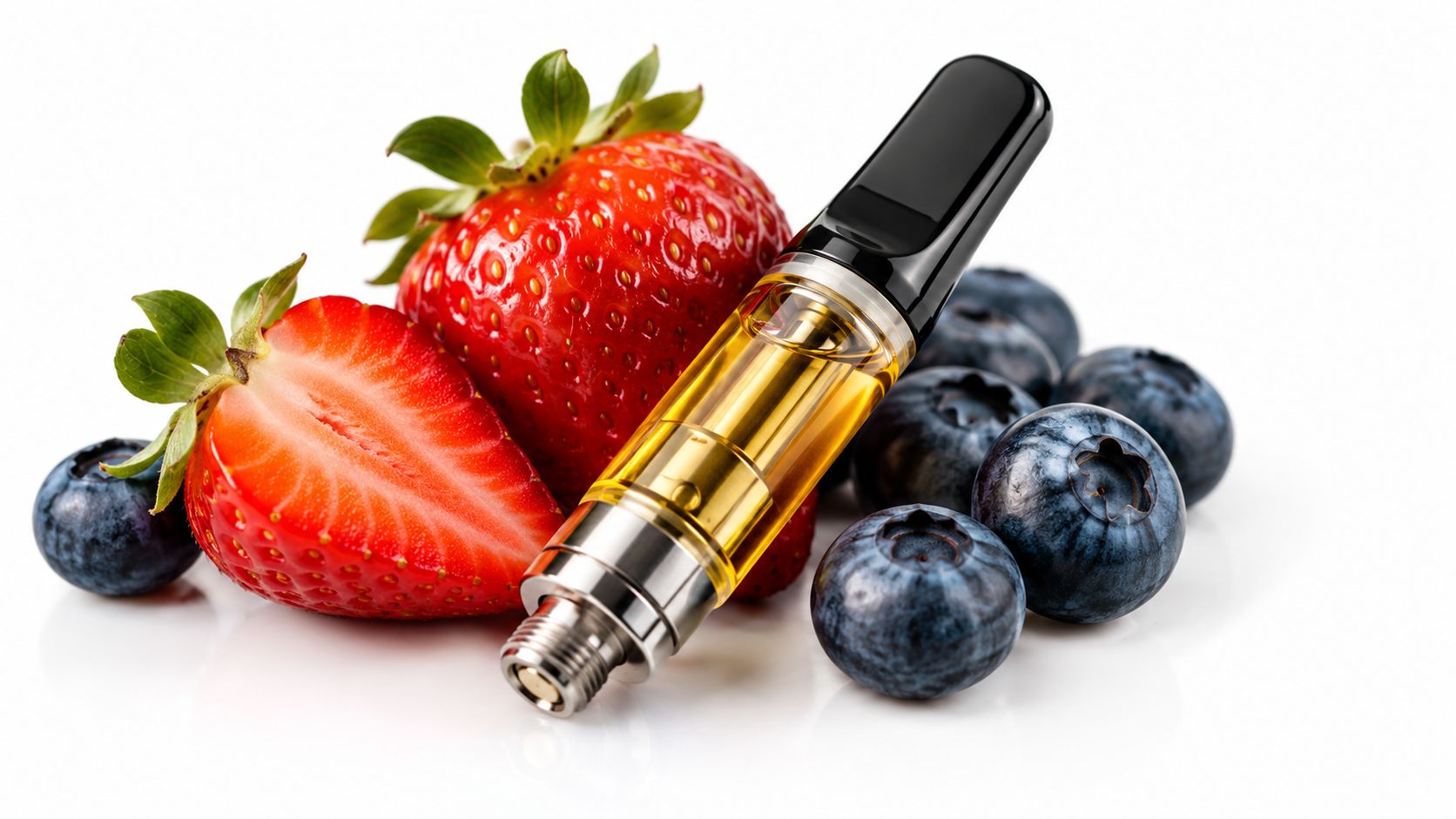
Ceramic hardware can offer a clean platform for terpene-forward oils, while cotton-based systems may behave differently as the oil composition changes. The relevant comparison is not ceramic versus cotton alone. It's how the complete assembly manages wicking, heat distribution, airflow, residual oil, and repeated draws.
A lower thermal load generally protects volatile top notes better than an aggressive setting, but the precise voltage or power range must come from device validation. Brands shouldn't publish a universal consumer setting without testing the specific cartridge, resistance, oil viscosity, and battery combination. A formulation that tastes bright in one ceramic device may taste dry or overly sharp in another.
Build the SKU around the sensory job
Strawberry Blue can occupy a bright fruit position, but avoid unsupported effect claims in product copy. The sativa-leaning lineage is a useful provenance cue, yet it doesn't establish a medical outcome or guarantee a particular consumer response. Position the SKU around pine-citrus berry character, clean flavor separation, and a controlled strain-inspired profile.
A useful portfolio question is whether the SKU adds a distinct sensory role or duplicates another fruit product. Reddog Consulting Group's guide on SKU rationalization is a helpful resource for that commercial decision. If two products share the same berry sweetness but differ only in naming, the development team may be carrying unnecessary complexity.
Gold Coast Terpenes offers bulk programs and wholesale options for brands that need to move from pilot work toward larger production planning. Treat supplier capacity, documentation, minimum order quantities, lead times, and lot consistency as procurement questions to verify directly. Don't assume that a supplier's retail catalog automatically maps to your manufacturing scale.
For broader hardware considerations, Gold Coast Terpenes' guide to cartridge ingredients gives product teams a useful checklist for separating oil composition from device performance. The final approval should still include accelerated storage, leakage inspection, draw testing, and a post-use sensory check.
Troubleshooting Common Formulation Questions
Strawberry Blue failures usually trace to imbalance, volatile loss, or hardware mismatch, rather than insufficient strawberry flavoring. Classify the problem as sensory, physical, or process-related before changing the formula. Reformulating too early can conceal the original cause and introduce another variable.
Why does the oil separate after blending
Phase separation points to incomplete mixing, incompatible materials, temperature gradients, or an addition level the oil cannot hold uniformly. Check vessel temperature, mixing order, terpene addition rate, and retained samples before adjusting the recipe. Confirm that no unapproved carrier or diluent entered the batch.
Why does it taste like pine cleaner
Pinene may be too prominent against the berry and citrus components, or the device may be applying excessive heat. Run a controlled bench trial with less sharp top-note emphasis. Restore balance through the existing berry, citrus, floral, and spice structure instead of covering the defect with extra sweetener.
Why did the berry note disappear after filling
Heat, open exposure, aggressive agitation, or extended dwell time can strip volatile material. Compare pre-fill and post-fill retained samples, recording vessel temperature, mixing duration, headspace, and fill conditions. A strong bulk sample followed by a flat cartridge points to device testing before blend reformulation.
How should regional terpene limits affect the recipe
Regional limits belong in the initial specification. Confirm the destination market's applicable rules, then set blend concentration, label language, safety documentation, and release testing to match them. Gold Coast Terpenes provides state information and safety documents, but the manufacturer must complete its own regulatory review.
What should a supplier provide
Request current CoAs, ingredient identity, botanical or cannabis-derived classification, contaminant documentation, relevant allergen information, and handling guidance. Confirm MOQs, production lead times, lot traceability, custom blending, and support for pilot quantities as well as bulk orders. Gold Coast Terpenes offers strain-specific profiles, isolated compounds, and formulation resources such as a mixing calculator. Validate every material in the intended oil and hardware system.
Gold Coast Terpenes supplies 100% botanically derived, THC-free terpene blends, strain-specific profiles, and isolates for distillate, concentrates, and vape formulation. Its materials are described as free of VG, PG, PEG, and MCT. For a Strawberry Blue-inspired SKU, visit Gold Coast Terpenes to review formulation resources and select a starting profile for the next bench trial.