
Skunk 47 is an indica-dominant cross of Skunk #1 and AK-47, and Gold Coast Terpenes supplies the precise botanical isolates required to replicate its dense, resinous terpene profile. A reported starting ratio is caryophyllene 0.5%, limonene 0.4%, myrcene 0.3%, and pinene 0.2%, giving formulators a practical structure for vape and distillate development.
What does a conventional Skunk 47 strain description leave out? It identifies the lineage, perhaps repeats a THC range, and calls the aroma skunky or earthy. It rarely tells a cartridge manufacturer how to turn that agricultural identity into a stable, repeatable sensory target.
That translation exposes the true formulation problem. A flower batch expresses a changing matrix shaped by phenotype, cultivation, harvest, curing, extraction, and storage. A cart blend has to deliver a recognizable first draw, maintain acceptable viscosity, survive device heat, and meet the product's labeling and compliance requirements. The name alone can't do that work.
For product developers, the useful question isn't whether Skunk 47 sounds pungent. It's which aromatic roles create the funk, which compounds provide lift, and how much brightness can be added before the profile stops reading as Skunk 47. Gold Coast Terpenes, a Redondo Beach, CA supplier, makes 100% botanically derived terpene blends, not cannabis-derived according to its product information. That distinction matters when a brand needs consistent, THC-free components for a controlled formulation process.
Defining Skunk 47 for Modern Vape Formulation
Skunk 47 works best as a dense, indica-leaning aroma target, not as a THC specification. Public strain references describe it as a cross of Skunk #1 and AK-47, while third-party listings commonly place THC around 20% to 23%, with variation by phenotype and growing conditions Leafly's Skunk 47 reference. For cartridge development, that potency range doesn't tell you how the oil should smell, taste, or perform after heating.
A formulation team should define the target through sensory architecture. The expected center is pungent skunk, earth, peppery resin, and restrained sweetness, with citrus, forest fruit, or berry used as supporting accents rather than the headline. This gives the blend an identity that can survive the loss of native flower complexity during extraction and distillation.
Why agricultural identity doesn't transfer automatically
A cultivar name represents genetics, but a cartridge contains a selected oil base plus added aromatic materials. Distillate may carry little of the original volatile signature, and an aggressive flavor addition can create a profile that smells like generic citrus, fuel, or candy instead of the intended cultivar.
The practical target is therefore not a perfect molecular copy of every harvested plant. It's a controlled sensory reconstruction that preserves the features buyers associate with the cultivar while remaining suitable for the chosen hardware and base oil.
Formulation rule: Treat reported strain data as a starting map. Confirm the finished blend by aroma, taste, viscosity, and device performance.
A useful strain terpene profile resource can help organize that map before bench work begins. Build the brief around the desired top, mid, and base notes, then select isolates or a strain-inspired terpene blend that supports those roles. Don't let a headline potency figure substitute for a flavor specification.
Decoding the Lineage and Aromatic Architecture
How do you turn a reported Skunk 47 lineage into a cartridge profile that still reads as authentic? Start with the aromatic jobs, not the cultivar name alone. Skunk 47 is commonly described as a Skunk #1 and AK-47 cross, with World of Seeds Bank credited by multiple strain databases as the breeder. Several listings characterize it as approximately 90% indica and 10% sativa, a classification associated with its fast-flowering, aroma-forward positioning.
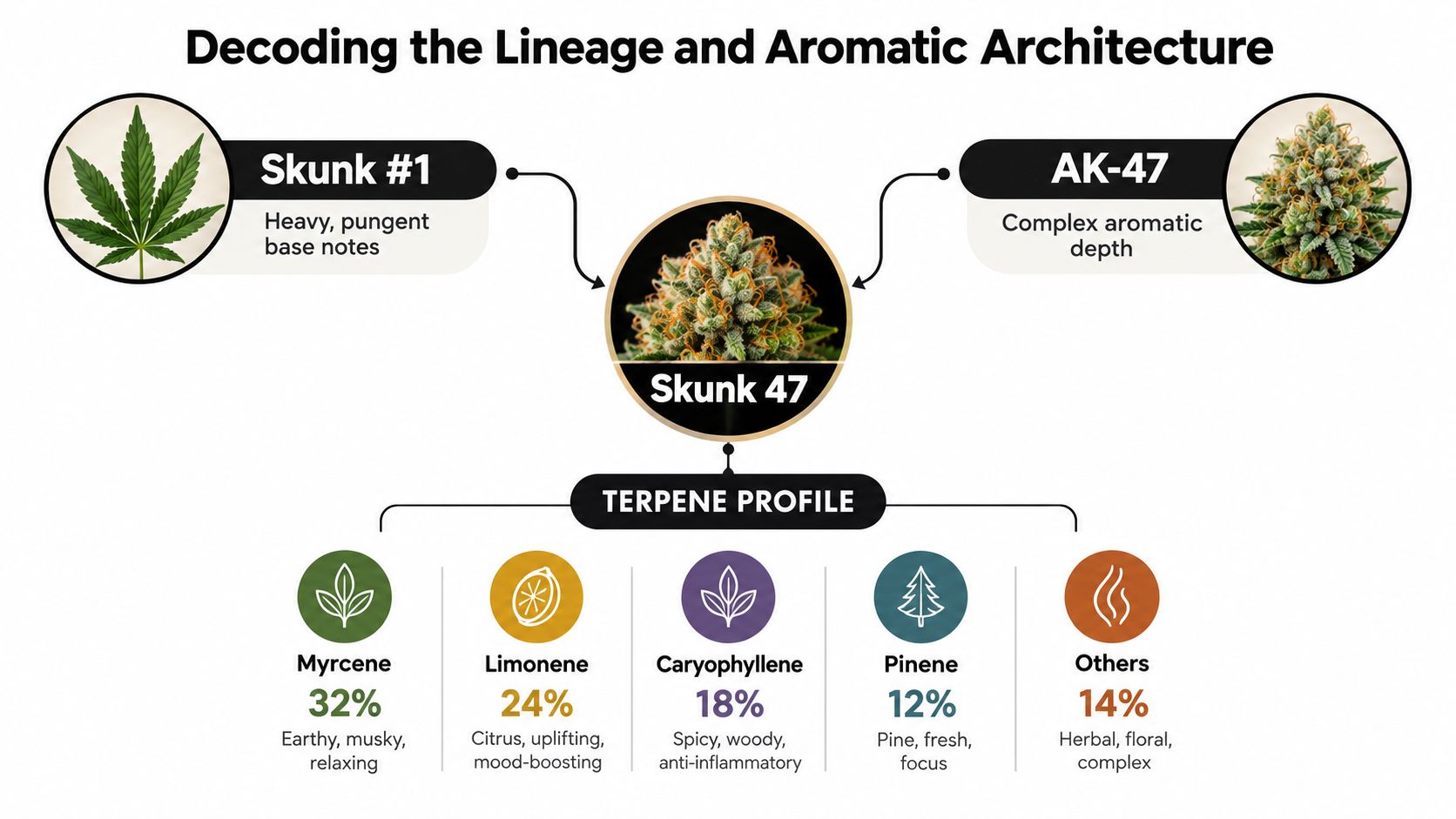
Genetics establish direction, not a finished blend specification. Skunk #1 suggests the pungent, musky, heavy base, while AK-47 can add earth, sharper spice, and a more lifted aromatic register. That combination creates a useful formulation brief, but it does not reduce the profile to one generic skunk note.
Building the sensory stack
For cart development, assign each part of the aroma a clear function:
- Base notes: Dense skunk, damp earth, and resinous weight should remain after the first inhale.
- Mid notes: Myrcene and caryophyllene can support the rounded, peppery, earthy body.
- Top notes: Limonene and restrained pinene can sharpen definition without making the cartridge taste like citrus or pine.
The main trade-off is clarity versus credibility. Bright compounds show quickly on a blotter, so adding more can make an early sample seem expressive. In the oil base, however, excessive brightness can bury the funk and make the result resemble a generic citrus or fuel profile. Preserve enough upper-note contrast to prevent heaviness, while keeping the base dominant.
Agricultural chemistry also varies across harvests, curing conditions, extraction, and distillation. Recreating every native volatile is unrealistic. A cartridge-ready blend should instead preserve the recognizable relationship between skunk, earth, peppery resin, and controlled citrus, then confirm that balance in the intended oil and hardware.
Use this guide to the smell associated with skunk profiles when training a sensory panel or aligning brand language. “Skunk-forward with earthy resin, pepper, and a controlled citrus lift” gives production staff a usable target, unlike “strong and exotic.”
Translating Chemotype Data into Formulation Ratios
The most actionable public starting point is caryophyllene 0.5%, limonene 0.4%, myrcene 0.3%, and pinene 0.2%. One industry strain database lists those values for Skunk 47 and presents them as a starting ratio for vape or distillate applications Strain.report's Skunk 47 profile. They shouldn't be treated as a universal batch certificate, but they establish a useful hierarchy.
Start with the dominant structure
The reported order places caryophyllene first, followed by limonene, myrcene, and pinene. In formulation terms, that suggests a blend where the peppery, resinous body leads, citrus provides controlled brightness, myrcene rounds the middle, and pinene supplies a narrow aromatic edge.
Use the ratio as a relationship rather than blindly copying it into every oil system. A practical bench process looks like this:
- Establish the base direction. Begin with the caryophyllene-led body. Smell it on a blotter and in the intended oil base, because dilution can change how quickly the heavier notes appear.
- Add the citrus lift. Introduce limonene carefully enough to clarify the opening without making the profile read as lemon-forward. Limonene should make the funk more legible, not replace it.
- Round the center. Use myrcene to connect the sharp top and dense base. If the blend becomes dull, the issue may be balance rather than a need for more top note.
- Tune the edge. Add pinene only to create definition. Too much can push the aroma toward a generic conifer character that doesn't belong in the target.
Why ratios must remain adjustable
The database values describe a reported terpene profile, but public strain data can vary with phenotype and growing conditions. The same named cultivar may also be represented by different extraction histories, which affects the retained aroma and the amount of reconstruction required.
For that reason, create a small ladder of variations around the stated relationship rather than one “finished” formula. Keep the caryophyllene-led identity constant, then test whether the panel prefers more or less citrus lift, mid-note roundness, or pine definition. Record the result by sensory descriptor, oil behavior, and device output.
A mixing ratios calculator can help convert a selected blend into production quantities. It doesn't replace compatibility testing or a finished-product sensory review. Calculators solve arithmetic. They don't determine whether the first draw still communicates the intended strain-inspired terpene blend.
Bench note: A ratio that smells accurate in a vial can become too sharp, too thin, or too sweet after it enters distillate and a heated cartridge. Evaluate the formulation where the customer will actually use it.
Evaluating Botanical Versus Cannabis-Derived Sourcing
Which terpene source gives a Skunk 47-inspired cartridge the right balance of identity, control, and repeatability? Botanical and cannabis-derived terpenes can both support the profile, but they create different formulation trade-offs. Botanical isolates make it easier to set the relative levels of caryophyllene, limonene, myrcene, and pinene. Cannabis-derived material may retain a broader native matrix, although that added complexity can make accurate replication and lot-to-lot consistency harder.
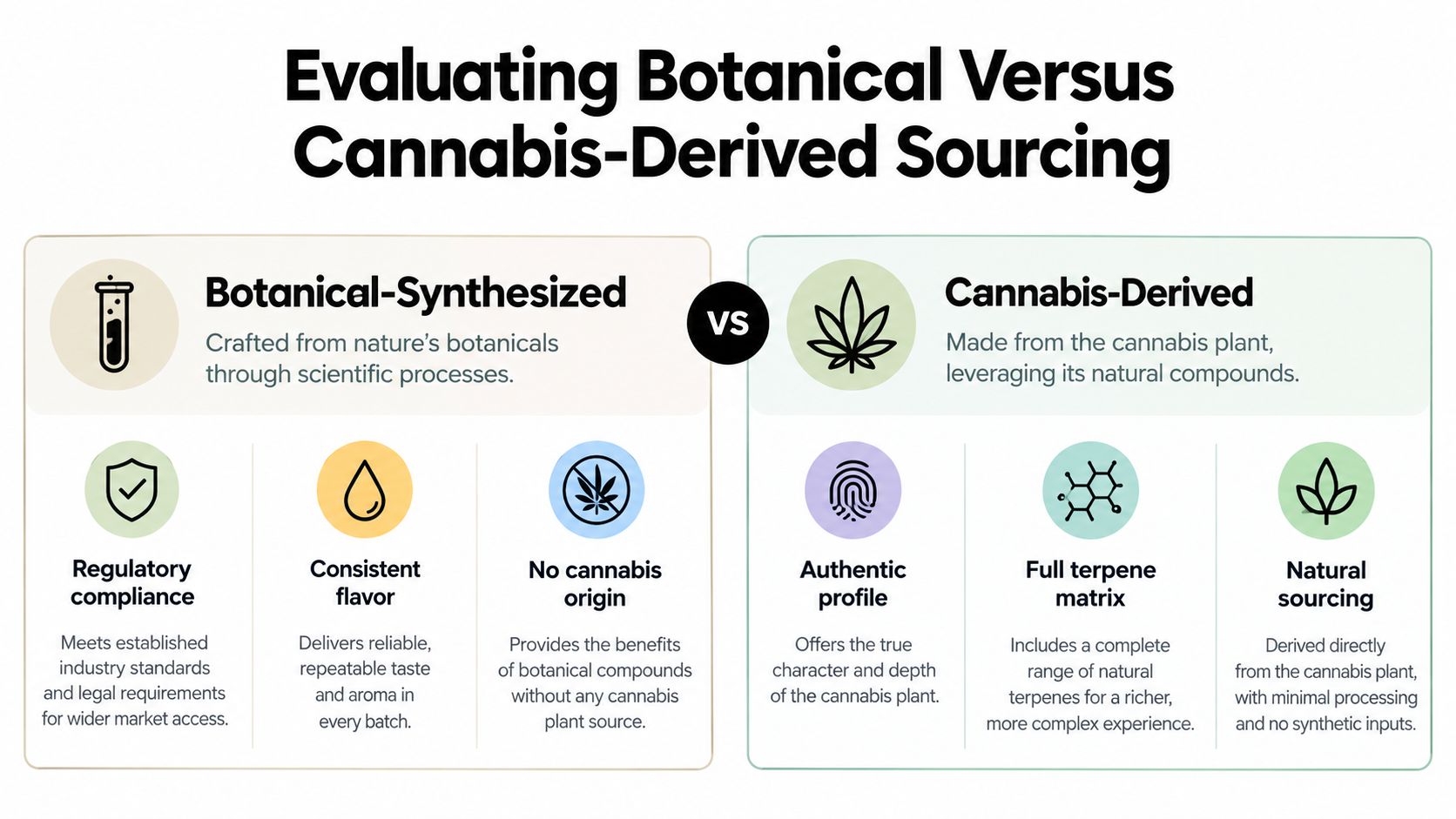
Choose the source according to the product brief. A known “funk” alone does not define the finished aroma. The cartridge still needs the right relationship between caryophyllene-led depth, citrus lift, myrcene roundness, and pinene definition.
Botanical sourcing
Gold Coast Terpenes identifies its products as 100% botanically derived and not cannabis-derived on its supplier site. For a formulator, that supports an isolate-based reconstruction when the target is a named sensory profile rather than the full variability of a cannabis extract.
The practical benefits are:
- Repeatable inputs: Select individual compounds to establish a defined sensory ratio.
- Clear origin positioning: Botanical origin can support labeling decisions and market-specific review.
- Adjustable reconstruction: Increase resinous body or reduce bright top notes without replacing the entire source material.
Cannabis-derived sourcing
Cannabis-derived terpenes can preserve more of the source plant's aromatic character, which suits products where authenticity includes contributors beyond the four commonly reported compounds. Those extra contributors can also pull the blend away from the approved target, so the source lot needs close sensory and documentation review.
Skunk 47's reported 90% indica and 10% sativa characterization supports a brief centered on dense skunk, earth, and resin rather than a highly lifted or sweet profile as described by Joint Commerce. Either route requires certificates, contaminant documentation, applicable state or national compliance review, and finished-product testing.
A cannabis-derived extract can be authentic to its source lot and still miss the brand's approved aroma. Botanical sourcing offers tighter ratio control, while cannabis-derived sourcing may provide greater agricultural complexity. The correct choice depends on whether repeatable reconstruction or source-matrix character carries more value for the cartridge.
Mastering Infusion Challenges in Distillate Bases
Distillate infusion succeeds when the terpene load, oil viscosity, and cartridge hardware are evaluated together. A blend that is aromatic in a bottle can become harsh, thin, separated, or inconsistent after it is mixed into distillate and exposed to repeated heating.
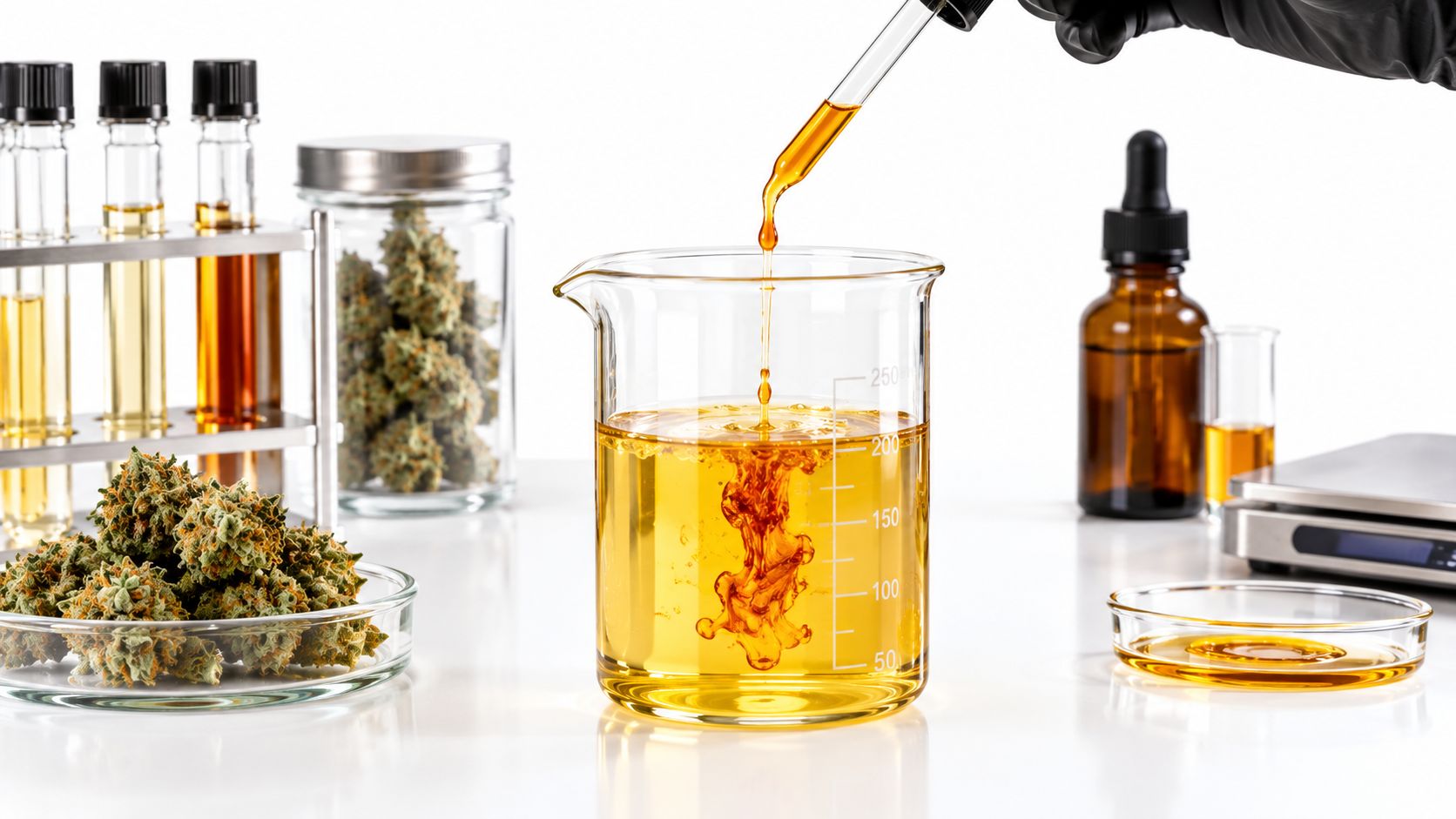
Start with a documented base. Record the distillate's appearance, viscosity, temperature during mixing, and any existing aromatic character. A strong residual note can alter the perceived ratio, so don't judge the terpene blend in isolation and assume the same balance will survive the final oil.
Mix for uniformity, not just speed
Warm the base only within the limits established by your process and equipment. Add the terpene blend gradually, use controlled agitation, and allow the mixture to equilibrate before judging aroma. Excessive heat can change the sensory result, while insufficient mixing can leave local concentration differences that show up as inconsistent fills or draws.
A distillate and terpene mixing guide can support the procedural side of the work. The core controls remain straightforward:
- Check compatibility: Look for haze, separation, precipitation, or texture changes after mixing and after rest.
- Assess viscosity: The oil must move through the cartridge at the intended operating conditions without relying on an unverified diluent strategy.
- Test the device: Evaluate low, middle, and high device settings where applicable, because heat changes both flavor release and harshness.
- Review the complete system: Cartridge materials, airflow, coil design, fill method, and storage conditions can all change the perceived profile.
A good sensory sample isn't enough if the oil behaves poorly in production. Conversely, a stable oil that loses its skunk character after heating needs reformulation, not just a packaging change.
This video can serve as a visual reference for the mixing stage, but it shouldn't replace your validated process controls.
Keep the commercial workflow in view. Document supplier lot information, batch records, mixing conditions, fill observations, and retain samples. If a brand sells across jurisdictions, review botanical-versus-cannabis-derived labeling requirements before approving artwork. Compliance is part of flavor development because the declared ingredient story has to match the material used.
Using Layered Strain Profiles for Added Nuance
A layered strain profile can give cartridge development a practical starting point when a scratch-built isolate blend feels too narrow. The goal is controlled complexity. A broader aromatic foundation can carry Skunk 47's dense core while reducing the need to force every secondary note through separate additions.
Descriptions of Skunk 47 commonly reference earthy and skunky aromas with subtle forest-fruit or berry accents as described by HashDash. For formulation, that profile points to a measured balance rather than a generic “funk” accord. Caryophyllene and myrcene can support the peppery, earthy body, while limonene and pinene need restraint if the blend is to retain its darker character. Agricultural chemistry is more variable than a fixed flavor recipe, so a layered base should be treated as a starting matrix, not an automatic match.
Where a layered base helps
A curated profile may provide a fuller aromatic progression than a four-isolate formula. That can help a product team assess a premium sensory direction early, without loading the blend with many individual compounds. It also gives the panel a closer approximation of the intended flavor architecture during initial trials.
The trade-off is control. Supporting notes in a prebuilt profile can be difficult to remove when they conflict with the target. Isolate-based construction allows more direct adjustment, while a layered profile can reduce bench work and help prevent a flat result.
Gold Coast Terpenes lists strain profiles alongside isolated compounds and strain-specific options. A development team can compare a layered starting point with a custom isolate approach, as shown by the Apple Fritter layered profile. Comparative bench testing remains the practical choice, because the same profile may behave differently across cart platforms.
Final Quality Checks Before Production Scaling
Approve a Skunk 47 formulation only after it passes sensory, physical, device, and documentation checks. A convincing vial sample is the beginning of validation, not the final release decision.
The production gate
Use a written panel and keep the review tied to the approved brief:
- Aroma identity: Does the blend lead with dense skunk and earth, with peppery resin and restrained lift?
- Flavor sequence: Does the opening provide definition, while the mid and base notes remain present through the exhale?
- Device behavior: Does the profile remain coherent across the operating temperatures selected for testing?
- Physical stability: Does the oil remain uniform without visible separation, precipitation, or unexpected texture change?
- Batch consistency: Do retained samples from the blend and filled carts match the approved reference?
- Documentation: Are supplier records, certificates, ingredient origin, labeling language, and applicable compliance reviews complete?
A panel should compare the finished cart against the approved reference, not against memory of flower. Memory exaggerates the most obvious note and hides the effects of extraction, dilution, hardware, and heat. Keep the reference sample under controlled conditions and use the same device type for every comparison.
Release standard: If the profile is recognizable only before filling, it isn't production-ready.
The strongest formulation connects three layers: lineage informs the aromatic brief, reported chemotype data establishes the initial ratio, and manufacturing tests determine whether that ratio survives the oil and device system. That workflow is more reliable than copying generic “skunky” language or chasing potency numbers that don't predict flavor performance.
Gold Coast Terpenes offers botanical terpene blends, strain-specific profiles, isolated compounds, mixing resources, and formulation support for teams developing carts and distillate products. Visit Gold Coast Terpenes to compare precise botanical inputs for a Skunk 47-inspired profile and begin a controlled bench evaluation.