
A wholesale buyer asks for a watermelon bubble gum cart, and the first instinct is usually to pull a watermelon-forward cannabis profile. The result may smell like fresh fruit, but it often misses the target. It reads as juicy melon, not the bright, sweet, slightly acidic confection note the buyer remembers.
That difference changes the entire bench strategy. You aren't trying to reproduce a plant's terpene expression. You're building a strain-inspired terpene blend for vape cartridges from candy-style aldehydes, supporting esters, acid character, and a stable terpene backbone that can survive a distillate matrix.
Why Watermelon Bubble Gum Is a Formulation Problem, Not a Strain
Watermelon bubble gum is best treated as a flavor system, not a botanical extraction target. Bubble gum itself dates to 1928, when Walter Diemer at Fleer in Philadelphia created the first successful formula. Its lower stickiness and greater stretch helped establish a commercial category that later expanded into fruit profiles, including watermelon. The history of bubble gum places watermelon alongside familiar fruit profiles such as grape and strawberry in mainstream product lines.
That history matters because the target is culturally recognizable even when it doesn't resemble fresh watermelon. The candy note is sharper, sweeter, more artificial, and more persistent than the fruit. A profile that leads only with green melon aldehydes can satisfy the first part of the brief while failing the part that makes the SKU read as bubble gum.
Start with the product brief
Before weighing materials, define what the buyer means by the name. A cart intended to taste like freshly cut watermelon needs a different structure from one intended to evoke soft gum, candy acidity, and a lingering confection finish.
For a commercial formulation, clarify:
- Opening impression: Should the first pull be crisp and green, or immediately sweet and candy-like?
- Core identity: Does the product need a recognizable gum accord, or only a watermelon flavor over a cannabis-compatible base?
- Matrix behavior: Will the blend sit in thin distillate, a thicker concentrate, or hardware that produces a hotter pull?
- Brand position: Is the SKU supposed to feel like a confection, or like a botanical fruit profile with a nostalgic accent?
A practical distinction helps here. Fruit-forward watermelon is an aroma impression built around freshness and watery green lift. Watermelon bubble gum adds sweetness, acid tension, soft esters, and a cushioned finish. Those elements must be constructed deliberately.
Practical rule: Don't select a watermelon terpene and assume the gum identity will appear automatically.
The right workflow starts with a profile definition, then maps the note into volatile classes and matrix behavior. A useful primer on the difference between botanical profiles and strain-oriented formulation is this guide to strain-specific terpenes. The important decision is whether you're selling fruit recognition, confection nostalgia, or a controlled combination of both.
What Defining a Watermelon Bubble Gum Profile Actually Means
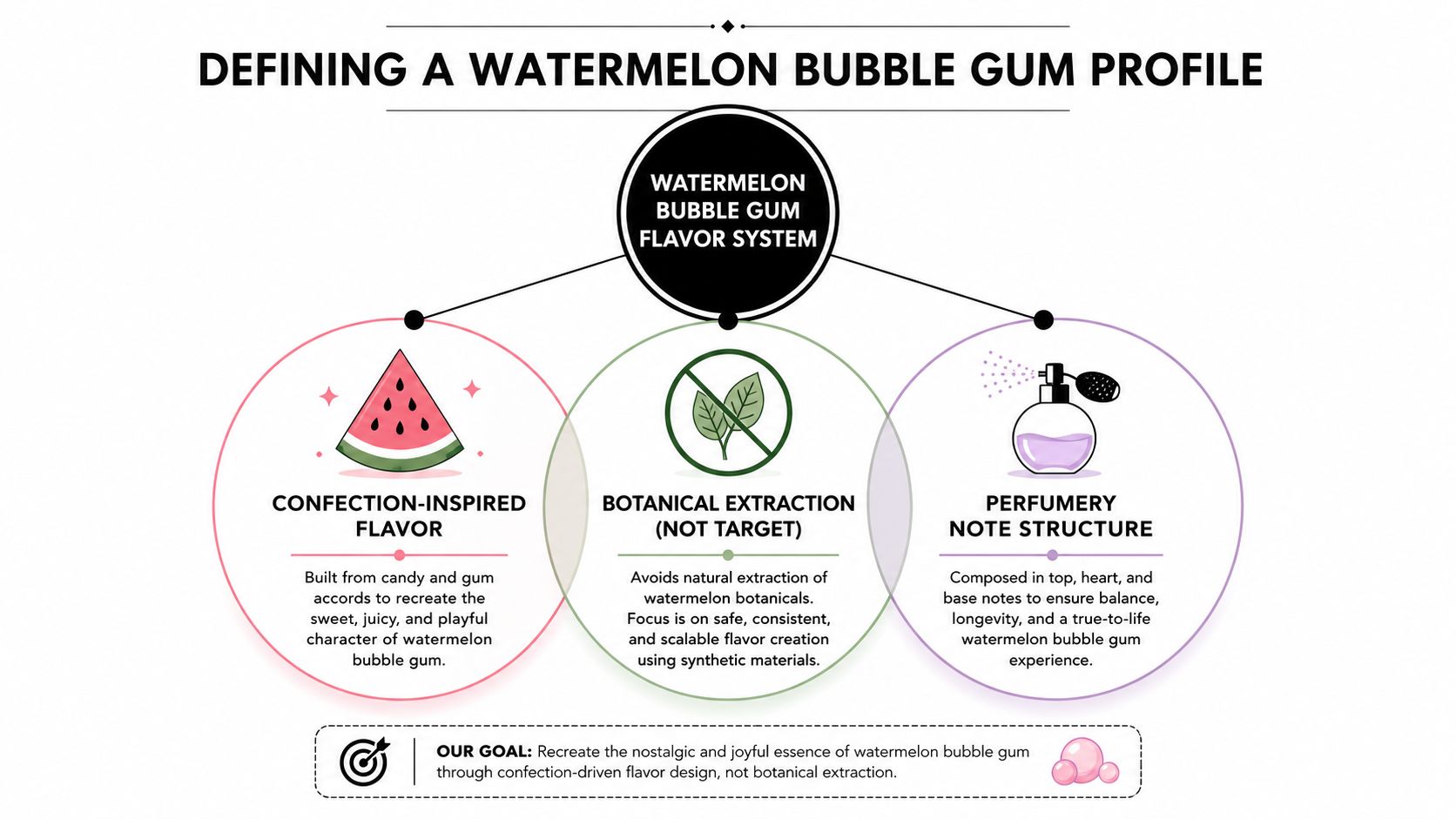
A useful definition prevents the build from drifting toward generic melon. Watermelon bubble gum is a confection-inspired flavor system with three interacting layers: candy-style watermelon volatiles, a sweet-acid framework, and a soft accord that carries the flavor through the pull. The target is therefore a candy chemistry problem, not a strain label or a single “watermelon” terpene.
The watermelon layer creates recognition. The acid structure adds brightness and keeps sweetness from becoming flat. The soft layer supplies the cushioned, gum-like body that remains after the volatile opening fades.
Separate the nostalgia signal from the raw materials
A customer may call the target “watermelon.” A formulator should translate that description into separate sensory jobs:
- Fresh-cut lift comes from green, volatile materials that establish the first recognition.
- Candy sweetness develops through the interaction of sweeteners, fruit esters, and rounded aroma materials.
- Acid tension comes from materials such as citric and adipic acid used in conventional confection formulations. Ingredient disclosures for mainstream watermelon gum list citric acid, adipic acid, glycerin, soy lecithin, and natural and artificial flavorings. The ingredient disclosure for a mainstream watermelon gum product shows why the finished impression depends on a system rather than one signature ingredient.
- Gum persistence comes from a soft, cushioned body that keeps the profile present as the top note recedes.
That separation matters in cannabis formulations. A real fruit extract may add botanical complexity, yet still miss the acid-sweet tension and elastic confection character associated with gum. In a hot distillate, a fragile fruit top can also disappear before the softer body has time to support it.
Judge the profile by behavior
A blotter gives only part of the answer. Evaluate the opening, middle, and finish after dilution into the intended distillate and hardware. The first stage should identify watermelon, the middle should read as rounded candy, and the finish should leave soft sweetness without a sharp chemical edge.
If the green layer dominates, the result resembles cut melon. If the candy materials dominate, it becomes generic fruit confection. Too much soft sweetness can push the profile toward perfumery and bury the watery fruit cue.
One piece of BUBBLE YUM watermelon bubble gum contains 25 calories, according to the product nutrition listing. That figure is not a dosing instruction. It reinforces the product category as a portable confection, with a flavor designed to be immediately legible, repeatable, and easy to carry in a small format.
The Aroma Compounds That Actually Drive the Note
The first mistake in a watermelon bubble gum build is treating the profile as one fruit note. The recognizable aroma comes from several volatile classes that perform different jobs at different moments.
Aldehydes lead the opening. Watermelon aroma is associated mainly with C6 and C9 aldehydes formed as fatty acids oxidize after cutting. One repeatedly identified watermelon-like odorant is (Z,Z)-3,6-nonadienal, while (Z)-3-hexenal contributes a fresh-cut, grassy nuance. Compound Interest's watermelon aroma chemistry overview is useful for understanding why the first impression can swing between juicy melon and green rind.
Build the fruit impression by class
Aldehydes provide lift, but they aren't the whole candy profile. Over-relying on them makes the cart smell like cut melon or rind.
- C6 aldehydes create a sharp, green, freshly cut opening. They register quickly and can become harsh when overdosed.
- C9 unsaturated aldehydes add the recognizable watery melon character and help extend the fruit impression beyond the first instant.
- Unsaturated alcohols soften the green edge and can add cucumber-like or rind-like smoothness. A peer-reviewed watermelon rind study identified five unsaturated nine-carbon alcohols and 16 aldehydes as aroma contributors, with the rind described as fresh, green, grassy, and cucumber-like. The watermelon rind aroma study supports using these materials as texture, not as the primary candy signal.
- Esters and lactones supply the sweet, rounded fruit body. They help turn a volatile melon opening into something that feels more like confectionery.
- Terpenes provide matrix compatibility and structure. Linalool can soften the center, beta-caryophyllene can add dry body, and a restrained valencene accent can bridge the fruit profile to a cannabis-oriented base.
Watermelon contains broad chemical complexity beyond the most recognizable edible-aroma compounds. A natural-products catalog reports 328 terpenoids described in the plant, although the strongest watermelon aroma cues are generally associated with aldehydes and related volatiles. The watermelon chemistry review helps separate overall plant chemistry from the smaller set of materials that matter most to a candy reconstruction.
Use a layered test, not a single-blend guess
A useful bench sequence is to smell the aldehyde fraction alone, then add the soft fruit fraction, and finally introduce the terpene backbone. If the aldehyde fraction already smells like finished gum, the later additions may push it into solvent or synthetic territory.
A mini-watermelon volatile study identified 20 main volatile compounds across aldehydes, alcohols, ketones, and terpenes or terpenoids. The volatile evolution study provides a practical reason to think in classes. The formulation doesn't need every compound. It needs enough contrast between the opening, body, and finish to preserve recognition after dilution.
For additional context when selecting a supporting citrus-wood accent, use this valencene terpene reference. Keep the accent restrained. Valencene should support the profile, not turn a candy watermelon cart into a dry citrus-wood expression.
Top, Mid, and Base Notes in a Watermelon Bubble Gum Blend
Perfumery structure is useful even when the finished product is inhaled rather than worn. A cart needs an opening that survives the first heating event, a center that carries the product identity, and a finish that doesn't collapse into thin sweetness.
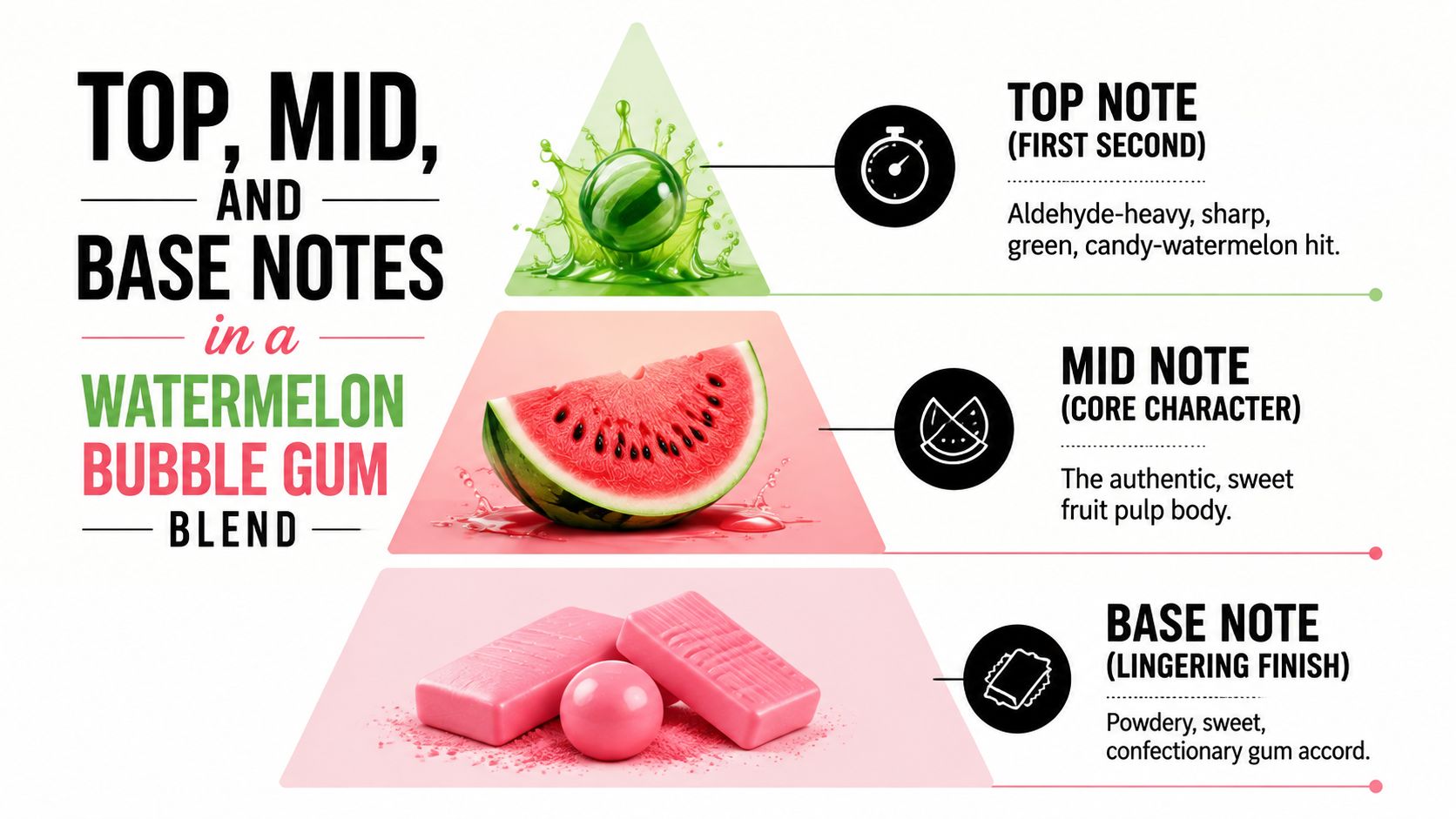
The top note should be aldehyde-heavy. The sharp green candy-watermelon hit registers during the first second of a pull. Use it to establish identity, not to carry the entire formula.
The middle creates the gum identity
The mid note is the most important layer for avoiding a flat fruit cart. Supporting esters, lactones, and a small amount of a confectionary material such as vanillin or maltol can create the soft, sweet center. These materials shouldn't bury the watermelon opening. Their job is to make the opening feel connected to a gum base.
A light linalool layer can smooth the transition from volatile fruit to distillate. A restrained fruit ester can add pulp and sweetness, while a creamy material can make the profile feel elastic and rounded rather than watery.
The base controls persistence
The base note doesn't need to smell strongly on its own. It needs to keep the profile from vanishing when the brighter compounds recede.
Representative base materials can include:
- Light woody support, used sparingly to give the blend a stable floor.
- A faint mint or wintergreen lift, which can suggest the clean finish of chewing gum without turning medicinal.
- Beta-caryophyllene, providing dry structure and helping the blend sit more naturally in a cannabis-compatible matrix.
- A restrained valencene accent, adding depth without taking the profile away from candy.
The order of evaluation matters. Smell the blend immediately, after dilution, and after it has rested. A top note that dominates at the bench may be the first material lost during processing, while a heavy base can become more prominent after the volatile materials fade.
The best watermelon bubble gum cart isn't the loudest at the first sniff. It's the one that still reads as watermelon, candy, and gum after the bright opening has passed.
Use substitutions by function rather than by name. If you don't have the exact green aldehyde, select another material that supplies fresh-cut lift, then adjust the sweet-acid center around it. If the blend feels too botanical, reduce the terpene backbone before adding more candy materials. If it feels like generic fruit candy, restore green lift rather than increasing sweetness.
Formulating the Profile for Distillate and Cartridges
A watermelon bubble gum blend can smell convincing in a vial and still disappear in a cartridge. Start with the distillate matrix, because viscosity, hardware temperature, and total terpene loading determine which parts of the confection profile survive delivery.
A practical starting point for distillate cartridges is a total terpene load of 5% to 12% by weight, adjusted for viscosity and hardware. Treat that range as a bench starting point, not a finished specification. Confirm the target with viscosity checks, cartridge performance, sensory evaluation, and applicable product requirements.
A representative structure
Use the following architecture to organize the flavor load. These are approximate allocations within that load, not a universal finished-product recipe.
| Note Layer | Representative Compounds | Approx. % of Flavor Load | Primary Role |
|---|---|---|---|
| Top | C6 and C9 aldehydes, fresh green melon materials | 25% to 35% | Immediate watermelon recognition |
| Mid | Fruit esters, lactones, linalool, soft confection materials | 40% to 50% | Sweet pulp, gum body, and rounded center |
| Base | Beta-caryophyllene, restrained valencene, light woody or mint support | 15% to 25% | Persistence, matrix integration, and finish |
A thinner or more dilute system may need a modestly stronger aldehyde fraction because processing can weaken the opening. Make that adjustment from sensory results, not by automatically adding more aldehyde. Too much creates sharpness before stability testing.
Mixing order protects the volatile fraction
Add heavier sesquiterpenes and any permitted diluent first. Follow with the mid-note materials. Add aldehydes and the most volatile esters near the end, using controlled agitation and minimal heat.
The sequence reduces flash-off and gives the heavier portion time to accept the brighter materials. Confection ingredient disclosures commonly pair acids and flavorings with dispersion or moisture-control components, illustrating why release behavior matters when rebuilding a candy profile for another matrix. The mainstream ingredient disclosure can serve as a confection reference, not as a cartridge formula.
For a small trial, prepare a flavor concentrate, dilute it into a measured distillate sample, and test it in the intended cartridge rather than only in glass. Follow a distillate mixing guide for the mechanical workflow, then verify the result in the actual hardware.
Common failures point to specific corrections:
- Aldehyde burn-off: Add that fraction later and reduce heat exposure.
- Base-note takeover: Lower beta-caryophyllene or woody support before increasing fruit materials.
- Thin sweetness: Increase mid-note body and restore acid tension instead of adding more top note.
- Harsh first pull: Reduce the sharpest aldehyde and let the soft center carry more of the opening.
A successful cartridge should retain the candy, watermelon, and gum identity after processing, not merely produce a strong first sniff at the bench.
Two Build Paths for Different Product Goals
There are two credible ways to formulate a watermelon bubble gum cart. The right choice depends on whether the SKU needs immediate candy recognition or a more integrated cannabis-matrix impression.
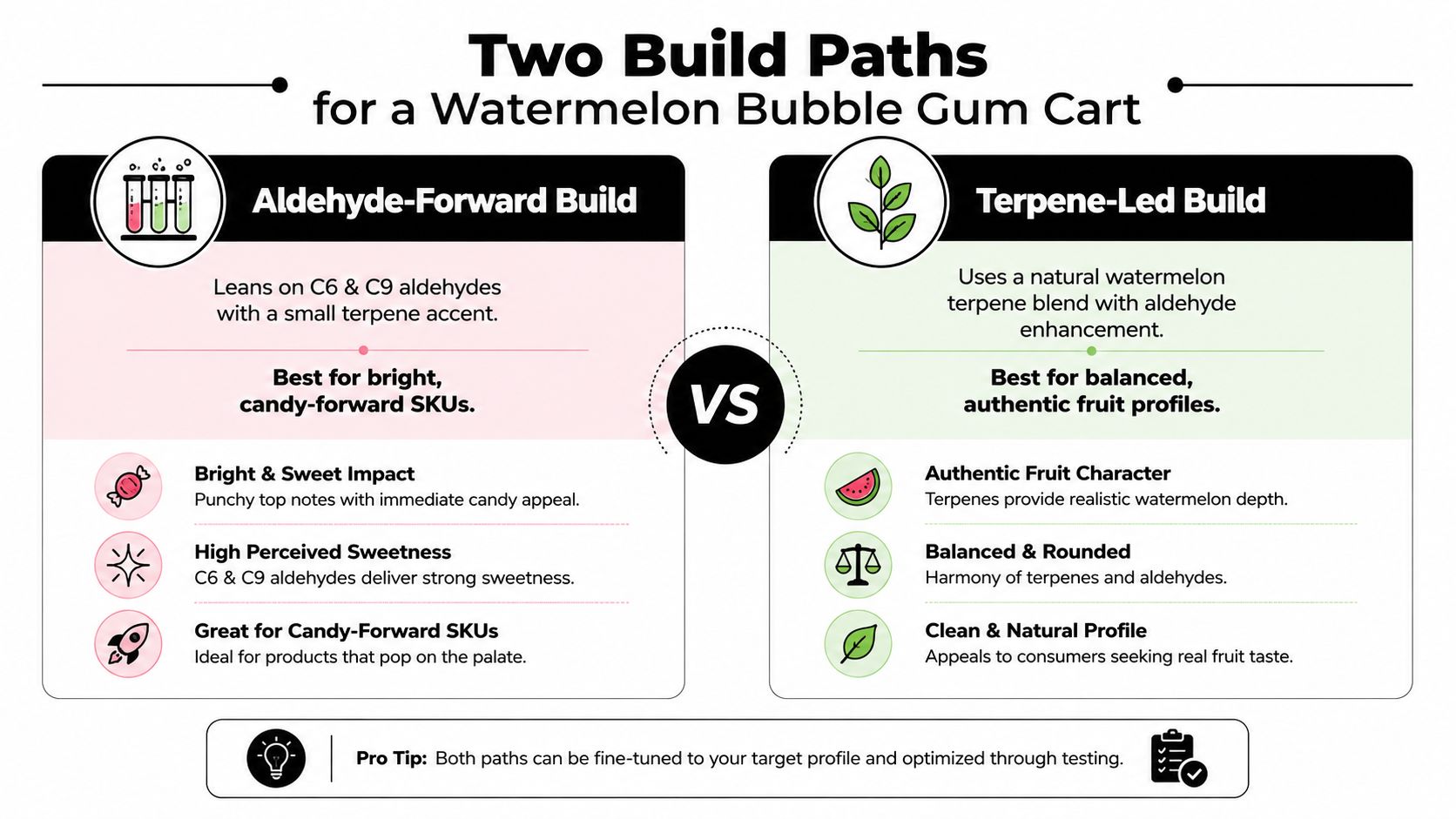
The aldehyde-forward build starts with the watermelon signal. C6 and C9 aldehydes lead, fruit esters add sweetness, and a small terpene accent prevents the result from feeling disconnected from distillate. This path works well when the package promise is explicit and the first pull needs to communicate the flavor quickly.
The terpene-led build begins with a cannabis-compatible base containing materials such as myrcene, beta-caryophyllene, and a touch of linalool. Aldehydes and esters are then layered over that foundation. The result tends to feel less like a standalone confection and more like a fruit-gum profile integrated into the oil.
Choose by SKU behavior
| Decision point | Aldehyde-forward | Terpene-led |
|---|---|---|
| First-pull impact | Fast and conspicuous | More gradual and blended |
| Sensory character | Candy-forward and nostalgic | Fruit-forward with botanical structure |
| Main risk | Harshness or volatility loss | The gum note becoming too subtle |
| Best fit | Flavor-led SKUs and strong naming | Brands seeking matrix integration |
An aldehyde-forward build is usually the more efficient route when the buyer wants “bubble gum” to be unmistakable. It also gives the formulator a clearer correction path. If the result is too green, add body. If it is too sharp, lower the opening fraction.
A terpene-led build makes more sense when the product already carries a pronounced cannabis aroma and the watermelon note must sit inside it. Myrcene can provide softness, beta-caryophyllene can give shape, and linalool can smooth the transition into the confection layer. The trade-off is that too much botanical structure can bury the nostalgic signal.
Pick the path from the product promise. Don't ask a terpene-led build to perform like a candy concentrate, or an aldehyde-heavy build to behave like a natural strain expression.
Test both paths at the same final terpene load and in the same cartridge hardware. Otherwise, the comparison reflects process variation instead of a real sensory difference.
Lab Safety, Legality, and Quality Control Basics
Concentrated aldehydes and esters require disciplined handling. Work with effective ventilation, wear suitable nitrile gloves, keep containers closed, and eliminate open flames near concentrated vapors. Review the supplier's safety documentation for every material, especially when working with materials that have strong odor impact at low concentration.
The cannabis-adjacent application adds another layer. Use SC Lab-tested, THC-free inputs with documented identity and contaminant controls. Keep supplier documentation with the batch record, and make sure the final ingredient disclosure matches the actual formulation. A flavor system shouldn't carry medical claims, and brand language should describe sensory character rather than therapeutic outcomes.
A practical pre-scale checklist
- Identity: Confirm raw-material identity and lot information before weighing.
- Documentation: Collect current safety documents and certificates for the materials used.
- Handling: Record dilution steps, mixing temperature, agitation time, and container condition.
- Compatibility: Check the blend in the intended distillate and cartridge hardware.
- Stability: Run an accelerated heat-stability check before approving production.
- Verification: Use gas chromatography where appropriate to verify composition and investigate unexpected peaks.
- Release: Compare the retained sample with the approved sensory reference before shipment.
Quality control should catch both chemical and sensory failures. A GC review can identify composition drift, while dilution checks reveal whether the profile changes when it enters the oil. Heat testing shows whether the volatile top note survives storage and use conditions.
Review quality control testing guidance alongside your internal SOPs. The specific acceptance criteria belong in your quality system, but the principle is consistent: don't release a watermelon bubble gum profile based on a fresh concentrate sniff alone.
Putting It Together and Avoiding the Common Mistakes
A reliable build begins with a sensory target, not a catalog label. Write down the intended opening, core, and finish before selecting materials. Then construct the profile in the same order the user experiences it.
A bench sequence that scales
- Define the target: Choose between fresh-cut watermelon, candy watermelon, and full bubble gum. Record what must be obvious on the first pull.
- Draft the pyramid: Assign the aldehyde opening, ester and confection center, and supporting terpene base.
- Make a small flavor trial: Keep the first blend small enough to adjust without wasting distillate.
- Dilute into the actual matrix: Test in the intended distillate, not only in a neutral carrier.
- Evaluate through calibrated hardware: Use the production cartridge style and record first pull, middle pull, finish, and aftertaste.
- Run stability checks: Compare the fresh sample with heat-exposed and rested samples before scaling.
- Scale by weight: Preserve the approved ratio and document every addition.
The most common failure is overloading aldehydes. The profile becomes melon rind or a sharp synthetic fruit note, while the gum identity never develops. Reduce the opening fraction and strengthen the mid-note body instead of adding more sweetener.
The second failure is ignoring the acid system. Without enough brightness, the blend becomes a flat sweet fruit profile. In a confection reference, citric and adipic acids help sharpen and shape the flavor system, but a cartridge formulation must evaluate acid-related materials for suitability, safety, and compliance in the intended application.
The third failure is skipping heat stability. A blend can pass the first sensory check and still lose its top note during storage or use. If the opening fades, review mixing order, heat exposure, container closure, and volatile loading before rebuilding the entire formula.
Gold Coast Terpenes offers botanical terpene blends, strain-specific profiles, isolated compounds, formulation resources, and tools such as a mixing calculator for cartridge and distillate work. Visit Gold Coast Terpenes to compare watermelon and Bubble Gum profile components, then build your own screened trial around the aldehyde, mid-note, and matrix requirements defined here.