
Your distillate is clear, the hardware is selected, and the first trial blend is ready. Then the citrus note arrives too sharply in the bulk oil, fades after heat cycling, or leaves the cartridge tasting flatter than the reference flower. That's the practical problem with a Flavor Pack strain profile. It's attractive because the aroma is immediate, but its limonene-led character needs to be treated as a formulation system, not just poured into oil.
For product developers, Flavor Pack is useful as both a documented cultivar reference and a repeatable strain-inspired terpene blend. The job is to preserve its bright fruit character while managing volatility, viscosity, hardware behavior, and finished-product consistency.
Why a Flavor Pack Strain Belongs in Your Formulation Library
A formulator reviewing wholesale terpene options may see Flavor Pack beside familiar profiles such as Blue Dream and Green Crack. The decision isn't whether the name sounds appealing. It's whether a citrus-forward profile fits the sensory direction, label positioning, and heating behavior of the next cartridge SKU.
Flavor Pack earns consideration because it gives the lab a clear starting point. Consumer-facing strain listings describe a terpene-heavy, fruit-and-dessert profile, while independent references identify limonene as the dominant compound. That makes the blend easier to reason about than an unnamed “candy citrus” target. You have a recognizable top note, a defined spicy middle, and a floral finish that can be adjusted without losing the profile's identity.
The first trade-off appears before any blending begins:
- More limonene creates a louder first impression, but can make the finished oil feel sharp or one-dimensional.
- More caryophyllene adds peppery depth and helps support the profile through heat, but too much can pull the blend away from bright fruit.
- More linalool softens the finish, although an excessive floral direction may weaken the clean citrus read.
Practical rule: Treat Flavor Pack as a reference architecture. Don't assume the flower's reported ratio is automatically the correct cartridge ratio.
A useful formulation library should help your team make repeatable decisions. For Flavor Pack, that means documenting the target aroma, selecting a total terpene load, identifying the compounds most exposed to heat loss, and confirming the result in the actual cartridge rather than judging only from the mixing vessel.
This approach also keeps the commercial objective clear. A Flavor Pack-inspired SKU should smell and taste consistent from batch to batch, communicate a recognizable sensory direction, and behave predictably in the selected hardware. The profile can support a social, daytime-leaning product direction, but those effect labels should remain formulation language, not medical claims.
What Flavor Pack Strain Means in Commercial Work
For a cart developer, Flavor Pack is both a named cultivar and a workable reference formula. It traces to Archive Seed Bank, and strain databases describe it as a 50/50 indica-sativa cross of Hollywood Pure Kush and Moonbow, with flowering time around 65 days and reported THC levels of 22% to 28.8% (SeedFinder lineage and profile data).
The pedigree gives the sensory direction useful context. Hollywood Pure Kush ties the profile to a flavorful OG branch, while Moonbow is described as a Zkittlez x Dosidos cross (AllBud's Flavor Pack profile). That combination places Flavor Pack within the fruit, candy, dessert, and gas family. For production work, the lineage helps define the target before you select terpenes or adjust a distillate batch.
SeedFinder records at least 2 direct descendants in Flavor Pack's genealogy. That record supports treating the name as a reusable breeding and product-development reference rather than only a single flower release.
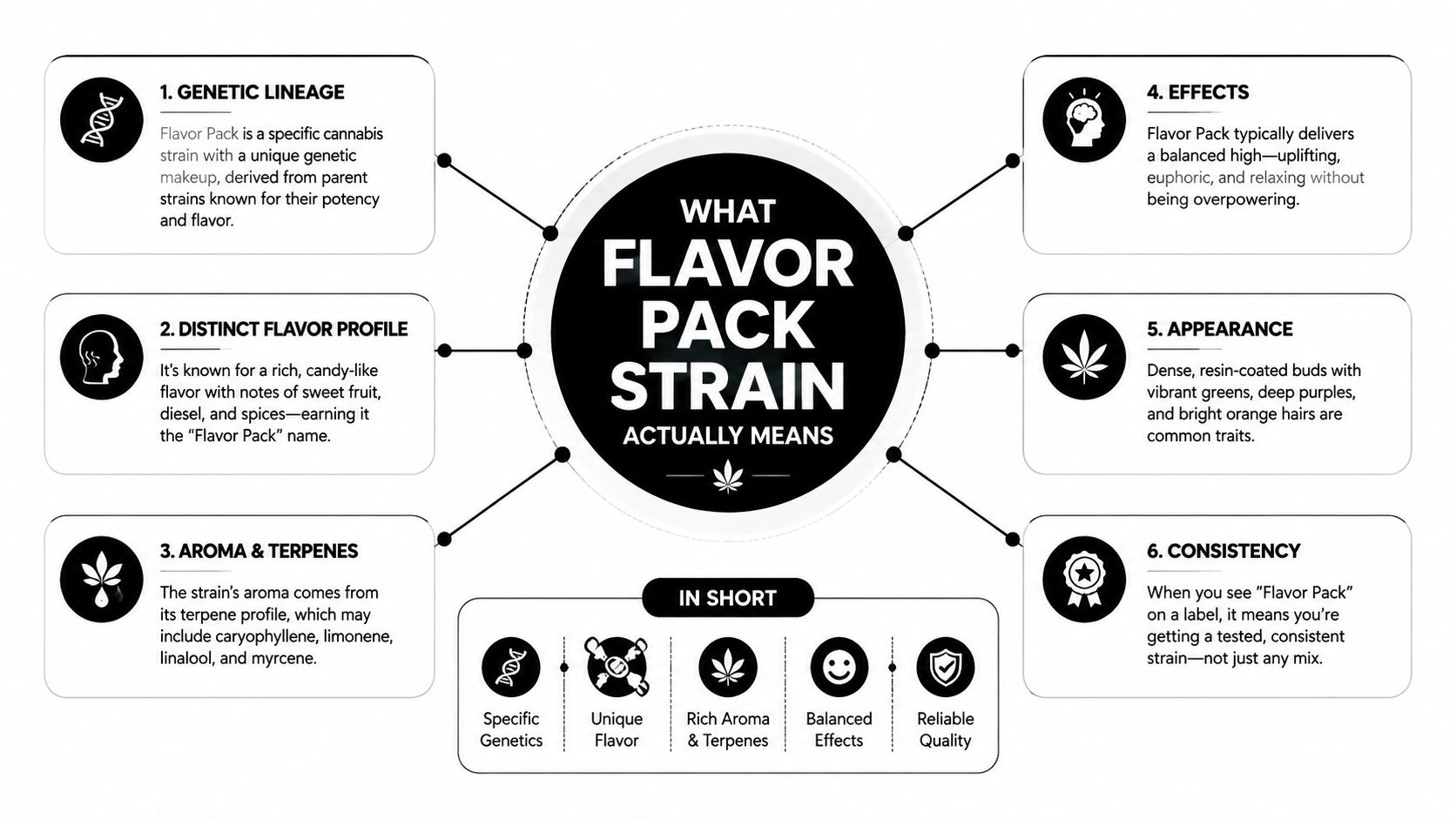
Two meanings in commercial work
Use Flavor Pack in two related senses:
- Cultivar reference: named flower with documented parentage, reported potency, and a recognizable sensory direction.
- Formulation concept: a measured terpene blend that can be scaled, added to distillate, and evaluated in a finished cartridge.
The distinction matters during scale-up. A purchased blend will not express exactly like the flower. Extraction conditions, storage, carrier composition, distillate character, and hardware temperature can change aroma, flavor, viscosity, and perceived intensity.
In this article, “Flavor Pack” means a citrus-forward, terpene-dominant formulation based on the documented profile. The strain name sets the sensory target. Your load, mixing conditions, storage controls, and cartridge hardware determine how much of that target remains after processing. That makes the profile a starting formula, not a fixed recipe.
Reading the Terpene Profile Like a Formulator
A dispensary description might stop at citrus, spice, and floral notes. A formulator needs a compound map. The reported Flavor Pack distribution is approximately 60% limonene, 28% caryophyllene, and 12% linalool (Flavor Pack terpene profile).
That split creates a clear sensory hierarchy. Limonene leads the opening impression with citrus brightness. Caryophyllene supplies a peppery, warmer middle layer. Linalool contributes a smaller floral component that rounds the finish rather than defining the aroma.
| Terpene | Approx. Share | Sensory Role | Boiling Point |
|---|---|---|---|
| Limonene | Approximately 60% | Bright citrus top note | Around 176°C |
| Caryophyllene | About 28% | Spicy, peppery middle | Around 130°C |
| Linalool | About 12% | Soft floral finish | Around 198°C |
The boiling-point data adds an operational layer. Independent terpene guidance associates limonene with citrus, caryophyllene with spice and pepper, and linalool with floral notes, with boiling points around 176°C, 130°C, and 198°C respectively (terpene aroma and volatility guide).
What the profile does in the cart
Caryophyllene's lower reported boiling point means it can be vulnerable during heat exposure, even though its heavier sesquiterpene character can provide useful body and persistence in a blend. Limonene remains the dominant sensory signature, but repeated heating can shift the balance if the formulation and hardware expose the volatile fraction too aggressively.
A citrus-heavy blend can therefore taste excellent in the mixing vessel and less complete during use. The user may perceive the first draw as bright, then experience a thinner or flatter finish after repeated heat cycles. Linalool's higher boiling point can help preserve a soft back note, but it won't replace the middle-layer complexity if the formulation loses its supporting compounds.
The practical risk isn't that Flavor Pack lacks character. It's that the character is front-loaded.
For that reason, evaluate the blend in three places: immediately after mixing, after settling, and in the final hardware. Sensory balance matters more than matching a reported ratio. The documented split tells you where Flavor Pack starts. It doesn't remove the need to adjust for coil temperature, oil viscosity, airflow, and draw behavior.
Blending Flavor Pack Strain into Carts and Distillate
Start with a documented load range, then narrow it through testing. One formulation source places cartridge blends at 5% to 15% terpenes by weight, while another gives a practical cartridge range of 4% to 7% and identifies 7.5% for standard distillate (cartridge terpene range guidance). These figures define a working envelope, not an automatic recipe.
A separate recommendation places balanced performance around a 6% to 10% total terpene load, with highly volatile monoterpenes reduced by 10% to 15% and more stable sesquiterpenes such as caryophyllene increased to support heat-cycle stability (terpene selection guidance). For Flavor Pack, the practical question is how much of its limonene-led top note the hardware can preserve without making the finished cart taste sharp or one-dimensional.
Hardware, oil viscosity, intended draw, and product format determine the useful target. A distillate batch and a cartridge may need different balances even when they use the same terpene blend.
A controlled mixing sequence
Set the target load before opening the bottle. Use the 6% to 10% band as a broad reference, then establish the production target through compatibility and sensory testing. Do not treat the upper end as the default.
Warm the base gently. Moderate warming improves flow and dispersion. Excessive heat can alter the aroma before filling, especially in a profile led by volatile citrus compounds.
Weigh the distillate and terpene blend precisely. Volume-based additions introduce avoidable variation. Record the base weight, terpene weight, lot information, and calculated final load.
Add the terpenes gradually. Mix as the blend enters the vessel so the volatile fraction does not remain concentrated in one area. Follow a documented distillate and terpene mixing workflow for the addition and batch records.
Allow the batch to settle. The aroma can change after the terpenes integrate with the distillate. A first smell is only an early check, not release approval.
Fill the final hardware and test again. The cartridge can produce more localized heat, different airflow, and a different vapor profile than the bulk sample.
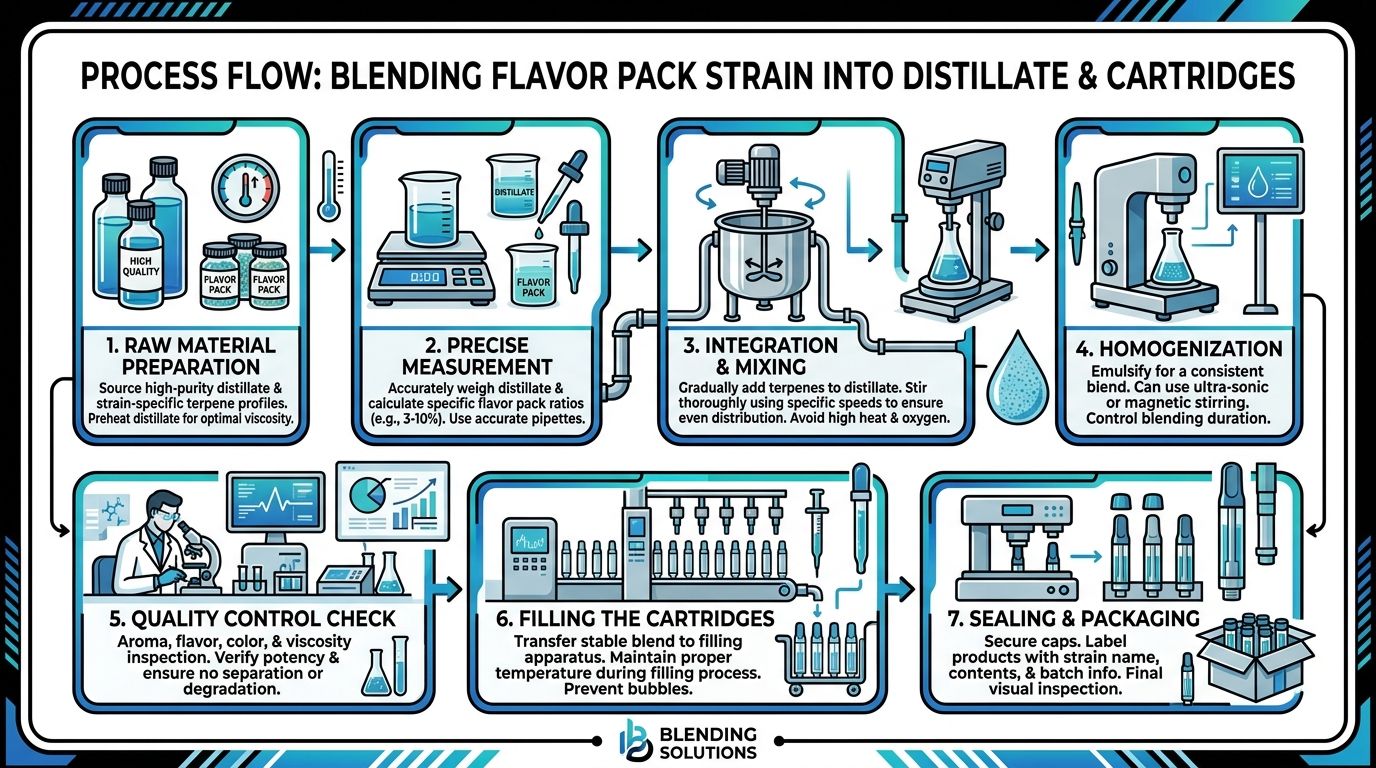
If the cart runs hot or the citrus top dominates after use, reduce the highly volatile monoterpene portion by 10% to 15% and compensate with a more stable sesquiterpene fraction such as caryophyllene. That adjustment can moderate the profile, but it cannot correct poor coil behavior or unsuitable airflow.
Approve the recipe only after it performs in the format customers will use. Distillate may tolerate a different viscosity and thermal environment, while a cart repeatedly heats a small localized area. Flavor Pack works best as a starting formula that is measured, rebalanced, and checked through the complete heat cycle.
Matching the Pack to the Desired Effect
Flavor Pack makes sense when the SKU needs a bright citrus direction with a social, daytime-leaning positioning. That doesn't mean the terpene blend produces a guaranteed effect. It means the aroma, flavor, and product language point toward a more uplifting profile than a dense, gas-heavy alternative.
Choose by sensory family first, then refine the top, middle, and base structure. One published framework uses a 30% top-note, 50% middle-note, and 20% base-note split for terpene combinations (terpene application framework). The framework gives a formulator a way to compare profiles without relying only on strain names.
A practical comparison
Flavor Pack: Choose it for bright citrus, sweet fruit, and a peppered middle. It works when the label and flavor need immediate lift, but the limonene-heavy structure requires volatility management.
Blue Dream: Use it for a berry-balanced direction with a softer, more familiar middle ground. It's a better fit when the product needs fruit character without making citrus the first and loudest note.
OG Kush: Select it for a heavier gas, spice, and body-oriented direction. A caryophyllene-anchored OG formulation generally communicates more depth than a citrus-led Flavor Pack profile, especially in evening-positioned products.
Forbidden Fruit: Use it when the target is darker fruit and candy rather than bright citrus. This option can help a brand build a richer dessert profile without pushing the blend toward the sharpness that excess limonene can create.
Green Crack: Choose it for a sharper, focus-leaning energy in the product's commercial language. Its role in a catalog differs from Flavor Pack because the desired impression is more pointed than rounded.
The same top, middle, and base framework can expose why two profiles behave differently. Flavor Pack leads with a bright monoterpene impression, then relies on caryophyllene and linalool for structure. OG Kush typically makes more sense when the middle and base need to dominate the sensory story.
Avoid printing effect promises that the formulation can't substantiate. Use language such as citrus-forward, social-leaning, berry-balanced, gas-heavy, or darker fruit when describing the intended direction. Keep medical claims out of the label and out of the product brief.
Lab and Safety Considerations Before You Scale
A cart developer can have the right Flavor Pack aroma in a beaker and still miss the target in production. Scale-up requires the input material and finished oil to pass the same quality review as the cannabinoid base. Carrier-free composition matters because VG, PG, PEG, and MCT can change viscosity, hardware compatibility, formulation behavior, and labeling requirements. Adding an unverified diluent to improve flow may fix filling while creating a larger documentation and compliance problem.
Gold Coast Terpenes states that its lab-verified, THC-free terpene blends are free of VG, PG, PEG, and MCT, and are SC Lab-tested and legal worldwide (Gold Coast Terpenes formulation and testing information). Treat those points as the supplier's stated specifications. Verify the exact lot yourself, then confirm that the material fits your jurisdiction, product category, and intended use.
The pre-scale checklist
Confirm the COA: Match the certificate to the lot, product name, and delivered material. Check that it supports the stated composition and testing status.
Confirm the labeling basis: Establish whether the blend is cannabis-derived or botanical. Apply the description required for your market to the finished label.
Review safety documentation: Keep the relevant SDS with the batch record. The SDS importance guide explains why this document belongs in the operational file, not only in purchasing records.
Inspect hardware compatibility: Review seals, tank materials, airflow, and expected viscosity before filling a production run. A formula that behaves well in glass can still expose problems in a cartridge.
Test the actual cartridge: Run the finished blend in the intended hardware at the intended voltage. Bulk aroma does not predict every result at the coil.

The final check combines sensory review with procedure. Compare the filled cart with the approved reference after settling and use. Record harshness, muted citrus, excessive pepper, separation, leaking, clogging, and flavor changes across the draw sequence. A batch that passes a bulk smell test but fails in its cartridge is not ready to ship.
Building a Repeatable Flavor Pack Strain Workflow
A repeatable Flavor Pack workflow has four controllable inputs: pack choice, total load, note layering, and hardware re-test. The two gates that can't be skipped are lab verification and a post-blend sensory check in the finished format.
For a citrus-forward SKU, select Flavor Pack because the profile supports that direction, not because the name is recognizable. Hold the formulation inside the 6% to 10% working band identified in the cited guidance, then test whether your chosen hardware needs a tighter cartridge range. If the cart runs hot, reduce the volatile limonene share by 10% to 15% and use caryophyllene to restore middle-layer depth, following the earlier formulation reference.
Keep the batch record simple and auditable:
- Record the blend and lot.
- Record the base and total terpene load.
- Record the top, middle, and base adjustments.
- Fill the actual cartridge.
- Re-test aroma, flavor, flow, and heat-cycle behavior.
- Approve or revise before scale-up.
A terpene sample pack can help a development team compare Flavor Pack with neighboring profiles before committing a larger production input. The useful outcome isn't a single favorite aroma. It's a controlled choice supported by sensory data and hardware performance.
Gold Coast Terpenes offers strain-specific blends, isolated compounds, sample packs, and formulation resources for cartridge and distillate development. Visit Gold Coast Terpenes to compare profiles, review formulation tools, and select a documented starting point for your next Flavor Pack-inspired SKU.