
A brand owner can make a clean 50-gram Blue Dream cartridge pilot, then scale the same profile to a 2-kilogram production batch and discover that the flavor no longer matches. The usual cause isn't the strain name or the calculator. It's an addition measured by eye, a syringe reading treated as a weight, or a terpene blend applied without recording the base extract mass.
A terpene mixing calculator helps convert a sensory target into a measured formulation. Used correctly, it gives the operator a repeatable amount of terpene blend, and often a corresponding volume, based on the actual batch inputs. That makes the calculator more than a plug-in tool. It becomes part of the batch record, scale-up process, and quality-control system.
Why Formulators Need a Terpene Mixing Calculator
The Blue Dream example exposes a production problem that appears across vape cartridges, concentrates, and flower applications. A small pilot can tolerate a little estimation because the operator is watching viscosity, aroma, and integration closely. A larger batch magnifies every inconsistency. If the terpene addition was based on drops or an approximate volume, the scaled batch may have a different flavor intensity, flow behavior, and finished weight.
The core job of the calculator is simple: connect the starting extract weight to a target terpene percentage and return an amount that can be weighed and documented. That translation matters because sensory language, such as bright, pine-forward, fruity, or earthy, doesn't tell a production technician how many grams belong in a vessel.
Publicly indexed terpene calculator guidance first appeared in 2020 and remained maintained in 2025, evidence that the concept moved from niche support content into a persistent manufacturing workflow aid. Modern tools also support categories such as vape, concentrate, and flower, rather than serving only one formulation type. See the vape cartridge mixing ratio guide when selecting a starting target for a cartridge project.
Production rule: A calculator doesn't create formulation quality by itself. It creates a consistent mathematical instruction that your team can verify, execute, and preserve in the batch record.
A useful record should identify the base material lot, extract weight, target addition, terpene blend lot, operator, date, and actual weighed addition. That structure lets a formulator compare lots without relying on memory or a handwritten note that says “added enough for flavor.”
How a Terpene Mixing Calculator Works
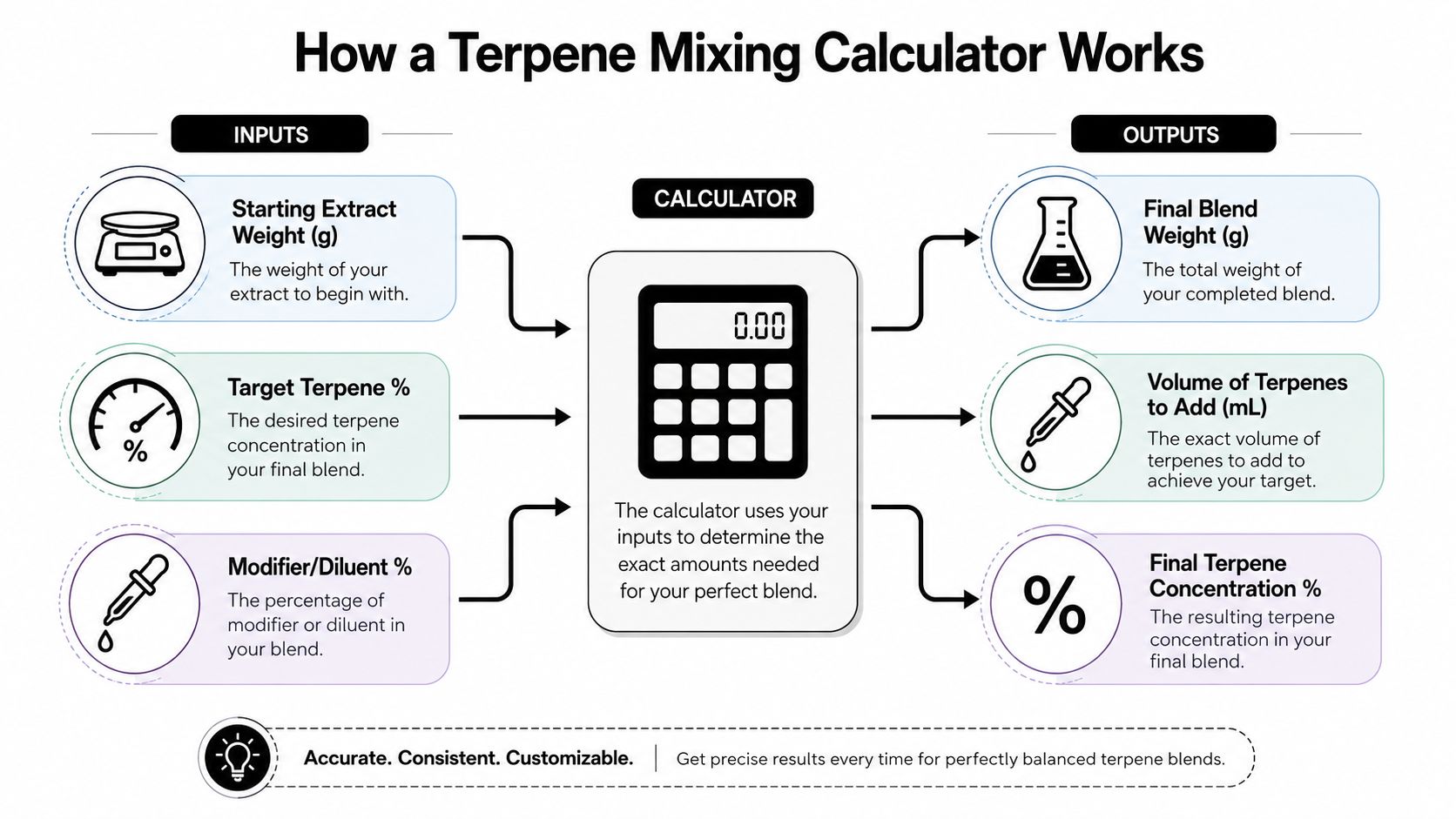
Most calculators ask for three practical inputs:
- Starting extract weight in grams, such as the mass of winterized distillate in the vessel.
- Target terpene percentage, entered as a percentage or decimal depending on the tool.
- Optional modifier or diluent percentage, if the formulation includes a viscosity or flow component.
The output commonly includes the required terpene weight in grams, the equivalent volume in milliliters, and the resulting blend information. A representative calculator asks for starting extract weight, target terpene percentage, and optional modifier percentage, then returns exact grams and milliliters for the batch. That workflow is described in the terpene calculator guidance for formulators.
A simple batch calculation
Suppose the vessel contains 500 grams of winterized distillate and the target terpene addition is 8%. Using the base-weight method:
500 g × 0.08 = 40 g of terpene blend
The operator enters 500 g as the extract weight and 8% as the target. The calculator returns 40 g of terpenes. If the tool also requests density, it can convert that 40-gram requirement into milliliters, but the gram value remains the controlling production measurement.
Weight and volume aren't interchangeable. A milliliter describes space, while a gram describes mass. Because terpene composition affects density, the same volume can represent different weights across profiles. Use volume as a handling reference or dispensing aid, not as a substitute for a verified mass calculation.
If the formulation includes a modifier, enter it separately when the calculator provides that field. Keep the terpene addition and modifier addition distinct in the record so the finished batch can be reconstructed accurately.
Weight-Based Formulation for Repeatable Batches
Weight-based dosing is the most defensible method for commercial terpene mixing because both the base extract and the addition can be tied to mass. Industry guidance recommends a calibrated scale with at least 0.01 g precision for this work, as stated in the weight-based terpene calculation guide.
The practical equation is:
Terpenes needed in grams = base material weight in grams × target percentage as a decimal
For example, a 200-gram base at a 7% target requires 14 grams by the base-weight method. The important point isn't the arithmetic difficulty. It's that the equation produces a result another operator can reproduce from the same inputs.
Milliliter measurements introduce a density assumption. Guidance places typical pure-terpene density around 0.8 to 0.95 g/ml, depending on the material and blend composition, as documented in the terpene density and mixing calculator resource. A monoterpene-heavy blend and a blend containing more sesquiterpenes may not deliver the same mass at the same measured volume.
What belongs in the batch record
Record the calculation before mixing begins, then record the actual addition after weighing. At minimum, include:
- Base extract lot and mass: Identify the material and the measured starting weight.
- Target terpene load: Record the percentage and the calculation method.
- Terpene blend identity: Include the profile, supplier lot, and any available analytical documentation.
- Actual terpene mass: Capture what entered the batch, not only what the calculator predicted.
- Modifier or diluent mass: Keep optional additions separate from the terpene amount.
- Operator and date: Make the result traceable to a specific production event.
That record supports internal review, deviation analysis, and lot-to-lot comparison. If a batch tastes different, the team can check whether the input profile changed, the target changed, or the operator missed the calculated mass.
Worked Examples for Cartridges and Distillate
A calculator earns its place in production when the result becomes a weighed instruction that another operator can repeat. The examples below use the base-weight method, so the terpene target is calculated from the starting material. If your quality system defines the target against final batch weight, select that method consistently in the calculator, batch record, and review.
Vape cartridge batch
Start with 200 grams of refined distillate and set a 7% terpene target.
200 g × 0.07 = 14 g terpenes
If the formulation includes an optional viscosity-reducing diluent at 2% of base weight:
200 g × 0.02 = 4 g diluent
The planned finished mass is:
200 g + 14 g + 4 g = 218 g
Enter 200 grams of distillate, 7% terpenes, and 2% modifier. The batch record should carry the calculated and actual values, rather than a note such as “7% flavor added.” Weigh the distillate, terpene blend, and modifier separately. Record the order of addition, mixing conditions, and final recovered mass, since transfer losses can make the calculated total differ from the material collected.
For handling and integration details, refer to the distillate and terpene mixing guide. Confirm the method at pilot scale before charging a larger vessel, particularly if the base contains residual volatile material or changes texture with temperature.
Distillate concentrate batch
For a 1-kilogram sauce or budder batch at a 3% terpene target, convert the base to grams before running the calculation:
1,000 g × 0.03 = 30 g terpenes
The planned combined mass is:
1,000 g + 30 g = 1,030 g
Residual solvent or moisture changes how that result should be interpreted. If the base has not reached its verified release condition, the measured 1,000 grams may not represent the stable formulation mass. Confirm release status, document the starting condition, and state whether the target uses as-received mass or an approved corrected basis. A calculator cannot correct an unresolved base-material issue.
| Parameter | Vape Cartridge Batch | Distillate Concentrate Batch |
|---|---|---|
| Base material | 200 g refined distillate | 1,000 g sauce or budder |
| Terpene target | 7% | 3% |
| Terpenes required | 14 g | 30 g |
| Optional modifier | 2%, 4 g | None specified |
| Planned combined mass | 218 g | 1,030 g |
At commercial scale, retain the calculator output with the weighing record and reconcile planned versus actual additions before release. That comparison shows whether a difference came from dispensing, transfer, or the input material itself.
Target Terpene Percentages by Product Category
A calculator output is only a starting value. The usable target depends on how the product carries, releases, and retains volatile compounds. Cartridge hardware imposes flow and wicking constraints. Concentrates must balance aroma against texture. Flower and topical products require separate retention, exposure, and safety assessments.
The category determines which measurements belong in the batch record:
| Product category | What the formulator must verify |
|---|---|
| Vape cartridges | Record the selected percentage by weight, distillate viscosity, hardware compatibility, fill temperature, and post-fill performance. Cartridge mixing ratio guidance can support the initial calculation, but it does not replace cartridge testing. |
| Distillate and cannabinoid concentrates | Record the basis used for the calculation, the concentrate's starting condition, final texture, and sensory intensity. Concentrate terpene percentage guidance provides a reference for setting a working target, not a release specification. |
| Flower and other applications | Define the application, contact route, retention behavior, and applicable safety review before selecting a target. A cartridge formulation cannot be transferred directly into a dry or topical matrix. |
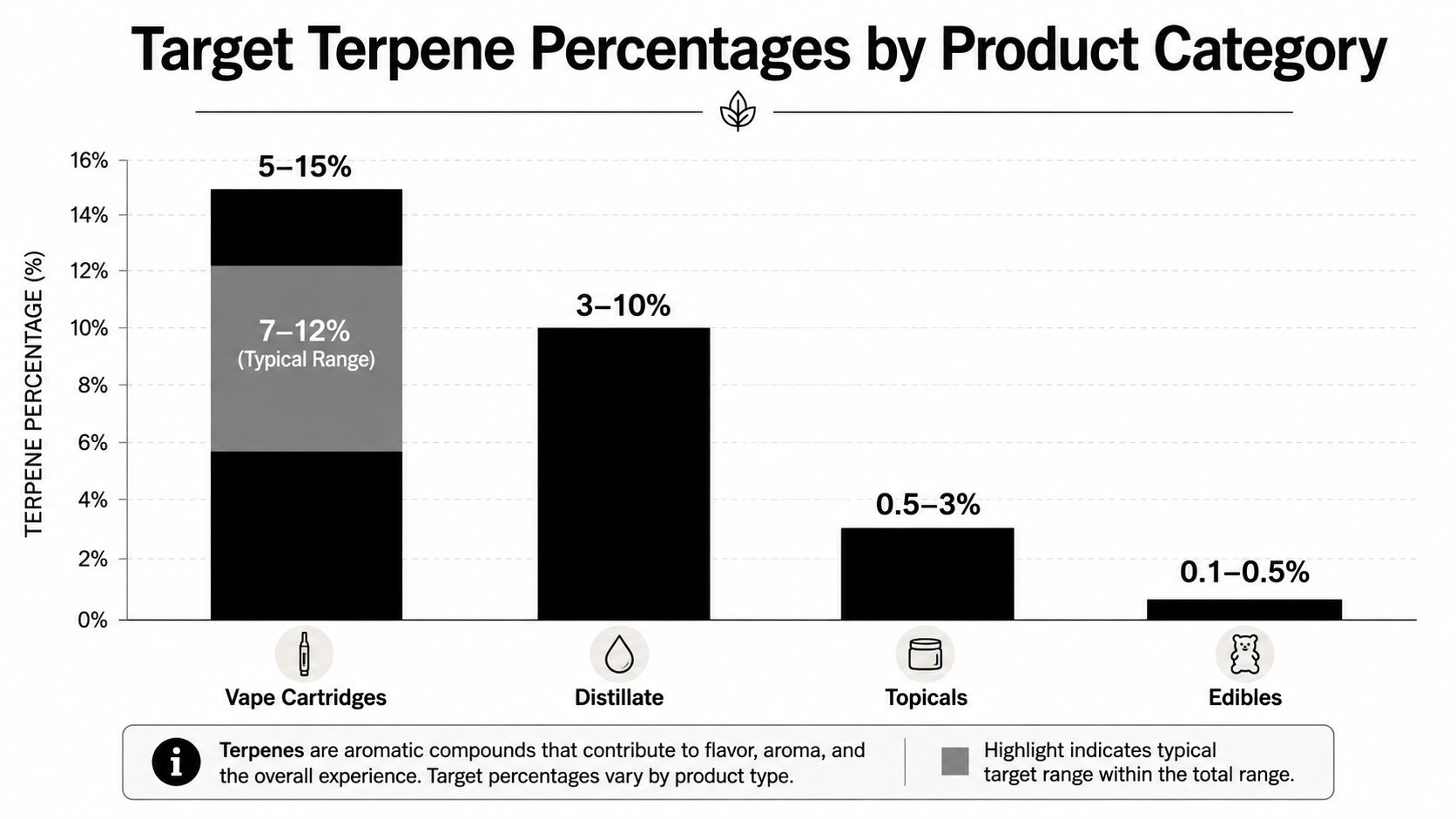
The upper boundary requires product-specific review. Higher terpene loading can increase irritation risk, destabilize the blend, or produce harsh sensory performance. Guidance around 10% to 15% is not a substitute for toxicology, hardware testing, or regulatory review, as noted in the terpene safety and mixing calculator resource.
For repeatable production, enter the chosen target, calculation basis, actual terpene mass, lot numbers, and measured final mass in the batch record. Reconcile planned and actual additions before release. The calculator handles mass conversion. The formulator must confirm that the selected target fits the product and that the finished batch performs as intended.
Note Layering and Blend Order in Formulation
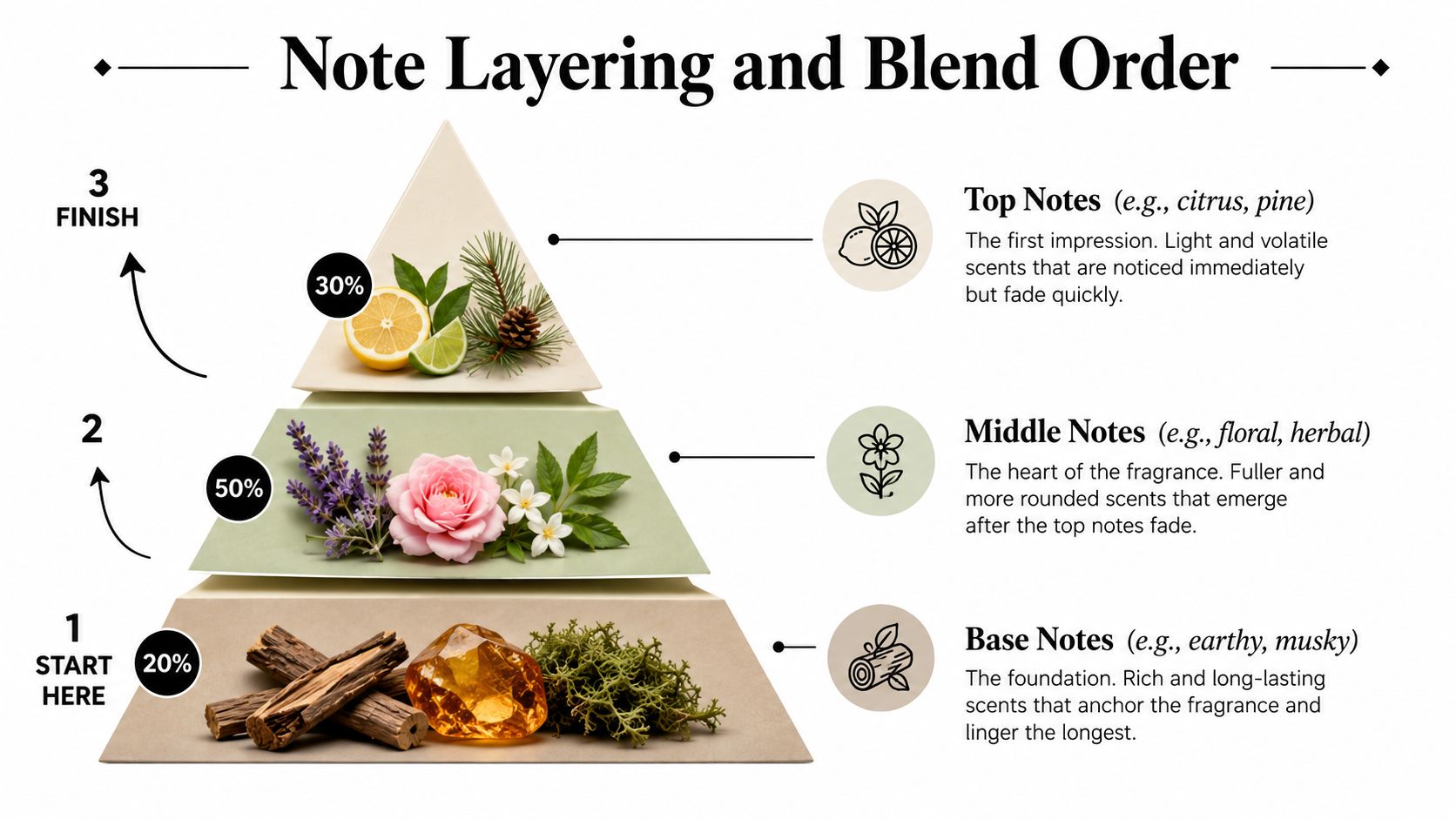
A terpene profile has structure. Top notes provide the first aromatic impression, middle notes connect the brighter and heavier elements, and base notes give the blend depth and persistence. Treating every compound as an interchangeable flavor ingredient can produce a mathematically correct batch that smells unbalanced.
A common starting architecture for a custom strain-inspired terpene blend is 30% top notes, 50% middle notes, and 20% base notes, based on the terpene combination guide. Volatile monoterpenes such as pinene and limonene can serve as top notes. Caryophyllene, a sesquiterpene, can sit in the middle structure, while heavier compounds such as nerolidol can contribute base depth.
Translating the structure into calculator inputs
Assume a calculator has already determined that the batch requires a fixed total mass of terpene blend. Apply the structural split to that total rather than calculating each note from an unrelated base:
- Top-note portion: 30% of the total terpene blend.
- Middle-note portion: 50% of the total terpene blend.
- Base-note portion: 20% of the total terpene blend.
The order of addition matters. Base notes can be incorporated earlier while the concentrate is hotter. Middle notes follow as the blend begins to come together. Add top notes last, at the lowest workable temperature, because their volatility makes them more vulnerable to aroma loss. The terpene temperature chart provides a practical reference for this process logic.
The calculator tells you how much to add. Note chemistry and process control determine when to add it. Record both decisions in the SOP, especially if the product is intended to replicate a sensory profile across multiple production lots.
Strain Replication Using Analytical Data
A strain-inspired terpene blend should begin with data, not a flavor description. For authentic replication, use a laboratory analysis such as a GC-MS report as the blueprint, then build the formulation from the dominant compounds identified in that report. The chromatography and terpene testing resource is useful when establishing that analytical starting point.
A calculator-driven replication workflow
First, identify the dominant compounds in the reference sample. If the project involves an OG Kush or Forbidden Fruit profile, don't assume the familiar name tells you the correct ratio. Use the report to identify the top three terpenes and their relative contribution.
Next, decide the total terpene load appropriate for the intended product. The calculator converts that total into grams for the planned batch size. Divide the total mass according to the analytical proportions, then add secondary and tertiary compounds to restore complexity.
Trace compounds require restraint. One formulation guide describes adding compounds that may appear below 0.1% only after the dominant, secondary, and tertiary structure is established, as discussed in the strain replication guidance. Their mass may be small, but removing them can change the character of the finished profile.
A useful worksheet contains four columns: compound name, analytical proportion, calculated mass, and actual mass weighed. Keep the source report attached to the batch record. If the supplier blend already contains some of the identified compounds, account for that contribution rather than adding a full isolate dose on top.
Replication is rarely a matter of copying a strain label. It is a controlled reconstruction of dominant aroma, supporting structure, and trace character, followed by sensory and physical validation in the actual base material.
Common Formulation Mistakes and Safety Limits
A calculator only processes the values entered. It cannot detect poor inputs, unsuitable equipment, or a batch record that no longer matches the material on the bench. Errors often begin before the operator selects “calculate.”
Configuration mistakes are common. Confirm the batch size, target loading, component proportions, and whether the calculator expects percentages or decimal fractions. Entering 5% where the field expects 0.05, or reversing the total batch mass and terpene mass, can produce a plausible but incorrect result. Save the configuration with the batch record so another operator can reproduce it.
Unit control matters. A volume reading does not establish terpene mass without a verified density, and density can vary by composition. A scale displaying two decimal places is not automatically accurate to 0.01 g. Check calibration status, verify with a suitable reference, and record the actual weight.
Base-material assumptions create another failure point. Residual terpenes, solvent, or moisture can make the starting mass misleading. Record the material condition and use a consistent basis for calculations. If extra modifier is added after the initial calculation, update the component masses and document the adjustment rather than treating it as harmless correction.
A calculated blend still requires a pilot check for viscosity, integration, aroma, and hardware behavior. Review terpene mixing safety guidance before approving the formula, and do not treat a strong aroma as evidence of correct formulation.
A calculator is a control point, not a complete formulation system.
Weigh every input, inspect the integrated blend, and investigate any pilot difference before increasing vessel size. Check the base, density, temperature, and mixing sequence before releasing a production batch.
Quick Reference for Terpene Formulation Benchmarks
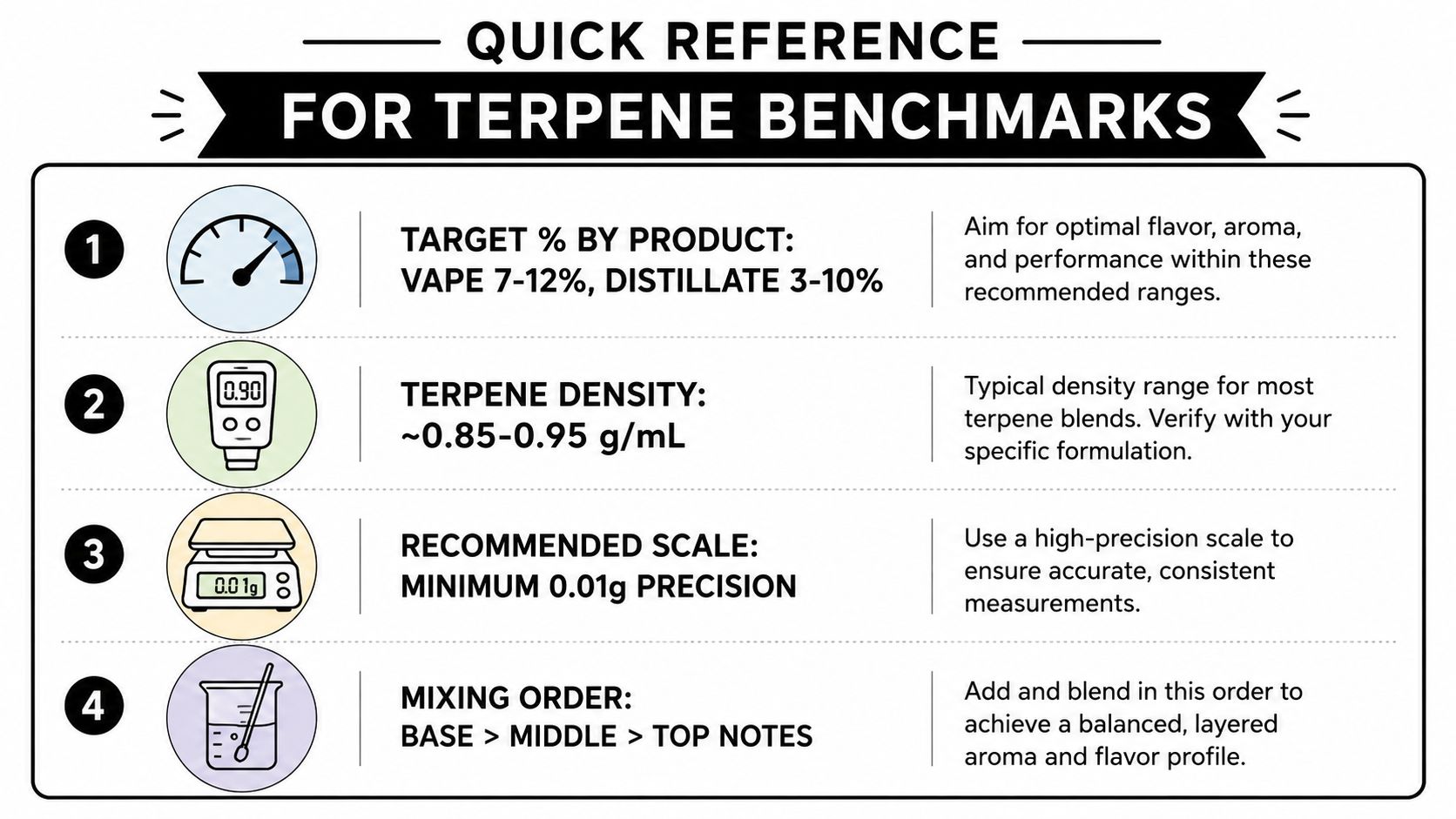
Use this lookup before entering values into a terpene mixing calculator. These are starting benchmarks, not universal release specifications.
- Vape cartridges: 5% to 15% total guidance, with 7% to 12% described as a common working range. See the cartridge ratio reference.
- Distillate concentrates: Often begin around 2% to 5%, while some guidance describes 5% to 10% as an upper working band. See the distillate terpene guidance.
- Terpene density: Typical pure-terpene density may fall around 0.8 to 0.95 g/ml, depending on composition. See the density calculator reference.
- Scale precision: Use a calibrated scale with at least 0.01 g precision, as described in the weight-based dosing guide.
- Note structure: Start with 30% top notes, 50% middle notes, and 20% base notes for a custom blend. See the terpene combination framework.
- Mixing order: Add base notes earlier, middle notes during integration, and top notes last at the lowest workable temperature. Consult the terpene temperature chart.
Next Steps for Scaling Your Formulation Workflow
Build a GC-MS blueprint library for the strain-inspired profiles that matter most to your product line. Store the dominant, supporting, and trace-compound targets alongside the calculator worksheet, supplier lot information, and sensory evaluation notes.
Then write the calculator into your SOP. The operator should document the extract weight, target percentage, calculated terpene mass, modifier mass, actual weighed additions, and mixing conditions before the batch starts. That simple requirement turns a useful web tool into a controlled manufacturing step.
Source inputs that fit the formulation. Gold Coast Terpenes supplies THC-free, lab-verified terpene blends and isolates described as free of VG, PG, PEG, and MCT, with options for cartridge, concentrate, and product-development work. Start with a curated strain profile when speed and consistency matter, then move to custom isolate blending once your analytical and sensory controls are established.
Gold Coast Terpenes offers strain-specific terpene blends, isolated compounds, formulation resources, safety documents, and a mixing calculator for teams developing repeatable cartridge and concentrate batches. Review the available profiles and formulation materials at Gold Coast Terpenes, then select a documented starting blend for your next pilot run.