
Zkittlez is definitively an indica-dominant hybrid, commonly described near a 70% indica and 30% sativa split. Gold Coast Terpenes supplies 100% botanically derived terpene blends, and the commercial value of a Zkittlez profile lies in its distinct fruity, candy-like aroma, not in that genetic ratio.
The popular answer to “zkittlez strain indica or sativa” is usually a percentage. That answer is convenient for a menu or product page, but it's a weak formulation specification. A cartridge manufacturer can't reproduce a sensory profile with a botanical category. The reliable blueprint is the target lot's certificate of analysis, including its cannabinoids, total terpenes, and dominant compounds.
Zkittlez is generally associated with Grape Ape, Grapefruit, and an undisclosed third parent, which helps explain its combination of relaxing indica-associated structure and brighter fruit characteristics. Yet genetics and retail labels don't tell you whether a particular extract will lead with grape, citrus, floral notes, or earthy spice. The batch does.
For product developers, the practical question is different: how do you build a stable, recognizable Zkittlez strain-inspired terpene blend for vape cartridges or distillate without treating “indica” as a chemical formula? The answer starts with chemotype accuracy, moves through sensory architecture, and ends with controlled testing in the finished hardware.
Beyond the Genetic Label
Zkittlez is best classified as an indica-dominant hybrid, but that classification shouldn't drive the formulation. Commercial descriptions commonly place it around 70% indica and 30% sativa, while other listings use different splits. Those ratios are breeding shorthand, not standardized laboratory measurements. Leafly's Zkittlez strain records also illustrate why reported potency and profile details can vary across listings and batches.
The more useful answer for a manufacturer is that Zkittlez is a THC-dominant hybrid with a variable, fruit-forward terpene chemotype. A published strain summary reports THC around 15%–23% and negligible CBD, while identifying compounds such as caryophyllene, limonene, humulene, linalool, and myrcene as possible contributors. Those figures describe reported material, not a universal specification for every extract sold under the name. Weedpedia's Zkittlez profile provides the relevant distinction between a recognizable cultivar identity and a fixed chemical signature.
Why the percentage debate fails in production
A label such as “70/30 indica” may help a retailer organize products, but it won't tell a formulator how an oil will smell after dilution, how the aroma will develop during heating, or whether a new lot will match the previous one. Genomic research found that samples labeled indica and sativa were not clearly distinct across the genome, although the labels showed stronger relationships with variation in some terpene-synthase genes and aroma-related compounds. The Nature study on cannabis classification supports a more cautious approach.
That distinction matters at scale. Two Zkittlez extracts can share a name while differing in terpene concentration, dominant compound, and sensory balance. One tested certificate reported 5.1452% total terpenoids, including approximately 23.877 mg/g limonene, 6.510 mg/g myrcene, and 3.930 mg/g linalool. Another Zkittlez certificate reported 1.640% total terpenes. The Hemp Doctor's strain guide shows why a generic “indica” recipe is a poor substitute for lot-specific analytical data.
Practical rule: Use “indica-dominant hybrid” for positioning. Use the COA for formulation.
Request the source extract's cannabinoid panel, minor cannabinoid results, total terpene concentration, and dominant terpene ranking. Then define a sensory target that describes candy sweetness, grape or berry character, tropical fruit, citrus lift, and the supporting earthy or spicy structure. That target is more actionable than a genetic ratio.
For a deeper explanation of why botanical categories don't function as chemical blueprints, see this indica versus sativa terpene guide. It's the right framework for moving from retail shorthand to a repeatable product specification.
Decoding the Flavor Architecture
The Zkittlez flavor profile works because it layers bright fruit over a warm, earthy foundation. Limonene can supply citrus brightness, caryophyllene adds peppery warmth, myrcene contributes musky depth, linalool brings floral softness, and humulene can provide a dry, woody counterpoint. The exact order and intensity must come from the reference batch, because published profiles and COAs don't agree uniformly.
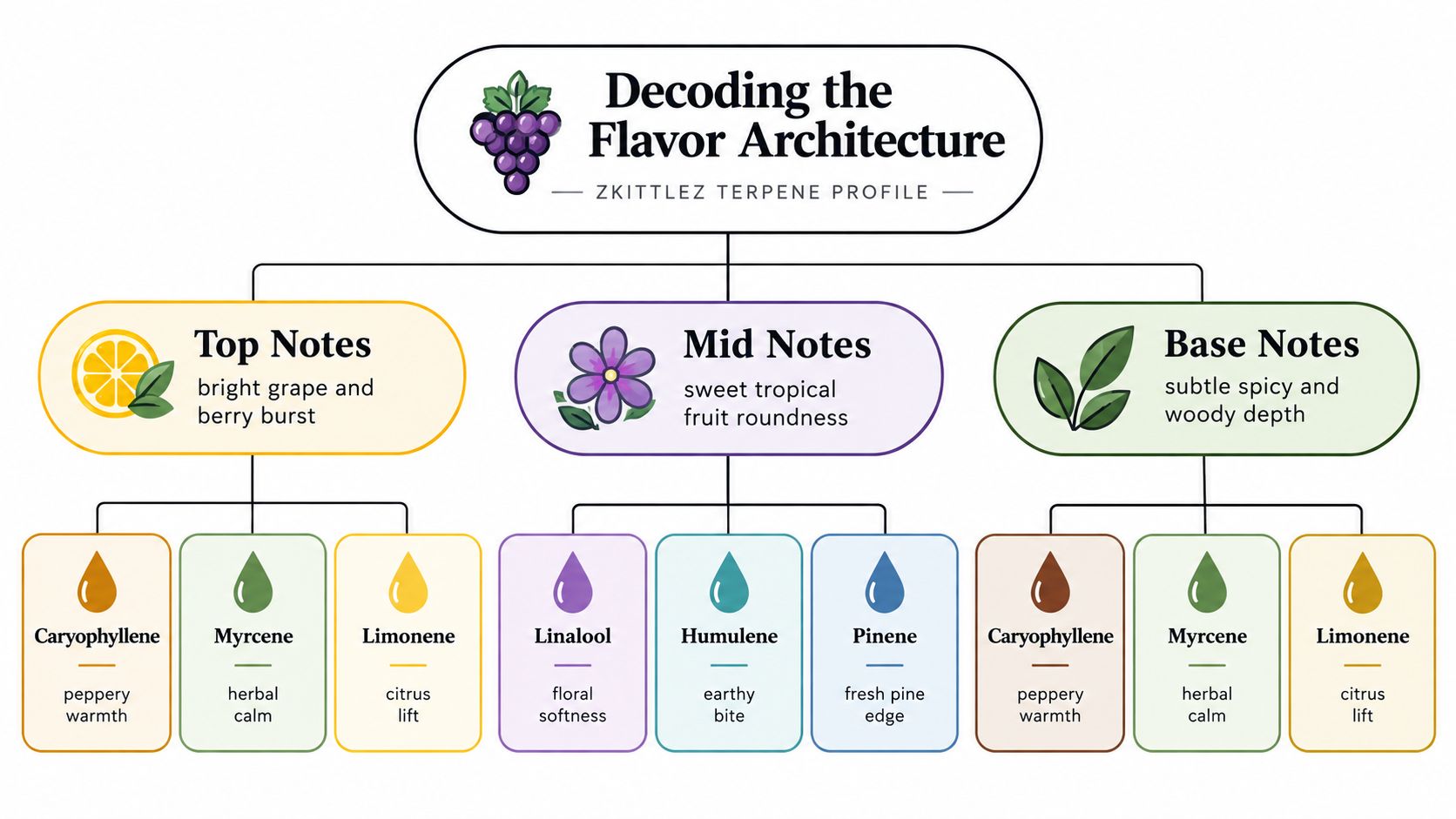
Top notes create the first impression
For a terpene profile for Zkittlez, limonene is often the most useful top-note tool because it can produce a bright citrus lift that supports grapefruit, sweet fruit, and a cleaner opening. It shouldn't be treated as the entire flavor. Too much emphasis on a sharp citrus isolate can pull the profile away from candy and toward a generic citrus formulation.
Pinene may contribute a fresh edge, but it needs careful handling in a candy-forward target. A small supporting presence can add definition. An aggressive presence can make the blend read as pine-cleaner rather than tropical fruit. The same principle applies to any volatile top note, especially after dilution into distillate.
The target isn't just “fruit.” It's a sequence:
- Opening: bright citrus and fresh fruit
- Middle: grape, berry, floral softness, and tropical roundness
- Finish: pepper, earth, wood, and faint musk
Mid notes carry the recognizable identity
Linalool can soften the transition between citrus and heavier notes with a floral nuance. Myrcene can fill out the middle and base with earthy or musky depth. In one tested Zkittlez profile, limonene led the reported terpene list, followed by myrcene and linalool. That result is useful as a reference, not as a universal recipe.
Caryophyllene is important because it stops a sweet formulation from becoming flat. Its peppery warmth acts as a structural bridge between fruit and earth. A Zkittlez-inspired blend without that supporting tension may smell pleasant in a vial but lose the cultivar's layered character in oil.
The practical method is to evaluate the blend at the intended use concentration, then compare it with the reference extract in a neutral sensory test. Test the aroma before dilution, after dilution, and after the product has rested long enough for the components to integrate. A top-heavy profile can smell impressive immediately and feel disconnected later.
Base notes protect the finish
Humulene can add a dry, woody or hop-like note, while myrcene reinforces the deeper body. These compounds should support the candy and fruit rather than bury them. The base is successful when the final impression remains sweet and distinctive, with enough earthy structure to prevent a one-dimensional confectionery note.
This Zkittlez terpene resource is useful when building a reference brief for extractors and flavor teams. The strongest brief identifies the dominant terpene, sets acceptable concentration ranges, records the cannabinoid matrix, and describes the aroma in sensory terms. It doesn't instruct a blender to copy a fixed percentage from an unrelated batch.
Botanical vs. Cannabis-Derived Consistency
Botanical isolates are usually the more controllable option when a manufacturer needs a repeatable, THC-free terpene input. Cannabis-derived terpenes can offer a closer connection to a particular extract, but their consistency depends heavily on the source material, processing history, available volume, and batch documentation.
For a vape brand, the decision affects more than aroma. Source selection can influence cannabinoid contamination risk, analytical requirements, labeling decisions, procurement, and whether the finished product behaves consistently in hardware. A formulator should evaluate the actual COA and specifications rather than assume that “cannabis-derived” automatically means more authentic.
Gold Coast Terpenes offers botanically derived, THC-free terpene blends and isolated compounds for product formulation. That approach can be useful when a brand wants to recreate a Zkittlez sensory identity while keeping the terpene input separate from the cannabinoid extract. The finished formula still requires its own compliance review and testing.
Source comparison for product developers
| Feature | Botanical Isolates | Cannabis-Derived |
|---|---|---|
| Primary use | Rebuilding a defined aroma and flavor target with selected compounds | Preserving the terpene fraction associated with a cannabis extract |
| Consistency | Can be standardized around documented compounds and blend specifications | Can vary with cultivar, cultivation, extraction, and source lot |
| Cannabinoid contribution | The terpene input can be THC-free when supported by testing | May introduce cannabinoids or other extract components depending on processing |
| Formulation control | Allows targeted adjustment of limonene, myrcene, caryophyllene, linalool, or humulene | Offers less control when the source arrives as a complex, variable fraction |
| Best fit | Strain-inspired blends, flavor matching, and repeatable SKU production | Products where the source extract itself is central to the product claim |
| Documentation | Review identity, purity, residual solvents, allergens, and batch testing | Review the same items plus cannabinoid and source-extract controls |
What consistency actually requires
Botanical sourcing doesn't remove the need for quality control. It gives the formulator a cleaner starting point for controlling the recipe. Each isolate should have identity and purity documentation, while the finished blend should be checked for the intended composition and compatibility with the carrier matrix.
Cannabis-derived material can work when the manufacturer has a stable supply chain and a strong lot-matching program. It becomes difficult when the brand expects the same Zkittlez profile from extracts produced under different conditions. A recognizable name won't correct variation in curing, extraction, storage, or terpene loss.
This CDT versus BDT comparison gives product teams a useful way to frame the decision. The correct choice depends on the claim, the analytical target, the regulatory market, and the level of sensory repeatability the SKU requires.
For labeling, don't imply that a botanical blend is cannabis-derived. Don't claim that a terpene blend reproduces a pharmacological effect associated with an indica label. Describe the product accurately as a strain-inspired flavor profile, list required ingredients, retain supplier documentation, and send the finished product for the testing required in the market where it will be sold.
Formulating for Vape Cartridges
A Zkittlez blend for vape cartridges should be built from a tested reference lot, introduced gradually into compatible distillate, and evaluated in the actual hardware. The right concentration is the one that preserves flavor, viscosity, solubility, and device performance. A strain label cannot determine that concentration on its own.

Start with a reference and a controlled bench batch
Record the source extract, its COA, the intended cannabinoid matrix, and the sensory description you're trying to reproduce. If the reference smells strongly of citrus and grape, but the first trial smells mainly earthy, the problem may be a mismatch in terpene ranking rather than an incorrect indica or sativa classification.
Use a small, accurately weighed bench batch. Add the terpene blend in measured increments rather than relying on drops, since drop size changes with viscosity, temperature, and pipette technique. Mix gently and allow the components to distribute before judging the aroma.
Gold Coast Terpenes provides a Terpenes 101 resource and Mixing Calculator that can help teams convert a target addition into a repeatable batch calculation. Treat the calculator as a math aid, not a replacement for compatibility testing, COA review, or finished-product analysis.
Check function before approving flavor
A blend can smell correct and still fail in a cartridge. Assess the following before moving to a production run:
- Viscosity: Confirm that the oil remains suitable for the selected hardware and filling process. Excessive dilution can change flow behavior and may create leakage or inconsistent dosing.
- Solubility: Look for haze, separation, sediment, or phase changes after mixing and resting. These signs indicate that the formulation needs investigation before filling.
- Wicking: Test the blend in the intended cartridge rather than in a glass vial alone. Oil movement through the hardware can change the perceived intensity and draw consistency.
- Thermal behavior: Evaluate the finished oil under the device's normal operating conditions. Bright notes can shift during heating, and a blend that smells balanced cold may present more sharply or more heavily when vaporized.
- Stability: Store retained samples under the conditions used for the product, then compare aroma, appearance, and performance over the defined review period.
This guide to terpenes for vape cartridges is relevant for teams balancing sensory accuracy with device behavior. Keep the formulation record tied to the lot number, blend version, mixing conditions, and hardware version. That record makes troubleshooting possible when a production batch tastes different from the development sample.
Don't formulate around the indica label
The most common mistake is adding a generic “indica” terpene blend to distillate and calling the result Zkittlez. That may create a pleasant product, but it won't necessarily reproduce the fruit, grape, citrus, spice, and earthy relationship that defines the reference.
A better workflow sets a sensory target first, selects compounds that support each note, and then verifies the result analytically and in hardware. The formulation should earn the Zkittlez name through its documented sensory and chemical resemblance, not through a copied category label.
Replicating Award-Winning Profiles
Zkittlez's commercial identity is rooted in layered candy, grape, tropical fruit, and citrus notes, not in a fixed THC or indica percentage. The cultivar received first place at the 2015 Cannabis Cup in San Francisco for Best US Hybrid Concentrate, an award that recognizes a particular product and sensory presentation rather than establishing a universal formula. CannaConnection's Zkittlez profile documents that award context without turning it into a potency or terpene specification.
The formulation lesson is straightforward. If the target is an award-associated profile, build the sensory sequence that makes the product recognizable:
- Candy and sweet fruit: Establish the main commercial cue without allowing sweetness to become generic.
- Grape and berry depth: Support the darker fruit character associated with the cultivar's lineage.
- Citrus lift: Use limonene-led brightness to keep the opening vivid and prevent the blend from feeling heavy.
- Floral softness: Use linalool as a bridge when the fruit needs a smoother, more rounded middle.
- Pepper, earth, and wood: Let caryophyllene, myrcene, and humulene give the finish structure.
Gold Coast Terpenes' Elevated Strains approach selectively emphasizes nuanced fruit and dessert notes, while its strain-specific profiles and isolates give a formulator different levels of control. A premade profile can accelerate development. Individual compounds make more sense when the reference lot has an unusual dominant terpene or when the brand needs to correct a specific sensory gap.
The trade-off is speed versus precision. A premade blend reduces bench work, but it may not match a highly variable extract. An isolate-led formulation provides greater control, but it demands stronger sensory testing, documentation, and blending discipline.
Test the blend after dilution and thermal exposure. A limonene-led opening may appear bright in a vial but lose separation in oil, while heavier caryophyllene, myrcene, and humulene notes can become more prominent after heating. Approve the profile only when the finished cartridge, not just the concentrate, matches the reference target.
FAQs on Terpene Formulation
Is Zkittlez indica or sativa for product development?
Zkittlez is best treated as an indica-dominant hybrid, commonly described near a 70:30 indica-to-sativa ratio, although other listings report different splits. For formulation, the ratio is less useful than the batch COA and its measured cannabinoid and terpene profile.
What should a Zkittlez terpene blend taste like?
A credible target usually combines candy sweetness, grape or berry, tropical fruit, citrus brightness, and a restrained earthy or peppery finish. Gold Coast Terpenes offers strain-specific blends and isolated compounds that can support either a faster premade approach or a more controlled isolate-led formulation.
Should formulators use botanical or cannabis-derived terpenes?
Botanical terpenes can provide a THC-free, controllable input when the supplier provides appropriate identity and purity documentation. Cannabis-derived terpenes may suit a product built around a specific extract, but the manufacturer must manage source variation, cannabinoid contamination risk, and lot consistency.
How should a team match a new Zkittlez batch?
Start with the new lot's COA, then compare dominant terpenes, total terpene concentration, cannabinoid matrix, and aroma against the approved reference. Adjust the blend to correct the sensory difference, and confirm the result in the final cartridge rather than approving it from a vial evaluation alone.
Can the blend be adjusted for stronger flavor?
Flavor intensity can be changed through controlled additions, but increasing terpene input can also affect viscosity, solubility, wicking, and thermal presentation. Gold Coast Terpenes' Mixing Calculator can support the arithmetic, while bench testing and finished-product analysis determine whether the change remains functional and compliant.
The consistent pattern across development work is that the label creates the starting hypothesis, while the chemistry and sensory test create the product. A manufacturer that documents the lot, builds around measured compounds, and validates the finished hardware has a more defensible path to repeatable Zkittlez flavor than one that formulates from an indica percentage.
Gold Coast Terpenes offers botanically derived, THC-free strain profiles, isolated compounds, formulation education, and tools for teams developing Zkittlez-inspired oils and cartridges. Review the available options and build your next documented flavor target with Gold Coast Terpenes.