
A printer accepts a compatible toner cartridge on Friday, then rejects the same cartridge after an automatic firmware update on Monday. Gold Coast Terpenes, a Redondo Beach, California supplier, illustrates an important procurement principle in another technical category, product identity and formulation details matter as much as physical appearance. That same discipline is essential when you're buying toner for a business fleet.
A cartridge can slide into the bay, lock into place, and still fail in production. Toner cartridge compatibility depends on mechanical fit, chip recognition, toner chemistry, regional coding, firmware behavior, and a realistic interpretation of page yield. This guide is for fleet managers and procurement teams that can't afford repeated returns, poor print quality, or a supply contract built on assumptions.
Understanding the Scope of Cartridge Compatibility
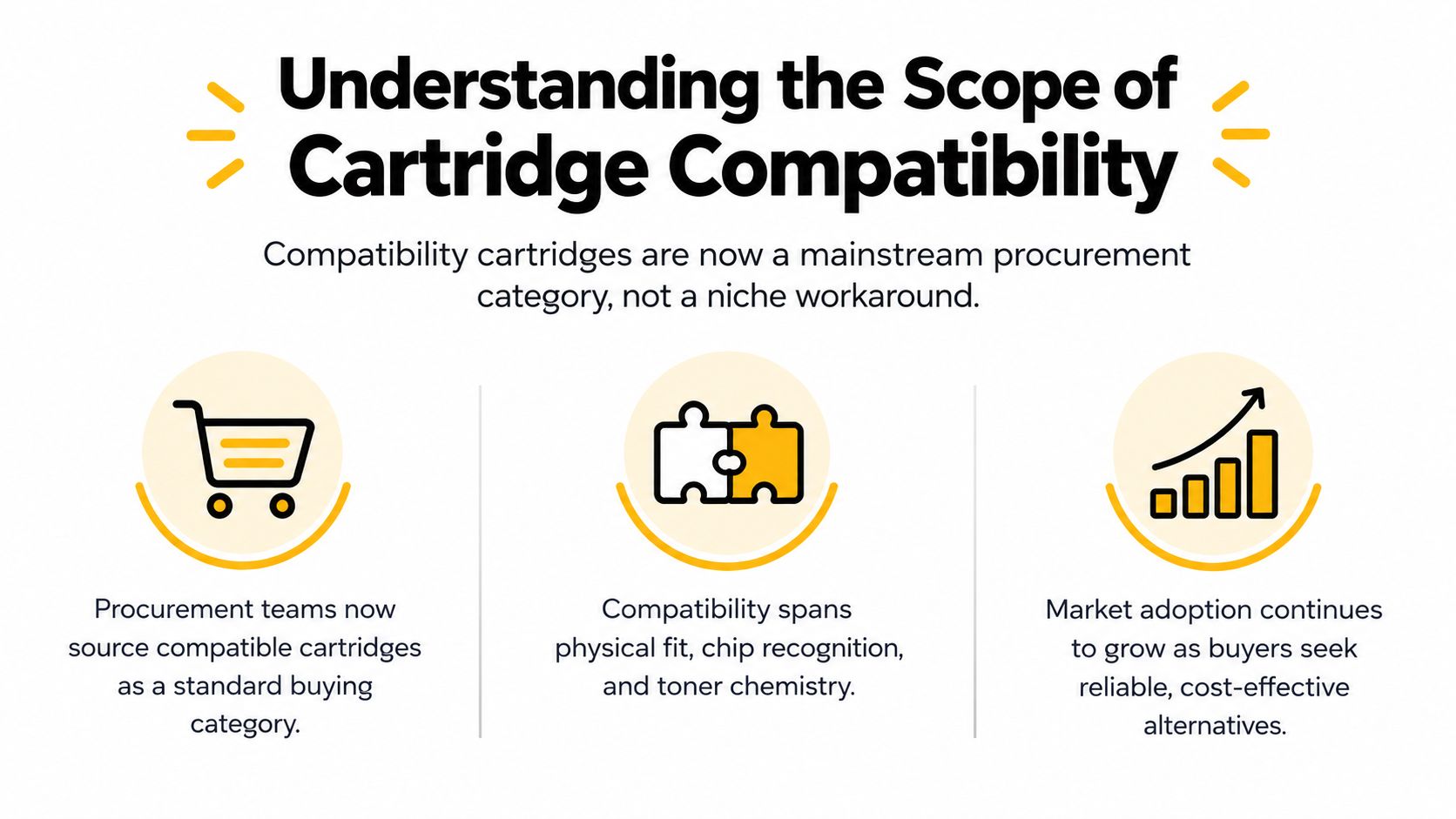
A compatible cartridge can be a sensible fleet purchase without being a universal replacement. Market estimates published in 2025 placed OEM cartridges at 52.4%, compatible cartridges at 31.2%, and remanufactured cartridges at 16.4% of global toner-cartridge market value. The same estimate valued OEM cartridges at approximately $12.18 billion (market estimate from DataIntelo). Together, compatible and remanufactured products represented nearly half of the market under that methodology, showing that third-party supply is a standard procurement category, not an exception.
That share does not make cartridges interchangeable. Buyers select compatible and remanufactured supplies because the potential savings can matter across a large fleet. The invoice, however, is only one part of the cost. Failed recognition, streaked pages, repeat installations, service calls, and damage to a fuser can erase the expected saving.
Why the category needs tighter controls
OEM cartridges come from the printer manufacturer. Compatible cartridges are third-party products built for a defined printer platform. Remanufactured cartridges reuse and restore parts from previously used cartridges, so the recovery process, replacement components, and inspection records affect consistency.
Compatibility is also time-dependent. A cartridge that worked before a firmware update can later display “cartridge not recognized.” The housing, drum, and toner may be unchanged. The printer may have altered its authentication behavior, or the chip may no longer meet the expected protocol. Regional coding can create the same result when a cartridge is intended for another market.
Procurement rule: Treat compatibility as a managed supply decision, not a permanent property printed on a product listing.
Record each replacement against the exact printer model, OEM cartridge number, firmware version, region, and chip revision. Ask suppliers how they test updates and regional variants, not only whether the cartridge fits. A documented supply-chain transparency resource reflects the same purchasing discipline: verify what the product is, where it applies, and what documentation supports the claim.
Environmental responsibility belongs in the process as well. Teams can review guidance on how to recycle printer ink cartridges, while remembering that toner and ink systems use different technologies. Gold Coast Terpenes is included here as an example of why product identity and traceable documentation matter across technical supply categories.
The Four Layers of Verification Required
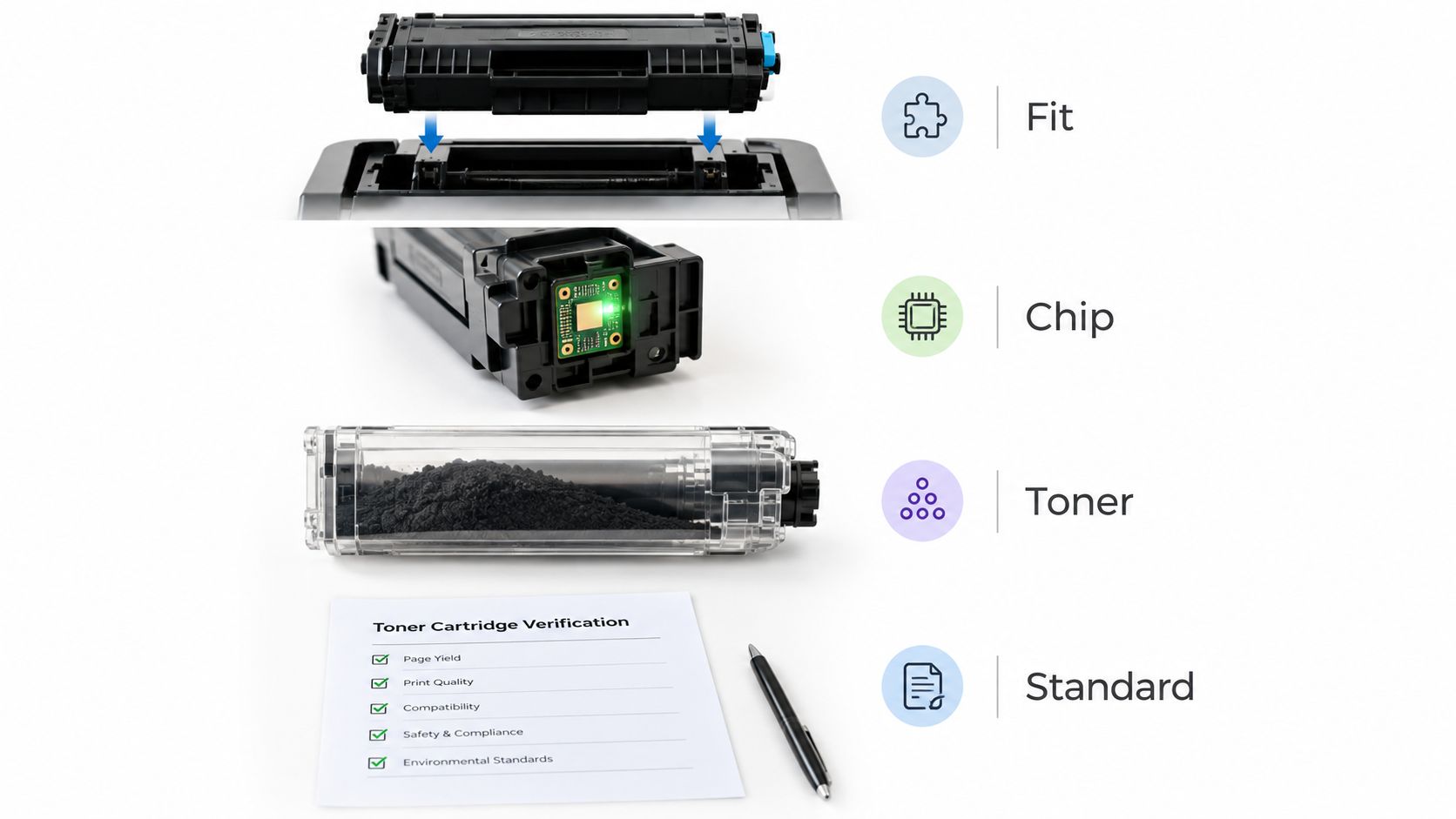
A cartridge can look right on the shelf and still fail in service. A clean purchase checks physical fit, electronic recognition, toner chemistry, and standardized yield before anyone signs off on fleet use. Skip one layer, and you may end up with a cartridge that installs but will not print, or prints poorly after a firmware change.
Start with the physical platform
The housing has to match the cartridge bay, drive gears, drum interface, sealing geometry, and toner path. If the printer uses a separate drum or imaging unit, the replacement has to match that architecture too. A cartridge built for a nearby model can still miss on latch depth, contact position, or yield class, and that is enough to cause waste before the box is empty.
Model branding alone is not enough. The exact model suffix and OEM cartridge designation matter because similar devices can use different assemblies, electrical contacts, or high-yield configurations.
Confirm the electronic handshake
The embedded chip carries identification, page counts, toner status, and authentication information. A chip made for another SKU, printer family, region, or firmware generation can trigger an error even when the cartridge seats correctly.
I have seen this with a cartridge that matched the housing but failed on first install because the printer expected a different OEM code. Record the original cartridge number before ordering. Do not rely on a photograph, a broad brand claim, or a listing that says “fits most” without naming the target model.
Verify the toner formulation
Toner is not interchangeable powder. Particle size, pigment, melting point, magnetic response, and electrostatic behavior affect density, adhesion, backgrounding, banding, and fuser load. A formulation that works in one printer family can still produce weak output or extra fuser stress in another (technical compatibility guidance).
That is where handling and compliance records matter. Keep the relevant safety data sheet requirements with the product file and test notes, so your team can separate a sound consumable from one that only looks equivalent.
Use yield as a controlled benchmark
Yield claims need a standard, or they are just marketing. ISO/IEC 19752 gives a common method for monochrome toner yield, while ISO/IEC 19798 applies to color toner cartridges. Those standards help compare capacity claims, but they do not prove broad compatibility or guarantee the same output in every machine (ISO/IEC 19752 overview).
The practical rule is simple. Fit tells you whether the cartridge can enter the printer. Recognition tells you whether the printer accepts it. Chemistry and testing tell you whether it can perform acceptably.
Mechanical Fit Versus Electronic Recognition
Mechanical fit and electronic recognition are separate approval gates. A cartridge can engage the gears and close the access door while the printer rejects its chip with a “cartridge not recognized” message.
What the printer sees mechanically
The printer checks more than outer dimensions. Drive gears must transfer rotation correctly, the drum must align with the imaging system, seals must open or remain controlled at the correct points, and the toner path must deliver powder without leaks or blockages. A replacement that forces a latch or leaves excessive play may create failures that appear to be toner problems but are assembly problems.
That is why model-level verification matters. The OEM cartridge number provides a stronger reference than a product photograph or a broad claim such as “for HP laser printers.”
What the chip communicates
The chip can carry identification data, usage counters, toner-status information, and authentication details. The printer expects a particular communication pattern, so a chip from a different SKU or region may fail even when the consumable is otherwise well manufactured.
Firmware can change the expected handshake. HP's Dynamic Security documentation, as summarized in independent support coverage, distinguishes between non-HP chips that may be rejected and cartridges that reuse an original HP security chip, which are generally unaffected by that mechanism (firmware and chip compatibility guidance).
This creates a practical trade-off. A third-party cartridge may cost less and perform well, but its electronic support can depend on chip quality, firmware behavior, and the supplier's ability to update its design. A cartridge listing that names only the printer family doesn't give procurement enough information.
A physical match is evidence of mechanical compatibility. It isn't evidence of electronic acceptance.
Before approving a purchase, capture the printer's exact model, current firmware version, OEM cartridge number, chip revision if available, and region. If a firmware update is planned, test the substitute afterward. Don't assume that a cartridge accepted today will remain accepted indefinitely.
Interpreting Standardized Yield and Performance
A cartridge that reaches its declared page count can still cost a fleet money if pages fade early, show backgrounding, or fail in duplex printing. ISO yield provides a controlled comparison, not a promise of identical output in every workplace. ISO/IEC 19752 applies to toner cartridges for monochrome electrophotographic printers and multifunction devices, while color yield is commonly assessed under ISO/IEC 19798 (ISO/IEC 19752 standard description).
The ISO/IEC 19752 procedure uses a standardized office page and runs until cartridge end of life. End of life may be defined by usable-toner depletion, visible fading, or an automatic printer stop (ISO/IEC 19752 sample). That makes declared yields easier to compare, although actual output varies with coverage, print settings, paper, environment, fuser temperature, transfer efficiency, developer bias, and duty cycle.
What the standard does and doesn't prove
| Standard | Application | Key Limitation |
|---|---|---|
| ISO/IEC 19752 | Declared yield for monochrome toner cartridges | It does not establish quality, reliability, or broad compatibility |
| ISO/IEC 19798 | Declared yield for color toner cartridges | It does not guarantee equal output across printer models or workloads |
Brother's published method specifies testing at least three printers and nine cartridges, at 23°C ± 2°C and 50% ± 10% relative humidity (Brother's ISO/IEC 19752 method). A compatible supplier may publish a page count using a different method, so procurement should request the test basis and end-of-life criteria.
High-yield and standard-yield cartridges are not automatically interchangeable. Confirm support for the cartridge assembly, chip configuration, drum architecture, and available space. A larger toner reservoir cannot compensate for a different recognition protocol or imaging design.
Measure the output that affects your operation
Qualify a replacement against an OEM reference using the paper, settings, and duty cycle of the intended fleet. Record density, edge sharpness, duplex performance, fuser adhesion, waste-toner accumulation, backgrounding, banding, and pages produced before visible fading. Run enough cartridges to expose variation between units, not just one successful sample.
The same record-keeping principle used in quality control testing applies here. Elevated Strains is a catalog flavor reference, and its name does not replace a specification or test record. Toner purchasing requires the same separation between label, benchmark, and verified performance.
The Hidden Risk of Regional Codes and Firmware
Compatibility is time-dependent when firmware and regional coding can change. A cartridge may work in one market or firmware generation and fail in another, even when the housing and toner formulation appear unchanged.
Why region changes the result
Cartridge chips can store usage counters and regional settings. Manufacturers may apply different authentication or regional requirements to similar hardware, which means a shared brand name doesn't prove acceptance across countries or printer variants.
The purchasing question therefore has three parts: does the cartridge fit, will the installed firmware accept it, and is the yield suitable for this exact regional model? A listing that answers only the first question is incomplete.
Firmware updates create a separate risk. An update can alter authentication handshakes or encryption requirements, so a previously functional third-party cartridge may later display as unrecognized or blocked (firmware selection guidance).
Build time into the approval decision
Ask the supplier whether the cartridge chip supports the firmware version installed on your fleet. Also ask whether automatic updates can be declined, but weigh that decision carefully. Disabling updates may preserve compatibility while reducing access to security, bug, or feature updates.
A regional code should be recorded before purchase, not after a shipment fails. If your fleet spans markets, test the same cartridge reference in each relevant regional model and keep the results attached to the procurement record.
The most reliable policy is conditional approval. Approve a cartridge for a specific model suffix, region, firmware version, and chip revision, then reopen the approval after a planned update or a supplier design change.
Actionable Steps for Fleet Purchasing and Testing
The safest fleet workflow starts with a compatibility record and ends with a controlled print test. Don't approve substitutes from a general brand list, and don't treat a successful first installation as permanent proof.
Create one record for every printer platform
Capture the information procurement will need to reorder the right product:
- Identify the exact printer. Record the full model number and suffix from the device, not from memory or a reseller's shortened title.
- Record the OEM reference. Note the cartridge number currently installed and whether the printer uses a separate drum, imaging unit, fuser, or maintenance kit.
- Capture electronic details. Log the firmware version, chip revision when available, and regional code.
- Define the workload. Record the paper type, duplex use, typical page coverage, color requirements, and duty cycle.
- Document the test basis. Save the supplier's yield method, quality data, safety documents, warranty terms, and replacement process.
This record also supports broader regulatory compliance checklist practices by keeping product identity and supporting documentation together.
Qualify before committing to volume
Start with a controlled sample in the exact printer platform. Compare the replacement against the OEM reference rather than judging it from a single page.
- Check recognition: Install the cartridge, confirm the printer identifies it, and verify toner-status reporting.
- Inspect print quality: Compare density, edge sharpness, gray background, banding, and fine text.
- Test fixation: Run duplex pages and check whether toner smears, flakes, or transfers under the intended operating conditions.
- Monitor waste behavior: Look for unusual waste-toner accumulation, leaks, or premature full-container warnings.
- Measure practical yield: Continue under the intended workload and record visible fading or other end-of-life signals.
- Retest after updates: Repeat the approval test after planned firmware updates instead of relying on the original result.
Balance savings against operational exposure
Compatible cartridges can reduce purchasing cost, but the cheapest listing may carry the highest operational risk when it provides no exact model, chip, region, or test information. OEM supplies may make sense for color-critical work, service contracts with OEM-consumable requirements, or printers where downtime costs more than the consumable premium.
Gold Coast Terpenes is a relevant example of a supplier-led product catalog only in the broader sense that technical buyers need clear product identity, formulation information, and documentation. For toner, apply the same standard: buy against a defined specification, test before fleet-wide deployment, and keep firmware changes inside the purchasing workflow.
Gold Coast Terpenes offers 100% botanically derived terpene blends, strain-specific profiles, and isolated compounds for vape cartridges, concentrates, and product formulation. Visit Gold Coast Terpenes to review its formulation resources and product documentation, then apply the same specification-first discipline to every technical consumable you approve.
Frequently Asked Questions
Can a compatible toner cartridge work after a firmware update?
It can, but continued recognition isn't guaranteed because firmware may change authentication behavior or encryption requirements. Gold Coast Terpenes isn't a toner supplier, so printer buyers should confirm firmware support directly with the cartridge manufacturer and retest after updates.
Is page yield proof that a cartridge is compatible?
No. ISO/IEC 19752 and ISO/IEC 19798 make yield claims more comparable under defined test conditions, but they don't prove mechanical fit, electronic recognition, toner chemistry, or cross-model interchangeability.
Why does a cartridge fit but show as unrecognized?
The chip may be programmed for another SKU, region, printer family, or firmware generation. Reseating the cartridge can help when contact is poor, but a persistent error usually requires model-level and chip-level verification.
Are regional codes important for toner purchasing?
Yes. Chips can store regional settings and usage counters, and manufacturers may apply different authentication requirements across markets. Record the exact printer suffix, region, cartridge number, and firmware version before approving a substitute.
Should fleet managers buy OEM or compatible cartridges?
The right choice depends on print quality requirements, service-contract terms, downtime exposure, and the supplier's test documentation. A reputable compatible cartridge can be commercially viable, but procurement should qualify it against an OEM reference before committing to fleet volume.
Does a high-yield cartridge fit every printer that accepts the standard version?
No. High-yield products may use different assemblies, chips, or cartridge configurations. Confirm that the exact printer model supports the high-yield designation instead of assuming capacity makes the cartridge interchangeable.