
You've probably seen this happen already. A pilot cartridge tastes sharp and clean in R&D, the first production run is close enough, and the next bulk lot drifts just far enough that the finished SKU no longer feels like the same product. The hardware is unchanged. The oil is in spec. The complaint lands on flavor, smoothness, or “overall profile.”
That's usually where wholesale terpenes stop being a simple ingredient purchase and start becoming a formulation and compliance problem.
For a new R&D team member, that shift matters. Buying terpenes isn't just about finding a strain-inspired terpene blend with the right aroma. It's about sourcing material you can scale, documenting it correctly for inhalable use, and reproducing the same sensory result across repeat batches without chasing your tail in production.
Why Mastering Wholesale Terpenes Is Critical for Brands
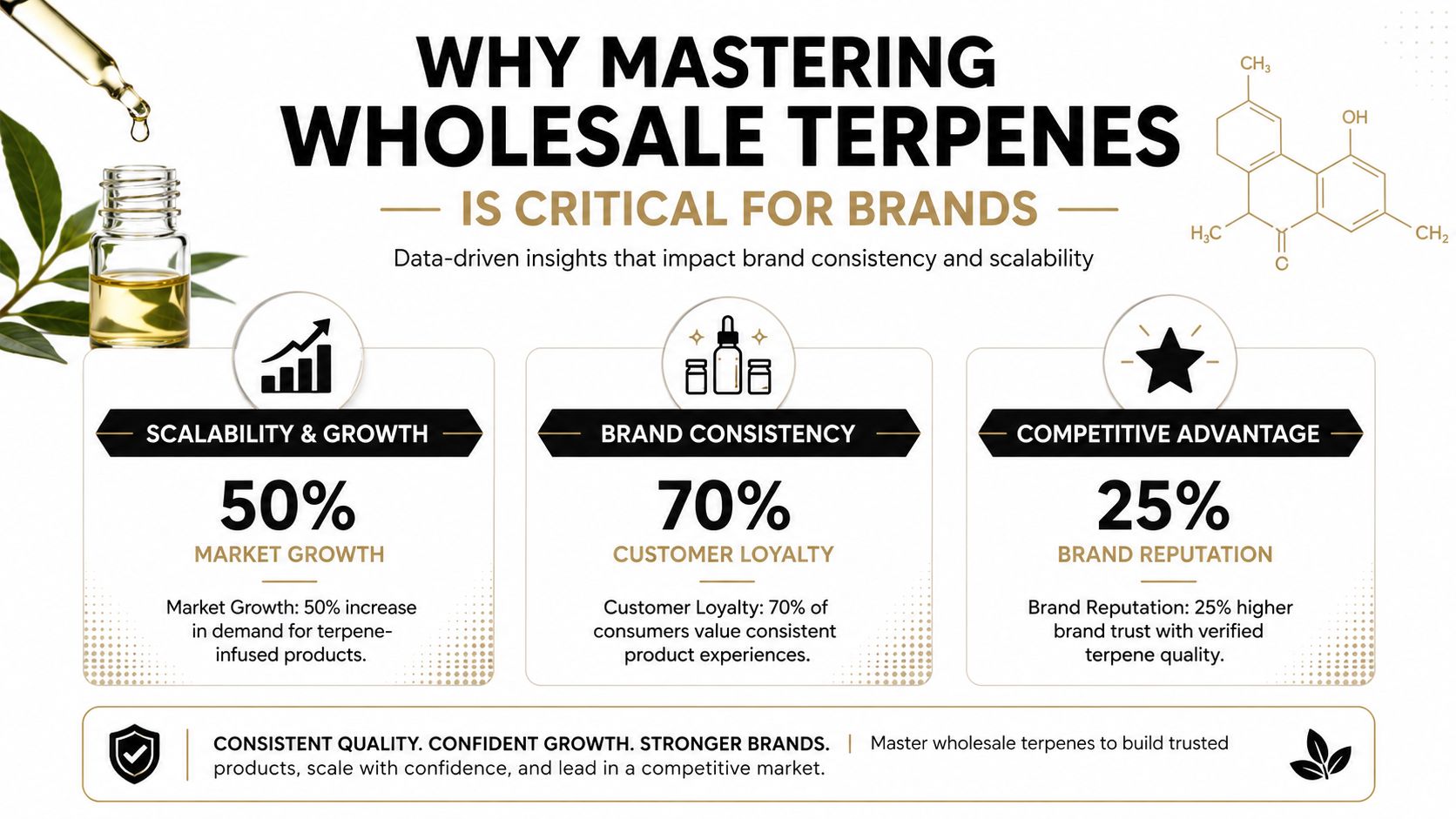
The fastest way to lose confidence in a product line is to build it on a profile you can't reliably reproduce. Brands don't get judged on how good a sample smelled in a beaker. They get judged on whether the cartridge, concentrate, or infused SKU bought today matches the one bought last month.
That's why wholesale terpenes sit closer to core process control than many teams realize. In commercial formulation, terpenes affect flavor accuracy, perceived smoothness, hardware compatibility, and how consistently a product expresses its intended profile. If the terpene input changes, the finished product changes with it.
Terpenes are a scaling issue, not just a flavor issue
A lot of early teams treat terpenes like a finishing touch. That works right up until they try to lock a winning profile into repeat manufacturing. Then the real questions show up.
- Can the supplier reproduce the same profile later
- Can the profile hold up in your actual hardware
- Can your compliance team defend the input for inhalable use
- Can purchasing reorder the same material without starting over
Those are business questions as much as lab questions.
The market direction makes that even harder to ignore. The global terpenes market was valued at approximately USD 1.1975 billion in 2024 and is projected to reach USD 2.43914 billion by 2032, reflecting a CAGR of 9.3%, driven by rising demand for natural aromatic ingredients in vaping, concentrates, and functional beverages according to Credence Research's terpenes market report. More demand means more suppliers, more profile options, and more variability in what defines “premium”.
Consistency becomes part of brand equity
Teams usually notice terpene quality only when it breaks something. A cart becomes harsher. A profile leans too citrus-forward. A reorder no longer lands in the same sensory window. Once that starts happening, the cost is larger than a failed batch. Sales has to explain inconsistency. Operations has to isolate whether the issue came from the oil, hardware, or profile. QA has to decide whether “close enough” is acceptable.
Practical rule: If your terpene supplier can't support repeatability, they aren't supporting your brand.
That's why serious buyers start with sourcing discipline. A bulk terpenes program built for production purchasing matters because scale changes what “good” means. At retail quantities, aroma sells. At manufacturing quantities, documented repeatability wins.
Choosing Your Formulation Building Blocks
When you open a wholesale terpene catalog, it helps to think like a painter looking at a palette. Some materials are single colors. Some are premixed combinations. Some are attempts to recreate a finished work with all the nuance intact. Each format can be right. Each creates different trade-offs in cost, control, and speed.
Three common formats in wholesale terpenes
Terpene isolates are your primary colors. Limonene, myrcene, and beta-caryophyllene let a formulator control structure at the compound level. If you're building a custom profile for cannabis product formulation, isolates give you precision, but they also put more burden on your team to balance volatility, note stacking, and production repeatability.
Terpene blends are more like premixed colors. They're useful when the goal is a broad direction, such as citrus-forward, kush-leaning, or fruit-heavy for distillate enhancement. They speed up development and usually reduce bench time, but they also reduce your ability to fine-tune specific note behavior.
Strain-specific profiles are the closest thing to replicating a finished reference. These are built for teams focused on replicating flavor of a known cultivar style or creating a strain-inspired terpene blend for vape cartridges. Done well, they save a lot of iteration. Done poorly, they become generic fragrance with a familiar name attached.
Comparison of Wholesale Terpene Formats
| Format Type | Best For | Pros | Cons |
|---|---|---|---|
| Terpene Isolates | Custom formulation work, correcting existing blends, targeted note control | Maximum creative control, useful for adjusting top/mid/base structure, strong for R&D | More formulation complexity, easier to overcorrect, greater need for internal sensory discipline |
| Terpene Blends | Fast product development, house profiles, broad sensory direction | Easier to use, less bench work, faster scale-up | Less granular control, harder to troubleshoot drift inside a proprietary mix |
| Strain-Specific Profiles | Strain-inspired terpene blend work, replicating flavor of known references, branded SKUs | Faster path to recognizable flavor targets, simpler for production teams | Quality varies widely by supplier, some profiles are shallow or overly top-note heavy |
Match the format to the job
If the brief is “build a flagship profile nobody else has,” isolates and custom blending make sense. If the brief is “launch quickly and stay close to a known market reference,” a ready-made profile is usually more practical. Teams waste time when they choose the format that sounds impressive instead of the one that fits the product brief.
A good shortcut is to decide where you need flexibility.
- Need absolute control: Start with isolates and a small internal library.
- Need speed: Start with a blend.
- Need recognizable flavor accuracy: Start with a strain-inspired profile and tune from there if needed.
Don't buy complexity you can't manage. A flexible format only helps if your team has the process discipline to use it.
For teams comparing profile depth and sourcing style, a catalog of full-spectrum terpene profiles for formulation work is often the clearest way to see whether a supplier is offering true formulation components or just naming conventions.
Navigating Terpene Lab Reports and Compliance
A lot of buyers say they check the COA. Far fewer know what they're checking for. In inhalable formulation, that gap is where bad decisions happen. A pretty chromatogram doesn't tell you whether the material is appropriate for your application, and “food-grade” doesn't answer the harder inhalation questions.
Start with the paperwork that actually matters
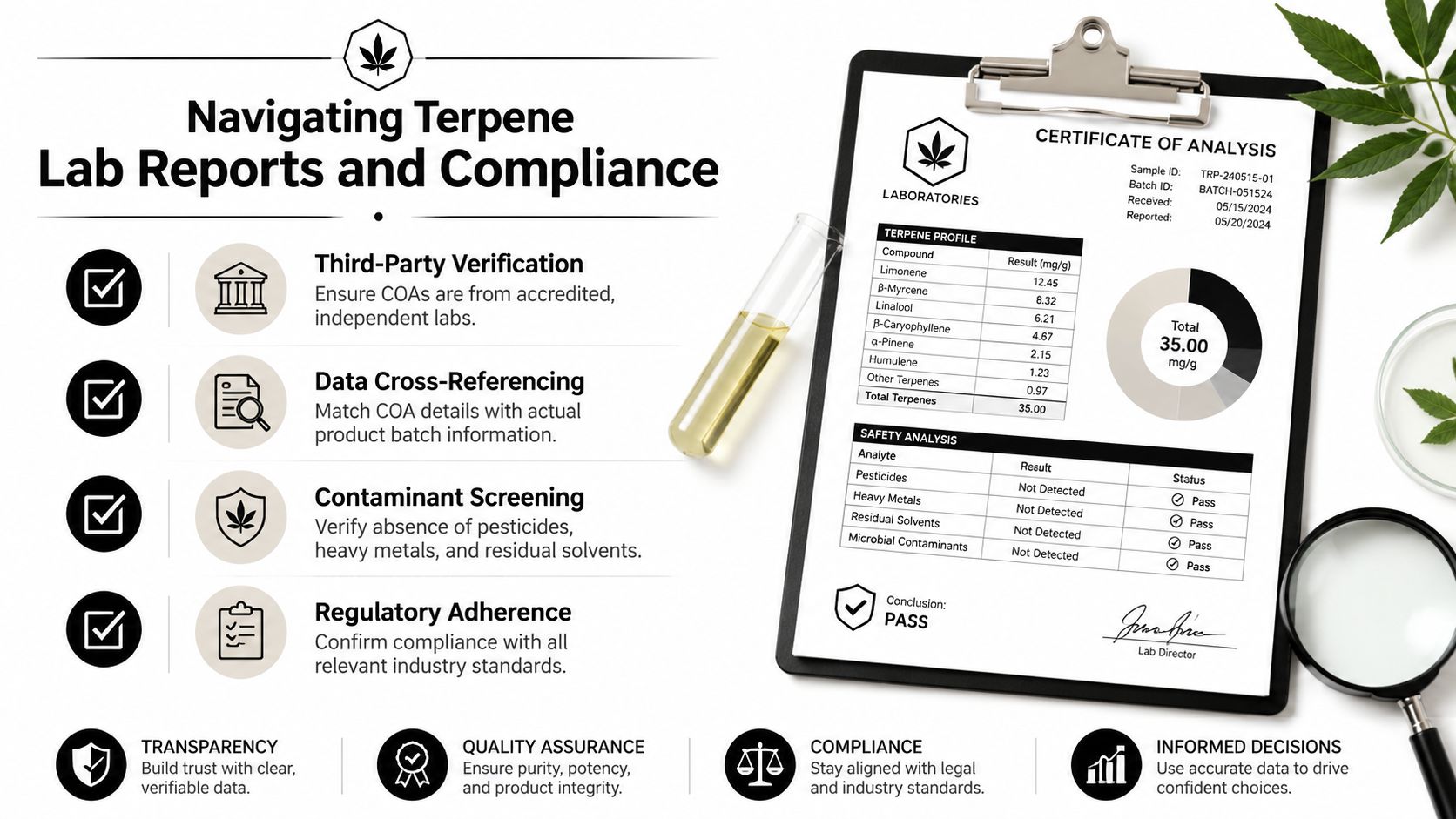
For sourcing wholesale terpenes for vape cartridges or other inhalable products, I expect two documents before I care about aroma notes. The first is a batch-specific Certificate of Analysis. The second is an SDS that aligns with handling, storage, and transport reality for concentrated aromatic inputs.
The COA needs to tie directly to the lot you're buying. If the batch number on the bottle, quote, and COA don't line up, you don't have a reliable chain of documentation. You have marketing support material.
What to verify on the COA
For inhalable products, the first compliance screen is residual solvent status. The clearest benchmark in the source material is this: for inhalable products, the industry safety benchmark for residual solvents in hydrocarbon-extracted isolates is less than 5 ppm, and reputable suppliers should validate that through ISO/IEC 17025 accredited labs while explicitly listing solvents such as ethanol, butane, and hexane on the COA as detailed in this residual solvent testing guidance.
That statement matters because buyers often accept vague purity language instead of solvent-specific clearance.
Check these items line by line:
- Batch identity: The lot number on the COA should match the inventory lot you're receiving.
- Lab accreditation: If the lab isn't ISO/IEC 17025 accredited, you're taking more on faith than you should for an inhalable input.
- Residual solvents: Look for explicit listing and clearance, not broad wording like “passes impurities.”
- Method transparency: GC-based methods with confirmation details are more useful than a generic “tested” note.
- Profile composition: The terpene breakdown should look plausible for the material type. If it's a complex profile, a suspiciously short panel can be a warning sign.
Food-grade is not the same as inhalation-ready
New teams often run into compliance issues. A material can be acceptable in a food or topical context and still create a compliance problem in an inhalable product workflow. The regulatory question isn't just “is it natural?” It's “is this documented and appropriate for this use case in the jurisdictions where we operate?”
A useful warning comes from Cannabis Science and Technology's discussion of added terpenes in regulated cannabis, which notes that it is difficult finding an ingredient approved to be used for an inhalation product. That's the blind spot many buyer guides skip.
If a supplier leans on GRAS-style language without addressing inhalation use, state-specific restrictions, or how they support inhalable claims, keep asking questions.
A short compliance screen for purchasing and QA
Use this before approving a terpene lot for formulation:
Confirm intended use
Ask the supplier to state whether they support the material for inhalable product formulation, not just general flavor use.Match documents to lot
COA, SDS, and purchase documentation should all point to the same batch.Review solvent clearance
Look for named solvents and explicit pass criteria rather than broad purity claims.Escalate ambiguous language
If the paperwork says “food-safe,” “natural,” or “clean” but doesn't address inhalation, don't fill in the blanks yourself.Archive everything
Keep lot-specific files internally. If a regulator, manufacturing partner, or customer asks later, you need traceability.
For teams that want a real-world example of what transparent testing documentation should look like, a chromatography testing resource for terpene verification is the kind of reference worth comparing against supplier paperwork.
Formulating with Terpenes for Distillate and Concentrates
Good formulation work starts before the first drop hits the oil. If terpenes have been stored poorly, left open too long, or mixed carelessly into warm distillate, the final result won't tell you much about the profile itself. It will mostly tell you the process was loose.

Handle the material like a volatile input
Terpenes are easy to damage with sloppy bench habits. Keep containers sealed whenever possible. Minimize headspace exposure during transfers. Use clean glass beakers, calibrated scales, and a magnetic stirrer or similarly controlled mixing setup so you're not guessing whether the batch is homogeneous.
For strain-inspired terpene blend work, I also keep sensory notes during every bench mix. A profile that smells balanced in the bottle can behave differently once it's diluted into distillate or concentrate.
Understand note structure before you mix
If you want a terpene profile for vape cartridges to feel complete, don't think only in terms of strongest aroma. Think in layers.
- Top notes usually create the first impression. Citrus, bright fruit, and sharper volatile compounds often live here.
- Mid notes give body and identity. Floral, herbal, and rounded profile character usually shows up in this zone.
- Base notes hold the profile together. Earthy, spicy, and heavier components keep the blend from feeling thin.
A lot of immature profiles fail because they have top-note impact without a stable center. They smell loud in a bottle and flat in application.
The source material gives a useful framework for core terpene roles in cannabis product formulation. According to this terpene effects and blend-mapping guide, six common anchors are beta-caryophyllene, linalool, limonene, myrcene, alpha-pinene, and terpinolene, with myrcene used at 2 to 8%, limonene at 5 to 20%, and beta-caryophyllene at 3 to 15% within the blend structure for specific formulation roles. That's useful as an internal composition lens, not as a generic dump-and-go rule.
Bench note: Build the skeleton first. Then tune brightness. Teams that start by chasing the loudest top note usually spend the next round fixing harshness.
Use a controlled loading range for distillate
For formulating with terpenes for distillate, start with a disciplined loading range. The ideal terpene loading range is 4 to 8% by weight, with 5% as the standard starting point for new blends. A 100 g batch at 5% uses 5 g terpenes and 95 g winterized oil according to this distillate mixing reference.
That starting point works because it gives you room to evaluate profile expression without pushing too hard into harshness or hardware instability. New teams often overdose terpenes trying to recover aroma lost elsewhere in the process. That usually creates a second problem instead of solving the first.
A simple mixing workflow that holds up
Weigh the total batch target
Decide the full batch weight first. Don't back into it after the fact.Calculate terpene weight
Multiply total batch weight by your target terpene percentage.Warm the oil carefully if needed
Use only enough heat to improve handling. Excess heat drives off volatile material.Add terpenes gradually
Don't dump the full amount in at once if you're testing a fresh profile.Mix until uniform
Use controlled stirring, then let the batch settle briefly before evaluating.Test in actual hardware
Aroma in glass isn't enough. Run the material in the cartridge type you plan to sell.
A practical tool helps here. A terpene calculator for distillate formulation work can save time and prevent basic percentage mistakes during bench prep and scale-up.
A visual walkthrough can also help align the bench team on process before they touch a production lot.
Beyond the COA Verifying Batch-to-Batch Consistency
A COA tells you what happened in one tested sample. It doesn't guarantee that every reorder will perform the same way once you scale into production. That's the mistake many teams make when they move from pilot work into repeat purchasing.
Why passing paperwork still isn't enough
Terpene profiles are chemically complex and physically volatile. A profile can look acceptable on paper and still behave differently in a larger blend, after transit, or inside a different production lot. Small shifts in minor compounds can change the way the whole profile reads in a finished cartridge.
That issue is stronger in nuanced, strain-inspired terpene blend work than in simpler one-note flavor systems. The more complexity you rely on, the more fragile your sensory consistency becomes.
LabX's overview of standardization challenges in terpene testing makes the core point clearly: standard testing may miss volatile compounds that partition differently in large batches, leading to inconsistent consumer experiences, so buyers need batch-specific extraction documentation and compound complexity metrics such as 150 to 200 compounds per profile to judge scalability.
What to ask the supplier before you scale
Don't stop at “Can you send a COA?” Ask operational questions that reveal whether the supplier understands production reality.
How do you control lot-to-lot variation
You're looking for a process answer, not reassurance.Can you provide samples from different production lots
One beautiful sample proves very little.Do you document extraction or blend method changes
Method drift often shows up as sensory drift later.How deep is your profile complexity
Complex profiles need more than a handful of headline compounds to stay believable.
A stable flavor program depends on what the supplier can repeat, not on what they can describe.
Build your own internal check instead of outsourcing trust
The best protection is an internal release process. Keep retained samples from approved lots. Compare every new lot side by side in the same base oil, at the same loading rate, in the same hardware. If your team changes two variables at once, you won't know what moved.
My preference is simple. Bench-test every incoming lot before assigning it to a production SKU, even when the paperwork looks clean. That extra step is cheaper than reworking filled carts.
A lightweight internal consistency protocol usually includes:
- Retain standards: Keep a small amount of the last approved lot.
- Side-by-side bench mixes: Evaluate old and new lots in the same matrix.
- Sensory notes with fixed language: Don't rely on memory.
- Fill test units: Hardware reveals issues a beaker won't.
- Release by lot, not by product name: The product name isn't the spec.
Selecting the Right Wholesale Terpene Partner
Choosing a supplier for wholesale terpenes is procurement, QA, and formulation strategy rolled into one. If you treat it like a simple price comparison, you'll usually pay for that later through reformulation work, stockouts, or compliance clean-up.
The supplier should fit your production model
A serious terpene partner needs to do more than sell a nice sample. They need to support how you build products. That means lot traceability, responsive documentation, enough catalog depth for product line expansion, and enough inventory discipline that your team isn't reformulating around availability issues.
The strongest suppliers also make it easier for your departments to work together. R&D needs profile accuracy. QA needs paperwork that withstands review. Purchasing needs predictable reorders. Operations needs inventory that doesn't disappear right before a run.
Benchmarks that separate premium suppliers from generic vendors
There are some useful hard standards here. According to Entour's premium supplier criteria for terpene sourcing, premium suppliers should quantify 12 or more distinct compounds per profile, offer profiles with 150 to 200 unique compounds, and guarantee 15 to 20 L inventory depth per SKU to support large-scale manufacturers without supply disruption.
Those benchmarks matter because they expose two common weak spots.
First, shallow testing panels. If a supplier only reports a narrow slice of the profile, you can't judge whether the material has enough complexity to behave consistently in real-world formulation. Second, weak inventory position. A profile that tastes right but can't be reordered at production depth isn't a real solution.
A practical vendor scorecard
When I'm evaluating a terpene supplier for vape cartridges or distillate work, I look at five categories.
| Category | What good looks like |
|---|---|
| Documentation | Batch-specific COAs, clear SDS access, lot traceability |
| Profile quality | Complex enough to avoid one-dimensional flavor, plausible analytical breakdown |
| Scalability | Inventory depth that supports repeat manufacturing |
| Technical support | Useful answers about formulation behavior, not just sales language |
| Catalog utility | Enough range to support line extensions without changing vendors constantly |
Price still matters. It just shouldn't lead the process. The cheapest liter becomes expensive fast if it creates sensory drift, customer complaints, or production delays.
Selection rule: Buy from the supplier you can still trust on the third reorder, not the one who impressed you on the first sample.
A good partner also supports different workflows. Some teams need isolates for custom adjustment. Others need ready-to-run profiles. Others need both because flagship SKUs and seasonal releases behave differently. The right supplier makes those options available without turning every reorder into a fresh qualification project.
Building Your Next Product with Confidence
Strong terpene work comes down to a few decisions made well and repeated consistently. Pick the right format for the job. Treat inhalation compliance as a real screening step, not a paperwork formality. Build your mixing process so it protects volatile ingredients instead of degrading them. And never confuse one clean COA with true production consistency.
That's the difference between a profile that sounds good in development and one that survives scale.
For a new R&D team member, the practical takeaway is simple. Don't evaluate wholesale terpenes by aroma alone. Evaluate them by how well they fit your use case, how clearly they're documented, and how reliably they can be reordered without changing the finished SKU. Brands that stay consistent usually aren't guessing better. They're controlling more variables.
If you're formulating a terpene profile for vape cartridges, building a strain-inspired terpene blend for distillate, or replicating flavor of an established target for cannabis product formulation, the workflow should stay disciplined. Start narrow. Document everything. Test in the same matrix and hardware you plan to sell. Approve by lot, not by label.
The teams that get this right shorten development cycles and avoid preventable reformulation work. More importantly, they create products that hold their identity from first run to scale-up.
If you're ready to turn that process into finished products, Gold Coast Terpenes offers strain-specific profiles, isolates, formulation tools, safety documentation, and wholesale options built for cartridges, concentrates, and commercial cannabis product development.