
A new lot of cartridges comes off the line, and the oil looks right. Viscosity is in range. Fill weights are clean. Then the first sensory pull lands flat, or worse, the profile is sharper than the last batch and the hardware starts weeping after a few days on the shelf.
That's usually not a distillate problem alone. It's a formulation control problem.
For teams building repeatable SKUs, a terpene sample pack isn't a novelty buy. It's an R&D instrument for benchmarking a terpene profile for vape cartridges, validating a strain-inspired terpene blend, and tightening decisions before a bulk order locks you into the wrong sensory direction. Used properly, sample packs help you compare profiles side by side, pressure-test them in small fills, and decide what survives mixing, storage, and hardware.
From Inconsistent Batches to Reliable SKUs
Commercial formulation fails when teams rely on memory instead of a bench workflow. One blend smelled bright in a warm beaker last month, so it gets reordered. A second operator mixes by feel. A third adjusts because the oil “seems muted.” That's how a product line drifts.
A terpene sample pack gives you a controlled way to stop that drift. Instead of evaluating one candidate profile in isolation, you can run side-by-side comparisons against your target SKU, your previous retained sample, and at least one alternate profile that solves for the same direction. That matters whether you're replicating flavor of a legacy strain profile or building something new for cannabis product formulation.
Where the pack fits in a real workflow
On a production-minded bench, the pack sits between sourcing and scale-up.
- Benchmarking first: You compare aroma architecture before a drum order.
- Small-batch validation next: You test how the profile behaves in oil, not just in the bottle.
- Release control last: You lock a formula and document it for repeat manufacturing.
That's the difference between “this smells close” and “this is the approved profile for lot release.”
Practical rule: If a terpene profile hasn't been tested in the actual oil and actual hardware, it hasn't really been tested.
The discipline around this is the same discipline behind broader quality assurance processes. Sample work reduces expensive mistakes because you catch sensory mismatch, harshness, and instability before they show up in packaged inventory.
There's also a market reason this matters. The global terpene market is projected at USD 1.48 billion in 2025 and approximately USD 2.95 billion by 2035, with a projected 7.14% CAGR, according to Precedence Research's terpene market projection. More suppliers and more profiles create more options, but they also create more chances to choose badly if your R&D process is loose.
Decoding Your Terpene Sample Pack Toolkit
Most formulators don't need more options. They need better screening. A good terpene sample pack for formulating for distillate should give you enough material to run repeatable tests without encouraging wasteful overmixing.
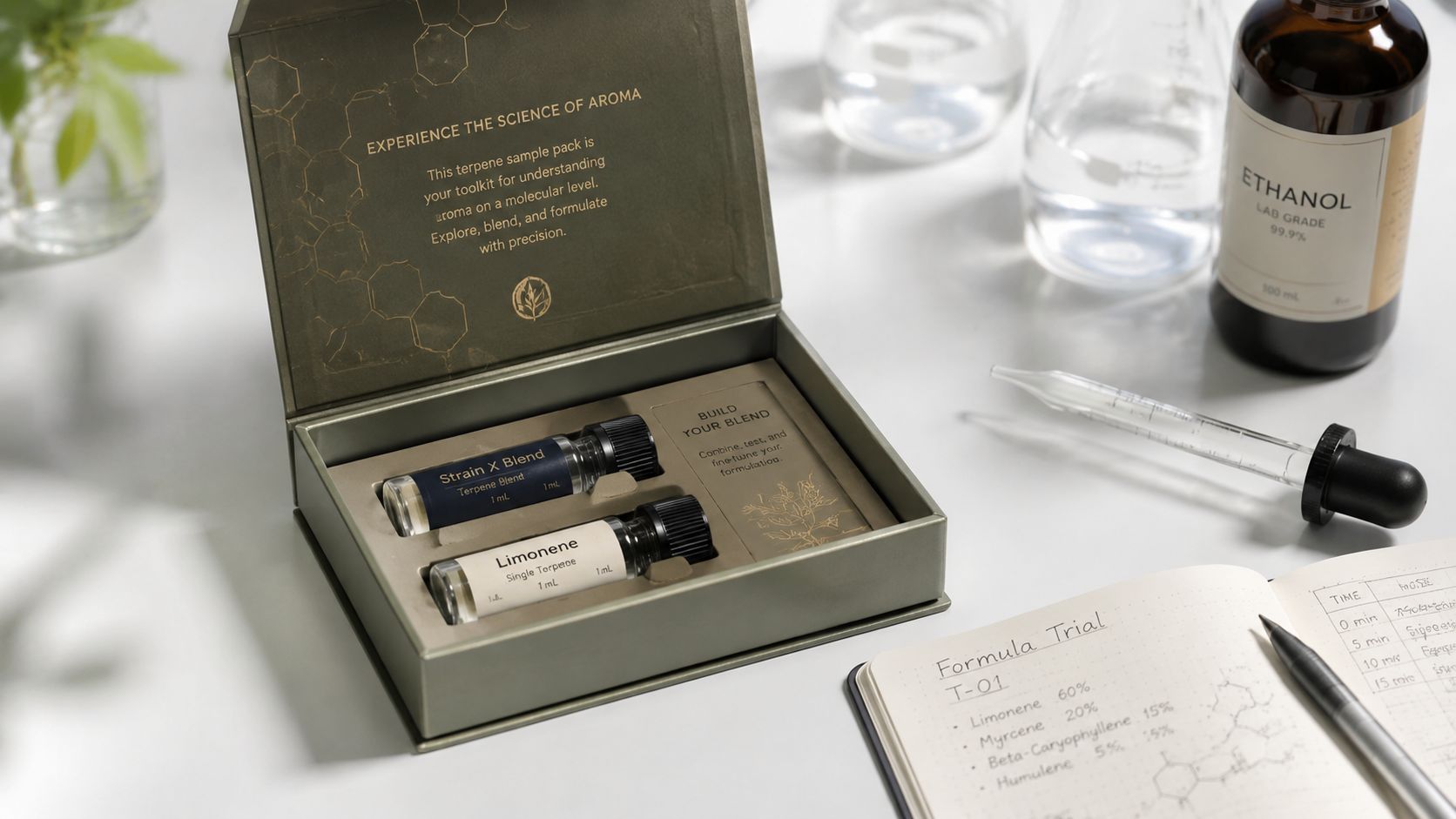
What a professional pack is actually for
The useful packs are built for comparison, not browsing. In practice, that means a set of profiles you can evaluate across the same distillate base, same mixing process, and same cartridge platform.
You'll typically use them for three things:
- Sensory benchmarking against a retained standard.
- Small-batch dilution testing to see where a profile opens up or collapses.
- Fit testing for a specific product format, especially carts and concentrates.
Premium sample packs for manufacturer formulation typically use 5 mL bottles per profile, for 25 mL total volume per kit, and that format is used because it supports sensory benchmarking and small-batch dilution work without oversaturating the extract matrix, according to Terpene Belt Farms' terpene sample kit guidance. The same source notes that the 5 mL bottle size provides enough material to formulate approximately 100–250 grams of carrier oil at typical 1–5% dilution ratios.
That size matters on the bench. It lets you run more than one pass. You can test a profile at a conservative load, a standard load, and a stress point without burning through a larger bottle you may never reorder.
What should be in the box
The strongest packs for commercial use usually include a mix of profile types rather than one narrow family.
| Pack component | Why it matters on the bench |
|---|---|
| Strain-inspired blends | Useful for replicating flavor of a known target SKU |
| Citrus or fruit-forward options | Good for checking top-note performance in carts |
| Gas, earth, or spice-heavy profiles | Help evaluate body and finish in heavier formulations |
| Individual isolates when available | Useful for correcting a profile instead of replacing it |
One practical tool for early trials is a mixing ratios calculator for terpene formulation. It's faster to set your test weights before you open bottles, especially when you're comparing multiple candidate profiles in the same session.
Sample packs work best when each vial becomes a record, not just a scent. Label every trial with oil lot, terpene lot, target load, hardware, and fill date.
What not to do with a sample pack
A few habits waste samples fast:
- Don't evaluate only from the bottle: Headspace aroma is useful, but vaporized expression is what ships.
- Don't test too many variables at once: If hardware, oil input, and terpene blend all change, the result tells you very little.
- Don't jump to bulk from one successful pull: You want repeatability across multiple fills and a short hold period.
Strategic Selection for Formulation Goals
Selection gets easier when you stop shopping by strain name alone. For a formulator, the better question is what the profile needs to do in the finished product.
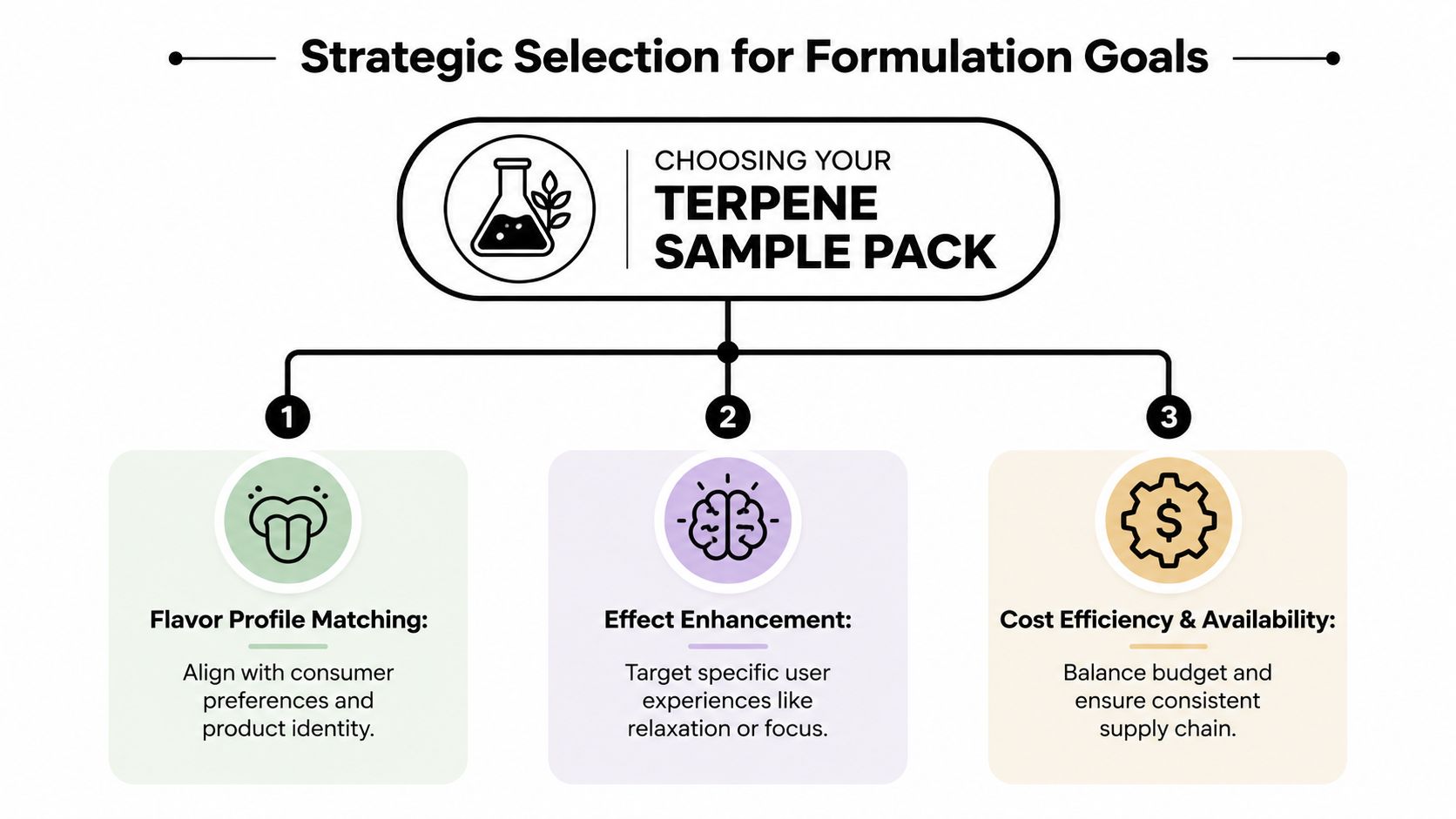
Match the pack to the job
Most selection decisions fall into three lanes.
| Formulation goal | What to prioritize |
|---|---|
| Replicate an existing SKU | Similar note structure, finish, and hardware behavior |
| Build a new house profile | Layering potential and room for adjustment |
| Tune a format for carts | Heat stability and clean expression under vaporization |
If you're selecting a terpene profile for vape cartridges, note structure matters more than marketing language. Top notes sell the first impression. Mid notes give identity. Base notes keep the profile from falling apart under heat.
Top, mid, and base notes on the bench
Top notes are usually the first thing your operator notices in a fresh fill. In cannabis formulation, brighter monoterpenes often drive that first impact. They're useful, but they're also fragile.
Mid notes carry the center of the profile. They often determine whether many strain-inspired blends feel natural and integrated or start to smell generic.
Base notes are where stability often lives. Heavier sesquiterpenes help hold the profile together, especially in vape applications where heat can strip the brighter fractions first.
For vape formulation, developers need to account for a 15–30% terpene loss factor for volatile monoterpenes, and for stability it's critical to keep monoterpene concentrations below 6% while using sesquiterpenes such as β-caryophyllene and humulene at 3–5% to provide thermal resilience and base-note structure, according to Arvida Labs on terpene and cannabinoid formulation strategies.
That single point changes how I'd screen a sample pack for carts. A profile that smells explosive in the vial but leans too hard on volatile top-end material often disappoints in finished hardware. A better profile may smell slightly less dramatic at first and still win in the cartridge because the backbone survives.
A cart doesn't reward the loudest bottle aroma. It rewards the profile that still tastes intentional after filling, settling, and heating.
For teams moving from samples to supply planning, bulk terpene sourcing options become relevant only after that note architecture has been proven in the actual application.
Don't confuse sensory goals with therapeutic claims
There's also a discipline issue in how profiles are described. Bright, earthy, peppery, floral, dense, thin, dry, sweet, and resinous are useful formulation terms. Medical-style promises aren't.
The gap matters because some effect-based terpene marketing overstates what the compounds do at realistic consumption levels. A review summarized in The Terpene Gap analysis notes that the entourage effect hypothesis remains unproven, and that typical consumer exposure sits around 5–10 mg of total terpenes per session, while animal studies showing bioactivity used doses roughly 700–1,400 times higher. For formulators, that means the honest commercial use case is flavor, aroma, and product identity.
A Practical Formulation Guide for Distillate
The fastest way to ruin a distillate trial is to chase intensity too early. Start with a measured baseline, then move in controlled steps.
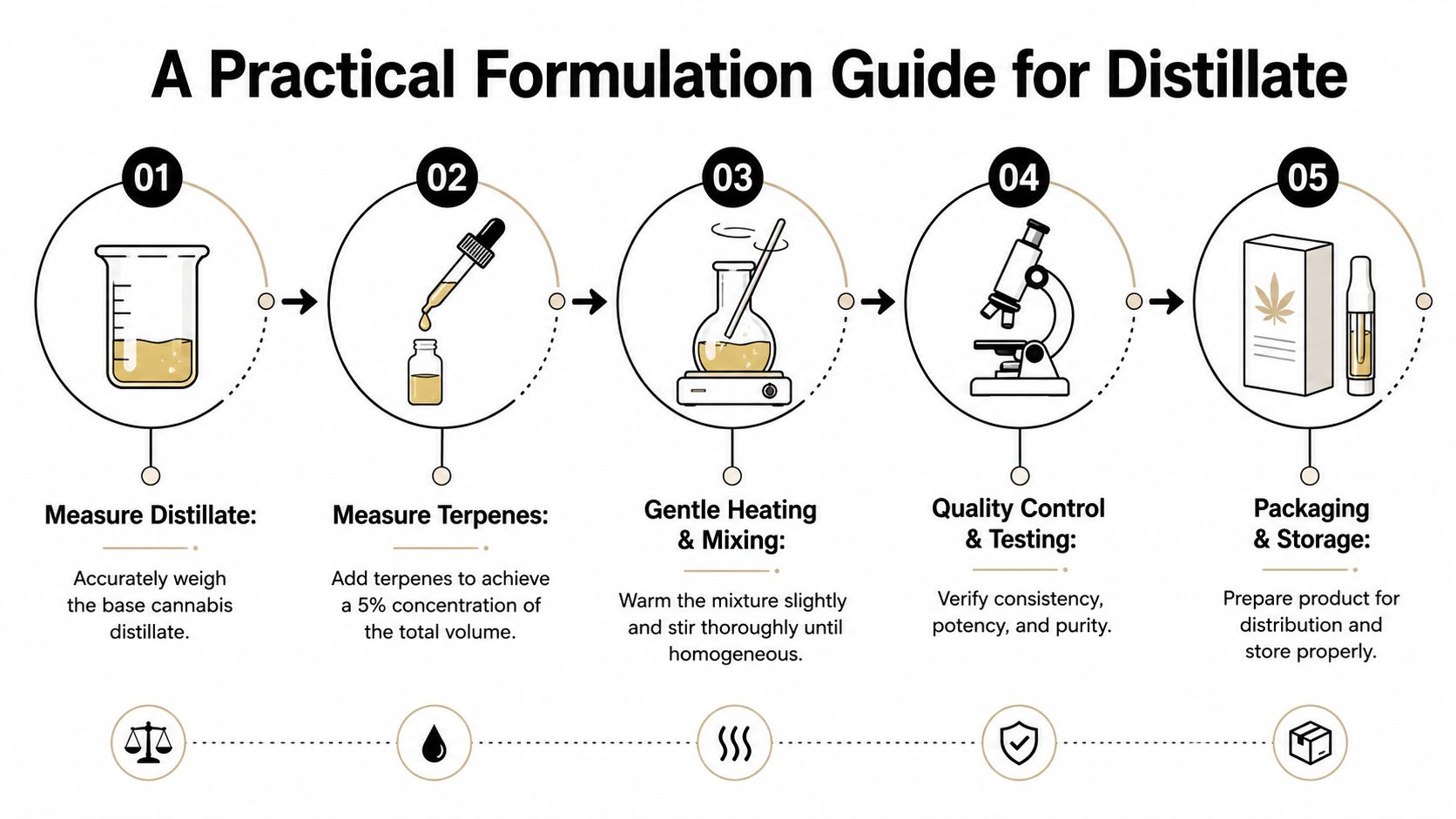
For standard vape cartridge development using distillate, the ideal terpene concentration by weight is 4–8%, with 5% as the starting baseline. Going past 8% raises the risk of harshness and hardware failures including leaking cartridges, according to Gold Coast Terpenes' terpene chart guidance.
Start with the math, not the aroma
A repeatable SOP begins with weight.
If your total batch is 100 g, and your target terpene load is 5%, the terpene input is 5 g. That's the benchmark example because it's easy to audit and easy to repeat.
A simple workflow looks like this:
- Weigh the distillate first. Record actual batch weight, not target weight.
- Calculate terpene load by total batch weight. Keep the number fixed on paper before you touch the bottle.
- Stage the terpenes separately. Don't free-pour into hot oil.
- Blend gently until homogeneous.
- Run a small test fill before scaling.
For teams building internal SOPs, a reference such as best terpenes for distillate formulation can be useful when narrowing profile families for initial trials.
A quick visual of the basic sequence helps when training operators:
Bench workflow that actually scales
The important part isn't just blending. It's reducing avoidable variation.
- Use retained standards: Keep a small approved reference from the last successful lot.
- Mix under the same conditions each time: Same vessel type, same stir method, same order of operations.
- Let the blend settle before judging it: Freshly mixed oil can read differently from rested oil.
If a profile feels weak at the standard baseline, don't assume the answer is pushing concentration immediately. First check whether the profile lacks base support, whether the distillate input changed, or whether the hardware is suppressing the top end.
Common failures in vape cartridge formulation
Most preventable failures show up in one of four ways.
| Failure | Likely formulation issue |
|---|---|
| Harsh throat feel | Terpene load too aggressive or profile imbalance |
| Leaky cartridges | Blend pushed too far, especially above the recommended upper range |
| Flat aroma after fill | Volatile-heavy profile without enough stable structure |
| Inconsistent lot-to-lot flavor | Poor documentation or uncontrolled weighing |
One option for early R&D is Gold Coast Terpenes' 3-Picker Pack, which allows selection of three strain profiles for side-by-side testing. That kind of format is useful when you want to compare alternatives before committing to a larger order.
If a profile only works at a concentration that threatens hardware performance, it's the wrong profile for that SKU.
What works better than constant upward adjustment
The better pattern is controlled iteration:
- First pass: Evaluate at the standard baseline.
- Second pass: Adjust profile selection, not just concentration.
- Third pass: Confirm in actual hardware after a short hold.
That process is slower than guessing. It's also how stable products get built.
Verifying Safety and Regulatory Compliance
A terpene sample pack can smell clean and still be a purchasing mistake. If the paperwork doesn't hold up, the sample doesn't belong in commercial development.
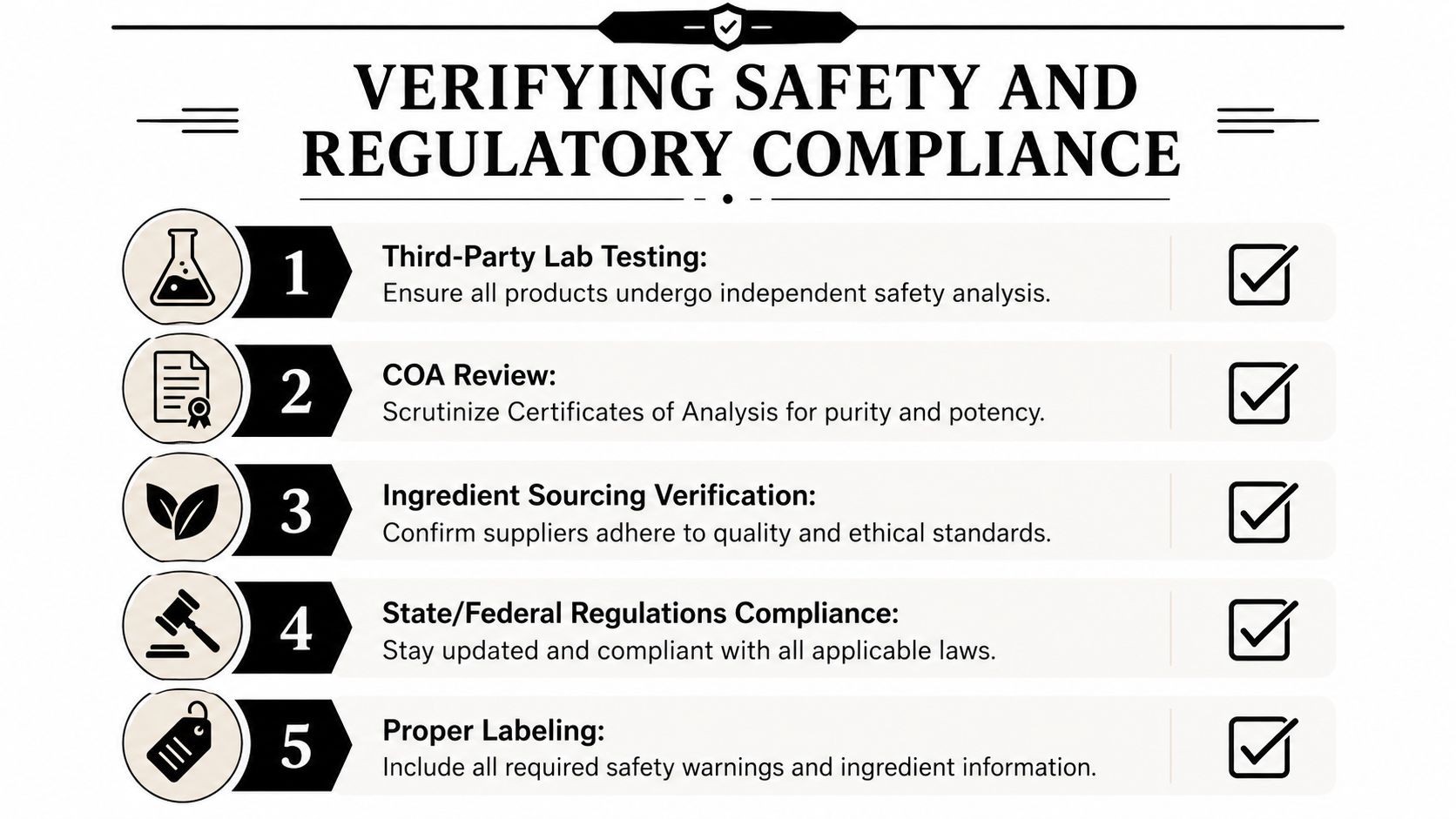
What to check on the COA
The first screen is simple. Does the report match the bottle in your hand?
Buyers need to verify COAs by matching batch numbers and screening for residual solvents and heavy metals. Once terpenes are combined with distillate, the final product requires a full round of mandatory tests including potency, homogeneity, and microbials, as described in this guide to reading terpene lab reports.
Here's the checklist I'd use before any sample advances into production trials:
- Batch match: The lot number on the vial has to match the report exactly.
- Lab identity: Confirm the testing lab is clearly identified and independent.
- Contaminant screen: Check residual solvents and heavy metals first, before getting distracted by aroma.
- Document type: Separate a real batch-specific COA from a generic safety sheet.
- Finished product testing plan: Make sure your team has a path for post-mix compliance testing.
Why this matters commercially
A surprising number of teams treat terpene paperwork like a nice extra. It isn't. If the supplier can't produce a usable batch-specific COA, you're already working with an avoidable blind spot.
The second mistake is assuming the terpene report somehow covers the finished cartridge. It doesn't. Once the blend hits distillate, the finished product becomes its own regulated item and needs its own testing workflow.
Clean ingredients don't eliminate finished-product obligations. They only get you to the starting line.
Ingredient standards still matter
For supplier screening, I'd also look for straightforward ingredient discipline. Sample packs intended for manufacturer use should be 100% naturally derived, food-grade terpenes that are solvent-free and filler-free, with zero THC/CBD and no cutting agents such as VG, PG, PEG, or MCT, as outlined on The Terpene Store sample pack specifications. That doesn't replace your own review, but it tells you what standard the supplier claims to meet.
Advanced Formulation and Troubleshooting
A lot of teams assume that if a profile feels weak, the fix is more terpenes. That's one of the fastest ways to waste material and create a worse cart.
Start with ratio, not intensity
For accurate strain replication, the target is to recreate natural flower ratios, which typically follow a cannabinoid-to-terpene weight ratio of 20:1 to 12:1. Exceeding 12% terpene concentration typically brings diminishing sensory returns while increasing hardware degradation and cost, according to Terpene Belt Farms on terpene percentage and strain replication.
That ratio is more useful than people think. If the profile tastes thin, harsh, or artificial, the issue may be that the formulation no longer resembles a believable flower architecture. The top end may be too loud, the center may be missing, or the base may not be carrying enough weight through heat.
Troubleshooting by symptom
| Symptom | What I'd question first |
|---|---|
| Bright aroma in bottle, weak cart expression | Too much dependence on volatile top notes |
| Oily but hollow finish | Mid and base structure are underbuilt |
| Harsh vapor | Total terpene load or note balance is off |
| Good flavor, poor hardware behavior | The formula may be commercially wrong even if it's sensorially strong |
If your first instinct is to push concentration, stop and re-evaluate the profile architecture. A quieter but more balanced blend often performs better than a louder blend with no foundation.
What usually works
- Rebuild the center: If the profile feels like aroma without body, the fix often sits in the mid notes.
- Strengthen the base: More thermal resilience usually comes from heavier components, not extra brightness.
- Retest in the same hardware: A profile that works in one cartridge may expose problems in another.
The bigger point is simple. Commercial formulation isn't a contest for the strongest smell. It's a balancing exercise between sensory accuracy, hardware compatibility, and repeatable manufacturing.
Frequently Asked Questions for Formulators
The handoff from sample testing to production is where most shortcuts show up. These are the questions that come up most often when a terpene sample pack moves from bench curiosity to actual SKU development.
Formulator FAQ
| Question | Answer |
|---|---|
| How do I choose a terpene sample pack for vape cartridges? | Choose by formulation target, not by strain name alone. Start with profiles that match the intended note structure and can survive heat. |
| Should I evaluate a sample only by smelling the vial? | No. Bottle aroma is only a preliminary screen. Final judgment belongs in the actual oil and hardware. |
| What's the best starting point for distillate trials? | Use the standard baseline covered earlier and document every input by weight. Consistency in process matters as much as the profile itself. |
| When does a profile deserve scale-up? | After it passes sensory review, small-batch fill testing, and a short stability check in the intended cartridge platform. |
| Why does a blend taste louder in the beaker than in the cart? | Volatile top notes often dominate early evaluation, then fade during filling and storage. A better-balanced profile usually performs better in finished hardware. |
| Can I fix a flat profile by just adding more terpenes? | Sometimes, but often that creates harshness or leakage risk. It's usually smarter to revisit the profile structure first. |
| What paperwork should I require before buying larger quantities? | Batch-specific COAs that match the lot, plus contaminant screening and a clear path for finished-product compliance after mixing. |
| Are sample packs only for beginners? | No. Experienced teams use them to benchmark alternate suppliers, compare revisions, and validate new SKUs without tying up capital in large-volume buys. |
The practical handoff to production
When a sample wins, lock the formula before opinions start changing it on the floor. Freeze the approved terpene lot, mixing order, target load, hardware pairing, and release criteria into a simple internal spec.
That's the point of a terpene sample pack in commercial development. It gives your team a low-risk way to choose deliberately, reject weak candidates early, and build a strain-inspired terpene blend for cannabis product formulation that can survive scale.
If you're comparing sample options for carts, concentrates, or distillate work, Gold Coast Terpenes offers natural terpene blends, isolates, formulation resources, and sample formats that fit bench testing before scale-up.