
Does “purp” mean one strain, one flavor, or purple-looking flower? For a product formulator, that question matters more than it does for a casual slang search. A team developing a cartridge or distillate SKU needs a sensory target it can reproduce, not a color label that changes from supplier to supplier.
The useful interpretation is to treat purp as a formulation archetype. It combines a visual association with a recognizable family of earthy, spicy, sweet, and fruit-leaning impressions. Those impressions can be translated into a structured terpene system, then adjusted for viscosity, vapor behavior, throat feel, and batch consistency. The color itself doesn't provide that control.
This distinction helps solve several common problems at once. A purple phenotype may not carry the aroma a buyer expects, a strain name may not describe a consistent chemical profile, and a visual cue may be mistaken for potency. A well-built strain-inspired terpene blend for vape cartridges starts with the sensory expectation, identifies the note layers behind it, and validates the finished formulation through testing rather than appearance.
What Purp Really Means in Cannabis Product Language
In cannabis product language, purp usually means cannabis associated with purple coloration, but it doesn't identify one universally defined strain. The term can refer to a purple phenotype, a legacy cultivar family, a strain shorthand, or a broader flavor and branding direction. That ambiguity is why a product brief that says only “purp” isn't yet precise enough for a formulation bench.
Historical accounts often trace modern purple cannabis lineages to Northern California's Mendocino County in the late 1990s. One widely cited genealogy places purple families in Northern California during the 1990s, with Mendocino Purps, Purple Kush, and Granddaddy Purple forming a major branch of the modern lineage. Another account places Mendocino Purps emergence around 1998, while Granddaddy Purple was popularized in 2003 by breeder Ken Estes. These histories explain the cultural weight of the term, but they don't create a single standardized recipe.
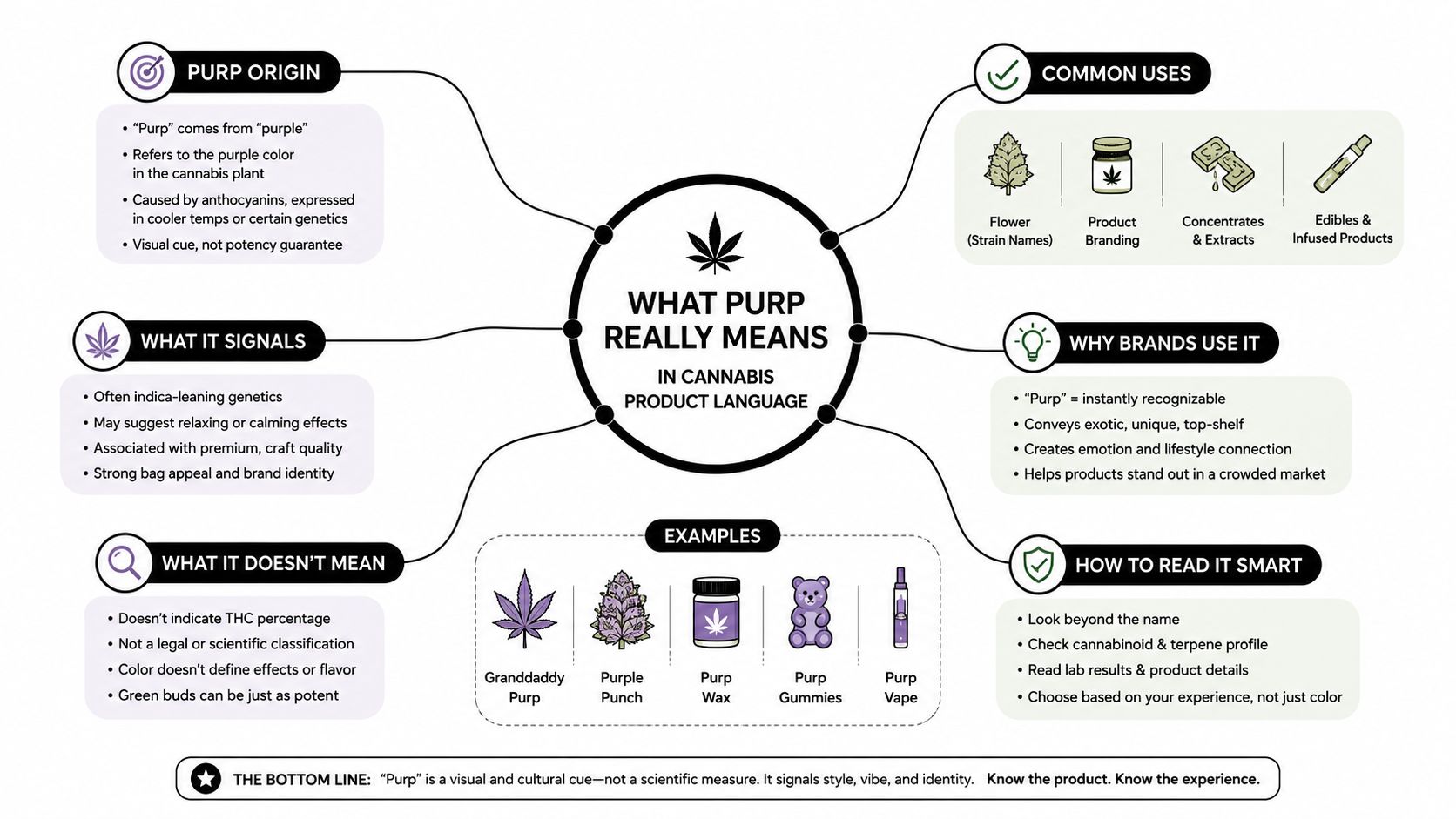
Color is the label, chemistry is the specification
A practical analogy is packaging versus ingredients. Purple color works like packaging. It shapes the first expectation, but it doesn't tell you exactly what's inside. Terpenes function more like the ingredient specification because they determine much of the aromatic direction that a formulator can measure, blend, and reproduce.
That makes a purp brief more useful when it includes descriptors such as:
- Earthy foundation, for depth and a grounded opening.
- Berry or grape association, for the recognizable sweet-fruit cue.
- Spice and wood, for structure and finish.
- Floral softness, when the target needs a rounder profile.
- Controlled brightness, so the blend doesn't become candy-like or citrus-dominant.
For a deeper cultivar reference, the Purple Urkle strain profile can help teams compare a named legacy direction with the broader purp archetype. A separate flavor reference such as 24k gold punch can also sit in a product-development library as a named profile, but it shouldn't be treated as a definition of purp.
The working definition is simple: purp is a sensory and branding shorthand, not a guaranteed chemical identity. For formulation, translate that shorthand into a target aroma, a note hierarchy, and acceptance criteria for the finished oil.
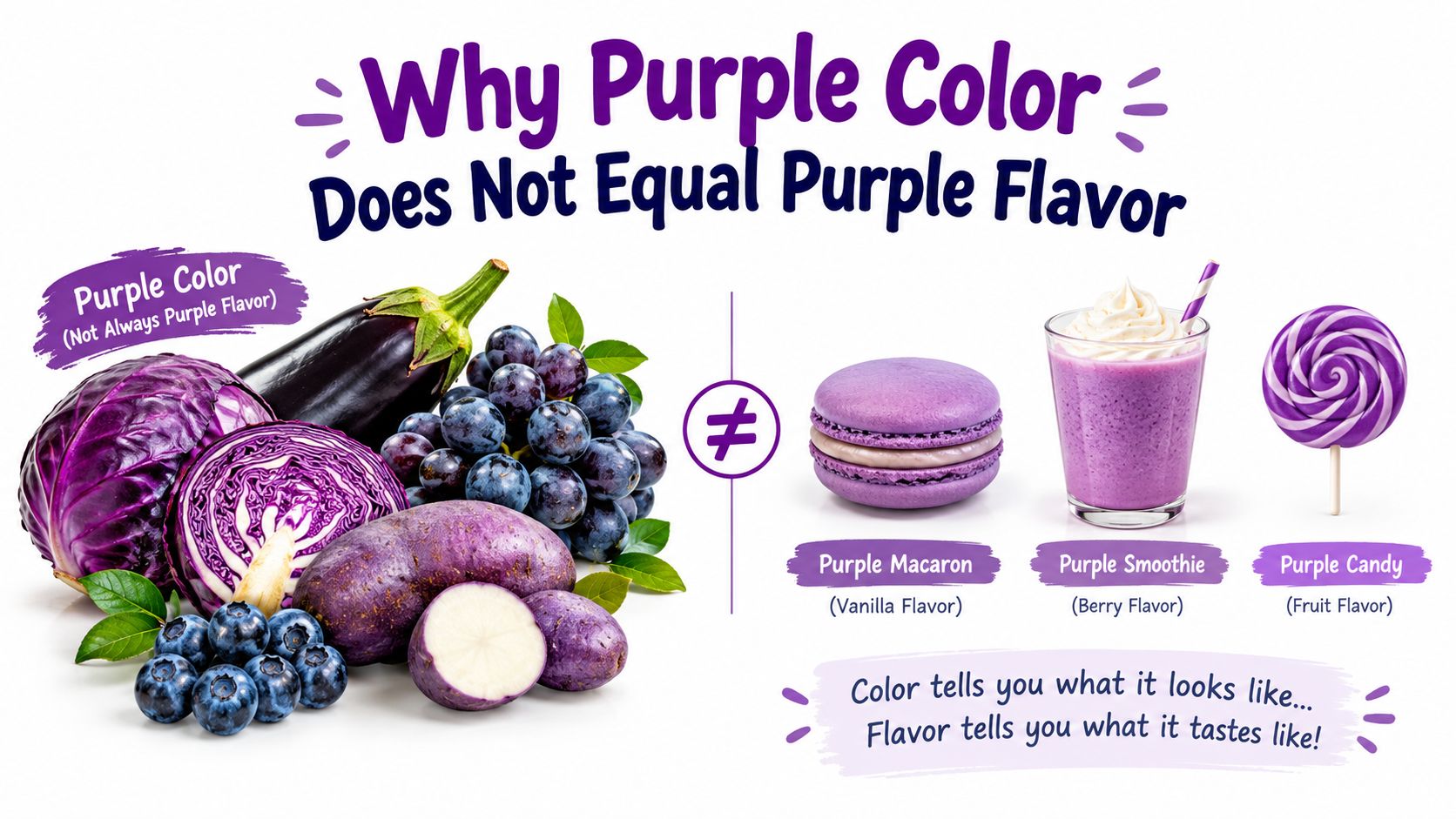
Why Purple Color Does Not Equal Purple Flavor
Purple appearance and purple-associated flavor come from different parts of the plant's chemistry. Anthocyanins drive the visible coloration through flavonoid biosynthesis, with environmental and genetic triggers influencing how that color develops. Aroma, by contrast, depends primarily on volatile compounds such as terpenes.
Purple cannabis phenotypes associated with “purp” are therefore not automatically grape-scented, berry-forward, or more potent. Research reviewed by NIH identified cyanidin-3-rutinoside as the major pigment in purple leaf, stem, and flower tissues, which reinforces the distinction between pigment production and aroma-compound production. The color is a visual trait. It isn't a reliable potency marker, and it can't substitute for a lab-verified terpene profile.
What this changes in product development
A formulator chasing color will solve the wrong problem. Distillate is often visually uniform, and a cartridge blend won't gain an authentic purp character just because the source material came from purple-looking flower. The sensory identity must be built through the volatile profile and then checked in the final hardware.
That process begins with a clear separation between three product claims:
- Appearance, which may support the visual story.
- Aroma and flavor, which require terpene analysis and sensory evaluation.
- Potency or effect, which must not be inferred from color or slang.
A brand brief can still use purple imagery, grape references, or legacy cultivar language. It just needs to avoid presenting those cues as proof of strength or a guaranteed effect. For a formulator, the relevant evidence is the source oil's certificate of analysis, the terpene blend documentation, and the sensory result after dilution and hardware testing.
The distinction also protects strain replication work. A named cultivar can vary across growers, harvests, extraction methods, and storage conditions. If the target is “purp,” record the aroma in operational terms, identify the dominant and supporting terpenes, and define what should appear on inhale, through the body of the draw, and on exhale.
The visual reference may help marketing teams. It shouldn't become the formulation specification.
The Purp Terpene Profile and How Its Notes Work Together
A useful purp profile is less like a single flavor ingredient and more like a three-layer chord. The opening gives the first aromatic impression, the middle supplies the recognizable identity, and the base keeps the profile present after the initial burst. This structure lets a formulator adjust character without flattening the blend.
Across verified purple-leaning chemovars, profiles are often myrcene-forward, with beta-caryophyllene, alpha-pinene, humulene, and linalool contributing secondary dimensions. Published analyses report total terpene content commonly around 1.2% to 2.5% by weight, with myrcene frequently around 0.3% to 0.9% and beta-caryophyllene around 0.2% to 0.6%, as documented in this purp terpene profile guide. Those figures describe reported plant profiles, not a universal cartridge recipe.
A perfumery model for the archetype
For product development, the blend can be read as follows:
- Top notes, often supported by alpha-pinene and other more volatile components, create lift and definition on the first inhale.
- Mid notes, including myrcene, linalool, and beta-caryophyllene, connect the opening to the main earthy, floral, and spicy body.
- Base notes, often reinforced by myrcene, beta-caryophyllene, humulene, and linalool, provide depth and persistence.
Monoterpenes such as limonene and pinene vaporize at lower temperatures, with one vape formulation guide placing them around 155°C to 180°C. Sesquiterpenes such as beta-caryophyllene and humulene have higher boiling points, above 200°C, which helps explain why brighter notes tend to appear early while heavier notes contribute body later in the draw. See this terpene flavor chart when mapping individual compounds to a sensory brief.
| Terpene | Note Layer | Aroma Contribution | Formulation Role |
|---|---|---|---|
| Myrcene | Mid and base | Earthy, herbal, soft fruit | Establishes body and helps prevent a thin profile |
| Beta-caryophyllene | Mid and base | Dry spice, pepper, wood | Adds structure and a persistent spicy finish |
| Alpha-pinene | Top | Pine, fresh green lift | Opens the blend and sharpens definition |
| Humulene | Base | Woody, earthy, hop-like depth | Anchors the heavier finish |
| Linalool | Mid and base | Floral, soft, rounded | Smooths sharper edges and adds floral depth |
The familiar purp direction emerges from the relationship among these layers, not from one compound alone. Too much top-note lift can make the blend read as pine or fresh herb. Too much base material can make the cartridge feel dense, muddy, or slow to open. Myrcene supplies continuity, beta-caryophyllene gives contrast, pinene provides an initial edge, humulene deepens the finish, and linalool rounds the composition.
Formulation principle: Build the profile so the first inhale, mid-draw body, and exhale finish each have a defined job.
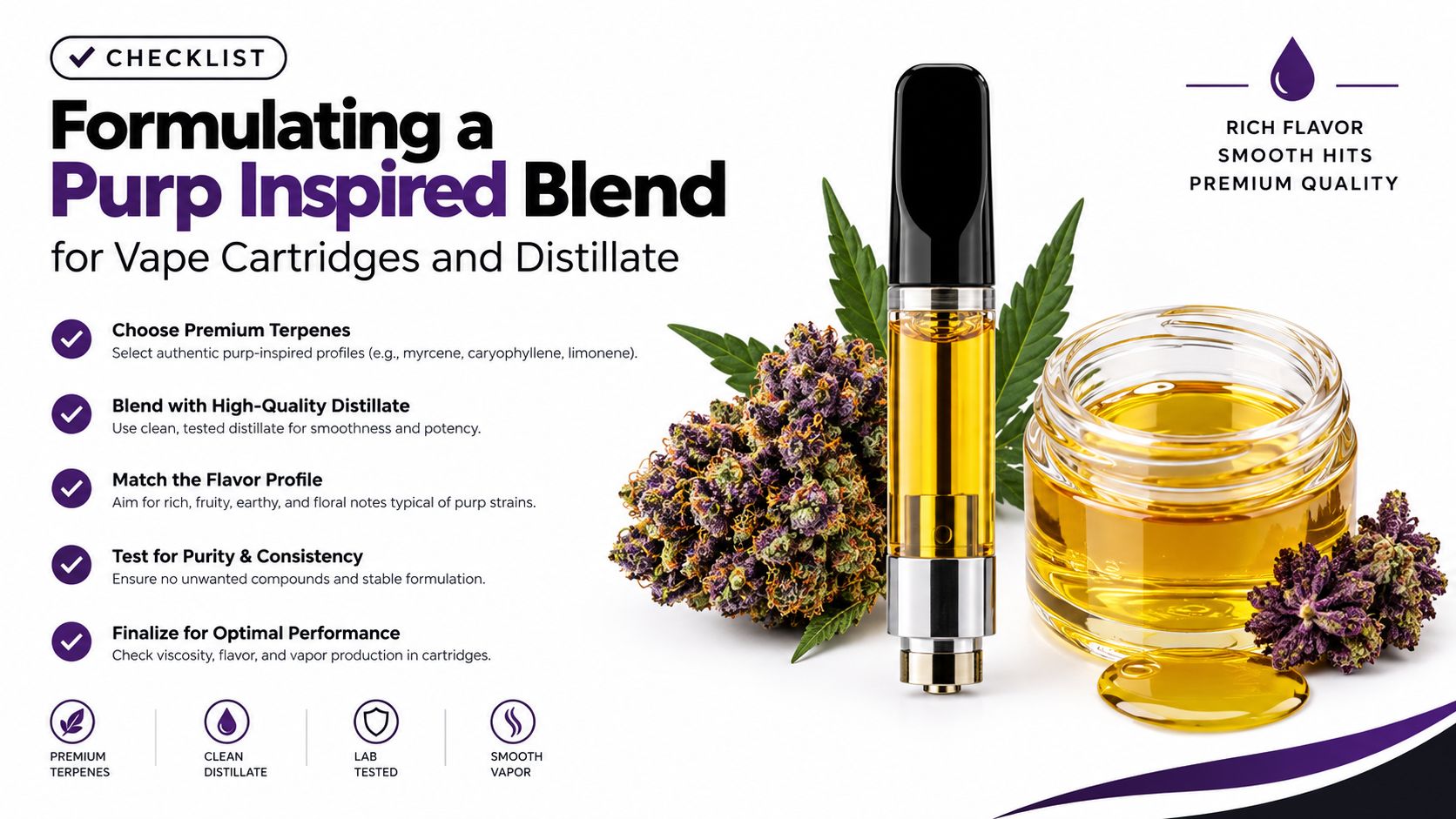
Formulating a Purp Inspired Blend for Vape Cartridges and Distillate
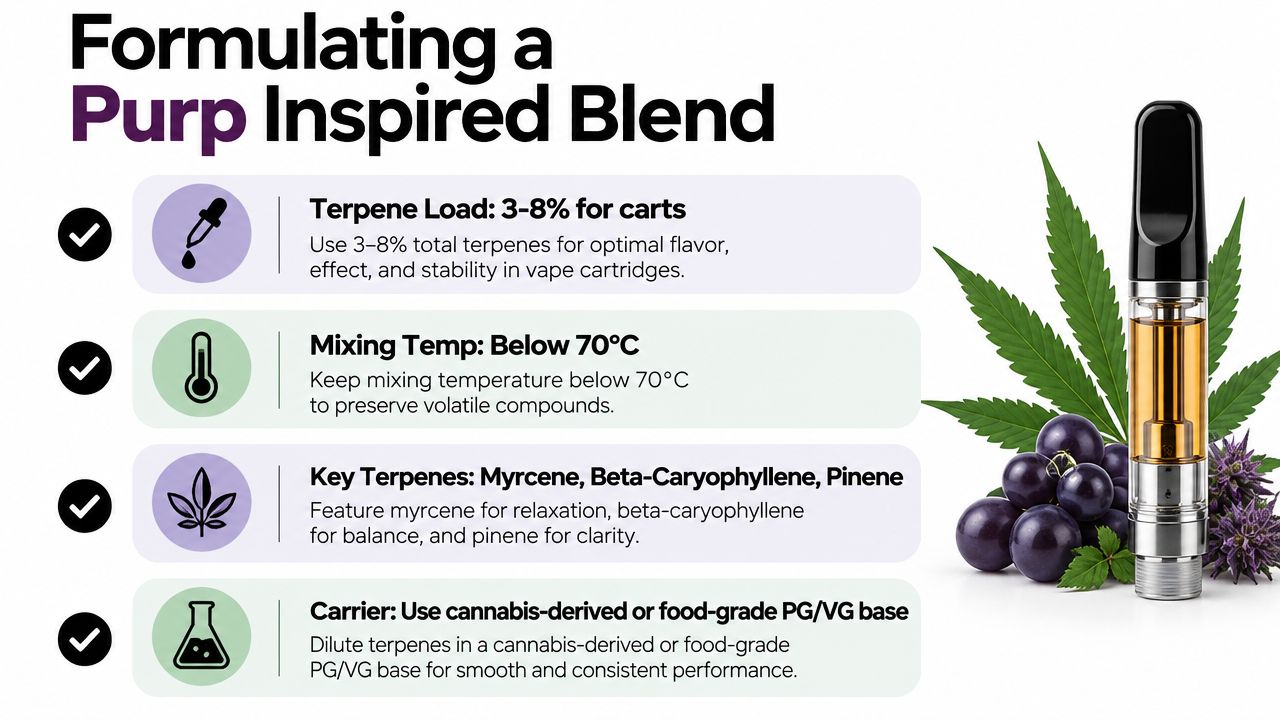
A practical formulation guide for distillate should treat flavor, physical behavior, and process control as one system. Terpenes can affect viscosity, vapor behavior, throat feel, and perceived effects in a distillate formulation, so a successful blend isn't judged only by smell in a bottle. The finished oil must also move through the hardware predictably and deliver a stable sensory experience.
A formulation guide for vape cartridges gives an operating range of 5% to 10% terpene content by weight, paired with a mixing temperature of 120°F to 150°F, or 49°C to 65°C. Treat that as a starting operating window, not an automatic target. The right point within the window depends on the extract, hardware, sensory strength, and product requirements. The same guide emphasizes that the extract should be fully decarboxylated to help prevent cannabinoid crystallization. Review the guide to using terpenes before setting a production procedure.
A repeatable bench workflow
Start with the oil, not the name. Confirm the distillate's condition, homogeneity, and documentation before adding a strain-inspired blend. If the base already carries residual aroma, account for it during sensory comparison rather than trying to overpower it.
Build a small aromatic concentrate. Begin with the intended note architecture. Use myrcene to establish the earthy body, beta-caryophyllene and humulene to support spice and depth, pinene to provide lift, and linalool to soften the transition. If the target needs more fruit brightness, adjust the supporting top and mid-note system rather than assuming purple color will supply sweetness.
Blend under controlled heat. Keep the process within the cited 120°F to 150°F, or 49°C to 65°C, operating range, and avoid treating heat as a shortcut for poor mixing. Excessive heat can change the balance of volatile compounds, while insufficient mixing can leave local concentration differences in the finished batch.
Check physical performance. Evaluate flow, fill behavior, vapor output, throat feel, and the sensory profile after the oil has entered the intended cartridge. A blend that smells accurate in a vial may behave differently after contact with hardware.
Document the result. Record the terpene lot, source oil, load, mixing conditions, hardware, and sensory observations. That record turns a subjective purp concept into a repeatable production reference.
Tune for the draw, not just the bottle
Top notes create the immediate aromatic signature, but they can disappear quickly if the middle and base lack support. Base-heavy blends may persist longer, yet they can obscure the fruit or floral cues that make the purp archetype recognizable. Sensory panels should therefore assess the full draw, including the opening, core, exhale, and after-aroma.
Fully decarboxylated extract is an important process condition because crystallization can undermine both fill consistency and product usability. Terpene selection also has a mechanical role. Changes in viscosity can influence how an oil feeds into hardware, how it vaporizes, and how the user perceives the throat sensation. Those variables belong in the same development record as flavor notes.
Purp Compared to Other Purple Profiles You Might Replicate
“Purp” is broad enough to function as a portfolio direction, but a product team still needs to choose a specific lane. A legacy earthy profile, a dessert-fruit profile, and a tropical-fruit profile can all sit under purple branding while producing very different cartridge experiences.
| Target direction | Dominant impression | Balance to emphasize | Development use |
|---|---|---|---|
| Classic purp | Earthy, spicy, berry-leaning | Myrcene with beta-caryophyllene and supporting woods | A grounded legacy-style SKU |
| Granddaddy Purple direction | Dense fruit, earth, floral softness | Myrcene, linalool, and spice support | A rounded purple cultivar reference |
| Purple Punch direction | Sweet grape, dessert, soft spice | Fruit-forward top and mid notes with restrained base depth | A sweeter, confectionary interpretation |
| Forbidden Fruit direction | Tropical fruit, citrus, floral brightness | Limonene and brighter fruit notes balanced by myrcene and linalool | A vivid fruit-led alternative |
The names above should guide comparison, not replace testing. Granddaddy Purple was popularized in 2003 by Ken Estes, while the wider purple lineage also includes Mendocino Purps and Purple Kush. That history gives product teams useful cultural reference points, but a named profile still needs a defined sensory and analytical target.
Choosing the right direction
Use the classic purp lane when the brand wants earth, spice, and depth to lead. In this version, myrcene provides the central body while beta-caryophyllene and humulene keep the finish dry and structured. Pinene should remain supportive rather than dominating.
A grape-candy direction needs more perceived sweetness and a softer transition. Linalool can help round the blend, while the darker compounds should be controlled so they don't turn the profile woody or medicinal in the finished cartridge. A strain-inspired terpene blend should be judged against a flavor reference, not against flower color.
For a tropical-fruit interpretation, brighter top and mid notes move the product away from traditional earth and toward fruit-forward clarity. The base still matters because it prevents the profile from becoming a short-lived opening with no recognizable finish.
These are not medical or effect categories. They're sensory design choices. Name the target by what the customer should smell and taste, then verify the result in the actual oil and hardware.
Building a Consistent Purp Experience That Customers Repurchase
A reliable purp product starts with a precise definition. The team should describe the target as a sensory archetype, identify the top, mid, and base notes, specify the intended terpene load, and test the blend in the hardware customers will use. Purple color can support the visual identity, but it can't serve as the quality specification.
Consistency also depends on disciplined sourcing and documentation. Use lab-verified, THC-free terpene materials with clear technical records, then maintain lot information and sensory references throughout production. Gold Coast Terpenes describes its materials as 100% natural, THC-free, and free of VG, PG, PEG, and MCT, with SC Lab testing and documentation resources available for formulation work. Teams can also review the documented quality assurance processes before selecting an ingredient source.
A repeatable sensory target gives purchasing, extraction, formulation, quality, and marketing teams the same language.
The commercial advantage comes from reducing interpretation. “Purp” alone is too vague. “Earthy berry opening, myrcene-led body, dry pepper finish, restrained pine lift, and stable cartridge flow” gives a product team something it can source, blend, test, and approve.
For brands planning multiple SKUs, this framework also prevents unnecessary duplication. A classic purp profile can anchor the portfolio, while dessert-fruit and tropical-fruit variations create distinct directions without pretending that every purple-labeled product has the same chemistry.
Gold Coast Terpenes offers strain-inspired blends, isolated compounds, formulation education, and practical resources for teams developing cartridges and distillate products. Visit Gold Coast Terpenes to review terpene profiles and formulation tools for building a consistent purp-inspired SKU.