
The Watermelon Splash profile is defined by its unmistakable juicy, candy-like watermelon aroma, rounded out with a fresh hint of melon rind. Its flavor profile is a consistent performer, which is why it has become a go-to for product formulators, especially in vape cartridges and distillates.
Its commercial success isn't accidental. It stems from a carefully balanced terpene recipe that consistently delivers a sweet, refreshing sensory experience that resonates with key consumer segments.
Deconstructing the Watermelon Splash Terpene Profile for Formulation
For formulators and brand owners, a strain's commercial appeal is the starting point for developing a winning product. Watermelon Splash consistently performs well in competitive markets, and while its effects are notable, its real staying power comes from its distinct, memorable flavor. This analysis moves beyond typical dispensary reviews to deconstruct the technical components of this profile.
Think of the profile as being built on three main sensory pillars: a prominent sweet watermelon candy note, a crisp and refreshing melon rind accent, and a subtle sweet base that provides structure. This trio is highly effective for consumers who gravitate toward fruity, candy-like flavors. That makes a Watermelon Splash strain-inspired terpene blend a strategic addition to virtually any product line.
The key is achieving the correct balance of key isolates to ensure the profile tastes authentic and not synthetic.
The Flavor Foundation
At its core, the success of this profile lies in its simplicity and direct appeal. For a product developer, this translates to a reliable, scalable flavor that performs well with different bases, especially clean THC and CBD distillates.
The most effective way to build it is layer by layer:
- Top Notes: The initial impact of bright, juicy fruit.
- Mid Notes: The authentic "green" character from the melon rind.
- Base Notes: A smooth, foundational sweetness that gives the flavor persistence.
This chart captures the essence of the Watermelon Splash sensory experience.
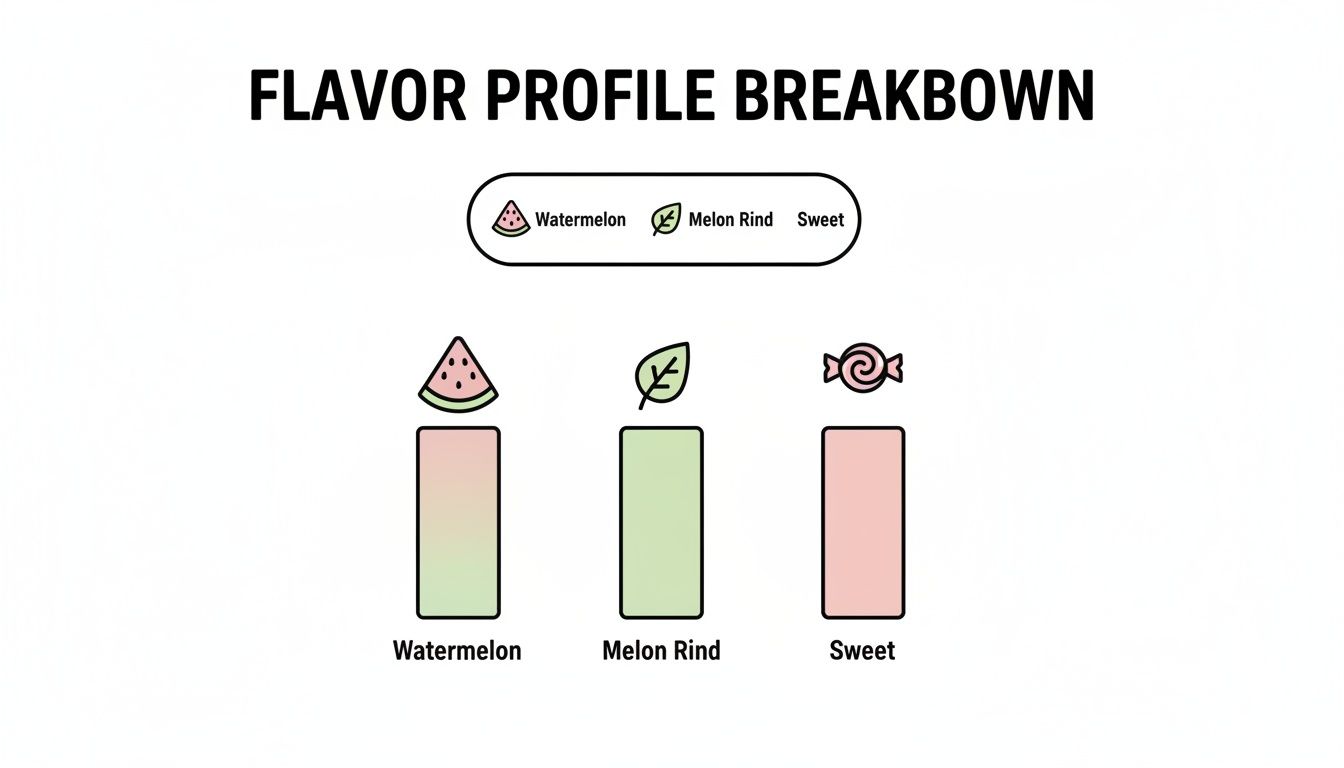
As illustrated, the prominent watermelon note is the anchor, but it requires the melon rind and sweet elements to feel complete. This is a critical balancing act. If the rind note is absent, the flavor becomes one-dimensionally sweet. Without the candy-like base, it will lack the desired impact.
Formulator's Insight: The primary challenge is nailing an authentic watermelon flavor that isn't generically "fruity." This requires strategically adding minor terpenes that introduce rind-like or even slightly earthy notes. This is what adds complexity and realism, and it’s what separates a premium product from a standard one.
Watermelon Splash Terpene Profile At a Glance
To replicate this profile accurately, one must understand the individual terpenes contributing to the final effect. This table summarizes the key components typically found in a Watermelon Splash formulation.
| Terpene | Typical Concentration (%) | Aromatic Note (Top/Mid/Base) | Sensory Contribution |
|---|---|---|---|
| Myrcene | 35 – 45% | Base | Provides a sweet, slightly earthy foundation and enhances other fruity notes. |
| Beta-Caryophyllene | 15 – 20% | Mid | Adds a touch of spicy, peppery complexity to cut through the sweetness. |
| Limonene | 10 – 15% | Top | Lends a bright, citrusy lift that keeps the profile feeling fresh and zesty. |
| Linalool | 5 – 10% | Mid | Contributes a soft, floral candy-like sweetness and a subtle aroma. |
| Pinene | 3 – 7% | Top | Introduces a subtle "green" note, essential for that authentic melon rind character. |
Understanding how these specific terpenes interact is fundamental. Each one adds a crucial layer, and tweaking their ratios is how you fine-tune the final flavor to meet brand specifications.
Getting this balance right is what it takes to create a successful strain-inspired terpene blend for cannabis product formulation. In the next sections, we will delve deeper into the specific isolates behind these notes and provide practical tips for R&D. For those new to this, our guide on understanding terpene roles in formulation is an excellent starting point.
The Dominant Terpenes Defining the Watermelon Splash Flavor
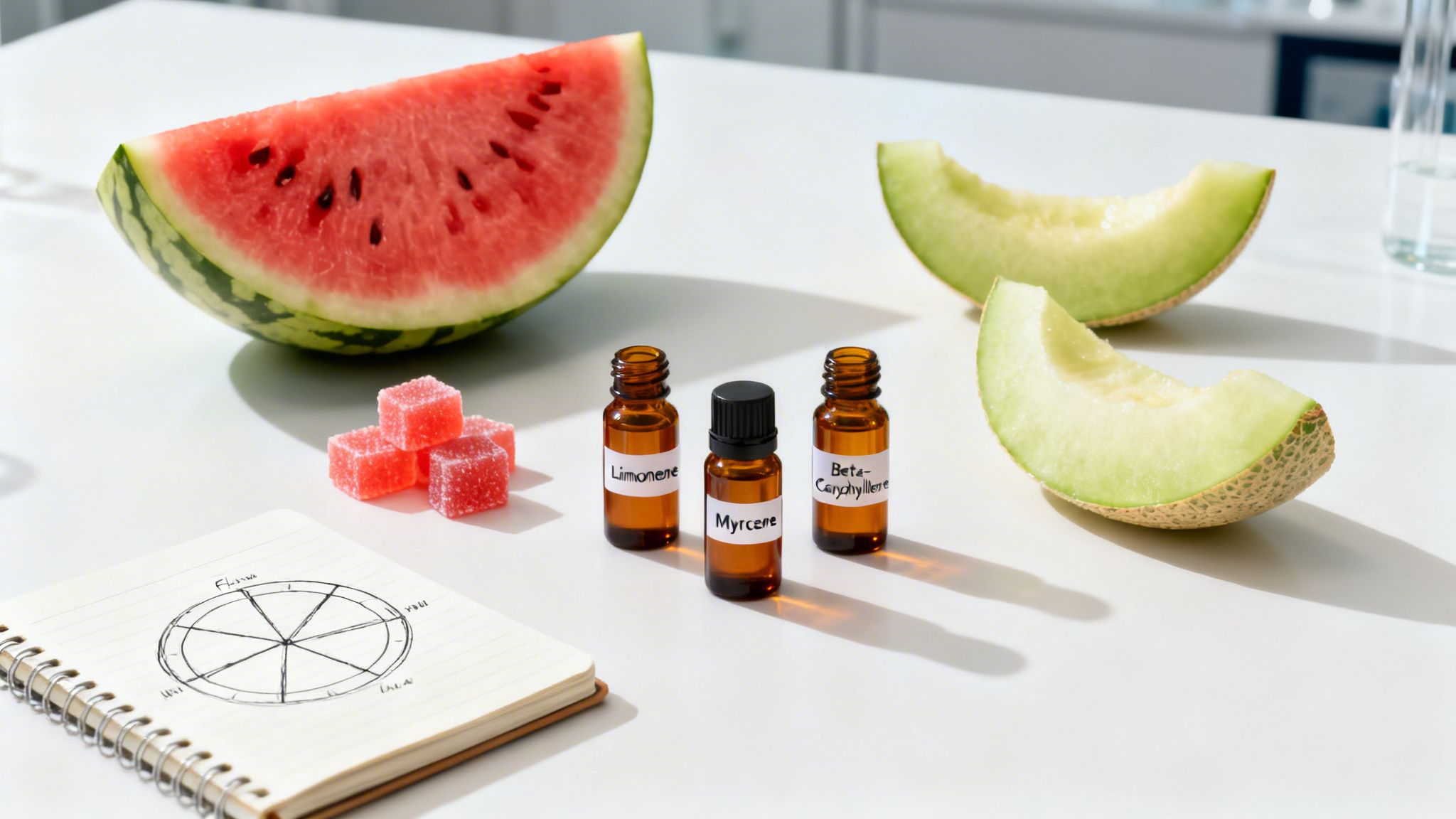
To accurately replicate the Watermelon Splash profile, it is essential to understand the specific chemical compounds that create its signature flavor and aroma. This is not a matter of combining generic fruity notes. It is a precise orchestration of specific terpenes, where each one functions as a top, mid, or base note. A handful of dominant isolates work in concert to build the foundation of the entire sensory experience.
Achieving the correct balance of these key players is the first—and most critical—step in formulating a Watermelon Splash strain-inspired terpene blend. A minor miscalculation in the ratios can shift the final product from a fresh, authentic melon to an artificial, one-note candy flavor. That difference can determine a product's commercial success.
Limonene: The Bright Citrus Top Note
Limonene provides the initial sensory impact of Watermelon Splash. It’s the bright, uplifting top note that presents first, providing a sharp, zesty quality that prevents the profile from feeling overly sweet or heavy. This is analogous to a squeeze of lime over fresh watermelon—it doesn't fundamentally change the flavor, but it elevates it, making the entire profile taste more vibrant and refreshing.
In a lab context, Limonene is highly volatile, meaning it is one of the first terpenes perceived by the senses. Its presence is essential for creating a fresh, authentic fruit impression immediately. Without sufficient Limonene, the profile can feel flat and muted, lacking the "splash" implied by its name. For a closer look at individual compounds, our guide to terpene isolates for product formulation is an excellent resource.
Beta-Caryophyllene: The Spicy Mid-Note Foundation
While Limonene delivers initial brightness, Beta-Caryophyllene serves as the crucial mid-note, adding depth and complexity. It contributes a subtle, peppery spice that cuts through the sweetness, similar to how a pinch of spice can enhance a fruit-based dessert. This terpene is the key to creating a more sophisticated, layered flavor that mimics the subtle bitterness of a real watermelon rind.
For formulators, Beta-Caryophyllene also functions as a bridge, connecting the light, volatile top notes with the heavier base notes. It prevents the sweet and fruity elements from becoming overwhelming or syrupy. A well-balanced Watermelon Splash profile utilizes this terpene to add a touch of warmth and prevent the blend from tasting like simple candy.
Formulator's Takeaway: The key interaction occurs between Limonene and Beta-Caryophyllene. Limonene delivers the juicy fruit sensation, while Beta-Caryophyllene introduces the subtle, earthy complexity of the rind. Nailing this ratio is critical for an authentic Watermelon Splash flavor.
Myrcene: The Sweet and Fruity Base Note
Myrcene is the anchor of the entire profile. As the primary base note, it provides a deep, sweet, and earthy character that enhances all other terpenes. In the context of Watermelon Splash, Myrcene is responsible for the impression of ripe, juicy fruit and the long-lasting sweet finish.
Myrcene can be considered the canvas upon which other aromatic notes are applied. A higher concentration of Myrcene will push the profile toward a sweeter, more candy-like character, while a more moderate amount allows the spicy and citrus notes to express more clearly. This makes Myrcene a critical control variable when replicating the flavor of Watermelon Splash for distillate.
The strain's terpene profile, led by Limonene at levels up to 0.80%, is a primary reason for its utility among extractors. Market data indicates this profile appears in 18% of hybrid vape products sold in U.S. dispensaries. A typical lab report breaks down a batch as follows: Limonene (0.80%), Caryophyllene Oxide (0.42%), Beta-Caryophyllene (0.41%), Humulene (0.39%), and Myrcene (0.30%). This provides a solid, data-backed foundation for product development.
How Supporting Terpenes Add Complexity and Depth
While dominant terpenes like Limonene and Myrcene establish the main flavor profile, the true nuance in replicating the flavor of the Watermelon Splash strain comes from the supporting isolates. These secondary terpenes are what separate a generic fruity blend from an authentic profile that achieves market differentiation.
They function as modifiers—subtle notes that prevent the flavor from becoming monolithic. In formulation, these terpenes are how a blend is elevated from standard to exceptional.
Humulene: The Earthy Balancing Act
Humulene is essential for an authentic Watermelon Splash profile. It introduces a subtle, earthy, almost woody note, which is crucial for counterbalancing the intense sweetness of the dominant fruity terpenes. Without it, the final product risks tasting more like a hard candy than authentic melon.
Humulene acts as a grounding mid-note, anchoring the bright citrusy top notes and rounding out the sweet, fruity base. Adding it to a formula is a deliberate move to increase realism. It provides the faint, organic hint of a watermelon rind that makes the entire profile more believable and less one-dimensional. Any successful Watermelon Splash strain terpene profile for vape cartridges will almost certainly contain a carefully measured amount of Humulene.
Formulator's Insight: The key here is subtlety. The goal is not for the end-user to consciously detect an "earthy" note. Instead, Humulene should work in the background, tempering the sweetness just enough to allow the true watermelon flavor to emerge without becoming cloying. This is a principle of advanced flavor design.
Caryophyllene Oxide: Adding a Touch of Spice
Another critical supporting player is Caryophyllene Oxide. As the oxidized form of Beta-Caryophyllene, it contributes a unique aromatic: a gentle, peppery spice with a touch of woodiness. It adds a warm complexity that interacts well with the fruity notes, analogous to how a pinch of spice can elevate a fruit pie.
Caryophyllene Oxide acts as a bridge, connecting the fruity mid-notes to the earthy base and ensuring a seamless sensory experience. It fills potential gaps in the profile, preventing it from feeling disjointed. For a formulator, this terpene is a valuable tool for fine-tuning. It adds a sophisticated finish that consumers may not be able to identify but will recognize as a marker of quality.
Building Depth, Layer by Layer
Crafting a sophisticated profile is about methodical layering. By using these secondary and tertiary terpenes, you can design a flavor that unfolds in distinct phases.
- The Opener: A bright, sweet burst of fruit presents first, driven by the primary terpenes.
- The Middle: Supporting terpenes like Humulene introduce complex, earthy, rind-like notes.
- The Finish: Caryophyllene Oxide leaves a subtle, warm spice on the back end that rounds out the experience.
This layered journey is what makes a high-end formulation stand out. Strategically using these supporting compounds gives your product a clear beginning, middle, and end, encouraging repeat use. It’s how you create something that not only tastes good on the first draw but reveals new subtleties over time.
A Practical Guide to Recreating the Profile
To capture the essence of Watermelon Splash in a commercial product requires a systematic approach. This section provides a practical framework for formulating a Watermelon Splash-inspired terpene blend, from concept to a shelf-ready product.
The process begins with the base, typically a high-purity THC or CBD distillate. This serves as a neutral canvas, ready to showcase the vibrant, fruity notes of the blend. The objective is to introduce the terpenes in a way that creates a perfectly homogenous mixture, ensuring consistent flavor from the first unit to the last.
Achieving Correct Concentrations and Mixing
For most vape cartridges and concentrates, the optimal range for terpene concentration is between 5% and 8% by weight. This range provides significant flavor impact without becoming harsh or artificial. With a juicy profile like Watermelon Splash, starting test batches at approximately 6% is an effective baseline.
Proper mixing is critical. Even the highest quality terpenes will yield inconsistent results if not fully homogenized. Gentle heat (100-120°F or 38-49°C) is effective for reducing the viscosity of the distillate, making it easier to work with.
- Step 1: Gently warm the distillate until it is fluid and stirs easily.
- Step 2: Accurately measure the terpene blend and add it to the warmed distillate.
- Step 3: Stir slowly but consistently for several minutes until the mixture is uniform. Avoid aggressive agitation, which can introduce air bubbles.
Before committing to a large production run, create small test batches. Mix several variations at 5.5%, 6.5%, and 7.5% to determine the optimal flavor expression with your specific distillate and hardware.
Sample Formulation Ratios for Watermelon Splash Blends
This is where you define the final character of your Watermelon Splash product. The goal could be a bright, sugary watermelon candy profile or a more subtle, true-to-the-fruit melon flavor. The table below provides two different starting points for replicating the flavor of Watermelon Splash for distillate. These are intended as a launchpad for your own R&D.
| Terpene Isolate | Sweet Candy Profile (% of Total Blend) | Natural Melon Profile (% of Total Blend) | Formulation Note |
|---|---|---|---|
| Limonene | 45% | 35% | Higher concentrations yield a bright, zesty candy flavor. |
| Beta-Caryophyllene | 20% | 25% | Increasing this adds spicy, rind-like complexity for a more authentic feel. |
| Myrcene | 20% | 15% | This is the sweet, ripe fruit base. Reduce for a less syrupy taste. |
| Humulene | 5% | 15% | The key to an authentic rind note. Increase significantly for a natural profile. |
| Caryophyllene Oxide | 5% | 5% | Adds a touch of warm spice that rounds out the finish in both versions. |
| Other Trace Terpenes | 5% | 5% | Use small amounts of Pinene or Linalool to add subtle green or floral notes. |
This formulation flexibility allows you to create a signature version of Watermelon Splash that aligns with your brand identity. For more ideas on manipulating these ratios, you can explore our full range of terpene isolates for product customization.
Formulator Best Practice: Always document your ratios and take detailed notes on the sensory results of each batch. A formula that is perfect in one batch of distillate might require minor adjustments in the next. Meticulous records are the foundation of scalable quality.
Getting Technical: Formulating Vapes and Concentrates
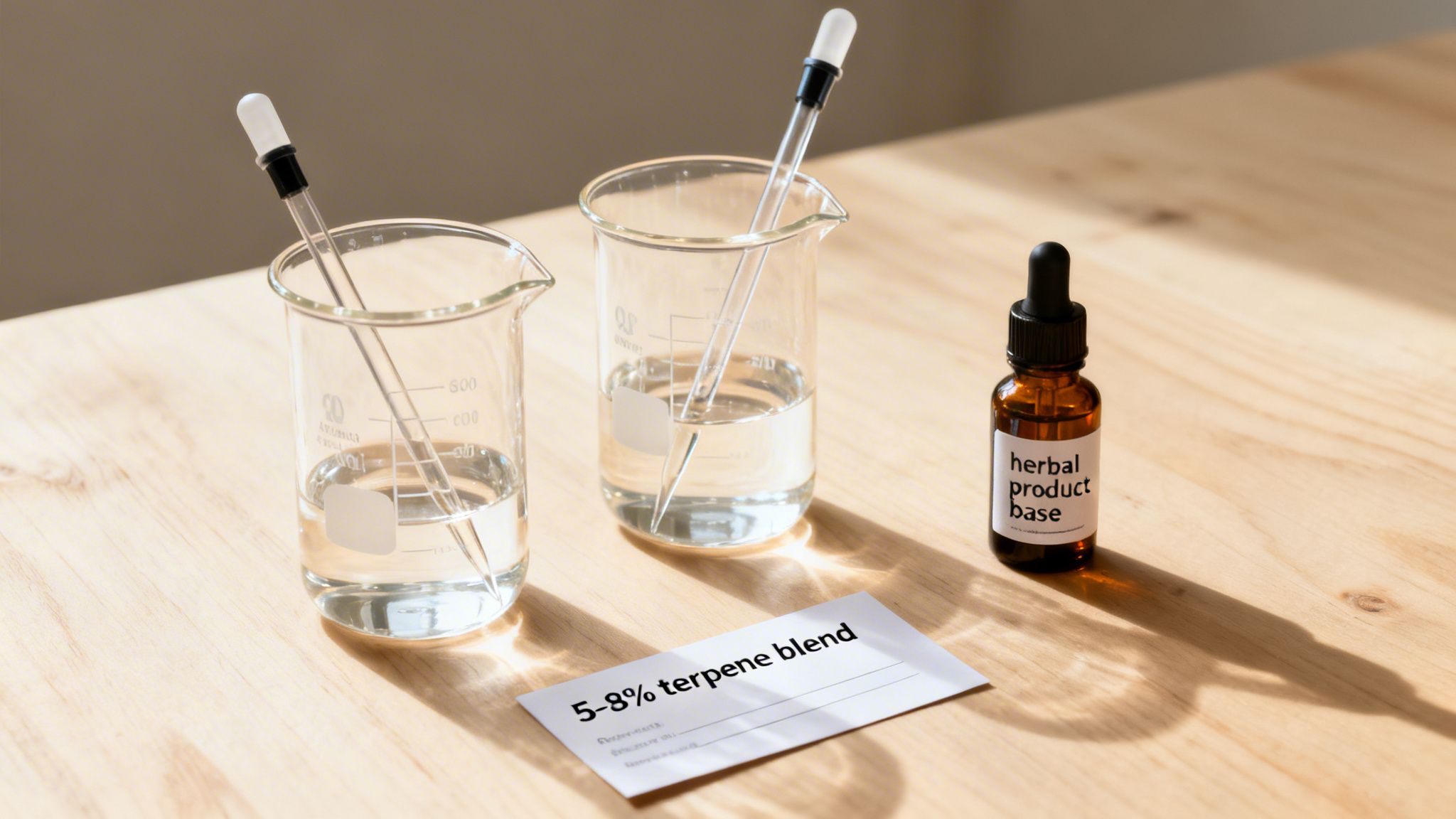
To create a standout Watermelon Splash product, flavor accuracy is only the first step. Transitioning from a lab sample to a successful commercial product requires attention to technical details like viscosity, hardware compatibility, and long-term stability. This is especially true when formulating a Watermelon Splash blend for vape cartridges, where the end-user experience depends on flawless performance.
The terpene blend and cannabinoid base must function as a cohesive system. If the final oil is too viscous, it will not wick into the atomizer correctly, leading to burnt tastes. If it is too thin, it can result in leaking cartridges. Achieving the correct viscosity is key to a reliable product.
Optimizing Viscosity and Dilution
In vape formulation, terpenes provide flavor and also act as a natural diluent. They reduce the viscosity of thick cannabinoid distillates, allowing the oil to flow smoothly into the vape's heating element. The objective is to achieve optimal flow without using undesirable cutting agents like VG, PG, or MCT oil.
The primary tool for controlling this is the concentration of your Watermelon Splash blend. For most standard vape hardware, a 6-7% concentration is a strong starting point. However, the base oil is a factor. A highly-refined, viscous distillate might require a concentration closer to 8%, while a less viscous oil might only need 5%.
A Pro Tip From the Lab: Always test your final oil in the exact hardware you intend to use for the final product. A formula that performs perfectly in one cartridge brand may fail in another. This R&D step prevents significant issues post-production.
Matching Hardware to Your Formulation
Hardware selection can significantly impact the flavor experience. The type of coil within the cartridge, for example, has a major effect on how the Watermelon Splash profile is expressed.
- Ceramic Coils: These are typically the preferred choice for complex, fruity profiles like Watermelon Splash. They heat evenly and at lower temperatures, which helps preserve delicate, volatile terpenes like Limonene. The result is a cleaner, more authentic flavor.
- Quartz Coils: These heat rapidly and are effective for producing large vapor clouds. However, the higher heat can sometimes degrade the most fragile flavor compounds, leading to a muted or altered taste.
Beyond the coil, the size of the cartridge's intake holes must match your oil's viscosity. Holes that are too small will cause wicking problems and dry hits. Holes that are too large will lead to oversaturation and leakage.
Avoiding Common Formulation Pitfalls
Finally, stability is crucial. A common issue is terpene separation, where the blend and the cannabinoid oil separate into layers over time. This is visually unappealing and creates an inconsistent user experience—one draw might be harsh and terpene-heavy, the next completely flavorless.
The solution lies in a proper mixing process. Gently warming the distillate and then using a slow, steady stirring method is the best way to create a fully homogenized, stable oil. Rushing this step can lead to product failure. By carefully managing viscosity, selecting appropriate hardware, and ensuring a stable mix, you can create a top-tier Watermelon Splash product that delivers a consistent, high-quality experience every time.
Common Formulation Questions Answered
When dialing in a new formulation, certain questions consistently arise. Here are the most common inquiries from formulators working with our Watermelon Splash profile, along with technical advice to refine your process.
What is the optimal usage rate for Watermelon Splash terpenes in THC distillate?
For most vape formulations using THC or CBD distillate, we recommend a starting range of 5% to 8% terpenes by weight. For a new batch, a 6% concentration is an excellent baseline to evaluate flavor strength and its effect on oil viscosity.
You may need to increase this to 7-8% when working with a highly refined or winterized distillate that is essentially flavorless. Conversely, less-refined extracts that retain some native terpenes might only require 5%. We strongly advise against exceeding a 10% concentration, as it can result in a harsh vapor and may cause hardware compatibility issues.
How can I make the flavor more like authentic melon and less like candy?
This is a common objective for brands targeting a more sophisticated, true-to-strain flavor profile. Transitioning from "sweet candy" to "fresh-cut watermelon" involves balancing the dominant sweet terpenes with more complex, subtle supporting isolates.
To achieve an authentic melon taste, consider these adjustments:
- Increase Humulene: This is the key isolate for adding subtle earthy, woody notes that create the impression of a real watermelon rind.
- Maintain Beta-Caryophyllene Balance: Ensure a sufficient level of this terpene to add a peppery spice. It is effective for cutting through sweetness and adding depth.
- Slightly Decrease Limonene: While Limonene provides the bright, fruity impact, reducing it slightly is often necessary to tone down the "candy" character.
Recalibrating your blend in this manner will yield a more authentic and layered flavor. The use of high-quality, pure isolates is non-negotiable for achieving a clean taste without chemical off-notes.
Does my choice of vape hardware affect this profile's expression?
Yes, absolutely. Hardware selection has a significant impact on how the end-user perceives the flavor. The Watermelon Splash profile, with its high concentration of the highly volatile Limonene, performs exceptionally well in ceramic core cartridges.
Ceramic coils are ideal because they heat more evenly and at lower temperatures. This gentle heating preserves delicate flavor molecules and prevents the burnt taste that can ruin a fruit profile. It ensures each draw delivers the bright, fresh notes of the Watermelon Splash strain-inspired terpene blend as intended.
Additionally, ensure your cartridge's intake holes are appropriately sized for your final oil viscosity. This simple check prevents clogs and leaks, protecting both your product and your brand's reputation. For a deeper dive, review our formulation resources for cannabis products.
Can this terpene profile be used in products other than vapes?
Certainly. While Watermelon Splash is a natural fit for vape cartridges, its flavor is versatile enough for a wide range of cannabis products. It is an excellent choice for:
- Flavoring distillates for dabbing.
- Enhancing the aroma and taste of infused pre-rolls.
- Creating unique scented tinctures and topicals.
For concentrates like badder, shatter, or wax, terpenes can be reintroduced post-extraction to restore aroma lost during processing. For these applications, a much lower percentage is required, typically around 1-4%. As with any new product development, always start with small R&D batches to determine the optimal concentration for each specific application.
Ready to create your own authentic Watermelon Splash-inspired product? Gold Coast Terpenes provides the lab-verified, strain-specific terpene blends and high-purity isolates you need for consistent, scalable results. Explore our full catalog and find the perfect profile for your next best-seller at https://www.goldcoastterpenes.com.