
You know the moment. A cart line tastes perfect at fill, QC signs off, and a few weeks later the same SKU comes back from distribution smelling like stale citrus peel, pine solvent, or a flat herbal note that didn't exist in the blend. That's terpene degradation, and in production it's never just a storage problem. It starts when you decant, blend, heat, expose headspace, or choose the wrong package, then keeps moving until the consumer opens the final unit.
For formulators, extractors, and brand owners, the commercial damage is immediate. A profile that drifts forces rework, retesting, returns, and lost shelf confidence. The chemistry behind that drift is specific, compound-dependent, and controllable when you treat it like a process problem instead of a warehouse afterthought.
How Production Workflows Drive Terpene Degradation
The failure usually shows up after the product has already cleared the line. A distillate cart leaves filling with the right front note, then comes back six weeks later with a muddy pine-citrus character that nobody signed off on. At that point, the problem is not some abstract aging curve. It is a SKU with a different sensory identity, and the root cause is often a chain of small exposures that started the day the terpenes were opened.
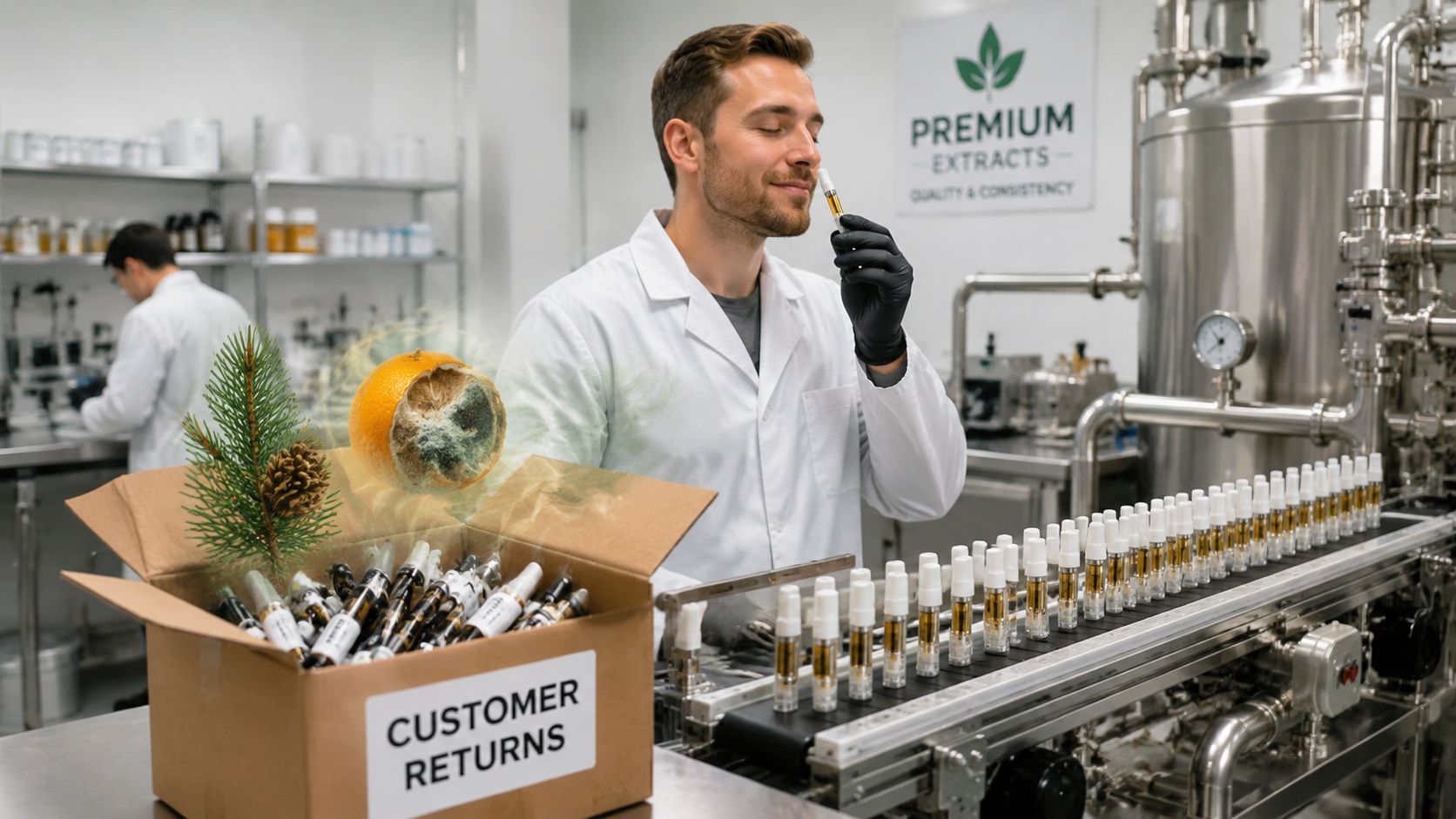
Temperature control is the part people underprice. In practical production, heat does not have to be extreme to push a terpene blend out of spec. Warm storage, repeated warming during transfer, and holding material in a room that is only a little too hot all shorten the useful life of the profile, while cooler storage keeps more of the original aroma intact for longer. That is not a packaging footnote. It is a formulation variable.
Practical rule: if a blend needs a hot room, a long open transfer, or a leaky closure to make it through production, the profile was never stable enough for the SKU.
The other mistake is treating finished goods as chemically identical to neat terpene drums. They are not. By the time a blend lands in a cart, concentrate, or infused paper, the matrix, surface area, headspace, and fill history all change how fast the aroma drifts. The same volatility that matters on the plant matters again in the package, which is why harvest timing and handling still matter before the material ever reaches formulation, as shown in the trichome harvest timing archive.
A useful internal reference for preservation practices is Terpene Belt Farms preservation guidance, but the core lesson is simpler. Every step in the workflow can add oxygen, heat, light, or residence time. Once that happens, terpene drift is no longer a storage problem alone. It is a process control problem.
The primary operational risk is cumulative exposure. Blending, pumping, filling, capping, warehousing, shipping, retail display, and consumer storage all add up. If any one step is sloppy, the batch can still pass launch and fail later.
The Core Chemistry Behind Terpene Degradation
A batch does not usually fail because one single reaction went wrong. Terpene degradation is a mix of oxidation, isomerization, polymerization, and thermal breakdown, and each pathway changes the profile in a different way. A cart that tastes flat because the bright top notes have fallen away is not failing the same way as a lot that has picked up a sharp, stale oxidation note.
Why monoterpenes fail first
Monoterpenes like limonene, myrcene, pinene, and terpinolene are the first to move because their double bonds give oxygen, UV-driven radicals, and heat a clear target. That is why the chemistry can shift quickly once the material is exposed during transfer, blending, or filling. For a basic refresher on terpene structure and reactivity, see the chemistry of terpenes overview.
Controlled degradation work shows how fast that shift can happen. In an in vitro rumen-fluid study, the pooled mean degradation rate for alpha-pinene was 0.036 h^-1 versus 0.001 h^-1 in the control, and limonene was 0.05 h^-1 versus 0.001 h^-1 in the control; beta-caryophyllene recovery was only about 30% of the initial dose in the test system controlled degradation study. The pattern is clear in that work, monoterpenes move faster than many sesquiterpenes.
Oxidation changes the molecule itself. Limonene and related compounds can form hydroperoxides, epoxides, aldehydes, ketones, and terpenoid oxides, which changes both aroma and analytical profile. The material may still smell terpene-rich and still be chemically shifted.
What the rearrangements actually do
Isomerization keeps the same atoms but changes how they are arranged, and that can create a different smell. Polymerization pushes smaller terpenes into heavier, less volatile masses that do not carry the same way in a cart or concentrate. Thermal breakdown adds another layer because heat can drive dehydrogenation, epoxidation, bond cleavage, and rearrangement.
Thermal degradation research on camphene, Δ3-carene, limonene, and α-terpinene showed oxidation in air producing products through those routes thermal degradation research. In production, that matters because a short thermal hold can leave a profile looking acceptable on paper while changing its chemistry.
A 2024 review on degradation products makes the larger point clearly, each terpene generates its own set of oxidation and cyclization products, and p-cymene shows up as a major aging product in cannabis flowers and extracts. That is why two blends stored under the same conditions can drift in different ways. One may flatten. Another may take on a harsher, stale edge. Same storage, different chemistry.
Key Drivers That Accelerate Terpene Loss
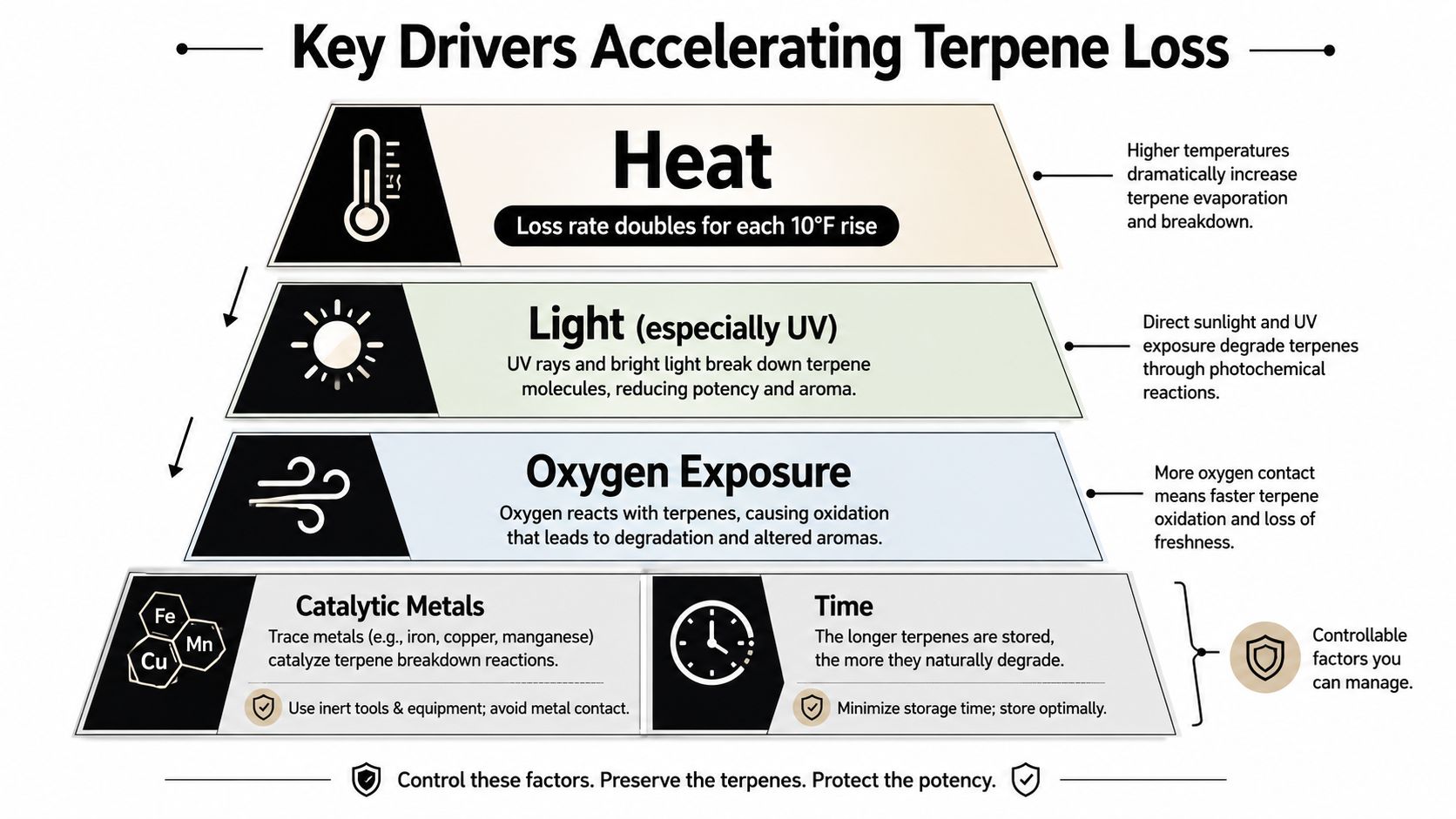
Heat is the first thing I check because it moves every other failure faster. Preservation guidance says terpene loss rates increase roughly twofold for each 10°F rise in temperature, and some terpenes start to degrade or evaporate at around 70°F (21°C) thermal acceleration benchmark. If a line runs warm, or a drum sits near a hot wall, you've already lost part of the profile before anyone notices.
The controllable drivers
Light, especially UV, drives photodegradation and hydroperoxide-radical formation. That's why clear jars and open fill areas are a bad pairing for bright monoterpene profiles. Oxygen in headspace fuels autoxidation continuously, even in packaging people call “airtight.”
Metals matter more than teams often admit. Trace iron and copper can catalyze oxidation, so a tank, valve, or transfer contact point can become a reaction surface. pH shifts also matter, especially in acidic distillate systems, where rearrangements can be catalyzed during blending or thermal hold. Diluents and carrier oils change volatility and partition behavior, so a blend can look stable in one matrix and fall apart in another.
A sealed container is not the same thing as a protected system. If the headspace is oxygen-rich and the package is transparent, the chemistry is still active.
What matters most by workflow
In a cart filling line, heat, open-air exposure, and metals matter first because they happen during active processing. In a concentrate jar, light and oxygen usually dominate because the product sits exposed longer. In a wholesale terpene drum, temperature stability and closure integrity usually decide whether the profile stays usable or drifts before first use.
A clean way to think about it is this, every driver increases reaction rate or exposure time. The fix is to reduce both.
How Degradation Changes Aroma, Potency, and Safety
The first sign is usually smell. Bright top notes drop out first because monoterpenes evaporate and oxidize faster, so the profile moves away from sharp citrus, pine, or sweet herb and toward heavier mid and base notes. In production terms, the cart smells flat, or it develops a peppery sharpness that was not present at fill.
Aroma drift follows note class
That shift is not random. Top notes are mostly the volatile monoterpene fraction, and those compounds are the ones most likely to disappear or transform early. Mid notes tend to survive longer, so the blend starts to feel less bright but still recognizable. Base notes like sesquiterpenes can persist much longer, which is why an aged profile often reads as heavier, woodier, or more resinous than the original design.
A controlled incubation study made the class difference obvious. After 24 hours, only 2% of initial alpha-phellandrene remained, losses ranged from 67% for delta-3-carene to 90% for (E)-beta-ocimene, while several oxygenated terpenoids were far more stable, with 100% of (E)-linalool oxide and 95% of (Z)-linalool oxide still intact incubation study. That is the sensory pattern you see in the lab and on the floor, bright material disappears first, while oxidized and oxygenated material lingers.
Safety and retest concerns are part of the same issue
Potency in this context is not cannabinoid potency, it is terpene profile fidelity. If the blend no longer matches the intended ratio, the cart no longer performs like the formulation on paper. That matters for strain replication, house-brand consistency, and any SKU where aroma is part of the value proposition.
Safety changes because oxidation products are not chemically neutral. As noted earlier, degradation can produce hydroperoxides, epoxides, and other transformed volatiles, and those products shift both the aroma and the irritation profile. For inhalable formats, that means a degraded blend can behave differently in the nose and throat than the material you released.
A practical retest plan needs to watch both composition and sensory drift. If a retained sample starts to smell harsher, flatter, or less aligned with the target profile, that is a formulation problem, not a cosmetic one. A strong chromatography testing workflow catches that shift before it shows up in customer feedback or a production hold.
Analytical Methods for Detecting Degradation
A final certificate of analysis only shows the state of the blend at the end of the line. It does not show what was lost, what oxidation products appeared, or how the profile drifted while the material sat in process or inventory. GC-MS remains the main tool because it identifies and quantifies individual terpenes, but the useful part is trend tracking across runs, not a single pass/fail snapshot.
What to read in the data
A stable chromatogram keeps its major peaks in a similar shape and ratio from one checkpoint to the next. Once degradation starts, the first sign is usually disappearing peaks, followed by new peaks that were not in the original mix, then a change in the balance between monoterpenes and sesquiterpenes. Headspace analysis matters because it measures the volatile fraction a consumer smells, not just what still sits in the bulk liquid.
The sampling plan should use fixed checkpoints so you can compare like with like. For a small brand, I would run initial, 30-day, 60-day, and 90-day data sets, then decide whether the blend is fit for release, reformulation, or tighter handling. A realistic accelerated screen means stressing retained samples under controlled conditions, then comparing that result with real-time storage. Finished carts, concentrates, and infused formats often behave differently from neat terpene samples, so a drum study should not be treated as a direct proxy for a packaged SKU.
For chromatography-specific method setup and interpretation, the chromatography testing workflow is the right place to anchor the lab plan.
A simple interpretation table
| Terpene Class | Examples | Refrigerated Shelf Life | Relative Stability |
|---|---|---|---|
| Monoterpenes | alpha-pinene, beta-myrcene, limonene | 6–12 months under refrigeration | Lower |
| Sesquiterpenes | beta-caryophyllene, humulene, bisabolol | 18–24 months in cool, dark conditions | Higher |
Those shelf-life class estimates align with preservation guidance that also notes monoterpenes are the more volatile group and sesquiterpenes are generally more stable in cool, dark storage. I would treat that table as a planning tool, not a guarantee. The matrix and packaging still decide the result.
GC-MS gives you identity and composition. Headspace shows what the consumer will smell. A stability schedule tells you whether the profile can survive your process.
Lab-Verified Strategies to Slow Terpene Degradation
The practical fix is layered because the failure is layered. Storage, packaging, formulation, and line handling all matter, and each one fails in a different way. Start with the controls you can enforce next week, then tighten the rest as the SKU proves out.
Storage and packaging that help
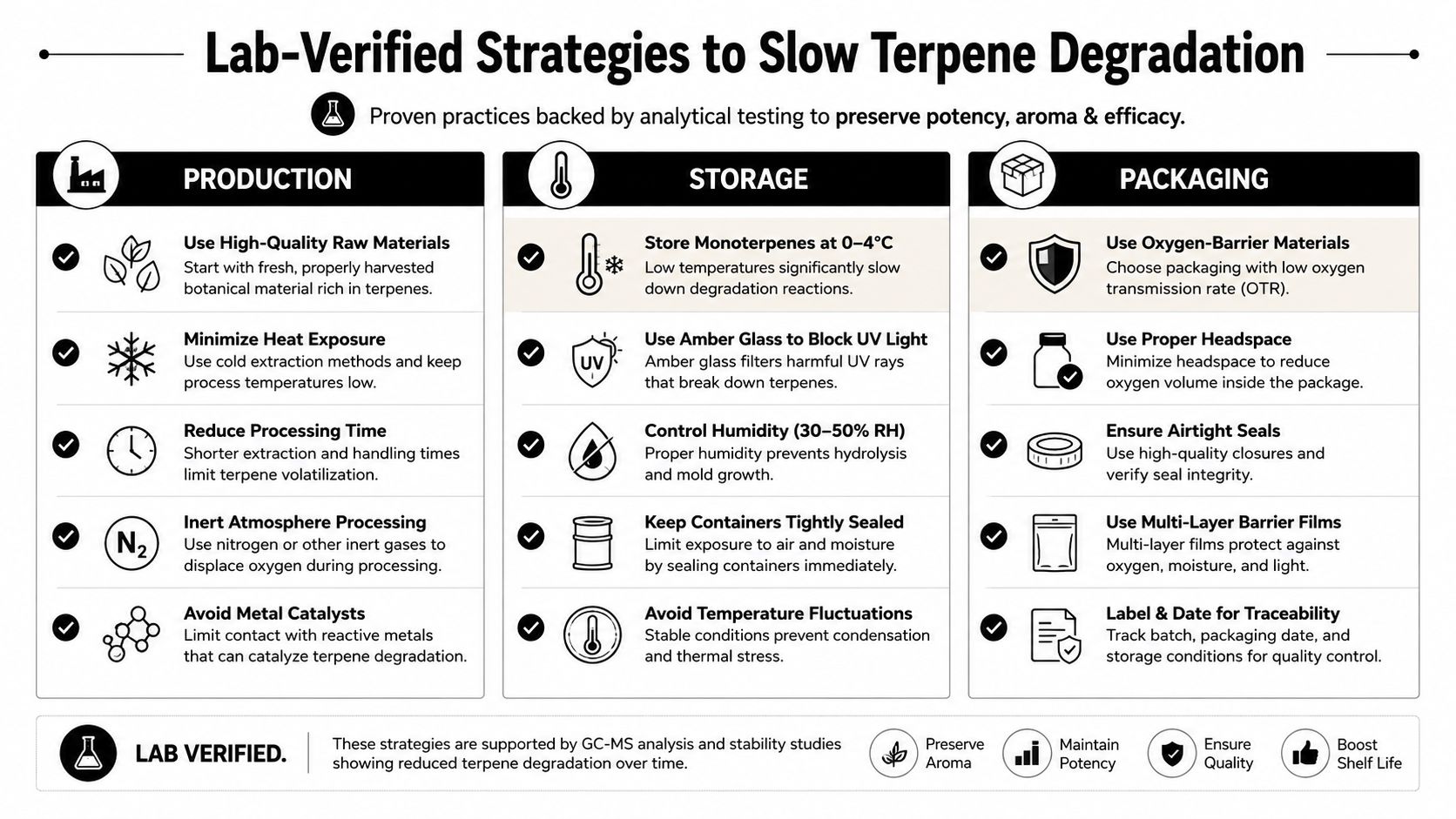
For storage, the benchmark matters. Keep monoterpene-heavy material cold, and keep sesquiterpene-rich material in cool, dark conditions when refrigeration isn't practical. The earlier preservation guidance supports 35–45°F for long-term retention and 60–70°F only as a less aggressive compromise. If the container is opened often, inert blanket gas helps. Nitrogen or argon blanketing reduces oxygen exposure after the seal is broken.
Packaging has to do three jobs. It needs to block UV, minimize oxygen, and reduce the amount of headspace a terpene can sit in. Amber glass, aluminum-based barrier materials, and tight closures all make sense here. Desiccant can help with moisture management in the right package, but it won't fix oxidation by itself.
Operational rule: if the package protects against light but not oxygen, or oxygen but not light, you are only solving half the problem.
Formulation and processing controls
Antioxidants can have a role, but they are not a magic shield. Alpha-tocopherol and ascorbyl palmitate are used as antioxidant options in formulation work, though inhalable applications need restraint and validation before anything is added to a commercial SKU. The bigger win is process discipline, not additive reliance.
If you are building a cartridge or concentrate, add terpenes late in the process and keep mixing temperatures low. Avoid metal hardware where possible, especially on transfer surfaces that sit in contact with the blend. Keep the fill line moving, because dwell time in open air is another oxidation window.
Gold Coast Terpenes offers terpene profiles and isolates that fit this kind of work, but the chemistry still depends on how you handle them. For a practical reference on handling, use the how to store terpenes guide as a control check, not a sales page.
A Practical Testing Schedule and Production Checklist
A blend that looks clean on day one should not be approved from a single panel. Run a full analytical panel at initial fill, then keep retained samples and test them again at 30 days, 60 days, and 90 days before release decisions. If the SKU will move through warm distribution channels or sit in retail storage, add an accelerated screen early so you can see where the profile starts to drift.
A practical schedule is simple enough to run without turning the lab plan into busywork. Keep the retained samples in the same package format, log the storage conditions, and compare chromatograms side by side. If the bulk oil looks stable but the finished cart does not, the bulk result is the one that misleads you.
A workable schedule
- Initial panel: Confirm identity, ratio, and headspace behavior at launch.
- 30-day check: Look for early peak loss or new oxidation peaks.
- 60-day check: Compare volatile top notes against the original signature.
- 90-day release decision: Decide whether the profile is stable enough for broad distribution.
- Annual verification: Reconfirm the blend against current process conditions.
That schedule gives you a real read on how the blend behaves after fill, after packaging, and after time in the channel. In production, the first failure often shows up as a shifted top note or a new oxidation peak long before the aroma is obviously off.
Daily production checklist
- Storage temperature verified: Catch hot spots before they touch the blend.
- Headspace checked: Less oxygen means less autoxidation.
- Fill-line temperature logged: Heat exposure during filling is a real loss point.
- Antioxidant concentration confirmed: Don't guess after compounding.
- Finished-cart retention sampled: Confirm the product that leaves the line still matches the profile you built.
Use the same checklist on every run. A small drift in fill temperature, headspace, or antioxidant dose can change the finished profile more than a long conversation about storage ever will.
For practical formulation support, the next step is usually the Terpenes 101 guide and a mixing workflow that keeps ratios repeatable. Gold Coast Terpenes also provides a Mixing Calculator that helps teams translate a target profile into a usable batch plan.