
You can dial in a terpene blend on paper, load it into a tank, and still end up with a product that smells right in the beaker but falls flat on the finished substrate. That gap between bench success and line performance is where spray on flavor earns its place. In cannabis formulation, the job isn't just adding aroma, it's getting that aroma to land evenly, survive handling, and still read clearly when a customer opens the package or takes the first draw.
Why Spray-On Flavor Changes Cannabis Formulation
The failure mode is familiar. A formulator builds a clean profile, the batch looks uniform, and the first few units smell right. Then the product gets packed, stored, shipped, and sampled, and the sensory result changes from one unit to the next. That's exactly where spray application matters, because it lets you add flavor after the bulk product is already formed, instead of hoping a blend stays consistent all the way through processing.
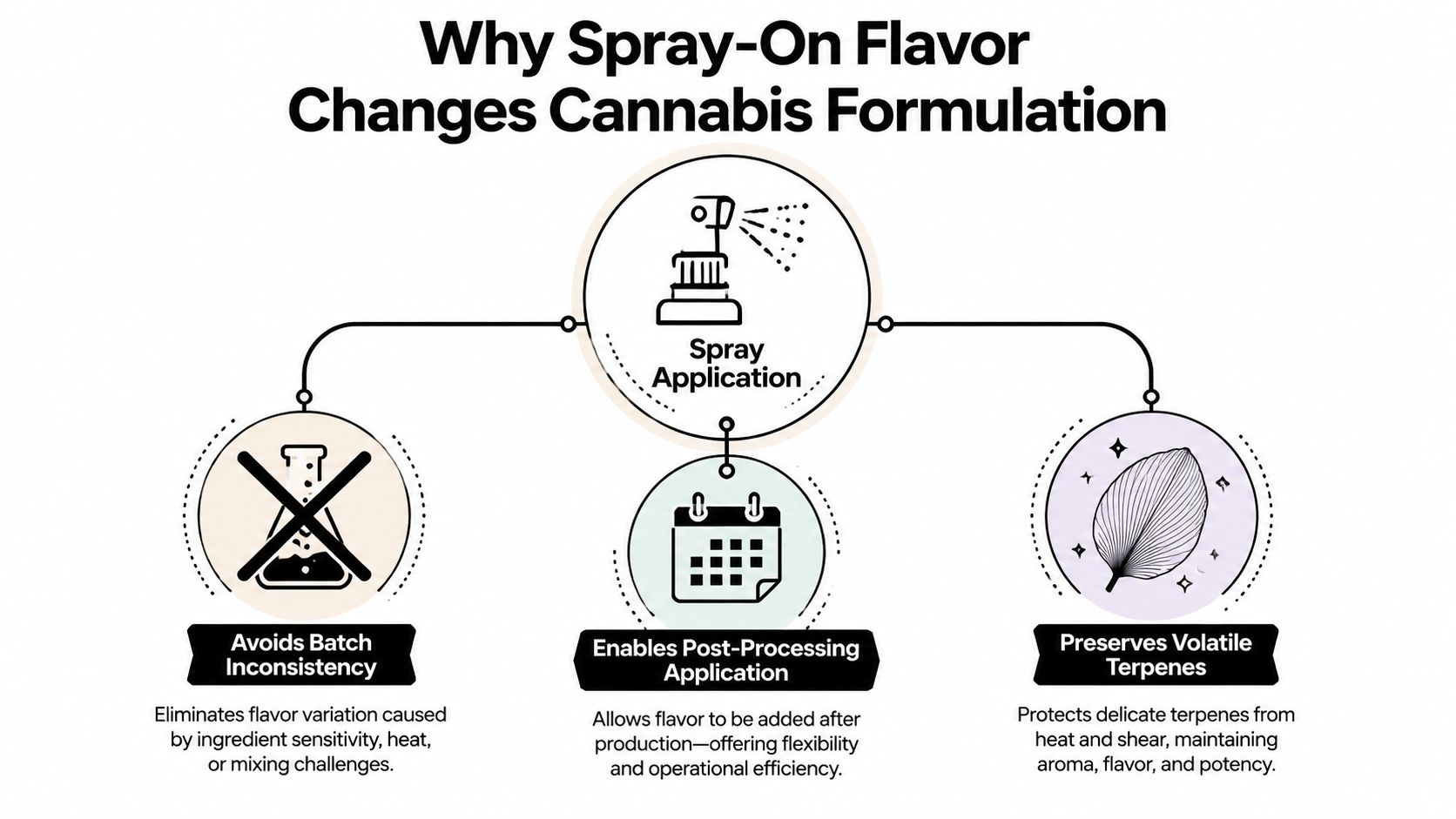
Why the process became commercially useful
The commercial history matters here. A historical review notes that spray-dried volatile flavors were invented and manufactured in quantity in England in 1932, and by 1981 worldwide sales of perfumes and flavors were estimated at $4.2 billion, with one estimate placing flavors alone at $1.45 billion. That growth only happened after industry learned how to stabilize volatile aroma compounds for production and distribution, which is the same problem cannabis formulators still face when they try to deliver flavor without losing the top notes in handling. Historical review of flavor spray drying
Practical rule: if the product can't be re-mixed after it's formed, spray application usually gives you more control than batch blending.
The broader aerosol world shows the same pattern. The European Aerosol Federation says the decisive breakthrough for modern aerosol delivery came in the 1920s and 1930s, and that in 1998 more than 10 billion aerosols were manufactured worldwide, with Europe accounting for 44% of total production. European Aerosol Federation history That scale is the reason spray formats are not a novelty. They're mature delivery systems built around portability, dosing control, and repeatability.
For cannabis product formulation, that matters in three places. Pre-roll enhancement needs surface application without soaking the flower. Finished edibles can't always be reworked in bulk once they're set. Topical and cartridge-adjacent formats often need a final sensory correction after base processing is complete. In each case, the spray isn't replacing formulation skill, it's giving the formulator a better point of control.
The deeper lesson is that spray-on flavor rewards precision. The market that grew around volatile aroma materials became highly formulation-driven, and the same dynamic shows up in cannabis today. If you want a spray system to work, you need the right carrier, the right atomization, and a profile that survives the process instead of only smelling strong in the first minute.
When to Choose Spray Application Over Batch Mixing
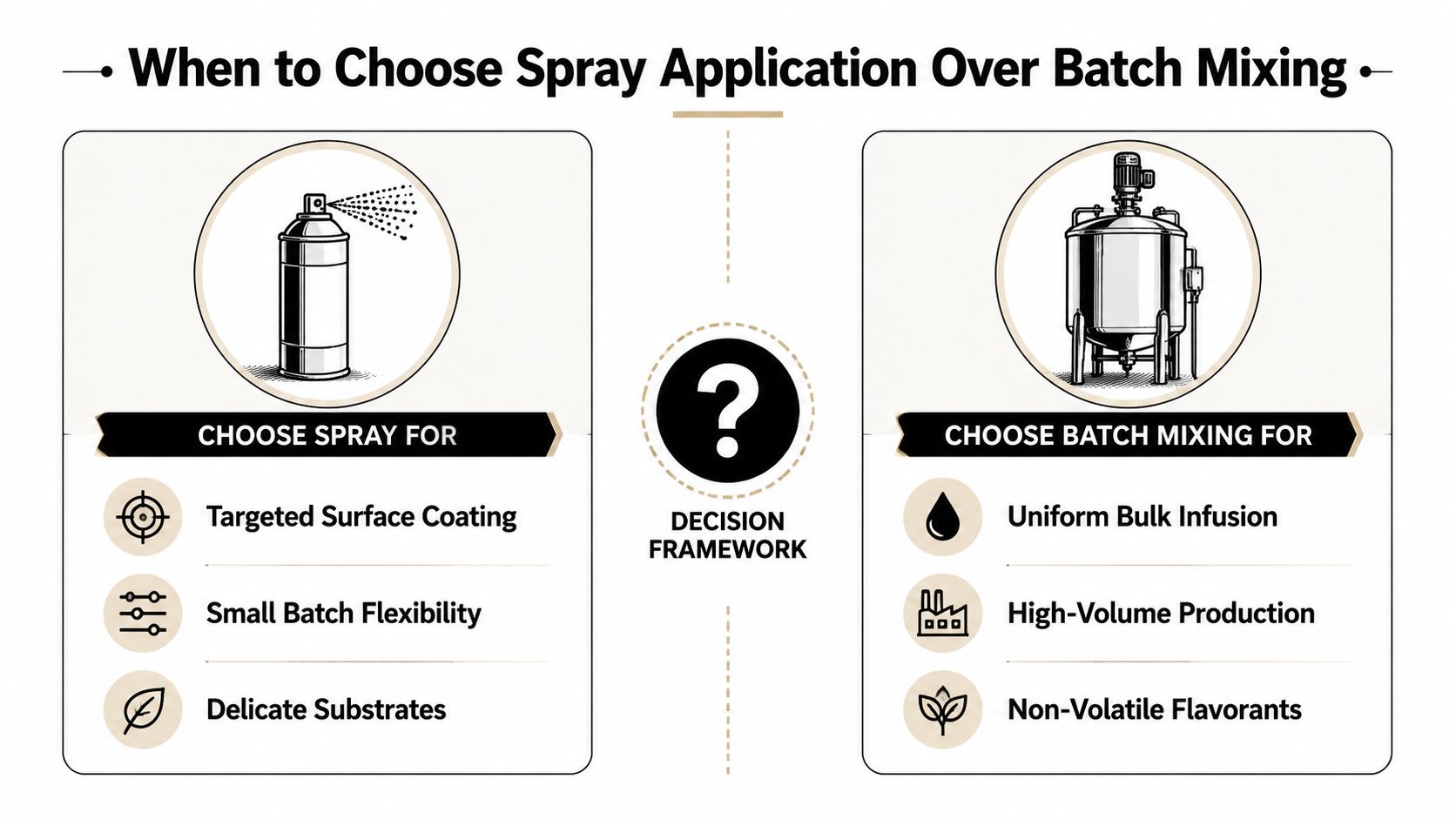
Not every product should be sprayed. Batch mixing still makes sense when the substrate is easy to blend, the flavorants are stable, and you want uniform bulk infusion with minimal downstream handling. Spray application earns its keep when the product is already finished, fragile, or hard to reprocess without damaging texture or sensory balance.
The decision is mostly about the substrate
For pre-rolls and flower, spray application is useful when the goal is a light, even finish instead of a wet or patchy surface. The literature notes that flavor dispersed or slurried in oil can be sprayed directly onto the product, but it's mainly suitable for thin goods, which is a reminder that penetration and uniformity are limited compared with in-process encapsulation. Spray-applied flavor on finished goods
For edibles, spray makes sense when the item can't be re-mixed after cooking, molding, or setting. A syrup, coating, or oil blend may work well during formulation, but once the product is finished, a spray gives you a controlled way to add aroma without rebuilding the whole batch. That's especially true when you need a top-surface sensory correction rather than a fully integrated flavor matrix.
For cartridge and concentrate workflows, spray is useful when the flavor adjustment happens late in the process and the base oil is already locked in. A batch mix can still be superior for liquid blends that tolerate uniform blending, but the spray becomes valuable when the final sensory tuning has to happen after viscosity, fill weight, or packaging constraints are already set.
Practical rule: choose spray when you need a post-processing correction, choose batch mixing when you need whole-batch uniformity from the start.
The decision framework is simple. If the substrate is delicate, finished, or hard to remix, spray wins. If the flavorant is non-volatile and the material can be homogenized without risk, batch mixing is usually easier and cheaper to control. That's why spray systems often show up in commercial lines after the formulation team hits a wall with consistency, not before.
For a practical starting point, this spray application archive note is useful as a reference point for how the category gets discussed in product development circles. The takeaway is that spray isn't a universal upgrade, it's a precision tool for cases where the product structure blocks traditional blending.
Selecting Terpene Profiles That Work With Spray Equipment
Terpene selection matters more in spray systems than it does in simple liquid blending. Atomization exposes the blend to heat, air, and surface area at the same time, so profiles that look similar in a bottle can behave very differently at the nozzle. If the profile ignores volatility and molecular weight, the first impression may be strong while the finished product loses its character fast.
Volatility should drive the profile, not branding
Process literature on flavor retention points to higher-molecular-weight flavor molecules as better candidates for spray work, because they are less likely to volatilize during atomization and drying. That is why compounds like Beta-Caryophyllene and Humulene usually hold up better under spray conditions than highly volatile notes that flash off quickly. In practice, a spray-ready blend needs to carry its identity through the middle and base notes, not rely only on a fragile top-note burst.
A useful way to read the profile is in layers:
- Top notes give the first impression, but they are the easiest to lose during spraying.
- Mid notes hold the aromatic identity of the blend.
- Base notes anchor persistence and keep the spray from feeling thin after application.
The process review on flavor spray drying describes a standard sequence, infeed preparation, atomization, hot-air drying, and cyclone collection, and it also makes clear that infeed design affects retention because the carrier system, solids-to-water ratio, and particle-size distribution shape how the material survives drying. That same logic applies to spray-on terpene work. A profile with too much volatility can smell loud at the nozzle and disappear on the substrate before it has time to settle.
How to read a profile for spray compatibility
The right question is not whether a strain-inspired blend smells right in the jar. The question is which components will still be present after application. A strain-inspired terpene blend with a firmer base usually survives spray handling better than one built almost entirely on delicate top-note compounds. For formulators who want a practical reference point, the terpene flavor guide is useful for matching flavor intent to application method.
| Terpene | Molecular Weight | Volatility | Spray Retention | Best Application |
|---|---|---|---|---|
| Beta-Caryophyllene | Higher | Lower | Better | Base note support in sprays |
| Humulene | Higher | Lower | Better | Base note support in sprays |
| Limonene | Lower | Higher | More fragile | Bright top-note correction |
| Myrcene | Lower | Higher | More fragile | Use with stronger carrier control |
For vape cartridge work, the safer path is usually a profile with more structural weight and less dependence on fleeting top notes. For flower enhancement, brighter notes can work, but only if the carrier and spray method keep them from disappearing before curing. For edible surface application, a layered profile usually performs better than a one-note citrus burst that fades after packing.
Carrier choice changes the outcome as much as the terpene list itself. A profile can be chemically acceptable and still spray poorly if the carrier holds droplets too long, breaks the pattern at the nozzle, or lets the most volatile fractions separate before they land. That is why profile selection has to be matched to equipment precision, not just aroma preference.
Keep the profile honest. If the spray has to work hard just to smell strong on day one, it usually will not hold up in production.
Precise Dilution Ratios and Dosing Calculations
Most spray failures start with simple math mistakes. The blend may be chemically sound, but once the concentration is too high, too low, or unevenly distributed, the product gets hard to sell and harder to reproduce. Good formulation work starts with a target concentration, then backs into carrier choice, spray weight, and test runs before anything leaves the bench.
Start with the target, then calculate the batch
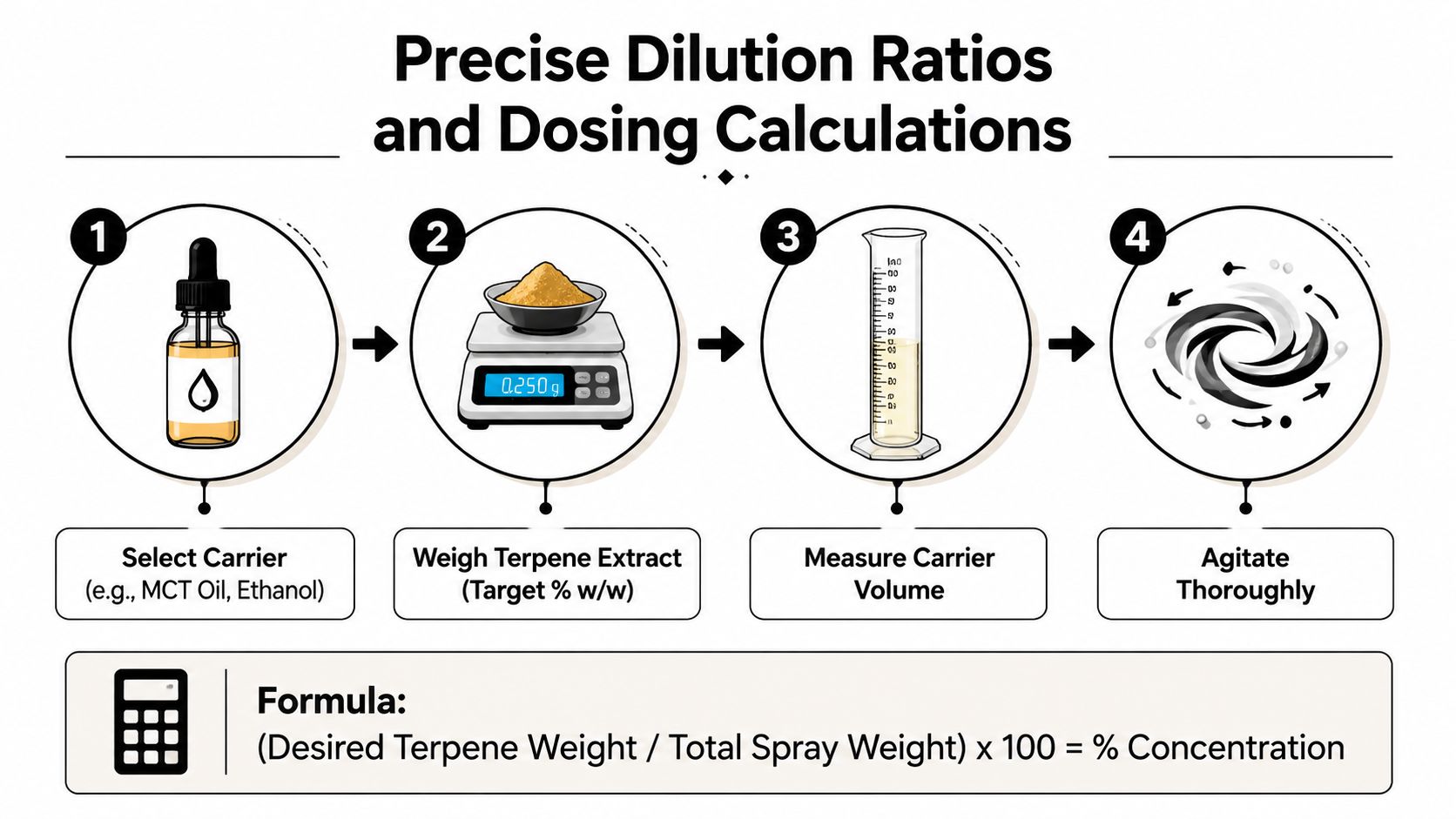
The basic formula is straightforward. Use (Desired Terpene Weight / Total Spray Weight) x 100 = % Concentration. For any spray system, that percentage has to be chosen around the substrate and the final sensory target, not around whatever volume happens to be convenient in the tank. A mixing ratio calculator can help document those adjustments and keep the math consistent from one batch to the next. mixing ratio calculator
A few practical ranges are common in formulation work, but they still need validation against the actual product:
- Flower enhancement: start in the lower spray range and build slowly, because surface saturation shows up fast.
- Vape cartridge post-filling adjustment: use a tighter target window, since the base oil is already fixed.
- Edible surface application: keep the spray light enough to avoid texture changes or visible wetting.
Carrier choice matters as much as terpene load. A blend can look fine on paper and still spray badly if the carrier holds droplets too long, breaks the pattern at the nozzle, or lets the most volatile fractions separate before they land. That is why the formulation has to support the droplet long enough to reach the substrate, spread in a controlled way, and stay there after application. The Flavor spray drying temperature and retention review is a useful reminder that feed properties shape retention during atomization, even if the process itself is not identical to cannabis spray use.
Use test sprays before you scale
Bench work should never go straight to production. Run a small test on the actual substrate, check whether the spray beads, streaks, or disappears too quickly, then adjust. If the surface looks wet but the sensory result is weak, the formulation may be too dilute or the droplet size may be too fine. If the surface smells strong at first and drops off fast, the volatile fraction is probably getting lost before it has time to bind to the product.
Practical rule: start low, document every adjustment, and only scale after the same result repeats on the real substrate.
The point of precise dilution is not just saving terpene cost. It prevents a batch that smells right in the room but fails once it is packed, stored, and opened by a buyer. That is the kind of error that shows up late and costs the most to fix.
Equipment Selection and Spray Method Optimization
A spray system can make a good flavor blend perform well or expose every weakness in the formulation. If the droplet is too coarse, too fine, or pushed at the wrong pressure, the carrier and terpene phase will not land the same way on every unit. That is why equipment choice is not a side decision. It controls whether the application gives steady flavor across the batch or a strong first impression that fades unevenly.
Match the sprayer to the product
For flower enhancement, fine-mist atomizers usually fit better than heavy spray heads because they spread a light coating without soaking the material. For edible surfaces, a wider spray pattern can help cover uneven shapes and shallow contours. For cartridge or concentrate post-processing, precision nozzles give tighter control when the target zone is small and the margin for over-application is narrow.
Droplet behavior matters as much as nozzle style. Smaller droplets can give cleaner coverage, but if the system leaves the mist too open, the more volatile fractions can drift or flash off before they settle. That trade-off is easy to miss when a spray smells strong in the room but does not hold up after curing, packing, or opening. A raw terpene spray reference can help frame how unprocessed application behaves before you commit to a production setup.
What to check before you buy a system
- Droplet size: smaller droplets give finer coverage, but can increase loss of volatile aroma if the system is too open.
- Spray angle: narrow angles concentrate application, wider angles help with surface coverage.
- Flow rate: too high, and you wet the substrate instead of coating it.
- Pressure consistency: unstable pressure creates uneven dosing from pass to pass.
Maintenance changes the result just as much as the hardware. Terpene buildup in nozzles alters the spray pattern, and once the pattern starts drifting, the dose does too. Clean the head, verify flow, and calibrate the system on the actual substrate, not just water in a test cup. That matters in small-batch work, where a handheld atomizer can look acceptable on one tray and drift badly on the next.
The best setup is the one that repeats the same droplet behavior every time. On the line, consistency beats impressive specs.
Common Formulation Mistakes and How to Fix Them
Most spray-on flavor problems are predictable. They show up after application, but the root cause is usually in the prep, the carrier, or the spray pattern. Once you know what each failure looks like, you can fix a lot of it without scrapping the entire batch.
The four problems that cost the most
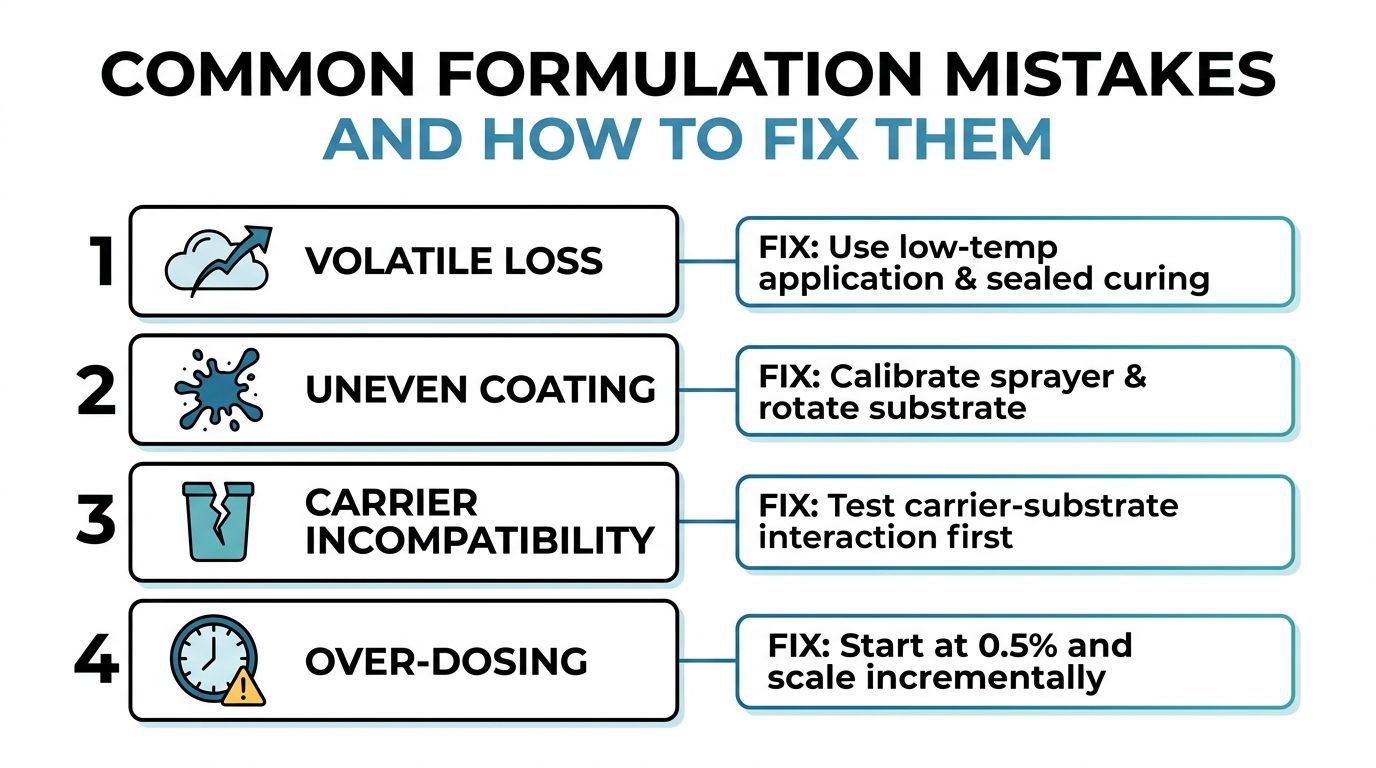
- Volatile loss: the spray smells strong right after application, then fades too quickly. The fix is to use lower-temperature application where possible and keep the product sealed through curing or hold time.
- Uneven coating: some areas carry the flavor, others don't. The fix is to calibrate the sprayer, control distance, and rotate the substrate during application.
- Carrier incompatibility: the blend separates, clouds, or creates off-notes. The fix is to test carrier-substrate interaction before the full batch.
- Over-dosing: the flavor overwhelms the product or creates an unbalanced finish. The fix is to start at a low load and scale incrementally.
The process literature already explains why volatile compounds are fragile in spray systems, and recent review work says spray drying remains dominant even though retention limits have driven innovations like vacuum low-temperature drying, ultrasound assistance, and monodisperse atomization. Recent review on volatile retention challenges That's not just an academic point. In production, it means you have to respect the volatility of the profile instead of assuming a strong initial aroma means the batch is stable.
Decide whether to correct or scrap
If the issue is coverage, you can often correct it with equipment adjustments and a second pass. If the issue is carrier incompatibility, the batch may need to be reworked or discarded, depending on how far the off-note has traveled through the material. If the issue is volatile loss, the fix is usually upstream, because once the aroma is gone, you can't spray it back in cleanly without risking a different failure.
A simple discipline prevents most of these problems. Log the carrier, the nozzle, the distance, the substrate, and the batch weight every time. When a problem repeats, the documentation usually points to the failure faster than guesswork does.
Quality Control Testing and Regulatory Compliance
Spray application creates more points of failure than simple batch mixing, so the quality control plan has to be tighter. The product has to pass on concentration, coverage, stability, and sensory consistency, and the documentation has to show what was sprayed, how it was tested, and whether the result stayed within spec.
Testing should match the risk
GC-MS analysis is the cleanest way to verify terpene concentration. Coverage uniformity needs visual inspection paired with sampling protocols so you can confirm the spray didn't pool or miss zones. Stability testing should use accelerated aging to reveal whether the aroma holds or fades too quickly. Sensory evaluation still matters, but it works best as a blind check against a defined target profile rather than a subjective yes-or-no tasting session.
Practical rule: if you can't prove concentration and coverage, you don't really know what the customer will experience.
The compliance side is just as important. Brands should verify THC-free status where required, exclude prohibited solvents such as VG, PG, PEG, and MCT, and keep batch traceability tight enough that every sprayed lot can be tied back to its inputs. Gold Coast Terpenes offers lab-verified, THC-free terpene products that are free of those solvents, which can simplify parts of the documentation flow when a formulation team is building a compliant spray system.
The practical goal isn't paperwork for its own sake. It's avoiding a batch that looks fine in the filling room but fails once someone asks for proof of what was applied, where it was applied, and whether it stayed consistent over time. Good QC turns spray-on flavor from a creative idea into a repeatable production tool.
If you're building a spray-on flavor system for cartridges, concentrates, flower enhancement, or finished goods, Gold Coast Terpenes can help with strain-specific profiles, isolated compounds, and lab-verified THC-free options that fit formulation work. Visit Gold Coast Terpenes to review terpene products, mixing resources, and formulation support before your next production run.