
The lab smelled fine on Friday. By Monday morning, the top notes in a strain-inspired blend had gone dull, and the batch that was supposed to move into cart development now needed a fresh adjustment, a new test mix, and another slot on the production calendar. That's the part people underestimate. Temperature control storage is not just about keeping terpenes “cold,” it's about keeping the profile intact long enough for the formula to reach packaging without losing the note that made it worth buying in the first place.
A lot of labs still treat this like a simple fridge decision. It isn't. Once a terpene profile arrives, it needs a small controlled system around it, one that protects flavor, aroma, and blend behavior from receiving dock to dosing bench. For practical storage guidance that starts with the basics, Gold Coast Terpenes' storage guidance is a useful reference point.
Why Temperature Control Storage Matters for Terpenes
The mistake usually happens on a normal week. A lab manager leaves a sealed profile in a stockroom, the HVAC drifts, the room hits a warm patch over the weekend, and by Monday the blend no longer smells like the sample that passed approval. That kind of miss doesn't just change aroma. It can trigger a reformulation cycle, stall a production slot, and push a launch date because the formula no longer matches the target profile.
Terpenes are fragile in a way that distillate often isn't. A strain-inspired blend can lose its top-note clarity long before a base oil looks or pours differently. That's why “room temperature” is not a stable storage plan, it's a moving target that changes with the building, the season, the door schedule, and the equipment next to the shelf.
What the product is really protecting
For formulation work, temperature control storage protects more than freshness. It protects the part of the profile that makes a Blue Dream-style blend bright, or an OG Kush-inspired profile heavy and earthy, or a Forbidden Fruit-style blend distinct enough to replicate from batch to batch. If the storage zone swings, the lab starts compensating for a problem that should never have reached the bench.
Practical rule: if a terpene SKU can change how it smells after a warm weekend, it should not be treated like ordinary inventory.
That's the point of this guide. Not buying a refrigerator for the sake of a refrigerator, but building a validated storage system that keeps terpenes within spec from arrival to dosing. For formulators, extractors, and brands, that's the difference between a repeatable SKU and a moving target.
How Terpenes Degrade When Storage Goes Wrong
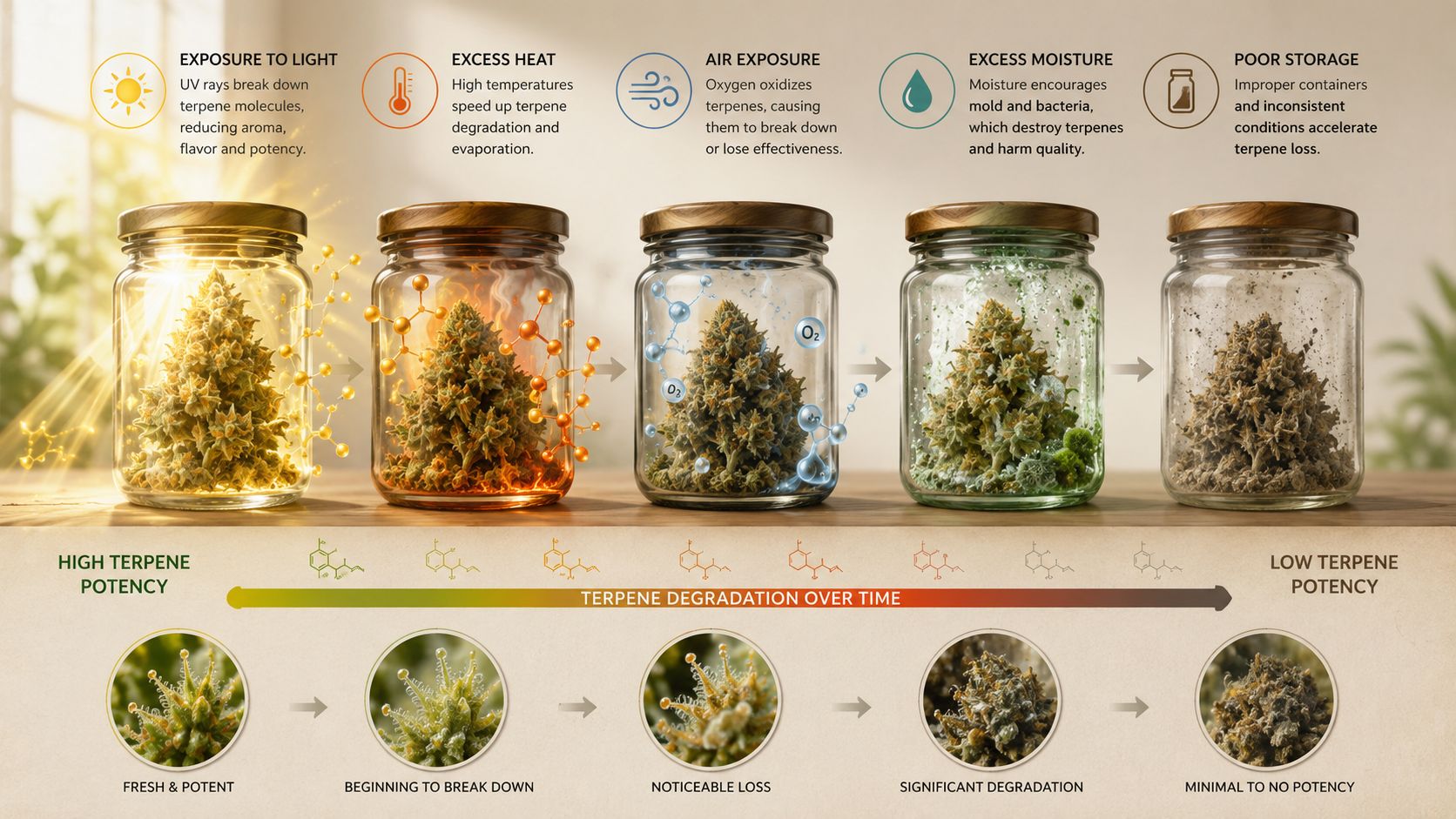
Heat, air, and light attack terpenes in different ways, but the practical result is the same. A clean profile turns flatter, less bright, and harder to reproduce. In a cart or concentrate, that can show up as a dull top note, a heavier texture, or a formula that no longer matches the sample locked by the brand team.
Oxidation changes the top note first
Oxidation is usually the first failure you notice because it hits the most expressive molecules. Limonene, myrcene, and pinene are especially vulnerable, and once oxygen starts reacting with them, the profile loses freshness fast. Oxidation creates surface degradation on the molecule, so the aroma still exists but the clean edge is gone.
The practical risk is highest in top-note-heavy profiles, where brightness is the selling point. If the first impression disappears, the whole blend can feel old even when the bottle is still sealed. For a formulator, that means the retail product no longer matches the approved scent target. To reduce that risk, keep oxygen exposure low from the start and use the handling practices in this terpene oxidation guide.
Polymerization thickens the blend
Polymerization is the mechanism that makes a blend behave like old paint. Reactive terpenes link into heavier structures, and the result can be a slower-moving, more viscous material that does not dose or atomize the same way. In cart development, that matters because viscosity and flavor delivery are connected.
If the product starts thickening, the hardware has to work harder. Wicks and oil paths that were fine in the lab can become less forgiving in production. The formula may still be technically usable, but it is no longer behaving the way the process team validated it.
Isomerization shifts the sensory target
Heat can also rearrange delicate molecules into forms that do not smell or read the same. With compounds such as beta-caryophyllene oxide and linalool, that kind of shift can change the perceived profile enough to throw off the labeled target. Heat rearranges delicate molecules into forms that don't smell or read the same.
For a brand, that matters because the profile is part of the product promise. If storage changes the sensory balance, the SKU may no longer replicate the original strain-inspired intent.
For oxidation-focused handling practices, this terpene oxidation guide is worth keeping close to the bench.
Choosing the Right Temperature Band for Each Product
Cold storage is not one number. A working lab often needs multiple bands at once, because a sealed strain-inspired blend, an open bench sample, and a bulk isolate do not face the same risk. The right choice depends on how long the SKU will sit, how much air it sees, and how sensitive the blend is to loss of top notes.
Match the band to the product, not the habit
Use controlled ambient for short-term working stock that is opened often, refrigerated storage for most sealed blends and pre-mixes, and frozen storage for bulk isolates and long-term references. The point is not to keep everything as cold as possible. The point is to keep each product in the narrowest safe zone that preserves its sensory target and handling behavior.
Practical rule: the more often a container opens, the less useful extreme cold becomes, because repeated warming and re-cooling create their own risk.
| Storage Bands by Product Type | ||
|---|---|---|
| Temperature Band | Product Type | Primary Risk Mitigated |
| +15°C to +25°C | Opened working stock, bench samples | Fast oxidation from repeated handling |
| +2°C to +8°C | Sealed terpene blends, distillate pre-mixes, finished carts waiting for packaging | Aroma drift and slow degradation |
| -25°C to -15°C | Bulk isolates, long-term isolate storage, reference standards | Long-term chemical drift and profile loss |
Why the same lab may need all three
A formulation room, a packaging room, and a sample archive each have different storage needs. A sealed bottle of a strain-inspired blend sitting in a refrigerator is not the same problem as a bulk isolate in deep freeze, and neither one behaves like a working bench bottle that gets opened all day. If you force every SKU into one band, you usually end up overhandling some products and underprotecting others.
The same logic applies to product purpose. A reference standard needs stability first. A finished cart waiting for packaging needs sensory integrity first. An open bench bottle needs convenience first, but still can't be left warm for long stretches.
For more background on how temperature affects aromatic behavior across profiles, this terpene temperature reference is a useful companion.
Containers, Headspace, and Inert Gas Best Practices
Temperature only works if the container supports it. A perfectly chilled bottle with too much air above the liquid can still oxidize faster than a slightly warmer bottle packed correctly. In practice, packaging decisions often decide whether the storage system succeeds or fails.
Pick the vessel based on the SKU
Amber glass is the default for most strain-inspired terpene blends because it blocks light better than clear glass and keeps the profile visually easy to inspect. Clear glass is fine for short inspection windows, but it is a weaker choice for routine storage because light exposure adds avoidable stress. Stainless steel makes more sense for bulk where durability, low permeability, and clean transfer matter more than sightline.
For larger containers, fluorinated drums or similarly low-permeability bulk packaging are the right move when the goal is to protect expensive inventory over time. HDPE can work in some workflows, but it is more of a handling compromise than a long-term ideal for delicate terpene lots.
Control the air above the liquid
Every bit of headspace carries oxygen and moisture, which means every extra pocket of air becomes part of the degradation problem. For opened working containers, keep headspace under roughly 10%. For bulk containers, aim for near zero whenever practical. That simple rule often does more for shelf stability than another degree or two of refrigeration.
A quick nitrogen or argon purge before capping is the easiest upgrade for high-value or opened material. It doesn't change the formula. It just removes the oxygen sitting above it.
Practical rule: if a bottle must be opened repeatedly, move a small portion to a working vial and keep the master container sealed as much as possible.
For terpene safety and material handling details, Gold Coast Terpenes' limonene SDS page is a practical document to keep in the SOP binder.
Designing a Cold-Chain Protocol for Transport
The storage problem doesn't stop at the lab door. Shipping is where a lot of good temperature control work falls apart, because a profile that stays stable on a shelf can still drift in a truck, a warehouse, or a weekend hold. A real cold-chain protocol starts before the box leaves the dock.
Build the pack-out around the warmest point
Use pre-conditioned phase-change packs, not loose ice or whatever is available in the break room freezer. Pair them with an insulated mailer or expanded polystyrene shipper, then place the product inside a secondary inner bag to protect it from condensation and accidental leaks. The key detail is the logger. Put a single-use USB temperature logger at the warmest expected point in the box, because that is where a failure will show up first.
For receiving, the process needs to be just as strict. Log the data the moment the shipment arrives, compare it to the validated band, and quarantine anything that shows an excursion. Record the lot, batch, and corrective action before the material goes back into storage or moves into production.
Choose carriers like the product is perishable, because it is
Weekend avoidance matters. So does a transit time ceiling that matches the formula's sensitivity. If the carrier can't deliver before a hold period, the shipment shouldn't go. A signature requirement helps keep product out of weekend truck storage, where the temperature can drift long before anyone notices.
The simple standard is this. If a lab is promising that a Forbidden Fruit-inspired blend will taste the same in six weeks, the shipment path has to support that promise from the first pack-out to the last receiving check. The cold chain is part of formulation, not a separate logistics task.
Household vs Purpose-Built Storage Equipment
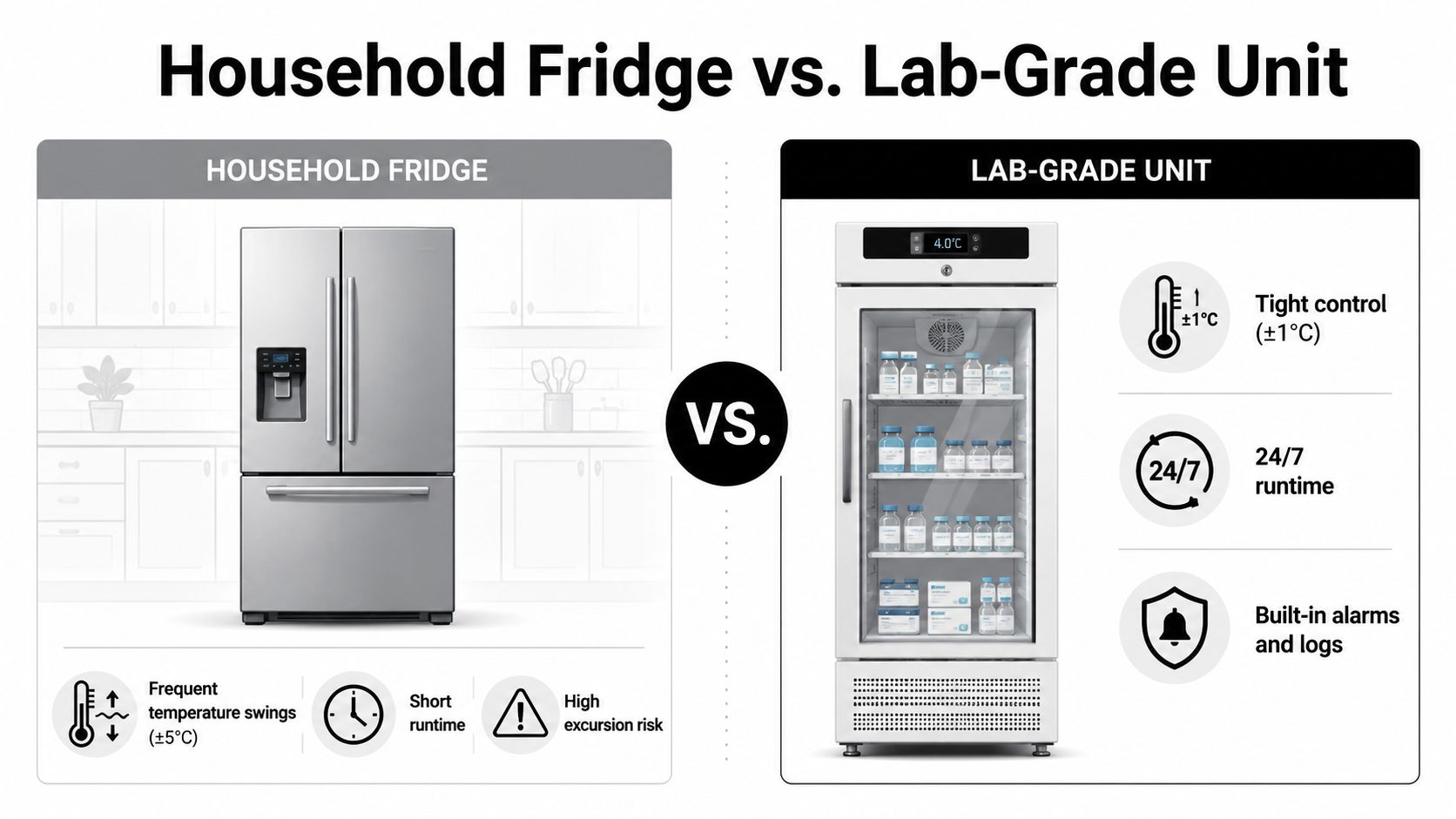
A domestic refrigerator can look like the easy answer because it is already in the building and feels cold enough. For terpenes, that usually turns into false savings. Household combination refrigeration units maintained normal temperatures 98.9% of the time in one study of 43,951 hours of observation, while purpose-built units reached 99.9% normal runtime WHO guidance and the cited study. The freezer side showed the gap even more clearly, with household-grade combination freezers normal only 95.0% of the time versus 99.3% for stand-alone freezers, and combination units averaging 13.6 excursions per 30 days versus 1.5 for purpose-built units.
Why domestic units fail in real use
The problem is not only temperature capability, it is how the unit is used. People open household refrigerators for lunch, drinks, samples, and random storage, and every opening pushes warm air across the load. Defrost cycles add more warming, which is exactly the kind of repeated stress that can speed terpene loss and shift a stored profile.
Combo units create another weak point in the freezer compartment. During normal use, that section can drift above ideal storage behavior, which exposes long-term inventory to avoidable excursions. A terpene blend does not need a unit that is “usually cold.” It needs a storage zone that stays inside its validated band with enough margin to survive door openings, defrost recovery, and daily traffic around the lab.
Purpose-built units handle that differently. They recover faster after door openings, hold tighter tolerances, and usually include alarm outputs that make an out-of-spec event visible before the batch sits warm for long enough to matter. That matters because each quiet miss increases the chance of oxidation, aroma drift, and a batch that no longer matches its original sensory target.
A practical buying framework
For a small lab holding only a modest amount of inventory, the minimum bar is a dedicated lab refrigerator paired with a separate lab freezer. That gives you cleaner zone separation and less cross-talk between daily use and stored material. Once inventory value rises and the SKU count grows, purpose-built units become easier to justify because they reduce the cost of excursions, rework, and batch loss.
The market is moving in the same direction. One report projects the global temperature-controlled warehousing market to reach $75.4 billion in 2025 and $176.8 billion by 2034, with an 11.2% CAGR. It also says frozen storage holds 48.3% of share and Asia Pacific leads with 38.2% of revenue share market report. That growth points to a simple operational truth. Controlled storage is no longer a side-room convenience, it is part of the production system.
Monitoring, Sensors, and Documentation as an SOP
A refrigerator only becomes a controlled storage system once it has sensors, alarms, and records. Without that layer, the lab is guessing. With it, the team can prove the storage zone stayed inside its validated band, which is what matters when a lot changes character or an auditor asks for evidence.
Build the minimum monitoring stack
Start with a calibrated digital data logger in each storage zone. Add an independent secondary probe for cross-checking, because a single sensor can drift without warning. Set audible and email or SMS alarms just inside the validated band so staff hear about a problem before the product spends hours warm enough for oxidation to start and aroma notes to shift.
Validation should happen before routine use. WHO guidance for regulated cold-chain storage calls for IQ, OQ, and PQ, plus mapping the full storage volume with electronic data loggers to identify hot and cold spots WHO validation guidance. That is the standard to copy, even in a smaller terpene lab, because the chemistry does not care whether the unit sits in a warehouse or next to the bench.
Document the storage behavior, not just the setpoint
A setpoint on the screen is not enough. Keep continuous logging where possible, or at minimum twice-daily visual checks for lower-tech operations. Review logs monthly, and retain records for at least one year after product shelf life ends.
That record is what separates a guess from a defensible decision. When a blend changes later, the team can trace whether the cause was formulation, packaging, or storage exposure. It also keeps people from blaming the wrong variable when the primary issue was a slow drift in the refrigerator or a sensor that no longer matched the chamber.
Practical rule: if you can't show the temperature trace for the lot, you do not really know what the storage did.
Troubleshooting and a Storage Checklist for Formulators
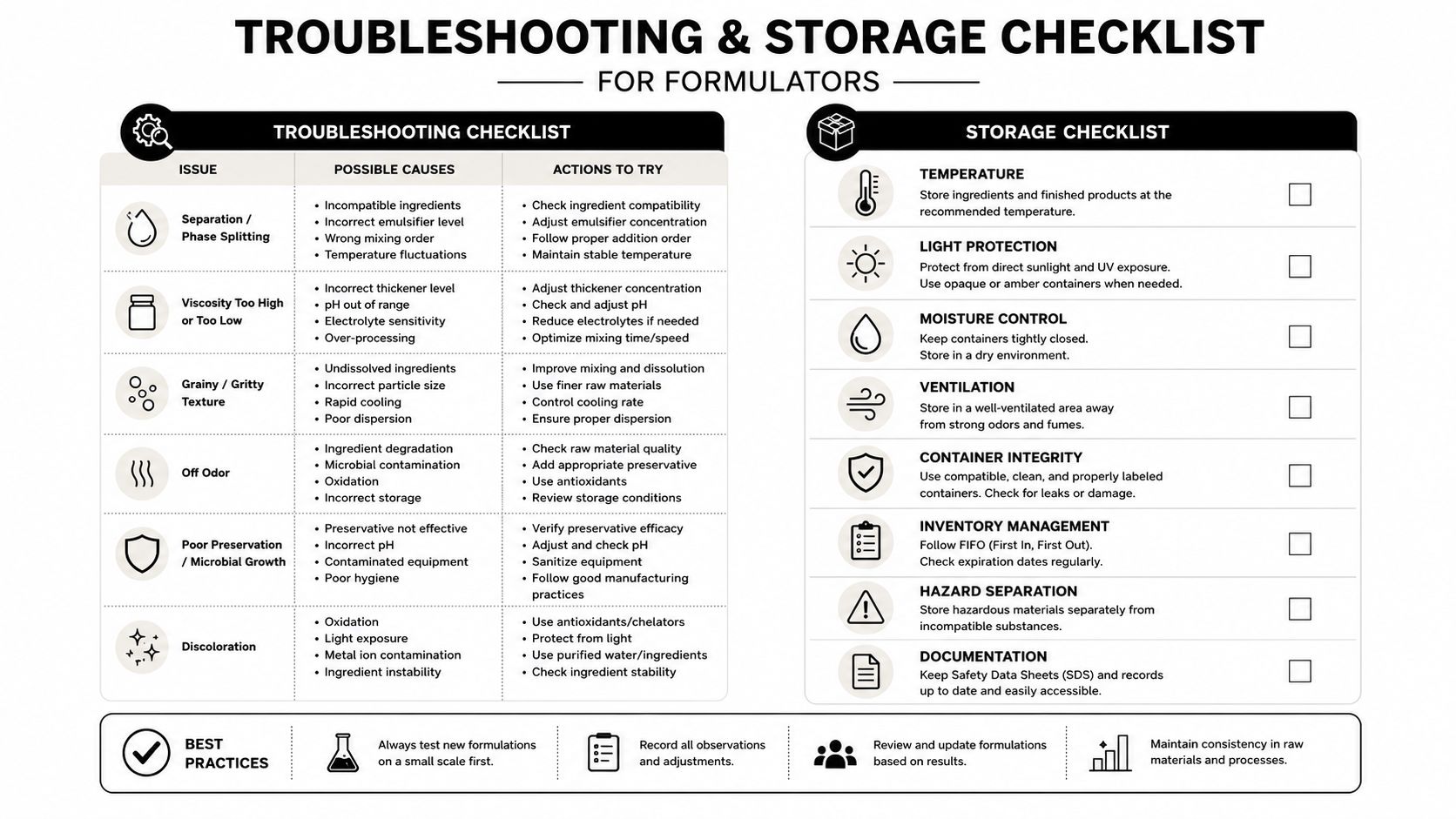
Most storage problems fall into three buckets. A heat exposure event happens after a power outage, HVAC failure, or summer weekend. A thaw and refreeze cycle usually comes from a door left ajar or a bad defrost setup. Sensor drift is quieter, but it's just as dangerous because the logger says everything is fine while the product is out of range.
What to do when something goes wrong
For a heat event, quarantine the lot first, then pull the trace and compare the excursion to the validated band and duration threshold. If the deviation crosses either limit, document the lot as affected and keep it out of production until QA clears it.
For a thaw and refreeze event, treat the product as mechanically and chemically stressed, not just warm. Check container integrity, inspect for condensation risk, and record whether the product ever left the validated range long enough to matter.
For sensor drift, verify the logger against the secondary probe before you trust any reading. If the sensors disagree, the calibration issue becomes the incident, not the product itself.
Pin this checklist next to the storage area
- Confirm the setpoint: Verify each zone is in the right band for the SKU sitting inside it.
- Audit headspace: Keep working vials tight and bulk containers as full as practical.
- Review the container material: Use amber glass, stainless steel, or low-permeability bulk packaging where the SKU justifies it.
- Check logger placement: Put sensors where the warmest condition will show up, not where it looks neat.
- Test alarms: Confirm audible and remote alerts still work after any equipment change.
- Review logs monthly: Don't wait for a failure to discover a drift pattern.
A terpene shelf should run like a controlled process, not a pile of bottles. Once each SKU has a validated zone, a documented container choice, and a receiving step that checks the trace, storage stops being a weak point and becomes part of the formulation system.
Gold Coast Terpenes supplies strain-specific profiles, isolates, and formulation resources that fit into a controlled storage workflow instead of fighting it. If you're building or tightening your terpene SOPs, visit Gold Coast Terpenes to review profile options, guides, and practical support for cartridge, concentrate, and flavor development work.