
The Rainbow Belts 2.0 strain has become a go-to starting point for product developers, and for good reason. Its lab-verified terpene architecture—centered on Beta‑caryophyllene, Limonene, and Linalool—hits predictable ranges that scale well into distillate and other formulated products without losing its signature candy-meets-gas character. This guide focuses on replicating that profile for commercial applications like vape cartridges and concentrates.
Understanding the Rainbow Belts 2.0 Strain Terpene Profile for Formulation
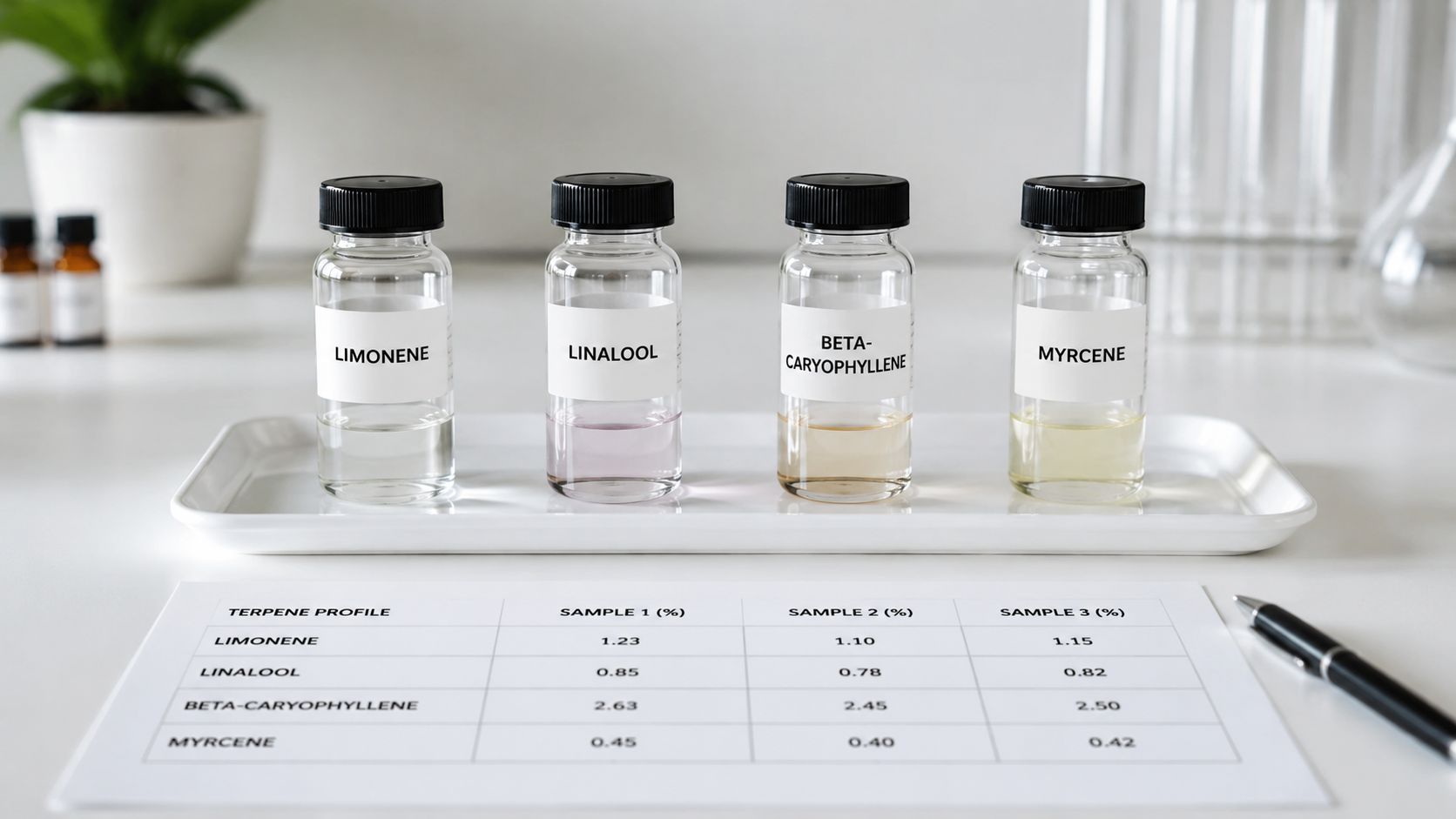
Think of the terpene fingerprint as a recipe you're going to rebuild from scratch at production scale. To successfully replicate the Rainbow Belts 2.0 profile, you must understand each component's role before adjusting ratios for your specific product format.
Here's what the analytical data typically shows:
- Premium flower runs 22–29% THC, which provides a potency anchor when calculating dilution for distillate-based products.
- Total terpene content for standout flower sits between 2.0–3.5%. Solventless rosin concentrates push that higher, often landing between 4–8% terpenes.
- The dominant terpenes to target by percentage are: Beta‑caryophyllene 0.4–0.9%, Limonene 0.3–0.8%, and Linalool 0.1–0.4%, with humulene, myrcene, and ocimene filling in at trace-to-low levels.
Matching ratios matters more than simply listing the same ingredients. A 2:1 limonene-to-caryophyllene ratio reads completely differently than a 1:2 mix, even though both formulas contain the same terpenes.
Key Formulation Drivers
Every terpene behaves differently in a blend, and the Rainbow Belts 2.0 profile has a few characteristics worth noting for product development:
- Volatility Profile: Limonene and ocimene evaporate faster than other components. In heat-exposed formats like vapes, these top notes are the first to be lost, impacting the initial flavor impression.
- Oxidation Risk: Linalool degrades relatively easily. Once oxidation occurs, off-notes become noticeable, compromising shelf life. Adding an antioxidant or minimizing headspace oxygen in packaging can significantly improve stability.
- Viscosity Effects: Increasing terpene concentration thins distillate, which can be beneficial for flow but poses a risk for cartridge leakage. It's a balancing act between flavor intensity and hardware compatibility.
Quick Technical Checklist
Set your target terpene load based on the format:
- Distillate carts: 2.0–4.0% total terpenes to manage viscosity and prevent leaks.
- Live resin or rosin carts: 6–8% is common and preserves the fuller flavor profile.
Rely on analytical data:
- Use Certificate of Analysis (COA) values to build your target ratios, then tighten specification bands to ±10% for production runs to ensure consistency.
Watch your thermal profile:
- Keep fill temperatures and operation ranges in check to protect limonene and linalool. Avoid prolonged exposure above 180–200°C during testing, as these terpenes will degrade and shift the flavor profile.
Rainbow Belts 2.0 Formulation Benchmarks
| Parameter | Typical Range | Formulation Note |
|---|---|---|
| THC in flower | 22–29% | Set distillate target after dilution math |
| Total terpenes (flower) | 2.0–3.5% | Baseline for authentic aroma |
| Beta‑caryophyllene | 0.4–0.9% | Mid/base note, signature spice |
| Limonene | 0.3–0.8% | Top note, citrus sparkle, volatile |
| Linalool | 0.1–0.4% | Mid floral note, oxidation flag |
These ranges provide a working framework—realistic targets that reflect what the strain actually delivers in practice. For more examples, you can explore various strain terpene profiles from Gold Coast Terpenes to use as reference points.
The practical path forward is straightforward: build a working blend that hits these percentage bands, run small-scale stability and thermal tests, then lock your internal QC specs against COAs. This ensures your Rainbow Belts 2.0 replication performs consistently across cartridges and concentrates—batch after batch.
Breaking Down Terpene Roles and Sensory Notes
Picture the Rainbow Belts 2.0 profile like a well-built perfume—the bright top notes, the floral-spicy middle, and the earthy finish all need to work in concert while surviving the heat and hardware of your final product.
Top notes provide the initial sensory hit and vanish quickly. Mid notes define the core character. Base notes are what linger, providing depth and preventing the flavor from feeling thin.
- Limonene (Top Note): Leading at 0.3–0.8%, Limonene delivers the sharp citrus pop that defines the initial impression. As the most volatile of the dominant trio, it's the first terpene to degrade with heat or oxygen exposure.
- Beta-caryophyllene (Mid/Base Note): Typically the most abundant at 0.4–0.9%, Beta-caryophyllene brings the peppery spice and gassy undertones that provide body and complexity. Its lower volatility helps it anchor the strain's signature across a session.
- Linalool (Mid Note): Present at 0.1–0.4%, Linalool adds a soft, lavender-like floral lift that smooths the profile. However, Linalool is an oxidation red flag; its presence requires careful handling to maintain shelf life.
- Myrcene and Humulene (Base/Supporting Notes): Both running between 0.05–0.3%, these terpenes act as depth anchors. Myrcene contributes an earthy musk that adds to the mouthfeel, while Humulene provides a subtle hoppy-herbal layer that prevents the profile from becoming one-dimensionally sweet.
Ratio precision beats raw presence every time. A 2:1 limonene-to-caryophyllene ratio reads bright and candy-like, while flipping that ratio pushes it spicy and fuel-heavy.
Target Percentages For Reconstructing The Profile
Use these bands as your starting framework—your batch COAs will tell you where to dial in the final numbers:
- Limonene 0.3–0.8%: Top note, volatility concern; keep headspace tight to protect it.
- Beta-caryophyllene 0.4–0.9%: Mid/base note, signature spice, stabilizes the mouthfeel.
- Linalool 0.1–0.4%: Mid floral note, oxidation-sensitive; consider adding antioxidants.
- Myrcene 0.05–0.3%: Base depth anchor, shifts how heavy the body feels.
- Humulene 0.05–0.2%: Herbal support, stops the sweetness from going flat.
Treat these as guardrails. Every batch moves slightly, so let your COAs set the real spec—typically within ±10% of your target bands.
A Simple Workflow For Reading COAs
- Pull the terpene table and record the absolute percentages.
- Calculate the limonene:caryophyllene:linalool ratio to check for profile accuracy.
- Flag any batch with limonene above 0.9% or linalool above 0.5% as these are stability warning signs.
Feed these numbers straight into your manufacturing specs and QC limits to prevent batch drift before it starts.
Translating Chemistry Into Sensory Roles
Think of Limonene as a perfume's opening spray—it must be strong enough to register immediately, but too much will burn off, leaving a hollow middle. Beta-caryophyllene is the lotion underneath—slower to fade, giving the whole profile structure. Linalool is the ribbon tying it together: beautiful, but oxygen and heat will fray it fast.
Quick Tips For Formulators
- Chase ratio balance, not maximum single-terpene percentages.
- Add antioxidants or use nitrogen blanketing when Linalool approaches 0.3–0.4%.
- Run accelerated thermal tests at 180–200°C to quantify top-note loss before committing to a full batch.
For a deeper look at how sensory roles map to terpene chemistry, check out the Terpene Flavor Chart from Gold Coast Terpenes.
Formulating Rainbow Belts 2.0 Terpenes for Vape Cartridges
Building a Rainbow Belts 2.0 strain-inspired terpene blend for vape cartridges requires lab-grade precision and an understanding of hardware-formulation interactions. The infographic below maps the dominant terpene tiers and their sensory roles, helping you turn COA data into practical mixing targets.
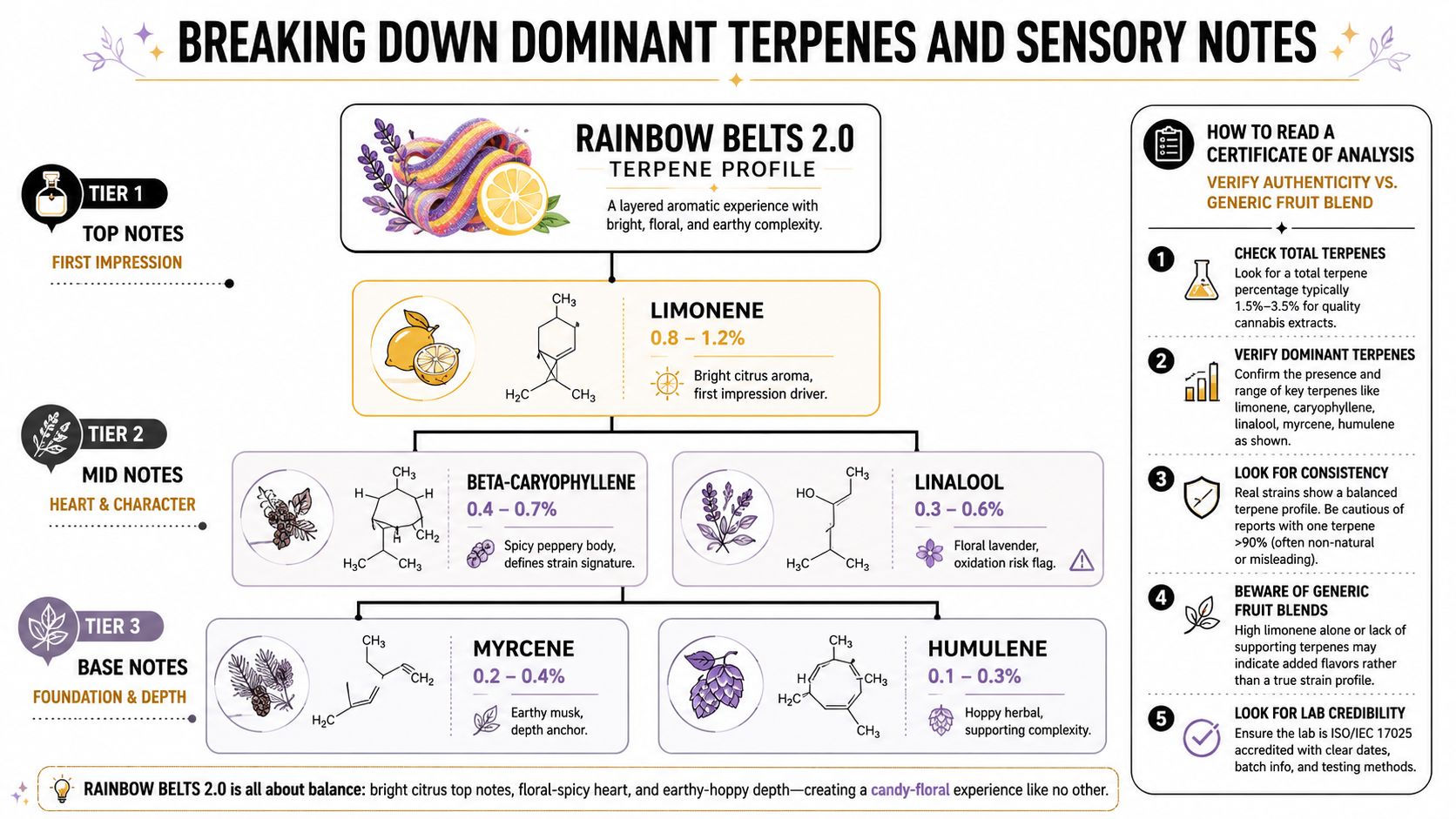
The key takeaway is that top-note volatility, mid-note body, and base-note anchoring must work in concert. An improper balance can lead to flavor drift or hardware failure.
Managing Dilution and Viscosity for Distillate Bases
For distillate cartridges, a total terpene concentration of 2.0–4.0% is standard. Exceeding this range thins the oil, which can improve flavor delivery but also increases the risk of leaks and wick flooding.
To maintain control:
- Measure kinematic viscosity after adding terpenes and compare it against your cartridge manufacturer's specifications.
- If viscosity drops too low, consider a high-boiling diluent or incrementally reduce the terpene percentage.
- Use sterile, calibrated equipment for mixing to avoid trapping microbubbles, which accelerate oxidation.
Anchor your terpene targets to COA bands and log viscosity changes at every 0.5% terpene step. Small shifts add up fast.
Thermal Stability and Oxidation Considerations
Linalool acts as a canary in the coal mine for oxidation. When it degrades, off-notes follow. Keep its proportion within the recommended band to maintain shelf stability. Run accelerated thermal tests at 180–200°C to observe top-note loss and watch for sulfur or floral degradation markers.
Countermeasures to consider:
- If Linalool approaches 0.3–0.4% in the finished oil, introduce food-grade antioxidants at low ppm levels.
- Reduce oxygen exposure by minimizing headspace and using nitrogen blanketing during batching and filling.
Homogenization Protocols and Batch Consistency
Repeatable mixing is essential for a consistent product experience. A reliable protocol includes:
- Pre-warm distillate to a fill temperature of 40–55°C to lower viscosity without degrading volatile terpenes.
- Add terpenes slowly under low-shear mixing to avoid creating emulsions or introducing microbubbles.
- Let the batch rest for 30–60 minutes, then use gentle recirculation to homogenize.
- Pull a QC sample for terpene GC and viscosity checks, ensuring results are within ±10% of your target bands.
QC checks for every batch:
- Confirm total terpene percentage matches COA targets.
- Verify the limonene:caryophyllene:linalool ratio to protect the signature aroma.
- Record viscosity, surface tension, and fill temperature in your batch log.
Cartridge Hardware Tips to Prevent Clogging and Separation
Hardware choice is as critical as the formulation itself. Key considerations include:
- If total terpenes exceed 3.5%, switch to ceramic or stainless steel wicks rated for low-viscosity oils.
- For live resin carts running 6–8% terpenes, keep Limonene at the lower end of its band to reduce volatility and improve stability.
- Run cycle-fill tests at production speed to identify potential separation or capillary failure early.
Related reading: Our guide on mixing distillate with terpenes covers procedural details and includes a mixing calculator to help lock in batch-to-batch consistency.
Final Takeaway
Precise ratios and disciplined homogenization are non-negotiable for success. Treat terpenes as performance ingredients—measure, test, and document every variable. This is how you ensure your Rainbow Belts 2.0 replication holds up from the first pull to the last.
Applying the Profile to Concentrates and Edibles
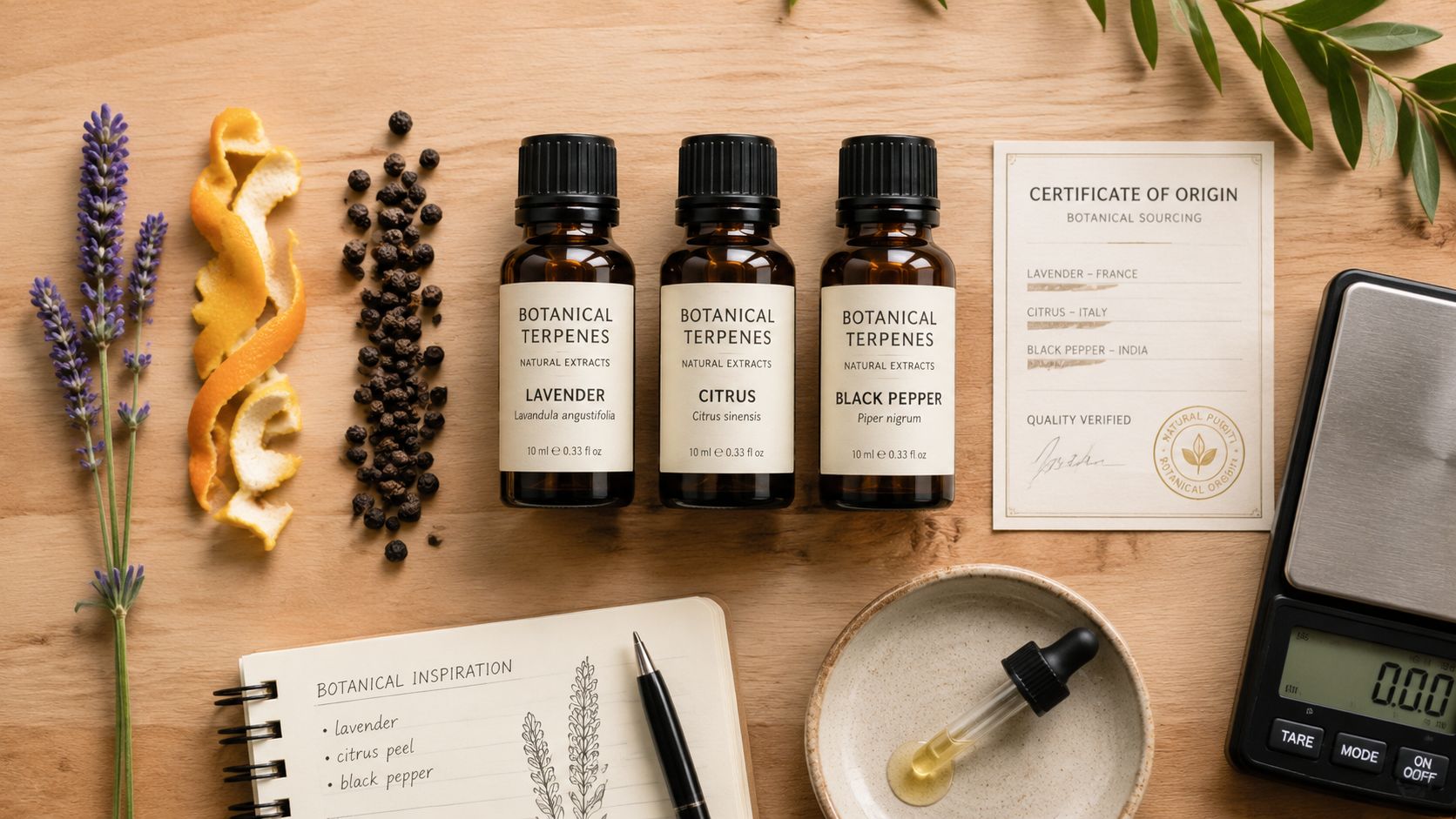
For extractors working with solventless and hydrocarbon concentrates, reintroducing terpenes allows for the restoration of the candy-citrus top notes and peppery mid-palate flavors often lost during processing. The key is finding the right concentration—enough to add sensory depth without compromising texture or shelf stability.
Key Considerations For Concentrates
- Rosin and cold-cure hash perform best at 4–8% total terpenes. This range preserves brightness and mouthfeel.
- Distillate-based concentrates should stay in the 2.0–4.0% range to prevent over-thinning and hardware issues.
- Protect oxidation-sensitive compounds like Linalool by using nitrogen blanketing and minimizing headspace during fills.
A practical checklist for extractors:
- Run terpene GC on each batch and log limonene:caryophyllene:linalool ratios to track consistency.
- Conduct accelerated thermal testing at 180–200°C to quantify top-note degradation from heat.
- When Linalool approaches 0.3–0.4% in the finished oil, introduce food-grade antioxidants at low ppm.
Accurate replication is about ratios, not just ingredient names. A slight shift can turn a candy-bright profile into something fuel-forward.
Adaptation Strategies For Edibles
Edible formulators face different challenges. Volatile top notes like Limonene can be lost during cooking or fade on the shelf. Encapsulation and emulsification are effective solutions. Microencapsulation protects oil-soluble terpenes, while liposomal emulsions ensure even dispersion in water-based systems. Always use food-grade terpene blends free of VG, PG, PEG, and MCT for cleaner labeling and regulatory compliance.
Practical steps for edible teams:
- Select a food-grade, strain-inspired terpene blend from a trusted vendor with verifiable COAs.
- Perform bake-in-place stability tests at actual cooking temperatures to measure terpene retention.
- Adjust encapsulation loading until top-note retention meets sensory targets.
For product development, Gold Coast Terpenes offers strain-specific terpene profiles and formulation resources to assist with implementation.
Quality Control and Compliance Testing Essentials
Bringing a Rainbow Belts 2.0 strain-inspired SKU to market requires a test-first mentality. Set internal QC bands based on batch COAs rather than idealized targets to control variance and protect the sensory profile.
- Critical Specifications:
- Terpene percentages with ±10% tolerance bands.
- Total terpene load limits per format (distillate carts 2.0–4.0%, live resin 6–8%).
- Residual solvents and heavy metals below regulatory limits.
Run these analytical checks on every finished batch and log results for traceability.
Recommended Routine Testing
- Terpene Verification: GC-FID or GC-MS to confirm identity and percentage.
- Residual Solvents: Headspace GC for hydrocarbon or solvent-based processes.
- Heavy Metals: ICP-MS to meet state compliance.
- Microbial and Pesticides: As required by jurisdiction.
"Batch-to-batch repeatability is the credibility metric for a brand" — treat COAs as the product spec, not just paperwork.
Implement process controls that preserve the Rainbow Belts 2.0 sensory layers:
- Minimize headspace and use nitrogen blanketing to protect volatile top notes like Limonene.
- Store finished goods in cool, dark conditions (15-20°C / 60–68°F) to limit Linalool oxidation.
- Use antioxidants at low ppm if data shows Linalool approaching instability around 0.3–0.4%.
A robust documentation strategy allows auditors and buyers to trace each SKU back to its raw material lots and test certificates. This documentation is the foundation of repeatable replication and commercial trust.
Sourcing Terpenes for a Strain-Inspired Blend
Choosing the right terpene source is the first step toward a reproducible Rainbow Belts 2.0 formulation. Botanical-derived terpenes offer consistent chemistry and are widely available, making them a workhorse for scalable production.
Why the Source Matters
The choice between botanical and cannabis-derived terpenes impacts your regulatory path, cost, and COA transparency. For multi-state distribution, 100% natural, botanically derived, THC-free blends simplify compliance and reduce legal risk.
Botanical Terpenes:
- Pros: Stable supply chain, lower cost, clean COAs.
- Cons: May lack the trace exotic compounds that define a strain's unique nuance.
Cannabis-Derived Terpenes:
- Pros: Authentic minor terpene fidelity.
- Cons: Higher cost, lot-to-lot variability, and potential regulatory hurdles.
Lock in repeatability by prioritizing suppliers who provide lot-specific COAs. That paper trail is your safety net.
Procurement Best Practices
- Define Annual Demand: Know your volume before negotiating pricing.
- Request Lot-Matching: Reserve the same lot for initial production runs to ensure consistency.
- Negotiate Tiered Pricing: Secure holdback samples for QC verification.
Sourcing From Gold Coast Terpenes
Gold Coast Terpenes offers a range of strain-inspired blends and individual isolates suitable for replicating profiles like Rainbow Belts 2.0.
- Check their terpene product pages for blends that match your target profile.
- Utilize their online resources, such as mixing calculators and formulation guides, to dial in ratios and viscosity.
A solid supplier relationship paired with tight lot control is what turns a lab COA into a scalable product. That is how you maintain profile integrity through production, filling, and shelf life.
Frequently Asked Questions About Rainbow Belts 2.0 Formulation
Q: How should I manage linalool for cartridge stability?
A: Linalool is prone to oxidation, which creates off-notes. For distillate carts, keep finished-oil Linalool between 0.1–0.4%, ideally under 0.3%. Use nitrogen blanketing during fills and minimize headspace. If stability data shows degradation, a food-grade antioxidant at low ppm can help, but process controls are the best long-term solution.
Q: Does the Rainbow Belts 2.0 profile work better with live resin or distillate bases?
A: It depends on your product goals. Live resin and rosin can handle higher terpene loads (4–8%), which allows the candy-floral profile to be more expressive. Distillate is more sensitive to viscosity changes, so a 2.0–4.0% terpene load is recommended to avoid hardware issues like leaks. The decision depends on desired flavor intensity and hardware constraints.
Q: How do I troubleshoot flavor fading over shelf life?
A: Fading is typically caused by the degradation of volatile terpenes. Map GC-MS data against sensory panel feedback at regular intervals. Limonene (top note) and Linalool (mid note) are usually the first to go. Protect them with low-oxygen packaging, cool storage (15-20°C / 60–68°F), and by performing accelerated thermal testing (180–200°C) to predict long-term stability. If Limonene drops significantly in accelerated tests, consider slightly increasing its initial concentration and tightening packaging controls.
Consistent ratio control beats chasing single-terpene highs. Document every lot and keep holdback samples.
For reliable strain-inspired terpene blends and technical guides, visit Gold Coast Terpenes at https://www.goldcoastterpenes.com