
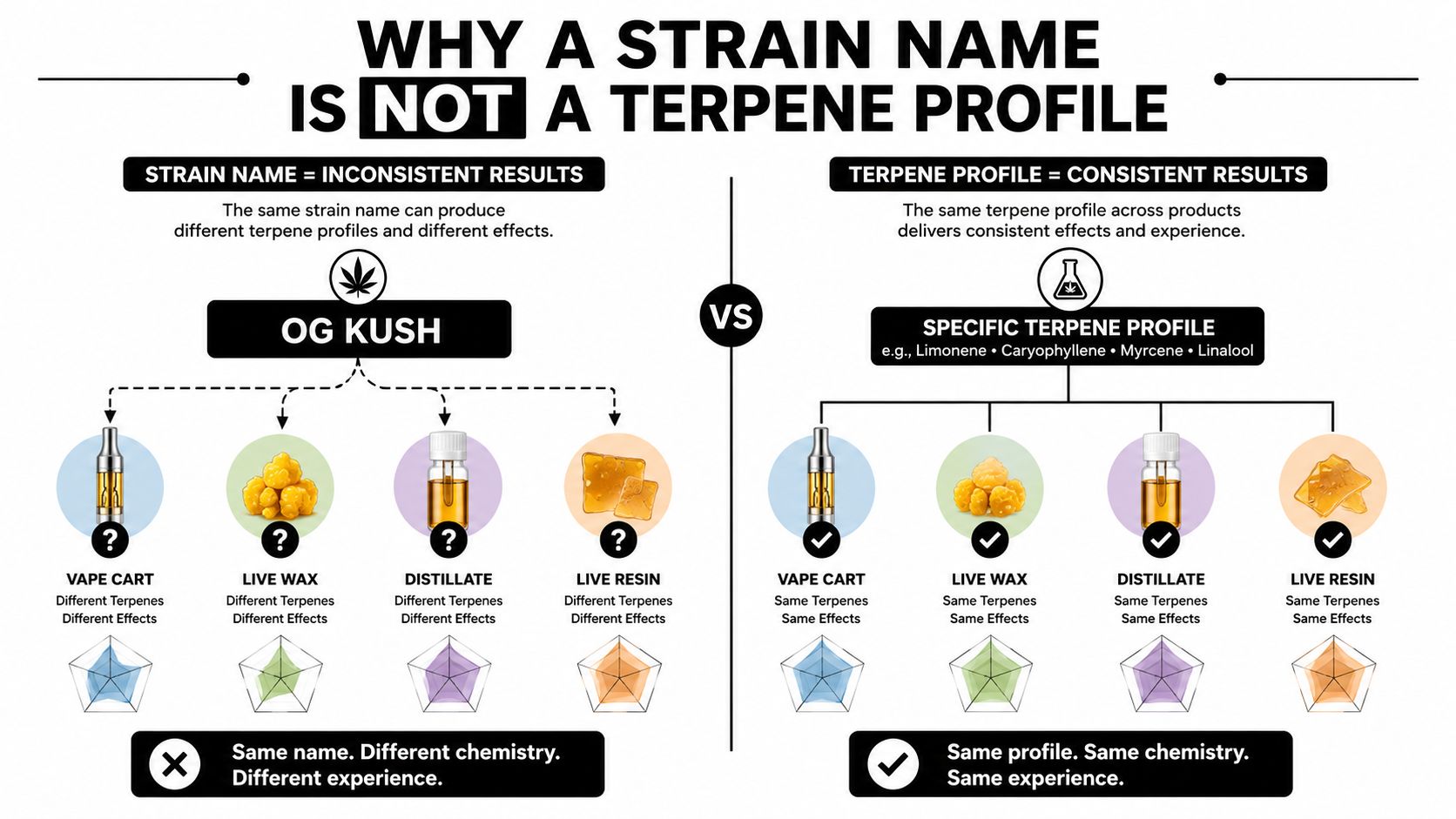
Most strain advice starts in the wrong place. A strain name is a marketing label, not a formulation spec, and it won't hold a vape cart, concentrate, or distillate SKU steady from batch to batch. If you're building products for consistency, you need a strain terpene profile that's tied to lab data, not folklore.
That distinction matters because the same cultivar name can hide a very different aromatic and functional outcome depending on grower, harvest window, extraction method, and downstream handling. In practice, the COA is the source of truth, and the label on the jar is only a starting hint. Formulators who treat strain names as fixed identities usually end up chasing flavor drift instead of controlling it.
Why a Strain Name Is Not a Terpene Profile
A strain name tells you what the market calls the material. It does not tell you what is inside it. For product developers, that is the core problem. Two lots sold under the same name can present different terpene balances, and once that material goes through different extraction paths, the finished profile can drift again.
Start with the data, not the cultivar name
A strain terpene profile is the full terpene spectrum in a cannabis cultivar, usually reported as each terpene's percentage of total plant weight in lab testing. That is a formulation asset, because it lets you compare material by composition rather than by reputation alone. The practical question is not “What strain is this?” It is “What does this batch contain, and can I reproduce that?”
The evidence behind that mindset is straightforward. One comparative study found wide terpene differences inside broadly similar cannabis types, with β-myrcene ranging from 16.1±3.4% in one strain to 80.1±7.3% in another Fundación Canna study on terpene variations. The same study also showed that mostly indica strains were often myrcene-led, while mostly sativa strains tended to be more complex and sometimes led by terpinolene or pinene.
What that means on the bench
If you are formulating carts or concentrates, the name on the incoming biomass cannot tell you whether the final oil should lean bright, herbal, or heavy. The COA can. I would rather start with a batch report than a strain story every time, because the report gives me a measurable basis for replication and SKU matching.
Practical rule: treat the strain name as a search term, then treat the COA as the recipe input.
For readers who want a consumer-facing contrast, the older “what strain has different highs” framing is too coarse for production work. A better workflow is to pull the report, identify the dominant terpenes, and decide whether the material can support the aroma target before you commit to blend design. A useful external primer on that retail-side misconception is this strain-effects discussion, but in formulation, the batch data still wins.
The Science Behind Terpene Profile Generation
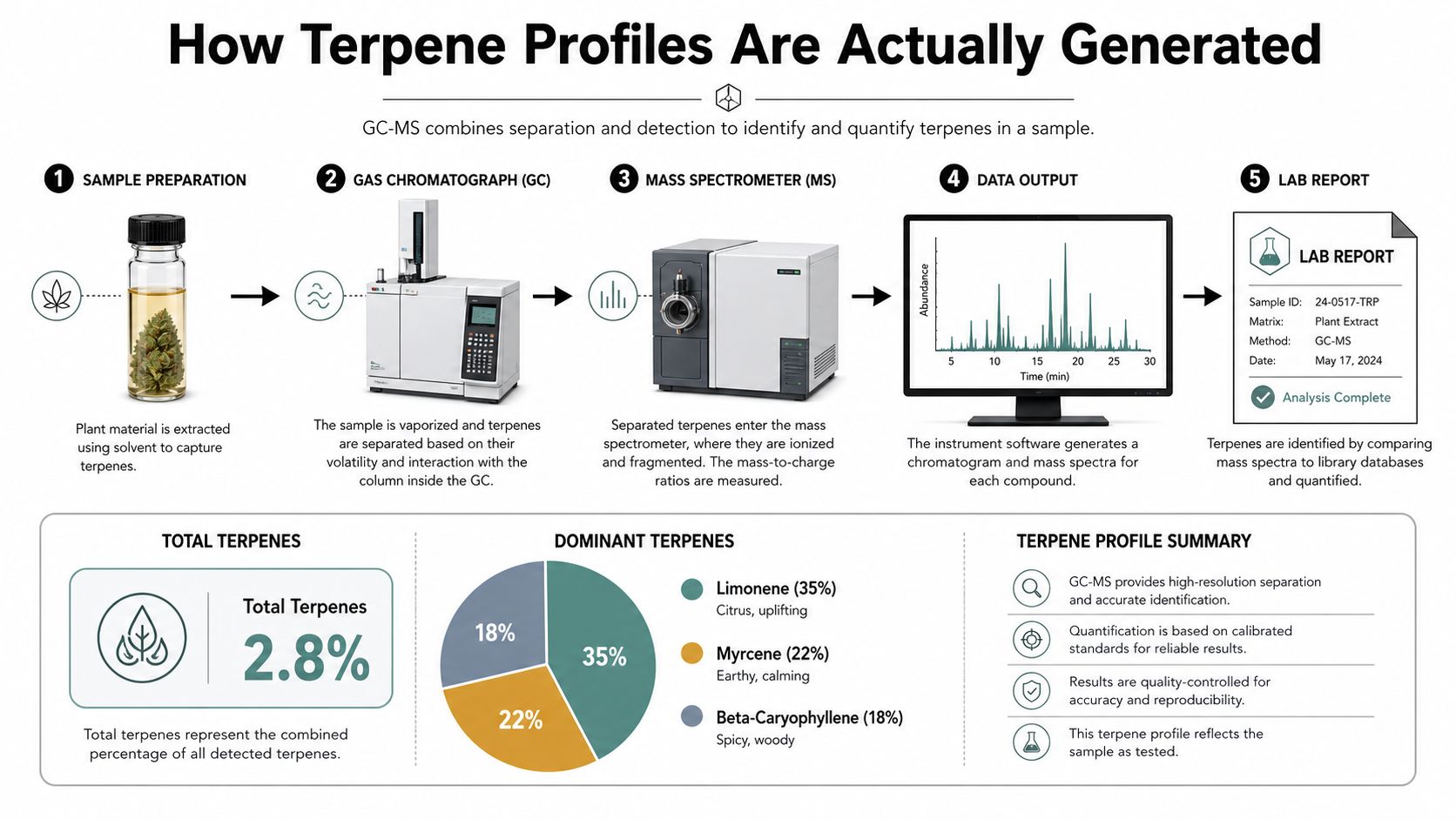
Terpene data comes from instrument analysis, not smell tests. Labs commonly use GC or GC-MS workflows, which separate the volatile compounds in a sample and then identify them by their chemical signatures. The point is not to create a poetic description, it is to turn aroma chemistry into a report that can be compared across lots and across suppliers.
Reading the percentages as ratios
A terpene profile is typically reported as a percentage of total weight. That matters because formulators do not need a romantic description of “citrus-forward” if the lab can show which compounds dominate and how far apart they are. A practical example from a terpene explainer lists lab results such as Myrcene 0.42%, Caryophyllene 0.31%, and Limonene 0.18% Cannacon terpene explanation. Those numbers are small, but they are useful because they define relative balance.
The broader chemistry inventory is also large enough to explain why two products with the same strain name can smell and perform differently. Cannabis contains more than 200 terpenes, and some sources report upwards of 400. That is why a profile cannot be reduced to a single top note. The whole ratio matters, and the chemistry behind those ratios starts with how the plant makes them in the first place, as outlined in this terpene biosynthesis overview.
Variability is the rule, not the exception
One profiling dataset found an average dominant compound set led by β-myrcene at 46.1±2.6%, followed by α-pinene at 14.0±1.5%, α-terpinolene at 10.2±1.8%, limonene at 7.3±1.3%, trans-β-ocimene at 6.6±0.7%, and β-pinene at 6.1±0.4%. Another study using comparative GC and GC-TOFMS profiling found 146 terpenes and terpenoids across six strains, with individual strains ranging from 62 to 116 detected compounds comparative GC/GC-TOFMS profiling. That breadth is exactly why a formulator should think in ranges and ratios, not absolutes.
Batch effects matter here. Growing conditions, cure, storage, and extraction method can shift the apparent profile enough that a familiar strain name no longer produces the same starting point. The same cultivar can be built around a different dominant terpene from one lot to the next, so the work begins with the report, not the label.
The best mental model is simple. Dominance is relative, not fixed. A strain terpene profile is a composition map, and the map only becomes useful when you compare batch to batch instead of assuming the cultivar name tells you the whole story.
A good lab report does not tell you what the product should feel like in a vague sense, it tells you what chemistry you have available to shape aroma and flavor.
Terpene Roles in a Finished Blend
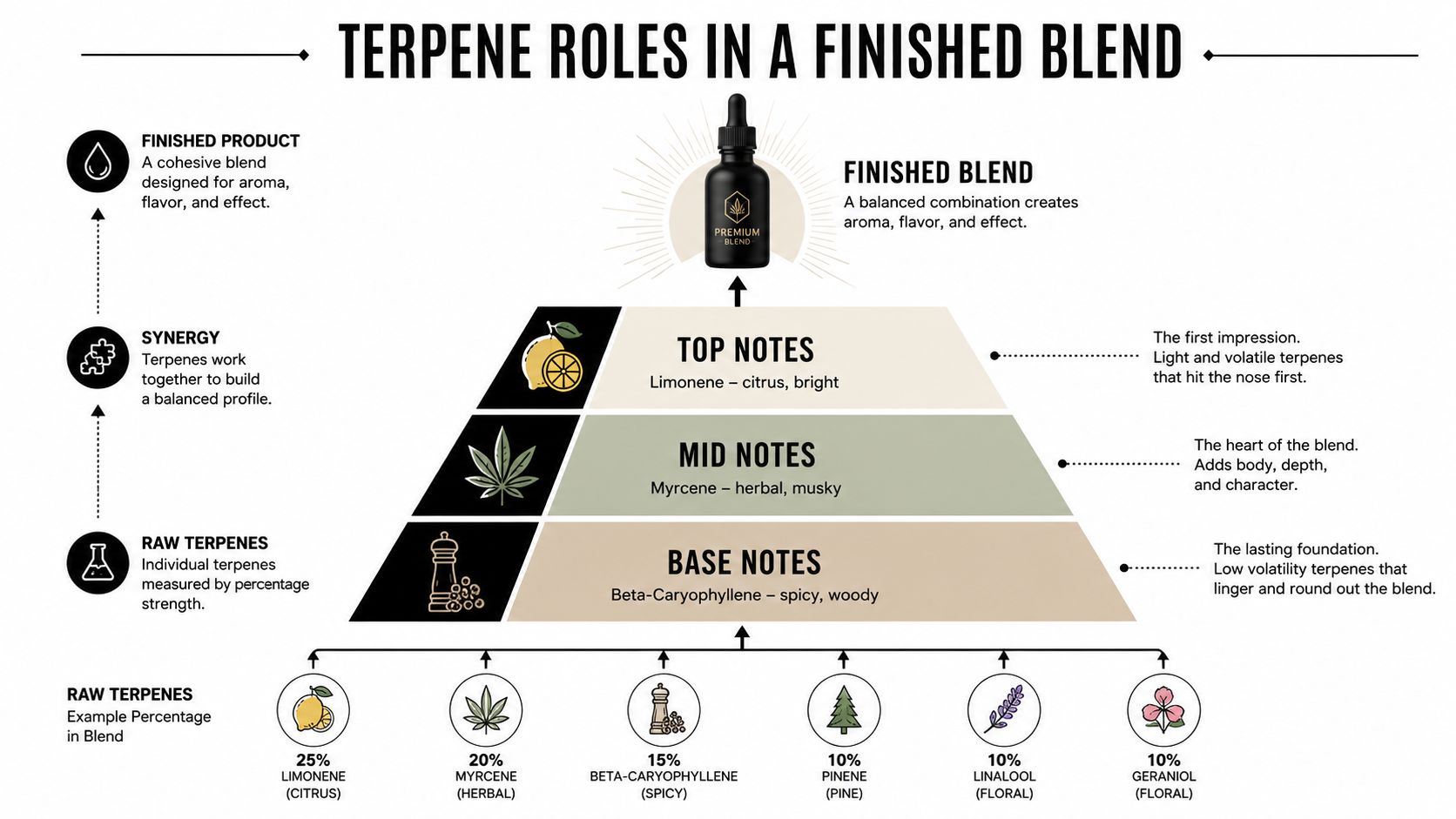
Raw percentages don't build a finished product by themselves. They only become useful when you assign each compound a job in the blend. In practice, that means thinking like a perfumer and a product developer at the same time, with top notes, mid notes, and base notes carrying different parts of the sensory load.
Top notes give the first impression
Limonene, terpinolene, ocimene, and often pinene are the compounds most likely to shape the first sniff. They're the notes that read as bright, sharp, fresh, or lifted. If you overbuild this layer, the blend can feel loud at first and thin on the finish.
For a cart or concentrate, top notes should usually support the profile, not carry the whole load. Limonene can push citrus clarity, pinene can add forested lift, and terpinolene can bring a sweeter, more complex opening. Ocimene sits in the same family of airy top-end work, especially when the formula needs a little sparkle.
Mid notes make the profile feel complete
Myrcene and linalool tend to carry the body of the aroma. Myrcene reads as earthy, herbal, and musky. Linalool adds floral softness and helps keep a blend from feeling too sharp or too dry.
Many new formulators miss the mark. They load the top notes because those are easiest to smell in the tank, then wonder why the finished cart feels hollow. Mid notes don't just support aroma, they help the blend feel rounder and more coherent after the first pull.
Base notes anchor the finish
Beta-caryophyllene and humulene usually work as base or grounding notes. Beta-caryophyllene brings a spicy, woody edge. Humulene can reinforce a dry, herbal, slightly bitter finish when a product needs structure rather than sweetness.
If the top note is the headline, the base note is what keeps the product from tasting like a draft.
The entourage framework is useful here as a commercial language, because it encourages buyers to think in terms of full-profile synergy rather than one compound doing all the work. The useful takeaway for formulation is not a medical claim. It's the idea that multiple terpenes can be selected together to shape aroma, flavor, and the product story more effectively than a single dominant note alone.
Reading a Lab Report Like a Formulator
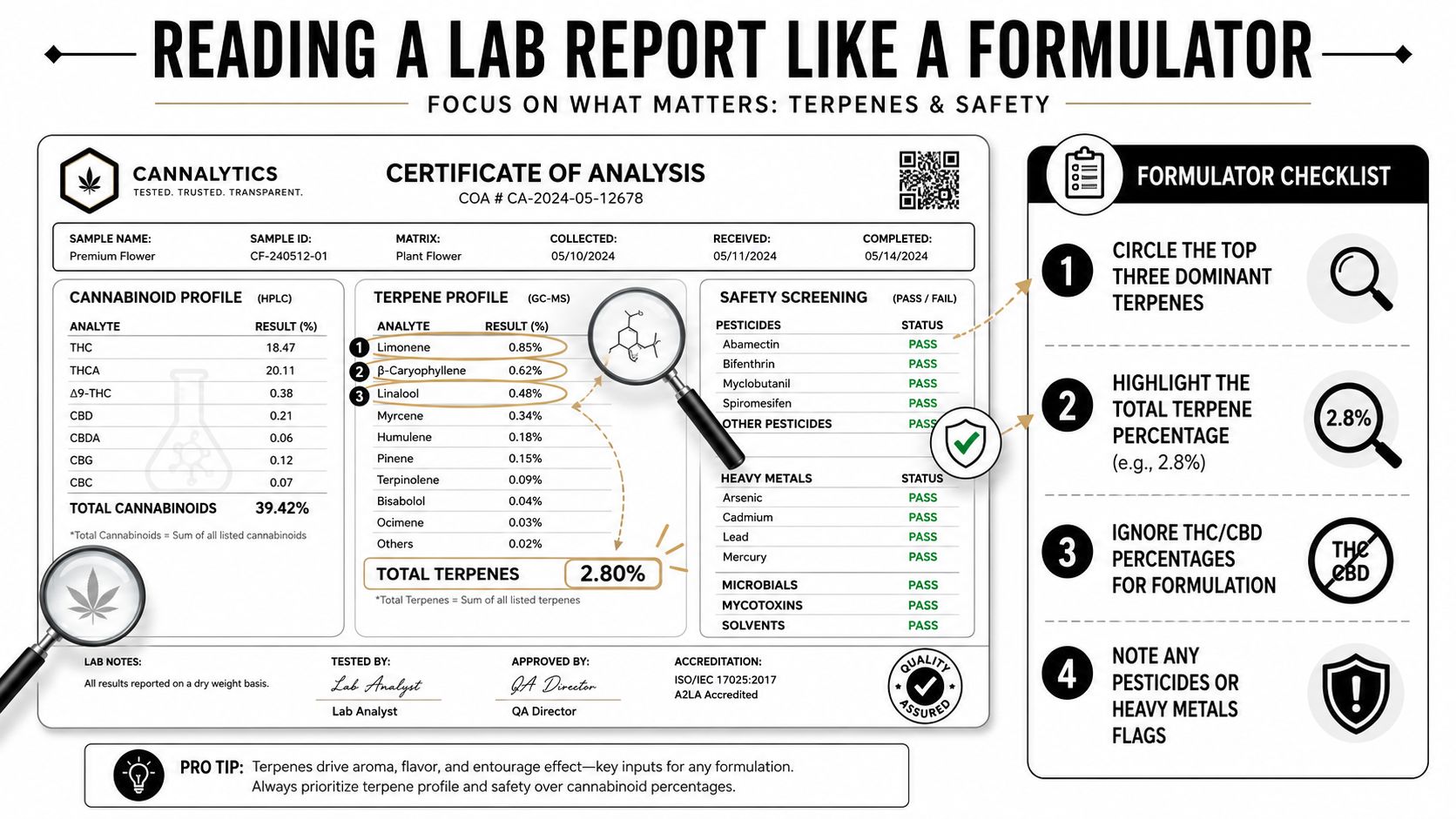
A COA can look busier than it needs to be. Most of the page is noise if you only care about building a stable flavor profile. The job is to isolate the few fields that affect a blend decision and ignore the rest until safety review time.
What to scan first
Start with the top three dominant terpenes. They usually tell you more about the product's character than the whole panel. Then check the total terpene percentage, because that tells you how much aromatic material you're really working with.
A representative lab snippet might show myrcene 0.42%, caryophyllene 0.31%, and limonene 0.18%. Those numbers are not random decoration. They tell you which notes will likely survive blending pressure and which ones may need support from isolates or a complementary strain profile.
What to verify before you blend
The terpene panel isn't the only thing that matters. You still need to look for any safety flags that could affect finished product use, especially pesticides or heavy metals, because a flavor-perfect batch is still a bad batch if the report raises a compliance issue. For team workflow, the interpretation page from Gold Coast Terpenes' lab report guide is a useful internal reference point when you're training staff to read reports consistently.
How to reconcile the report with the nose
If the chemistry and the aroma disagree, don't trust the nose alone. A sample may smell bright because the top notes are loud, while the underlying ratio still skews earthy or heavy. Formulators get into trouble when they build from the first impression and ignore the actual balance.
A practical workflow looks like this:
- Circle the dominant compounds. Use the top trio as the core of the flavor map.
- Note the total terpene load. It tells you how aggressively the profile can be pushed.
- Check the safety screen. Don't move material into production until QC clears it.
- Compare against your target aroma. Decide whether the batch supports replication or needs correction.
If you want to understand where those compounds came from biologically, the terpene biosynthesis article from Gold Coast Terpenes is a useful technical bridge. For bench work, though, the main question stays the same. Does the report give you a repeatable target, or only a strain name?
Blending and Dilution Best Practices
A terpene blend that works in a jar can fail in hardware. The failure usually shows up after dilution, when viscosity shifts, heat changes the way the blend behaves, and the top notes hit harder than they did on the bench. For distillate work, a common starting inclusion rate is 3 to 8%, depending on the viscosity and the intensity you want. That range is where formulators usually begin stress-testing flavor before they lock a production spec.
Build around hardware compatibility
The carrier system matters as much as the terpene ratio. Standard formulation practice is to avoid VG, PG, PEG, and MCT when the target is cartridge compatibility, because those additives can create hardware and consistency problems that get worse under heat. A cleaner approach is to keep the formula aligned with a terpene-only or terpene-forward system and test it on the actual device you plan to sell.
Practical rule: if the blend only looks good in beaker tests, it isn't finished yet.
Overloading the top notes is another common mistake. A mix that smells exciting at room temperature can turn sharp or flat after dilution, especially if limonene or terpinolene dominates too hard. The better move is to let the base and mid notes carry the body, then use the top notes for lift.
A simple bench example
Take a 100 g distillate batch at a 5% terpene load. That means the formula needs 5 g of terpenes blended into 95 g of distillate. If the target profile is bright but stable, start by giving the top note a supporting role instead of making it the largest component.
A practical sketch would look like this:
- Top note support: limonene or terpinolene for opening brightness.
- Mid-body anchor: myrcene or linalool for roundness.
- Base finish: beta-caryophyllene or humulene for structure.
That does not mean every formula should use those exact compounds in the same proportion. It means the blend should be built so the first inhale, the mid-palate, and the finish all have a job. Once the ratios are stable, you can tune the formula in small steps instead of reworking the whole batch.
For formulators who want a faster way to check inclusion rates, a mixing ratios calculator is useful on the production desk. Gold Coast Terpenes also sells terpene blends and isolated compounds that can be used for this kind of adjustment work, especially when a profile needs one note pushed up without rewriting the whole structure.
Four Reference Profiles Worth Studying
These profiles are useful because they're familiar enough to benchmark, but broad enough to show how the same naming system can still hide real formulation differences. I use them as scaffolds, not nostalgia pieces. The goal is to see what kind of aroma architecture each one suggests for a cartridge or concentrate SKU.
| Profile | Typical Dominant Terpene | Secondary Terpenes | Formulation Position |
|---|---|---|---|
| Blue Dream | Limonene or pinene leaning, with myrcene support | Myrcene, caryophyllene | Bright, balanced, broadly usable for vape work |
| OG Kush | Myrcene dominant, often with limonene or pinene | Caryophyllene, humulene | Dense, grounded, strong base for heavier flavor builds |
| Forbidden Fruit | Limonene and myrcene with fruit-forward support | Caryophyllene, linalool | Sweet, rounded, dessert or exotic leaning |
| Green Crack | Pinene or limonene leaning, with sharper lift | Myrcene, terpinolene | Crisp, alert, useful for bright daytime positioning |
Blue Dream and OG Kush show two different design philosophies
Blue Dream is useful when a brand wants a balanced profile that can stay readable across a wide audience. It usually suggests a brighter opening and enough body to keep the cart from feeling thin. OG Kush, by contrast, gives you a darker, more anchored structure, which is better when the product needs a heavier sensory identity.
Forbidden Fruit and Green Crack sit at opposite ends of the fruit-bright spectrum
Forbidden Fruit is a good reference when the target is lush, rounded, and dessert-adjacent without becoming syrupy. Green Crack, on the other hand, is the cleaner blueprint for a sharper, more vertical profile where top-note lift matters more than sweetness. The point isn't to copy these names. It's to recognize the scaffold beneath them.
A few pattern cues help in development:
- Use Blue Dream when you need a flexible, balanced SKU that won't overcommit to one note.
- Use OG Kush when the product needs a deeper, more grounded finish.
- Use Forbidden Fruit when the brief calls for fruit-rich complexity and a softer edge.
- Use Green Crack when the brief calls for crispness, clarity, and a brighter top-end.
The commercial value is consistency. When a buying team asks for a known profile, they're really asking for a repeatable sensory map. The lab data tells you whether the batch can support that map, and the blend tells you whether you can make it durable in hardware.
Lab Verification Safety and Legal Guardrails
No formulation work should start until the batch passes third-party verification. SC Lab-tested or equivalent independent testing matters because it gives the brand a defensible basis for composition, safety screening, and supplier trust. It also keeps product decisions grounded in documents instead of sales copy.
Build QC into the workflow
Terpene material sold as THC-free and positioned as legal worldwide is easier to work into cross-border planning, but that doesn't remove the need for internal checks. The practical issue is still exposure and compatibility, especially when the finished formula is going into inhalation hardware. Terpene dilution should stay conservative enough that the blend remains controlled, predictable, and appropriate for the intended format.
QC checklist: verify the COA, confirm the terpene panel matches the production brief, review contaminant screens, check carrier compatibility, and sign off only after hardware testing passes.
The safety conversation should be operational, not abstract. Terpenes are concentrated aromatic compounds, and that means your team should treat them like active ingredients, not flavoring water. If a batch isn't clean, consistent, and correctly diluted, it doesn't move forward.
Tools, Calculators, and Next Steps
A strain name does not give you a finished terpene profile. Batch-specific lab data does. That is why the first useful tools are the ones that help you compare measured composition, track dilution, and reproduce a target blend without relying on folklore.
If you are dialing in a new profile, keep the tools close and the assumptions loose. Change one variable at a time, then record what shifted in the aroma, the top note, and the finish. That kind of note-taking shows you whether the change came from limonene lift, myrcene body, or a stronger beta-caryophyllene base.
The mixing calculator helps with batch-size planning, and an isolates catalog is useful when a profile needs more limonene lift, more myrcene body, or a firmer beta-caryophyllene base. For deeper formulation reading, the broader guide library on Gold Coast Terpenes gives you a practical path into vape, distillate, and concentrate work without forcing you to guess from strain names alone.
If you are moving into scale-up, look at wholesale, bulk, and affiliate options only after you have locked the profile and verified hardware behavior. At that point, repeatability matters more than experimentation, because small changes in ratio or carrier choice can shift the final blend enough to matter in production.
A simple repeatable workflow is the right next step: review the lab report, build a small trial blend, compare it against your reference batch, and adjust only the components that explain the difference. That approach is slower than guessing from a cultivar name, but it gives formulators a profile they can consistently reproduce.