
Camphor is a terpenoid ketone with the molecular formula C10H16O, and in chemistry it's classified as a cyclic monoterpene ketone found widely in plants such as Cinnamomum camphora. The definition of camphor is broader than most product pages admit, because the term also covers several similar compounds, which matters when you're sourcing terpene inputs for formulation.
A lot of generic advice treats camphor like a single-note aroma with a single use. That's too shallow for cartridge and distillate work, where the difference between a named molecule, a botanical extract, and a family label can change how a blend behaves, how it's documented, and how it's handled in production.
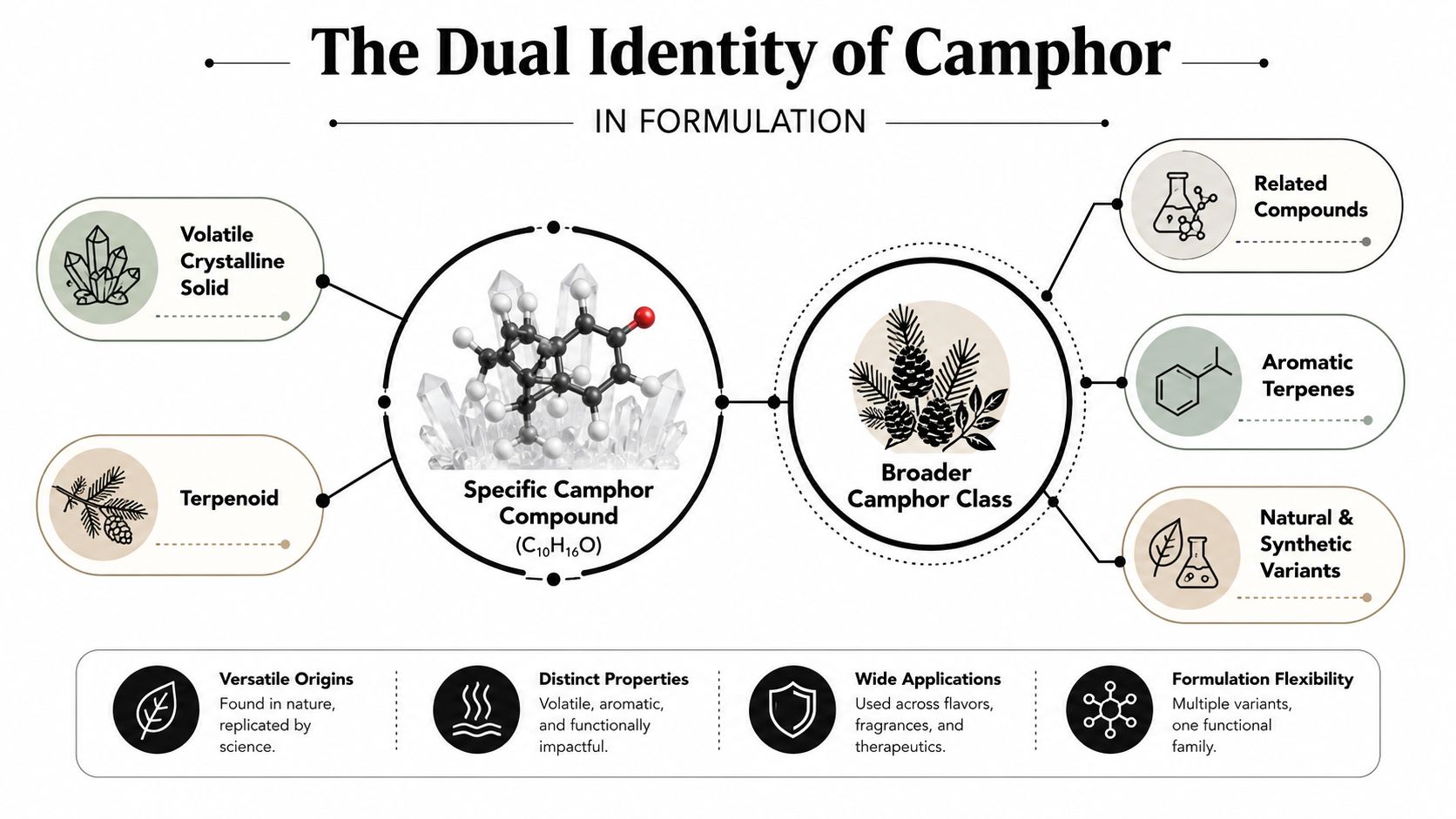
The Dual Identity of Camphor in Formulation
Camphor is often described as if it were one simple ingredient, but that framing hides the first sourcing problem formulators run into. In dictionary and chemistry references, camphor can mean a specific volatile crystalline compound, or it can refer to “any of several similar compounds”, which is exactly why supplier language can get slippery when a COA just says “camphor.” Merriam-Webster's definition of camphor captures that split clearly, and Britannica's camphor overview places the substance in the context of a real terpenoid ketone rather than a loose aroma descriptor.
What the name can mean in practice
For product developers, the word can point to three different realities. It can mean the plant-derived crystalline solid that's historically associated with Cinnamomum camphora. It can mean a synthetic laboratory-produced compound with the same identity. Or it can be used more loosely as a family label for related camphor-like molecules, which is where mistakes happen in procurement and blending.
Practical rule: Never assume “camphor” on a supplier sheet tells you enough. You need the exact identity, not just the aroma family.
That distinction matters because a formulation spec built around the molecule itself is not the same thing as a blend that wants a camphoraceous impression. When a brand wants a very specific terpene profile for cannabis product formulation, the sourcing conversation has to start with identity, not just scent.
Why this creates real sourcing risk
The practical issue is that common-language definitions and chemistry references don't always overlap cleanly. A retailer may use “camphor” as shorthand for aroma character, while a formulator needs a specific molecule with predictable volatility, solvency, and labeling implications. That gap is why the definition of camphor belongs in formulation work, not just in glossaries.
If you're sourcing for strain-inspired terpene blend development, ask for the exact product identity, the botanical or synthetic origin, and the test data that confirms it. Gold Coast Terpenes has a camphor oil uses archive that fits well as a starting point for comparing usage context, but the decision still comes down to what your formula needs to do.
Molecular Properties That Dictate Formulation Behavior
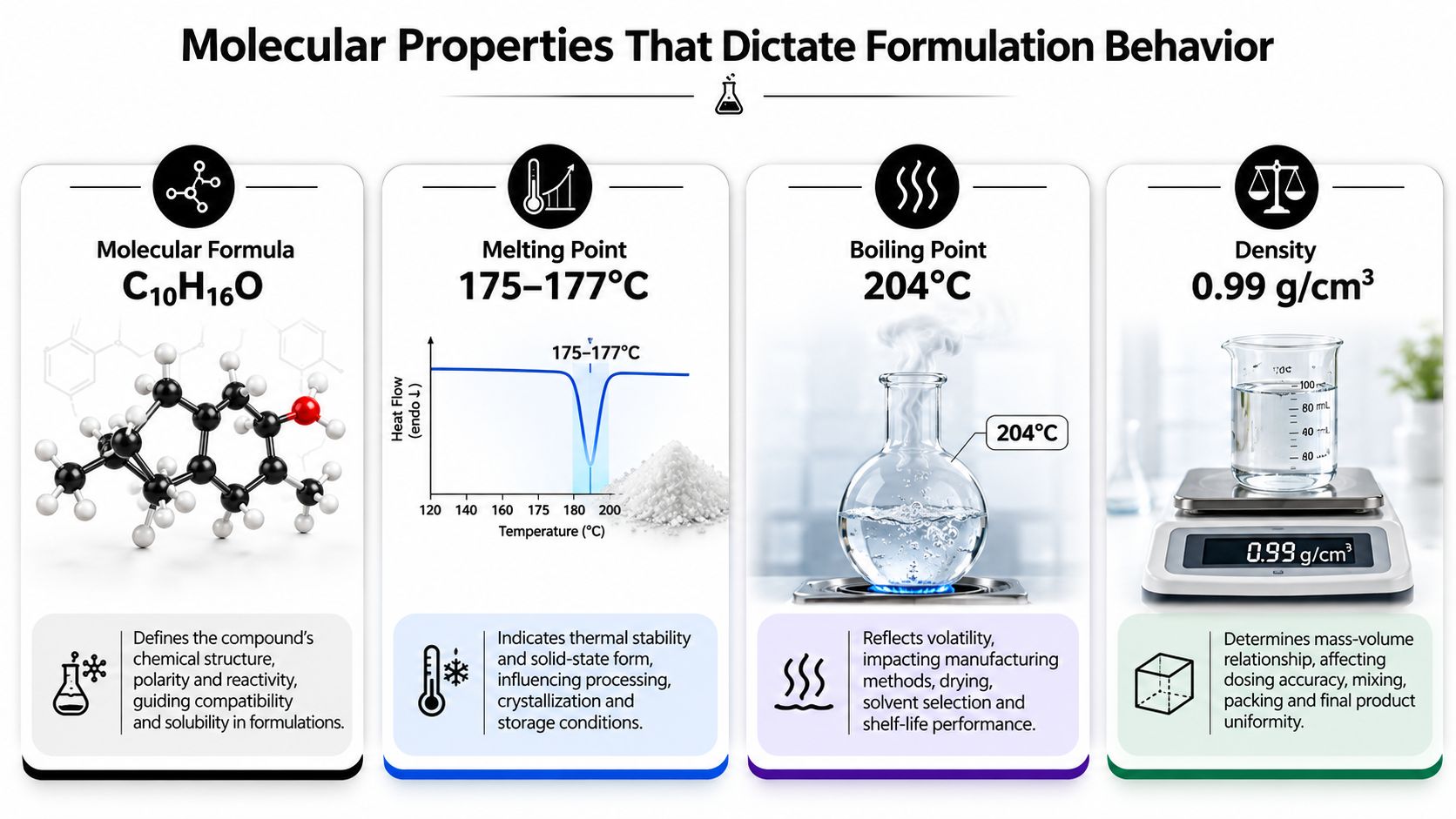
Camphor starts with physical behavior, not scent. The pure compound is a white, waxy solid that melts at about 178–179 °C (352–354 °F), and it can give off flammable vapors above 150 °F. ChemicalBook's property listing gives the handling details that matter in a production room, while Britannica's camphor entry anchors the compound's identity. For a broader chemistry frame, this overview of terpene chemistry is useful background.
Why it sublimes and why that matters
Camphor does not behave like a quiet additive. It sublimes at room temperature, so it can move from solid to vapor without acting like a typical nonvolatile ingredient. That matters in cartridges, distillates, and topical systems that sit in inventory for long periods. If the matrix cannot hold a volatile solid well, migration, crystallization, or concentration drift can show up during storage.
It is also practically insoluble in water, but soluble in alcohol, ether, chloroform, and other organic solvents. That makes it far easier to work with in oil-phase and solvent-based systems than in aqueous formats. In production terms, camphor belongs in the same conversation as other volatile solids used in fumigants, plastics processing, and topical products, not in the same bucket as water-friendly additives.
Handling rule: If the ingredient wants an organic phase, force it into a water phase only when there is a deliberate emulsification strategy.
Storage and mixing implications
The melting and boiling behavior points to a narrow handling window during production. Camphor should be stored away from heat, open flame, and warm staging areas where vapors can become a safety issue. Order of addition matters too, because dropping it late into a half-cooled viscous oil can leave microcrystals behind.
For formulators working on terpene profile for cannabis product formulation, this is the point that determines whether a batch stays uniform. A camphor-containing blend that looks fine at fill can still shift after cooling if the solvent system cannot keep it distributed. Stable mixing and compatible carriers matter more than guesswork.
What works better in production
Camphor performs best when the formula is designed around volatility instead of fighting it. That means using carriers and terpene ratios that can tolerate a volatile crystalline solid, rather than hoping a dense distillate base will behave like a universal solvent. The same chemistry explains why it can read strongly in small amounts and dominate a blend if the rest of the profile is too soft.
In practice, camphor is both a sensory component and a process check. If the formula cannot hold it cleanly, the problem is usually in the carrier system, the cooling curve, or the choice of blend partners.
Camphor's Role in Terpene Profiles and Strain Replication
Camphor sits in the top note position in many terpene systems because it hits fast and reads clean, sharp, and cooling. In a strain-inspired terpene blend, that makes it useful for creating immediate aromatic lift, especially when you need a profile to open with a penetrating edge before the mid-notes settle in. If you're building for flavor accuracy, camphor usually shouldn't be asked to carry the whole profile by itself.
How to place it in a blend
A camphor-forward profile usually works best when the blend has three layers. The top note handles the first impression, the mid note rounds the body, and the base note keeps the profile from feeling thin or harsh. Camphor belongs in the first layer, but it needs support from other terpenes that slow down the perception of sharpness.
For cannabis product formulation, that means pairing its assertive character with softer or heavier components so the aroma doesn't collapse into a medicinal or overly pungent edge. Myrcene can help add body, limonene can brighten the opening without flattening the profile, and beta-caryophyllene can give the blend a more grounded finish. The goal is not to mask camphor, it's to keep it legible without letting it take over.
Practical blending logic
A reliable approach is to start with the sensory target, not the ingredient list. If the reference profile leans fresh and penetrating, build the opening around camphor and then decide what kind of middle you want under it. If the target is a softer, more rounded strain-inspired terpene blend, reduce the camphor prominence and let supporting terpenes create the perception of freshness instead.
Formulator's note: Camphor is easiest to control when you treat it like an accent note, not a base building block.
Isolated camphor makes sense when you need exactness and repeatability. Camphor-containing essential oils can be useful when you want a broader botanical impression, but they add more variables, which can complicate flavor matching in vape cartridges for gold-standard batch consistency. The commercial trade-off is straightforward, isolated material gives tighter control, while botanical blends give more natural complexity.
If you're mapping a replicating flavor of camphor style profile, build in small sensory adjustments and keep notes on how the opening changes after cooling and resting. That's where a blend can go from technically correct to commercially usable.
Natural Versus Synthetic Camphor for Product Development
Camphor sourcing changes the claims you can make, the consistency you can expect from lot to lot, and the way the material scales in production. The distinction matters because camphor is not just a single marketing term. In practice, formulators may be dealing with a defined molecule, or with a broader terpene-ketone class as that term gets used in sourcing conversations, and those are not interchangeable decisions. Britannica's camphor overview describes its long use in incense and medicine, while the National Cancer Institute notes that camphor can also be made in a laboratory and shows up in commercial products such as mothballs. NCI's camphor definition is the cleaner reference for that manufactured-material context.
Comparing the two sourcing paths
Natural camphor tends to appeal to brands that want a botanical story and a cleaner label narrative. Synthetic camphor is usually selected when the priority is batch-to-batch consistency, especially in larger manufacturing runs where small shifts can affect fill performance and sensory output. The choice is operational first, not moral.
For formulation work, the practical questions are straightforward. Is the material traceable. Is the identity confirmed. Can the supplier support the documentation your QA team needs. A certificate of analysis should tell you what the ingredient is, not only what it smells like. If you are comparing it with other terpene inputs, the natural versus artificial terpenes guide gives useful context for how sourcing choices change the profile you can build.
What to verify before you buy
- Identity match: Confirm that the material is the specific camphor you intend to use, not a broader camphor-like mixture.
- Origin clarity: Ask whether it is plant-derived or synthesized, because that affects how you describe it in product materials.
- Documentation quality: Make sure the supplier can provide records suitable for your internal QA file.
- Use-case fit: Check whether the material suits vape cartridge work, distillate blending, or a different product class.
The decision often comes down to whether you need a tightly controlled ingredient or a more expressive botanical input. In product development, that makes source selection a formulation choice as much as a procurement choice.
Safety Protocols and Regulatory Boundaries for Camphor
Camphor demands tighter handling than many terpene inputs. Its use depends on route, concentration, and the final product category, and those factors change the safety answer more than the aroma does. In formulation work, that means the label claim, the exposure route, and the handling controls all have to line up.
Camphor is not a generic flavor note you can drop into any blend and assume it will behave. The ingredient can appear in commercial and industrial settings, and it also shows up in products intended for very different types of contact. That dual use profile is exactly why the definition of camphor has to be read with care, not treated as a simple scent description.
Why route of exposure changes the answer
A useful definition of camphor has to say how the material is being used. Topical, inhaled, household, and industrial applications sit under different expectations, and the safety answer changes with the route and the concentration. A blend that may fit one product class can be a poor choice in another, even if the aroma profile looks right on paper.
For vape cartridges and distillate systems, the issue is not just scent. It is thermal behavior, inhalation suitability, and how a volatile solid behaves once it is heated inside a device. If the ingredient is not intended for that exposure route, the formulation should not force it. A product file should also support that decision with clear documentation, which is where a solid safety data sheet importance resource becomes part of the development process rather than an afterthought.
Control points that actually matter
- Keep ingestion risk explicit: If the product is not meant to be swallowed, the label should say so plainly.
- Store away from heat: Camphor can emit flammable vapors above 150 °F.
- Protect workers during handling: Use closed containers, controlled weighing, and bench ventilation.
- Document the route of use: Your internal file should match the actual product type, not just the ingredient name.
That discipline matters in cannabis product development, where inhalation and topical products carry different technical and compliance expectations. A camphor-containing blend may be workable, but only if the documentation, handling plan, and use claim all match the same route of exposure.
A cautious formulation stance
I stay conservative with camphor in anything that will be heated, inhaled, or stored warm for long periods. The ingredient can be useful, but only when the formula respects its volatility and the product category respects its safety limits. If the route of exposure is not clear, the formulation is not ready.
Practical Formulation Strategies for Camphor Integration
Camphor works best when the process is built around its behavior from the start. In winterized distillate oils, live resin blends, and vape cartridge formulations, the main goal is to keep it fully integrated, evenly dispersed, and stable after cooling. If you add it like a routine flavoring, you'll often get crystallization, uneven intensity, or a profile that changes after fill.
A simple production sequence
Start with the base oil or terpene matrix and confirm that it's warm enough to accept a volatile solid without shocking the system. Add camphor under controlled conditions, then mix long enough for visual homogeneity before bringing the batch down to fill temperature. The order matters because camphor's tendency to sublime makes late, cold addition more likely to leave material behind.
For distillate work, the cleanest results usually come from blending into a fully winterized base before the final terpene adjustment. In live resin systems, the target is usually less about raw intensity and more about keeping the aromatic bridge coherent, so camphor should be used sparingly and checked against the native profile before any final balance step.
Troubleshooting common failures
If you see precipitation in cartridges, the blend is usually telling you one of three things. The camphor load is too high for the carrier system. The cooling curve was too aggressive. Or the rest of the terpene stack doesn't have enough solubility support to keep the ingredient in solution.
If the aroma turns stale or off, oxidation and repeated heat exposure are often part of the story. If one batch smells right and the next doesn't, the problem is usually process drift, not the ingredient itself. Tighten the mixing order, hold temperatures steady, and keep the rest of the profile consistent.
Production rule: Solve camphor problems with process control before you blame the material.
Choosing the right product path
Use camphor when the profile needs sharpness, clarity, or a cooler aromatic edge. Hold back when the brand brief calls for soft fruit, creamy dessert, or heavy base-note coverage. For some teams, a camphor-containing terpene system from Gold Coast Terpenes is a practical way to source a consistent component, but the primary advantage still comes from matching the ingredient to the device, the carrier, and the regulatory context.
If you're validating a new SKU, test for sensory stability after rest, check for visible settling, and compare the opening aroma against a reference sample after the product has cooled. That feedback loop is what turns camphor from a tricky raw material into a controlled part of your formulation toolkit.
If you're developing terpene blends, vape cartridges, or distillate systems that need camphor handled correctly, Gold Coast Terpenes supplies terpene ingredients, strain-inspired profiles, and formulation resources that fit this kind of work. Visit Gold Coast Terpenes to review camphor-related options, compare blend components, and build a more controlled sensory profile for your next product.