
A convincing Skunk Diesel strain profile isn't created by adding more gas aroma. It comes from coordinating citrus lift, peppery fuel, earthy body, and a carefully controlled skunk base. Gold Coast Terpenes positions its catalog around 100% botanical-derived, THC-free terpene blends, which makes that layered profile useful as a repeatable reference for cartridge and extract formulation rather than a label copied from one variable flower batch.
For product developers, the strain name is a sensory brief, not a potency promise. This guide covers the lineage, terpene architecture, vapor behavior, botanical versus cannabis-derived inputs, load-rate decisions, hardware matching, compliance questions, and practical methods for replicating the flavor of Skunk Diesel for vape cartridges and distillate.
What Makes the Skunk Diesel Strain a Useful Formulation Reference
Any formulator who treats Skunk Diesel as one gas note leaves flavor performance, throat feel, and hardware stability on the table. The profile works better as three coordinated layers: a bright citrus-fuel opening, a muscular peppery center, and a persistent earthy-skunk finish. That structure translates to winterized distillate carts, live resin pods, and sauce-style disposables, although each matrix and device will express it differently.
Gold Coast Terpenes supplies botanical-derived, THC-free blends intended for cartridge, concentrate, and product formulation work. That positioning matters when a development team needs to tune aroma independently from cannabinoid content, document inputs, and reproduce a strain-inspired flavor across production lots.
Treat the name as a sensory target
Skunk Diesel is commonly described as a cross of NYC Diesel and Sensi Skunk, with one database listing it at 55% indica and 45% sativa. Another listing reports approximately 17% to 18% THC and CBD as high as 0.2%. Those figures describe a listed cultivar profile, not a guaranteed result for a distillate product, and they shouldn't be used as a substitute for a batch-specific certificate of analysis. The lineage and reported cannabinoid range are summarized by Blimburn Seeds' Skunk Diesel reference.
For a formulator, the useful question is different: what sensory components must survive extraction, blending, storage, and heating? A label that says Skunk Diesel may express as sharp diesel, citrus peel, musky skunk, dry earth, or a flatter generic fuel profile depending on the source material and process.
Practical rule: Build the brief around the aroma consumers should recognize, then validate the blend in the actual oil and hardware. Don't assume the strain name guarantees a consistent vapor experience.
Why the profile suits commercial development
A three-layer brief gives teams clear development checkpoints:
- Opening pull: limonene and related bright volatiles should provide citrus snap without turning into cleaner-like sharpness.
- Mid-palate: beta-caryophyllene, humulene, and supporting compounds should create pepper, dry spice, and fuel density.
- Finish: myrcene, linalool, and trace sulfur-associated chemistry should leave the musky, earthy character that separates skunk from ordinary gas.
That framework also helps a brand compare a botanical reference against flower-derived oil. Gold Coast Terpenes describes its products as free of VG, PG, PEG, and MCT, with laboratory testing and THC-free positioning. Those are formulation attributes to verify against the current documentation for the specific product, especially when the finished item will carry state-specific labeling or inhalation-use requirements.
The practical workflow is straightforward. Define the sensory target, choose a botanical or cannabis-derived route, set a total load appropriate to the device, blend at controlled temperature, and test the finished matrix after storage. A strain-inspired terpene blend only earns its name when the first pull, middle vapor, and aftertaste arrive in the intended order.
Lineage of the Skunk Diesel Strain and Why It Matters for Terpene Work
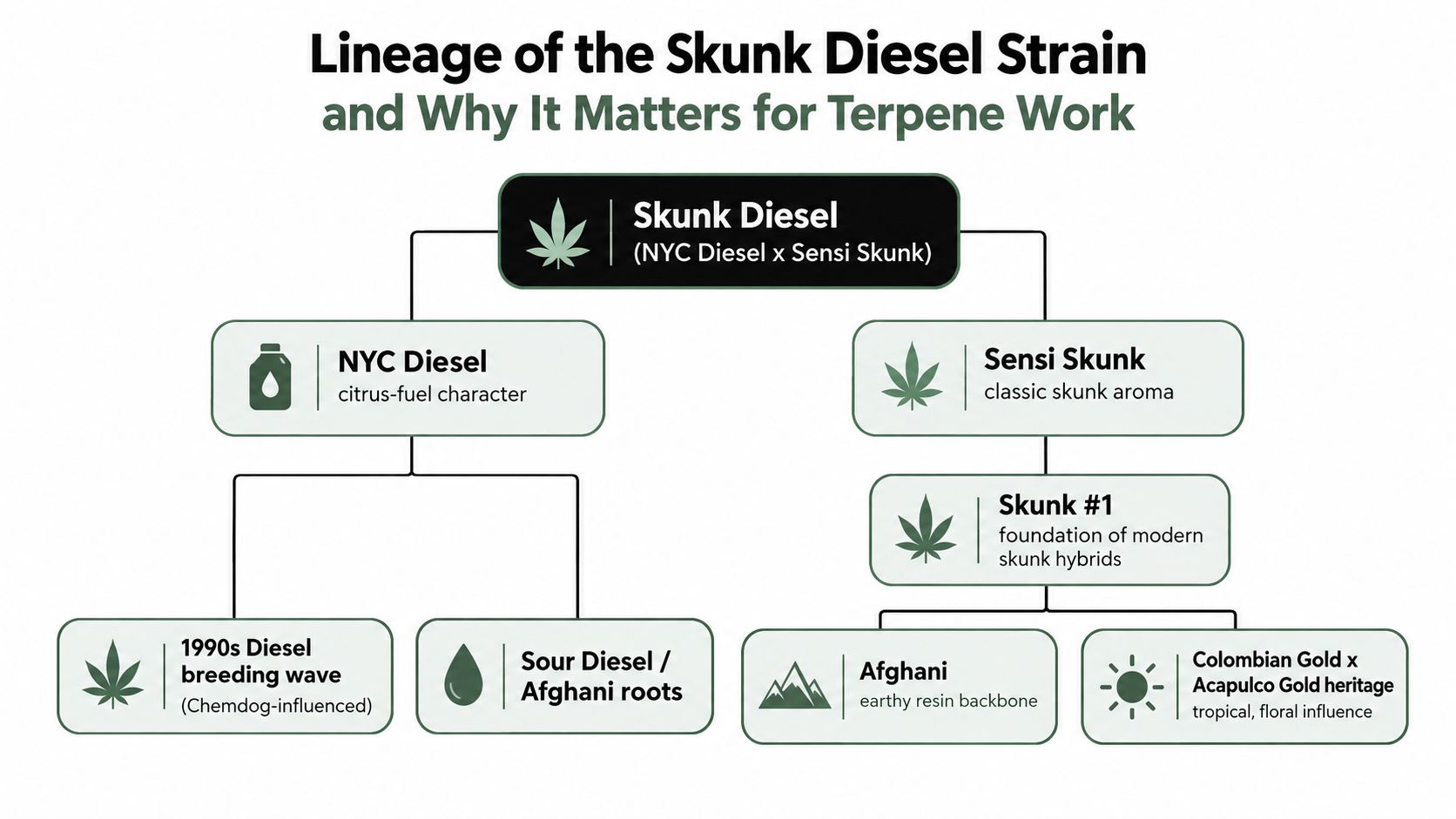
Skunk Diesel is commonly listed as NYC Diesel crossed with Sensi Skunk, placing it at the intersection of the Diesel and Skunk families. That ancestry suggests a profile built from citrus-fuel brightness, musky skunk character, and a deeper earthy resin body, but lineage should guide weighting rather than dictate an exact laboratory formula.
The Skunk side supplies structure
Skunk #1 is widely described as a stabilized three-way hybrid involving Afghani, Colombian, and Acapulco Gold lines. A documented breeding timeline describes repeated stabilization across generations, producing comparatively uniform height, structure, and flowering behavior. That consistency helped move cannabis breeding toward more predictable commercial production, as summarized in the Skunk cannabis strain history).
For terpene work, the important inheritance is sensory rather than botanical. Afghani influence is commonly associated with a resinous, earthy backbone, while the broader Skunk family contributes the musky, pungent direction. Those traits create the base that keeps a Diesel blend from becoming a simple lemon-and-solvent flavor.
The Diesel side supplies lift and identity
NYC Diesel is one branch of the broader Diesel naming and breeding tradition. The wider Diesel family developed through East Coast breeding scenes during the 1990s and 2000s, with Chemdog-influenced lines helping establish the sharp chemical, citrus, and fuel vocabulary that later became commercially recognizable. Exact relationships among named Diesel cultivars can be disputed, so a responsible formulation brief should distinguish documented parentage from broader family resemblance.
The practical implication is a weighting decision. Use limonene and pinene-family materials to create brightness, beta-caryophyllene to supply peppery fuel depth, and myrcene to support the earthy body. Keep the skunk impact subordinate to the blend architecture unless the target specifically calls for an aggressive sulfur impression.
Elevated Strains is one example of a strain-oriented flavor catalog item, but it shouldn't be treated as a substitute for a Skunk Diesel sensory match. Each profile still needs evaluation in the intended oil and device.
Lineage becomes a bench-testing hypothesis
The genetic stack tells a developer what to test first, not what must appear in identical proportions. A flower extract may carry a different balance from a botanical blend, and extraction can reduce or distort volatile sulfur compounds. Start with the expected citrus, pepper, musk, and earth families, then adjust after smelling the neat blend, diluted oil, and vaporized sample.
That approach is more reliable than copying a terpene list from a strain database. The list establishes direction. The finished product decides whether the direction is convincing.
Terpene Profile for Skunk Diesel Across Top, Mid, and Base Notes
A useful terpene profile for Skunk Diesel has three jobs. Limonene and pinene-family materials create the first-pull brightness, beta-caryophyllene and humulene build the peppery fuel center, and myrcene with supporting floral and sulfur-associated notes carries the finish. A neutral Sour Diesel flavor reference lists caryophyllene, d-limonene, myrcene, beta-pinene, linalool, alpha-pinene, alpha-terpineol, and camphene, a combination also described by Cali Terpenes' Sour Diesel flavor profile.
Read the profile as a vapor curve
The table below is a development framework, not a claim that every terpene evaporates at one isolated temperature. Coil construction, airflow, voltage, oil viscosity, and puff duration all change delivery.
| Note Layer | Primary Terpenes | Sensory Role | Vapor Window (°C) |
|---|---|---|---|
| Top | Limonene, alpha-terpinolene, alpha-pinene, beta-pinene | Citrus peel, green rind, fresh fuel lift | 180 to 200 |
| Mid | Beta-caryophyllene, humulene, camphene | Pepper, dry spice, diesel muscle, herbal depth | 210 to 230 |
| Base | Myrcene, linalool, trace sulfur-associated compounds | Earth, musk, soft floral rounding, lingering skunk | 240 and below |
The commercially relevant Sour Diesel reference also lists limonene, caryophyllene, myrcene, pinene, linalool, alpha-terpineol, and camphene as the main profile components. See the terpene flavor chart when mapping individual materials to a broader sensory vocabulary.
What each layer contributes
Top notes create recognition quickly. Limonene supplies the citrus edge, while alpha-pinene and beta-pinene add fresh, green lift. Terpinolene can sharpen the opening, but it should remain a supporting accent. Too much top-note material can make the blend read as pine cleaner rather than diesel with citrus.
Mid notes prevent the profile from collapsing. Beta-caryophyllene contributes pepper and dry spice, and humulene helps create a woody, herbal body. Here, the “fuel” impression gains texture. A generic gas blend often overemphasizes one sharp aromatic and misses this denser mid-palate.
Base notes determine whether the skunk impression lasts. Myrcene supplies earthy musk, while linalool can soften an abrasive edge. Distinct skunk intensity is associated with trace sulfur-bearing compounds, not only with high myrcene. Those minor volatiles are vulnerable to extraction, heat, oxygen, and storage, so a strain name alone can't guarantee their presence.
A representative distillate brief should therefore specify a bright top, a restrained but clear pepper-fuel middle, and an earthy base with controlled skunk impact. Don't chase sulfur intensity without checking the finished oil for harshness, instability, and hardware compatibility.
Botanical Versus Cannabis-Derived Terpenes for Skunk-Diesel Replication
Botanical-derived terpenes are usually the more practical reference route for scaled Skunk Diesel replication. They offer a cleaner path to repeatable limonene, beta-caryophyllene, and pinene-family inputs, while cannabis-derived terpenes can support a premium provenance story when the supply chain, documentation, and batch variation are acceptable.
The decision isn't only about aroma authenticity. Buyers also need to assess label language, compliance review, contaminant documentation, lot consistency, and how the blend behaves after it enters a cartridge.
| Attribute | Botanical-Derived | Cannabis-Derived |
|---|---|---|
| Label positioning | Can be identified as botanical-derived when supported by supplier documentation | Can support cannabis-derived positioning when origin and documentation are verified |
| Batch consistency | Often easier to standardize across production lots | Can vary with cultivar, harvest, extraction, and processing |
| Documentation | Request current COAs, allergen information, safety documents, and intended-use guidance | Request the same records, plus origin and extraction documentation |
| Hardware behavior | Individual isolates can be adjusted precisely for viscosity and flavor | Native minor components may alter aroma, color, and stability |
| Commercial fit | Suits repeatable strain-inspired profiles and scaled programs | Suits programs where provenance is part of the product strategy |
Label and compliance decisions
A botanical input isn't cannabis-derived just because the finished product contains cannabis extract. Brands should keep ingredient identity, source, and finished-product claims distinct. Review state requirements, inhalation-use restrictions, allergen disclosures, Prop 65 obligations where applicable, child-resistant packaging rules, and the current COA for every production lot.
A cannabis-derived profile may appear more authentic on paper, but it can introduce greater sensory drift. A flower-derived terpene fraction may express the right character in one lot and a different balance in the next. A botanical blend lets the developer rebuild the sensory target with defined components, then document the formulation more clearly.
The CDT versus BDT comparison guide is useful when a purchasing team needs to explain the distinction internally. It shouldn't replace a regulatory review by the brand's qualified compliance team.
Hardware behavior matters more than origin stories
Both input routes can fail if the finished formulation is overheated or stored poorly. Limonene and terpinolene can drift toward harsher oxidation notes, while sulfur-leaning materials may lose their intended impact or become disproportionately dominant. Bench-test both routes in the actual ceramic, wick, or disposable platform before making a sourcing decision.
For most repeatable programs, botanical-derived components offer the control needed to match a sensory standard. Cannabis-derived inputs remain a valid choice when the brand can accept variation and has the documentation to support its claims.
Formulating a Strain-Inspired Skunk Diesel Blend for Distillate and Carts
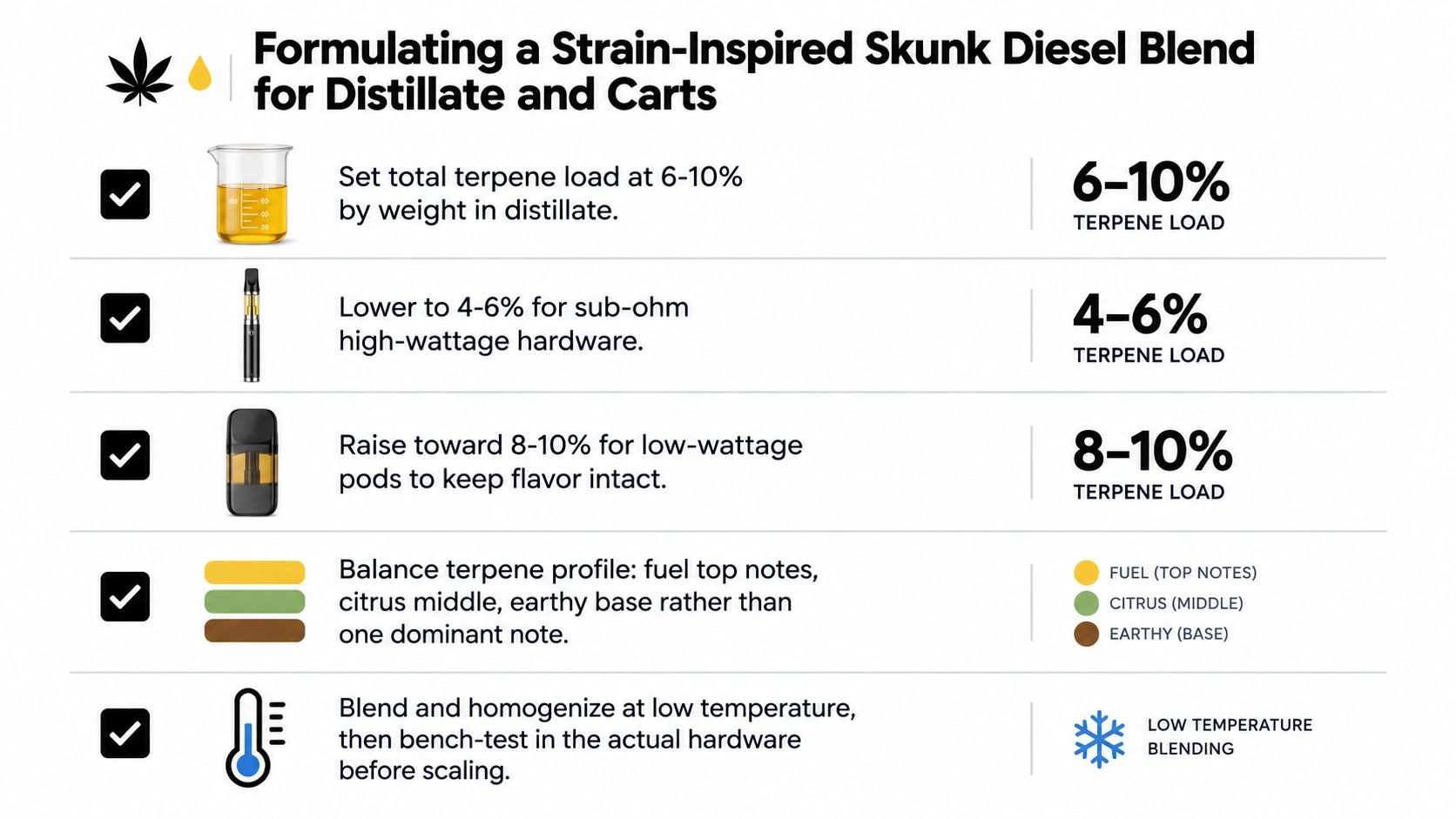
A workable strain-inspired terpene blend for distillate starts at 6% to 10% by weight, then moves lower or higher according to hardware and vapor delivery. A commercial skunk-style guide also identifies 5% to 7% as a starting load for a strain-inspired blend in winterized distillate and suggests a 0.5% to 1% beta-caryophyllene isolate addition for a peppery fuel effect, as described in this skunk replication guide. Because these ranges come from different formulation guides, treat them as bench-testing starting points, not universal specifications.
Set the load by device class
The same oil can taste balanced in one platform and muted or abrasive in another.
- Sub-ohm, high-wattage hardware: Start around 4% to 6% total terpenes. Higher heat and greater aerosol output can exaggerate sharp top notes and throat feel.
- Low-wattage pod systems: Test toward 8% to 10% when the oil and hardware require more aromatic concentration for flavor translation.
- Distillate stability ceiling: Treat 12% total terpenes as a practical warning point for instability and irritation testing. A separate skunk guide recommends keeping vape applications between 3% and 12%, with concentrations above 15% associated with greater throat irritation and instability risk. The guidance appears in this skunk formulation guide.
Build the blend in layers
Begin with the profile's citrus-fuel top. Limonene provides brightness, while terpinolene can add a sharper green lift. Add beta-caryophyllene for pepper and fuel density, then use myrcene to supply an earthy, musky body. A small supporting amount of pinene, humulene, linalool, camphene, ocimene, or bisabolol can shape lift and roundness, but every addition should have a sensory purpose.
The sulfur impression requires special care. Terpenes can suggest skunk, but distinct skunk intensity is associated with trace sulfur-bearing compounds. Those materials should be handled according to supplier safety and intended-use documentation, and they should be evaluated at very low levels in the complete oil rather than judged in isolation.
For the isolate boost, the commercial guide above gives 0.5% to 1% beta-caryophyllene isolate as a reference. A narrower development screen of 0.3% to 0.8% can help determine how much pepper-fuel lift the matrix needs without automatically pushing the complete terpene load toward the upper boundary. Keep the isolate inside the total load calculation.
Match the heat and mixing process
For ceramic cart development, one starting hardware window is 2.2 to 2.6 ohms at 3.2 to 3.6 volts. Treat those values as a test condition, not a guarantee of coil temperature. Actual heat depends on resistance, power delivery, airflow, oil feed, draw length, and device design.
Blend and homogenize at low temperature. Excess heat can strip the brightest volatiles before filling, while aggressive mixing can introduce unnecessary oxygen. After filling, test first pulls, middle pulls, and late-session behavior in the final hardware. The best terpenes for distillate guide can support the initial material-selection stage, but the finished matrix remains the decision point.
Record sensory notes alongside viscosity, fill behavior, leakage, wicking, and vapor output. A blend that smells perfect in a vial can still flood a cartridge, mute in a pod, or become harsh after storage.
Common Pitfalls When Replicating Skunk-Diesel Flavor in Finished Products
Skunk Diesel fails in finished products when the developer chases “gas” instead of building the full aroma sequence. Myrcene can supply earthy musk, but it does not replace the citrus-fuel top, peppered mid, or sulfur-skunk base. A generic fuel blend often smells sharp in the bottle, then turns flat or heavy once diluted into distillate.
Four errors that show up in production
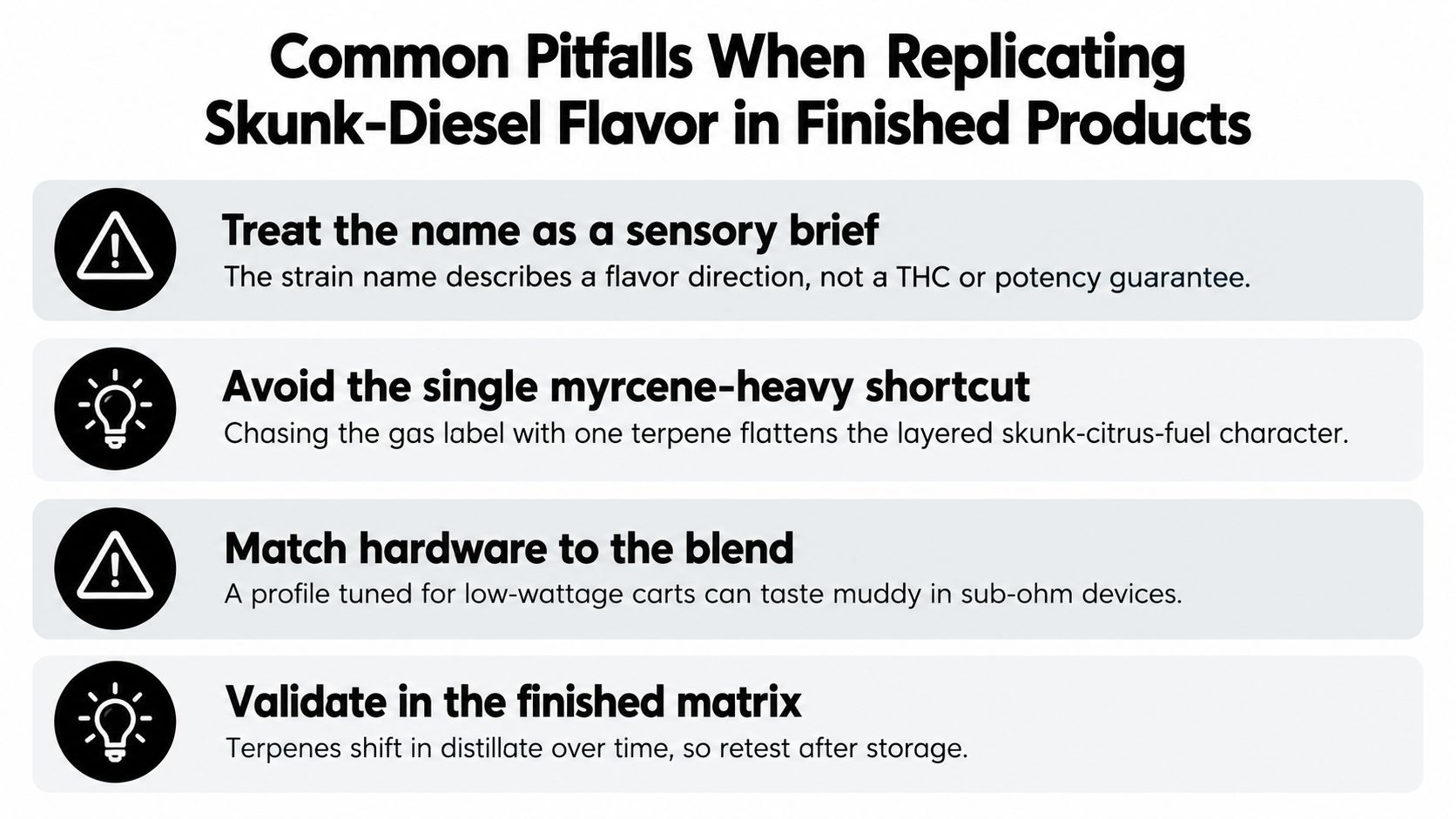
- Treat the name as a sensory brief: Skunk Diesel indicates a flavor direction. It does not define the finished cartridge's THC level, effects, or exact aroma chemistry.
- Avoid the single myrcene-heavy shortcut: Myrcene carries earthy musk, while limonene and related citrus materials provide lift. Beta-caryophyllene can reinforce pepper and fuel. Using myrcene as the whole gas strategy flattens the profile and may make vapor feel dense.
- Match hardware to the blend: A bright top accord can disappear in a hotter device, while a low-temperature pod may leave a heavier base underdeveloped. Evaluate the same blend across the intended cartridge hardware and draw conditions.
- Validate in the finished matrix: Distillate can shift terpene balance during storage. Check fresh and stored samples for first-pull recognition, mid-vapor continuity, finish, and throat feel.
Sharp top notes need restraint
Terpinolene can add green brightness, but excessive use may push the opening toward pine-sol harshness at higher heat. Keep it subordinate to the citrus and fuel structure. Distinct skunk intensity is associated with trace sulfur-bearing compounds, as explained in our guide to why weed smells like skunk.
Sulfur-leaning accords require oxidative-stability testing. Terpinolene and ocimene may shift during storage, and minor sulfur volatiles can be lost or distorted during extraction and handling. Use sealed, compatible containers, limit heat exposure, and compare fresh and stored samples under matching draw conditions.
A four-to-six-terpene architecture with a controlled beta-caryophyllene isolate boost gives the formulator more control than a single-note fuel shortcut. Keep sulfur character restrained enough to survive the matrix without overwhelming the citrus top.
Success is repeatable recognition from the first pull, a coherent transition through the vapor, a clean finish, acceptable throat feel, and stable performance across the production lot.
Frequently Asked Questions About Skunk Diesel Strain Terpene Sourcing
What should a buyer request before ordering?
Request the current certificate of analysis, ingredient or source description, allergen information, Prop 65 disclosures where relevant, safety documentation, and intended-use guidance. Gold Coast Terpenes describes its terpene products as THC-free and free of VG, PG, PEG, and MCT, but the buyer should verify the documents for the exact blend and application.
Does Gold Coast Terpenes publish minimum order quantities?
MOQ, bottle sizes, lead times, and bulk terms can change by product and order type. Ask Gold Coast Terpenes for the current purchasing information rather than assuming a catalog snapshot applies to a production run.
Can the profile ship as a ready-made blend or separate components?
A buyer should confirm whether the selected Skunk Diesel direction is supplied as a ready-to-use blend, individual isolates, or components that can be combined into top, mid, and base accords. Separate materials are useful when a lab needs to adjust limonene, beta-caryophyllene, myrcene, or supporting notes independently.
What labeling language applies to botanical-derived terpenes?
Use source-accurate language supported by supplier documentation. Botanical-derived and cannabis-derived are different descriptions, and the finished product's ingredient panel, marketing claims, and state compliance review should reflect the actual source.
Are there shipping restrictions?
Shipping rules can vary by destination, product category, and jurisdiction. Confirm state-by-state restrictions, carrier requirements, and any limits affecting cannabis, hemp, or inhalation products before placing a commercial order.
What packaging should a brand plan for?
Finished vape products may require child-resistant packaging and other package or labeling controls depending on the market. The terpene supplier's bottle packaging and the finished cartridge package are separate compliance questions, so the brand should validate both with its regulatory team.
Gold Coast Terpenes offers strain-specific blends, isolated compounds such as limonene, myrcene, and beta-caryophyllene, formulation resources, safety documents, and a mixing calculator. For a Skunk Diesel development program, use those resources to create a documented bench formula, then confirm flavor, stability, labeling, and hardware behavior with the current product documentation before scaling.
Gold Coast Terpenes offers botanical-derived, THC-free strain profiles and isolated compounds for cartridge, distillate, concentrate, and broader cannabis product formulation work. Visit Gold Coast Terpenes to compare strain-inspired options, review formulation resources, and start a documented Skunk Diesel flavor-matching workflow.