
A brand manager drops a Raspberry Parfait SKU brief on your bench Monday morning. The sales language is simple, “sweet, creamy, uplifting,” and the launch window is eighteen days. The problem is that a name and a tasting note aren't enough to make a repeatable cartridge. You need a chemical target, a sensory reference, a compatible device, and a process that survives the difference between one flower lot and the next.
For a formulation team, the Raspberry Parfait strain is most useful as a replication problem, not a fixed flavor label. Public profiles repeatedly point toward a sativa-dominant hybrid bred from Shishkaberry and Truffula Tree, while lab-style listings show a terpinolene-led signature with meaningful variation in supporting compounds. That gap between branding and COA reality determines whether a vape tastes like bright berry cream or becomes generic sweet fruit.
The walk-through below turns that brief into production decisions for strain-inspired terpene blends, distillate, and vape cartridges. It covers the target note architecture, batch acceptance logic, hardware considerations, and the records your team should preserve before approving a commercial fill.
Setting Up Your Raspberry Parfait Formulation Brief
Start by converting the sales brief into deliverables. “Sweet, creamy, uplifting” describes the intended impression, but it doesn't tell the lab what to weigh, what to test, or what to reject. Before mixing oil, the formulator should document five items:
- Sensory architecture: Define the expected top, mid, and base notes, including which note must arrive first on the draw.
- Load-rate window: Establish the intended total terpene addition and the acceptable adjustment range for the selected oil.
- Hardware call: Identify whether the formula is intended for ceramic-core or cotton-wick 510 hardware, then confirm viscosity and separation behavior.
- Reference standard: Retain a sealed flower, resin, or approved flavor reference for sensory comparison.
- Release criteria: State what counts as an acceptable berry, cream, herbal, and spice balance before production begins.
The chemistry gives you a defensible starting point. Independent strain reporting describes Raspberry Parfait at around 20% average THC, with batches commonly reported around 18% to 24%, while a retail-lab profile recorded 20.80% THC and 2.86% total terpenes (GrowDiaries strain reviews, Joint Commerce terpene guide). Those figures aren't a finished cartridge formula, but they show why the brief should be built around a profile rather than a single headline potency claim.
Establish the target before the blend
Write the brief as a sensory and analytical boundary. Terpinolene should lead the aromatic opening, myrcene and ocimene should provide fruit body, and caryophyllene, bisabolol, and other lower-volatility compounds should prevent the finish from becoming thin. The ratio matters more than the strain name printed on a source label.
A common production failure starts when the team skips this step and reaches for whichever “berry” blend is already on the shelf. That shortcut may produce sweetness, but it can erase the bright herbal lift that distinguishes this profile. It also makes later batches impossible to compare because nobody knows whether a change came from the biomass, the blend, or the hardware.
Practical rule: Don't approve a Raspberry Parfait formulation until the team can describe the first inhale, mid-palate, and finish without using the strain name as a substitute for sensory detail.
The rest of the brief should answer one operational question: what must remain recognizable when the next COA arrives? That answer will guide the target bands, botanical terpene load, device selection, and final sensory panel.
Strain Lineage and Why It Matters for Replication
Raspberry Parfait is most commonly described in strain databases as an 80% sativa and 20% indica hybrid, with lineage repeatedly traced to Shishkaberry crossed with Truffula Tree. Humboldt Seed Company is the breeder most often credited with its development, placing the cultivar within the modern boutique wave selected for flavor, structure, and commercial cultivation performance rather than a classic landrace tradition (Hytiva Raspberry Parfait profile).
That background matters because replication begins with a genetic hypothesis. A Shishkaberry and Truffula Tree cross suggests a berry-centered foundation with contemporary dessert character, but the breeder's selected cut determines which aromatic compounds become dominant. One expression may emphasize terpinolene and bright herbal lift. Another may retain the berry identity while shifting more weight toward myrcene, caryophyllene, ocimene, or floral support.
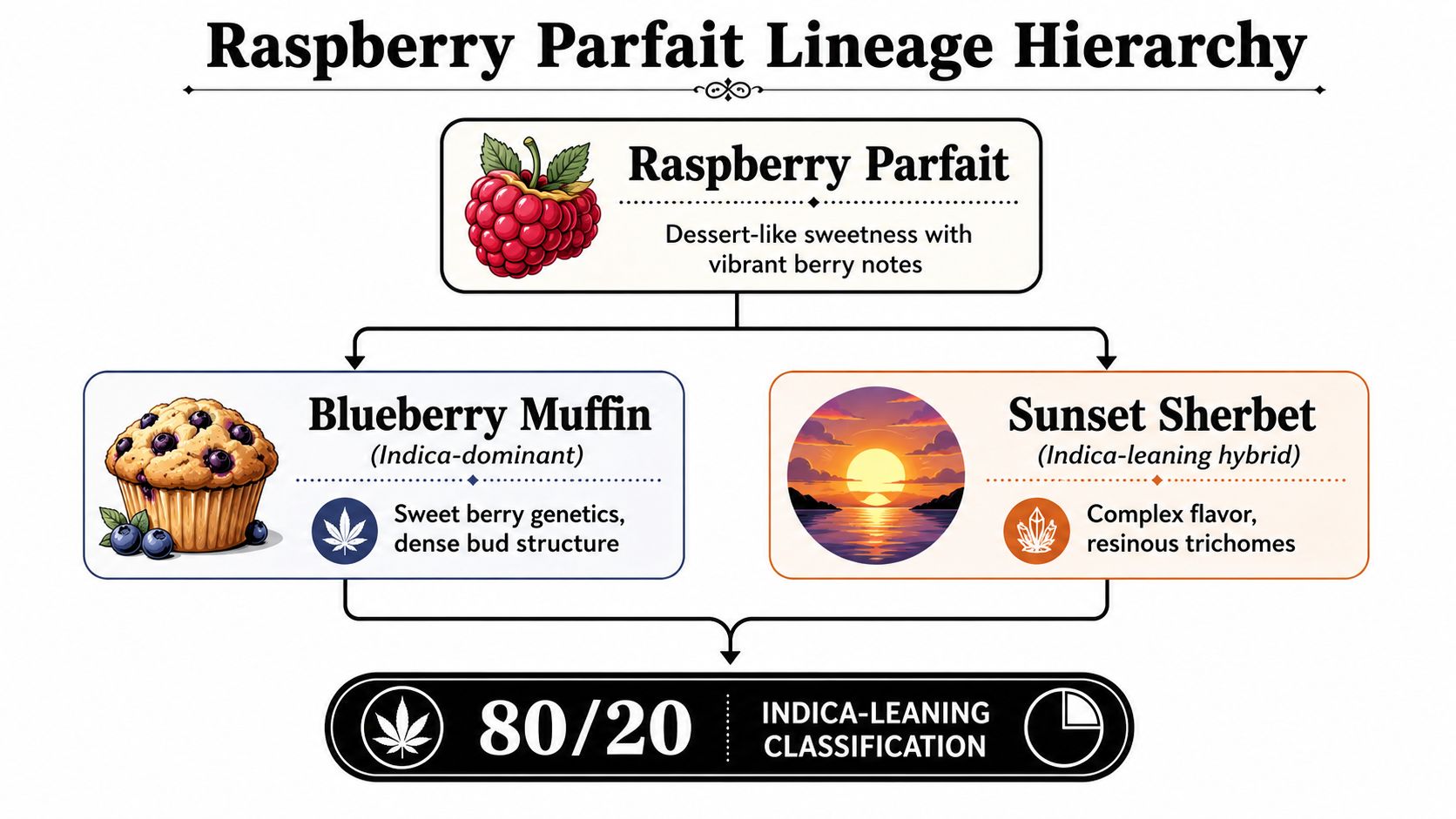
The supplied lineage visual uses Blueberry Muffin and Sunset Sherbet, but the repeatedly documented Raspberry Parfait parentage in the strain data is Shishkaberry and Truffula Tree. For a brand team, that discrepancy is a quality-control signal. It means visual or retail shorthand shouldn't override the COA and provenance records attached to the actual biomass.
Use lineage as a starting hypothesis
The cross helps you choose which compounds to investigate first, but it isn't a finished specification. Two phenotypes carrying the same name can produce materially different COAs, especially after differences in cultivation, harvest timing, curing, and storage. A formulator who copies a generic “sweet berry” template may reproduce the dessert idea while losing the sharper terpinolene-led opening associated with many Raspberry Parfait listings.
Keep the historical context in the formulation record, then move quickly to measurable inputs. Record the breeder or source attribution, lot identity, harvest information, cannabinoid and terpene results, and the sensory reference used by the approval panel. A practical strain terpene profile archive can help organize comparison work, but the incoming lot's own COA remains the controlling document.
Lineage therefore influences the first blend screen, not the final release decision. In cartridge work, it tells you which top notes deserve protection. In distillate work, it helps you decide which isolated compounds can restore a missing aromatic lane without forcing every batch into the same artificial profile.
Terpene Profile and Top Mid Base Note Roles
A representative lab-style Raspberry Parfait sample recorded 2.86% total terpenes, including 1.11% terpinolene, 0.31% caryophyllene, 0.25% myrcene, 0.21% ocimene, and 0.17% bisabolol. Another reported profile found 22% THC with 0.6% terpinolene as the major terpene, while a separate dataset listed 0.65 mg/g terpinolene and 0.31 mg/g beta-myrcene (Joint Commerce chemical profile, AllBud Raspberry Parfait profile).
Those results support a terpinolene-led formulation strategy, but they don't justify treating every batch as identical. Terpinolene is the volatile top-note driver. It can present as sharp, sweet, floral, herbal, and slightly pine-clean, giving the draw its bright lift. Myrcene and ocimene sit closer to the middle of the profile, adding rounded fruit body and soft sweetness without making the blend feel heavy. Caryophyllene, bisabolol, and related lower-volatility support compounds help anchor the finish with pepper, warmth, and a restrained floral cream impression.
Assign each compound a job
| Terpene | Typical Range (%) | Note Role | Sensory Contribution |
|---|---|---|---|
| Terpinolene | 0.6% to 1.11% in representative profiles | Top | Bright berry, herbal lift, floral-pine edge |
| Myrcene | 0.25% to 0.31% in representative profiles | Mid | Soft fruit body and rounded texture |
| Ocimene | 0.21% in a representative profile | Mid | Sweet, green, airy fruit nuance |
| Beta-caryophyllene | 0.31% in a representative profile | Base support | Warm pepper and structural depth |
| Bisabolol | 0.17% in a representative profile | Base support | Soft floral and creamy finish |
| Pinene and related support notes | Batch dependent | Top and mid support | Freshness and lift without dominating |
A more detailed terpene flavor chart is useful when translating analytical results into panel language. The key is to avoid assigning every compound the same importance. Terpinolene and ocimene are more vulnerable to sensory loss during heat exposure and open handling, so a blend that passes at the mixing bench may lose its fruit lift after filling or repeated use. Myrcene and sesquiterpene support can remain perceptible longer, but too much can flatten the profile into a heavier, warmer finish.
Build the first ratio, then adjust by COA
A workable starting architecture is roughly 45% top notes, 35% mid notes, and 20% base notes. For a hypothetical 100-part aroma concentrate, that could mean 30 parts terpinolene, 10 parts ocimene and pinene support, 35 parts myrcene and related fruit-body materials, and 25 parts caryophyllene, bisabolol, and other anchoring compounds. This is a screening ratio, not a universal Raspberry Parfait specification.
The proportion should move when the source COA already carries a strong native terpene load. If the extract is naturally terpinolene-rich, reduce the botanical addition and protect the existing top note. If the distillate is stripped and neutral, build the top more deliberately, then check whether the hardware turns the bright opening harsh or short-lived.
COA Variability and the Single Profile Trap
A Raspberry Parfait lot can carry the same name and still require a different formulation decision. Independent listings place terpinolene, myrcene, ocimene, caryophyllene, bisabolol, and related compounds at different levels. Separate market results also report total terpene values of 7.64% and 4.3% for different versions, as shown in the Cannadeals Florida market listing.
Use the strain name as a sourcing clue, then let the COA define the batch. The production target should be a range that preserves the recognizable sequence despite changes in flower or extract. For a terpinolene-led version, set a working brief around 0.8% to 1.2% terpinolene and 0.2% to 0.5% myrcene. Keep ocimene and beta-caryophyllene flexible. Their balance determines whether the finished profile reads as bright fruit or warm spice.
| Terpene | Low COA (%) | High COA (%) | Working Target (%) |
|---|---|---|---|
| Terpinolene | 0.4% | 1.6% | 0.8% to 1.2% |
| Myrcene | 0.2% | 0.5% | 0.2% to 0.5% |
| Ocimene | Not fixed across documented profiles | Not fixed across documented profiles | Flexible swing variable |
| Beta-caryophyllene | Not fixed across documented profiles | Not fixed across documented profiles | Flexible swing variable |
| Linalool | Position varies by batch | Position varies by batch | Adjust to sensory finish |
The documented brief supports the low and high terpinolene values above. It does not establish a matched range for every compound, so record rank changes instead of filling gaps with assumed numbers. Note whether caryophyllene or linalool rises relative to the batch's dominant compounds.
Document provenance, not just percentages
Keep harvest date, cure status, extraction method, and laboratory paperwork with the formula record. Herbilabs Labware quality documents offers a useful comparison for organizing quality records. It does not replace the licensed producer's current COA, which remains the controlling batch document.
Use the COA to choose between supplementation and reconstruction. If terpinolene already falls within the working band, avoid adding more solely to support a “bright raspberry” brief. If myrcene is below the desired body, add enough supporting material to restore roundness, then retest separation and device behavior.
A COA certificate of analysis guide can standardize internal review. The production rule is direct: lock a target range, not a single number. A point estimate creates avoidable drift when the next cultivator supplies a different phenotype.
Cartridge and Distillate Formulation Notes
Treat neutral distillate as a blank canvas. The objective isn't to recreate every native compound from flower. It's to construct the recognizable Raspberry Parfait sequence, bright entry, soft fruit middle, and restrained creamy-spiced finish, while keeping the oil stable in the selected device.
For a 510-thread 1 mL cartridge, one practical screen uses a 3% total botanical terpene load. Within that load, allocate approximately:
- Terpinolene: 35% to 40% of the terpene load.
- Myrcene: 12% to 15%.
- Beta-caryophyllene: 8% to 10%.
- Ocimene: 8% to 10%.
- Linalool: 5% to 7%.
- Remainder: Humulene, alpha-pinene, and beta-pinene for lift and structure.
This produces a top-forward profile without allowing terpinolene to carry the entire sensory burden. At more than 6% total terpenes, the supplied formulation data identifies standing separation risk, particularly in cold-fill workflows below 45°C. That risk makes viscosity checks and hold testing essential rather than optional.
Match the blend to the hardware
Ceramic-core hardware is generally better suited to a heavier monoterpene contribution than cotton-wick systems. Cotton wicks can mute the top fruit note after extended use, so a formula that tastes precise in a fresh sample may lose its defining opening during the device test. Confirm the result through a controlled draw panel and inspect the oil for haze, layering, or visible separation.
A short example helps. At a 3% total load, terpinolene would represent 1.05% to 1.20% of the finished oil if it accounts for 35% to 40% of the terpene portion. Myrcene would represent 0.36% to 0.45%, while beta-caryophyllene and ocimene would each represent 0.24% to 0.30%. Those figures are arithmetic applications of the specified load plan, not claims about a universal commercial formula.
Bench discipline: Weigh terpene inputs on an analytical balance. Volumetric additions introduce avoidable error, especially when a volatile top note determines whether the finished cart reads as Raspberry Parfait or generic berry.
For live resin or HTFSE cartridges, reduce botanical terpene addition to 1% to 1.5% and let the native profile carry the front. Supplement only when the current COA and sensory panel show a specific gap. The distillate mixing guide can support process standardization, but your own oil temperature, mixing time, and hardware test should control the final procedure.
Keep the finished oil under nitrogen until filling. Record the terpene lot, balance ID, oil temperature, mixing endpoint, fill timing, cartridge lot, and stability observations. That log is what lets the team reproduce the batch instead of relying on memory.
Comparing Raspberry Parfait to Flavor First Targets
Raspberry Parfait belongs in the bright berry, top-note-dominant lane. It doesn't fit every dessert or fruit brief, and forcing it into the wrong category creates a mismatch that no amount of naming can fix.
Tropical profiles such as Mango Madness or Papaya Kush are better suited to a softer, riper mouthfeel. In the supplied comparison framework, those profiles lean more heavily on myrcene and ocimene, with terpinolene below 0.5%, producing less of the sharp herbal brightness associated with Raspberry Parfait. Candy-gas hybrids such as Gelato Carts move in the opposite direction, placing limonene and beta-caryophyllene forward and pushing fruit beneath a creamy, diesel-like base.
Vanilla Cream Pie also serves a different job. Its linalool and humulene emphasis supports a baked, lower-aroma profile, while Raspberry Parfait needs a more immediate aromatic lift on the draw. The formulation decision should follow the requested sensory endpoint, not the popularity of the strain name.
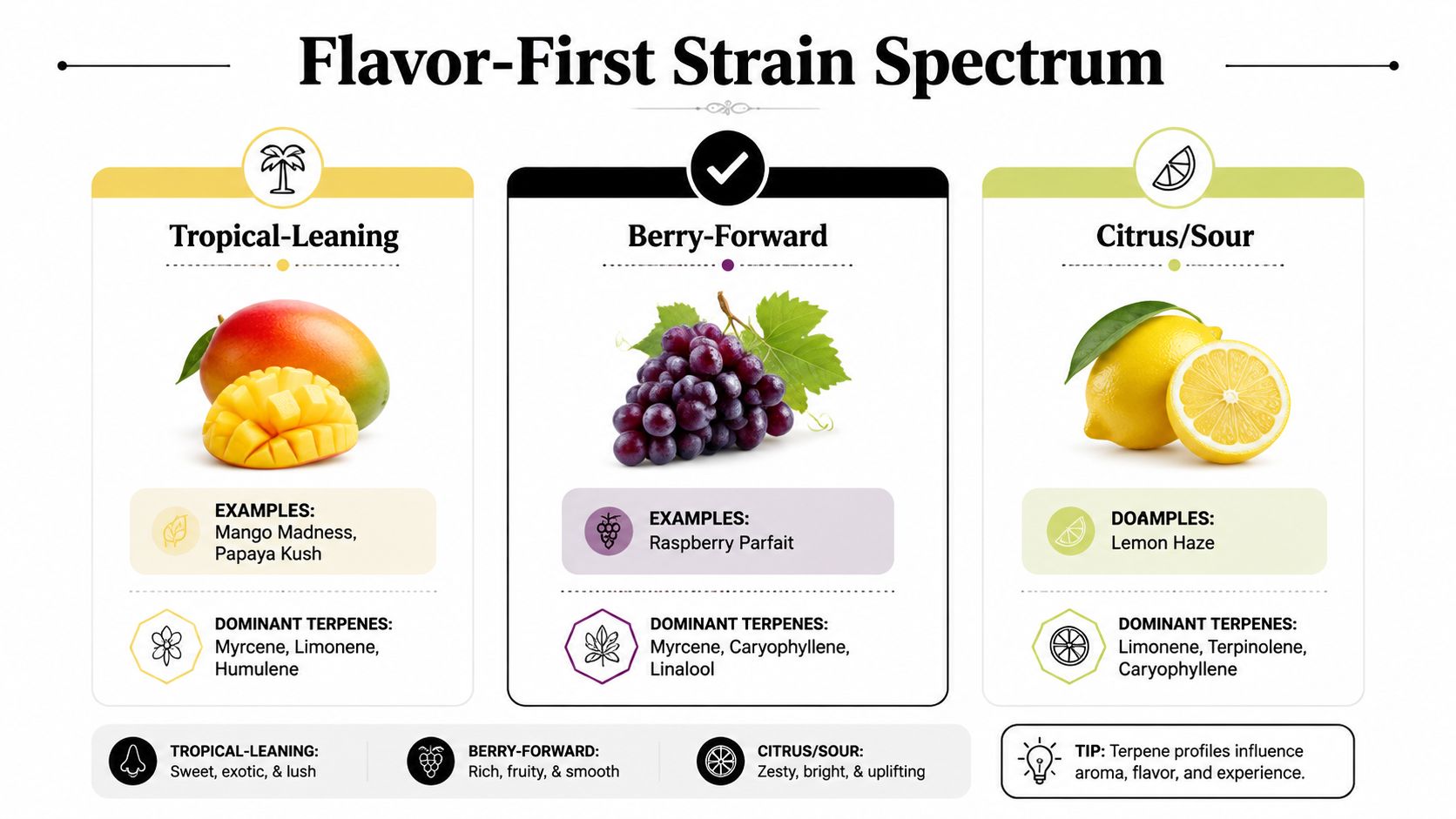
Choose the category before choosing the isolate
| Target direction | Better starting emphasis | Raspberry Parfait fit |
|---|---|---|
| Tropical and ripe | Myrcene and ocimene body | Partial fit, soften the terpinolene edge |
| Berry and bright | Terpinolene-led top with fruit support | Strong fit |
| Candy and gas | Limonene and beta-caryophyllene base | Poor fit without major reformulation |
| Baked and subdued | Linalool and humulene | Poor fit if lift is required |
A brand brief calling for a clear berry and herbal signature has a defensible reason to use Raspberry Parfait as its reference. A brief calling for dense gas, heavy warmth, or a low-aroma pastry finish should begin elsewhere.
The comparison is useful during naming review, too. If the sensory panel identifies citrus, spice, and cream but no clear berry opening, don't solve the problem with packaging copy. Adjust the top-note architecture or reject the batch.
For a practical visual reference, the following video can support internal discussion of flavor-first profile mapping.
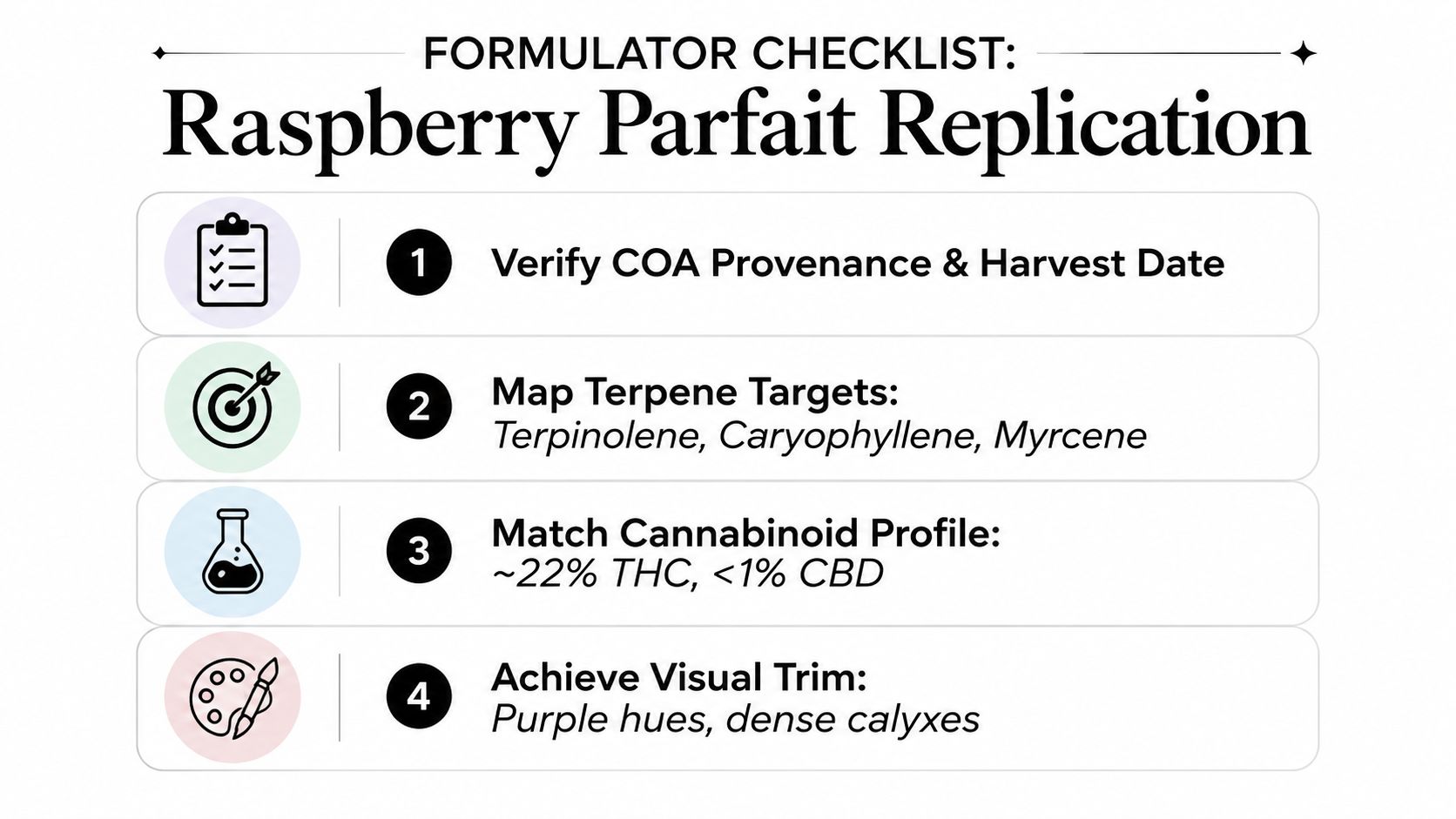
Formulator Checklist for Replicating Raspberry Parfait
Use the checklist on the production floor, not only during product development. It turns a broad strain-inspired brief into a traceable approval sequence.
Confirm provenance first. Record the supplier, source lot, current COA, harvest date, cure information, and extraction route. Reject any material whose identity depends only on a menu label or inherited spreadsheet.
Map the analytical targets. Compare terpinolene, caryophyllene, and myrcene against the documented 0.45%, 0.28%, and 0.18% benchmark supplied for the pilot workflow. Treat those values as comparison markers, not universal strain constants, because the broader COA record shows meaningful variation.
Match the cannabinoid profile. Use the supplied visual benchmark of approximately 22% THC and less than 1% CBD only when evaluating a reference flower or source material. Don't use cannabinoid similarity as proof that the terpene profile matches.
Build the pilot at 6% to 8% total load. This is the specified pilot screen for evaluating the blend before narrowing the commercial formula. Check clarity, separation, viscosity, fill behavior, and sensory balance. A batch that separates or becomes harsh is rejected even if its bench aroma is attractive.
Run the hardware pull. Complete a 72-hour stability pull on the candidate cartridge, then compare fresh and post-test samples. Log whether the berry top remains present, whether cream becomes dominant, and whether the finish turns peppery or flat.
Compare against the reference. Use a blind sensory panel where possible. Document the delta for first impression, mid-palate, finish, vapor harshness, and residual aroma. Don't let the panel approve a profile solely because it smells sweet in the bottle.
Make controlled adjustments. If the panel finds the opening dull, iterate with a 0.05% terpinolene adjustment. Change one variable at a time, then repeat the relevant stability and sensory checks.
Lock the record. File the approved formula, terpene specifications, oil lot, hardware lot, balance record, mixing conditions, fill conditions, and acceptance decision. The next brief should be able to reproduce the SKU without relying on the original formulator's memory.
Common rejection criteria include visible separation, loss of the top note during the device pull, an oil temperature outside the validated process window, unexplained COA gaps, and a sensory result that reads as generic berry rather than Raspberry Parfait. Log those failures. A rejected batch still teaches the team which ratios and devices don't work.
Gold Coast Terpenes offers strain-specific blends and isolated compounds for cartridges, concentrates, and distillate formulation, with lab-verified, THC-free materials and documentation tools for production teams. Visit Gold Coast Terpenes to review terpene profiles and select components for a Raspberry Parfait-inspired pilot.