
You've got a cart that looked perfect at fill, then shows a harsh first pull, a slow separation line, or a flavor that tastes flatter than the dry oil smelled in the beaker. That's usually the moment a brand owner realizes propylene glycol alternatives aren't just a label decision, they're a hardware and flavor decision.
The solvent you choose changes how a cartridge wicks, how fast terpenes flash off, and whether the profile still reads like the strain you were trying to reproduce. In practice, the right swap can preserve top notes and reduce thermal stress, while the wrong one can bury the aroma under a heavy carrier or expose the coil to more degradation than the formula can tolerate.
| Solvent | Best use case | Thermal behavior | Formulation risk |
|---|---|---|---|
| 1,3-Propanediol | Bio-based replacement for personal care and some cartridge-adjacent systems | Strong functional substitute with a higher boiling point than PG | Still needs full-system testing for viscosity and flavor carry |
| Ethylene Glycol | Heat-transfer systems, not cartridge liquids | Better freeze protection and heat transfer than PG, but not a cartridge choice for consumer use | Regulatory and toxicity constraints make it a poor fit for vape formulas |
| Terpene-based diluent | For vape cartridges and for distillate when flavor is the priority | Better flavor expression under heat when properly balanced | Too much can thin aggressively or overwhelm the profile |
| MCT-type carrier | Some cosmetic and industrial uses, with caution in vaping contexts | Stable in many formulas, but not ideal for every cartridge build | Can mute aroma and behaves differently from terpene-forward blends |
Why Formulators Are Moving Beyond Propylene Glycol
A lot of teams do not start by looking for a replacement. They start with a customer complaint. The cart feels too sharp on the inhale, the strain expression tastes washed out, or the oil looks fine on day one and drifts after a week on the shelf. In that situation, propylene glycol alternatives become a commercial fix as much as a chemical one.
The old workhorse has limits in cartridge work
Propylene glycol has been everywhere for years, and that history matters. A 2012 cosmetic safety assessment found it in 9,747 uses out of 34,391 formulations reviewed, with concentrations ranging from 0.0008% to 99%, which shows how embedded it has been in consumer products (Sage journal review). That kind of ubiquity made PG familiar, but it also created pressure to replace it when brands started asking for cleaner labels and tighter sensory control.
In cartridge work, the problem is not only label preference. PG can carry a noticeable throat hit, and under heat that can work against flavor fidelity. If a strain-inspired blend is supposed to open with citrus, pine, or bright fruit, a carrier that flattens those top notes works against the SKU from the first puff. I see that most often in cartridges built around delicate terpene profiles, where the carrier should stay in the background instead of masking the first impression. For a practical comparison of carrier classes, see this overview of polyethylene glycol alternatives.
Practical rule: If the carrier dominates the aroma before the terpenes do, the formula is wrong for a strain-forward cartridge.
Thermal stability and flavor carry are the real constraints
PG also creates trade-offs at the hardware level. A solvent can look fine on paper and still behave poorly once it sits in a reservoir, wicks through a coil, and sees repeated heat cycles. Some alternatives stay quieter in the mouthfeel but still hold the terpene top notes well, while others soften the throat hit at the cost of aroma intensity. That is the part many brand teams underestimate, because the commercial outcome depends on whether the carrier protects the strain profile or buries it.
A formulary decision should start with how the oil behaves under heat, not with a label claim alone. If the carrier flashes off too quickly, the first puff can seem lively while later puffs flatten out. If it holds too much weight, the cartridge may stay stable but read dull to the customer. Both failures show up as the same complaint, the product does not taste like the strain it was sold to be.
Chemical Profiles of Leading Propylene Glycol Alternatives
The right substitute depends on what the formula has to survive. A cartridge liquid has to move through the hardware, hold up in storage, and still deliver the strain profile the brand sold on the label. I do not treat all propylene glycol alternatives as interchangeable, because their heat behavior and flavor masking are not the same.
1,3-Propanediol is the closest functional replacement
1,3-propanediol, often called PDO or propanediol, is the most technically credible bio-based substitute in a lot of formulation work. It serves as a humectant, co-solvent, viscosity modifier, and formulating intermediate (J R Hess). The same source lists a boiling point of about 214°C and a freezing point of about −25°C for 1,3-PDO, compared with PG at about 187°C and −57°C (J R Hess).
That profile tells you something practical. PDO is not a drop-in copy, but it can behave more like a formulation aid than a flavor thief if you balance it correctly. In cosmetics and other consumer systems, it is often used when a brand wants a natural or bio-based story without giving up utility. In a cartridge context, that matters most when the formula needs a carrier that will not bury delicate top notes from strain-specific terpenes.
Thermal and flow behavior decide whether a swap succeeds
Ethylene glycol and propylene glycol are often compared in industrial thermal systems, but that comparison is not a cartridge formulation recipe. For heat-transfer uses, EG shows a lower freeze point of −38°F versus PG at −30°F, a higher boiling point of about 197°C versus 217°F, lower viscosity at 77°F, and higher thermal conductivity, while PG is still favored where food-contact or potable-water exposure matters (Alliance Chemical). That same source notes PG can require 10–15% more pump energy because of its higher viscosity (Alliance Chemical).
For cartridge formulators, the lesson is narrower. Viscosity affects wicking, but hardware and consumer safety constraints matter more than a clean spec sheet. A solvent that looks efficient in an industrial loop can be a poor fit in a consumer vape device, especially if it starts muting terpene top notes or leaving the finish flat after repeated heat cycles.
A solvent choice should survive the coil, preserve the nose of the terpene blend, and still fill cleanly. If it only does one of those three, it is not the right one.
Compare the main choices by function, not just by name
The internal decision should start with the end use. A terpene-forward diluent can work well for flavor-centric SKUs, while 1,3-PDO is more useful when you want a bio-based replacement in adjacent product lines or controlled formulation systems. For a broader technical overview of related alternatives, the polyethylene glycol alternatives archive is a useful cross-reference for ingredient screening.
| Solvent | Boiling Point (°C) | Freezing Point (°C) | Relative Viscosity |
|---|---|---|---|
| Propylene Glycol | 187 | −57 | Lower than many bio-based carriers |
| 1,3-Propanediol | 214 | −25 | Slightly different flow profile from PG |
| Ethylene Glycol | 197 | −39 | Lower than PG in heat-transfer use, but not a cartridge choice |
Thermal Stability and Flavor Expression in Vape Hardware
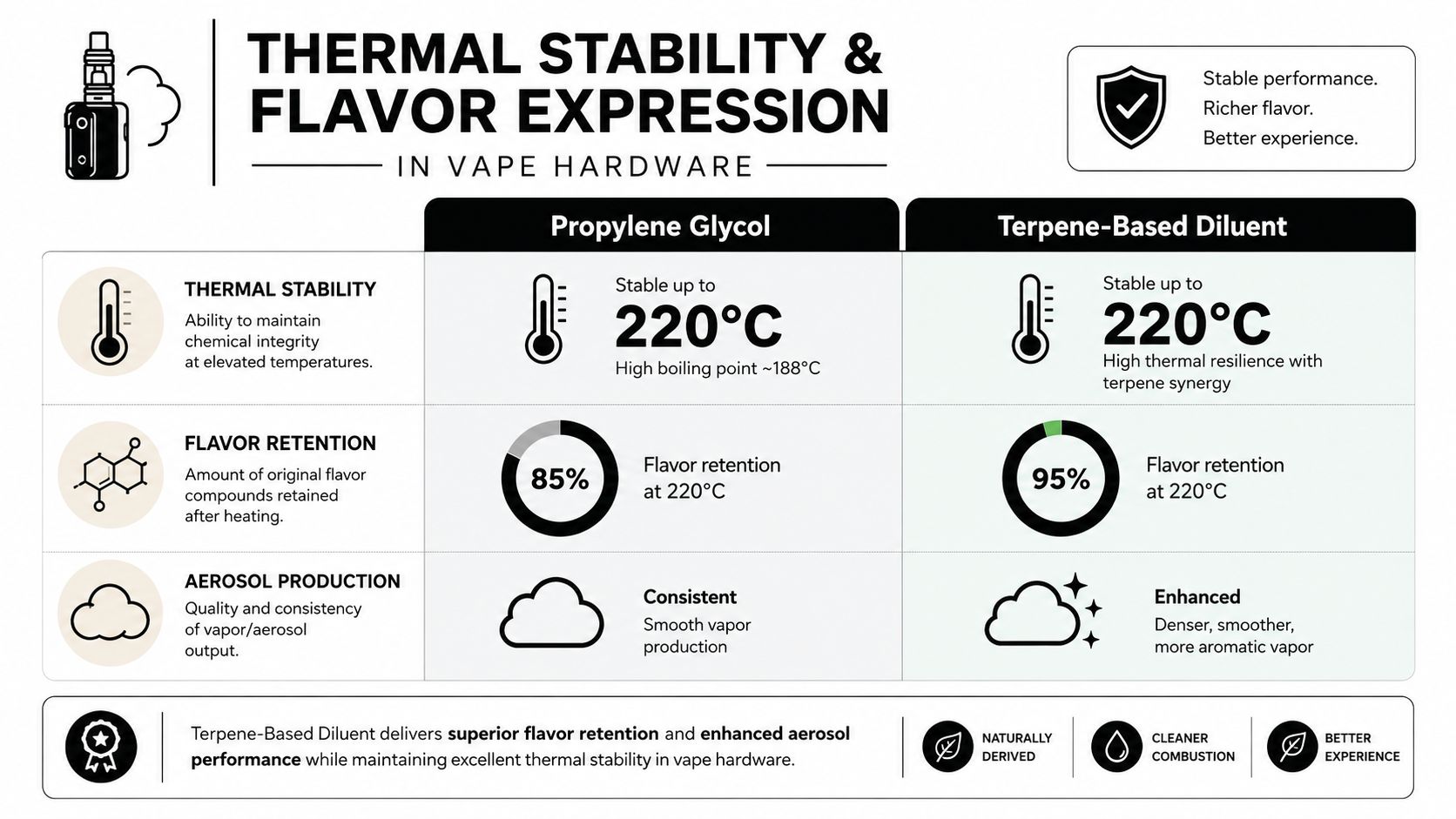
A cartridge can look clean in the tank and still fail at the coil. That failure usually shows up as a dull nose, a burnt edge, or a flavor that turns muddy after a few heat cycles. Solvent selection stops being theoretical and starts deciding whether the SKU tastes premium or compromised.
Heat stress changes what the customer tastes
In a Scientific Reports study on e-cigarette refill liquids, 1,3-PDO produced less thermal decomposition by-products than propylene glycol and glycerol, while maintaining similar aerodynamic properties to PG (Scientific Reports). The same study also reported better flavoring properties for 1,3-PDO than both glycerol and PG. For cartridge developers, that matters because thermal breakdown does not stay hidden in the coil, it shows up in the cup as off-notes and in the mouth as a flattened finish.
That is the practical reason a terpene-based diluent often outperforms a glycol-heavy solution in strain replication. Terpenes do not behave like inert filler. They participate in the aroma architecture, especially in the top and mid notes that define a recognizable profile. If those notes are delicate, a carrier that flashes cleanly matters more than a carrier that only reads as thin on paper.
Practical rule: If the goal is flavor fidelity, test the blend at operating temperature, not just at room temp.
Hardware compatibility is still the gatekeeper
The catch is that better flavor expression does not excuse a bad viscosity match. A terpene-forward liquid that is too thin can overfeed the wick, leak from a loose seal, or hit inconsistently in a 510-threaded cartridge. A carrier that is too heavy can starve the coil and mimic a bad batch even when the extract is fine.
For a deeper formulation check, the boiling point of terpenes guide is a practical companion when you are comparing heat behavior across individual aromatic fractions. The goal is simple. Keep the solvent from masking the profile, and keep the hardware from forcing the solvent to do a job it cannot do.
Flavor masking is usually a ratio problem
A brand might think the extract is weak when the actual issue is the carrier. Heavy base notes can hide lighter citrus or floral top notes, especially in dessert-style blends that already lean dense. By contrast, a lighter, better-matched carrier can let the profile open in stages, first on the nose, then across the inhale, then on the finish.
That is why thermal testing should always sit beside sensory review. If the same cartridge tastes clean in the first few pulls and burnt by the twentieth, the carrier is part of the problem, not just the hardware.
Formulating with Terpenes as the Primary Diluent
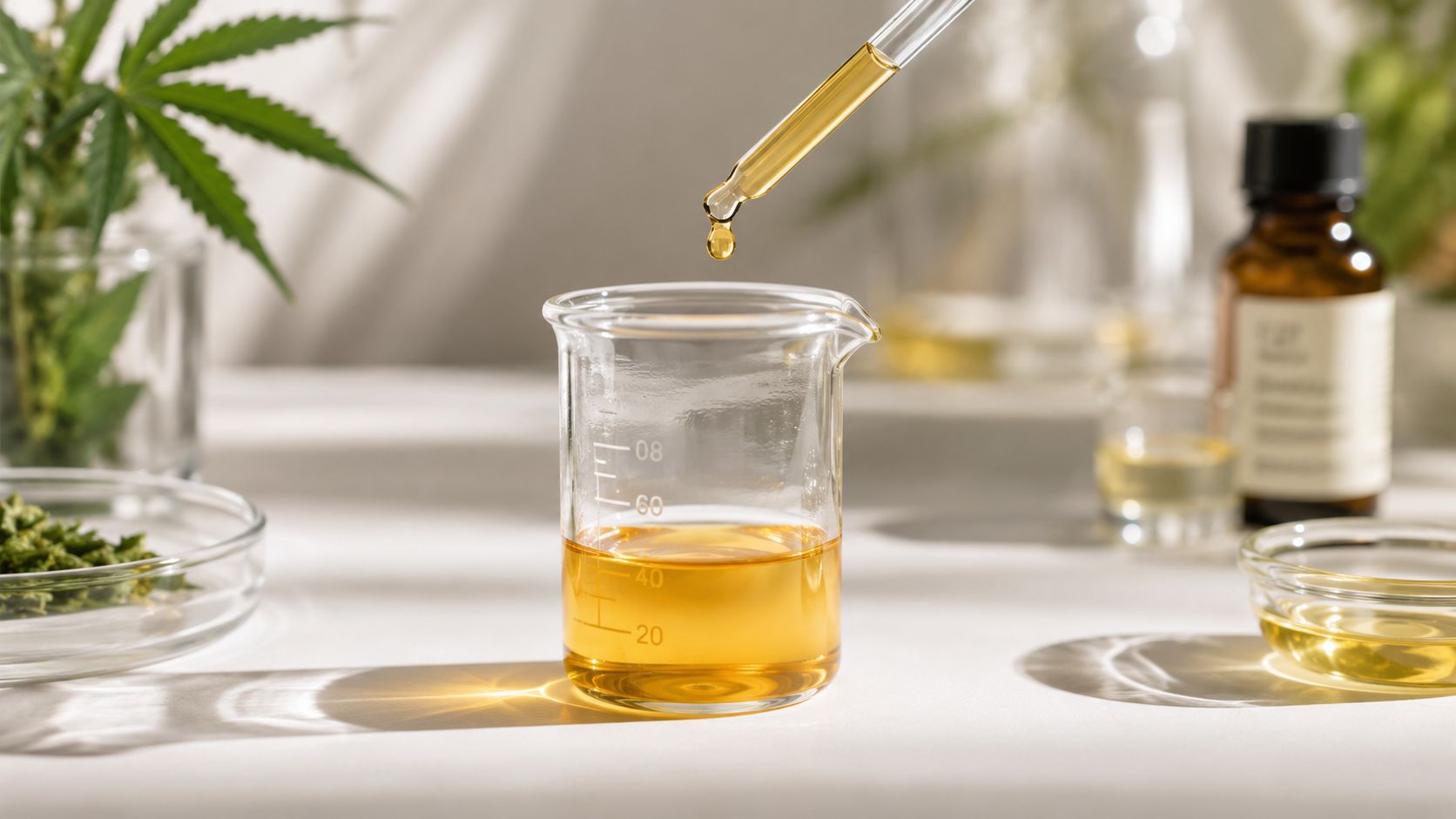
If the brief is strain authenticity, terpene-driven dilution is usually the cleanest route. It lets the formula carry its own aroma logic instead of relying on a synthetic solvent to create movement in the oil. That matters in for cannabis product formulation workflows where the customer is buying a named sensory profile, not just a viscosity number.
Start with the extract, then set the carrier around it. Winterized distillate usually needs a different balance than a saucier live-resin system because the base oil behaves differently in the cartridge. A high-terpene sauce may already have enough movement, while a dense distillate may need a tighter adjustment to avoid clogging or over-thinning.
For a practical workflow, the how to thin distillate for cartridges resource is the sort of reference I'd keep open during bench development. Gold Coast Terpenes also offers a Terpene Mixing Calculator, which is directly useful when you need a starting percentage for a specific oil body and cartridge target. I'd still verify the final percentage on the actual hardware, because a beaker result does not always translate to a ceramic core.
Use the profile to set the mix
A high-terpene, citrus-dominant blend usually benefits from a lighter hand with the diluent. Those top notes can disappear fast if the carrier is too heavy or too dominant, especially when the formula has strain-specific terpenes that need room to express. A dessert-forward profile can tolerate more body because its base notes are supposed to carry more weight, and the finish can hold up to a little more density.
Practical rule: The more delicate the top notes, the less you can afford to let the carrier dominate the aroma.
Heat behavior matters here as much as ratio. Some terpene blends hold their character well under coil stress, while others flatten early, turn sharp, or mask the first impression the brand is trying to sell. A brand might think the extract is weak when the actual issue is the carrier.
Match the extract type to the viscosity target
The goal is smooth flow without sacrificing expression. If the cartridge floods, back off the diluent and recheck the fill level and draw behavior. If it starves, the formula may be too thick, or the terpene balance may be too low for the hardware alone.
Thermal testing should sit beside sensory review. A formula can read clean in a beaker and still degrade in use, which is why bench results need to be checked under real coil conditions. If the same cartridge tastes clean in the first few pulls and burnt by the twentieth, the carrier is part of the problem.
The video below is a useful visual for teams training technicians on oil preparation and cartridge loading.
A good bench process also includes storage validation. Once a terpene-heavy formula is filled, let it sit and check whether the nose stays consistent and the oil line stays uniform. That one check catches a lot of avoidable batch failures before they become customer complaints.
Matching Solvents to Specific Terpene Profiles
A solvent that works on a deep, round profile can flatten a bright one. That's the simplest way to think about carrier selection, and it's where many cartridge brands lose the strain story they paid to build. The right match depends on whether the target is top-note sparkle, mid-note body, or base-note persistence.
Bright profiles need breathing room
Citrus, pine, and other high-top-note blends need a carrier that stays out of the way. If the solvent is too heavy, the initial aroma can feel muted before the consumer ever gets to the intended terpene arc. That's why a high-viscosity carrier is risky for profiles that depend on fast aromatic lift.
A blend built around a lemon or haze-style profile should be judged on how clearly the first impression lands. If the opening smells dull, the problem is rarely the strain concept. It's usually the way the carrier is muting the volatile fraction.
Dense profiles can tolerate more body
Dessert, fuel, and earthy profiles often rely on base notes to create the sensation of depth. Those blends can accept a little more carrier weight if the goal is to create a fuller finish. A profile like Forbidden Fruit can read well with more body because its aromatic structure already leans rounder and more layered.
By contrast, a citrus-dominant blend such as Super Lemon Haze can lose its edge if the solvent makes the top note collapse too early. That doesn't mean the formula fails. It means the solvent is pushing the profile toward the wrong sensory center.
The decision matrix should be simple:
- Top-note-forward SKUs: Keep the carrier light, protect volatility, and avoid burying the opening aroma.
- Mid-note-balanced SKUs: Use enough body to stabilize the oil, but don't let the solvent flatten the transition.
- Base-note-heavy SKUs: Favor structure and persistence, because these blends can carry a slightly denser feel without losing identity.
The MCT extraction and terpene preservation guide is useful background if you're evaluating how carrier choice changes aroma retention in broader formulation work. For cartridge SKUs, the test is still sensory. The carrier should support the strain profile, not overwrite it.
Build a profile-specific rule set
Brands that manage multiple SKUs should set different viscosity targets by profile family. One carrier setting rarely works across bright sativas, dessert blends, and earthy indicas without compromise. If the lineup is large, the formulation SOP should reflect that reality instead of forcing every oil into the same viscosity box.
Troubleshooting Common Formulation Challenges
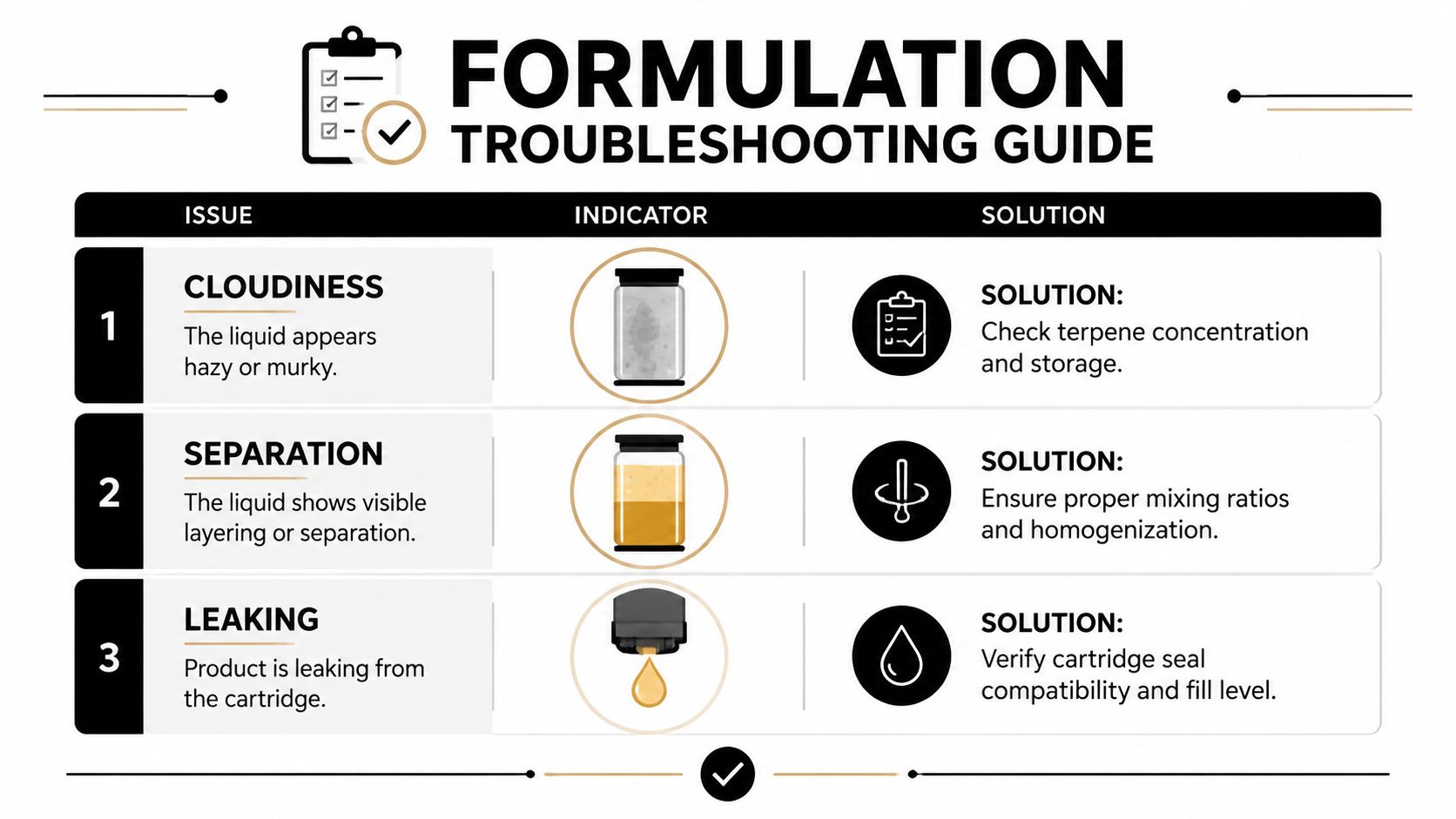
Most bad cartridge runs fail in predictable ways. The oil looks cloudy, the blend separates after fill, or the cart leaks because the viscosity and seal behavior don't match the hardware. Those are fixable problems if the batch gets checked early enough.
Cloudiness usually points to a mixing or storage issue
Cloudiness often shows up when the terpene concentration is too aggressive for the extract or when the blend wasn't fully homogenized. Temperature control matters during the mix phase, because cold oil can hide solubility problems that reappear later. I'd also check storage conditions, since a formula that looks fine warm can haze after sitting in a cooler room.
Separation means the ratio is wrong or the blend wasn't finished
If the carrier and extract don't stay together, the first thing to verify is the mixing ratio. Then check whether the batch was held long enough at the right temperature to fully combine. Winterization helps here because residual waxes and lipids can make a later separation problem look like a carrier problem.
Leaking is often a hardware fit problem before it's a chemistry problem
A lot of teams blame the oil when the cartridge seal is the actual failure point. Verify seal compatibility, fill level, and wick behavior before changing the formula again. If the oil is too thin for the hardware, fix the system, not just the ingredient list.
A simple batch checklist keeps the process honest:
- Check clarity after cool-down: Don't judge the blend only while it's warm.
- Inspect the fill line: Overfilling creates avoidable leak risk.
- Test the first draw and the tenth draw: Burnt notes can appear after heat cycling, not immediately.
- Document storage behavior: A clean bench result means little if the shelf sample drifts.
Sustainability and the Future of Bio-Based Carriers
A lot of carrier decisions now come down to whether the ingredient can support the oil, the hardware, and the brand claim at the same time. Bio-based options like 1,3-PDO matter because they give formulators a route away from petroleum-derived glycols without giving up a useful carrier function. Procurement teams keep reviewing them for broader product lines, especially when the formula has to stay stable through mixing, filling, and retail storage.
Bio-based does not have to mean lower performance
The better case for bio-based carriers is practical, not ideological. In the cited assessment, the bio-derived glycol replacement showed lower greenhouse-gas emissions and lower energy use than propylene glycol in production, with a further reduction versus propanediol in the same analysis (essentialingredients.com PDF). That kind of data gives formulators a usable conversation point with procurement, compliance, and brand teams without relying on broad sustainability language.
Supply signals point in the same direction. One report describes a bio-based propylene glycol market that is expanding, while another places total propylene glycol demand in the millions of metric tons and bio-based variants at a small share of that total. Those figures matter because they suggest bio-based substitution is no longer just a lab-side preference. It is becoming part of how brands think about sourcing, continuity, and reformulation risk.
Sensory quality still decides what gets shipped
A cleaner sourcing story means little if the carrier dulls the oil in the cartridge. The key test is whether the blend still reads clearly after heat cycling, because thermal stress can flatten top notes, pull terpene balance off center, or make a strain-specific profile taste generic. In practice, the best bio-based carrier is the one that supports vapor delivery without masking the parts of the profile that customers expect to recognize.
That means the next formulation step is not just finding a greener solvent. It is choosing a carrier that holds up under device temperature, preserves the intended terpene signature, and still works with commercial fill targets and viscosity requirements. The market will keep separating general-purpose solvents from cartridge-focused systems, and the winning options will be the ones that balance thermal stability with flavor expression instead of forcing formulators to choose only one.
Gold Coast Terpenes supplies 100% natural terpene blends, strain-specific profiles, isolates, and formulation tools that fit this exact kind of cartridge development work. If you are comparing carriers, rebuilding a strain-inspired terpene blend, or dialing in a new SKU, visit Gold Coast Terpenes and use the mixing resources to pressure-test your next formulation before you scale it.