
You've got the recipe mapped, the tank is mixed, and the first test cart tastes right. Then the next production run lands slightly off, not broken, just different enough that the profile no longer matches the R&D sample. In a terpene lab, that gap usually comes from tiny measurement errors stacking up across weighing, temperature, dispensing, and documentation, not from the raw materials themselves.
Precision measurement techniques are what keep that drift from turning into a batch problem. The industry got here through a long shift from local, body-based measures to standardized systems, starting with the 1791 launch of the metric system in France and continuing through later redefinitions that moved length standards toward constants of nature, a foundation for modern calibration discipline (timeline of metrology and standardization). That history matters in a formulation lab because repeatable flavor only happens when every measurement starts from a known reference.
Why Your Terpene Blend Missed the Mark
The first sign is usually subtle. A batch that should hit a bright top note lands flatter, or a strain-inspired profile that worked in development feels heavier in production, even though the same ingredients were used. In practice, that often means the problem sits in the measurement chain, not the blend concept.
Small errors become sensory errors
Terpene work exposes tiny differences fast. A slight overdraw on a volatile note, a temperature swing during dispensing, or a balance that's being used outside its useful range can shift the final aroma enough to matter commercially. Once that happens, brand owners don't hear “measurement nuance,” they hear “this one doesn't match.”
Standardization is the only real defense. The long arc from older artifact-based measures to constants of nature is more than metrology history, it's the logic behind every disciplined formulation SOP, from raw weighing to final QC (timeline of metrology and standardization). If the target is a repeatable vape cartridge profile, every step has to be traceable to the same baseline.
Practical rule: if a formulation only works when one operator handles every step, the process isn't stable yet.
A solid starting point is a documented ratio system, not a memory-based one. A formulation reference like your guide to using the correct terpene ratios gives the blend logic, but the measurement discipline is what keeps that logic intact in production.
Foundations of an Accurate Formulation Lab
A formulation can drift before the first dispense if the room, the instrument, and the reference conditions are not aligned. In practice, that means treating calibration and environment as part of the formula itself, because both affect whether you are correcting for process drift or making a reliable product.
Start with the room, not the recipe
The accepted reference temperature for dimensional measurement is 20 °C (68 °F), and ISO 1:2022 is cited as fixing that standard reference temperature for dimensional work (precision measurement reference temperature). In a terpene lab, anything measured outside that environment needs thermal compensation, since temperature shifts can change the size or behavior of components enough to distort the result.
That matters for more than one reason. Viscosity, density, and transfer behavior all become less predictable when the bench is not controlled, so a measurement that looks correct on paper can still land wrong in the blend vessel. If the goal is a repeatable formulation guide for cartridges or distillate, room conditions have to be treated as controlled inputs.
Choose the right instrument for the tolerance
The Rule of Ten is simple and useful, the measuring instrument's resolution should divide the tolerance into ten parts, so the gage is at least 10 times as accurate as the feature being measured (Rule of Ten). In plain terms, if the tool cannot see far enough below the tolerance, it cannot verify it in a meaningful way.
That is where too many labs spend money in the wrong place. An instrument can be technically impressive and still be a poor fit if setup drift, maintenance burden, or operator inconsistency dominate the actual error budget. A lower-cost system with disciplined procedures can sometimes outperform a more advanced one that is hard to align or keep stable.
A few operational habits make the biggest difference:
- Verify calibration on schedule: do not assume yesterday's zero is still valid today.
- Document the setup: instrument ID, reference conditions, and who ran the check all matter later.
- Control the workspace: draft, vibration, and residual heat can all push a borderline measurement off target.
- Match the tool to the tolerance: a fast tool that is too coarse only creates expensive confidence.
Contamination control follows the same logic. A clean measurement setup is part of the method, not a separate housekeeping task, and a practical reference like ways to prevent contamination belongs in the lab SOP stack for that reason.
Gravimetric vs Volumetric Which to Use and When
The main decision in a terpene lab is simple on the surface. Do you measure by mass or by volume? Under production pressure, that choice affects speed, repeatability, and how much correction you'll need later.
Gravimetric wins when consistency matters most
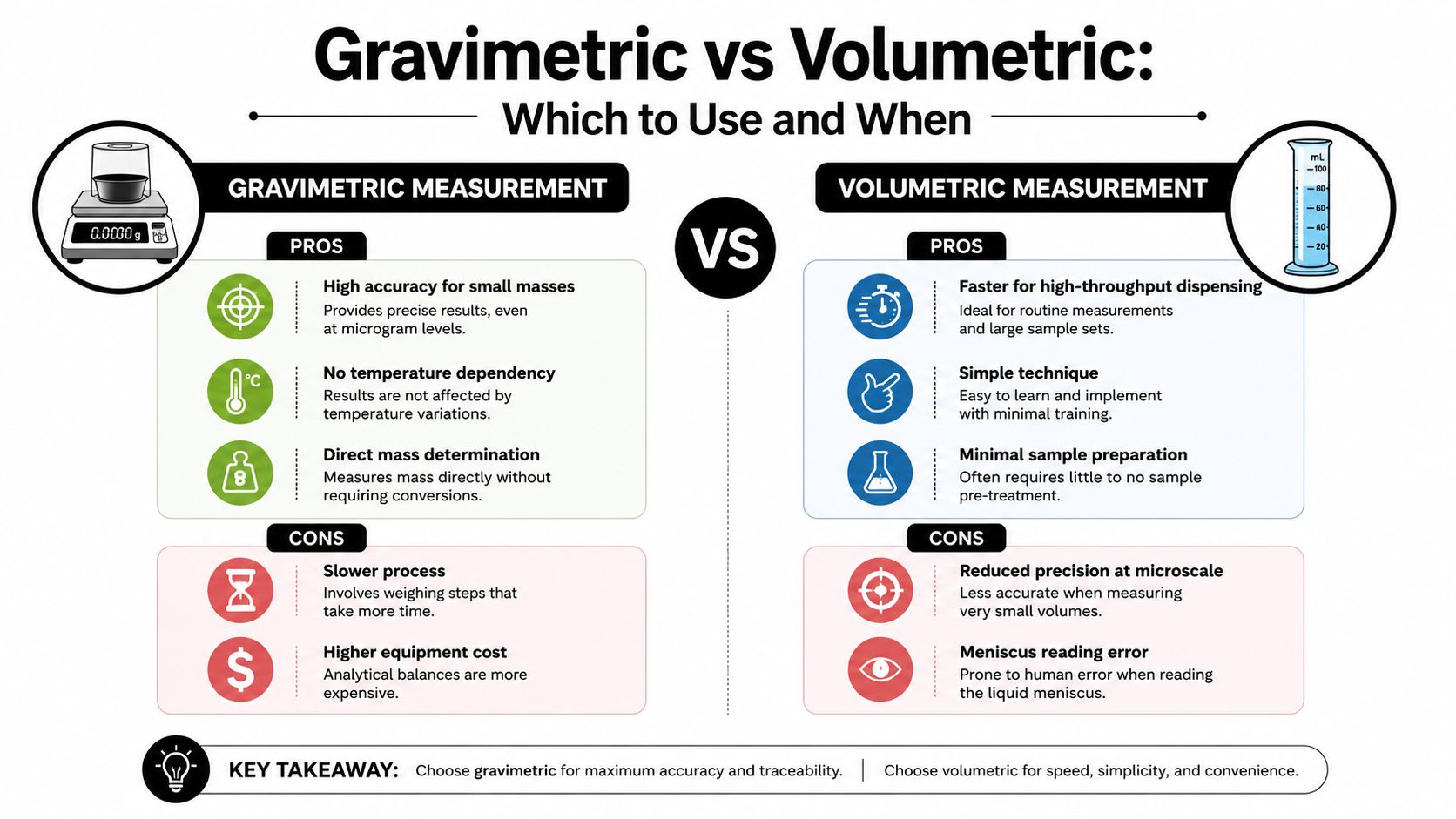
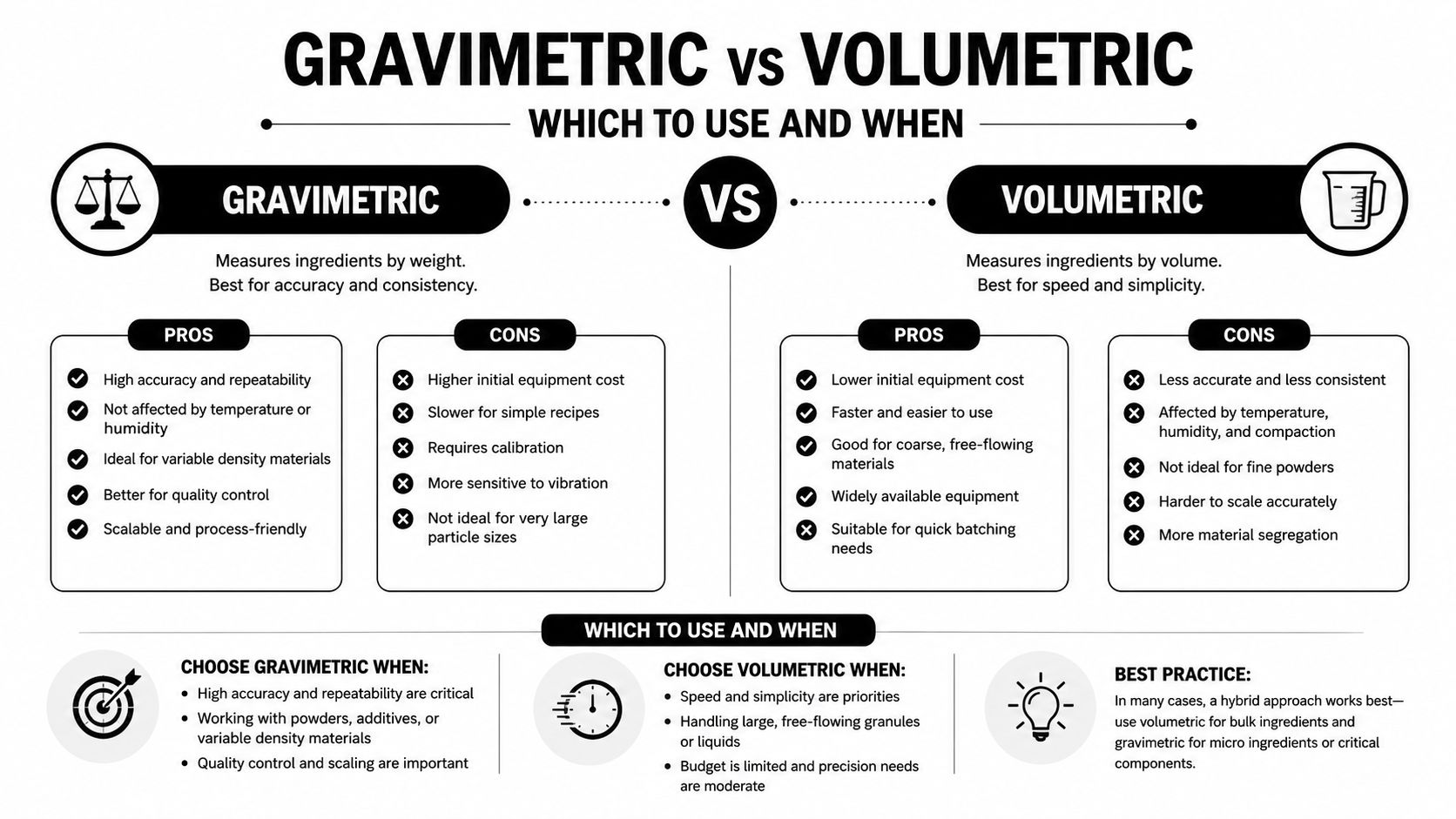
Weighing is usually the cleaner choice when the blend needs tight repeatability. Mass doesn't change because a bench is a little warmer or a liquid has a slightly different density, so gravimetric work removes a major source of hidden variation from the process. That's why it's the preferred option when you're building a profile that needs to replicate a specific sensory target across batches.
For small masses, the instrument choice matters. An analytical balance is recommended when you need a mass typically less than a gram to the nearest 0.0001 g, while a top-loading balance is better for less exact measurements or when handling a larger amount of material, specifically more than 10 g (ACS balance guidance). That threshold is practical, not theoretical. If you're making a micro-adjustment to a top note, the analytical balance gives you room to work without guessing.
Volumetric methods still have a place
Volume can still make sense when throughput matters more than microscale exactness. It's faster, easier to train on, and often good enough for larger-scale or less sensitive work where the formulation window is wider. In a busy lab, that speed can matter, but only if the team understands where meniscus reading, tip wetting, and liquid behavior add uncertainty.
A volumetric process works best when the lab has already characterized the material and accepted the trade-off. For example, a routine add-back step in a stable workflow may not need the same level of metrological control as a new strain-inspired terpene blend. When the target is a commercial vape formula with narrow flavor expectations, gravimetric measurement usually gives you fewer surprises.
Use gravimetric measurement when the product needs tight sensory matching, when the liquid is volatile, or when temperature shifts are likely.
Use volumetric measurement when speed matters more than the finest repeatability, and the method has already been validated in-house.
If you're deciding how to apply either method in a real recipe, a mixing ratios calculator is a useful check, but it only works if the numbers going into it are grounded in a controlled weighing or dispensing routine.
Mastering Your Pipetting and Dispensing Technique
A good instrument can still produce bad data in the hands of a rushed operator. Small pipetting errors can hide during the run, then show up later as a flat note, an uneven aroma, or a batch that misses its target. Technique has to be trained as a process, not treated like a reflex.

Control the motion, not just the volume
Start with the tip. Match the tip size to the job, pre-wet it when working with volatile terpenes, and keep immersion depth consistent so the aspirated volume does not shift from one pull to the next. Plunger speed matters too, because a quick or jerky motion can leave residue, trap bubbles, or cause incomplete transfer.
The handling matters as much as the setting. Reverse pipetting helps with viscous or sticky materials, and positive displacement pipettes can be the better choice when an air-cushion pipette will not move the liquid cleanly. In a formulation lab, those tools are controls against transfer loss, not extras.
Respect the material, especially with distillate
Cannabis distillate behaves differently from a light solvent or a low-viscosity isolate solution. It clings, stretches, and releases inconsistently if the operator treats it like water. Reverse pipetting, a warmed but controlled transfer environment, and a slow, repeatable hand all help protect the final blend.
Density also matters. One milliliter of one material is not interchangeable with one milliliter of another if the densities differ, so volume alone can mislead you when you are trying to hit a target mass or ratio. If the formulation depends on trace additions, measuring by mass avoids that extra correction step.
The Rule of Ten makes the same point in practical terms. If the tool's resolution is not at least 10 times finer than the tolerance you are trying to hit, the result can look precise without proving much of anything. That kind of false confidence is one of the fastest ways to end up with off-spec flavor.
For routine checks on whether a dispense step is holding its target, a quality control testing guide is useful context, but only if the operator is already recording results against a consistent method.
Keep the hand motion boring. Boring measurements are usually the ones that scale.
QC Verification and Documentation for Consistency
A formulation run does not become professional because it worked once. It becomes professional when the lab can show the same result again, under the same documented conditions, with the same traceability from start to finish. That is the bridge between development work and production that can hold up under review.
Verify the dispense, then record the proof
A quick mass check on a dispensed volume is one of the simplest ways to catch pipette drift, temperature drift, or operator technique problems before they spread through a batch. If the intended transfer and the measured outcome do not align, the process issue is already visible, and you can correct it before more material is committed.
The larger point is that QC should function as an error budget. A lower-cost setup that stays stable and repeatable can outperform a more complex system that is hard to align or expensive to maintain, as described in practical error budgeting in precision measurement. In terpene work, that matters because the target is consistent aroma delivery, not laboratory theater.
Build records that let you troubleshoot fast
A usable batch record should capture the raw material lot, the instrument ID, the operator, the measured amounts, and the final yield. Without that chain, the next deviation becomes guesswork. With it, you can trace whether the problem came from source material, a balance check, a dispensing step, or a handling error.
Good documentation also supports controlled product development. If one batch of a strain-inspired blend lands correctly and the next does not, the record shows whether the recipe changed or the process did. That difference is what separates a blend issue from a workflow issue.
For teams building a formal QC routine, quality control testing belongs in the same operating folder as the formulation sheet. If you do not document the measurement, you cannot defend the product.
Put the checks where the risk is highest
Not every step needs a full assay, but every high-risk step needs verification. That usually means the first dispense, the most volatile component, and any transfer that depends on operator judgment. Catching drift at those points keeps a minor deviation from turning into a full batch correction.
A practical lab also budgets for what is likely to move first. Temperature shifts change viscosity and transfer behavior, and hand technique can move a result just enough to matter when the tolerance is tight. Put the check on the step that can drift, document the outcome, and keep the process tied to what was measured.
Integrating Precision into Your Formulation Workflow
A reliable terpene workflow is built on four things, a controlled environment, calibrated tools, proper technique, and tight documentation. When those four are in place, the difference between a promising prototype and a production-ready profile gets much smaller.
That's why professional brands can replicate a signature flavor while amateur workflows keep chasing the same “close enough” result. The product may be an OG Kush style profile, a fresh fruit blend, or a custom vape cartridge formula, but the logic is the same. Precision measurement techniques keep the top notes, mid notes, and base notes in the intended balance from one batch to the next.
For next steps, use a strain profile as the sensory target, validate the recipe with a mixing tool, and finish with a documented QC check. Gold Coast Terpenes offers strain profiles, isolate components, and formulation resources that can serve as starting points when you're building or refining a recipe. If you want a cleaner workflow, shop the profile, measure by mass when possible, and save every batch record.
A CTA for Gold Coast Terpenes.