
A strain name makes a weak production specification. Power Punch can point a formula toward a fruit-forward target; the batch still has to prove which compounds are present and at what levels. Gold Coast Terpenes supplies 100% natural, THC-free terpene blends and strain-specific profiles for cartridges, concentrates and product formulation, so the practical move is to set measurable note roles, confirm the certificate of analysis, blend gravimetrically, then check aerosol output before a production run.
What Makes Power Punch a Usable Terpene Profile for Formulators?
Power Punch is useful as a fruit-forward formulation reference, not a fixed chemical recipe. Its reported parentage helps define the sensory direction, while laboratory results must define the material you're matching.
STRNG Seeds describes Power Punch as Purple Punch crossed with Blue Power, approximately 65% indica and 35% sativa, with typical flower references of 18%–21% THC and 0%–1% CBD. Those figures describe reported flower characteristics, not a finished distillate specification.
Purple Punch's association with sweet fruit and dessert-style aromas gives a developer a useful starting brief. It doesn't establish the identities or proportions of the compounds responsible for a particular sample's aroma. Breeder selection, phenotype, cultivation, harvest timing, curing and analytical method can all affect the reference material.
Convert the cultivar description into a specification
For a Power Punch strain-inspired terpene blend, separate the project into distinct deliverables:
- Sensory target: Describe the desired fruit character, sweetness, herbal balance and finish.
- Chemical target: Record the measured compounds and their acceptance ranges.
- Application target: Identify the cannabinoid matrix, cartridge hardware and intended operating conditions.
- Claim boundary: Decide whether the product is strain-inspired or supported as a match to an authenticated reference lot.
This separation prevents a common purchasing mistake: approving a flavor because the supplier's strain name matches the marketing brief.
Practical rule: Approve the reference sample before approving the formula. Otherwise, different people can approve different versions of Power Punch without realizing it.
Extracts also need their own potency specifications. Extraction concentrates cannabinoids, so a flower description can't establish the cannabinoid strength of a concentrate or terpene-enhanced cartridge. Keep cannabinoid potency, terpene composition and sensory acceptance as separate release criteria, even when they appear on the same product specification.
Which Terpenes Build the Top, Mid and Base Notes of a Power Punch Blend?
Limonene and alpha-pinene establish the top notes; linalool and terpinolene support the middle; beta-caryophyllene and alpha-humulene anchor the finish. These are useful formulation roles, not proof that every Power Punch flower sample contains the same terpene ranking.
The Gold Coast Terpenes terpene chart organizes these compounds around citrus, pine, floral, herbal, spicy and woody characteristics. Use that structure to build a layered profile rather than asking a single dominant compound to reproduce a complex fruit impression.
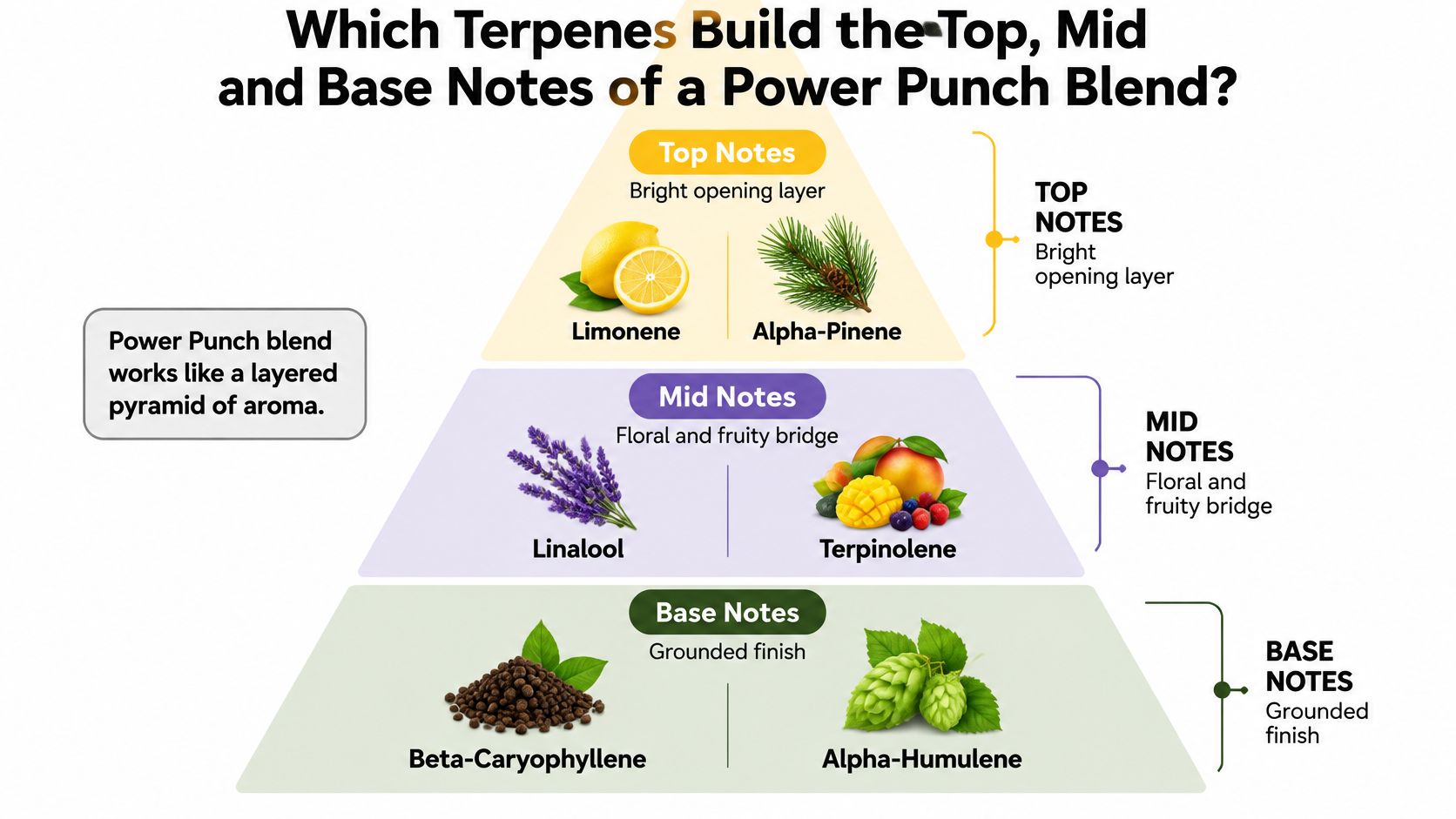
Power Punch terpene roles by sensory phase
| Note role | Terpenes to anchor it | Sensory phase | Job in the blend |
|---|---|---|---|
| Top notes | Limonene; alpha-pinene | Initial inhale | Sets immediate citrus and pine impression |
| Mid notes | Linalool; terpinolene | Central palate | Carries floral, herbal and lightly sweet character and prevents a hollow body |
| Base notes | Beta-caryophyllene; alpha-humulene | Finish after exhale | Adds spicy, woody anchor and persistence |
Start with the opening impression. Limonene and alpha-pinene can provide brightness, but a sharp citrus-pine opening shouldn't replace the intended fruit character. Record whether the opening supports the reference or distracts from it.
The middle requires a different judgment. Linalool and terpinolene can contribute floral, herbal and lightly sweet character, but lightly sweet isn't synonymous with blueberry or grape. Treat the berry description as a sensory acceptance target, not a chemical identity you can assign to one terpene.
Then evaluate the finish. Beta-caryophyllene and alpha-humulene can add structure, but an excessively woody or spicy finish may pull the blend away from its fruit-forward brief. Their value is balance and persistence, not merely a higher concentration.
Build and evaluate by role
Use the terpene flavor chart to translate descriptive language into candidate materials, then document the draft:
- Map the aroma. Assign each target descriptor to an opening, middle or finishing role.
- Allocate the blend. Record each ingredient's share of the terpene concentrate, separately from its concentration in the finished oil.
- Evaluate the phases. Score the initial impression, central body and finish independently.
- Change the relevant layer. If the middle feels empty, don't automatically increase the entire blend.
For example, a fruit-forward target may smell convincing immediately but lose its character through the draw. That calls for a mid-note adjustment, followed by aerosol evaluation, rather than a blanket increase in terpene loading.
How Much Terpene Blend Goes Into a Distillate Cartridge?
A practical development starting range is 5%–8% terpene blend by weight for distillate cartridges, not a drop count. The Gold Coast Terpenes extract formulation resource places that cartridge range within broader finished-product guidance of 2%–15% and provides the basis for the pilot calculations below.
Terpene loading by weight for a 100 g batch
| Loading case | Terpene blend (% by weight) | Terpene blend in 100 g | Distillate in 100 g |
|---|---|---|---|
| Published general range | 2–15% | 2–15 g | 85–98 g |
| Distillate cartridge range | 5–8% | 5–8 g | 92–95 g |
| Comparison point A | 7.5% | 7.5 g | 92.5 g |
| Comparison point B | 15% | 15 g | 85 g |
The table uses finished batch weight as the denominator. Within each range, the lower terpene amount pairs with the higher distillate amount.
Viscosity, hardware, aerosol output and sensory intensity determine whether a candidate loading works. These ranges aren't finished-product specifications, and the higher comparison point isn't a recommendation for commercial release.
Calculate from finished batch mass
Use a calibrated balance and a batch sheet that distinguishes the terpene concentrate from the finished formulation:
- Set the finished mass. Define the total material needed for filling, retained samples and testing.
- Calculate terpene mass. Multiply finished batch mass by the selected terpene mass fraction.
- Calculate matrix mass. Subtract terpene mass from finished batch mass when the formula contains only distillate and terpene blend.
- Weigh and reconcile. Record actual additions, container tare weights and any transfer loss.
- Compare candidates. Evaluate another loading under the same hardware and draw conditions before selecting the formula.
The guide to adding terpenes to distillate provides additional formulation context. Keep the arithmetic on the batch sheet even if a calculator handles the calculation, so another operator can verify the denominator and component totals.
A percentage of the finished batch is not the same as adding that percentage on top of an existing quantity of distillate.
That distinction matters during scale-up. Adding terpene blend to an already weighed matrix changes the finished total, so the actual concentration won't equal a percentage calculated against the original matrix alone.
Record the mixing sequence, material temperatures and time to apparent homogeneity as process variables. A correct mass calculation doesn't establish uniformity, and a uniform oil doesn't establish acceptable aerosol performance. Release requires both a reproducible preparation method and a tested finished system.
Does Raising Terpene Loading Change Cartridge Emissions?
Raising terpene loading can change emissions as well as flavor. A stronger aroma alone cannot justify a higher concentration, so the cannabinoid matrix, terpene blend and hardware need testing as one system before a commercial loading is chosen.
The Gold Coast Terpenes botanical terpene resource describes a California-supported study of delta-8-THC and delta-10-THC distillates containing commercial terpene mixtures at 0%, 7.5% and 15% by mass, with carbonyl-emission increases reaching as high as ninefold after terpene addition. That multiplier belongs to the tested systems. Any new cartridge formula still needs its own emissions data before release.
Thermal persistence creates a second problem for flavor matching. A secondary summary of a heating study reports twelve cannabis terpenes exposed to 100°C–500°C, with survival at higher temperatures ranging from approximately 97%–98% for myrcene down to 11%–28% for terpinolene. Real cartridges run under different conditions, yet the spread explains why a cold aroma check cannot validate a heated product.
Run a controlled loading comparison
Use the study's control and comparison loadings as an experimental design rather than automatically acceptable product concentrations.
- Prepare the comparison set. Hold the cannabinoid lot, terpene lot and hardware model constant across candidates, and include an unflavored control so the laboratory can separate matrix-related emissions from changes tied to terpene addition.
- Characterize oil and aerosol. Compare the preheat composition with collected aerosol or standardized draw samples, and request analytical results alongside sensory observations.
- Control operating conditions. Document voltage, coil characteristics, airflow and puff duration. If temperature isn't measured, don't substitute a voltage setting for a claimed coil temperature.
- Change one variable and retest. A hardware adjustment can alter both emissions and flavor delivery, making the previous result insufficient for release.
Keep analytical and sensory decisions separate
A terpinolene-led middle can read correctly in the oil and still fall short in the delivered aroma. Raising its concentration may fix the cold sample while leaving the heated profile unchanged.
Don't compensate for thermal loss by concentration alone. Compare a revised blend, a revised operating condition and the unchanged control before deciding which intervention addresses the failure.
The testing laboratory should define carbonyl methods, reporting units and acceptance criteria for your market and product category. A sensory panel can identify a missing fruit note; it can't establish inhalation safety.
Why Do Power Punch Batches Vary, and How Do You Check One Before Matching It?
Power Punch batches can differ because a commercial cultivar name doesn't control the chemistry of every plant or finished material sold under it. Anchor the target to a documented reference lot with an analytical report; a remembered description won't survive a change in supplier or season.
The AllBud Power Punch profile supplies the familiar blueberry-grape, candy-like sensory direction. Use that language to select a reference, then require analytical evidence before treating the description as a reproducible specification.
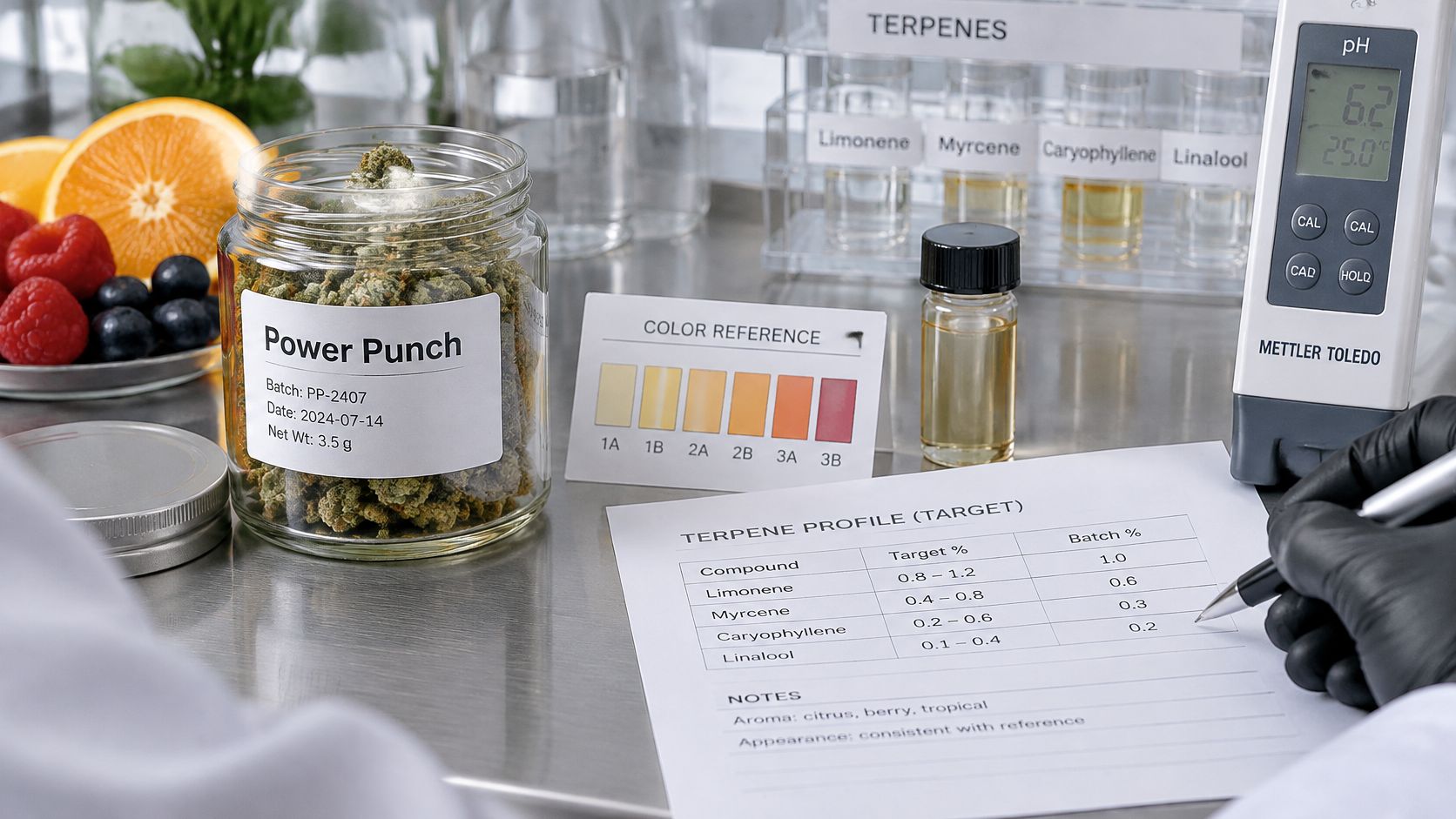
Qualify the reference before matching it
A useful reference file connects the sample in your lab to its origin and analytical report:
- Certificate of analysis: Confirm that the sample identifier and lot match the material received.
- Total terpene content: Check the reporting basis and distinguish quantified compounds from compounds outside the laboratory's panel.
- Dominant compounds: Record measured concentrations, not only a ranked list.
- Cannabinoid balance: Retain the THC:CBD ratio and actual potency results as matrix information.
- Harvest and handling history: Capture harvest date, curing information where available and storage conditions.
- Cultivar provenance: Record the producer and identification supplied with the reference.
Check whether the report uses weight percentages, another concentration unit or normalized proportions within the measured terpene fraction. Those representations answer different questions. A relative share of measured terpenes can't be substituted directly for a finished-oil loading.
Write acceptance ranges around an approved sample
Create a target sheet with the sensory description, the leading measured compounds and an acceptance range for each. Set those ranges from analytical uncertainty, supplier capability and acceptable sensory variation. Arbitrary tolerances tend to fail at the first supplier change because they encode nothing about where the variation comes from.
For a strain-inspired blend, separate chemical agreement from sensory agreement. A blend may meet its own composition specification without reproducing every constituent of the flower reference, while a sensory match may use a different composition entirely.
Keep an approved retained reference and the corresponding report together. A later purchase carrying the same name doesn't redefine the target on its own.
Record the lot's origin in the same file, whether the reference is cannabis flower, a cannabis-derived extract or a botanically built blend. A strain-inspired formulation should never be presented as authenticated cannabis flower chemistry merely because the aroma is familiar.
How Do Botanical and Cannabis-Derived Terpenes Differ for Power Punch Blends?
Botanical, cannabis-derived and nature-identical describe where a terpene's molecules originated. A Power Punch blend can match your approved sample from any of the three categories, so origin documentation and flavor verification remain separate checks.
Botanical material comes from plant species outside cannabis. Cannabis-derived material comes from the cannabis plant. A nature-identical designation means the compound chemically matches a natural terpene; it carries no plant-origin claim on its own. When you buy a strain-specific profile from a supplier such as Gold Coast Terpenes, the profile name describes the target flavor, and the batch certificate describes the actual material.
Use origin documentation to support purchasing and labeling decisions. The botanical versus cannabis-derived terpene guide defines the terminology for the comparison; the lot records still have to support the specific material you buy.
Botanical, cannabis-derived and nature-identical terpenes compared
| Attribute | Botanical | Cannabis-derived | Nature-identical |
|---|---|---|---|
| Source | Plant species outside cannabis | Cannabis plant material | Compound chemically matching a natural terpene |
| Confirm on the batch certificate | Plant-source declaration for the lot | Cannabis origin and lot linkage | Manufacturing-origin statement |
| Marketing claim it supports | Plant-origin, with cannabis-free claims requiring supporting records | Cannabis-origin disclosure | Chemically identical to a natural compound |
| Batch record needed | COA plus botanical-source declaration | Cannabis laboratory record and origin documentation | COA with identity confirmation and manufacturing-origin statement |
| Labeling risk | Claim must match batch records | Origin disclosure may apply by jurisdiction | Must not be presented as botanically sourced without evidence |
A terpene identity result on a certificate confirms what the molecule is. It establishes nothing about manufacturing origin. Request a source declaration when the analytical certificate omits that information, and retain both documents under the supplier lot.
The same logic applies to cannabis-derived material and cultivar claims. An origin record confirms the plant category. Tying that material to a named cultivar, such as the flower reference behind your Power Punch blend, requires provenance documentation in addition to the origin certificate.
Match claims to evidence
For side-by-side development, code the botanical blend and cannabis-derived reference so evaluators assess flavor without seeing the origin label. Keep the origin visible in the controlled batch records, even when the sensory samples are blinded.
Have regulatory counsel review the proposed ingredient terminology and origin claims for the intended market. Botanical sourcing, analytical purity and compliance with a particular finished-product rule are different questions; none substitutes for the others.
Internally, connect the blend identity, loading and lot to the finished-product batch. Put the disclosures required by the applicable market on the package rather than assuming a universal label format.
How Do You Choose a Terpene Supplier and Order a Pilot Batch?
Choose a supplier by batch documentation, traceability and formulation support, then qualify a pilot before committing to production volume. Catalog size tells you how many profiles a supplier lists; the approval decision rests on what the paperwork shows for the specific lot you will receive.
The terpene purchasing guide is a useful starting point for supplier questions. Turn those questions into a pass-or-fail approval sheet so purchasing doesn't substitute sales assurances for technical review.
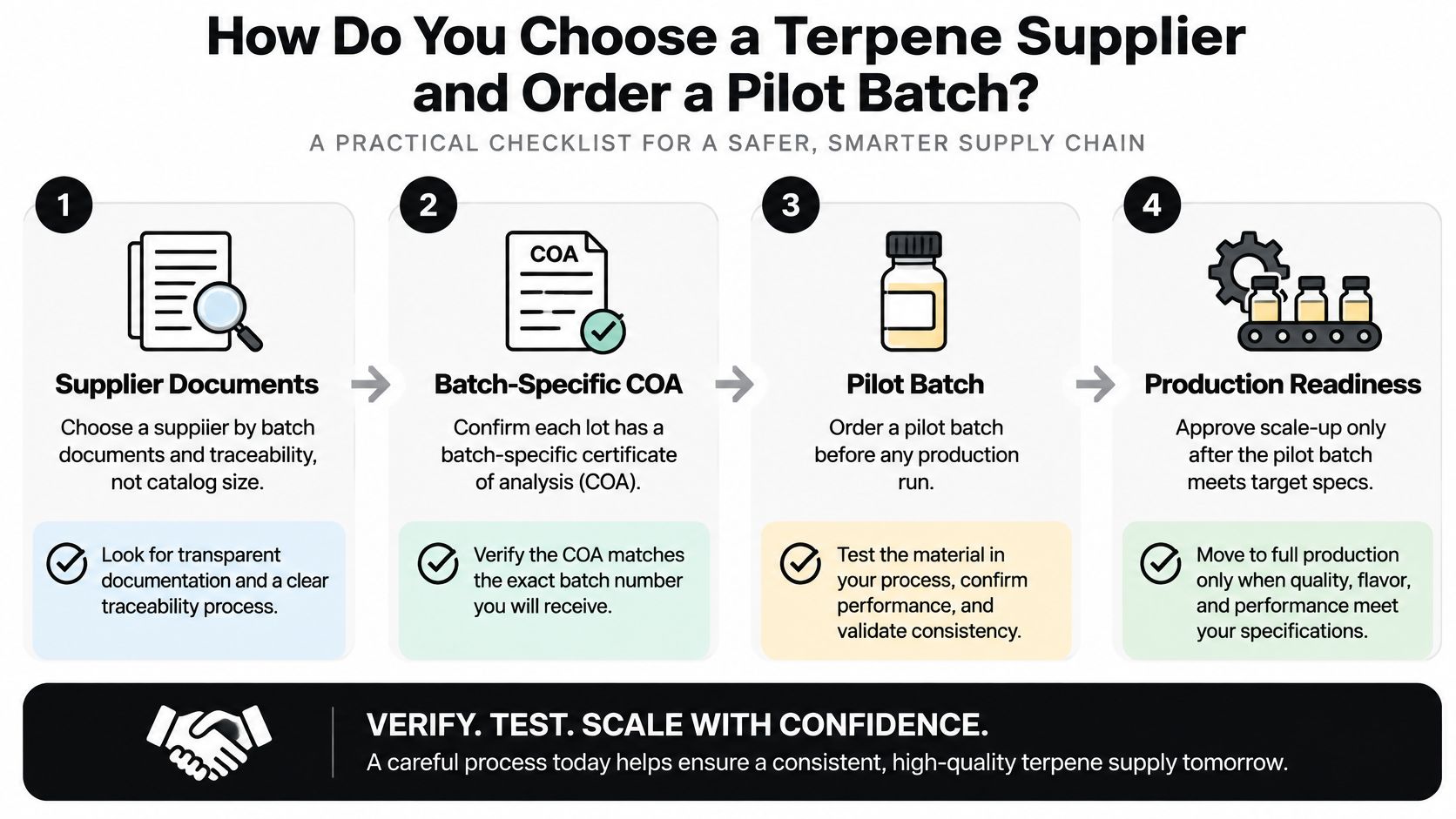
Use document-based purchasing gates
| Approval gate | Pass condition |
|---|---|
| Batch analysis | A lot-specific report identifies measured terpenes and concentrations |
| Origin | Documentation distinguishes botanical, cannabis-derived and other manufacturing origins |
| Independent testing | The actual laboratory report is available for review |
| Complete composition | Carrier or diluent use is disclosed, including VG, PG, PEG or MCT |
| Pilot access and MOQ | Sample quantity, production minimum and reorder increment are confirmed in writing |
| Traceability | Container lot codes connect to certificates and purchase records |
| Market documentation | Compliance documents address the intended product and destination |
| Reorder control | Blend specifications and change-notification expectations are documented |
Reject a supplier that won't provide a usable certificate for the lot being approved before purchase. A generic example certificate can help you review report format, but it can't qualify the material that will arrive.
No published minimum order quantity should be assumed. Confirm the pilot quantity and commercial MOQ separately, along with whether different profiles can share an order.
Order for comparison, then approve for production
Gold Coast Terpenes's 3ml Strain Picker Pack lets customers select any three different terpene profiles in 1.5ml or 3ml sizes, and its bulk ordering option permits multiple strains in one order. That structure suits side-by-side screening: three candidate profiles in sample volumes cost less than committing to a full-size container of each. Its Elevated Strains line uses Master Terpologists who raise levels of selected rare and exotic terpenes to bring out fruity and flavorful nuances; a modified profile like that makes sensory qualification important rather than optional.
Use pilot material in a deliberate approval sequence:
- Choose the reference. Approve the sensory target and assign opening, middle and finishing roles.
- Prepare the gravimetric pilot. Use the cartridge development range and record actual additions.
- Run the controlled comparisons. Include the unflavored matrix and experimentally relevant loading candidates.
- Score delivered flavor. Compare coded samples under the same draw conditions.
- Release the specification. Approve production only when composition, aerosol results and sensory acceptance agree.
Two handling points protect the pilot's value. Measure the received sample's mass rather than converting its labeled volume to grams without density information, since a volume-to-mass assumption propagates error into every loading figure downstream. And reserve material for repeat testing: a pilot that consumes the entire sample leaves no retained reference for troubleshooting if the production lot arrives different from what you approved.
What Do Formulators Still Ask About Power Punch Formulation?
The remaining questions are mostly claim and handling decisions: how specific the name allows you to be, how concentrated material should be treated, and when a pilot should be reformulated instead of pushed forward.
Is Power Punch a fixed terpene formula I can copy exactly?
Treat Power Punch as a cultivar reference and flavor target. A reproducible formulation needs an approved reference sample, measured composition, and sensory acceptance criteria; with botanical materials from Gold Coast Terpenes, describe the result as strain-inspired unless evidence supports a narrower matching claim.
What product claim is safest for a botanical Power Punch blend?
Use “strain-inspired” for aroma and flavor positioning. Keep cultivar, cannabis-derived, and origin language out of the claim unless the purchased lot documentation specifically supports it.
What handling rule applies before bench-scale flavor work?
Treat strain profiles as concentrates: Gold Coast Terpenes states that its strains are highly concentrated and need proper dilution before use. Prepare additions by mass, keep the matrix lot constant, and reserve enough sample for a repeat run if a result looks out of family.
When should a Power Punch pilot be reformulated?
Change the blend or the stated target when the approved sample, measured composition, and cartridge results do not agree under the same draw conditions. Do not use a higher experimental loading to force a weak concept through acceptance.
Gold Coast Terpenes offers concentrated botanical profiles, isolated compounds, curated packs and bulk ordering for developing a Power Punch-inspired flavor direction. Visit Gold Coast Terpenes to choose trial materials, then qualify the selected lot against your sensory target, composition limits and cartridge test results before placing a production order.