
Published THC figures for this cultivar span 26.7% to 33%, a 6.3 percentage point spread, according to the AllBud strain listing. That spread is the starting lesson for formulation work. A cultivar name gives you a flavor direction, not a chemical specification you can print on a batch record.
So a Georgia Apple Pie terpene profile starts with a verified reference batch. Build the apple, stone fruit, pastry, and spice layers, test them in distillate and in vape cartridges, and release only the lots that match the reference by COA and by nose. Gold Coast Terpenes, a supplier of over 50 Indica, Sativa, and Hybrid terpene strains, works from the same principle: the strain name sets the target, and the COA decides whether you hit it. Keep load, heat, labeling, and supplier checks as separate variables so you can change one at a time.
What Terpene Profile Should a Georgia Apple Pie Blend Target?
I build a Georgia Apple Pie target in three layers: bright apple and stone fruit on top, cinnamon and baked pastry in the middle, and dough, nut, vanilla, or earth at the base. Each layer has to survive into the finished oil as its own impression. Gold Coast Terpenes, which lists 50+ strain-specific terpene profiles plus isolates such as limonene, myrcene, and beta-caryophyllene, stocks the raw candidates. The layering itself sits with the formulator.
The lineage explains the direction. Georgia Apple Pie is commonly listed as Georgia Pie crossed with Apple Fritter, and the Leafly listing for Georgia Apple Pie records Apple Fritter and Georgia Pie as the named parents. That parentage supports peach, baked apple, sugary pastry, and warm spice, yet it leaves the chemical fingerprint of any given cut unverified. Treat the name as a brief for a dessert-style flavor profile, then prove the result in your own matrix.
Target terpene layers for a Georgia Apple Pie blend
| Layer | Sensory target | Terpene candidates | Parent COA anchor |
|---|---|---|---|
| Top | Bright apple and stone fruit | Limonene, alpha-pinene | Alpha-pinene 0.024%; limonene not reported |
| Mid | Cinnamon and baked pastry | Beta-caryophyllene | 0.524% |
| Base | Dough, nut, vanilla and earth | Alpha-humulene, beta-myrcene | Alpha-humulene 0.212%; beta-myrcene 0.036% |
The COA anchors above come from one published Georgia Pie sample totaling 1.339% terpenes by weight, which also reports beta-pinene at 0.036% and trans-ocimene at 0.027% and names cinnamon, lemon, and hops as primary aromas, according to the Crop King Seeds Georgia Apple Pie page.
The top layer has to read fresh before it reads sweet. Limonene and alpha-pinene are candidates because they lift fruit cues, and either one can drag the blend toward citrus cleaner or pine when pushed too hard. Keep the top thin and volatile. Judge it first on the blotter, then again after it sits in warm distillate, since these notes are the easiest to lose.
The mid layer carries the pie identity. Beta-caryophyllene gives warm, peppery depth that can sit under cinnamon and baked pastry character, and it still needs support from the other layers to read as crust rather than pepper. Use it to anchor the spice and pastry impression, then check whether the blend still smells baked once the fruit top starts to fade.
What the parent COA can and cannot tell you
Those values show relative prominence inside a single Georgia Pie sample. A finished blend target is a different calculation. The measured profile leans caryophyllene heavy, while the listed aromas point to cinnamon and citrus cues that may need deliberate balancing on their own. Flower percentages also scale badly: a blend goes into oil at a small percentage and then gets heated during use, so proportions copied straight off a COA tend to land wrong in a cartridge.
Practical rule: If a taster can't name the fruit top, the pastry middle, and the doughy base as three separate impressions, the blend isn't ready for load testing.
Close this stage with a pass or fail sensory test. The blend should open with apple and stone fruit, move into cinnamon and crust, and finish soft rather than sharp. Only then does load become a useful question.
Why Do Two Batches of the Same Strain Smell Different?
Treat the strain name as a flavor target rather than a fixed chemical recipe. Two lots can sit under the same Georgia Apple Pie label and still push different ratios, so each incoming lot gets checked against the retained reference before it earns a place in production.
A peer-reviewed cannabis terpene study reports at least 48 terpene peaks across cultivars, with myrcene, alpha-pinene, limonene, beta-caryophyllene, and alpha-humulene recurring broadly while their relative abundance shifts among cultivars and batches. Even matched plants can drift enough to matter. Commercial lots separated by room, harvest date, dry, and cure have more chances to move, which is why the reference blend and lot COA are essential.
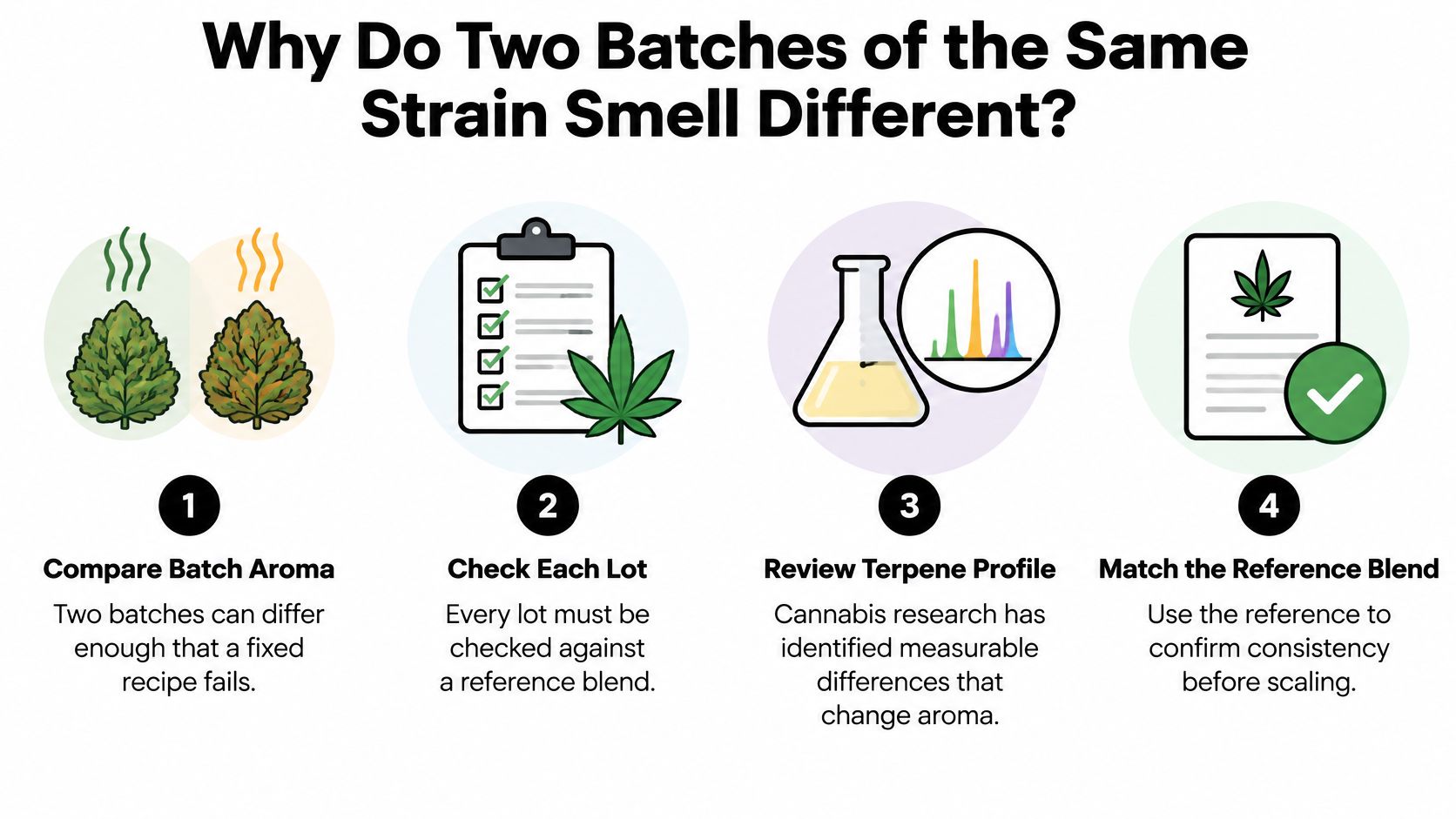
Say one lot gives peach, apple, and pastry in the right order. The next lot under the same name arrives sharper, greener, or more peppery, and the finished cartridge reads spice first and fruit second. The process stayed the same. The sensory drivers moved, and the consumer experiences that as a different product. Genetics sets the possibility; environment shapes much of the expression, so formulators track how growing conditions influence terpene flavor instead of assuming the label settles the profile.
What to verify on each incoming lot
- Total terpene content: Compare the lot total with the acceptance range you set from the reference, not with a marketing average.
- Five recurring terpenes: Check myrcene, alpha-pinene, limonene, beta-caryophyllene, and alpha-humulene individually, since a matching total can still hide a shifted ratio.
- Sensory match in matrix: Smell and taste the lot in the intended distillate or concentrate next to the retained reference, because neat aroma doesn't predict in-oil balance.
- Method and date: Record the lab method and test date on the COA, so you're not comparing results produced under different conditions.
Potency can vary across listings too, so never use the cultivar name as a THC claim. Set acceptance ranges from the reference, verify each lot by chromatographic testing, and release only lots inside those ranges.
If a lot falls outside, don't fix it blindly at the mixing tank. Identify which layer moved, adjust that layer, and retest in matrix. Small corrections work when you know the driver. Guessing creates a second problem on top of the first.
How to Build a Reference Blend Before You Scale
A strain name sets the flavor target. The reference blend turns that target into numbers. It is a small, documented test batch that every later lot is matched against, working as both a sensory anchor and a chemical record, and it belongs in place before you commit to production volumes, while corrections are still cheap.
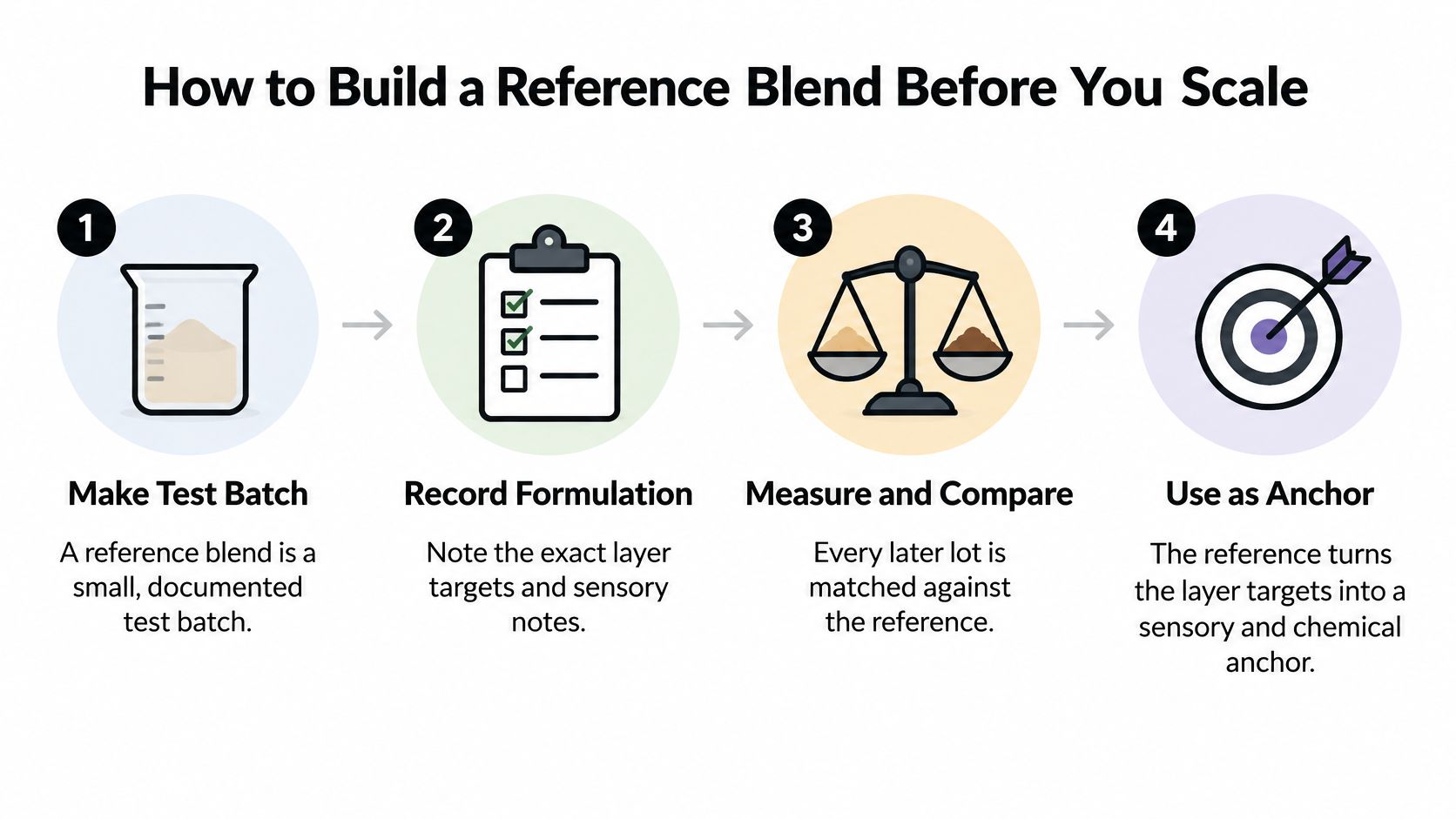
Work through structured sensory evaluation methods and keep the scoring sheet inside the batch record. Informal comments like "smells close" give the next operator nothing to reproduce. Score fruit, pastry, spice, and base notes separately, so disagreements point to a specific layer instead of dissolving into opinion.
Six steps to a usable reference
- Write the target layers. List the top, mid, and base targets for the Georgia Apple Pie strain profile and assign one or two candidate terpenes to each. This stops the common error of padding the formula with whatever happens to sit on the bench.
- Confirm each component COA. Check identity and total terpene content before weighing, and file the lot number of every input. Strain and isolate profiles from a catalog like Gold Coast Terpenes can serve as starting components, and its Elevated Strains Apple Fritter listing works as a dessert style component reference, but each lot still needs its own COA.
- Weigh by mass. Use a calibrated scale and record the measured values for each input. Mass records make the stated load defensible later, when a production lot has to be compared with the reference.
- Blend at one load. Mix at 5% in the intended distillate or concentrate, using your normal vessel and enough material to fill test hardware. Heating and mixing conditions are separate variables, handled later, so hold them steady here.
- Evaluate against the control. Compare the blend with the 0% control in the same matrix and score top, mid, and base separately. The control shows what the base oil contributes, so you don't credit the blend for aroma that was already there.
- Change one layer at a time. Adjust only the layer that missed, retest, and save the final mix with its lot number, COAs, scores, and date as the retained reference. Single variable changes keep each result interpretable.
Keep a sealed retained sample of the approved reference with its full record, so every later lot is judged against a physical standard that can be retested.
Two failure modes sink reference blends. The first is approving a blend that only worked neat: distillate can mute fruit, emphasize pepper, or flatten pastry notes, and hardware changes the impression again. The second is undocumented drift, where the batch that passed lives only in one person's memory of the session. Your reference is finished when it has passed in the matrix and format you intend to sell, with records complete enough that someone else could rebuild it.
How Much Terpene Load Does the Apple Pie Profile Need?
Test five total terpene loads, 0%, 2.5%, 5%, 7.5%, and 10% by weight, and pick the lowest one where all three layers come through clearly. I treat the lowest-clear-load rule as the deciding criterion, because a Georgia Apple Pie strain profile depends on balance between delicate fruit and warm spice. Push past the point where the layers read cleanly, and the extra terpenes add sharpness, thin the oil, and let the spice layer crowd out the apple. These percentages are a development screen, with the finished specification set by your own results.
The same screen works on any supplier's blend, so candidate profiles get compared on equal terms.
Terpene load screen for a Georgia Apple Pie distillate blend
| Total terpene load | Purpose in the screen | What to check |
|---|---|---|
| 0% (control) | Separates distillate aroma from blend aroma | Any aroma present before terpenes are added |
| 2.5% | Tests whether top notes stay distinct at low load | Apple and stone fruit cues are clear |
| 5% | Midpoint for balancing the layers | Cinnamon and pastry balance the fruit |
| 7.5% | Tests whether the blend turns sharp or dominant | Sharpness, viscosity change and phase separation |
| 10% | Upper screen limit | Thinning, color shift and fill behavior in hardware |
Start with the control. Any caramelized or oxidized note already sitting in the distillate shows up at 0%, so score it there before the blend gets credit or blame for it. At 2.5%, the apple and stone fruit cues should read clearly without the taster hunting for them. A clear top with an empty middle at this point says more about layer balance than about total load.
At 5%, cinnamon and pastry should meet the fruit rather than replace it, which makes this the most informative point for distillate development. At 7.5%, watch for the turn: fruit going sharp, spice getting loud, or the oil starting to separate. The 10% point is a stress test for thinning, color shift, clarity loss, and cartridge fill behavior. Published guidance on how much terpene to add to distillate gives useful background, while your screen results in your oil make the final call.
For every sample in the screen, record viscosity, phase separation, color, aroma, clarity, and cartridge fill behavior before anyone argues from preference. Jar aroma alone doesn't qualify a load. Fill behavior and standing stability carry equal weight, and a sample that fails either one stays in development regardless of how it tasted.
Pick the release load only after hardware, oil viscosity, sensory intensity, and stability have been assessed together. If two loads pass on flavor, choose the lower one. It leaves more room on viscosity and reduces the risk of one strong layer taking over during storage.
What Cartridge Symptoms Reveal About Mixing Heat
Published mixing ranges conflict, so heat is a variable to test, not a setting to copy. One formulation table places typical terpene loading at 3% to 7% by weight with a mixing temperature of 55°C to 65°C, while another workflow warms distillate to 40°C to 50°C before addition and mixes for 15 to 30 minutes. Your oil, vessel, and hardware decide which end of those ranges works.
The mechanism explains why. Heat lowers viscosity and speeds dispersion, yet the same heat can strip volatile top notes, so apple and stone fruit fade or turn sharp in a Georgia Apple Pie strain blend. Run the mix too cool and the viscous oil resists dispersion, leaving streaks and pockets of uneven aroma. Every hotplate setting trades fruit retention against mixing quality.
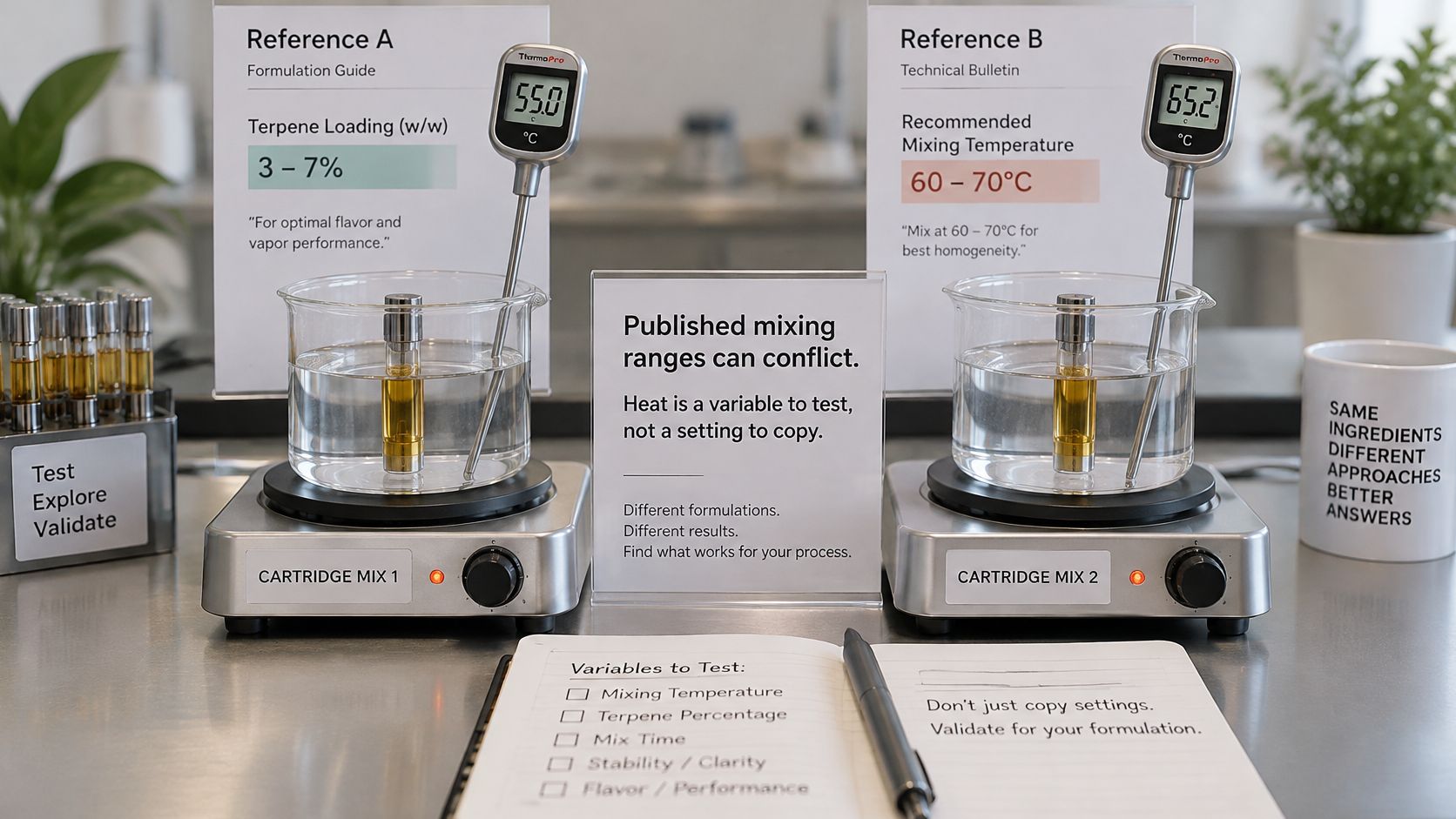
Read the finished cartridge as diagnostic evidence. A symptom that shows up across a full fill run points to a process condition, while a symptom in one device points to hardware or filling. Keep those categories separate before you start adjusting the formula.
Cartridge symptoms, likely causes and adjustments
| Symptom | Likely cause | Adjustment to test |
|---|---|---|
| Sharp, green or pepper-heavy aroma | Excess heat or loss of fruit balance | Test the lower end of the heat range and recheck the top notes |
| Fruit fades soon after filling | Top notes lost during processing | Reduce heat or mix time within the tested range and recheck after storage |
| Thick oil with visible streaks | Poor dispersion at low heat | Warm within the tested range and extend mix time |
| Changes in fill, wicking or leakage | Viscosity shift from load | Retest at a lower load in the actual cartridge |
A sharp, green, or pepper heavy result usually means the fruit top took the damage and the spice layer is now exposed. Don't respond by adding more fruit components at the same temperature, because you'll likely cook the addition the same way. Drop toward the lower end of your tested range, hold load constant, and recheck the top notes against your reference blend. The strain name gives you a flavor target; the reference tells you whether the batch still matches it.
Fruit that fades soon after filling is a subtler version of the same problem. It can pass a sniff test at the bench and fail a week later, which is why post storage evaluation matters more than fill day aroma. Reduce heat or shorten mix time within your tested window, then judge after storage in the sealed device.
Thick oil with visible streaks points the other way. The blend hasn't dispersed, so some cartridges will taste strong and others weak even though the batch average is correct. Warm within the tested range and extend mechanical mixing, then inspect for streaks under light before filling. Changes in fill, wicking, or leakage usually track viscosity rather than flavor, so retest at a lower load in the actual cartridge before blaming the hardware.
Release rule: Judge aroma after storage in the finished device, not only at fill, and put every heat or time change in the batch record.
Document mixing temperature, mixing time, load, and hardware for every run for vape cartridges. Without that record, a good batch can't be repeated and a bad batch can't be diagnosed. With it, each symptom becomes a testable adjustment instead of an argument.
What Claims Can a Formulator Make About Effects?
The terpene profile doesn't support effect claims on a label, so limit product language to aroma and flavor descriptors backed by a lot COA. A strain name can describe a flavor target. It can't establish what a finished product will do for a person.
Grower and retail listings often describe effects anecdotally for the Georgia Apple Pie strain, using words tied to mood or body feel. Those descriptions come from varied flower, varied doses, and varied users, and they don't transfer to your distillate, your cannabinoid ratio, or your device. If your label repeats them, you're making a promise your COA can't support.
Avoid medical language entirely. Don't use treatment, relief, or therapeutic wording, and don't soften it with casual equivalents that imply the same outcome. Even familiar words like calming or uplifting become effect claims when they appear on packaging, so keep them off the sellable copy unless your market counsel has reviewed the exact wording.
Name the product for what it is
Call it a strain-inspired terpene blend, not the Georgia Apple Pie strain itself. Your blend is built to match a flavor direction from layered components, not a verified chemical fingerprint taken from one harvest. Accurate naming protects the buyer, who needs to know whether they're purchasing a botanical blend, a cannabis derived extract, or flower, and it protects your brand when a customer compares lots.
Make the source explicit on the specification sheet and, where required, on the label. State whether each terpene is botanically derived, cannabis derived, or nature-identical, because source affects labeling, cost, supply risk, and buyer trust. Link every flavor claim to a specific lot number, so "baked apple and cinnamon" refers to material you tested rather than to the cultivar name in general.
Three checks before any label is released
- Aroma and flavor only: Every claim describes smell or taste, with no effect, medical, or outcome language.
- Current lot COA: The claim maps to a tested lot with identity and terpene values on file.
- Strain inspired naming: The product name signals inspiration, not botanical identity or equivalence to flower.
Labeling and naming rules vary by market, and a phrase that's acceptable in one state or country may trigger a restriction in another. Have the final wording checked against local requirements before release. I would rather ship a narrower flavor claim that the lot data supports than a broad strain promise that invites a takedown.
How to Choose a Terpene Supplier for a Georgia Apple Pie Blend
A supplier can look polished and still fail the blend. Ask for documents before samples: source status, a lot COA, and written purchasing terms. Price per milliliter can wait. For a Georgia Apple Pie profile, the target is a repeatable flavor record built from verified lots, so the best supplier is the one whose paperwork lets you reproduce the reference.
Start with source. Botanically derived terpenes come from non cannabis plants, cannabis derived terpenes come from cannabis, and nature-identical compounds are synthesized to match natural molecules. Each route can be legitimate, yet source affects supply risk, labeling language, and buyer trust. If a supplier leaves origin vague, stop there.
Supplier checklist for formulation buyers
- Source label on every product: Confirm botanical, cannabis derived, or nature-identical status in writing, and reject any blend with unclear origin.
- Lot specific COA: Request identity and total terpene content for the exact lot, then match it against your locked reference before purchase. One catalog example shows the level of documentation to request from every candidate: Gold Coast Terpenes lists SC Lab-tested terpenes for cartridges, more than 50 Indica, Sativa, and Hybrid profiles, and wholesale pricing on strain orders over 64oz.
- Written MOQ and lead time: Get minimum order quantity and lead time in writing for each strain profile and isolate, so pilot batches and bulk runs can be costed before you design around a component. Ask where your pilot quantity sits relative to any volume break.
- Usable starting components: Check whether dessert style strain profiles, such as an Apple Fritter profile, and single isolates can serve as components for your reference. General guidance on where to buy terpenes helps frame the sourcing search; your reference match remains the deciding test.
Compare candidates on those four points side by side, then run the finalists through the same load screen in your oil. A supplier with a slightly higher price and complete lot paperwork usually costs less than a cheap lot that forces reformulation. Retest cost, delayed fills, and rejected hardware runs belong in the comparison. Pick the supplier that makes the next lot auditable before the first purchase order is signed.
Build your next Georgia Apple Pie test batch from documented components, run the load and heat screens in your own hardware, and keep the COA set tied to every lot. Gold Coast Terpenes supplies strain profiles and isolates you can evaluate against that reference for distillate and cartridge development. Visit Gold Coast Terpenes to review available profiles and request the lot documentation your formulation file needs.