
You're staring at a spec sheet, a flavor brief, or a tank sample that's close but not quite right. The label says Pistachio Gelato, and the product needs to taste like a dessert-family cultivar without turning into generic sweetness, flat cream, or harsh spice.
That's a formulation problem, not a consumer-review problem. The name is a starting point, but the work is translating a caryophyllene, limonene, myrcene profile into a cart that holds together, tastes intentional, and survives the hardware it lives in.
Why Pistachio Gelato Belongs on a Formulator's Bench
A Pistachio Gelato strain brief is useful because it gives you a rare combination of cues, dessert sweetness, nut-forward nuance, and modern potency. It's not just another Gelato-derived flavor target. The profile sits in the space where a formulators' choice of base, mid, and top notes changes whether the finished oil reads like pistachio cream, generic gelato, or peppery dessert.
Treat the name as a sensory target
For product development, the name functions as a flavor brief. It tells you to build a profile that feels creamy first, slightly roasted second, and bright enough on the finish to avoid collapsing into heavy sweetness. That's why the terpene stack matters more than the menu language. The blend has to deliver a believable nutty-dessert arc in a cart, not just a pleasant smell in a jar.
The practical takeaway is simple. If you're building a strain-inspired terpene blend for vape cartridges, you're solving for aroma persistence, draw smoothness, and aftertaste, all at once. A profile that leans too far into caryophyllene can become dry and peppery. A profile that overweights limonene can lose the pistachio cue and drift into candy citrus.
Practical rule: start with the flavor you want the finished cart to say on the first pull, then work backward into the terpene mix. Don't start with “how much terpene can this oil take?” and hope the name appears later.
Why this profile is commercially useful
The commercial value comes from specificity. Pistachio Gelato sits inside the dessert family, but it has more structure than a generic vanilla or cake-style brief. That makes it useful for formulating for distillate and for richer extract bases where the top notes need help surviving heat and storage.
If you want a broader Gelato reference point, this Gelato strain overview is a useful companion for comparing how the family expresses itself across named cuts. The point isn't to copy the consumer story. It's to anchor your formulation choices in a recognizable sensory family so your bench trials have a real target.
Lineage and Genetic Background You Can Actually Use
The genetics are messy in the way modern cannabis naming often is. One source calls Pistachio Gelato a Pistachio × Gelato cross, another keeps the parentage unknown, and another traces it to LCG S1 seed (Gelato 33 parent) × Sugar Cone 3 (Gelato 45 × Cookies N Cream). What matters for a formulator is not pretending that one database has the final answer, but recognizing that the strain sits inside the wider Gelato lineage.
Use the lineage as a sensory family, not a purity test
That broader Gelato family has been traced to Southern California in 2014 in one strain database, which is useful because it tells you the profile belongs to a newer, phenotype-driven market where naming can stay stable even when exact pedigree reporting does not. In other words, the commercial name often outlives the clean genetics record.
The strain is widely described as a 65% indica / 35% sativa hybrid, and dispensary listings put THC in the mid-20s to 30% range. AllBud reports an average THC level of 26% to 30% and calls it a “slightly indica dominant hybrid”, while Leafly lists it at 26% THC and notes The Cure Co as the breeder. A retailer listing tied to the same profile also shows a tested sample at 26.21% THC with 0.09% CBD in the same strain family context. Those numbers matter because they position the profile as a high-potency, experienced-user target, not a low-dose flavoring exercise.
What that means for finished products
For formulation, the indica-leaning split suggests the market expects a body-led experience and a heavier flavor impression. That doesn't mean making medical claims, and it doesn't mean promising effects. It means the sensory brief should feel evening-leaning, dense, and dessert-forward.
The safer marketing language is simple. Call it indica-leaning, dessert-style, or Gelato-family inspired if the chemistry supports it. Avoid implying outcomes. Your job is to replicate the flavor architecture and maintain consistency batch to batch.
Reading the Sensory and Terpene Blueprint
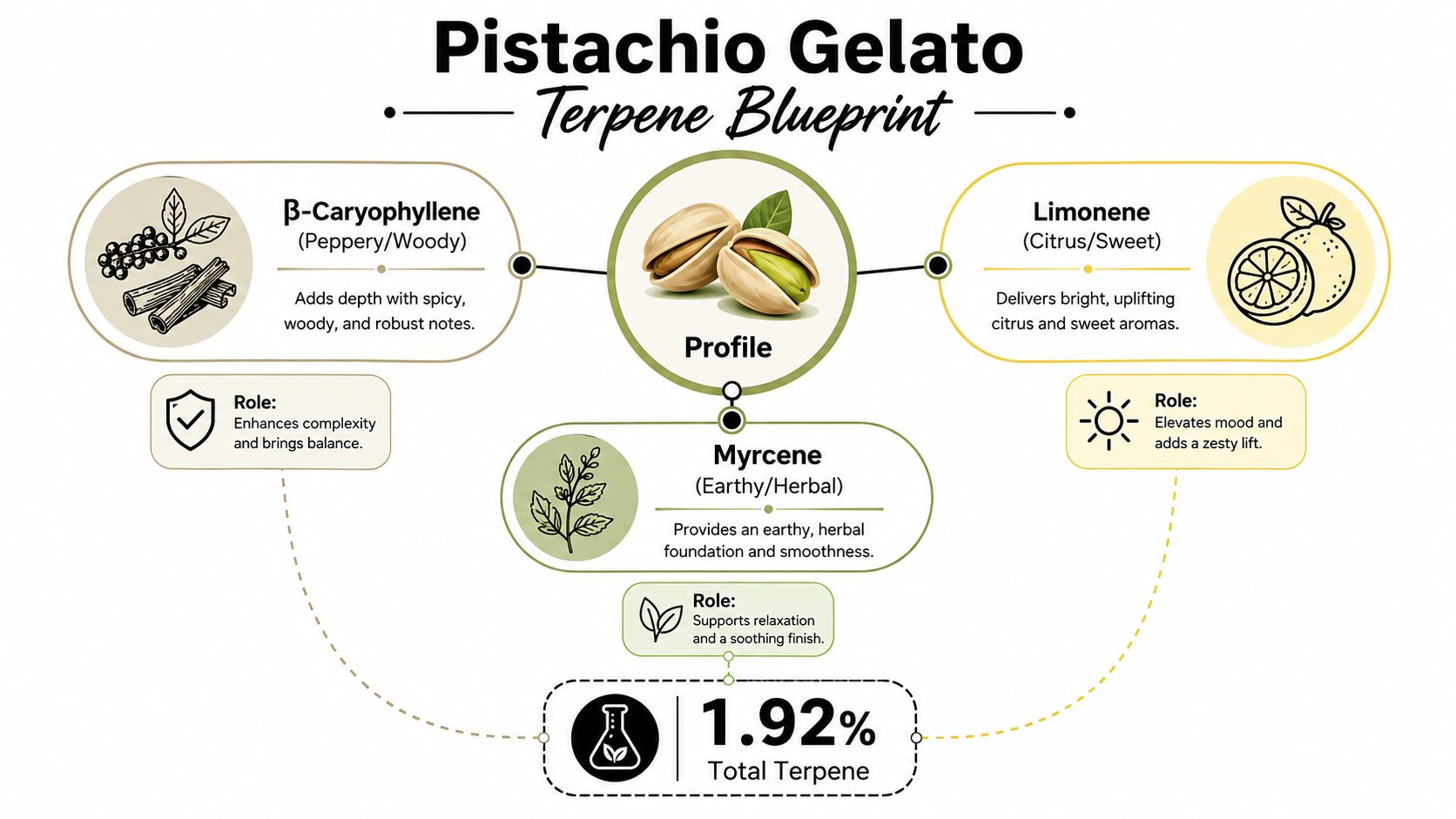
The most useful way to read this profile is as a caryophyllene, limonene, myrcene framework. That stack shows up consistently across strain writeups, and it gives you a workable sensory map before you ever touch a beaker. The source material tied to this profile describes roasted-nut sweetness, creamy vanilla, ripe berries, and faint diesel, which is exactly the kind of layered brief you need when the goal is a believable dessert cart.
What each terpene is doing
GrowDiaries' strain writeup links the profile to caryophyllene, limonene, and myrcene. In practical terms, caryophyllene is the pistachio cue. It brings spice, dry warmth, and a roasted edge that keeps the blend from reading like simple cream. Limonene is the brightener, the flicker that keeps sweetness from going dull. Myrcene is the dessert backbone, the creamy-earthy layer that gives the profile its weight and smoothness.
The lab-style sample from Massachusetts is more specific. It reported 1.92% total terpenes, with myrcene 0.85%, pinene 0.41%, and caryophyllene 0.19%. That sample is useful because it shows the profile is not terpene-heavy overall, but still has a readable earthy base, a pine lift, and a spice anchor. In a replication workflow, that means myrcene should sit as the base note, pinene should lift the mid-palate, and caryophyllene should hold the lower-mid spice line.
The mistake is treating pistachio as a single note. In formulation, it's really a small stack of roles that all need to stay in balance.
The sensory vocabulary you should use
When you're evaluating bench samples, use language that maps to what the nose does. Creamy belongs to myrcene-led weight. Nutty and peppery belong to caryophyllene. Bright and clean belongs to limonene and pinene. If a sample is missing the nutty impression, it usually isn't because it needs more sweetness. It usually needs a cleaner spice-to-base relationship.
A broader Gelato guide also shows the typical shape of the family, with beta-caryophyllene at 0.3% to 0.9%, limonene at 0.2% to 0.8%, and linalool at 0.1% to 0.4% in third-party lab reports surveyed across dispensaries as summarized in a Gelato strain guide. That spread is useful because it tells you the family likes a spicy woody foundation, a citrus-bright middle, and a softer finish.
Translating Lab Data Into a Top, Mid, and Base Structure
A good Pistachio Gelato blend starts with a hierarchy, not a pile of terpenes. The hierarchy comes from the 1.92% total terpene sample and the broader Gelato ranges, then you turn that into a practical sensory scaffold. Think in base, mid, and top notes, because that's how the profile survives hardware, storage, and real customer use.
Build the base first
The base is where the profile gets its body. For this kind of dessert-targeted blend, myrcene and caryophyllene do most of the heavy lifting. Myrcene gives the creamy-earthy mass, while caryophyllene gives the roasted-nut edge that makes the pistachio impression feel intentional instead of accidental.
A workable starting skeleton is to keep about 45% to 55% of the blend mass in base terpenes, 30% to 40% in mid notes, and 5% to 15% in top notes. Those are formulation ranges, not hard facts from a lab report. They're a practical way to organize a blend before you test it against your own oil system.
Use the mids to keep the dessert note alive
The mid layer is where limonene and pinene earn their keep. Limonene gives the profile a sweet-citrus flicker, while pinene adds a cleaner green lift that helps the draw open up instead of feeling heavy from the first puff. In the Massachusetts sample, pinene showed up at 0.41%, which is enough to matter even when the total terpene load is modest.
| Pistachio Gelato Terpene Role Map | |||
|---|---|---|---|
| Terpene | Perceptual Role | Blend Range % | Sensory Job |
| Myrcene | Base | 25% to 40% of the terpene blend | Creamy, earthy, dessert weight |
| Caryophyllene | Base to mid | 20% to 35% of the terpene blend | Roasted nut, spice, dry structure |
| Limonene | Mid | 15% to 25% of the terpene blend | Citrus lift, sweetness clarity |
| Pinene | Mid | 5% to 15% of the terpene blend | Freshness, open draw, green lift |
| Linalool or similar light accents | Top | 5% to 10% of the terpene blend | Soft finish, floral smoothing |
Keep the top light
The top note should stay restrained. If you load too much floral or candy-forward material, the profile stops reading as pistachio gelato and starts reading as a sweet perfume. That's why lighter accents such as linalool, or trace finish notes like bisabolol when appropriate, should sit low in the mix.
If you need a bench reference for aroma comparison, use the sensing terpenes guide as a sensory vocabulary aid. It helps junior formulators separate what they smell from what they think they should smell.
Dilution Targets for Distillate and Live Resin Carts
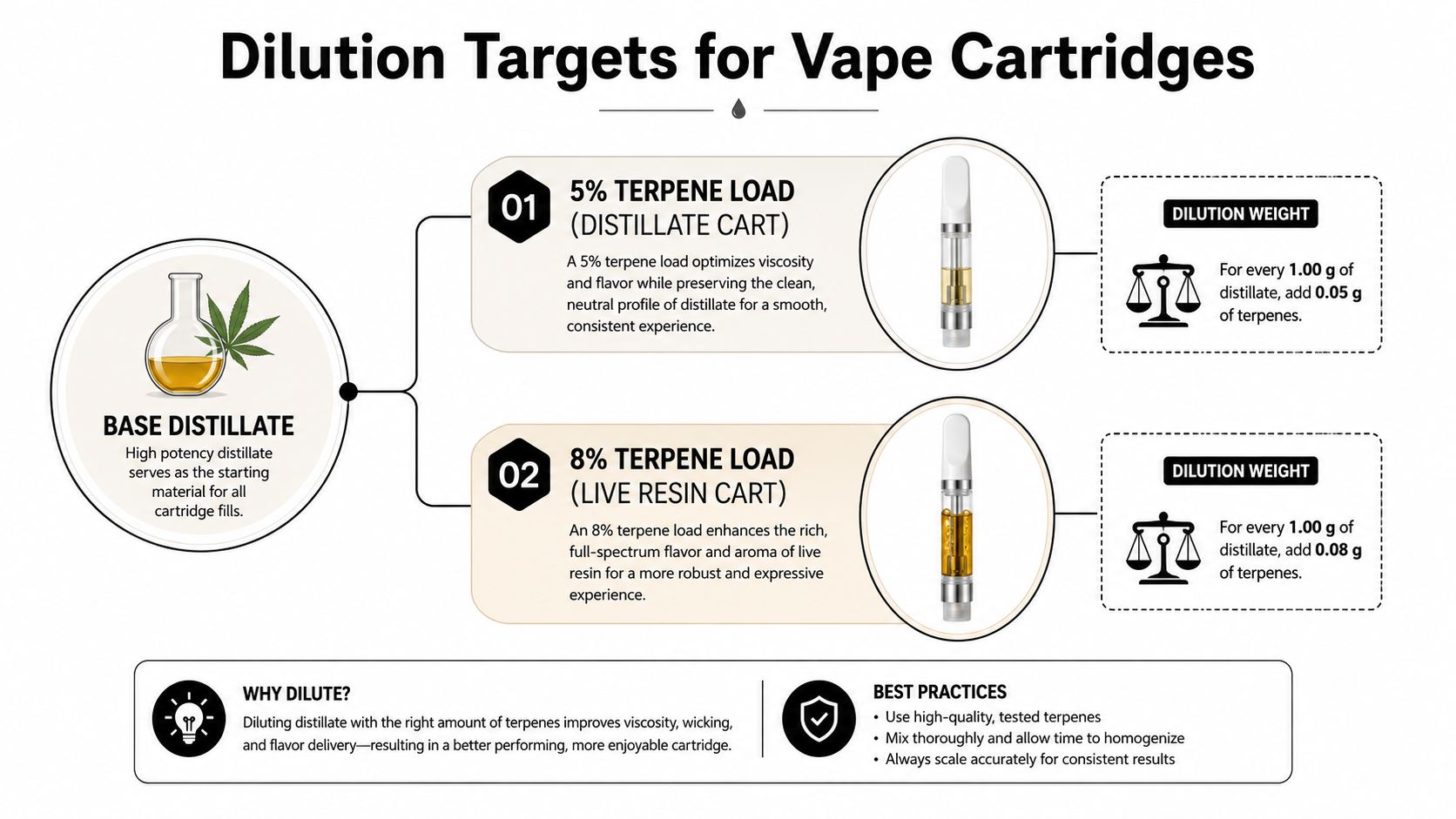
Once the ratio skeleton is set, the next decision is total load. For a strain-inspired terpene blend for vape cartridges, the practical range usually lives in the single digits by weight. That's where you preserve flavor without sacrificing viscosity, coil behavior, or shelf stability.
Distillate carts want cleaner restraint
For a 5% total terpene distillate cart, the blend can be kept tight and clear. A practical split is roughly 2.5% caryophyllene and myrcene base, 1.7% limonene and pinene mid, and 0.8% floral top. That keeps the dessert body in front while still giving the draw enough lift.
The reason this works is simple. Distillate already provides a neutral carrier, so the terpenes don't need to carry the whole identity by themselves. They just need to define it. If you push too hard, the cart can turn sharp, thin, or hot on the throat.
Live resin carts usually need more headroom
For an 8% live resin cart, the same shape can be scaled up a little because live resin brings more of its own flavor and can lose clarity in the tank as oxidation sets in. A slightly higher load helps preserve the profile through real-world storage and use. In practice, that means keeping the same base-to-mid-to-top balance, but giving the whole blend more presence so it doesn't fade quickly.
Working rule: if the matrix already tastes like something, you don't need to over-terp it. If the matrix is quiet, the blend has to work harder, but only up to the point where the cartridge still wicks cleanly.
Don't chase dabbing strength in cartridge form
There's a difference between strain-inspired dilution and aggressive strength loads. Once you move past the normal cartridge window and start building around 12%+, you're often asking a ceramic cart to do a job it wasn't designed for. Separation, harshness, and unstable flavor show up fast.
If you're thinning distillate for cartridge work, this distillate dilution guide is a practical reference. For benchmark development, the safest workflow is still to stay in the lower-load cart range first, then scale only after the blend behaves in the hardware you sell.
Hardware and Extract Compatibility
The same Pistachio Gelato terpene blend behaves differently depending on the carrier. That's not a defect in the formula, it's the normal result of changing viscosity, wax content, and how aggressively the hardware pulls heat through the oil. Distillate, live resin sauce, and rosin-compatible carts each ask for a different level of caution.
Distillate is the easiest platform
Winterized distillate is the cleanest carrier for this profile. It tends to present the flavor with the least noise, and it's the easiest place to hold a 5% to 7% style load without fighting too much native aroma. The trade-off is that distillate can mute the top notes, so the citrus and pine mids may need a slight nudge to stay readable on the draw.
That's where the structure above pays off. If the base is too heavy, distillate will flatten the finish. If the mids are too light, the pistachio cue disappears first.
Live resin gives you more expression, but less forgiveness
Live resin sauce is usually the most expressive carrier for dessert-style profiles. A 6% to 9% load can sound right because the native flavor helps carry the blend. The downside is oxidation. A caryophyllene-heavy base can darken fast inside the tank, especially if headspace is sloppy or the fill process is rough.
Tighter headspace and a fresher base load matter here. You're trying to preserve a creamy, roasted profile without letting it drift into stale spice. Live resin is the place where small handling mistakes show up fastest.
Rosin asks for the most restraint
Rosin is the hardest matrix of the three. High fat and wax content compete with terpenes for volatility, which means you usually need a lower total terpene load and a softer top end. The blend should lean harder on the base notes and accept that the bright finish won't be as loud as it is in distillate.
Ceramic hardware generally gives you more room to preserve nuance than wick-heavy setups, especially for dessert profiles that rely on subtle mid-palate transitions. If the cart is underpowered, though, even a good formula will taste muted. Match the blend to the hardware, not the other way around.
Mixing Workflow, Quality Control, and Stability Checks
Good formulation lives or dies at the bench. A Pistachio Gelato-style profile doesn't need fancy tricks, it needs clean handling, controlled heat, and a repeatable sequence. Once the order changes, the profile changes.
Follow the blend order
Warm the extract only to working temperature, then weigh each component on a 0.01 g scale. Pre-mix the base notes first, fold in the mid notes, and add the top notes last so they don't flash off before the batch is homogenized. Stir gently, apply only the heat you need, and let the blend rest before filling.
That order matters because the dessert profile is delicate at the top and structural at the base. If you heat everything at once, the finish gets thin fast.
Check the batch before it ever reaches packaging
A good QC pass starts with the eye. Look for clarity under a loupe, then compare the smell strip against a reference sample. If you have access to analytical testing, use GC or in-house HPLC verification where available. The point isn't to obsess over one trace deviation, it's to confirm that your bench result matches the target.
Stability note: if the sample darkens, separates, or starts pulling harsh in test puffs, don't scale it. Fix the formulation first.
For a deeper operational checklist, the quality control testing guide is a good reference point. In storage, use nitrogen-purged headspace, amber glass, and cool conditions whenever possible. This profile is more prone to oxidation than a bright citrus-heavy blend, so a 30-day accelerated shelf test is worth running before you commit to production.
Keep the media of the blend consistent
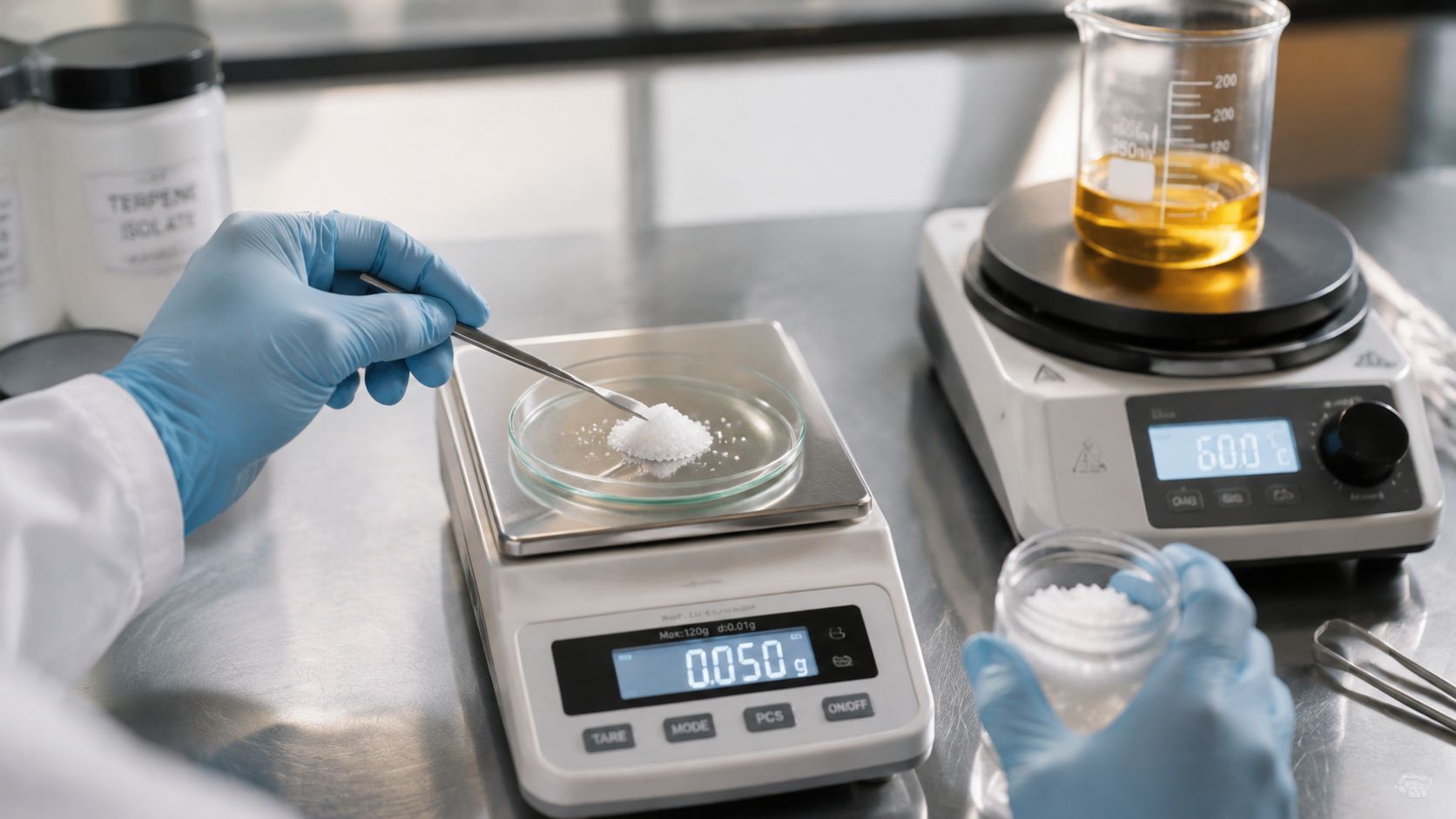
The visual cue matters because accurate weighing is the difference between a profile that repeats and one that “kind of” works. If the bench sample smells right but doesn't hold, the failure is usually in handling, not in the idea.
Practical Formulation Tips and Next Steps
Start with the ratio skeleton, then verify it against your own analytical data. Bench the blend at small scale first, keep isolates or fractionated components separate until the final mix, and document lot numbers so you can trace what changed if the profile drifts.
Watch the common failure points
- Overloading caryophyllene: this is the most common mistake when people chase the pistachio cue too hard. The cart can end up peppery and scratchy instead of nutty.
- Under-loading myrcene: the profile loses its creamy dessert weight and starts reading thin or sharp.
- Skipping stability work: carts can darken or separate quickly, especially when the base is too heavy or the fill process introduces too much air.
Use a Mixing Calculator when you scale, keep Terpenes 101 handy if junior staff need a refresher, and pull isolate or safety documents before you commit a batch to packaging. Gold Coast Terpenes offers strain-style terpene profiles and isolated compounds that fit this kind of development work, so it's one practical option when you're building a consistent dessert-style cart line.
The commercial win here isn't a clever name. It's a blend that keeps its lab-verifiable ratio, behaves in hardware, and tastes like the brief every time you open a new lot. If you're building or revising a Pistachio Gelato-style cartridge program, visit Gold Coast Terpenes and compare strain-specific profiles, isolates, and formulation tools against your current bench standard.