
Most advice on the chocolate cannabis strain is backwards. A name that sounds like dessert doesn't guarantee a dessert vapor profile, and if you build cartridges from strain lore alone, you usually end up with something earthy, sweet, and vaguely cocoa-adjacent instead of anything close to actual chocolate.
For formulators, that gap matters more than the name on the jar. The practical question isn't whether a cultivar is called Chocolate Thai or Chocolate Kush, it's whether the finished oil still carries the right top, mid, and base notes after extraction, blending, and heat exposure.
Why Chocolate Strains Rarely Taste Like Chocolate in Vapor Form
The biggest mistake is assuming the strain name predicts the finished vapor. In flower, “chocolate” often reads as cocoa powder, roasted coffee, earth, spice, and a little sweetness. In a cart or concentrate, volatile compounds flatten fast, so the same material can lose the darker dessert edge and collapse into a generic sweet-earth profile.
Name recognition is not flavor engineering
Chocolate-named cultivars are a family, not a single chemical signature. Published guides list multiple distinct lines, including Chocolate Thai, Chocolate Chunk, Chocolate Hashberry, Chocolony, True Chocolate, Chocolate Drop, and Chocolate Lava (Joint Commerce). That variety is the first warning sign for product teams, because the label tells you almost nothing about how the oil will behave after processing.
The other problem is heat. Extraction, winterization, decarb, and cartridge use all stress the compounds that create cocoa-like nuance. Even when the flower smells rich and dark in the jar, vaporization can strip away the softer notes that made it feel like dessert in the first place.
Practical rule: if the target is a believable chocolate impression, start with chemistry, not cultivar branding.
Potency doesn't solve the flavor problem
Modern chocolate-flavor lines often sit in the same potency bracket as mainstream premium flower. Dark Chocolate is reported at 21.4% THC and 0.33% CBD, Chocolate OG at 19.88% to 21.12% THC, and Chocolate Haze typically at 17% to 22% THC (SeedFinder). That places many of these strains squarely in the contemporary high-potency lane, but potency alone doesn't preserve the dessert note.
That matters because extraction teams often chase the strongest flower and assume the finished product will carry the same character. It won't, unless the terpene architecture survives the process and the blend is rebuilt with intent. Chocolate Thai is the historical reference point here, and its reported 12% to 16% THC range shows how far many modern hybrids have moved from the old landrace profile (SeedFinder).
The commercial takeaway is simple. If a SKU needs genuine chocolate character in vapor form, the job is terpene preservation plus blend design, not just selecting a sweet-named plant.
The Myrcene Caryophyllene Limonene Framework for Chocolate Profiles
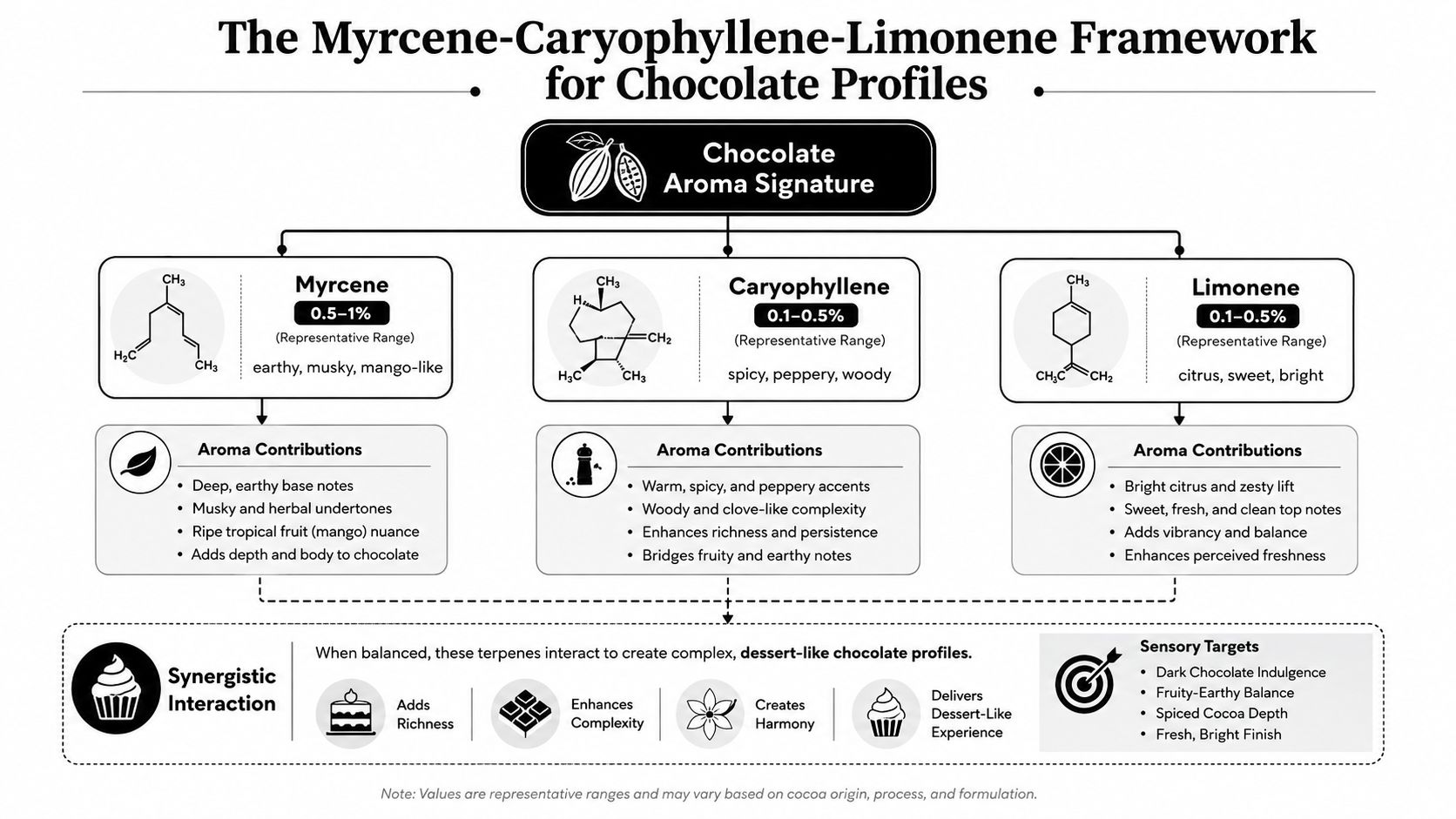
Chocolate-forward aroma usually sits on a myrcene, caryophyllene, limonene base, sometimes with pinene acting as a secondary lift. That framework matters because each terpene pushes the profile in a different direction, and small shifts change whether the result reads as cocoa, coffee, earth, or citrus-bright sweetness. One independent guide notes that high-quality flower often lands around 1.5% to 3.0% total terpene content by dry weight, with elite lots going higher (Joint Commerce).
Myrcene gives the base weight
Myrcene is the part that feels dark, musky, and grounded. In practice, it gives the blend the low-end density that consumers associate with dark chocolate, especially when the profile needs to read more roasted than candy-like. Market-reported chocolate-leaning flower often clusters around 18% to 26% THC with CBD below 1%, so the heavy sensory lift usually comes from terpene balance, not cannabinoid balance (Joint Commerce).
That's also why myrcene loss is so noticeable. If the base note falls out during processing, the oil can still smell “sweet,” but it stops reading as chocolate and starts reading as generic earth or faint herbal smoke.
Caryophyllene keeps the profile from going flat
Caryophyllene supplies the spicy, peppery, woody edge that makes the blend believable. Too little, and the profile feels sugary and thin. Too much, and the oil starts leaning into wood, clove, or dry spice instead of dessert.
Chocolate OG is a useful benchmark because a strain database reports 19.88% to 21.12% THC, 0.35% to 0.57% CBD, plus measurable CBG, CBC, CBN, and THCV (Capital Cannabis). That kind of complexity is why chocolate-forward material rarely behaves like a single-note flavor. The caryophyllene layer has to sit inside a broader cannabinoid and terpene matrix, not overpower it.
Limonene should brighten, not dominate
Limonene gives the top-note sparkle. Used carefully, it keeps the profile from collapsing into mud. Used aggressively, it pushes the blend into citrus-forward territory, and the chocolate cue gets lost.
The internal rule I use is blunt. Myrcene builds the body, caryophyllene adds structure, and limonene only earns its place if it lifts the first impression without stealing the finish. If the top note screams lemon cleaner, the formula is already off.
For a deeper look at how those two major aromatics behave in formulation, the comparison in myrcene versus limonene profiles is worth keeping nearby while you build or troubleshoot a batch.
How Extraction Methods Impact Chocolate Terpene Preservation
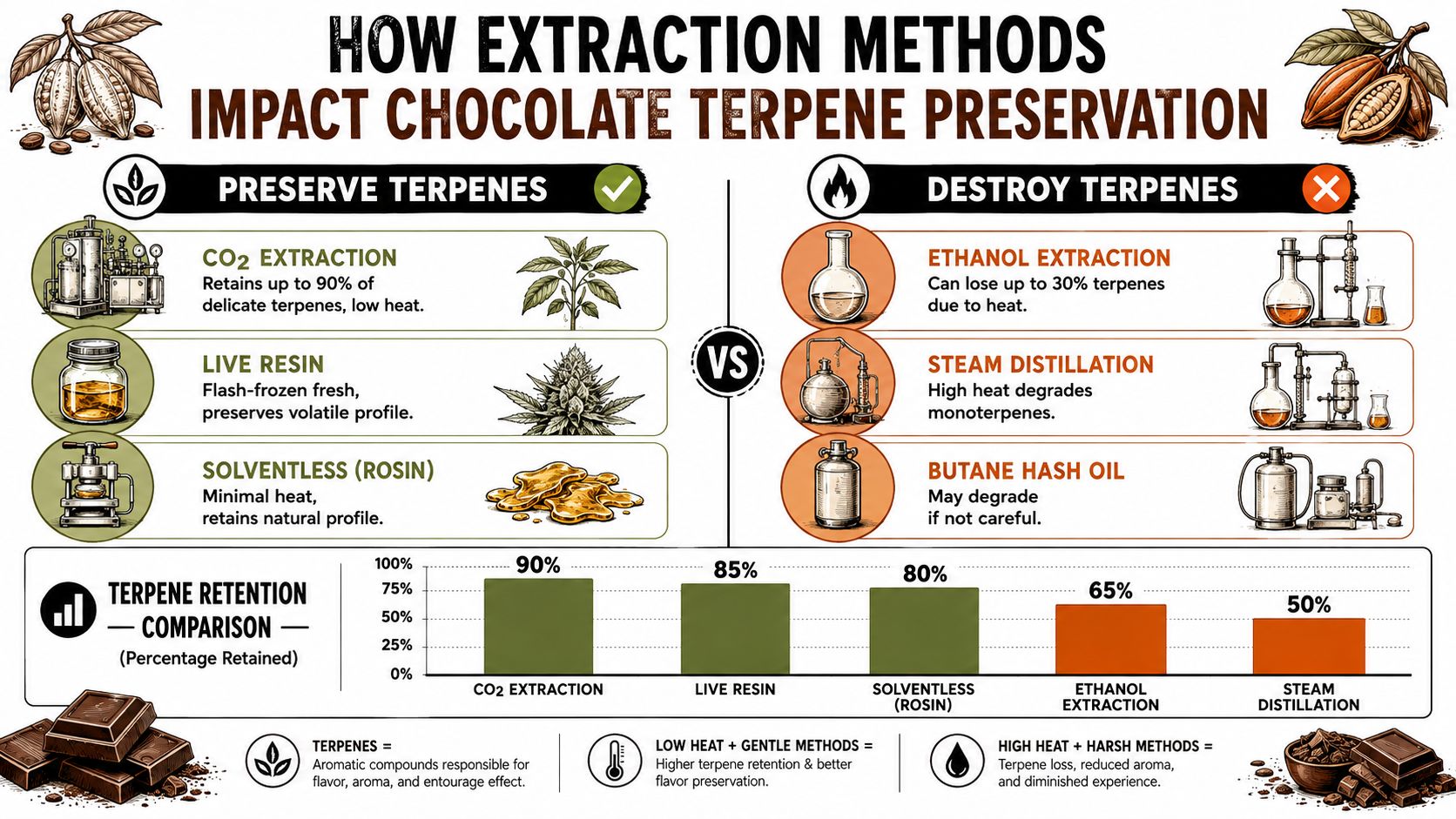
Chocolate profiles are fragile under heat, air, and time. The same material can smell rich in flower, acceptable in live resin, and disappointingly flat in distillate if the process strips too much of the volatile fraction. That's why method choice matters as much as cultivar choice.
Live resin and rosin usually keep more of the dessert note
Fresh-frozen inputs tend to preserve the parts of the profile that make chocolate strains recognizable. Live resin keeps the volatile signature closer to the original flower, and solventless rosin avoids a lot of the thermal abuse that can wash out delicate notes. In a chocolate-forward SKU, that usually means more cocoa nuance and less generic sweetness.
That's the main reason product teams reach for these formats when flavor fidelity matters. You're not just preserving potency, you're preserving the subtle balance that keeps the profile from drifting toward raw earth or flat herbal sweetness.
Distillate needs rebuilding, not wishful thinking
Distillate gives you a clean canvas, but it does not preserve the original aroma. If you start with highly refined oil, you should assume the chocolate character is gone unless you rebuild it deliberately with a terpene blend. That's where many carts fail. They're potent, but they smell like flavoring rather than a strain-inspired profile.
Ethanol-based and high-heat workflows can also remove or distort the softer notes that make a strain taste plush instead of sharp. The exact trade-offs depend on the plant material and process controls, but the pattern is consistent enough to plan around.
Process choice should follow product intent
If the SKU is meant to feel close to the flower, prioritize methods that preserve the terpene stack. If the SKU is meant to hit a specific flavor target in a stable retail product, distillate plus rebuild can work better, as long as the blend is engineered with real sensory logic.
Bottom line: live resin and rosin can carry more of the original chocolate impression, distillate usually cannot unless you put the aroma back in on purpose.
For a solvent overview that's useful when you're comparing extraction routes, the solvent extraction methods guide is a practical reference point.
Building Chocolate-Inspired Terpene Blends for Cartridges and Concentrates
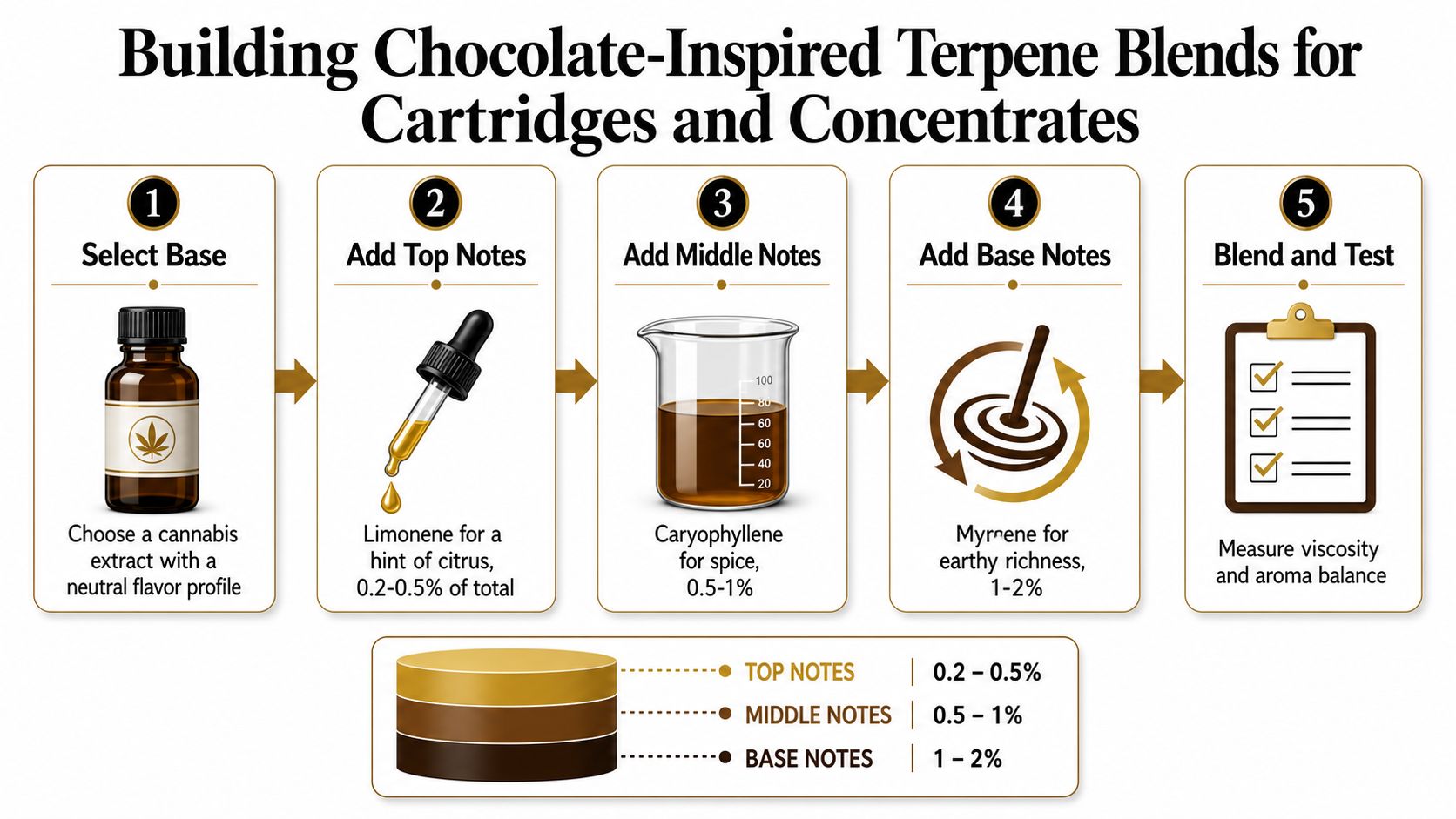
A convincing chocolate profile in vapor form usually comes from layering, not from one “chocolate” ingredient. The blend has to read correctly at the top of the inhale, hold together through the middle, and finish with enough depth that the user feels a cocoa impression instead of a candy note. The fastest way to miss is to overbuild sweetness and underbuild base weight.
Start with a neutral base
Use a neutral extract when the goal is flavor control. If the base oil already has a loud profile, the chocolate reconstruction fights the material instead of sitting on top of it. That creates instability, especially in cartridges where the first few puffs can taste one way and the last few taste completely different.
A clean base also makes QC easier. You can identify whether a problem comes from the oil, the terpene load, or the hardware.
Build top, middle, and base notes separately
For chocolate-inspired work, I treat limonene as the top note, caryophyllene as the middle structure, and myrcene as the base. Limonene should stay light, just enough to keep the nose from feeling stale. Caryophyllene carries the peppery bridge. Myrcene gives the dense, earthy finish that makes the blend feel more like cocoa powder than confectionery syrup.
If you push limonene too hard, the blend turns citrusy. If you push myrcene too hard, it goes muddy. If caryophyllene is absent, the profile has no spine.
Use dessert accents carefully
Chocolate-like impressions often benefit from minor additions that round the profile without turning it into a pastry flavor. Linalool can soften the edges and add a floral-chocolate impression. Ocimene can lift the front end and make the aroma feel less heavy. Pinene should stay restrained, because it can pull the finish toward pine and away from dessert.
The useful mindset is restraint. You're not building a bakery cart. You're building a strain-inspired profile that hints at cocoa, spice, and earth in a controlled way.
Check stability before you lock the formula
Storage changes everything. A blend that smells right on day one can drift after a few weeks if the terpene ratios are too aggressive or the carrier isn't compatible. Watch viscosity, separation, and aroma fade, then adjust one variable at a time.
Production rule: don't call a chocolate blend finished until it survives storage, fill, and heat testing without losing the base note.
If you're sourcing ready-made components, a strain profile pack or isolated compound set from Gold Coast Terpenes can serve as one formulation route alongside in-house blending, especially when you need repeatable batch behavior.
For blending mechanics and handling basics, the how to use terpenes guide is a useful companion resource.
Cultivation Data and Potency Patterns for Commercial Strain Selection
Commercial strain selection for chocolate profiles should start with yield, timing, and consistency, not nostalgia. A cultivar that smells great in a breeder photo can still be a poor sourcing choice if it finishes too slowly, yields too little, or gives you inconsistent resin across harvests.
The numbers point to a mainstream potency lane
Modern chocolate strains cluster around roughly 20% THC, which puts them in line with regulated-market premium flower rather than old-school low-potency heritage material (SeedFinder). Dark Chocolate is reported at 21.4% THC and 0.33% CBD, Chocolate OG at 19.88% to 21.12% THC, and Chocolate Haze at 17% to 22% THC (SeedFinder). Chocolate Thai sits lower at 12% to 16% THC, which makes it the historical benchmark rather than the commercial potency model (SeedFinder).
That spread matters because extraction potential and sensory intensity don't track perfectly. A more powerful flower isn't automatically a better flavor donor, and a lower-THC heritage line can still be useful if the aromatic target is authentic.
Flowering time and yield change the economics
Chocolate Haze is documented as a Chocolate Thai × Cannalope Haze cross, with flowering around 9 to 11 weeks (Strainpedia). Dark Chocolate is listed at 58 to 63 days flowering and an October harvest month, with yields of 600 to 700 g/m² indoors and 650+ g per plant outdoors (Strainpedia). One Chocolate profile is also reported at 1.5 to 2 pounds cured per plant outdoors (Strainpedia).
Those figures aren't just cultivation trivia. They shape how much usable material you can expect, how often you can turn inventory, and whether a strain is worth building a dedicated profile around.
Use the strain table as a sourcing filter
| Strain Name | THC Range | Flowering Time | Indoor Yield | Outdoor Yield |
|---|---|---|---|---|
| Dark Chocolate | 21.4% THC | 58 to 63 days | 600 to 700 g/m² | 650+ g per plant |
| Chocolate Haze | 17% to 22% THC | 9 to 11 weeks | Not specified in verified data | Not specified in verified data |
| Chocolate Thai | 12% to 16% THC | Historical landrace reference | Not specified in verified data | Not specified in verified data |
The practical read is clear. If you need reliable commercial output, prioritize lines that finish on time and resin consistently. If you need historical flavor reference, use the older line as a sensory template, not as your production benchmark.
Formulation Scenarios for Different Product Types and Target Effects
Chocolate profiles don't behave the same way across product formats. A cartridge, a concentrate, a tincture, and a topical all reward different design choices, and the same terpene balance can feel energetic in one format and heavy in another.
Cartridges need the cleanest balance
In carts, the formula has to survive heat and still taste coherent after multiple pulls. A daytime-style chocolate cart usually leans lighter on myrcene and keeps limonene high enough to brighten the inhale without turning citrusy. That same blend can still feel grounded if caryophyllene provides enough middle structure.
For evening products, I shift weight toward myrcene and let caryophyllene support the finish. The result is less airy and more grounded, which better matches the dense sensory cue many buyers expect from chocolate-named SKUs.
Concentrates can tolerate more depth
Concentrates give you more room to build a richer, darker profile. That's where the cocoa impression can be stronger, because the user expects intensity and the format can carry a heavier terpene load without tasting thin. The trick is to keep the finish clean so the blend doesn't turn resinous or stale.
Chocolate-forward concentrates also benefit from batch-specific tuning. A resin that already has a dry, earthy finish needs less myrcene than a stripped distillate base.
Minor cannabinoids change the read
Chocolate-family material isn't just about terpenes. One Chocolate OG profile includes measurable CBG, CBC, CBN, and THCV alongside its THC and CBD values (Capital Cannabis). Those minor cannabinoids don't define the flavor, but they can influence how the product is positioned and how the final experience is framed by the brand.
The inconsistency in effect reports is real. Some chocolate cultivars are described as bright and head-forward, while others are clearly indica-leaning and body-heavy. The name doesn't decide the outcome. The genotype, terpene balance, and dose do.
Troubleshoot by symptom, not by guesswork
If vapor feels harsh, the profile is usually too sharp on the top end or too unstable in the carrier. If flavor fades quickly, the base note is too weak. If separation shows up in storage, the formula needs better compatibility and a less aggressive terpene load.
Use the sensory defect as the diagnosis. Harshness, fade, and separation each point to a different formulation failure.
Evidence-Based Strain Selection Over Marketing-Driven Naming
Buying material because the name sounds appealing is how teams waste months. Chocolate is one of the easiest labels to overtrust, because it sounds specific while still covering a very wide range of genotype, terpene behavior, and finishing quality.
Treat the COA as the real sourcing document
A credible selection process starts with lab data. You want terpene density, cannabinoid spread, and batch consistency, not just a THC headline. Chocolate strains often cluster around 18% to 26% THC in market reports, with CBD usually below 1%, so a good label alone doesn't tell you whether the flavor will survive in your format (Joint Commerce).
The most useful question to ask a supplier is simple. What does the terpene panel look like across multiple lots, and how stable is it?
Test lineage, not just branding
The chocolate family includes very different inputs. Chocolate Thai, Chocolate Chunk, Chocolate Hashberry, Chocolony, True Chocolate, Chocolate Drop, and Chocolate Lava may all wear the same flavor tag, but they don't produce the same resin, the same flowering behavior, or the same finished aroma (Joint Commerce). If you're sourcing for cartridges or concentrates, that difference decides whether you rebuild the profile from scratch or preserve what's already there.
Use the lineage to predict whether the material is likely to lean more earthy, spicy, sweet, or bright. Then verify it with actual lab output and bench testing.
Pick the right formulation path
For some SKUs, flower-sourced extraction is the right answer. For others, a terpene-rebuilt approach will be more reliable and more cost-effective. The choice comes down to whether the plant material consistently gives you the sensory result you need after processing.
If you're balancing repeatability against novelty, use the strain name as a starting point, not a decision. The name can guide the first sample pull. The lab data decides whether the profile deserves a place in production.
Build around measured aroma, repeated batch performance, and the finished vapor experience. That's how chocolate SKUs stay recognizable after the plant is gone.
For a practical framework on selecting material by terpene behavior, the art of strain selection guide is the right place to compare against your own sourcing SOP.
Gold Coast Terpenes offers strain-specific terpene profiles, isolated compounds, and blending resources for carts, concentrates, and other finished products. If you're working on chocolate-forward vapor that needs more than a catchy name, visit Gold Coast Terpenes to review profile options and formulation tools that can help you build a more precise dessert note.