
Pinene shows up in about 30% of tested cannabis strains and can sit at 0.1% to 0.3% of dry weight, with some cultivars pushing higher, so it's not a niche aroma note that only appears in rare flower lots. For formulators, that matters because pinene isn't just a flavor cue, it's a recurring marker that can shape how a cartridge, distillate blend, or concentrate reads on the nose and on the palate. The mistake is starting from strain names instead of lab data, because the buyer's real question is never “Does this strain sound piney?” It's whether the batch carries enough pinene to justify the brief.
Why Pinene Terpene Strains Matter in Formulation
A strain name can hint at pine, but a lab result tells you whether the profile is worth building around. In cannabis chemotyping, pinene is common enough to matter, yet usually not dominant enough to carry a blend on its own, which is exactly why it deserves deliberate placement in formulation work. That's the commercial reality behind pinene terpene strains, they're useful when you need a recognizable pine signature without letting that note take over the whole composition.
Why formulators treat pinene as a marker, not a headline terpene
Large terpene datasets place α-pinene around 6.5% of dominant terpenoids across strains, while myrcene, β-caryophyllene, limonene, and terpinolene show up more often at the top of the profile, according to SC Labs. That pattern tells you something practical. Pinene appears often enough to be a recurring target, but not so often that you can assume it will define every batch the way myrcene often does in broader strain characterization. SC Labs terpene data supports that view, and the chemistry review at PMC shows why pinene can still be a major component in cultivated material.
Practical rule: if a buyer says they want a pine-forward product, don't ask first for a strain name. Ask for the COA, the terpene panel, and the isomer split.
That's why pinene matters in commercial development. It gives you a sensory anchor that can survive in a blend, but only if you're working from the lab result and not the marketing label. For a practical starting point on pinene behavior in product work, this alpha-pinene guide is a useful internal reference.
The Chemistry Behind Alpha and Beta Pinene
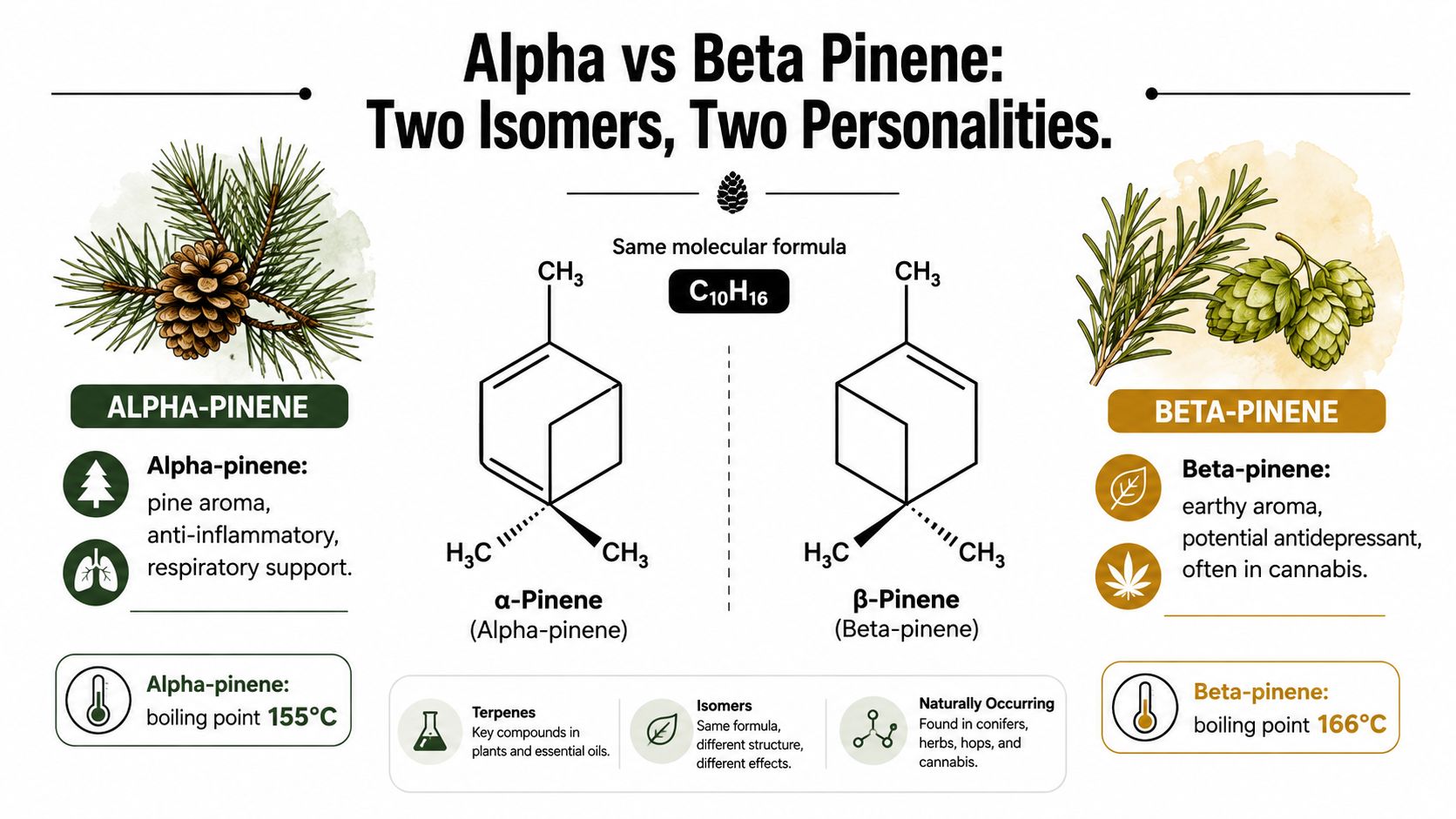
Pinene has two structural isomers that show up in cannabis work all the time, alpha-pinene and beta-pinene. They share the same molecular formula, but their ring arrangements differ, which changes how they smell, how they behave under heat, and how they read in a finished product. That difference sounds academic until you've watched a cartridge lean too sharp, or a blend lose its pine character after a rough heating profile.
What changes between alpha and beta
Alpha-pinene is usually the sharper, cleaner pine note. In a blend, it tends to present like a bright top note, the kind that hits first and defines the first impression. Beta-pinene reads a little broader and more earthy, so it can feel rounder in the middle of a profile and less needle-like at the front end.
The infographic above calls out the reported boiling points as 155°C for alpha-pinene and 166°C for beta-pinene. Those values matter because thermal behavior affects how a terpene shows up in a cartridge or infused concentrate. If the delivery system runs hot, the more volatile component tends to define the opening hit, while the less volatile isomer can help carry the pine impression a little further into the draw.
Why the ratio matters more than the name
A pine-forward formulation isn't just “more pinene.” The ratio between alpha and beta changes the impression. A batch heavy in alpha-pinene can feel bright and crisp, while a profile with more beta-pinene can feel woodier and less pointed. That's why the same strain label can produce different results across lots, and why formulators should spec the isomer balance instead of treating “pinene” as a single uniform ingredient.
The lab panel matters because pinene is a family of decisions, not one decision.
For deeper background on terpene structure and how these compounds behave in formulation, this terpene chemistry resource is worth keeping close when you're comparing raw material options.
The included video is useful for teams that prefer a visual chemistry refresher before they lock a blend brief.
Pinene-Rich Strains for Formulation Reference
A pinene-rich cultivar list is useful for formulation work, not for consumer browsing. A strain name can point you toward a starting spec, but the central question is whether the batch data matches the sensory target you need in a cartridge or concentrate. Some named cultivars do show pinene levels worth tracking, yet the spread in reported values is wide enough that each one should be treated as a reference point, not a guarantee.
Notable pinene-rich cannabis strains
| Strain | Pinene (%) | Profile Notes |
|---|---|---|
| Miracle Alien Cookies | 0.99% | High pinene expression, well above the common population norm. |
| Khalifa Kush | 0.80% | Strong pinene presence, useful when you want a pine-led profile. |
| Skunk #1 | 0.70% | Reliable reference when building classic strain-inspired blends. |
| Jack Herer | 0.25% | Pinene-forward at a modest level, useful as a benchmark rather than a high-load base. |
| Lemon Skunk | 0.28% | Documented as a named cultivar with strong pinene levels. |
| CBD Skunk Haze | 0.22% | Also cited as a cultivar with higher pinene. |
| Purple Kush | 0.18% | Included in sources as a pinene-relevant reference cultivar. |
The table makes the trade-off plain. A cultivar can be called pinene-rich and still land at a level that functions more like an accent than a base. That matters when you are drafting a brief for vape cartridges or concentrate replication, because a small measured amount may be enough to make the profile read correctly without crowding the rest of the blend.
The bigger lesson is simple. Strain names are not process controls. Grow conditions, harvest timing, and extraction choices can all shift the terpene profile, so a formulation team that buys on reputation alone ends up paying for inconsistency. For a lab-first check on terpene reporting and certificate review, the COA guide from Gold Coast Terpenes is the better reference point. It keeps the focus on verified output instead of marketing language.
When a brand asks for “something like Jack Herer,” the conversation should stay on sensory targets and COA data, not the label. That is how you avoid overbuying a profile that looks piney on paper but lands weak in finished product.
Formulating with Pinene for Cartridges and Concentrates
Pinene works best when you treat it like a top- or mid-note accent, not a full base. That's because pinene-dominant strains are rare enough that building a production line around them is inefficient, and because pinene's sensory role is directional rather than weight-bearing. In a cartridge, a little of the right pinene can change the opening impression fast. Too much can flatten the rest of the bouquet or make the profile feel narrow.
How to place it in a blend
Use pinene to sharpen a profile, then support it with other terpenes that don't fight it. Myrcene can soften the overall blend, limonene can lift the citrus-pine edge, and caryophyllene can give the mix a dry, earthy frame. That's the kind of structure that makes a strain-inspired profile feel credible instead of one-dimensional.
For a pine-forward cartridge brief, I usually start by asking three questions.
- Where does pinene sit in the first inhale? If it has to announce itself immediately, alpha-pinene usually deserves more attention.
- Does the profile need lift or roundness? Limonene can brighten, while caryophyllene can steady the base.
- What should survive heat? In cartridge and concentrate formats, the opening note is what many users notice first, so thermal behavior matters as much as raw inclusion.
Pinene also behaves differently depending on the carrier system. In distillate enrichment, the terpene load has to stay compatible with the oil phase and still read clearly after blending. In a concentrate or live-resin-style product, the same compound can present more naturally because the matrix already contains more aromatic depth. For hands-on blending reference, this alpha-pinene terpene page is a useful internal resource.
Formulation note: pinene should usually be spec'd for aroma impact first, not for sheer concentration. The balance with the rest of the blend matters more than making the number look high.
That's the core difference between a good pinene formulation and a noisy one. The best blends don't smell like added pine. They smell like a complete strain profile where the pine note sits exactly where the brief says it should.
Reading COAs to Verify Pinene Content
A strain name like Blue Dream, OG Kush, or Jack Herer can be a useful starting point, but it does not tell you what is in the batch on your bench. Terpene content shifts across cultivar, batch, and growing conditions, and the review at PMC makes that variability clear. For procurement, the COA is the document that should drive the decision, not the label on the jar.
What to look for on the lab report
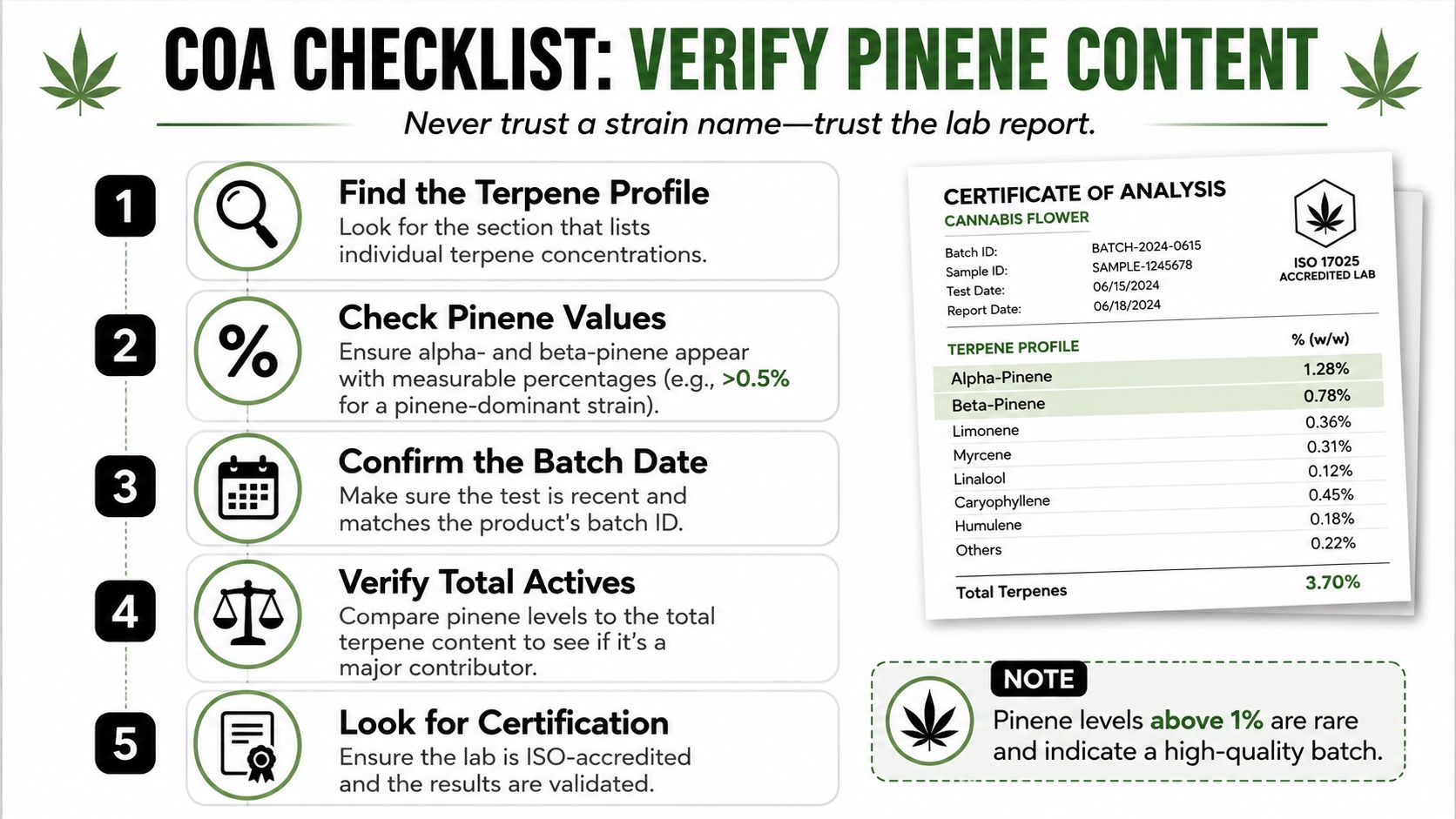
Start with the terpene panel, then check whether alpha-pinene and beta-pinene are listed separately. If the report only gives one combined figure, ask for the isomer breakdown before you write the blend spec. The two compounds do different work in aroma and thermal behavior, so a single pinene number can hide the shape of the profile.
The checklist graphic above matches the way I read a COA in practice.
- Find the terpene profile. Do not scan the cannabinoid totals and assume the aroma picture follows.
- Check pinene values. Look for measurable alpha- and beta-pinene rather than a vague label.
- Confirm the batch date. The report has to match the product you are buying.
- Compare pinene to total terpenes. A terpene can be present without being useful for formulation.
- Verify the lab credentials. A report only helps if the testing is trustworthy.
If you want a clean reference for what a COA should show, the certificate of analysis guide is a useful internal resource to keep on hand during sourcing.
How to set a useful threshold
The market uses “high pinene” loosely, but formulation needs a threshold that fits the product. One industry dataset describes pinene as significant in about 30% of tested strains and typically around 0.1% to 0.3% of dry weight, with exceptional cultivars reaching roughly 0.5% or higher. That gives you a practical frame for procurement. If a batch falls far below the target, it may still smell piney in the jar, but it will not behave like a pinene-forward raw material in production.
Buy to spec, not to strain reputation. If the COA does not show the terpene split you need, it does not belong in a formulation brief that depends on it.
Regulatory and Safety Checklist for Pinene Products
Pinene creates fewer compliance headaches than many additives, but it still needs disciplined handling because it's volatile, aromatic, and easy to mis-specify on labels. The compliance job isn't to make claims about what pinene does. It's to document what went into the product, how it was tested, and how it will hold up in storage and distribution.
A practical checklist for production teams
- Verify the COA before blending. Pinene content should be confirmed on the incoming raw material, not assumed from the SKU name.
- Keep the terpene record tied to the batch. If the batch ID changes, the documentation should change with it.
- Screen for contaminants. The terpene profile is only one part of the release decision.
- Confirm solvent compatibility. Pinene should be incorporated only into systems that can hold the blend without separation or unwanted haze.
- Store it cool and sealed. Volatile terpenes lose fidelity fast if the package handling is sloppy.
- Avoid health claims on labels. Communicate aroma and formulation attributes, not medical outcomes.
A clean internal file matters just as much as the label. If the product is later audited, the team should be able to trace the terpene source, the assay, the batch record, and the final label copy without reconstructing the story from memory. That's especially important in terpene-enriched vape and concentrate products where the aroma profile is part of the product identity.
The legal side is straightforward, even if the paperwork isn't. Make sure your representation of pinene is truthful, specific, and consistent with the lab data. If a product is sold as pinene-forward, the documentation has to support that claim from raw material through finished good.
Pinene Blending Strategies and Use Cases
Pinene earns its place in a blend when the brand wants a clean pine impression without a heavy, resinous wall of aroma. In cartridge work, I've seen it function well as the first recognizable note in a strain-inspired profile, then hand off to other terpenes that carry the mid-body and drydown. In concentrates, it can reinforce a familiar cultivar profile without forcing the whole jar to smell like solvent-clean pine.
Where it fits by product type
For vape cartridges, pinene usually needs a tight structure around it. A pine note on its own can feel thin, but pinene paired with limonene and caryophyllene often reads more complete. That gives the blend a brighter opening, a stable middle, and an earthy finish that feels closer to a real cultivar profile.
For distillate, pinene is often used as a correction tool. If the oil tastes flat or muted, a small, well-balanced dose can lift the profile and make it feel more strain-specific. The key is restraint, because adding too much can make the formulation read like an aromatics demo instead of a finished product.
For concentrated flavor profiles, pinene works as a directional note that helps anchor the profile to a familiar strain family. It can support pine, spice, and resin cues without dominating the whole composition, which is useful when the goal is faithful replication rather than a loud singular aroma.
Gold Coast Terpenes supplies strain-specific terpene blends and isolated compounds that can be used for this kind of work, including named profile components for cartridge and concentrate development. That makes it one practical sourcing option among several when a formulation team needs a repeatable pine-forward starting point.
The decision framework is simple. If the product needs brightness, prioritize alpha-pinene. If it needs a rounder pine body, beta-pinene deserves a stronger role. If it needs a credible strain recreation, pinene should be balanced against the rest of the terpene system instead of being treated as the whole story.
Conclusion Building Pinene-Forward Product Lines
Pinene only looks simple from a distance. In practice, it's a formulation-critical terpene that needs the same discipline as any other major component in a cartridge or concentrate brief. The work is reading the COA, separating alpha from beta, and using the strain name only as a starting clue, not a purchasing decision. Precise pinene placement is what turns a pine-inspired idea into a reproducible product line.
Gold Coast Terpenes supplies terpene blends, isolated compounds, and strain-specific profiles for cartridge and concentrate formulation. If you're building around pinene, their lab-verified terpene options can help you compare profiles, tighten sensory targets, and keep batches consistent. Visit Gold Coast Terpenes to review formulation tools and sourcing options for your next pinene-forward product.