
You've got the right flavor target on the bench, but the cart still doesn't read like Apple Fritter. The distillate is clean, the label is on-brand, and the first sensory panel still says the same thing, close, but not quite there. That gap usually isn't a branding problem. It's a terpene architecture problem, and Apple Fritter is one of the clearest examples of why effect and aroma have to be rebuilt together, not handled as separate checkboxes.
For a formulation team, apple fritter strain effects are useful because they reveal what the profile must do in a cartridge, not just how it should smell. The strain is consistently described as a high-THC hybrid, with typical potency in the 22 to 28 percent THC range and some phenotypes reaching up to 32 percent THC in independent strain references (Leafly's Apple Fritter profile). That potency only tells part of the story. The balance between euphoria and body calm is what makes the profile commercially recognizable, and that balance has to survive the move from flower into oil.
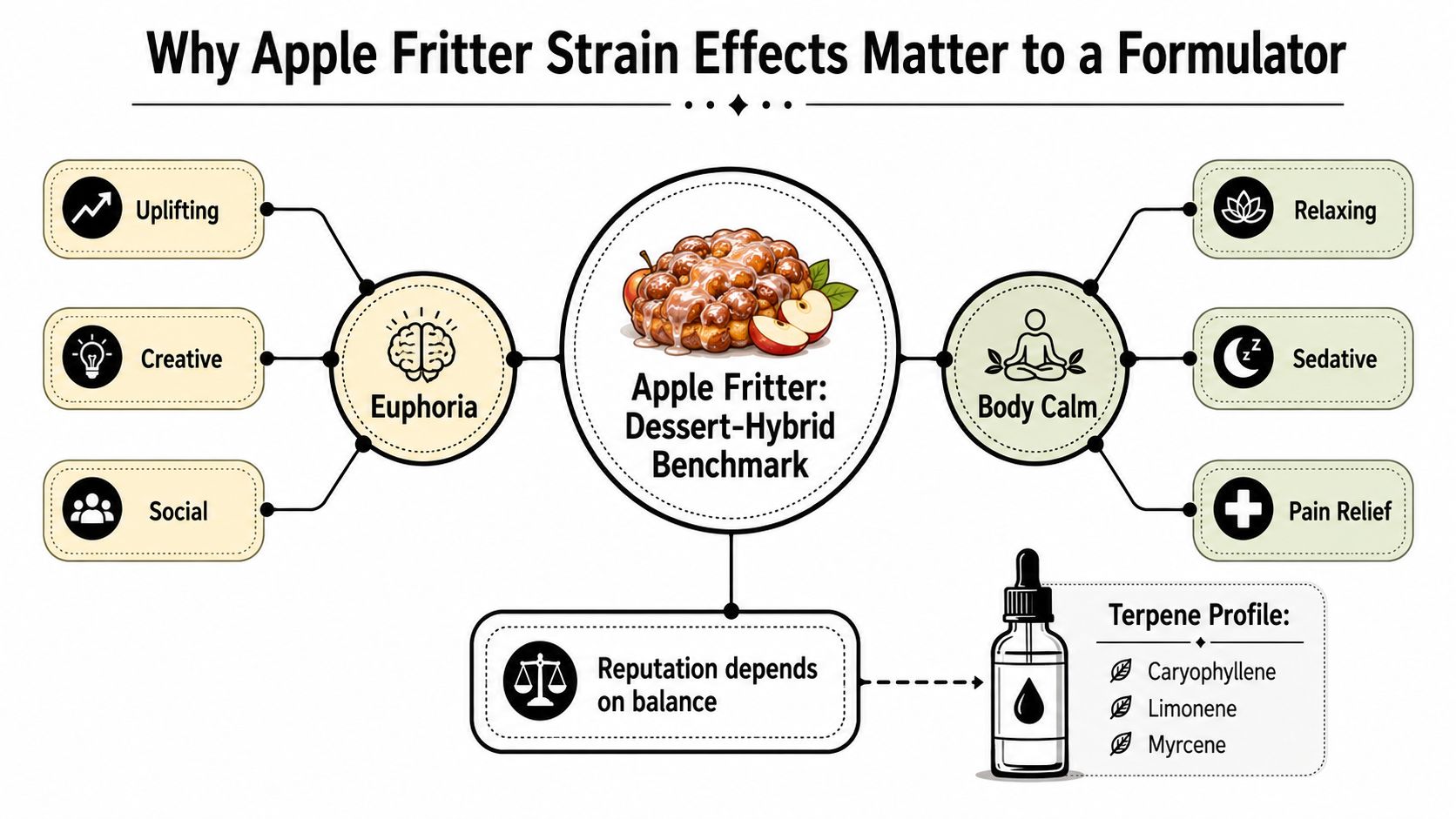
A cart that only copies the dessert note usually lands as generic sweet apple. A cart that rebuilds the effect architecture reads as Apple Fritter.
The practical reason this matters is simple. A strain-inspired blend that chases pastry sweetness but misses the caryophyllene, myrcene, and limonene relationship will drift into another cultivar entirely. That's why a working brief for an Apple Fritter-inspired SKU should start with effect balance, then move into top, mid, and base note selection, dosing, and hardware behavior. For a broader strain architecture reference, keep a strain terpene profile guide open, like this terpene profile resource, before you start loading oil.
Why Apple Fritter Strain Effects Matter to a Formulator
A first prototype often fails in the same way. The team gets the baked-apple note right, the panel likes the sweetness, and the cart still feels thin because it never delivers the calm, lifted body character buyers associate with Apple Fritter. Flavor cannot sit on top of the experience as decoration. It has to support the way the effect is perceived.
Apple Fritter matters to a formulator because the profile is commercially useful without being one-dimensional. User-reported data on Leafly's Apple Fritter profile describes the strain as relaxed, happy, and euphoric, and it also points to anxiety, stress, and depression relief reports that help explain why the strain keeps showing up as a balanced evening option rather than a heavy sleeper. That combination gives you a clear target. If the cart loses the lift, or the body ease, it stops reading like Apple Fritter.
Balance is the product, not the side effect
That balance is what has to survive the move into oil. A blend that puts too much weight on myrcene can slide into couch-lock and make the dessert side feel muted. A blend that pushes limonene too hard can feel bright but ungrounded, which is how a product ends up as apple candy instead of Apple Fritter.
The commercial risk is straightforward. Consumers do not separate aroma from effect very cleanly, and a cart that smells right but hits wrong usually loses repeat purchase. A cart that holds the body calm plus uplift pattern keeps a sharper identity in the dessert tier, where many SKUs sound similar before the first pull.
For a practical formulation brief, the target is not just a popular strain name. The target is the same calm, euphoric, slightly evening-leaning behavior in oil that the flower is known for, with enough structure that the profile still feels complete after extraction and dilution. A strain terpene profile reference helps frame that work before oil loading begins.
The Terpene Profile Driving the Effects
Apple Fritter's effect signature traces back to a caryophyllene–myrcene–limonene stack, with humulene acting as a quieter support note. One dispensary report measured 1.39 percent total terpenes, with beta-caryophyllene at 0.62 percent, limonene at 0.30 percent, and alpha-humulene at 0.17 percent (NuggMD's Apple Fritter terpene profile). That kind of distribution tells you more than the name of the strain ever will.
What each compound is doing
Beta-caryophyllene gives the blend its grounded, peppery center. In a cartridge, it helps the profile feel anchored instead of thin. Myrcene pushes the effect toward relaxation and a slower landing, which is why Apple Fritter usually reads as a later-day cultivar. Limonene keeps the blend from collapsing into sedation, adding lift and keeping the top of the profile lively. Humulene doesn't dominate the experience, but it supports the baked, earthy middle that makes the profile feel complete.
Practical rule: ratio matters more than presence. You can add every “correct” terpene and still miss Apple Fritter if the proportions lean too far toward one axis.
| Terpene | Reported share | Functional role | Layer |
|---|---|---|---|
| Beta-caryophyllene | 0.62 percent | Grounded body feel, spice, structure | Mid |
| Limonene | 0.30 percent | Mood lift, brightness, top-note clarity | Top |
| Alpha-humulene | 0.17 percent | Quiet woody support, baked-goods depth | Mid |
| Myrcene | Not quantified in the cited report | Relaxation pull, smoother finish | Base |
A blend heavy on myrcene may still taste pleasant, but it won't behave like Apple Fritter. A blend that keeps caryophyllene forward, limonene present, and humulene in support is much closer to the commercial reference point. That ratio-driven thinking is what lets a distillate cart keep the strain's identity after the original flower chemistry is gone.
For a matching formulation workflow, keep your blend reference aligned with a strain-to-flavor guide so the sensory target stays tied to the chemistry, not to generic dessert language.
Building Top, Mid, and Base Notes
Apple Fritter needs a three-layer build, not a single sweet note stretched across the whole cart. The top should open like fruit and pastry, the mid should carry warm baked depth, and the base should round into calm without turning muddy. That's the difference between a cart that tastes like Apple Fritter and one that only reminds people of apple candy.
Start with the top note
Limonene belongs at the front of the blend because it keeps the opening bright and readable. For Apple Fritter-inspired work, the top note should stay crisp and restrained, not loud enough to dominate the baked center. In practice, a top layer built around limonene-forward citrus-fruit accents works best when it supports, rather than replaces, the dessert core.
Let the mid layer carry the strain identity
The middle is where the strain's character is won or lost. Beta-caryophyllene and humulene should shape the warm, doughy center, because that's where the Apple Fritter profile stops sounding generic. If the mid layer gets thin, the cart becomes a fruit profile with no pastry body.
Use the base to slow the finish
Myrcene belongs at the base because it rounds the exit and softens the experience. A touch of linalool can help the finish feel smoother, but it should stay supportive, not floral enough to turn the profile into lavender pastry. The base should make the inhale feel fuller and the aftertaste linger, without flattening the bright top note.
The best Apple Fritter blends don't force sweetness. They let the baked center appear before the calm finish settles in.
A formulator who starts with this architecture is already ahead of most market copies. The point is not to stack as many dessert cues as possible. The point is to preserve the transition from fruit to dough to calm, because that transition is what gives Apple Fritter its recognizable shape.
For texture and note-balancing support, a terpene flavor chart is worth keeping beside the batch sheet while you dial the layers.
Onset, Peak, and the Dose-Response Curve
Apple Fritter is one of those profiles where the experience changes fast enough to punish loose dosing. Reported inhaled onset is 2 to 5 minutes, the peak arrives around 30 to 45 minutes, and the plateau lasts roughly 90 to 120 minutes, while some retail guides extend inhaled duration estimates to 2 to 4 hours (Joint Commerce's Apple Fritter guide). For a vape formulator, those numbers matter because the consumer can over-pull before the blend has fully expressed itself.
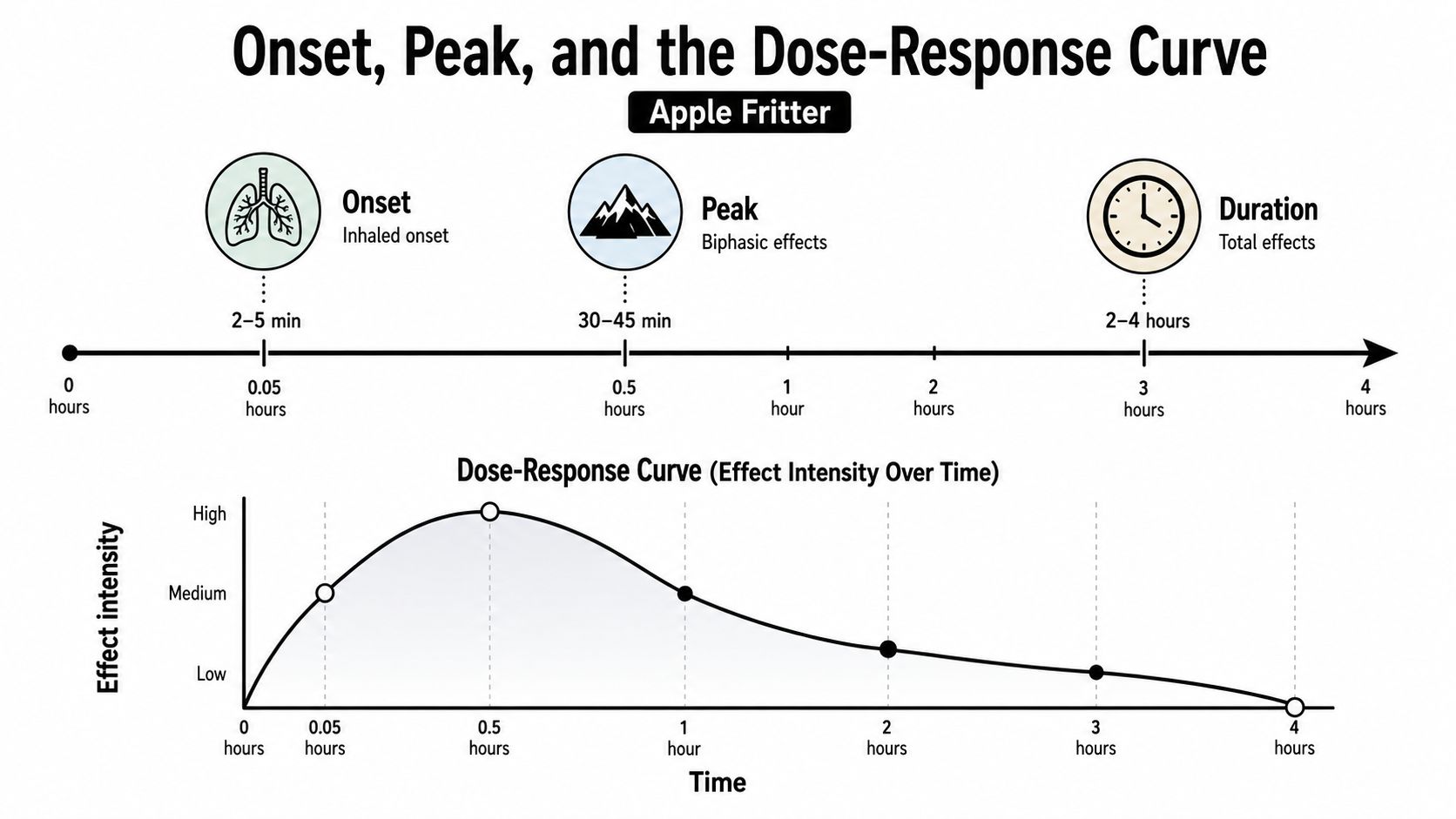
The curve changes with serving size
Smaller servings can feel social, creative, and mood-lifting. Larger servings, or late redosing, can push the same blend toward drowsiness, dizziness, or anxiety. That's not a flaw in the strain. It's a biphasic dose-response that becomes more obvious when the oil is potent and the onset is fast.
Commercially, that matters because Apple Fritter also sits in a high-THC band that commonly lands in the low to high 20s. AllBud cites a 22 to 28 percent average THC level, and another report says it regularly tests above 24 percent THC (AllBud's Apple Fritter listing). In a fast-onset cartridge, that kind of potency can turn a moderate pull into a heavier session before the user has time to calibrate.
The takeaway for formulation is straightforward. Build for the mid-range serving, not the maximum pull. If the cart only behaves well when users take tiny, cautious draws, the profile may be technically accurate but commercially fragile. A good Apple Fritter cart stays readable when the consumer takes a normal puff and still lands on the balance point the strain is known for.
Loading the Blend into Distillate and Cartridges
A clean Apple Fritter-inspired formula starts with the oil base, not the top note. Winterized distillate should be your blank canvas, then the terpene blend should be loaded in a way that preserves brightness and avoids smearing the mid layer. If you dump everything in at once, the blend often turns muddy before the panel even gets to hardware testing.
Build in the right order
Start with the base-support compounds, then move into the structural mid, and finish with the top. That usually means adding the calmer, heavier notes first, followed by caryophyllene and humulene, then limonene and any brighter accent last. This keeps the fruit and pastry cues from getting buried while the blend is still warm and mixing.
Hardware choice matters too. Ceramic coils tend to reveal more of the layered profile, especially the middle and base. Wick-based hardware can pull more aggressively at the top note, which sometimes makes the cart taste brighter but less complete. If the hardware is sensitive, a blend that seems balanced in a test vial can read differently in the finished device.
Avoid the common failure points
- Do not overbuild myrcene if the goal is Apple Fritter, because the cart can slide into heavy sedation and lose its bakery lift.
- Do not underdose humulene, because the mid note collapses and the profile becomes thin.
- Do not chase candy sweetness with extra fruit isolates until the cart tastes like a different cultivar.
- Do not ignore the coil behavior, because the same formula can read top-heavy in one device and muddy in another.
A practical loading band for terpene-forward cart work is to start conservatively, then adjust by sensory panel and viscosity. The right load is the one that keeps the profile expressive without stressing the hardware or flattening the oil. If the first prototype tastes right but burns harshly, the blend is too aggressive for the system you've chosen.
How Apple Fritter Compares to Similar Dessert Hybrids
A buyer asking for Apple Fritter usually wants dessert character with restraint. The strain sits in the same sweet-hybrid family as Wedding Cake and Gelato, but the effect read is different enough to matter in formulation work.
Where the profile sits on the spectrum
Apple Fritter lands between pastry weight and fruit lift. Compared with Wedding Cake, it feels less creamy and more fruit-driven. Compared with Runtz, it comes across as less candy-bright and more grounded, with a firmer baked note underneath.
That balance is what makes it useful. Caryophyllene carries the body, limonene keeps the profile from feeling dull, and myrcene determines how far the blend tips into evening use. The result is a hybrid that can feel upbeat without getting sharp, and relaxing without losing shape.
A comparison chart of Apple Fritter, Wedding Cake, and Gelato shows the same general pattern, with Apple Fritter sitting closer to a dessert hybrid that still has structure, while the other two skew toward either creamier sweetness or a cleaner, more polished finish (A comparison chart showing the flavor profile, terpene signature, and primary effects of Apple Fritter, Wedding Cake, and Gelato cannabis strains.). In practical terms, that makes it a better fit for a SKU that needs dessert appeal without drifting into pure candy or full sedation.
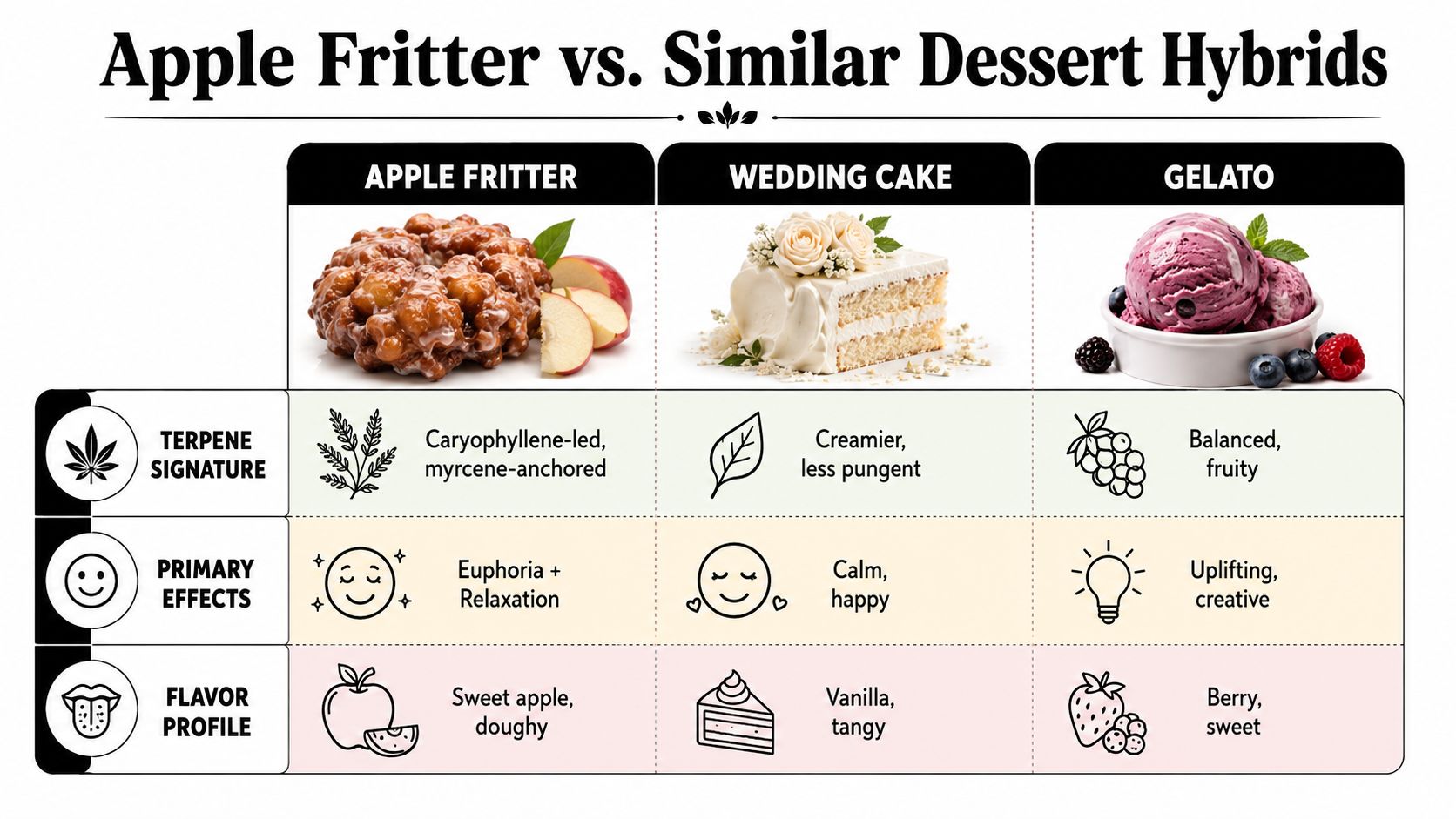
Use Apple Fritter when the brief calls for a pastry-forward cart with real body and a controlled finish. If the target is brighter fruit candy, another cultivar will fit better. If the goal is a balanced evening hybrid with a defined terpene structure and a baked finish, Apple Fritter is the cleaner choice. For buyers who want the paperwork to match the sensory target, a safety documentation guide should sit in the compliance packet before the first wholesale review.
Lab Testing and Safety Documentation Checklist
Wholesale buyers don't just want a cart that tastes right. They want a paper trail that proves the blend is consistent, the hardware is safe, and the final oil matches the target profile batch after batch. That means the Apple Fritter-inspired SKU should carry a full documentation set, not a marketing story.
What needs to be on file
The core file should include SC Lab-verified terpene certificates for each batch, a full cannabinoid profile, and screening for pesticides, heavy metals, and microbial contamination. It should also include a batch ID, expiry date, safety data sheets, and a compliance certificate. If the formula uses multiple isolates, the flavor-loading sheet should record the exact percentage of each isolate in the final blend.
The guardrails matter just as much as the paperwork. Keep the blend free of VG, PG, PEG, and MCT diluents, and verify that the total terpene load stays within hardware tolerance. A cart that pushes too hard on terpene content may look good on paper and still fail in use. A blend that matches the published caryophyllene, myrcene, and limonene relationship within an agreed tolerance band is much more likely to survive sensory review and commercial rollout.
For a buyer-facing compliance packet, a safety documentation guide should sit alongside the COA before the first wholesale conversation.
- Confirm terpene COAs: Keep batch-specific terpene certificates attached to the final formula.
- Verify screening panels: Document pesticide, heavy metal, and microbial results for the oil and hardware path.
- Track formula percentages: Record every isolate or blend component in the loading sheet.
- Match the target profile: Check the caryophyllene, myrcene, and limonene relationship against the approved reference.
- Protect the hardware: Stay inside the tolerance range for the coil or wick system you're using.
If you're building an Apple Fritter cart line, use a terpene partner that can supply strain-specific blends, isolates, and formulation support built for distillate work. Gold Coast Terpenes is a practical place to start, especially when you need the profile to taste true and the documentation to stand up in wholesale review. Visit Gold Coast Terpenes to review strain-specific terpene options, formulation resources, and the support needed to turn an Apple Fritter concept into a cartridge that performs.