
A natural flavoring is a flavor whose components come from listed natural sources such as spices, fruits, herbs, or fermentation products, and whose main job is flavoring. If that tells you where a flavor starts, what tells you whether it belongs in your formula?
For manufacturers, the answer is traceability and a clear specification. A label term alone won't tell your team how a blend was processed, what's in it, or whether it will match your target aroma in the finished base.
What Natural Flavorings Mean in Plain Terms
A natural flavoring supplies taste or aroma from an allowed natural source rather than serving mainly as a nutrient. Think about grating lemon zest into a kitchen mixture. You're drawing aroma from a recognizable plant material.
Now compare that with a chemist building a lemon scent from individual compounds. The smell alone won't tell you whether those compounds came from botanical extraction or chemical synthesis. The source records matter as much as the sensory result.
A legal category, not a processing promise
The U.S. natural-flavor definition has its modern foundation in a federal rule published September 10, 1976, and the human-food framework is 21 CFR 101.22; the eCFR's parallel animal-food flavor-labeling provision also describes the broad source-and-function approach. Human-food manufacturers should verify their label against the human-food provision, not substitute the animal-food provision for it.
Allowed forms include an essential oil, oleoresin, essence, extractive, protein hydrolysate, or distillate. Products of roasting, heating, or enzymolysis can also qualify. Enzymolysis means using enzymes to break material down.
The natural sources extend beyond fruit and herbs. They include spices, fruit juices, vegetables, edible yeast, bark, buds, roots, leaves, and fermentation products. Animal-derived materials, including meat, seafood, poultry, eggs, and dairy, also fall within the broader category.
The source map helps separate familiar ingredients from the technical forms a manufacturer might purchase.
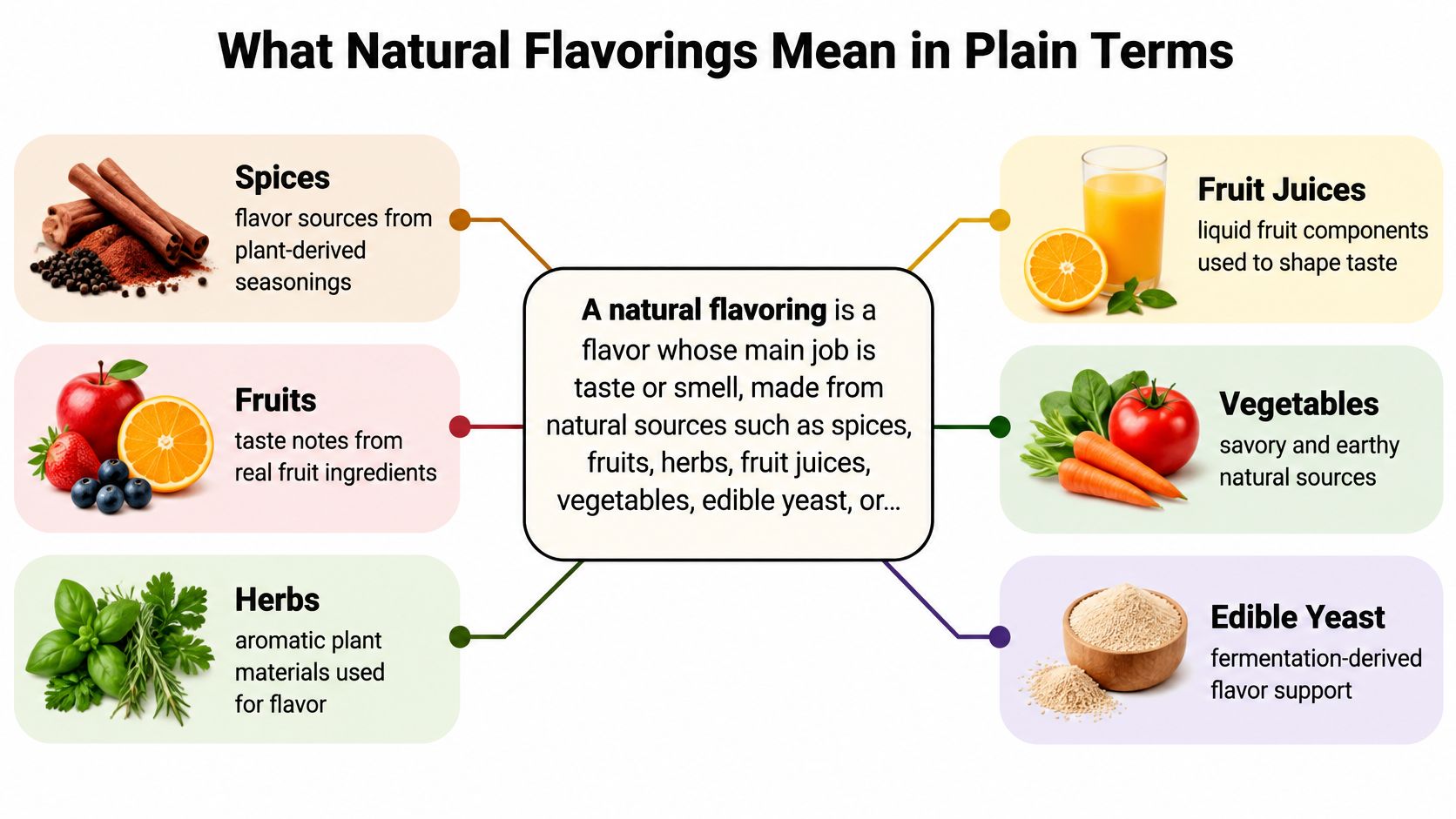
Turn the definition into a purchasing check
Say you're buying a citrus flavor for an oil-based formula. A whole peel extract and a carefully assembled blend of naturally sourced aroma compounds may both be candidates. They aren't interchangeable just because their descriptions sound similar.
Natural doesn't mean raw, unprocessed, organic, or chemically simple. Nor does a fruit-like aroma prove that every component came from that fruit.
Before approving a material, ask:
- Origin: Which botanical or other permitted material supplied the flavor components?
- Processing: Were they extracted, distilled, heated, or enzyme-treated?
- Evidence: Which origin records, specifications, and lot documents support the description?
Those questions turn a broad label category into something purchasing and quality teams can evaluate.
Natural vs Artificial Flavorings and Common Mix-Ups
Two flavorings can smell nearly identical in the bottle and still belong to different regulatory categories. The difference sits in where the molecules came from and how they were made, and that difference is what your paperwork has to prove.
Natural and artificial flavorings compared
| Factor | Natural flavorings | Artificial flavorings |
|---|---|---|
| Source | Spices, fruits, herbs, fruit juices, vegetables, edible yeast, or fermentation products | Chemical synthesis, not derived from listed natural materials |
| Processing | Extraction, distillation, heat, or enzyme treatment | Chemical manufacture and purification |
| U.S. label term | Natural flavor, when source and function rules are met | Artificial flavor |
| Batch consistency | Crop, season, and harvest can affect composition; test each lot | Usually more uniform from batch to batch |
| What the paperwork must trace | Which botanical material supplied the flavor and how each harvest lot was handled | Which synthesis route produced the material and how purity was controlled |
These categories describe source and processing. Both require assessment of identity, consistency, and performance. Treat the labels like two shipping routes to the same warehouse. One route crosses farmland, the other crosses a factory floor, yet the receiving team still inspects every box either way.
Natural materials may require blending and standardization to meet a target. A synthetic material still needs a defined specification and a suitable intended use. Neither purchasing route removes the need for incoming quality checks.
Correct the assumption and change the test
Natural means safer is the first mix-up. FDA applies the same safety standard regardless of natural or synthetic origin, as the Miami Herald's overview of natural-flavor labeling explains. Replace the assumption with questions about composition, concentration, and application.
The USDA technical review of nonsynthetic flavors explains that GRAS status is tied to use conditions, and a new use or different concentration can require reevaluation. A familiar ingredient name works like a driver's license, not a blank check. It permits a defined activity under defined conditions, and a familiar ingredient name isn't permission to use any amount in any product.
Same name means same taste is another trap. Two strawberry flavor systems can share a major aroma compound yet differ in supporting compounds, the way two choirs singing the same note can still sound different because of the voices behind it. Request lot data and compare them in your actual base, not only from the bottle.
More terpene means more flavor also fails as a formulation rule. An excessive addition can overwhelm the base or create an unbalanced finish. Use a written target, a small trial, and a controlled dose ladder rather than making a large correction early.
Buying rule: Choose the flavor type that fits your label claim, sensory target, and supporting documents.
Clear wording matters outside the lab, too. A multinational study of perceived food naturalness found that people judge the whole product and its ingredient cues, not just a natural-flavor statement. Describe the source and sensory character plainly without implying health benefits.
How Terpenes Build a Natural Flavor Profile
Think of a terpene blend like a perfume. The first fresh impression is the top note. The middle gives the aroma its body, while the base adds a longer-lasting impression.
These are useful sensory descriptions, not fixed rules for every formula. Temperature, concentration, and the surrounding ingredients can change how a compound presents.
Terpenes are aromatic compounds found in plants, fruits, and spices. Our terpenes are botanically derived. For a formulator, the useful question is how each component contributes to the intended flavor rather than whether one compound smells pleasant on its own.
Common terpenes and the aromas they add
| Terpene | Typical aroma | Typical role in a blend |
|---|---|---|
| Limonene | Bright, fresh citrus peel | Top note for lift |
| Terpinolene | Fresh, piney, slightly floral | Top note for brightness |
| Linalool | Floral, lavender-like | Middle note for body |
| Myrcene | Earthy, herbal, ripe fruit | Middle or base note |
| Beta-Caryophyllene | Peppery, warm, woody spice | Base note for depth |
| Valencene | Sweet, woody citrus | Base note for sweet citrus |
Build a relationship between notes
Suppose a development team wants a bright citrus profile with a soft floral center and warm depth. Limonene might establish the citrus direction, linalool could soften the middle, and beta-caryophyllene could supply a restrained spicy base.
That's a starting hypothesis, not a finished recipe. Too much floral character may move the result away from the target. Too much spice may cover the fresh peel impression.
A single terpene rarely reproduces a complete fruit or dessert flavor. In a simple hypothetical trial, two to four terpenes can help a team explore the balance before adding more complexity. Some flavor targets also need non-terpene aroma components, so don't assume that a terpene-only blend can reproduce every reference.
Match the profile to the material
The same blend can read differently in a cream base and a clear oil. Don't approve a profile solely because it smells right on a testing strip.
- Keep a reference: Use the same approved aroma sample throughout development.
- Separate descriptors: Record citrus, floral, herbal, and spice impressions independently.
- Test the shipping base: Include the ingredients and relevant processing conditions.
- Control complexity: Add a component only when it fills a defined sensory gap.
A useful blend specification describes both composition and sensory intent. The analytical profile helps confirm what was supplied; the application test establishes whether it does the job.
How to Match a Flavor Profile in Your Formula
Start with an approved application and supplier-supported use conditions. The percentages below are hypothetical formulation examples, not recommended use limits, and they aren't inhalation-safety guidance.
Use the process map to keep development focused on the target rather than on adding more ingredients.
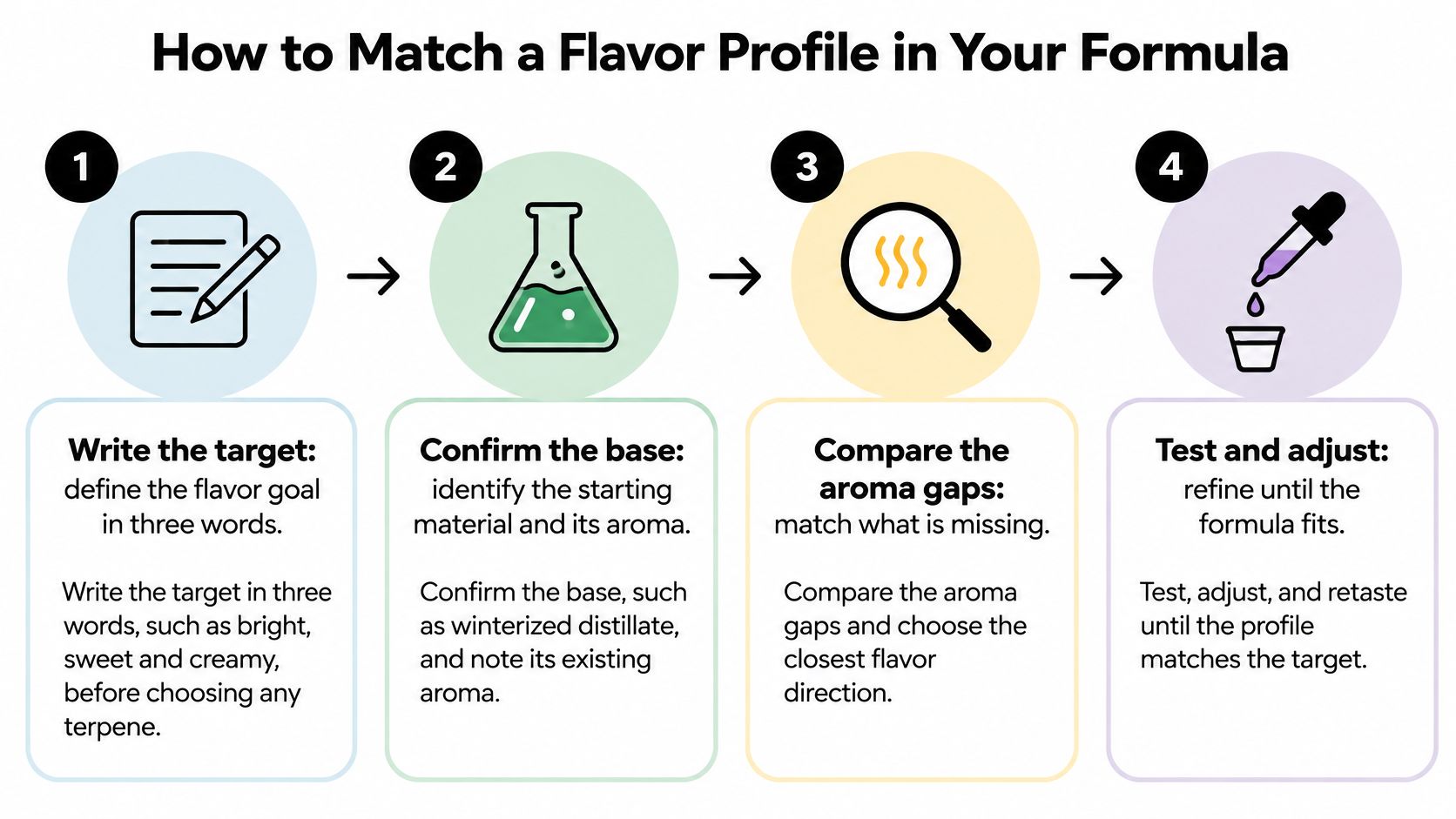
Run a controlled matching routine
Write the target in three words. For example, choose bright, sweet, and creamy before selecting ingredients. Starting with a favorite isolate instead can pull the formula away from the intended result.
Confirm the base and its existing aroma. Record the starting character of the approved base, such as winterized distillate, before adding a blend. Ignoring that starting aroma can lead the team to correct the wrong problem.
Choose a small group of components. In a hypothetical two-to-four-component trial, assign a top note, middle support, and base depth. Adding several overlapping notes at once makes it harder to identify which change helped.
Build a dose ladder within approved limits. If the application assessment permits it, a hypothetical trial might compare 0.5%, 1%, and 2% by finished weight. Don't treat these example levels as suitable for every ingredient or route of exposure.
Mix uniformly, rest, and reassess. Use a covered, compatible vessel and a documented mixing process; add volatile top notes late if the validated process allows. Evaluating before the blend is uniform can produce a misleading result.
Log the complete formula. Record component weights, supplier lots, mixing conditions, rest conditions, and observations. Skipping the log turns a good match into a result that another operator can't reliably repeat.
Make the batch math explicit
For a hypothetical 500 g finished batch at 1% total blend, use 5 g of blend and 495 g of base. An illustrative blend could contain 2 g limonene, 2 g linalool, and 1 g beta-caryophyllene.
For hypothetical 50 g finished samples, 0.5% means 0.25 g blend with 49.75 g base, while 2% means 1 g blend with 49 g base. Define percentages against finished weight so operators don't confuse adding to a base with making up a final batch.
Approve a match only after it meets the target following the defined rest period and repeats in a separate trial.
For food projects, the guide to terpenes in food provides additional application context. Keep food sensory testing separate from non-food evaluation.
The accompanying video offers a visual reference alongside the written batch procedure.
Choosing a Terpene Supplier
Can the supplier name the botanical origin? Can they document the processing method? Can they provide a lot-specific certificate of analysis?
Those questions should come before a price comparison. A sample that smells promising isn't enough if your team can't connect it to a defined, repeatable material.
Compare the paperwork with the sample
Request a specification sheet that identifies the terpene components and their stated proportions or acceptance ranges. It should also disclose carriers and diluents and identify the base types for which the supplier has application information.
A certificate of analysis and a specification serve different purposes. The specification defines what you agreed to buy. The certificate reports the relevant results for the lot you received.
- Identity: Confirm the botanical-origin description and component names.
- Consistency: Ask which analytical tests and acceptance limits control lot release.
- Application fit: Request information relevant to your actual base and manufacturing process.
- Change control: Establish how source, composition, or process changes will be communicated.
For a practical purchasing framework, use the guide to where to buy terpenes to organize your comparison.
Use the same test for each candidate
Send competing suppliers the same target notes and base description. Compare coded samples using identical blend additions, mixing conditions, and rest periods. Keep the unflavored base as a reference.
Score the specific attributes you need, such as citrus lift, floral body, or spice intensity. Don't let a stronger sample win merely because it is easier to notice.
Ask about minimum order quantities, lead times, bulk pricing, and whether custom development is available. These are purchasing questions, not substitutes for technical approval.
Supplier decision: Prefer the material your quality team can identify, qualify, and reorder over a cheaper sample with incomplete records.
Keep an organized supplier file linking approved specifications, lot certificates, and trial results. When purchasing asks whether an alternative is equivalent, that file gives formulation and quality teams a concrete basis for answering.
Labeling and Compliance Checks Before Launch
Treat label approval as a controlled release step, not a final proofreading task. The formula, supplier documents, and finished-product wording must describe the same material.
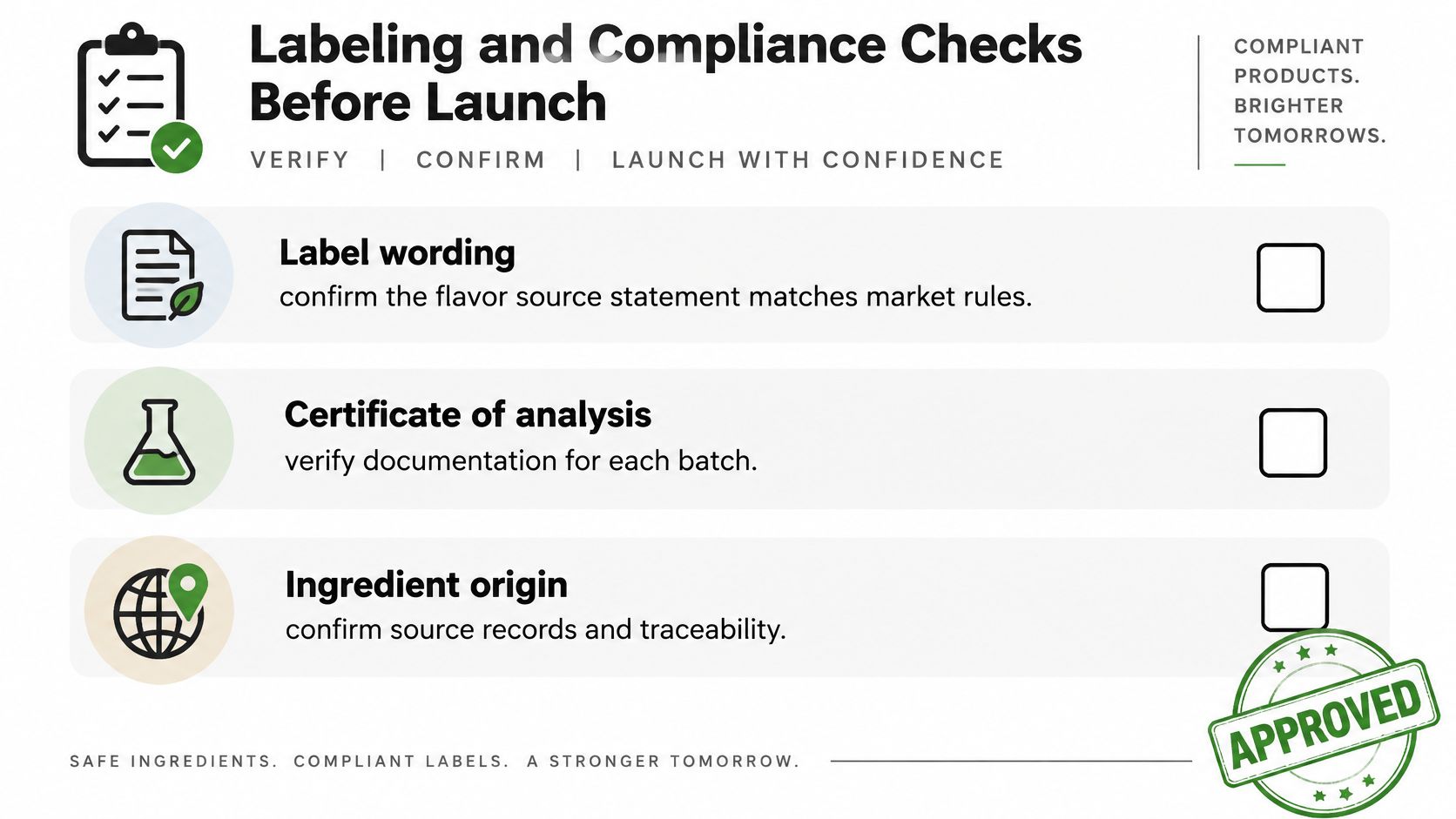
Complete the release checklist
- Label wording: Confirm that the flavor-source statement fits the rules of the sales market and product category.
- Certificate of analysis: Hold the relevant certificate for each incoming batch and compare results with the approved specification.
- Origin and processing: Retain records identifying source materials and the manufacturing method.
- Carriers and diluents: Review the complete system, including components that may affect its permitted description.
- Residual solvents: Obtain information appropriate to the extraction process and intended application.
- Allergen statement: Review source materials, processing aids, and relevant cross-contact information.
- Intended-use limits: Keep food and non-food applications separate and document the applicable use assessment.
- Batch identity: Link incoming ingredient lots to mixing records and finished-product lots.
The European Commission's explanation of Regulation 1334/2008 states that natural may describe a flavoring component containing exclusively flavoring preparations and/or natural flavoring substances; the narrower term natural flavoring substance(s) requires exclusively natural flavoring substances.
That distinction shows why marketing wording can't be approved independently of composition. A technical sheet, purchased flavor system, and proposed label need to agree.
Use this visual checklist as a reminder, alongside the complete release record.
Assign the right sign-offs
A FEMA expert-panel assessment of natural flavor complexes describes constituent- and exposure-based evaluation under stated intended-use conditions. Food-use conclusions don't automatically establish suitability for inhalation or other non-food routes.
For cartridge manufacturing, require an application-specific toxicological and regulatory review. Don't use a food-flavor description as evidence that a finished cartridge is suitable for its intended use.
Assign regulatory staff to label wording and market requirements. Quality should approve identity, certificates, and traceability; formulation should confirm composition and use level; qualified safety reviewers should assess the intended application.
The regulatory compliance checklist can help organize those responsibilities. Release the formula only when each owner has closed their assigned checks.
Request Samples for Your Next Blend
A useful sample request starts with a manufacturing problem, not a broad request for something fruity. Tell the supplier what your base already smells like, what is missing, and what the finished product should communicate. A sample works like a small rehearsal. It shows how a profile behaves in your actual material before you commit to a larger order.
Send a sample brief your team can use
Include the base type, target descriptors, intended application, and relevant processing conditions. If you have an approved reference, describe how the new blend should compare with it. State whether you're seeking a close match or a new flavor direction.
Here is a concrete brief for a lemon-forward blend in winterized distillate oils. “We are evaluating terpenes for cartridges in a winterized distillate base. The target is lemon forward, with strawberry underneath and a clean sweet finish. Please include options that can add a distinct flavor without pushing the profile toward grape or peach. The brief should identify whether the recommendation is a strain profile or an isolate-led direction. Keep the evaluation tied to the same base and processing conditions we will use in production.”
That brief gives the supplier enough detail to send useful candidates. It also gives your team a fair way to compare them. If two samples are evaluated under different conditions, the result says more about the test than about the blend.
Gold Coast Terpenes' terpenes are extracted from fresh plants and are free of mixtures, chemicals, and additives. Ingredients contain no VG, PG, PEG, or MCT. Flavor options range from blueberry, lemon, and strawberry to grape and peach. For cartridge work, terpenes for cartridges are added to winterized distillate oils and are free from additives, VG, PG, PEG, and MCT. Terpenes for cartridges are also SC Lab-tested.
Use the terpene sample request to submit your target notes and base type. Ask for a starting blend to evaluate, then let your controlled application test determine whether it earns approval. Include the intended application, the reference profile if you have one, and the exact descriptors you want the sample to answer.