
Ask ten cartridge makers how to build a Bubba Kush cart and most will give you the same answer: it's a caryophyllene strain, so push beta-caryophyllene hard and stop there. That advice gets you a peppery oil with no earthy floor and no citrus lift, which isn't the profile your buyers are matching against. It also falls apart the moment you compare a second flower lot.
The Bubba Kush terpene profile is a target range, not a fixed recipe. Lots move, drying moves them further, and the only reliable check is the finished oil, read on a paper strip and confirmed in a lab report. Chasing one perfect percentage list is the slowest route to a product that repeats.
Three habits carry most of the quality: a reference fingerprint you hold against every lot, a build order that follows how a nose reads the blend, and a pass or fail test on finished oil before you scale.
Core Terpenes That Define the Bubba Kush Profile
| Terpene | Aroma note | What the research shows |
|---|---|---|
| Beta-caryophyllene | Peppery, spicy, woody | Core group member in the 2017 study |
| Limonene | Bright citrus | Core group member in the 2017 study |
| Myrcene | Earthy, musky, herbal | Core group member in the 2017 study |
| Alpha-humulene | Hoppy, woody | Supporting note in commercial terpene work |
| Alpha-pinene | Fresh pine | Supporting note in commercial terpene work |
| Linalool | Floral, light | Supporting note in commercial terpene work |
Three rows carry the profile and three shape it. Beta-caryophyllene, limonene and myrcene are the core trio. Alpha-humulene, alpha-pinene and linalool are useful supporting notes, especially when the aim is a finished cart that smells layered instead of stripped down to pepper. Treat the whole table as a working fingerprint, then check it against the lot in front of you.
A 2017 peer-reviewed study of 81 high-THC Cannabis sativa cultivars gives the core its shape. The authors used chromatographic measurement and multivariate statistics to sort cultivars into terpenoid chemotypes. Bubba Kush landed in a group dominated by limonene, beta-caryophyllene and myrcene, with those three sitting in an approximate 2:2:1 relationship. That group also included alpha-bisabolol, and the authors named Bubba Kush and Master Kush as its representatives.
Read the study's own means before locking a formula. Bubba Kush was reported at roughly 1.7 ± 0.8, 3.0 ± 1.1 and 0.7 ± 0.4 in the study's analytical concentration units. That puts beta-caryophyllene nearer twice limonene than level with it, which matters when a peppery top note starts taking over the cart.
Starting point: two parts limonene, two parts beta-caryophyllene, one part myrcene gets a batch into the right neighborhood. Your own certificate decides the exact address, and supporting compounds go in one at a time after the core smells right.
That ratio is a first target, not a production instruction. Use it to frame the core, then correct against flavor matching and finished-oil testing. A strain name points to a pattern, while the lot range decides how far you can trust that pattern.
Earthy, Sweet and Peppery Notes to Match
A nose reads this profile in a set order, and a blend built in that order is easier to repair when it drifts. Base first, warmth second, lift third, edges last.
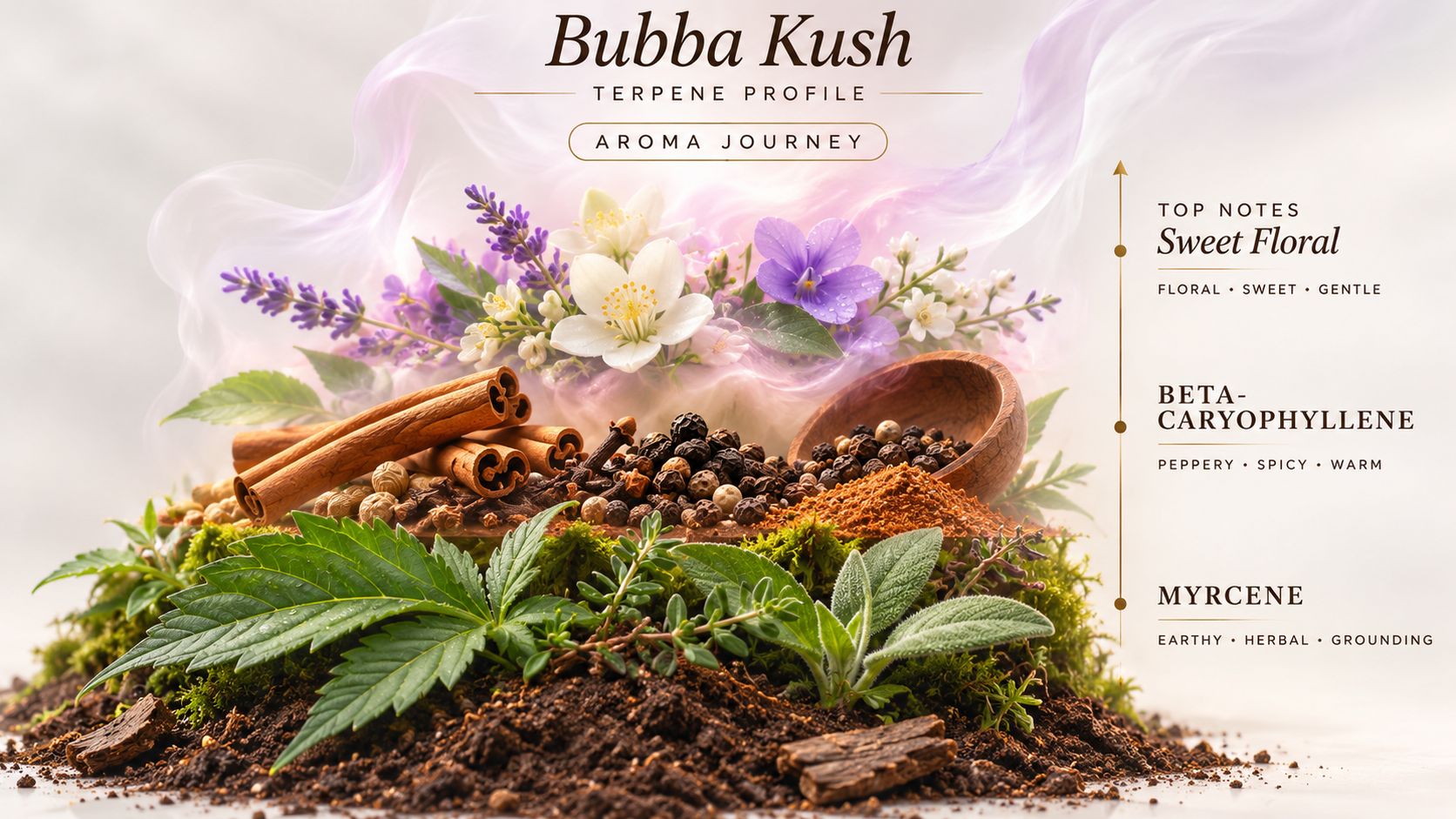
- Base, myrcene. Earthy, musky and herbal, it lays the floor the rest of the blend stands on. Skip it and the oil reads bright and thin, like citrus cleaner.
- Warmth, beta-caryophyllene. Peppery, spicy depth sits directly on that floor. This is the note buyers identify first in a cart, and it's usually the highest number in a lab report for a reason.
- Lift, limonene. Bright citrus keeps the earthy base from reading heavy and pushes the sweetness toward citrus rather than dessert. Cut it too far and the blend turns muddy.
- Edge, alpha-humulene and alpha-pinene. Alpha-humulene contributes to the hoppy aroma of cannabis, which gives a woody, faintly bitter lift. Alpha-pinene brings fresh pine and belongs at trace level. Beta-pinene accounts for the familiar odor of cannabis, often associated with pine trees and turpentine, and it can do the same lifting job when you want pine without the sharp edge.
Build the dominant three first, taste, then add one supporting terpene at a time. Adding two at once tells you nothing about which one changed the blend.
The paper-strip check. Put the blend on a paper strip at two strengths: your planned dose in the finished oil and half of it. Write three descriptors for each strip and set them beside the target sample. Success looks like a strip that reads earthy first, peppery second, citrus third.
Fix order: if pine comes forward before the citrus, cut alpha-pinene first and retest before you touch anything else.
How Drying Shifts the Bubba Kush Profile
A blend built from a fresh-flower reference can land wrong in a cart if the material behind those numbers was dried. Most briefs never ask which stage the reference came from.
| Compound | Fresh flower (%) | Dried flower (%) |
|---|---|---|
| Myrcene | 39.44 | 30.12 |
| Limonene | 36.45 | 18.68 |
| Alpha-pinene | 4.55 | 12.82 |
| Trans-caryophyllene | 3.41 | 8.06 |
A headspace GC-MS comparison of fresh and dried Bubba Kush × OG Kush flowers shows how far one drying step moves the balance. Limonene lost about half its share, myrcene gave up roughly nine points, alpha-pinene nearly tripled and trans-caryophyllene more than doubled.
What moves and why
Volatile compounds leave at different rates. The lighter, brighter molecules go first, and some compounds change with heat and oxygen across the same window. Limonene is early to leave, so a dried sample reads less citrus and more pine, spice and wood even when the genetics are identical.
That matters at the bench in a specific way. Rebuild a citrus-forward cart from a dried-flower reference and you'll overshoot the pine side. Rebuild from fresh-frozen material and your blend turns out sweeter than the dried market standard buyers compare it to.
Bench checks that catch the shift
Ask the supplier whether the input behind a profile was fresh or dried before you accept it. Then match the reference to the stage you plan to sell against.
Hold storage cool and dark, and keep heat exposure short during mixing and filling. The drying and curing guide covers the temperature and airflow side of flower, and the same logic applies to oil: less heat, less drift.
Decision rule: if your target is citrus-forward, measure limonene on the finished oil before you approve the lot. Raw terpene input tells you what you bought, not what you shipped.
Batch Variation and Reading a Lot Range
The single-recipe idea fails on the numbers. Aggregated sample data for this named profile drifts far enough between lots to change your formula.
| Compound | Average (%) | Observed range (%) |
|---|---|---|
| Beta-caryophyllene | 0.29 | 0.09 to 0.59 |
| Beta-myrcene | 0.15 | 0 to 0.54 |
| Alpha-humulene | 0.27 | Up to 1.81 |
Across aggregated Bubba Kush sample data, beta-caryophyllene averages about 0.29% but ranges from 0.09% to 0.59%, beta-myrcene averages about 0.15% with a range of 0% to 0.54%, and alpha-humulene averages about 0.27% while reaching 1.81% in some samples. A generic blend can reproduce the familiar peppery, earthy, herbal feel. It can't reproduce every flower lot on its own.
Reading a certificate of analysis for the right things
Four fields decide whether a COA is useful to you. Check the dominant compounds and their percentages, the lot number, the test date and the lab method. A caryophyllene number with no lot number attached is marketing, not specification.
Separate cultivar identity from a batch profile. Identity tells you which family of notes to expect. The batch record tells you what to put in the tank this week.
Two valid targets: a midpoint range for a line you'll run for years, or a specific lot for a limited release. Choose one before you blend, because the two need different specs and different tolerances.
Keep retention samples from every finished batch, sealed and labeled with the lot and date. When a later lot smells off, you have a physical reference to compare against instead of a memory of how the last run went. If a supplier's numbers look unusually precise for a named strain, the certificate of analysis guide walks through what else to verify.
How to Build a Bubba Kush-Style Blend
Build the blend around the core, then prove it in the oil you sell.
| Terpene | Starting share | Role in the blend |
|---|---|---|
| Limonene | 2 parts | Bright citrus lift |
| Beta-caryophyllene | 2 parts | Peppery, spicy core |
| Myrcene | 1 part | Earthy, musky base |
| Alpha-humulene | Trace, add last | Hoppy, woody edge |
| Alpha-pinene | Trace, add last | Fresh pine lift |
| Dosing rate (% of finished oil) | Start at the low end of the supplier's written range | Recorded as a percentage of finished oil |
A commercial quality-control report for a Bubba Kush industrial-hemp flower sample dated October 31, 2024 measured beta-caryophyllene at 5.39 mg/g, beta-myrcene at 4.43 mg/g and limonene at 2.52 mg/g. Caryophyllene led, myrcene followed, limonene sat third in that one lot, and the report also listed alpha-pinene, beta-pinene, linalool, alpha-humulene, caryophyllene oxide, valencene and bisabolol. A named profile is a multi-compound system, not a three-ingredient formula.
Steps that survive a scale-up
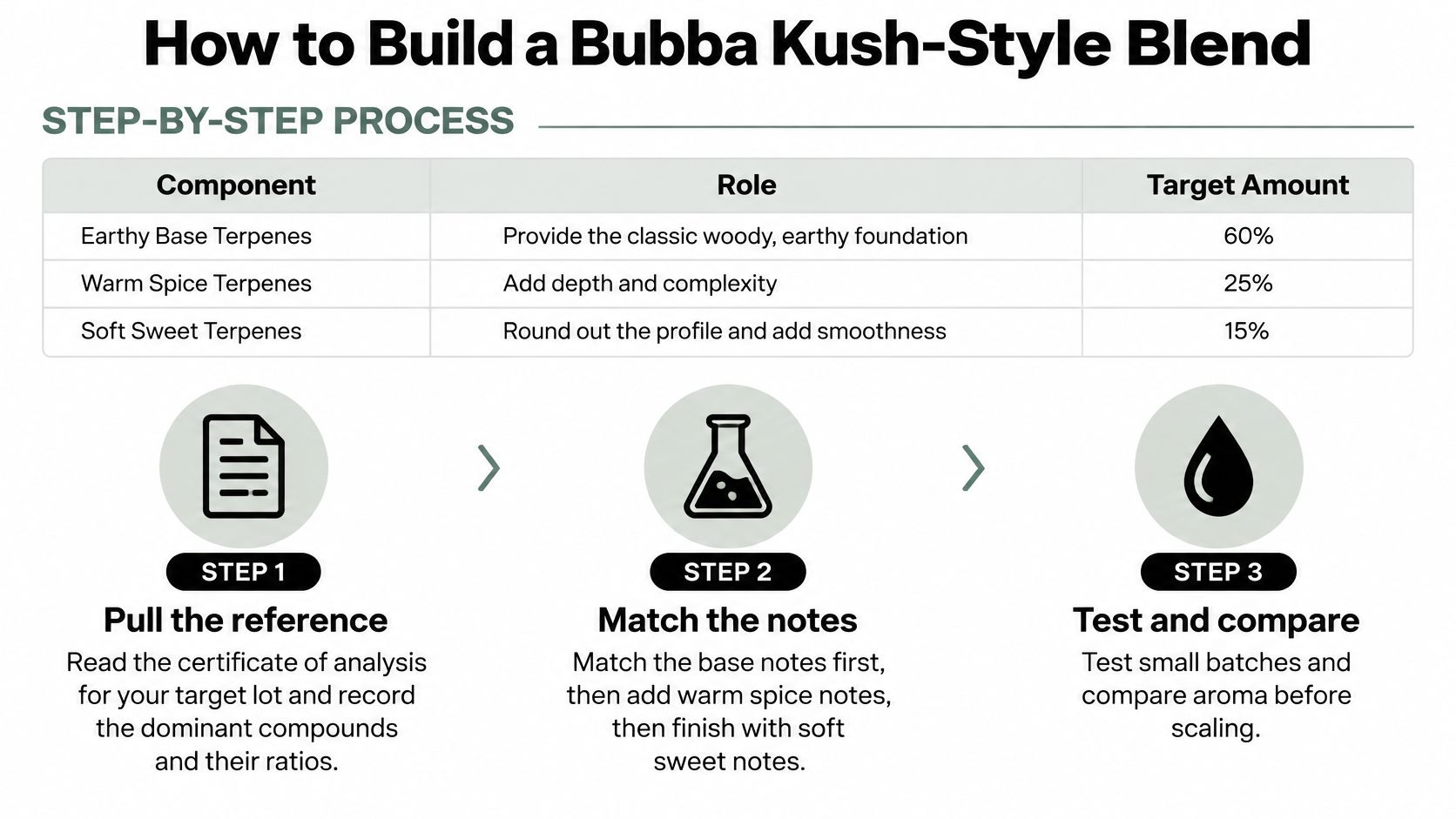
- Pull the reference. Read the certificate for your target lot and write down the dominant compounds and their percentages next to the lot number. Without that record, every later batch is guesswork.
- Set the core near the 2:2:1 framework. Start limonene, beta-caryophyllene and myrcene close to those parts, then adjust to your own certificate. The study's reported means put caryophyllene near twice limonene, so expect the split to sit slightly off the framework.
- Add the edges last. Alpha-humulene or alpha-pinene go in at trace level, only once the core smells right. A pine note added early is hard to pull back out.
- Dose into winterized distillate. Terpenes for cartridges are added to winterized distillate oils, so record the load as a percent of finished oil and follow the supplier's written guidance. Don't raise the load to chase a louder smell; that trades hardware performance for a short-lived aroma bump. The mixing ratios calculator converts a target percentage into grams for your batch weight.
- Mix until no droplets or dry pockets remain, then let the batch equilibrate before you judge it. A freshly mixed oil reads sharp; a settled one reads like the product your buyer will open.
- Test the finished oil, not just the raw input. Run the paper-strip check, then evaluate viscosity and hardware performance on filled carts. Color, clarity and coil behavior all shift with the blend and the distillate lot.
- Record the blend, lots and results. Note the base distillate next to the blend, because a different input batch changes the outcome even when the terpene formula is identical.
Scale up only after a sample passes every one of those checks.
Compliance and Sourcing Checks Before You Order
A 2021 peer-reviewed study of twelve cannabis vape cartridges collected from California dispensaries between September 2018 and December 2019 identified more than 100 terpenes and natural extracts across the tested materials. It also detected additives including vitamin E acetate, polyethylene glycols and medium-chain triglycerides, and found caryophyllene, D-limonene, alpha-humulene, linalool, terpinolene and 2-pinene among the most abundant terpene-related compounds.
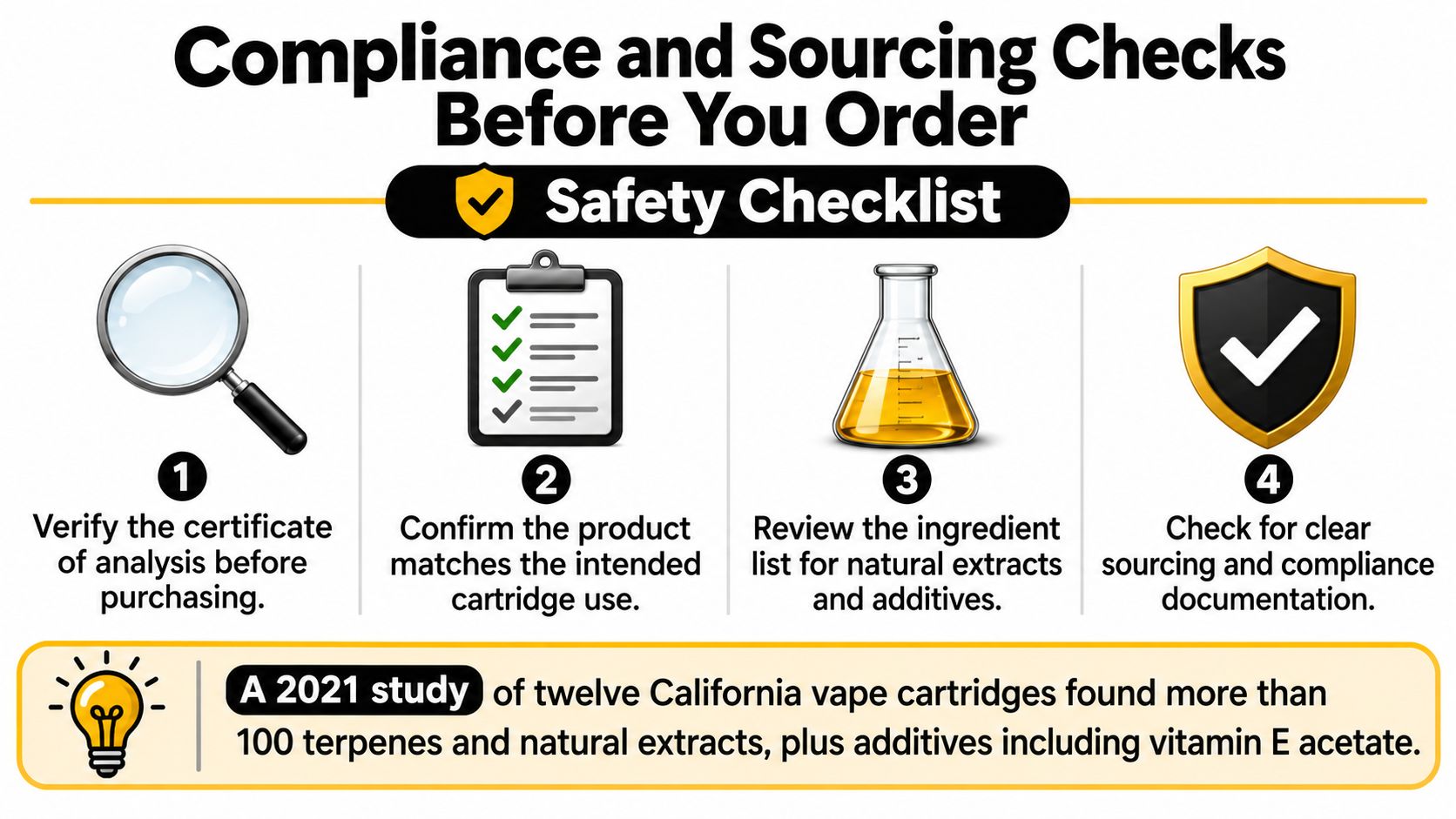
That finding sets the bar for raw material checks. Turn each item into a question you ask before a purchase order goes out.
- Document every diluent and additive. If it isn't written down and signed off, it isn't specified.
- Request a certificate of analysis for each terpene lot. A profile sheet isn't a lot certificate.
- Confirm the blend contains only ingredients approved for your target market. Approval in one state or country means nothing in the next.
- Check that each result names the lab and the test date. Our terpene information is provided by SC Labs, and you should expect the same traceability from any lot you approve.
- Confirm the terpenes are botanically derived, not cannabis-derived, when that's what your label and market require.
A familiar flavor doesn't make an ingredient suitable for inhalation. Bubba Kush-style blends can be built around caryophyllene, limonene, myrcene and supporting compounds, but validate compatibility with your chosen distillate, hardware and filling process before a full run. Our product pages state that terpene statements have not been evaluated by the Food and Drug Administration, and market rules vary, so check current technical documents and the terpene legality overview before production.
Approval rule: if a supplier can't hand you a current certificate and a clear ingredient list, don't approve the lot.
Request Samples and Test Your Blend Next
Three actions move this from reading to ordering.
- Shortlist blends against your reference. Compare each candidate to the dominant compounds and ratios on your target lot's certificate, not to a strain name.
- Request a sample and run it in your own distillate. Our terpenes for cartridges are SC Lab-tested and legal worldwide, but the true test happens at your dose, in your oil, on your hardware. Use the paper-strip check, then check viscosity and fill performance.
- Order in bulk or ask for a custom formulation once a sample passes. We list isolates such as alpha-pinene, beta-caryophyllene, limonene, linalool, myrcene and terpinolene, which lets you nudge one note without rebuilding the whole blend.
Ask for the current certificate with each sample and keep it with the retention sample. When the sample clears every check, you'll have a shortlist, a tested oil, a recorded lot reference and a clear decision to place the order.
Request a sample of the blend you want to test first.
Gold Coast Terpenes supplies botanically derived, THC-free terpene blends and isolated compounds built for cartridge makers and extractors, including strain-profile blends you can hold against your own certificate of analysis. Compare them against your target lot, then request samples and run them in your distillate at your planned ratio before you commit to a production run. Visit Gold Coast Terpenes to browse blends and isolates, or to start a bulk or custom order conversation.