
London Pound Cake terpenes are a formulation problem disguised as a strain profile. The strain has been reported at 20% to 29% THC, with some indoor batches above 30% THC, while CBD usually sits below 1% or below detectable limits, so the commercial challenge is not balance, it's control, especially when the same name can read differently across lab menus and retail specs (Joint Commerce strain guide). For brands building vape cartridges, distillate blends, or a strain-inspired terpene blend, the question isn't whether London Pound Cake smells like dessert, it's which notes hold up in hardware and which ones fade first.
Why This Profile Matters to Formulators
London Pound Cake started showing up in mainstream retail around 2018, and that timing matters because it landed during a phase when dessert-forward profiles had to perform in cartridges, not just flower jars (TryCannaVine strain guide). That pushed formulators to treat it as more than a consumer-facing flavor name. It became a test case for whether a profile could stay recognizable after dilution, heating, and weeks on shelf.
For a production team, the practical appeal is straightforward. The aroma reads as berry, grape, lemon-citrus, vanilla, and creamy cake, which gives you room to build, but only if the blend stays coherent under heat. A good supplier brief for London Pound Cake terpenes should ask for batch-level consistency, third-party verification, and a carrier system that stays out of the way. That means no VG, PG, PEG, or MCT in the oil path if the goal is a clean cartridge formula.
For a broader catalog view, see the strain terpene profiles archive.
Practical rule: if the terpene system smells right in the bottle but turns thin, sharp, or vague in hardware, the formula is underbuilt for commercial use.
The right way to read this profile is as a working reference for cannabis product formulation, not a strain explainer. You should finish this guide knowing how to spot the stable parts of the profile, how to handle source disagreement, and how to set a blend up for bench testing before you commit to production. If you already keep a strain library, this is the kind of profile that belongs in a formulation queue, not a mood board.
The Published Terpene Profile and Why Sources Disagree
Published LPC chemistry points in the same general direction, even when the wording shifts from source to source. The cultivar is usually described as indica-dominant, often around 70% indica / 30% sativa, with THC commonly listed in the 20% to 29% range and CBD typically under 1% (Strainpedia profile). For formulators, the real work starts with the terpene profile, because that is where the published descriptions begin to diverge.
What stays consistent
Across strain references, the same core notes keep showing up. Limonene, caryophyllene, and myrcene appear most often, and several guides also include linalool in the recurring group, which matters once the oil is warmed, thinned, and moved through cartridge hardware (Mood strain guide, Strainweaver profile). The exact percentages shift by source, but the sensory shape stays recognizable, citrus up front, spice and pepper in the middle, then a softer herbal and dessert-like base.
Where the disagreement comes from
A sample report cited by Joint Commerce strain guide places limonene at approximately 60% of the terpene profile, which makes the profile look strongly limonene-led even in a sedating phenotype. Other references give more weight to caryophyllene, limonene, and myrcene as the main trio, and AbstraxTech strain article treats caryophyllene as the lead impression in the finished aroma. That is not a clean contradiction, it is a sample issue. Cultivar name, harvest timing, cure state, and which flower lot gets sent to the lab all push the reported result around.
Understanding how to read those shifts matters, and our guide on lab report interpretation can help.
Reported London Pound Cake terpene windows
| Terpene | Reported Range | Role in the Profile |
|---|---|---|
| Limonene | ~0.20% to 0.60% | Bright top note, citrus lift |
| Caryophyllene | ~0.15% to ~0.50% | Peppery, spicy mid-base |
| Myrcene | Not fixed in the sources, but consistently recurring | Earthy, soft dessert foundation |
| Linalool | Recurring as a secondary note | Floral depth, smooths the blend |
The useful reading is practical. Limonene can dominate the aroma in one batch, while caryophyllene and myrcene define the structure in another. For formulators, that means limonene should be treated as a floating top-note anchor, while caryophyllene and myrcene are the more dependable structural pieces.
Building the Profile With Isolates and Blends
The cleanest way to build London Pound Cake terpenes is to separate the profile into top, mid, and base notes. That keeps the blend from collapsing into either pure citrus or flat sweetness. In practice, limonene gives the first impression, caryophyllene and linalool carry the middle, and myrcene plus humulene keep the finish round instead of thin.
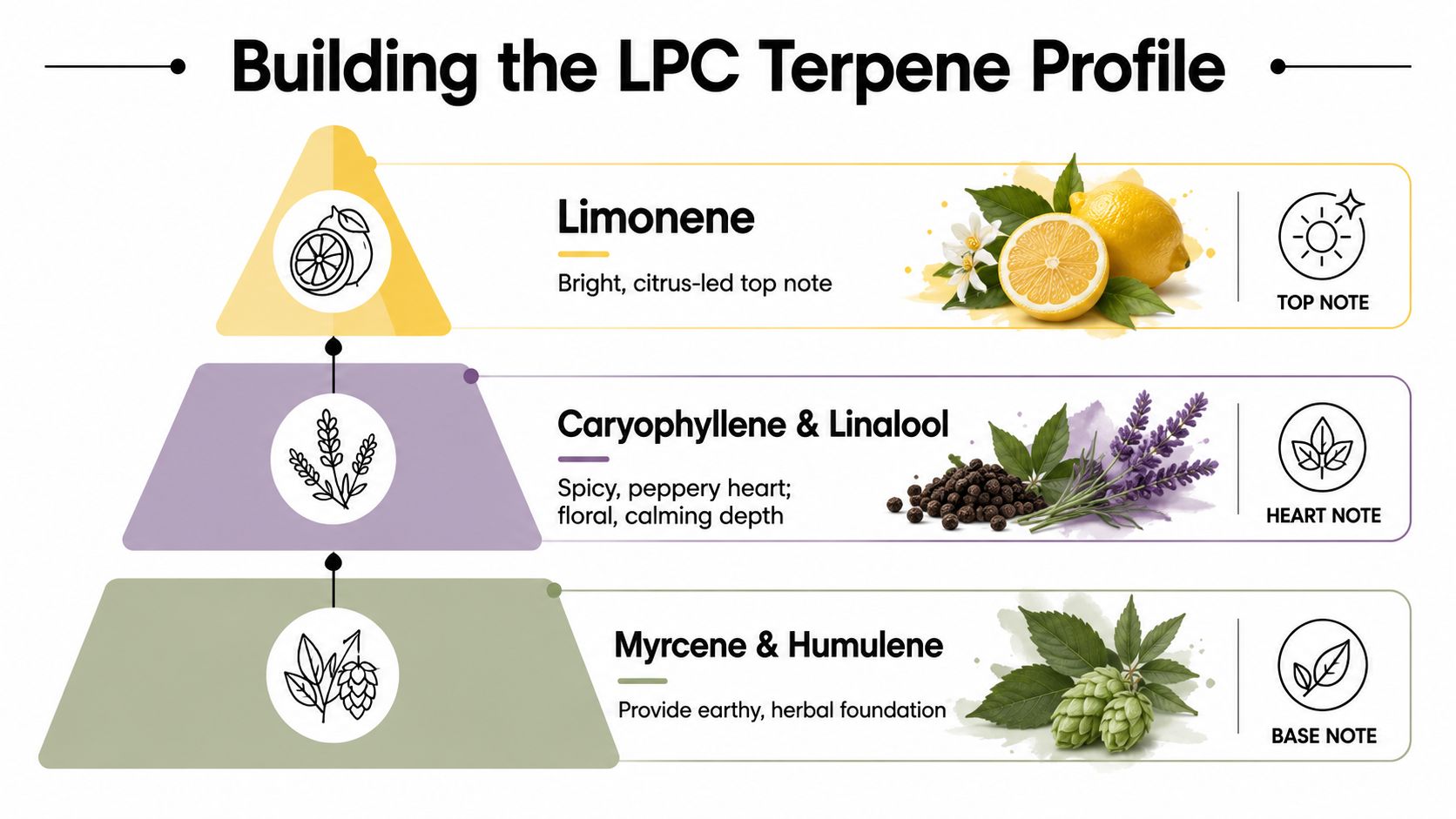
A practical starting architecture
For a strain-inspired blend built from isolates, a workable launch point is limonene around 30% to 45% of the terpene blend, caryophyllene around 15% to 25%, and myrcene around 10% to 20%, with the remainder split across linalool, beta-pinene, humulene, and a dessert-supporting enhancer. Those numbers are formulation targets, not a claim about any single flower sample, and they're best used as a first bench batch rather than a final spec.
Practical rule: chase the sensory architecture, not a perfect replica ratio. A good commercial LPC blend sounds like the strain, not like a lab printout.
If you're building from isolates, the job is to keep limonene high enough to read as citrus-led without letting it bleach the body notes. If you're starting from a pre-blended profile, the supplier has already done some of that balancing, so your main work is confirming that the finish still carries the creamy, cake-like impression after dilution. That's why a stock profile is often the safer production path for first-time runs, especially in carts.
What works and what doesn't
What works is a layered profile where the first inhale is bright, the mid-palate has spice and floral lift, and the finish stays soft. What doesn't work is overfeeding limonene until the blend turns generic citrus, or overloading caryophyllene so the oil tastes dry and woody. Both mistakes flatten the dessert character, which is the whole reason the strain name sells.
For formulation teams that want a shortcut, a pre-built strain-inspired terpene blend is usually the better starting point than trying to reconstruct every note from scratch. If the brief calls for deeper selection work, the isolation path can still get there, but it demands more bench time and more sensory iteration (Gold Coast Terpenes isolation resource).
Dilution Guidance and Cart Load Targets
The right London Pound Cake profile still fails if the total terpene load is wrong. For distillate carts, the common working window is 5% to 15% by weight, and the lower end usually preserves the heavier caryophyllene and myrcene notes better than an aggressive load does. Push too high, and limonene tends to jump forward while the dessert body gets thinner.
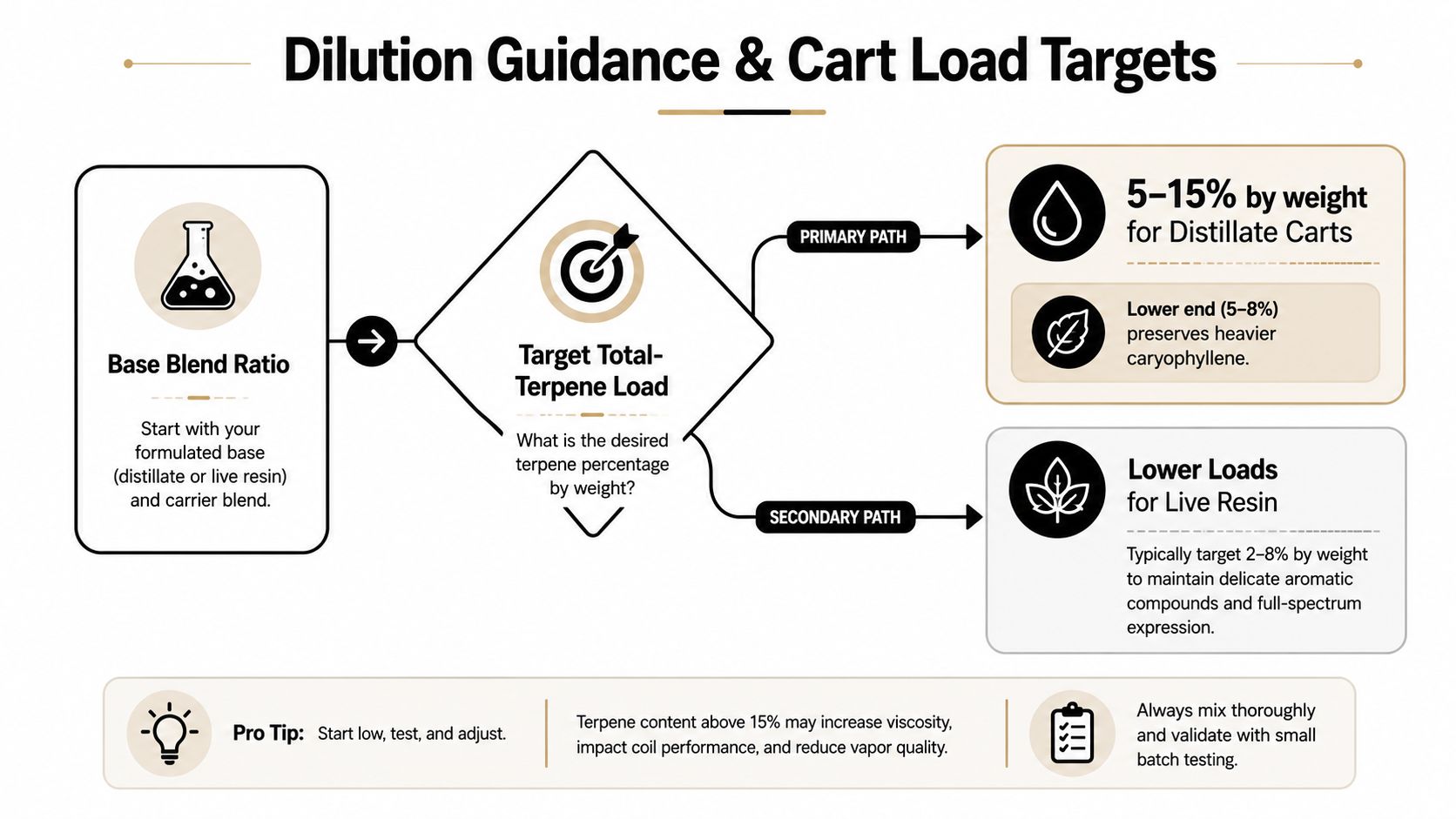
Bench math that holds up
A simple way to prototype is with a 10% stock terpene solution. If you want a finished oil at 5%, you blend one part stock to one part distillate. At 10%, the stock becomes the finished load, so the bench sample is effectively your production target. That makes it easy to compare flavor before and after heat exposure without guessing at the conversion.
The bench step matters more than many teams expect. Mix the oil fully, let it rest, then check viscosity and clarity before you fill hardware. If the blend feels too thin at room temperature, it usually behaves worse after filling. If it clouds, separates, or smells sharp immediately after mixing, don't scale it.
What to avoid in modern hardware
VG, PG, PEG, and MCT are dead ends for a serious cartridge brief. They complicate hardware performance, and they don't help you preserve the clean LPC profile you're trying to protect. A terpene-only dilution system is simpler to defend on spec, easier to QC, and less likely to create a weird aftertaste when the oil heats.
For live resin, the total load generally needs to sit lower than a distillate cart would, because the native profile is already doing part of the sensory work. Overloading a live-resin cartridge can bury the original extraction character instead of improving it. That's why the same terpene percentage that works in a distillate formula can feel loud in live resin.
Lower load first, then raise it only if the bench sample still reads flat after warming. Most formulation errors happen because teams correct too early.
Batch Consistency and QC Release Criteria
One good bench batch doesn't make a good production program. The issue appears when the same recipe gets built twice and the finished oil reads differently because the limonene-rich isolate lot shifted. I've seen that problem surface in back-to-back production runs where the blend sheet stayed identical, but the first batch leaned citrus and the second one felt heavier, less lifted, and harder to label cleanly.
A realistic batch scenario
A brand runs two 10,000-unit distillate batches with the same London Pound Cake recipe. Batch A tests as expected because the limonene isolate lands where procurement said it would. Batch B still clears the blend spec, but the citrus top note drops enough that caryophyllene and myrcene feel more dominant in the cart. The consumer may not describe it in lab terms, but the buyer notices the difference immediately.
That's why the QC conversation has to start with acceptance windows, not just a recipe sheet. For finished bulk oil, set a release band for the dominant terpenes, then define what counts as a re-blend or a hold. If one component drifts outside the acceptable range, the question is whether the profile is still label-true, not whether the total terpene percentage looks fine on paper.
What buyers eventually ask for
Buyers usually want the batch record, the COA for the finished oil, and proof that the incoming terpenes matched the supplier's own testing. They also want to know whether the profile came from a consistent lot or a one-off blend adjustment. Suppliers that publish batch-level third-party testing make those conversations much easier because they give you a paper trail instead of a flavor promise.
A defensible QC process doesn't need to be complicated. It just needs to tell you when the blend is still London Pound Cake, when it has drifted into a citrus-forward variant, and when it should be reworked before fill. That distinction protects your label and keeps the production line from turning every batch into a new product.
Hardware-Specific Adjustments for Live Resin and Distillate Carts
A London Pound Cake ratio that works in one cart format won't automatically work in another. Standard 510 ceramic hardware can carry a fuller terpene load, while quartz wick systems usually need a lighter hand because they heat faster and can expose top notes more aggressively. Live resin is a separate case, since the native terpenes already in the extract change how much added terpene the oil can tolerate.
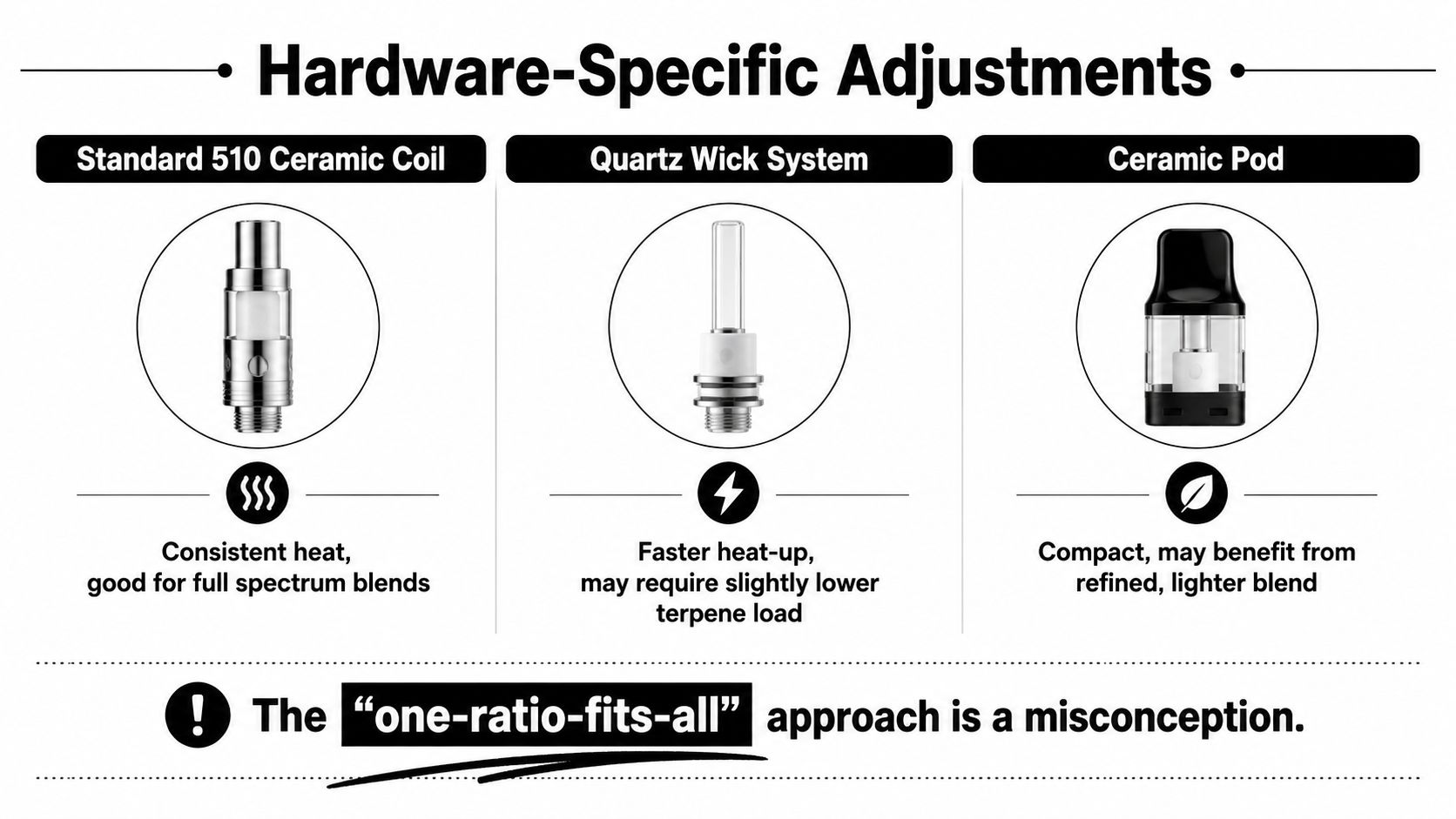
Suggested load and ratio adjustments by hardware
| Cart Format | Total Terpene Load | Limonene Skew | Caryophyllene/Myrcene Skew |
|---|---|---|---|
| Standard 510 ceramic coil | Moderate to fuller loading | Can stay higher if the finish remains balanced | Can support a stronger base without darkening as fast |
| Quartz wick system | Lower than ceramic in most cases | Keep the citrus top note controlled | Reduce the heavy base if the oil starts reading sharp |
| Ceramic pod | Refined, lighter blend | Use enough to keep brightness, not enough to dominate | Keep the base clean and compact |
| Live resin cart | Lower added-terpene load | Add only if the native profile feels muted | Preserve the extraction's own base notes |
The biggest mistake is treating one ratio as universal. A ceramic coil can often handle more caryophyllene and myrcene without the profile collapsing, while a quartz wick can make the same blend feel louder and less rounded. Live-resin formulations need the most restraint because you're layering on top of something that already has a terpene signature.
What to look for on the bench
If the oil darkens too fast, the base notes are probably too heavy for the hardware. If the first pull tastes all citrus and then falls flat, the limonene share is probably too high for that device class. If the profile feels thin but still stable, the issue may not be hardware at all, it may be that the underlying blend needs more body.
A practical way to decide is to test the same batch in the intended hardware before committing to scale. That is the quickest way to see whether the London Pound Cake profile stays label-true in a ceramic system, needs tightening in a quartz setup, or should be reduced for live resin. For a related live-resin formulation reference, see the live resin sauce resource.
Label Claims, Compliance, and the Buyer Conversation
A defensible London Pound Cake-style label starts with what's on the COA, not what sounds good in a sales deck. Buyers should see the dominant terpene percentages, a clean residual solvent panel, and heavy metals clearance where required, plus a carrier declaration that shows the formula is free of VG, PG, PEG, and MCT. That combination tells procurement the blend is built for regulated hardware, not for vague flavor marketing.
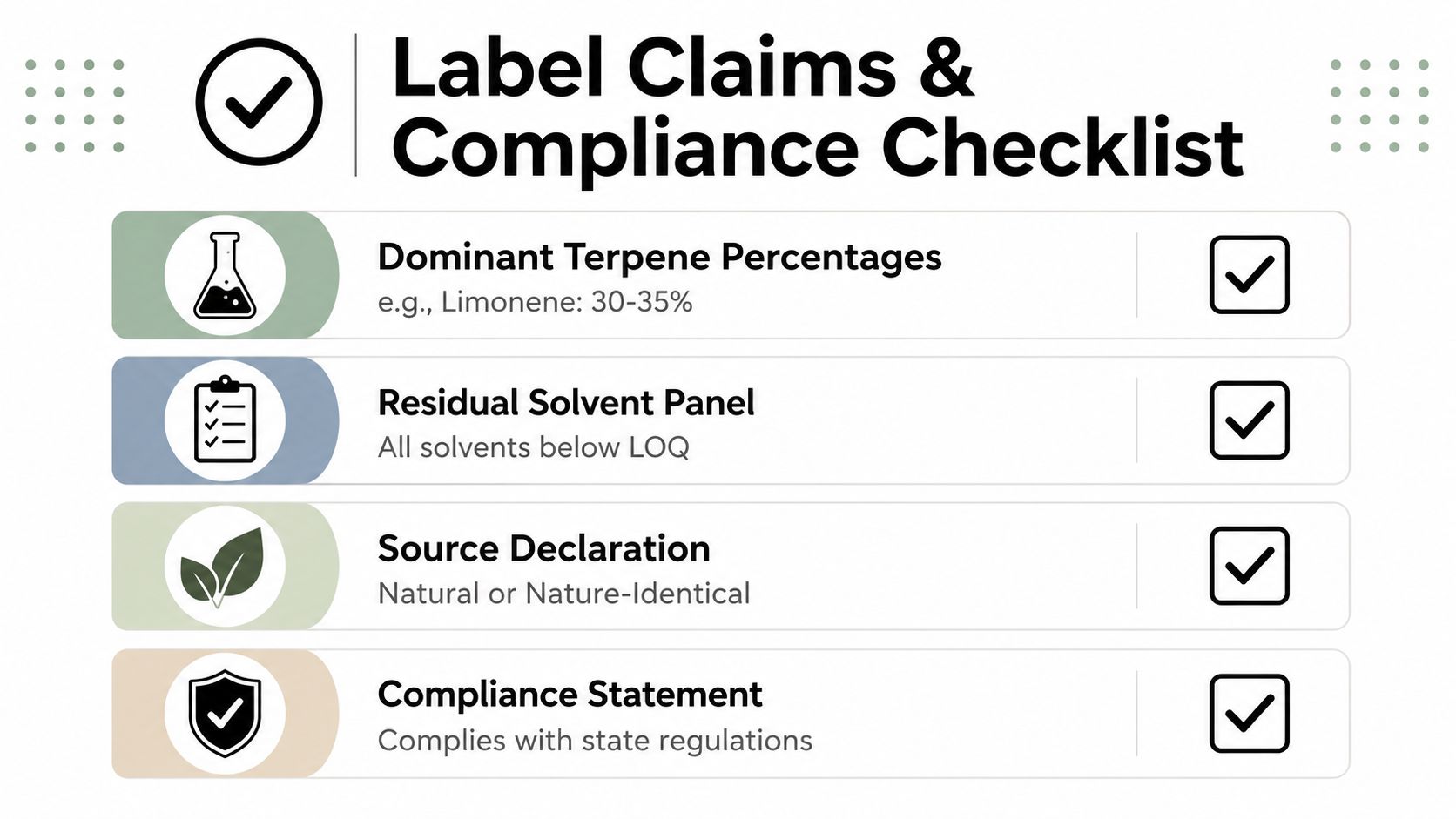
What to say and what not to say
Use strain-inspired language when the formula is built to echo a profile, and reserve strain-derived language for cases where the material basis really supports it. Most compliant markets treat terpene blends as flavor systems, not as medical claims, so the label should stay anchored to sensory description and documented composition. That keeps the conversation in operations, where it belongs.
The paperwork should live with the batch record. Keep the incoming terpene COA, the finished blend COA, the release decision, and the production notes that show whether the formula was adjusted for hardware or load. If a buyer asks how you got from lab oil to finished cart, those are the documents that answer the question without hand-waving.
A clean label conversation is simple when the formulation is disciplined. If the blend is consistent, the claims are modest, and the records are complete, the buyer can approve it without back-and-forth. If any one of those pieces is missing, the risk goes up fast.
Practical Questions From the Production Floor
How do I verify an incoming London Pound Cake terpene blend? Check the supplier COA against the batch label, confirm the dominant notes are where you expected them, and smell the retained sample before blending. If the citrus top note is unusually sharp or the base smells dry, hold the lot until you know whether it's a real shift or a sampling issue.
When should I re-blend instead of blending down? Re-blend when the profile still reads as London Pound Cake but one note is too loud for the hardware. Blend down when the oil is already too thin, too sharp, or too one-dimensional to recover without changing the product identity.
What pushes limonene out of the finished cart? Excess heat, a load that's too heavy for the device, or a base that buries the top note during storage can all do it. If limonene is disappearing, lower the terpene load first and retest in the actual hardware.
How do I keep the dessert character over 30 days? Use a stable carrier-free terpene system, test in the intended cart format, and avoid overloading the blend at fill. Shelf-life is usually won or lost in the first formulation decision, not at the end of storage.
Gold Coast Terpenes works with formulators who need strain-specific profiles, isolated compounds, and clean terpene systems for cartridges and concentrates. If you're building a London Pound Cake-style cart or tightening an existing blend, visit Gold Coast Terpenes to review terpene options, isolate support, and formulation resources that fit this kind of production brief.