
Why do so many Guava Haze products drift away from the profile buyers expect before they ever reach the cart? The answer is that Guava Haze often behaves less like a fixed chemovar and more like a flavor family, with public strain guides showing conflicting lineages and cut-to-cut variation in terpene dominance, THC expression, and sensory balance. For formulators, that makes the name useful only if the blend is built around a clear target profile, not a romantic idea of a single plant.
The practical move is simple. Treat the guava haze strain as a sensory brief, then engineer the aroma, flavor, and finish with terpene inputs that can be repeated batch after batch. That approach is more reliable for replicating flavor of Guava Haze in vape products than chasing whatever phenotype happened to be in a menu photo.
Replicating Guava Haze When Genetics Are Inconsistent
A lot of strain naming assumes stability that the market doesn't provide. Public strain guides describe Guava Haze as a sativa-leaning hybrid with tropical flavor, but they also show conflicting lineages for “Guava” and “Guava Haze” adjacent names, including one source that ties it to Guava #13 and Ghost Train Haze and another that points to a very different Guava lineage built from a Local Caribbean landrace and Guava x Kush Mints genetics. That's not a minor detail for product developers, because the same label can carry different aromatic signatures from one cut to the next. See the broader replication approach in this terpene replication resource.
Why the name is not the formulation
The word Guava Haze matters in the market, but it's not a quality control system. If the team behind a cart line tries to mirror a single flower sample without deciding which sensory traits are mandatory, the finished product will drift. One batch may lean brighter and more Haze-like, another may feel rounder, sweeter, or more floral.
Practical rule: build the blend to the brand promise, not to the most recent jar you smelled.
That matters even more for vapor products, where the user experiences the top note immediately and the middle and base notes follow fast. If the profile is inconsistent, the cartridge feels off even when the oil tests clean. A formulation-first mindset makes the name commercially usable.
What works and what does not
What works is reducing the target into repeatable sensory components. What does not work is assuming the flower name alone tells you the terpene story. Guava Haze listings commonly present effects as stable, but the available references show that THC ranges, CBD content, and terpene dominance vary across listings, so the name often behaves more like a flavor family than a standardized chemovar.
For manufacturers, that means the line should be developed around a consistent guava-tropical opening, a Haze-leaning lift, and a smooth finish. That target can be built with controlled terpene inputs even when the source material isn't perfectly uniform. The formulation job is to translate ambiguity into a stable SKU.
Deconstructing the Guava Haze Sensory Profile
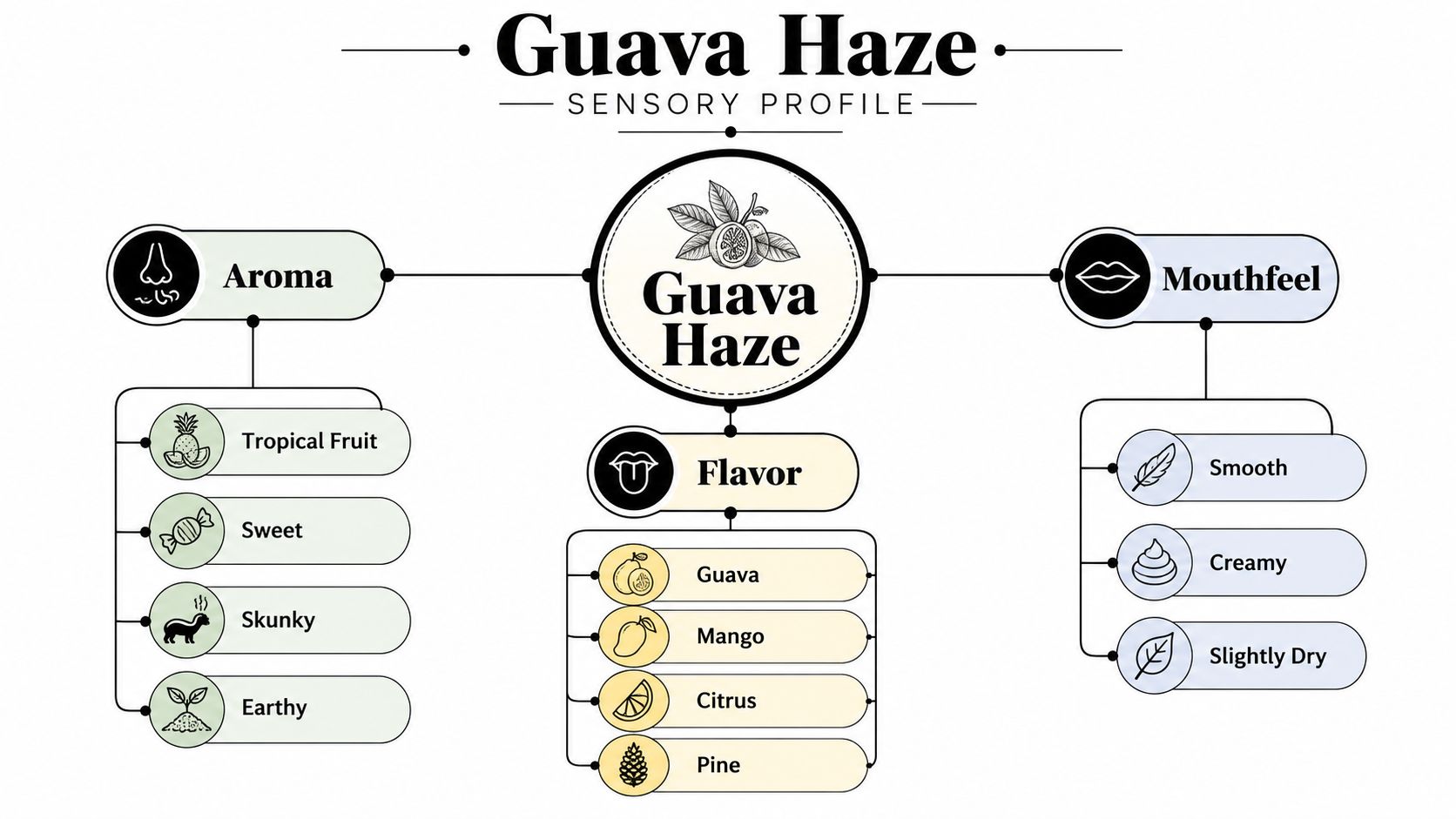
Guava Haze reads as layered, not flat. The aroma usually opens with tropical fruit, then moves into a sweeter guava core, and finishes with a faint haze, spice, or earthy edge that keeps the profile from turning candy-like. That structure is why a simple “fruity terpene blend” rarely lands correctly in carts.
Top notes carry the first impression
The top note is the first inhale and the first smell off the nozzle. For Guava Haze, that layer should feel bright and lifted, with tropical fruit, citrus sparkle, and a little green freshness so the blend doesn't collapse into syrup. If the top note is too heavy, the profile loses the airy Haze character and starts reading like generic fruit candy.
In practical blending terms, the most volatile terpenes do the heavy lifting. The top note should disappear quickly enough to make room for the middle note, but it still has to be loud enough to define the first impression. That balance is what makes the product feel “Guava Haze” instead of just “sweet.”
Middle notes define the name
The middle note is where the guava identity lives. This is the creamy, pulpy part of the aroma, the piece that makes the profile feel ripe rather than just citrusy. It should feel round, slightly exotic, and a little soft at the edges.
A useful analogy is a tropical perfume built in layers. The citrus lift comes first, the guava nectar sits in the center, and the haze base keeps the whole structure from becoming sticky. If the middle is weak, the whole blend feels unfinished, even if the top note is pleasant.
Base notes provide structure
The base note should add depth, not dominance. A subtle skunky, earthy, or lightly spicy backbone helps the profile hold up in heated delivery and keeps the sweetness from flattening. In vape work, that base also improves continuity between the first puff and the last.
The guava haze strain profile is strongest when the base feels restrained. Too much spice makes the blend harsh. Too much earth makes the tropical top collapse. The right base note is the quiet frame around the fruit.
| Guava Haze Sensory Layer | What It Should Feel Like | Formulation Job |
|---|---|---|
| Top note | Bright tropical fruit, citrus lift | Create the first impression |
| Middle note | Creamy guava, ripe pulp, soft sweetness | Anchor the name |
| Base note | Light spice, earth, faint haze | Add depth and persistence |
The Guava Haze Terpene Profile Blueprint
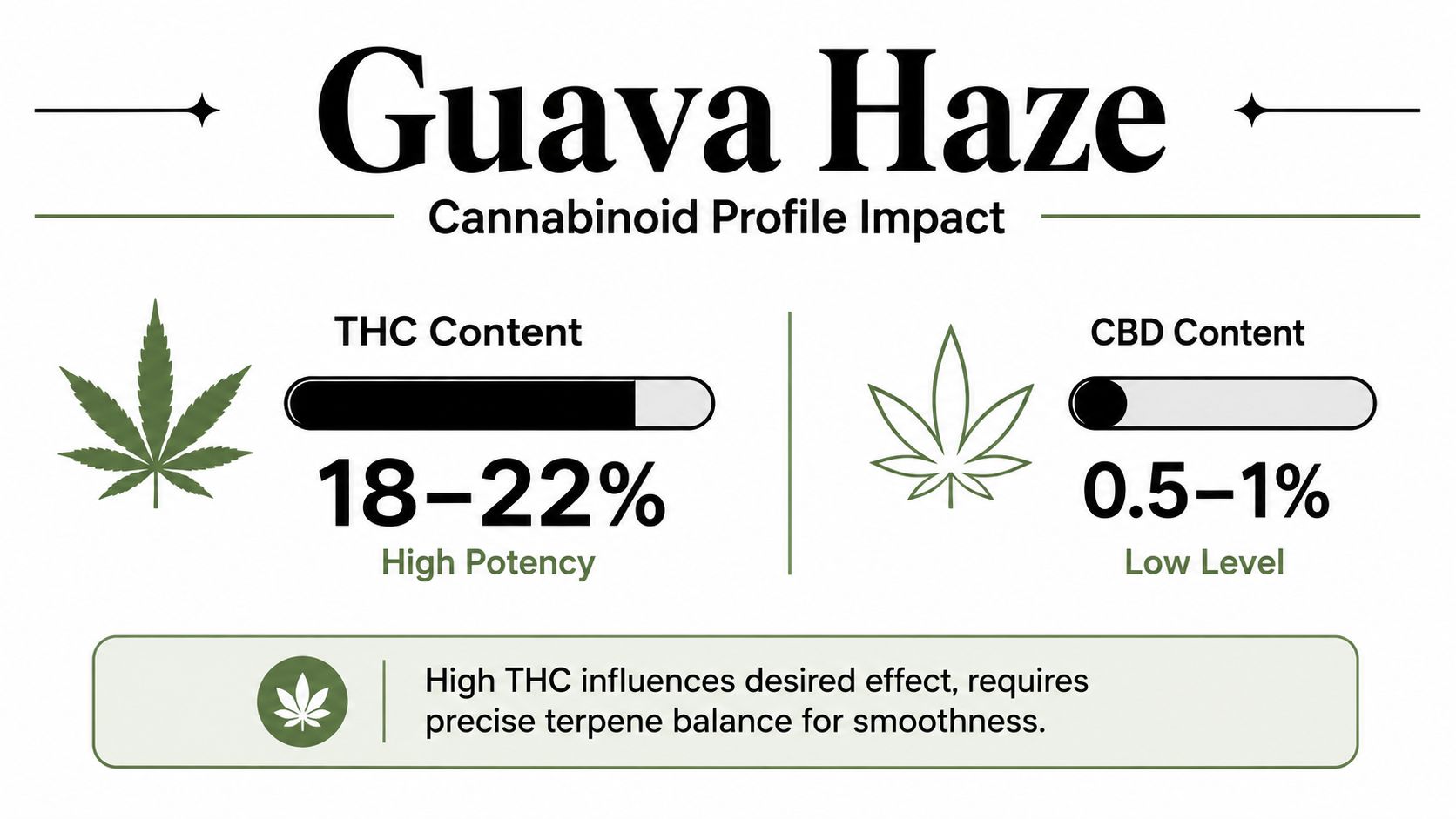
The terpene blueprint should be built around a bright opening, a rounded middle, and a restrained base. Independent references place Guava Haze in a mid-to-high potency sensory bracket, with THC commonly around 20%–25% and CBD often near or below 1% in many references, which means the terpene blend has to do more of the flavor work. One strain guide describes THC levels commonly around 18%–26% and CBD below 1%, while another notes standout phenotypes above the usual range and a source near 25% THC with about 1% CBD. Joint Commerce's Guava Haze guide and Weed.de's strain reference support that potency context.
How to think about the blend
The most useful way to build the profile is to assign each terpene a job. Limonene should brighten the top note and keep the fruit lively. Myrcene helps round the middle so the guava reads fleshy rather than thin. Beta-caryophyllene adds structure and a dry edge that keeps the finish from turning sugary.
The reason this matters is simple. In a low-CBD system, the oil won't get much aromatic smoothing from cannabinoids, so small terpene shifts are more noticeable. The blend has to balance lift, body, and finish on its own. That's why Guava Haze often feels more sensitive to mix ratios than a louder dessert profile.
Target terpene roles for formulation
| Guava Haze Target Terpene Profile | Aroma/Flavor Contribution | Note Classification | Target Range (%) |
|---|---|---|---|
| Limonene | Citrus lift, bright tropical top note | Top | 0.4-0.8 |
| Myrcene | Soft fruit body, ripe guava depth | Mid | 0.2-0.6 |
| Beta-caryophyllene | Dry spice, structure, subtle bite | Base | 0.1-0.4 |
| Terpinolene | Hazy lift, green fruit shimmer | Top | 0.1-0.3 |
| Ocimene | Fresh, airy, floral-fruit bridge | Mid | 0.05-0.2 |
| Linalool | Soft cream, floral nuance, smoothness | Mid/Base | 0.05-0.15 |
| Humulene | Dry herbal trim, cleaner finish | Base | Trace to 0.1 |
Those ranges are starting points, not fixed rules. The goal is a cart that smells tropical at first pull, then settles into a more nuanced guava-haze line on the exhale. If you push limonene too hard, the profile turns generic citrus. If you overbuild myrcene, the fruit gets muddy.
Formulation insight: the Guava Haze name survives best when the profile stays airy. Heavy sweetness kills the Haze part of the experience.
For broader background on terpene selection, the terpene flavor chart is a useful reference point.
How Cannabinoid Profile Impacts Formulation
The cannabinoid base changes how the terpene blend reads in the finished cart. Guava Haze is consistently described as high-THC and low-CBD, with public references placing THC in the 18%–26% zone and CBD often below 1%. That combination means the oil itself won't soften flavor or perception much, so terpene balance becomes the main tool for shaping smoothness and expression. The cannabinoid context also appears in the lab report interpretation resource.
Why a clean base matters
A neutral, high-potency THC distillate is usually the cleanest canvas for this style of build. The point isn't to chase potency for its own sake. The point is to avoid competing aromas that blur the guava top note or make the haze finish feel heavy.
Low CBD also changes perception in a practical way. There's less cannabinoid moderation in the background, so the terpene blend has to do more of the work that a richer full-spectrum oil might otherwise contribute. That makes small ratio changes more obvious during tasting and hardware validation.
What the ratio tells you
If the base oil is clean, the terpene system can stay focused on sensory architecture. The tropical top comes forward, the guava middle remains creamy, and the base note stays dry enough to finish cleanly. If the base oil already carries strong native character, the formula often needs less terpene intensity and a narrower flavor design.
This is also where market inconsistency shows up. Two Guava Haze lots can look similar on paper but behave differently in a cartridge because one cut carries more haze-like lift while another leans sweeter. A strong formulation process assumes that variation and builds a blend that can tolerate it.
A useful production mindset
- Choose the cleanest base possible: This gives the terpene blend room to express the target profile.
- Keep the top note bright, not sharp: Brightness helps recognition, sharpness hurts repeatability.
- Use the mid note to define identity: Guava should feel ripe and soft, not perfumed.
- Let the base note finish dry: That keeps the cart from reading as syrupy.
The cannabinoid profile doesn't replace terpene design, it frames it. In Guava Haze, that frame is especially important because the cultivar's public identity is strong while its chemistry is not perfectly standardized.
Formulation Guide for Guava Haze Vape Carts
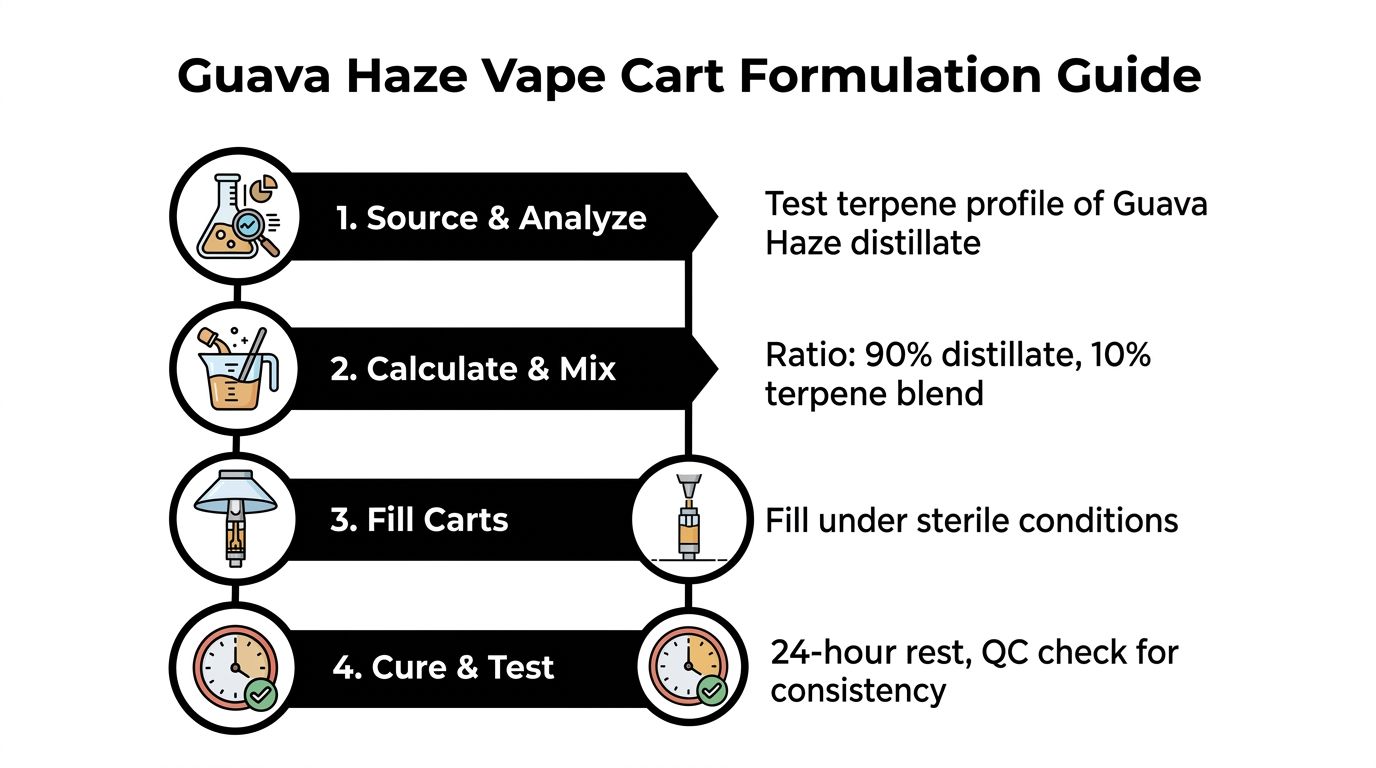
A workable starting point for vape development is a terpene load around 5% to 8% by weight, adjusted for the distillate's viscosity, native flavor, and hardware behavior. That range gives enough aroma to carry the guava top note without overpowering the base oil. For a more detailed mixing workflow, the how to mix distillate with terpenes guide is a useful companion.
Start with the oil, not the flavor
Source a distillate or concentrate base that is clean, stable, and predictable under heat. If the oil already has a loud background note, the guava profile will be harder to shape. A neutral base lets the terpene architecture do the work instead of fighting against native flavor.
Mix slowly and warm the oil only as much as needed for homogeneity. Overheating can push off the brightest volatiles before the cart is even filled. That loss shows up later as a flat top note and a shorter flavor curve.
Build the blend in layers
For a Guava Haze cart, think in terms of top, mid, and base notes during compounding. The first pass should emphasize the tropical and citrus lift, the second pass should reinforce the creamy guava center, and the last pass should trim the finish with spice or dry herbal structure. That order helps you fine-tune the profile without chasing your tail.
Cartridge hardware matters here too. Ceramic cores often handle delicate tropical profiles more gracefully than aggressive setups because the heat delivery tends to be steadier. Quartz can present flavor clearly, but if the system runs hot, the most volatile top notes can feel thinner or more volatile than intended.
Keep the process repeatable
- Measure by weight: This gives tighter batch control than rough volumetric estimates.
- Stir until fully uniform: Incomplete mixing creates inconsistent pulls.
- Rest before filling when possible: Letting the blend settle helps reveal haze, haze-like spice, or sweetness that needs adjustment.
- Run the same fill conditions every time: Variability in temperature and fill speed changes how the oil seats in the cartridge.
The practical target is a cart that tastes like Guava Haze from the first puff to the last. If the blend tastes right in the beaker but falls apart in hardware, the ratio, temperature, or fill method needs revision.
Ensuring Stability and Quality Control in Production
A good Guava Haze formula can still fail in production if the terpene supply drifts or the process isn't controlled. Batch-to-batch variation shows up quickly in a flavor family that depends on subtle balance, especially when the target profile relies on bright top notes and a restrained base. That's why consistent sourcing and documented handling matter as much as the recipe itself.

Control the inputs
Use lab-verified terpene blends and keep incoming materials consistent across lots. If one batch is richer in citrus lift and the next leans heavier into spice, the finished Guava Haze cart will drift even if the formula sheet stays the same. Consistency starts before compounding begins.
Storage matters just as much. Keep terpene materials away from light, excess heat, and oxygen, because those conditions dull the most delicate notes first. Tropical profiles are especially vulnerable to that kind of damage because the aromatic payoff depends on the top end staying bright.
Validate the process
Process validation should include the same fill method, the same rest window, and the same sensory check at release. Teams that skip documentation usually end up trying to troubleshoot flavor drift after the product is already in market. That's expensive, and it makes a stable SKU harder to defend.
If the cart tastes different after filling, the recipe is not the only variable. The handling steps are part of the formula.
Quality control also protects the brand story. When a consumer buys a Guava Haze cart, they expect the guava-tropical profile to show up reliably, not just occasionally. Repetition builds trust, and trust is what turns a strain-inspired vape into a repeat purchase.
What to watch during scale-up
- Incoming aroma checks: Confirm that the terpene lot matches the sensory target before blending.
- Fill consistency: Uneven fills change the way the oil heats and therefore how the flavor presents.
- Storage discipline: Keep finished goods sealed, cool, and protected from unnecessary handling.
- Release criteria: Don't ship a batch that reads soft, flat, or over-spiced in final tasting.
Guava Haze works best when the production team treats flavor like a controlled system, not a loose creative exercise. The more consistent the inputs, the easier it is to hold the tropical lift, guava body, and haze finish in alignment across runs.
Guava Haze Formulation FAQ
Is Guava Haze the same strain everywhere
No, and that's the core problem. Public references show multiple lineages and phenotype expressions, so the name does not guarantee a fixed sensory outcome. In formulation work, the safer move is to standardize the flavor target instead of assuming the genetics will stay identical.
What should I prioritize if the guava note feels weak
Strengthen the middle note, not the top. A profile can smell bright but still miss the guava identity if the creamy fruit center is underbuilt. That usually means the balance between citrus lift and soft fruit body needs adjustment.
Why does the cart feel too sharp
The blend is probably leaning too hard on top-note terpenes, or the hardware is running hot. Sharpness usually means the bright layer is winning without enough middle-note support or base-note smoothing. Backing off the most volatile components often fixes the issue faster than adding more flavor.
What's the safest starting point for dilution
For most development work, a 5% to 8% terpene starting window is the most practical place to begin, then adjust based on viscosity and sensory performance. That range gives enough aroma to evaluate the profile without flooding the oil. If the distillate is already flavorful, start lower and test before scaling.
How do I keep consistency across batches
Lock the source materials, the mixing method, and the hold time before filling. Guava Haze is especially sensitive to small shifts because its identity depends on layered fruit, haze, and dry finish notes. Documenting those steps makes the profile much easier to repeat.
Gold Coast Terpenes supplies lab-verified, THC-free terpene blends and isolated compounds that fit exactly this kind of formulation work, from tropical strain replication to cartridge tuning. If you're building a Guava Haze SKU and need a consistent sensory target, visit Gold Coast Terpenes to explore strain-inspired profiles, terpene guides, and mixing resources for your next production run.