
You're usually staring at the same problem when an Ice Cream Cake cart misses the mark. The batch is labeled correctly, the distillate is clean, and the first sniff still reads like generic vanilla cake batter or a bright citrus mix that collapses into nothing on the inhale. That's not a naming problem, it's a formulation problem.
Ice Cream Cake terpenes work because the cultivar behaves like a layered architecture, not a one-note dessert. Public lab results and strain references repeatedly place the profile in a high-THC, low-CBD range, with total THC often in the 20–27% band and total cannabinoids around 22–30% in flower, while terpene content commonly lands around 1.5–3.0% by dry weight in well-grown material, according to strain guides that summarize public lab and menu data (Joint Commerce strain guide). For formulation work, that matters because the smell is built from chemistry, not from a shortcut label.
Why Ice Cream Cake Terpenes Trip Up Most Formulators
A cart can look correct on paper and still miss the target once it moves from bench work to filling. The usual failure is predictable. A team chases “cake” and ends up with something that smells like sweetener, vanilla flavoring, or a thin citrus top that falls away after a few puffs. A dessert profile like this needs structure, not just sweetness.
The bench problem behind the label
Consumers hear one flavor name. Formulators do not get that shortcut. The top note has to register quickly, the mid note has to keep the profile recognizable, and the base note has to hold the dessert impression after the coil heats the oil.
For Ice Cream Cake, limonene is the anchor, but limonene by itself does not make the profile. Caryophyllene, myrcene, and linalool do the heavier lifting. They keep the citrus from reading as generic and give the blend its creamy, doughy, floral edge. A vanilla-first approach usually misses the mark, while a layered terpene plan can stay much closer to the flower experience.
Practical rule: If the first draft smells like citrus soda, the limonene is too loud. If it smells like wet dough or old earth, the myrcene is doing too much of the job.
Junior formulators get tripped up here because the consumer description sounds simple, but the chemistry is not. Public references are often descriptive rather than standardized, which means the same cultivar can show up through menus, labs, and brand copy without a single universal method behind it. One strain guide that summarizes that public material is the StrainWeaver Ice Cream Cake profile. A working formulation has to tolerate that ambiguity and still taste consistent.
A solid Ice Cream Cake bench note starts with a direct question, “What carries the first impression?” That keeps the blend from drifting into a generic dessert idea and forces you to build the top, mid, and base note map the oil needs.
Keep a reference open while you build the blend. A terpene guide like this side-effect and handling reference helps the team keep aroma intensity, hardware behavior, and sensory balance aligned in cartridges.
Breaking Down the Dominant Ice Cream Cake Profile
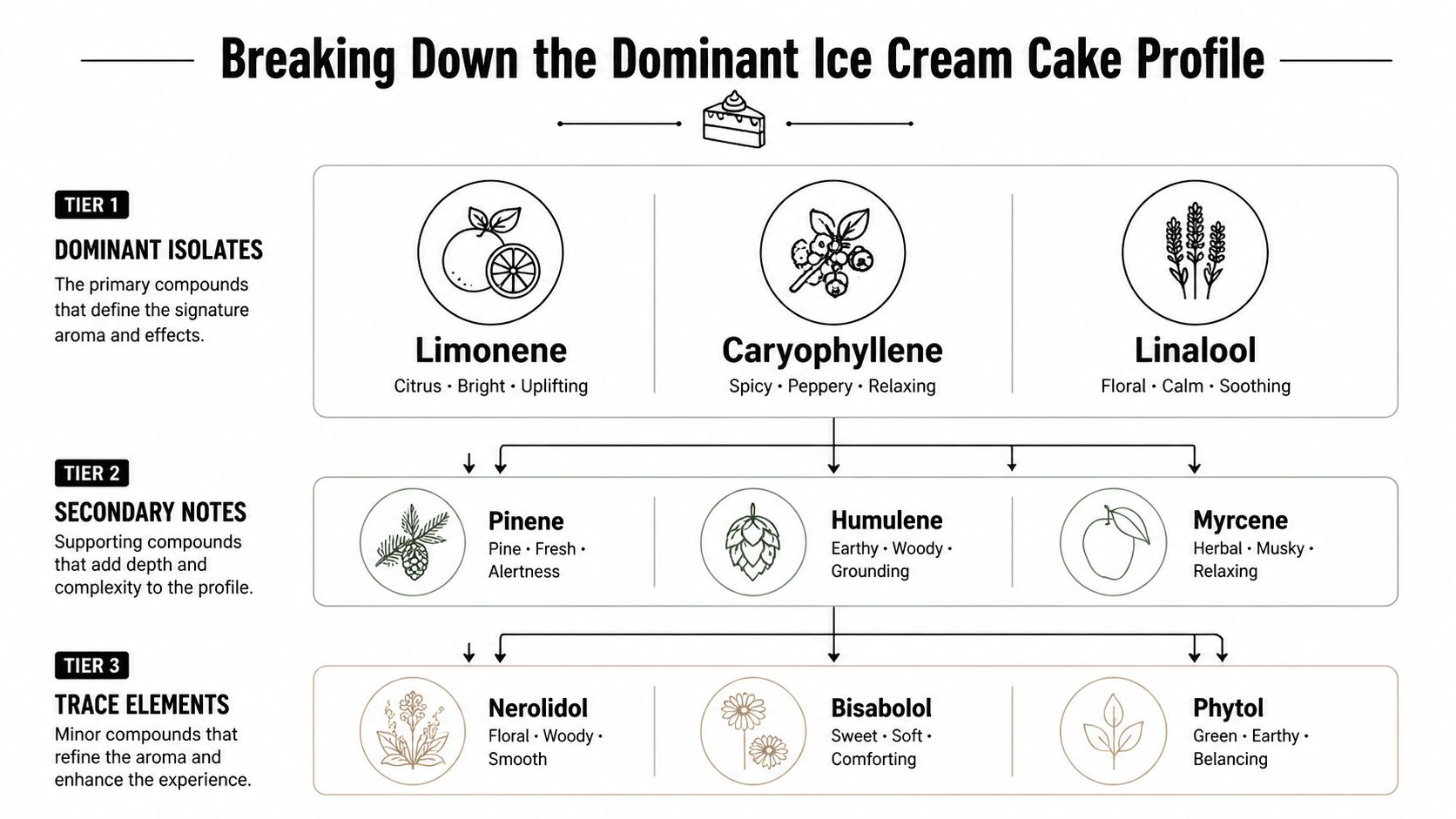
A batch that reads correctly on paper can still miss the mark on the bench if you treat Ice Cream Cake like a single-note dessert oil. The stronger commercial readings point to a small dominant set rather than a broad, evenly weighted bouquet. In public strain references, caryophyllene, limonene, and linalool keep showing up near the top, with myrcene and pinene acting as regular support, and humulene appearing often enough to matter in the final aroma impression. That is useful for a formulator because it shows where to spend weight and where to stay restrained.
What the profile looks like in practical terms
One technical profile breaks the blend into a working ratio of limonene ~60%, caryophyllene ~28%, and linalool ~12%, which is a formulation guide, not a universal lab verdict. A separate industry guide reports average flower at 2.64% terpenes and 19.06% THC, with a tested sample around 23.1% total THC, 27.4% total cannabinoids, and 9.5 mg/g myrcene. Those figures do not replace your own panel work, but they do show the scale of what usually shows up in the material.
The dessert identity still does not live in those three compounds alone. One strain note describes Ice Cream Cake as containing over thirty different isolates, with d-limonene, myrcene, linalool, and pinene called out as dominant isolates and the wider bouquet supporting vanilla-cake, cream-cheese, floral, nut, and citrus layers. That is why a thin three-terpene blend often smells technically close but emotionally wrong.
Stock the profile by function, not by name
Use the broader bouquet as the shopping list, then decide what earns space in the blend. A good reference point is a terpene flavor chart, because it helps the team keep aroma intensity and sensory roles separated instead of chasing names.
- Limonene gives the opening lift and the first bright recognition.
- Caryophyllene supplies spice, weight, and the savory edge that keeps the blend from reading like candy.
- Linalool softens the finish and pushes the creamy-floral impression.
- Myrcene fills the gap between citrus and dessert, but only if it is held in check.
- Pinene adds clarity, especially when the top note gets muddy.
- Humulene can sharpen the profile enough to keep it from feeling syrupy.
That hierarchy is more reliable than trying to force a universal Ice Cream Cake formula out of a single product sheet. The profile is multi-isolate by nature, and the best replicas respect that architecture.
Top, Mid, and Base Notes in the Profile
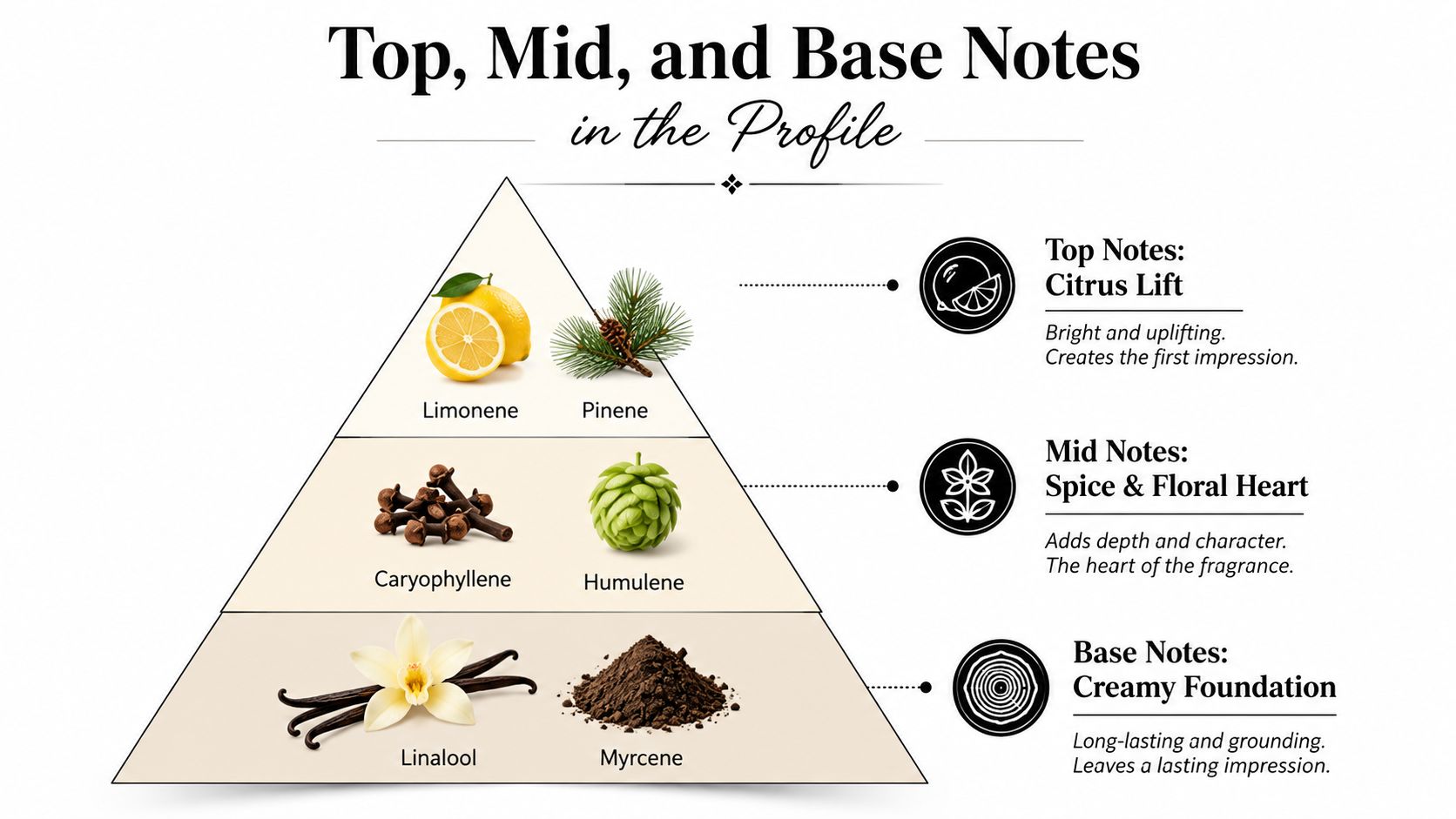
The fastest way to miss this profile is to treat it like a flat flavor sheet. A better way is to build it like a fragrance pyramid, because the nose on a cart moves in layers. The top note hits first, the mid note gives identity, and the base note decides whether the finish feels dessert-like or just sweet.
Top note citrus lift
Limonene carries the bright opening. In a finished cart, it should read as clean and immediate, not as lemon cleaner or candy citrus. Pinene can sit beside it when you need sharper definition, but too much makes the blend feel green and lean instead of creamy.
That's where a lot of batches go sideways. The team tastes the first puff, likes the sparkle, and keeps pushing the citrus until the whole profile turns generic. The correct move is to let limonene establish recognition, then stop before it dominates the nose.
Mid note spice and floral heart
Caryophyllene is the spine of the middle, while humulene adds quiet woody structure. Together they keep the blend from floating away into sugar water. They also create the dry contrast that makes the dessert note feel more realistic.
Linalool starts bridging from the mid into the base because it can read floral, creamy, or softly herbal depending on what it's paired with. In Ice Cream Cake, that bridge matters. It's one of the reasons a careful blend can smell like frosting, dough, or cream cheese without ever needing an actual vanilla isolate.
The cream note isn't a single ingredient story. It's limonene on top of linalool and myrcene, with spice underneath to give it shape.
Base note creamy foundation
Myrcene does the heavy lifting at the bottom. It can bring herbal sweetness, a soft earthy base, and the roundness that keeps the profile from feeling thin. Nerolidol and geraniol can be useful support pieces when you want more floral depth and a longer pastry finish, especially in formulation work where the goal is to mirror the aftertaste of flower rather than just the first puff.
For recipe planning, keep the base note focused. Too much myrcene flattens the top and drags the blend into a heavy finish. Too little, and the cart loses the dessert character that makes Ice Cream Cake recognizable.
If you want a broader terpene reference while you build the pyramid, keep a flavor chart guide nearby. It helps teams translate a sensory brief into isolate choices without guessing at every note.
Target Ratios and Isolate Picks for Vape and Distillate
A useful Ice Cream Cake cart starts with a total terpene load that matches the hardware and the oil. For distillate carts, a 3–7% terpene load is the practical range. For high-terpene extracts, a 1–3% load is usually enough because the base material already carries more native aroma and you don't need to force the profile so hard.
The biggest mistake is loading a cart like it's a perfume sample. That can make the first pull loud, but it often hurts wick behavior and muddies the finish. Keep the flavor precise, not oversized.
Starter ratios by format
| Isolate | Note Role | Cart Ratio (% of total) | Distillate Ratio (% of total) | Sourcing Priority |
|---|---|---|---|---|
| Limonene | Top note lift | 35–45% | 30–40% | Mandatory |
| Caryophyllene | Mid note spice | 20–30% | 20–25% | Mandatory |
| Linalool | Floral cream bridge | 10–18% | 10–15% | Mandatory |
| Myrcene | Base note depth | 8–15% | 10–15% | Mandatory |
| Pinene | Clarity and lift | 2–6% | 2–4% | Optional but useful |
| Humulene | Dry structure | 2–5% | 2–4% | Optional |
| Nerolidol | Creamy finish | 1–3% | 1–3% | Optional |
| Geraniol | Floral pastry nuance | 1–3% | 1–2% | Optional |
A workable bench starting point
For a 5% total terpene load in distillate, a practical starting blend is built around limonene first, then caryophyllene, then linalool and myrcene. That means the blend should still read limonene-forward, but not so forward that the cart becomes citrus-bright and forgettable. The minor terpenes are there to round off the edges, not to compete for the top spot.
A junior chemist should treat limonene, caryophyllene, linalool, and myrcene as the essentials. Pinene, humulene, nerolidol, and geraniol become tuning tools. If the blend is too sharp, soften it with a trace of linalool or nerolidol. If it feels too heavy, trim myrcene before touching the top note.
Shopping note: source the primary isolates at higher purity first, then use the minor isolates to correct the finish. Trying to save money on the dominant pieces usually costs more in rejected samples.
For teams that want a calculator on hand, the mixing ratios calculator is the right reference point for converting a target load into batch weights.
Mixing Instructions for Carts and Concentrates
A weak batch usually starts before the fill line. The cleanest workflow is simple, pre-mix the terpene blend in a glass vial, warm the distillate just enough to lower viscosity, then add the terpenes by weight. That keeps the oil moving without turning the blend airy or stripping off the lighter top notes.
Sequence matters in practice. Put the dominant isolates in first, then the modifiers, then the trace pieces. The top note stays easier to correct that way, and the dessert character holds together instead of collapsing into a flat sweet base.
Practical handling on the bench
Use a glass vial or beaker, a calibrated scale, and a clean mixing tool. Stir gently, then let the blend rest before filling. Immediate filling can hide poor integration, and a cart that looks uniform at the bench can still separate after it sits.
For cartridge work, keep the oil compatible with ceramic coil hardware and avoid over-stressing the wick with a blend that is too thin or too terpene-heavy. That trade-off shows up fast in production. Thin oil wicks easily but can flood, while a heavy blend can mute the profile and slow the draw.
Cartridge filling usually goes smoother when the oil is warm enough to move but not so hot that it flashes off the lighter top notes. Cold room conditions can make a batch look mixed before it is. A quick visual check and a fresh smell test after resting are more reliable than trusting the first pass.
For high-terpene extracts, the same logic applies, but the terpene load is lower because the base already carries more aroma. Distillate needs more help. Extracts need less. That difference matters more than brand style or packaging language.
Use homogenization as a real checkpoint, not a box to tick. Fill two sample carts from opposite sides of the vial. If they smell different, the batch is not ready.
A small-batch QA step works well here. Pull one finished cart after settling, warm it briefly in the hand, and compare the cold and warm aroma. If the warm sample gets brighter but also cleaner, the balance is close. If it turns flat or peppery, the ratio stack needs another pass.
For a practical walk-through on the bench, use the how to mix distillate with terpenes guide as a reference for batch order, weight checks, and fill-side handling.
Troubleshooting Off Notes and Common Mistakes
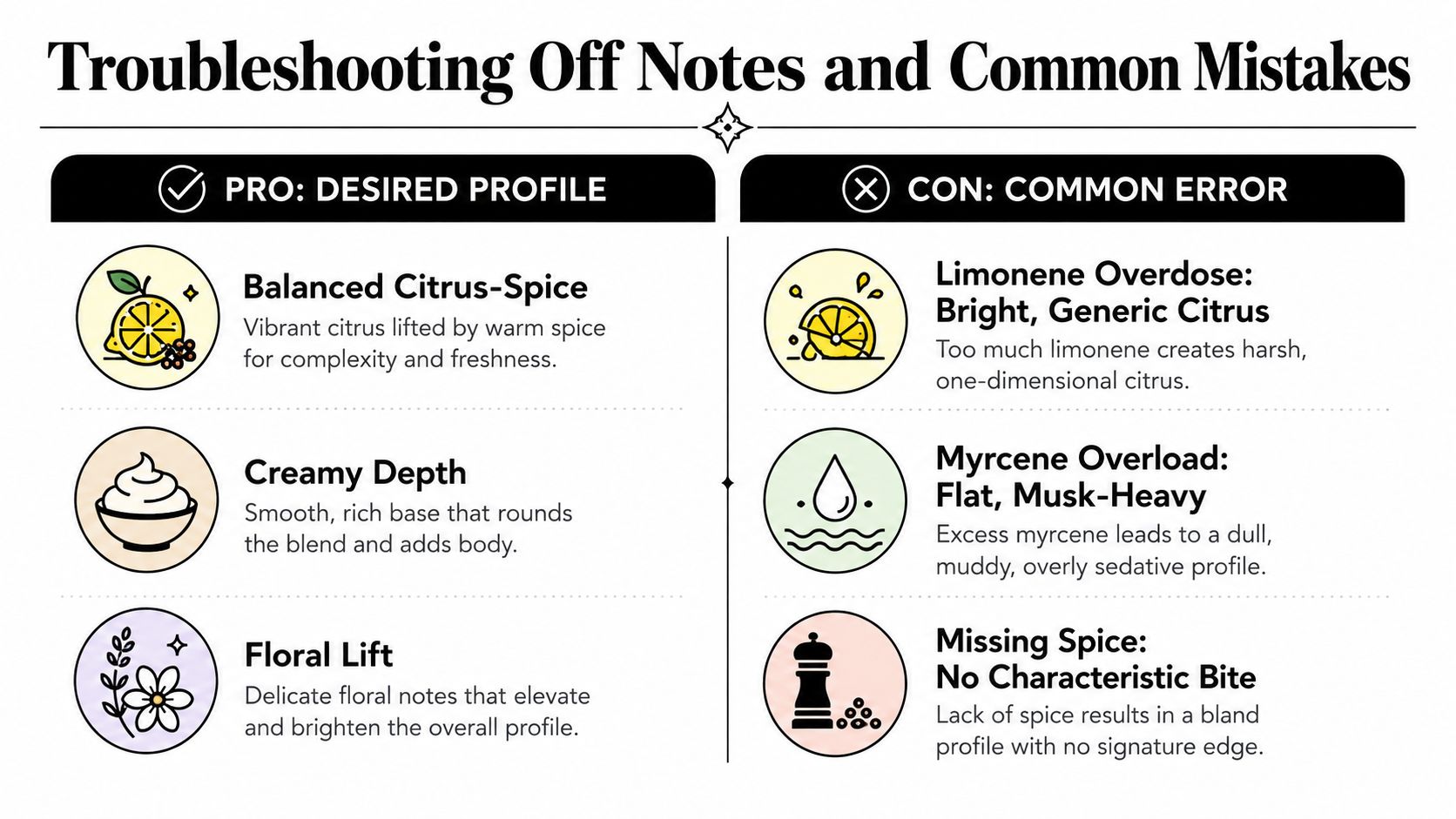
When a panel sample misses, the defect is usually obvious if you know where to look. The wrong batches tend to fall into three buckets, too bright, too heavy, or too loose. Each one points to a different knob on the bench.
Symptom and fix map
- Bright, generic citrus: limonene is overbuilt. Trim the top note and restore caryophyllene plus linalool so the profile stops reading like citrus flavoring.
- Flat, musk-heavy finish: myrcene is too high. Pull it back and let pinene or humulene reintroduce shape without making the blend sharper.
- Missing characteristic bite: the spice tier is too thin. Caryophyllene needs to come up before you touch the dessert notes.
- Hot spots from cartridge to cartridge: the batch wasn't homogenized enough. Reblend, rest, and sample from more than one point in the vial.
- Hardware stress and separation: avoid shortcut diluents like MCT, PG, or PEG in formulations that need stable cartridge behavior. Those shortcuts can create more problems than they solve.
The most expensive mistake is not a bad isolate choice, it's trying to fix a bad draft with more of the same isolate. If the profile feels flat, don't immediately add more terpene load. Decide whether the problem is top note, mid note, or base note, then correct that layer only.
A batch that tastes “strong” but not “Ice Cream Cake” usually has the wrong balance, not the wrong total percentage.
The point of this troubleshooting map is to save the SKU before it reaches filling or packaging. A lot of rejected samples can be salvaged with a controlled trim to limonene or myrcene, then a restore step for caryophyllene and linalool. The team that learns to fix the architecture, not the label, wastes a lot less material.
Testing, Safety, and Scaling for Wholesale
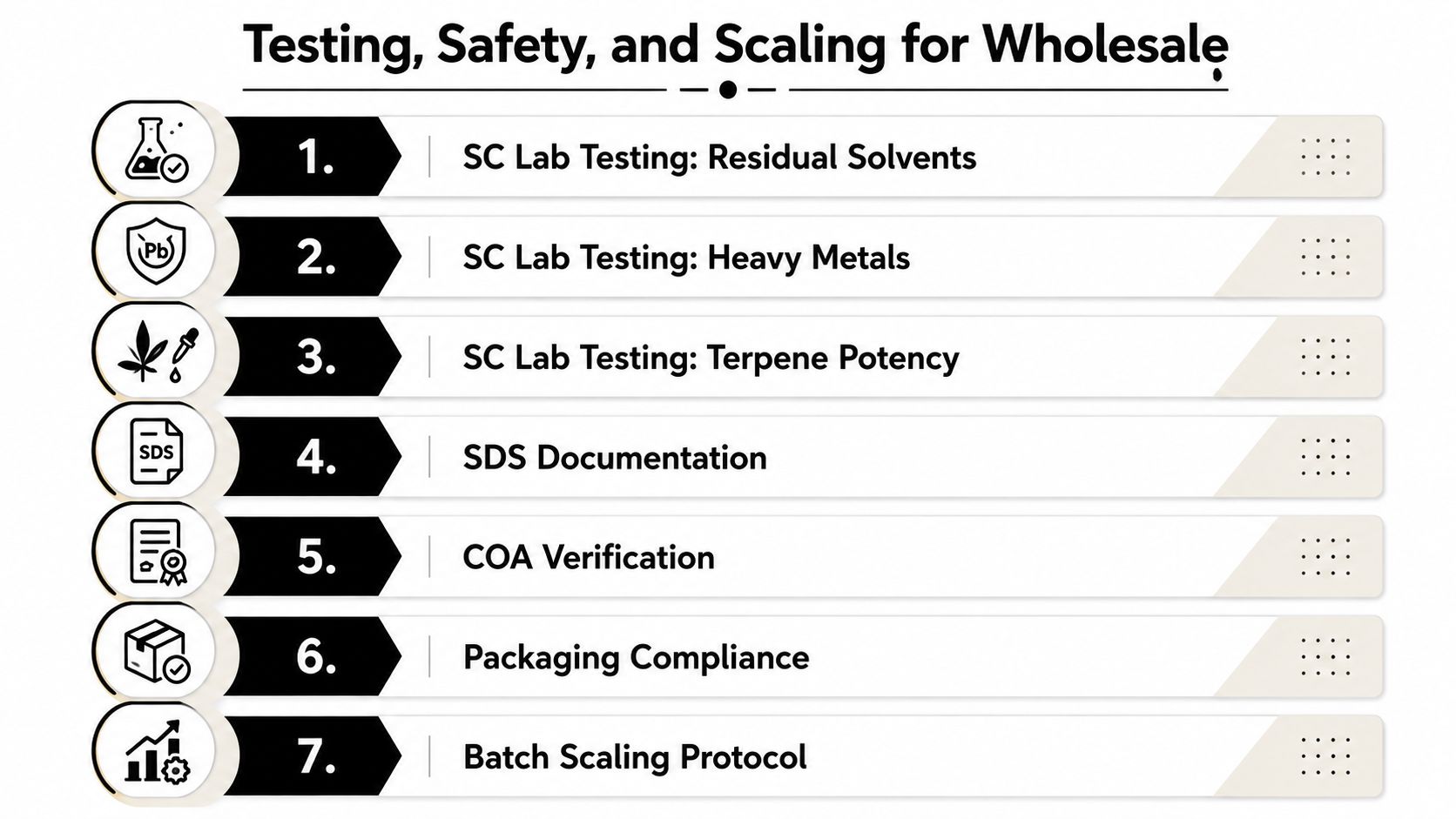
Wholesale only works when the bench recipe is defensible. That means third-party SC lab testing for residual solvents, heavy metals, and terpene potency verification, plus clean paperwork that lets a buyer re-order without re-tasting every batch. If a product can't be repeated, it isn't ready to scale.
A simple wholesale checklist
- SC Lab Testing, Residual Solvents.
- SC Lab Testing, Heavy Metals.
- SC Lab Testing, Terpene Potency.
- SDS Documentation.
- COA Verification.
- Packaging Compliance.
- Batch Scaling Protocol.
Written ratio sheets matter just as much as the lab work. Lock the isolate lots, retain a reference sample, and keep the same target weights in every re-run. That's what protects the profile six months later when a sales rep asks for the same flavor and expects the same result.
Safety documentation should travel with the product file, not sit in a folder nobody opens. SDS records and allergen notes are part of the commercial story because they let operations, compliance, and fulfillment work from the same information.
Scaling isn't about making more oil. It's about making the same oil again. The brands that win wholesale with dessert profiles are the ones that treat terpene balance like a controlled spec, not a creative experiment.
If you're building an Ice Cream Cake cart, a distillate blend, or a strain-inspired terpene blend for product formulation, Gold Coast Terpenes carries profile options, isolates, and practical formulation resources that fit real production work. Visit Gold Coast Terpenes to review terpene products, compare formulation tools, and source components for your next batch.