
You're usually handed an oil that smells fine in the jar, then goes flat in hardware. The terpene load is there, the cannabinoid base is there, but the cart still reads like a generic fuel blend instead of a recognizable OG. That gap is why All Gas OG belongs in a formulation workflow, not just a strain menu.
For cart developers and extractors, the value isn't the name alone. The value is the combination of a fuel-forward sensory profile, high potency, and a fast-finishing cultivar that gives labs and menus a repeatable target to work from. Strain references place All Gas OG at roughly 80% indica / 20% sativa, with breeder-listed parentage of Humboldt Venom OG x Humboldt OG and typical THC in the 20%–25% range, while lab-focused references put modern batches at 18%–26% total THC and flowering time at about 55 days (Strainpedia).
That combination matters in the lab. A profile like this is not about chasing a single phenotypic cut. It is about rebuilding a familiar aroma structure with enough consistency that a finished cart still reads as gassy, skunky, piney, and peppery after dilution, filling, and storage. If the base is wrong, the top notes will not rescue it.
For aroma translation work, Gold Coast Terpenes' strain terpene profiles are useful because they line up a recognizable sensory target with a repeatable formulation path.
Why All Gas OG Belongs in a Formulation Brief
A batch comes back from fill, and the feedback is blunt. The oil is potent, the viscosity is workable, but the flavor misses the diesel, skunk, and pine cue the brand asked for. That gap separates a finished cannabinoid oil from a formulation that still reads like All Gas OG in the mouth and nose.
Commercial value sits in recognition, not nostalgia
All Gas OG earns a place in a formulation brief because the sensory target is already clear enough to build against. Commercial references consistently place it in the indica-dominant camp, with high THC and a fast flowering window of about 55 days. That gives a product team two practical anchors. The cultivar is familiar enough that expectations are already set, and the profile is stable enough to translate into distillate, live resin-style blends, or concentrate-forward products without guessing at the intended lane (Strainpedia).
Brand teams often ask for “gas” without defining what that means in the finished SKU. In practice, gas can mean sharp fuel, skunk musk, pine resin, black pepper, or a citrus lift sitting above a heavier base. A useful brief turns that loose language into a working target. Without that step, the result usually lands as a generic fuel cart even if the label says All Gas OG.
For a formulation team, strain terpene profiles are useful because they connect a recognizable sensory target to a repeatable build path.
Why the numbers matter, and where they stop mattering
The reliable numbers are the ones that describe the cultivar's commercial shape, not a promise of one fixed flavor. In the verified data, All Gas OG is reported as a high-potency cultivar with modern batches often in the 18%–26% total THC band, and one lab-focused guide notes 20.68% THC, 24.52% TAC, and 2.16% total terpenes in a sample (Lake Effect VT). That tells you the starting material can support a loud profile, but it does not tell you how the finished cartridge will behave once the oil is thinned and heated.
Practical rule: In formulation, the cultivar name is the target. The batch COA is the constraint.
That mindset keeps teams from overpromising on phenotype fidelity. You are not recreating one flower head. You are building a dependable sensory lane that holds up across lots, vendors, and filling conditions.
Mapping the All Gas OG Sensory Profile
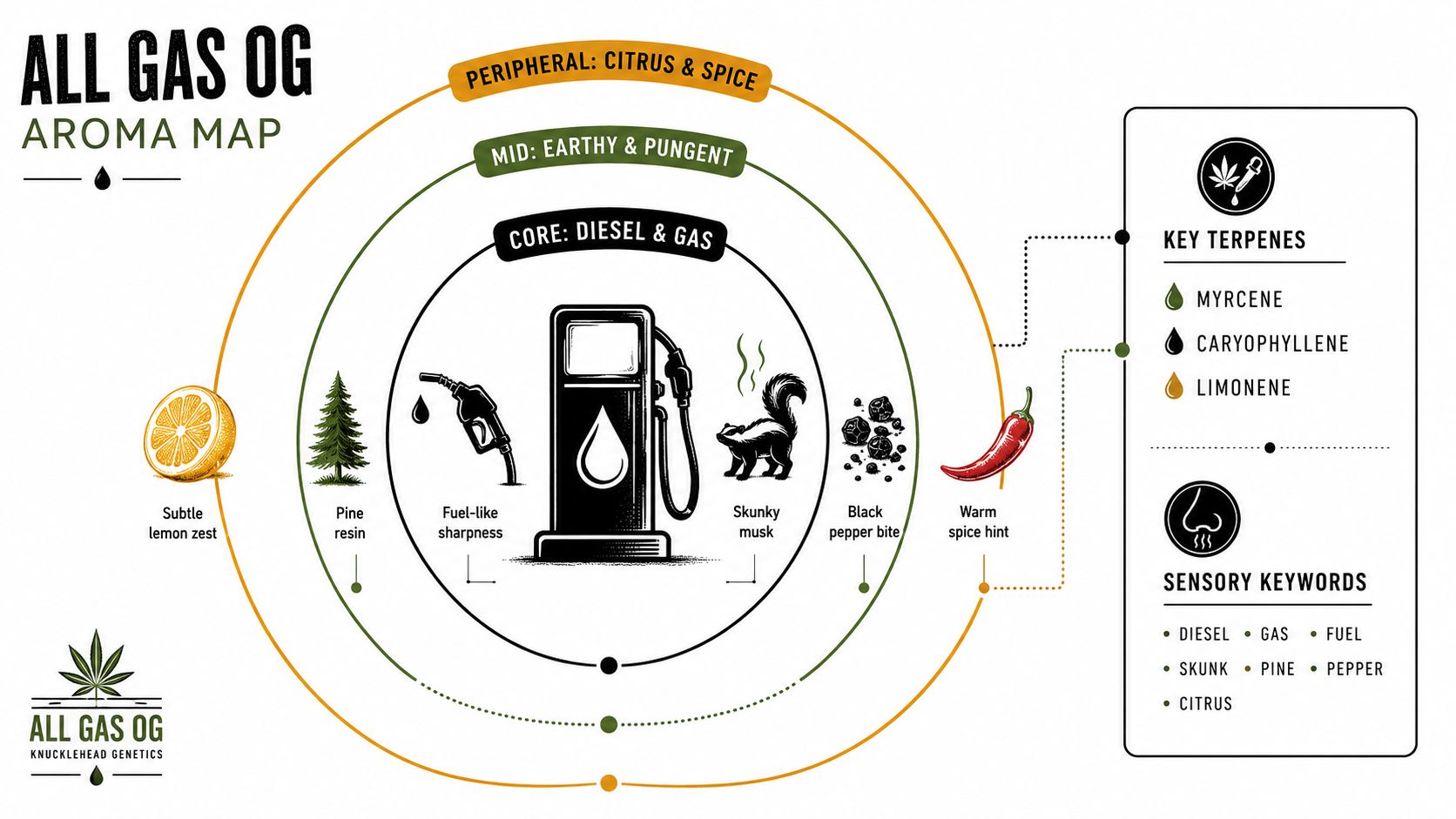
A formulation brief for All Gas OG starts with a fuel-forward target, then breaks that target into note layers a lab can build. The names attached to the cultivar are unusually consistent across independent descriptions. The recurring core is diesel, gas, fuel, and skunk, with secondary notes moving through earth, wood, pepper, pine, citrus, and orange. That consistency is what makes the profile useful in a lab, because the goal is not to chase a novelty fruit note, but to rebuild a recognizable OG fuel lane with enough structure to hold through dilution and heat. For a practical reference on how aroma language gets sorted before blending, use this guide to tasting notes and cannabis aromas.
Build the aroma as layers, not as a single note
The base identity sits on the fuel and skunk axis. Those notes tell the user the product belongs to the OG family, and they also give the formula enough mass to survive vaporization. If that base is too light, the oil quickly slides into generic pine cleaner or a thin citrus blend that misses the mark.
The middle layer gives the profile shape. Pepper, wood, and earth keep the aroma dense instead of bright, and they stop the blend from reading like a simple terpene splash. Overloading limonene and pinene usually weakens that midsection, then the spent-fuel impression drops out and the finished oil loses its All Gas OG identity.
The top layer controls the first inhale. Pine and a restrained citrus accent should lift the profile without making it sweet or perfume-like. In practice, those notes need to flash and fade faster than the gas core, because that short-lived lift is what gives the blend motion.
Why repeatability reduces formulation risk
Repeatability matters here because the aroma descriptions converge instead of scattering into unrelated flavor families. One commercial description lists the flavor as skunk, pine, orange, while another describes the nose as a fuel-and-skunk bouquet layered with pine, pepper, and faint citrus zest. That overlap gives the formulator a usable map for note assignment and reduces the chance of building to the wrong sensory target.
The most reliable workflow is to assign the gas note to the base, the spice and resin notes to the middle, and the citrus-pine trace to the top. If the first puff reads as gas, the middle should read as spice and resin, and the finish should leave a faint citrus-pine trace. If the order flips, the product may still taste clean, but it will not read as All Gas OG.
Strong gas profiles usually come from restraint, not from piling on every terpene that smells sharp.
Terpene Roles and Recommended Percentage Targets
A fuel-forward All Gas OG build works only when the terpene architecture stays disciplined. The blend needs a base note, a middle note, and a top note that all support the gas core without turning the oil thin or perfumey. For distillate carts, a 5% to 8% total terpene load is a practical starting point, then the blend should be adjusted after you see how it behaves in the hardware you use.
A practical layering blueprint
| Layer | Primary Terpenes | Target % of Total Terpene Load | Sensory Role |
|---|---|---|---|
| Base | Caryophyllene, myrcene, humulene | 45% to 60% | Fuel depth, pepper, earth, lingering weight |
| Mid | Pinene, caryophyllene, humulene | 20% to 30% | Pine resin, dry wood, structure |
| Top | Limonene, pinene | 10% to 20% | Bright lift, citrus edge, first-impact volatility |
Use that table as a map, not a fixed formula. Caryophyllene and myrcene need to stay heavy enough that the profile remains grounded, while limonene and pinene should act as accents instead of the main event. In an All Gas OG build, caryophyllene carries the peppery wood note, myrcene supports the earthy base, humulene keeps the profile dry and slightly bitter, and pinene adds the pine resin lift that keeps the blend from collapsing into a flat, muddy finish.
How to think about the load
At the lower end of the range, the blend usually feels cleaner and more restrained. At the higher end, the gas identity gets louder, but the cart can turn harsher or more volatile if the base oil already has a strong aroma. With a high-terpene extract, reduce the added terpenes and treat the native oil as part of the flavor system rather than as a blank carrier. Many formators overcorrect here and end up with a profile that tastes hot instead of accurate.
Field rule: If the base already has a loud nose, add terpenes for balance, not for volume.
One useful commercial reference point is a sample reported at 2.15% total terpenes, with caryophyllene at 0.63%, limonene at 0.53%, humulene at 0.24%, and myrcene at 0.15% (Joint Commerce). That spread supports the idea that the “gas” impression is not a single terpene trick. It comes from a stacked profile with a pepper-spice core and citrus-pine accents.
Diluent Compatibility and Hardware Behavior
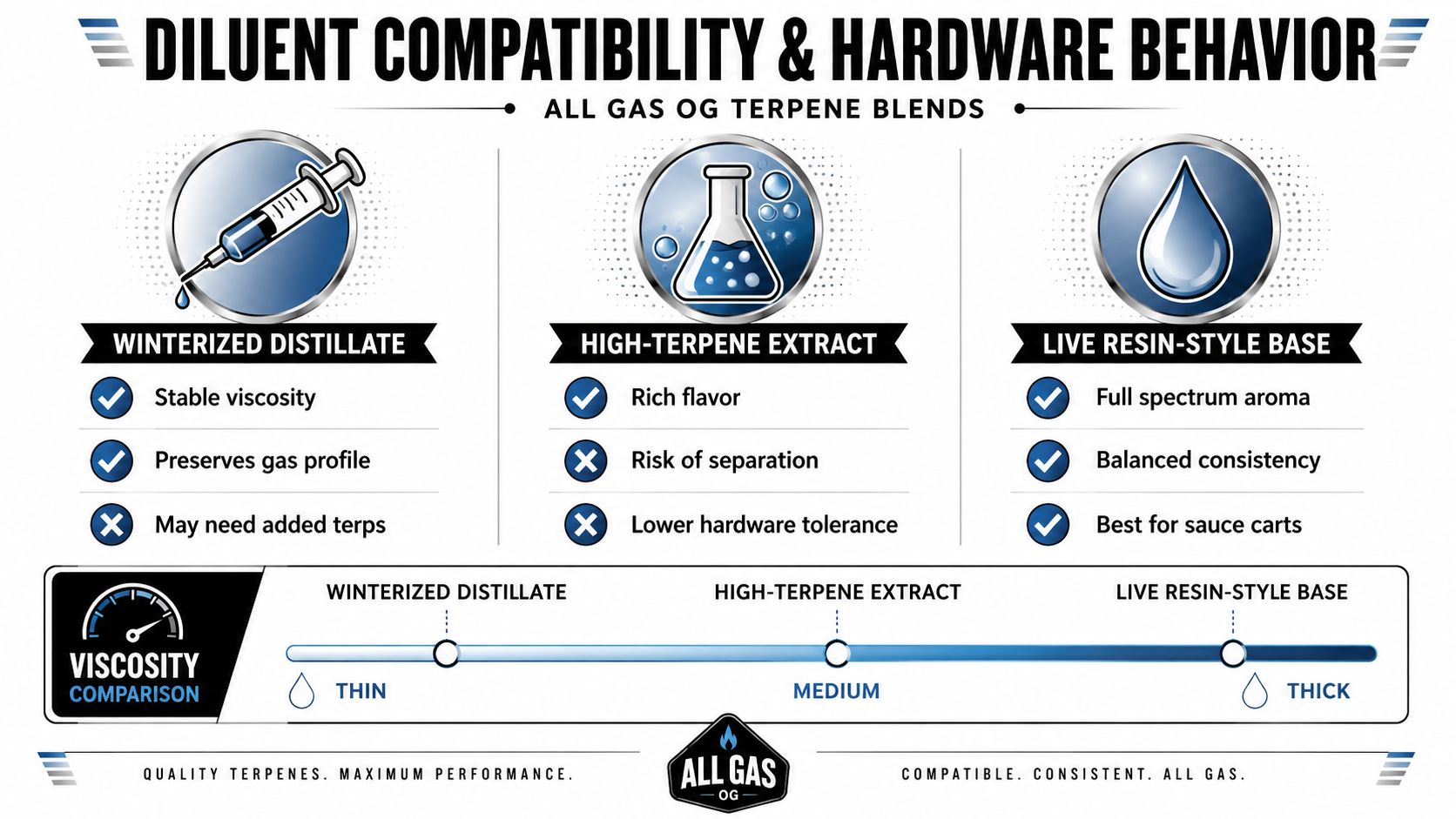
A fuel-heavy blend can look stable in a beaker and still misbehave in a cart. The main issues are viscosity, phase behavior, and how the oil interacts with the coil. Once All Gas OG terpenes are mixed into a cannabinoid base, the system may thin quickly, then separate or over-wick if the ratio is too aggressive.
Choose the base before you tune the flavor
Winterized distillate is usually the easiest platform for this profile because it starts neutral and lets the All Gas OG blend carry the sensory load. It may need added terps to wake it up, but it's more predictable in cartridge hardware.
High-terpene extract brings richer flavor out of the gate, but the downside is separation risk and lower hardware tolerance. If the oil already has a strong terpene fraction, adding a full All Gas OG profile can push it into a harsh or unstable range.
Live resin-style base usually gives the best middle ground for this profile, because it can preserve a broader aromatic frame without forcing the formulator to overcompensate. The trade-off is consistency. Every native batch behaves a little differently, so the same recipe can land differently across lots.
Why certain diluents stay out of the room
For cannabis vapor hardware, VG, PG, PEG, and MCT are typically avoided in these builds. They don't solve the core problem of making a fuel-forward profile taste like All Gas OG, and they introduce compatibility questions the formulator doesn't need. A terpene blend should tune the oil's behavior, not work against it.
Viscosity shifts are the next thing to watch. A terpene-heavy mix can thin winterized distillate enough to improve wicking, but too much thinning creates flooding, leakage, or a cart that runs hot. Too little thinning leaves the oil sluggish and starved at the coil.
Coil choice changes the final read
Ceramic coils usually express the profile more cleanly than cotton wick setups because they hold the fuel, pepper, and pine notes without burning off the brightest top layer too fast. Cotton can work, but it tends to be less forgiving when the blend is aggressive or the fill is slightly over-thinned. Pre-soak testing matters here. Let a small test lot sit in the selected cart for a realistic soak window, then check whether the aroma stays intact, the oil moves evenly, and the cart doesn't mute after the first few draws.
How to thin distillate for cartridges is a useful reference if your base is running too stiff for clean fill behavior.
Stability, Flavor Retention, and Aging Considerations
A fuel-forward All Gas OG blend can hold its core character and still age poorly if the volatile fraction is pushed too far. The bright pine and citrus edges usually disappear first, while the heavier fuel and spice notes stay in place longer. The result is familiar enough to read as “gas,” but flatter, with less of the sharp top-end definition that separates All Gas OG from a generic diesel profile.
Top notes move first
Monoterpene-heavy accents, especially the pine and citrus side of the profile, are the least stable part of the blend. Heat, oxygen, light, and excessive headspace all pull those notes down faster. In practice, a cart can taste lively right after fill and noticeably flatter after storage if the package gives those top notes too much room to drift.
The heavier notes, especially caryophyllene and humulene, hold the frame for longer. They do not make the blend bright, but they keep the dry pepper and woody structure that makes the gas impression believable. For shelf stability, those middle and base notes carry more weight than chasing a large limonene spike.
Over-terping shortens the useful window
A blend pushed too hard on terpene content often ages worse than a leaner one. The first aroma can be loud, but the excess volatility burns off faster, and the cart may read thin, sharp, or oxidized sooner than expected. In retail, that is a poor trade, because the first impression may sell the sample, but the later weeks determine whether the product earns a reorder.
Package and release like the profile matters
Tighter headspace, light-resistant packaging, and a realistic batch release schedule all help preserve the aroma. The batch should be treated as a live profile rather than a fixed one. If the base is already high in terpenes, it should move sooner. If the platform starts from winterized distillate, the profile usually holds longer, but only when the fill is clean and the oil was not over-thinned.
A chromatography check from Gold Coast Terpenes' chromatography testing resource is useful here if you want to confirm that the stored oil still matches the target instead of only matching it on day one.
Blending Workflow for Cartridges and Concentrates
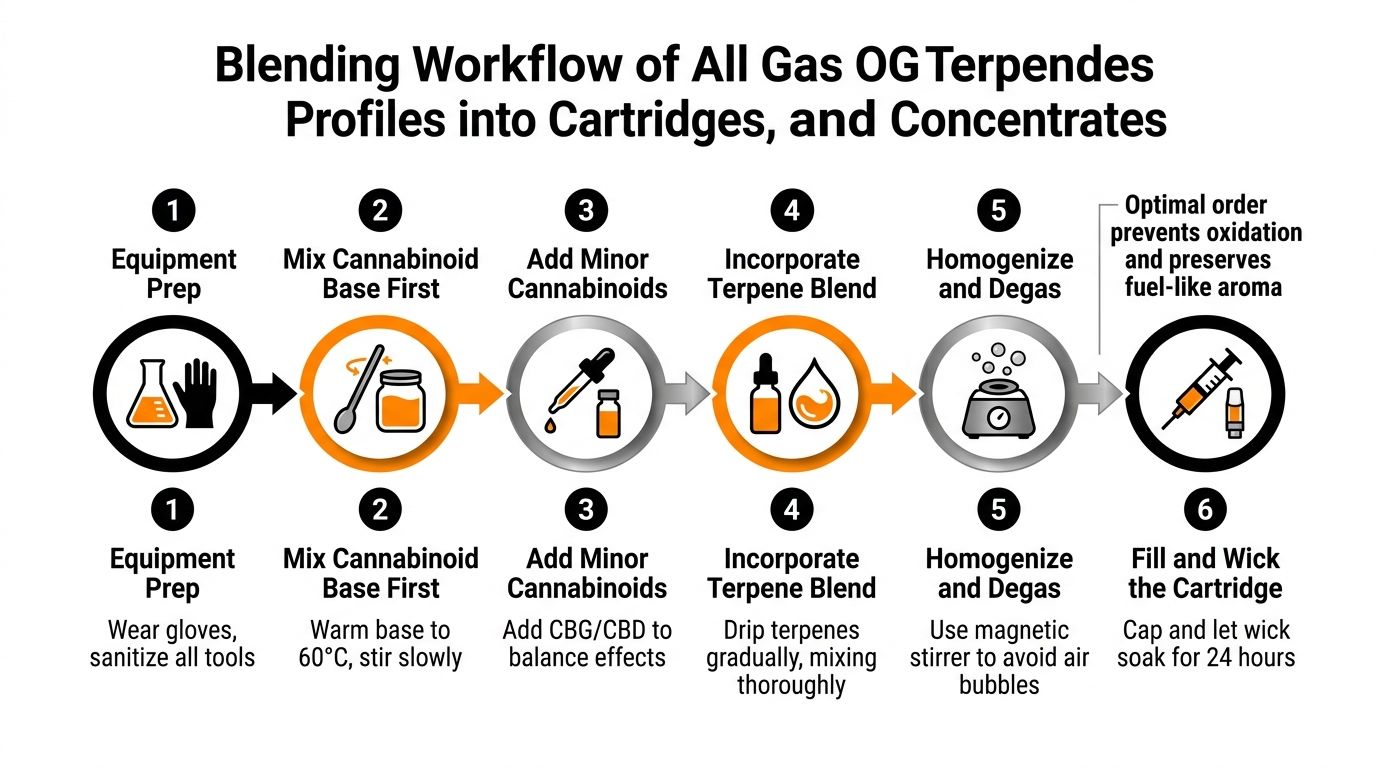
A repeatable All Gas OG build starts with process discipline, not with fragrance guesswork. The goal is to keep the oil uniform, protect volatile notes, and avoid adding so much terpene that the final product becomes hard to fill or harsh on draw. Small labs can do this well if they keep the order of operations stable.
Keep the sequence boring
- Equipment prep. Sanitize the vessel, tools, and fill line, then wear gloves and confirm the work area is clear of open flame.
- Mix the cannabinoid base first. Warm the base gently and stir until it's uniform before adding anything aromatic.
- Add minor cannabinoids if used. If your formula includes CBG or CBD for product design reasons, dissolve them fully before terpenes go in.
- Incorporate the terpene blend. Add the All Gas OG profile slowly, then mix thoroughly so no local hot spot over-concentrates the aroma.
- Homogenize and degas. Let the oil settle and remove bubbles before fill.
- Fill and wick the cartridge. Cap it, then give it time to soak before release.
The order matters because terpenes change viscosity fast. If you add them too early, the mix can get thinner before the cannabinoids are fully integrated. If you add them too late and stir too hard, you can strip off the top notes you were trying to preserve.
A realistic batch example
For a 100 g batch of winterized distillate, a 6% total terpene load means 6 g of terpene blend and 94 g of cannabinoid base. If the base already carries a native aroma, start lower and test before scaling. That's often the safer move for an All Gas OG build, because the profile should read as fuel-forward, not solvent-forward.
Practical rule: Warm the base enough to mix, not enough to chase aroma into the air.
Safety is part of the workflow. Terpenes are flammable, and heated filling rooms don't forgive sloppy handling. Keep surfaces clean, avoid excess open-air exposure, and pull QA samples after homogenization and again after fill so you can compare the oil before and after hardware contact.
Lab Testing, Dosing, and Final Formulation Checklist
A batch can smell right in the mixing vessel and still miss the mark after fill, cooling, and storage. For All Gas OG, the key question is whether the fuel core survives contact with the final oil system, the cartridge, and the hold time before release. That means testing the finished blend against the target, then checking whether the hardware can carry that profile without leaking, muting, or shifting the balance.
What to verify before release
- Terpene assays. Run GC-MS on the finished blend, then compare the dominant notes against the target fuel-spice-citrus pattern. In a practical All Gas OG build, the panel should still reflect the intended balance of myrcene, limonene, and caryophyllene, with a low residual-solvent burden if extraction was involved. If the readout drifts hard toward one note, the blend usually needs a correction before fill.
- Cannabinoid assays. Use HPLC to confirm potency and cannabinoid balance before fill release. If the oil shifted during blending, the assay should show it before the product goes out the door. A stable assay matters more than a flattering first sniff.
- Dosing discipline. Keep terpene concentration in a range that the hardware can tolerate. For carts, the brief target is 5% to 10%. Concentrates may sit higher depending on format and carrier load, but the risk rises fast if the oil becomes too thin or the top notes flash off during handling.
- Final checks. Inspect visual clarity, room-temperature viscosity, and hardware compatibility, then compare the lab result against your internal tolerance window. Check whether the oil wicks evenly, stays suspended, and keeps the gas note from flattening after fill.
A chromatogram is only useful if someone can interpret it against a target profile. That is why Gold Coast Terpenes' chromatography testing guide belongs in the formulation workflow before release, not after a complaint. Gold Coast Terpenes also supplies strain-specific terpene profiles and formulation support components that fit this kind of work, including blends for carts and concentrates. Visit Gold Coast Terpenes if you are building an All Gas OG-style SKU and want a consistent starting point for flavor reconstruction.